⏱ 19 min read
Most enterprise architecture transformations fail long before the first roadmap deck is shown to the steering committee. ArchiMate in TOGAF ADM
Not because the architects are dumb. Not because the tools are weak. Not even because the technology is too complex.
They fail because the organization thinks architecture transformation is a documentation exercise. A framework rollout. A new repository. A prettier set of PowerPoint diagrams with more hexagons and less accountability.
It isn’t.
Enterprise architecture transformation is the hard, often uncomfortable shift from unmanaged technology sprawl to intentional operating control. From disconnected systems to governed change. From “every team does what works for them” to “we know why this exists, who owns it, what it depends on, and what happens if it breaks.”
That sounds obvious. It rarely is.
And here’s the uncomfortable truth: chaos is often tolerated because it helps people move fast in the short term. Business units get what they want. Product teams ship. Vendors get signed. Cloud accounts multiply. Kafka clusters appear in different departments. Identity and access management becomes a mix of old LDAP, half-implemented SSO, and an IAM platform nobody fully owns. The architecture becomes a graveyard of local optimizations.
Then one day the CIO asks a very simple question:
“What do we actually have, and how do we control it?”
That’s the moment enterprise architecture transformation starts.
What enterprise architecture transformation actually means
Let’s make this plain early.
Enterprise architecture transformation is the process of moving an organization from fragmented technology decisions to a governed, business-aligned architecture model.
That includes:
- understanding the current estate
- defining target architecture principles
- reducing duplication
- improving integration patterns
- clarifying ownership
- creating decision rights
- aligning technology investment to business outcomes
In practice, it means fewer random platforms, fewer redundant systems, cleaner interfaces, stronger security control, and better ability to change without breaking everything.
It is not just about applications. It includes:
- business capabilities
- data flows
- integration patterns
- security and IAM
- cloud operating models
- infrastructure strategy
- governance
- delivery constraints
- organizational accountability
A lot of people hear “enterprise architecture transformation” and think of frameworks like TOGAF. Fine. Use what’s helpful. Ignore what isn’t. Real transformation is not a framework compliance exercise. It is operational control over complexity.
That’s the SEO-friendly answer.
Now let’s talk like adults.
The real problem: enterprises don’t suffer from lack of architecture, they suffer from unmanaged architecture
Every enterprise already has an architecture. Even the messy ones. Especially the messy ones.
The problem is not absence. The problem is emergence without control.
Architecture happens whether architects are involved or not. Every rushed procurement, every integration shortcut, every “temporary” cloud environment, every bespoke API, every direct database dependency, every privileged IAM exception — all of that is architecture.
So when leaders say, “We need enterprise architecture,” what they usually mean is:
- we have too many systems
- nobody knows the truth
- integration is brittle
- security exceptions are everywhere
- cloud cost is out of control
- identity is fragmented
- data ownership is unclear
- change takes too long
- regulators are asking questions
- outages reveal hidden dependencies we never modeled
That’s the transformation trigger.
And in sectors like banking, this trigger comes earlier and harder because complexity is not just inefficient. It’s dangerous.
If your lending platform, customer onboarding stack, fraud engine, Kafka event backbone, IAM controls, and cloud-hosted analytics environment are all evolving separately, you do not have agility. You have accumulated risk wearing modern clothes.
Control is not bureaucracy. It’s the ability to change safely.
This is where people get ideological.

Some hear “control” and immediately imagine architecture review boards that kill delivery velocity. Endless standards documents. Central teams saying no. Architects becoming diagram police.
That version of control is useless.
Real architectural control means:
- clear technology principles
- intentional platform choices
- transparent ownership
- known dependencies
- enforceable guardrails
- repeatable patterns
- exceptions managed consciously, not accidentally
In other words, control should make delivery easier, not harder.
If a bank has three messaging patterns, six identity providers, four API gateways, and nine different cloud landing zones, teams do not have freedom. They have confusion. They waste time rediscovering constraints. They build around inconsistency. They create integration debt because the enterprise never made the hard calls.
A mature architecture function reduces choice where choice adds no value.
That’s a contrarian point in some circles, but it’s true. Standardization is not the enemy of innovation. Randomness is.
The journey from chaos to control usually follows five stages
Most organizations move through these stages, though not neatly.
1. Sprawl
This is where many enterprises live for years.
Typical symptoms:
- duplicated applications across business units
- multiple customer masters
- inconsistent IAM implementation
- cloud adoption without operating model clarity
- point-to-point integrations everywhere
- Kafka used by some teams, ignored by others
- no reliable system inventory
- architecture diagrams that are already wrong
The organization still functions. That’s why the mess survives.
2. Visibility
This is the first real turning point.
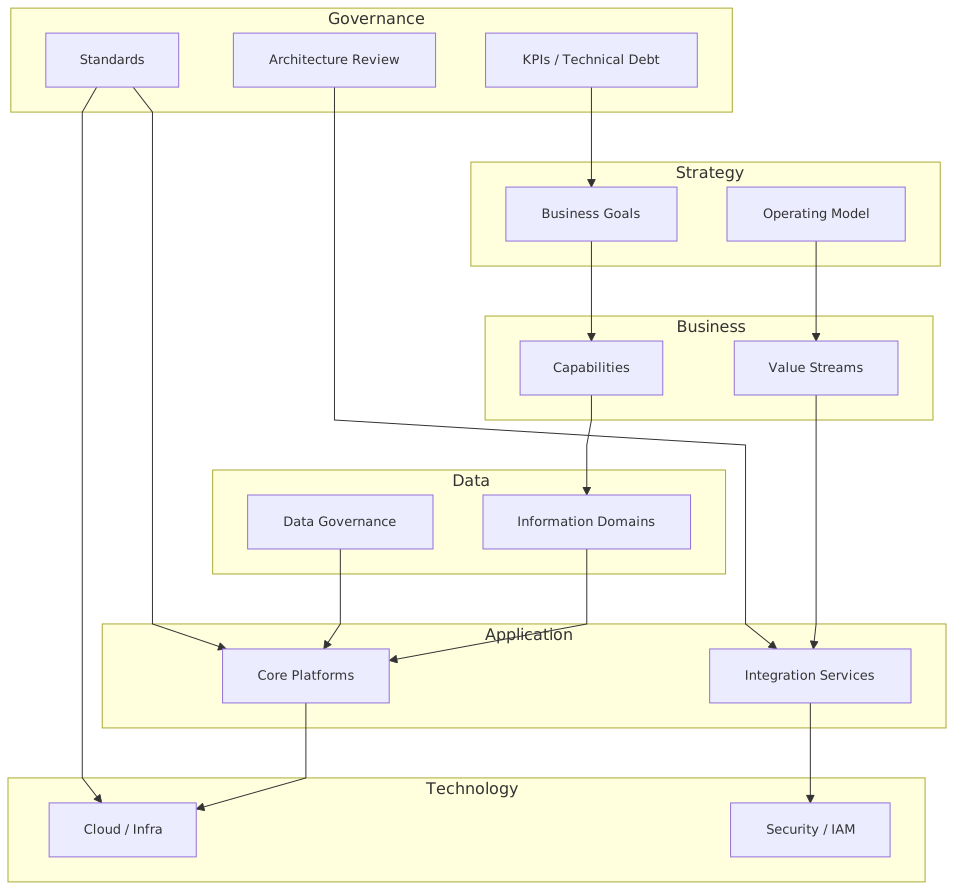
You cannot transform what you cannot see.
Visibility means:
- application portfolio mapping
- business capability mapping
- dependency analysis
- interface cataloging
- ownership assignment
- security and IAM control assessment
- cloud account and platform baseline review
- data classification and lineage identification
This stage sounds boring. It is not. It is where fantasy dies and reality begins.
A lot of architecture teams skip this because they want to get to target state design quickly. Big mistake. If your current state is fake, your target state is theater.
3. Standardization
Once the estate is visible, the enterprise starts making choices.
Examples:
- one strategic IAM platform instead of fragmented identity silos
- one or two approved integration patterns instead of ten
- Kafka established as the event streaming standard for defined use cases
- cloud landing zones standardized for security, networking, logging, and cost control
- API standards enforced across channels
- application rationalization initiated around duplicated capabilities
This is where resistance appears. Every local team has a reason their setup is different. Sometimes they’re right. Usually they’re just used to it.
4. Governance with teeth
This is where architecture transformation becomes real.
Not governance as ceremony. Governance as mechanism. ArchiMate for governance
That includes:
- architecture decision records
- design authority tied to investment approvals
- exception processes with expiry dates
- platform standards embedded in delivery pipelines
- IAM and security controls tied to release gates
- cloud policy enforcement through automation
- measurable architecture KPIs
If your governance can be ignored without consequence, it is not governance. It is suggestion. EA governance checklist
5. Adaptive control
This is the mature state.
The enterprise is not “finished.” It is able to absorb change without structural collapse.
New products can be launched on standard platforms. New integrations follow known patterns. IAM is federated and governed. Kafka event contracts are managed properly. Cloud environments are provisioned through policy-backed templates. Architecture reviews focus on meaningful trade-offs, not basic hygiene failures.
That’s control. Not rigidity. Managed adaptability.
What this looks like in real architecture work
This is the part many articles skip. They stay abstract. Real architecture work is not abstract.
A transformation architect spends time on things like:
- untangling ownership disputes between business and technology teams
- identifying which integrations are actually mission-critical
- deciding where Kafka is appropriate and where it is overused
- forcing clarity on IAM boundaries across workforce, customer, and machine identities
- defining cloud landing zone patterns before scaling cloud usage
- mediating between product urgency and platform consistency
- killing duplicate initiatives politely, then firmly
- making roadmaps that acknowledge budget, legacy constraints, and political reality
A real architect is not just drawing target states. They are shaping decision quality.
For example, in a banking environment, you may find:
- customer onboarding using one IAM flow
- mobile banking using another
- broker portals using a third
- internal workforce access still tied to legacy Active Directory
- service-to-service authentication managed inconsistently across API gateway, Kubernetes secrets, and ad hoc shared credentials
That is not just a security issue. It’s an architectural fragmentation issue.
The architect’s job is to define a coherent identity model:
- what is the source of truth for identities?
- how are customer identities separated from workforce identities?
- how is federation handled?
- what are the privileged access controls?
- how do machine identities work in cloud-native services?
- what does least privilege look like in practice?
- what gets centralized, and what remains local?
That’s real work. Messy, cross-functional, political, and technical.
Same with Kafka. In many enterprises, Kafka becomes a symbol of modernization. Suddenly every team wants event-driven architecture. Fine. But event-driven done badly is just asynchronous chaos.
The architect has to ask:
- which domains publish events?
- who owns event schemas?
- what retention policies apply?
- how are regulatory audit needs met?
- what should be event-driven versus request-response?
- how is replay handled?
- what data should never be sprayed onto a shared topic ecosystem?
Without those decisions, Kafka doesn’t create agility. It creates distributed confusion at scale.
Common mistakes architects make during transformation
Let’s be blunt. Architects are often part of the problem.
Here are the mistakes I see repeatedly.
1. They confuse completeness with usefulness
Architects love models. Repositories. metamodels. taxonomies. capability maps with 14 color codes. Half of it never gets used.
Useful architecture is decision-supporting architecture.
If a model does not help prioritize investment, reduce risk, improve delivery, or clarify ownership, it is probably decoration.
2. They design target states that ignore organizational reality
A perfect target architecture that requires the enterprise to become a different company is not a strategy. It’s fantasy.
Real transformation starts from constraints:
- funding cycles
- vendor contracts
- regulatory obligations
- skill gaps
- platform maturity
- politics
- delivery pressure
Good architects know the target. Great architects know the path.
3. They over-centralize too early
Here’s a contrarian thought: not every inconsistency needs to be eliminated immediately.
Some architects try to standardize everything at once. That usually creates backlash and slows the whole transformation.
You need to standardize the things that create systemic friction first:
- identity
- integration patterns
- cloud governance
- data ownership
- platform security baselines
If two niche departments use different reporting tools, that may not be the first war to fight.
4. They mistake cloud migration for architecture transformation
Moving bad architecture into the cloud does not improve it. It often makes it more expensive.
Lift-and-shift can be necessary. Fine. But don’t call it transformation if the same broken IAM model, same duplicated services, same brittle interfaces, and same unclear ownership are still there after migration.
Cloud is an amplifier. It scales good architecture and bad architecture equally well.
5. They avoid conflict
This is a big one.
Architecture transformation requires saying:
- no, we are not funding a fourth workflow platform
- no, this team does not get a private IAM exception forever
- no, direct database integration is not acceptable
- no, Kafka is not your answer just because you attended a conference
- no, your cloud account cannot bypass baseline controls
Architects who only facilitate and never decide become scribes.
6. They treat governance as a meeting
Governance is not a monthly review board where people present slides nobody reads.
Governance is embedded control:
- policies in platforms
- patterns in templates
- approval gates linked to investment
- exceptions with formal ownership
- measurable compliance
- decision traceability
If governance lives only in meetings, it will lose to delivery pressure every time.
A real enterprise example: banking transformation with Kafka, IAM, and cloud
Let’s make this concrete.
A mid-sized regional bank — retail, commercial, payments, and wealth — had grown through acquisition over a decade. On paper, they had an enterprise architecture function. In reality, they had fragmented domains and polite disorder.
What they inherited
- 420+ applications across business and support functions
- 5 customer-facing identity stores
- 3 workforce identity patterns
- separate API gateways in two divisions
- multiple integration styles: batch, ESB, REST, unmanaged messaging, and a growing Kafka footprint
- cloud adoption in AWS and Azure, but with inconsistent landing zone controls
- duplicated customer communication platforms
- hidden dependencies between core banking, fraud, CRM, and digital channels
The bank’s leadership thought the problem was “legacy systems.”
It wasn’t. Legacy was part of it. The deeper issue was lack of architectural control. New systems had simply been added on top of old ones without coherent operating principles.
What triggered transformation
Three things happened almost at once:
- A digital onboarding initiative stalled because identity verification, customer creation, and fraud screening depended on too many disconnected systems.
- A regulatory review exposed weak privilege management and inconsistent access recertification.
- Cloud spend jumped 38% year over year with poor attribution and duplicated platform services.
That got attention.
What the architecture team did right
They did not start with a target-state poster.
They started with visibility.
Step 1: map capabilities and systems
They mapped business capabilities first:
- customer onboarding
- payments processing
- lending origination
- fraud detection
- customer servicing
- identity and access management
- document management
- notifications
Then they linked applications, interfaces, data stores, and owners to those capabilities.
This sounds basic. It was transformational because for the first time leadership could see that “customer onboarding” was not one process. It was a chain crossing digital channels, IAM, KYC vendors, CRM, document services, fraud systems, and core banking.
Step 2: establish architecture principles with actual consequences
They defined a short set of principles:
- customer and workforce identities are governed separately
- event streaming uses Kafka only for approved domain patterns
- APIs are the default synchronous integration mechanism
- direct database integration is prohibited for new designs
- cloud workloads must deploy through approved landing zones
- every application must have a named owner and lifecycle status
The key was not the principles themselves. It was that funding approvals and design reviews were tied to them.
Step 3: rationalize IAM first
This was smart.
Many organizations leave IAM to the security team and treat it as adjacent to architecture. Wrong move.
The bank separated identity domains:
- workforce identity centralized through a strategic IAM stack with federation and MFA
- customer identity moved toward a unified CIAM model for digital channels
- privileged access placed under stronger governance
- machine identity standards introduced for APIs and cloud-native workloads
This one move reduced friction across onboarding, internal access control, and cloud integration.
Step 4: tame Kafka before scaling it
Kafka existed already, but in a semi-wild state. Teams published events with inconsistent schema discipline. Topic ownership was fuzzy. Some events were really just poor substitutes for APIs.
The architecture team created a domain event model:
- named business event owners
- schema governance
- topic naming standards
- retention rules
- replay and audit expectations
- clear guidance on when to use Kafka and when not to
Kafka then became an enterprise integration asset instead of a distributed experiment.
Step 5: standardize cloud landing zones
The bank did not force every workload into a single cloud immediately. That would have been political suicide and probably unnecessary.
Instead, they standardized the operating model:
- account/subscription structure
- IAM integration
- logging and monitoring
- network baselines
- secrets management
- policy enforcement
- cost tagging
- CI/CD guardrails
That gave them control without pretending one cloud would solve all problems.
Results after 18 months
Not miraculous. Real.
- onboarding integration lead time dropped significantly because key identity and API patterns were standardized
- privileged access findings reduced in internal audit cycles
- cloud provisioning became faster because teams no longer invented environments from scratch
- Kafka adoption became more selective and more successful
- application rationalization retired several duplicated services
- leadership gained a credible roadmap linked to business capabilities, not just technology towers
Most importantly, architecture became useful. Not theoretical. Useful.
A practical transformation table
Here’s a table I wish more architecture teams used early in the journey.
Simple table, but it gets to the point. Chaos is rarely random. It points to missing control mechanisms.
The contrarian view: not all chaos should be eliminated
Now a deliberately unpopular point.
Some chaos is useful.
Early experimentation in product teams, temporary duplication during mergers, tactical exceptions during regulatory deadlines — these can be rational. The problem is not that exceptions exist. The problem is when temporary architecture becomes permanent by neglect.
Architects who try to erase all mess immediately usually fail. Enterprises are living systems. Transitional states are normal.
The real discipline is to know the difference between:
- intentional temporary complexity
- unmanaged permanent complexity
That distinction matters.
For example, if a bank acquires a smaller lender and runs two onboarding platforms for 12 months while integration plans mature, that may be fine.
If five years later both platforms are still running because no one wanted to force the decision, that is not flexibility. That is governance failure. architecture decision record template
So yes, allow controlled mess when it buys time or learning. But label it, time-box it, and assign ownership for resolution.
How to lead architecture transformation without becoming the “office of no”
This matters because architecture functions get ignored when they become detached from delivery.
A few practical rules.
Speak in business capability terms first
Executives do not care about your integration taxonomy until they understand how architecture affects onboarding speed, fraud loss, resilience, audit exposure, or cost-to-serve.
Make standards easier than exceptions
If teams have to fight through bureaucracy to use the standard platform but can bypass everything by shouting loudly, your model is backwards.
Embed with delivery teams
Architecture should not operate only from the center. You need enterprise-level control and domain-level intimacy.
Publish decision logic
People resist architecture less when they understand the trade-offs behind a standard.
Track a few metrics that matter
Not vanity metrics. Useful ones:
- number of duplicated applications per capability
- percentage of applications with named owners
- proportion of workloads on approved cloud landing zones
- number of IAM exceptions
- integration pattern compliance
- time to provision compliant environments
Accept that some decisions are political
Don’t pretend everything is technical. Some platforms survive because a powerful executive sponsors them. Fine. Factor that in. Real architects deal with power structures, not imaginary neutral environments.
What good looks like
A transformed enterprise architecture function is not the team with the best repository. It is the team that helps the enterprise answer these questions confidently:
- what business capabilities matter most, and which systems support them?
- where are we duplicated, fragile, or exposed?
- which technology standards are strategic, and why?
- how do IAM, integration, data, and cloud patterns work together?
- who owns each critical platform, interface, and exception?
- what should be modernized, retired, consolidated, or left alone?
- how do we change faster without losing control?
If your architecture function can answer those questions with evidence, roadmaps, and practical governance, you are moving from chaos to control.
If not, you are probably still curating diagrams.
Final thought
Enterprise architecture transformation is not about making the enterprise neat. Enterprises are never neat.
It is about making complexity legible, governable, and economically sensible.
That means fewer accidental decisions. Fewer orphan systems. Fewer identity loopholes. Fewer integration anti-patterns. Better cloud discipline. Better use of platforms like Kafka. Better alignment between business ambition and technical reality.
And yes, it means architects need to stop hiding behind frameworks and start making sharper calls.
Because in the end, architecture is not the art of describing complexity.
It is the discipline of controlling it.
FAQ
1. What is enterprise architecture transformation in simple terms?
It is the shift from fragmented, unmanaged technology decisions to a governed architecture aligned with business goals. In practice, that means clearer ownership, fewer duplicate systems, stronger security controls, better integration patterns, and more controlled change.
2. How is enterprise architecture transformation different from cloud transformation?
Cloud transformation is about moving or building workloads in cloud environments. Enterprise architecture transformation is broader. It includes application portfolio, integration, IAM, data, governance, and operating model decisions. You can migrate to cloud and still have terrible architecture.
3. Why is IAM so important in enterprise architecture?
Because identity touches everything: workforce access, customer journeys, machine-to-machine trust, privileged access, audit, security, and compliance. Fragmented IAM is not just a security weakness; it creates operational friction across applications, APIs, and cloud platforms.
4. When should an enterprise use Kafka in its architecture?
Use Kafka when you need scalable event streaming, decoupled domain events, replay capability, or high-throughput asynchronous integration. Don’t use it as a fashionable replacement for every API or batch flow. Without event ownership and schema governance, Kafka can create more chaos than control.
5. What is the biggest mistake architects make in transformation programs?
Designing target states that look impressive but ignore delivery reality. A transformation only works when the roadmap fits budget, skills, politics, regulatory constraints, and platform maturity. Architecture has to be executable, not just elegant.
Frequently Asked Questions
What is enterprise architecture?
Enterprise architecture is a discipline that aligns an organisation's strategy, business processes, information systems, and technology. Using frameworks like TOGAF and modeling languages like ArchiMate, it provides a structured view of how the enterprise operates and how it needs to change.
How does ArchiMate support enterprise architecture practice?
ArchiMate provides a standard modeling language that connects strategy, business operations, applications, data, and technology in one coherent model. It enables traceability from strategic goals through business capabilities and application services to the technology platforms that support them.
What tools are used for enterprise architecture modeling?
The main tools are Sparx Enterprise Architect (ArchiMate, UML, BPMN, SysML), Archi (free, ArchiMate-only), and BiZZdesign Enterprise Studio. Sparx EA is the most feature-rich option, supporting concurrent repositories, automation, scripting, and integration with delivery tools like Jira and Azure DevOps.