⏱ 19 min read
Distributed systems rarely fail where the architecture diagram looks complicated. They fail where the organization has lied to itself.
That sounds harsher than it is. But after enough transformations, platform rewrites, cloud migrations, event-driven overhauls, and “strategic” moves to microservices, a pattern emerges: the biggest risks are not hidden in the exotic parts. They sit in the seams. Between teams. Between data models. Between old transaction guarantees and new asynchronous promises. Between what the business thinks is true and what the software can actually prove. microservices architecture diagrams
That seam is the architecture risk surface.
Most enterprise discussions about risk are too soft. They talk about “technical debt,” “resilience,” or “complexity” as if these were weather systems. They are not. Risk in distributed systems is structural. It is created by specific architectural choices: service boundaries that don’t match domain boundaries, event streams that pretend ordering is simple, shared databases masquerading as integration, synchronous chains stretched across organizational fault lines, and migrations that preserve old inconsistencies while adding new ones.
A distributed system is not just code spread across machines. It is a set of business commitments implemented under partial failure. Once you see it that way, architecture risk becomes visible. You can map it. You can reason about it. You can reduce it. But you cannot wish it away with Kubernetes, Kafka, or a slide deck full of hexagons. event-driven architecture patterns
This article lays out a practical way to think about the risk surface in distributed systems: where risk comes from, how to map it, how domain-driven design sharpens the picture, how to migrate safely with a progressive strangler approach, and where reconciliation must be treated as a first-class architectural capability rather than a messy afterthought.
Context
In a monolith, risk tends to pool in obvious places: the giant deployment, the hotspot module, the ancient schema, the batch job everyone fears. In distributed systems, risk atomizes. It spreads. Every network call, message handoff, schema change, ownership boundary, retry policy, and compensating action adds a little uncertainty. One small uncertainty is manageable. Hundreds become architecture.
The fashionable language for this is “complexity.” I think that is too vague. Complexity is a symptom. The thing architects need to manage is exposure.
A risk surface is the set of architectural edges where failures are likely to originate, amplify, or become hard to recover from. Not all edges are equal. Some are sharp because they carry money movement. Some because they span bounded contexts. Some because they depend on eventual consistency where the business expects instant truth. Some because no one owns the end-to-end outcome.
This is where domain-driven design matters. DDD is not a naming exercise and it is certainly not a way to make architecture diagrams look more thoughtful. It is a way to reduce unnecessary risk by aligning software boundaries with business semantics. If the system says “Order,” “Settlement,” and “Shipment” but the business treats them as different commitments with different invariants, then collapsing them into one service or spreading them across the wrong services increases the risk surface. The architecture starts making promises the domain did not agree to.
A good architecture follows the fault lines of the business. A bad one creates new fault lines and then calls the resulting incidents operational noise.
Problem
The core problem is simple: distributed systems increase the number of points where local success does not imply global correctness.
A service can succeed and the business process can still fail. A Kafka consumer can commit an offset while downstream side effects silently diverge. A payment can be authorized, an order accepted, inventory reserved, and the customer still ends up with a cancellation email because reconciliation exposed a mismatch hours later. Every component can report green while the business is red.
Traditional architecture reviews often miss this because they focus on components rather than commitments. They ask:
- Is the service scalable?
- Is the API versioned?
- Is Kafka partitioned correctly?
- Is the database highly available?
All useful questions. None sufficient.
The better question is: where can the system violate a business invariant without immediate detection or easy repair?
That is the risk surface.
The classic distributed system traps show up quickly:
- Semantic mismatch between bounded contexts
- Temporal mismatch between business expectations and eventual consistency
- Control mismatch where one team depends on another team’s release cycle or SLA
- Data duplication without clear authority
- Workflow fragmentation where no service owns the process outcome
- Migration overlap where legacy and target systems both act on the same business entity
- Observability gaps where events exist but causality is opaque
The tragedy is that many “modernization” programs make these worse. They decompose a monolith into microservices before they understand the domain. They introduce Kafka as if asynchronous messaging automatically creates loose coupling. It does not. In practice, it often replaces visible coupling with delayed coupling.
Delayed coupling is still coupling. It just fails later and in more expensive ways.
Forces
Architectural risk is shaped by competing forces. This is where clean theory tends to get mugged by enterprise reality.
Business speed versus semantic integrity
The business wants faster change. Separate teams. Independent deployability. Product-aligned services. All sensible. But speed without semantic integrity creates a distributed guessing game. If “customer,” “account,” or “order” means different things in different services, change accelerates local delivery while degrading system truth.
Autonomy versus coordination
Microservices promise team autonomy. Fair enough. But end-to-end business outcomes still need coordination. The less explicit the coordination model, the more risk shifts into retries, compensations, and support playbooks.
Availability versus consistency
No enterprise avoids this tradeoff forever. If a workflow spans order management, payments, fraud, inventory, shipping, and notifications, then strong consistency across all of them is usually unrealistic. But eventual consistency is not free. It demands explicit reconciliation, timeout semantics, business-visible statuses, and operational procedures.
Legacy stability versus migration urgency
The old system is usually ugly but known. The new system is elegant but young. During migration, risk is highest because you now own two truth models, two integration surfaces, and a moving boundary between them. This is where progressive strangler migration helps, but only if accompanied by disciplined routing, event mirroring, and reconciliation.
Platform standardization versus domain fit
Shared platforms love standard patterns: one event model, one persistence stack, one workflow engine, one gateway policy. This reduces platform entropy. But forcing every domain into the same integration style can increase business risk. Some domains tolerate asynchronous convergence. Some do not. If your settlement process cannot be fuzzy, don’t architect it like your marketing preference pipeline.
Solution
The practical solution is to treat distributed architecture as a map of business commitments and design to minimize the risk surface around the commitments that matter most.
This means four things.
1. Model the domain before decomposing the system
Use bounded contexts to identify where business language, rules, and invariants differ. Not every noun becomes a service. Not every workflow should be sliced into autonomous pieces. The target is not maximum decomposition. The target is coherent responsibility.
A useful heuristic: if a business invariant must hold synchronously, keep that logic within one transactional boundary where possible. If it can converge asynchronously, make the delay explicit in the domain model and user experience.
2. Build a risk heatmap, not just a component diagram
A risk heatmap identifies interfaces and processes with high exposure based on factors such as:
- cross-team dependency
- asynchronous handoff
- duplicate data ownership
- customer-visible latency sensitivity
- money movement or regulatory impact
- weak observability
- migration overlap
- manual reconciliation frequency
This changes architecture conversations. Instead of asking whether a service is “critical,” ask whether the boundary around it is brittle.
3. Make reconciliation a first-class capability
If the architecture uses eventual consistency, then reconciliation is not a back-office script. It is part of the design.
You need:
- authoritative source definitions
- replay and reprocessing strategy
- idempotent consumers
- divergence detection
- compensating actions
- human-operable exception queues
- business reporting on unresolved mismatches
A distributed system without reconciliation is a gambling habit disguised as architecture.
4. Migrate progressively with controlled strangling
Replace risk by shrinking it, not by relocating it overnight.
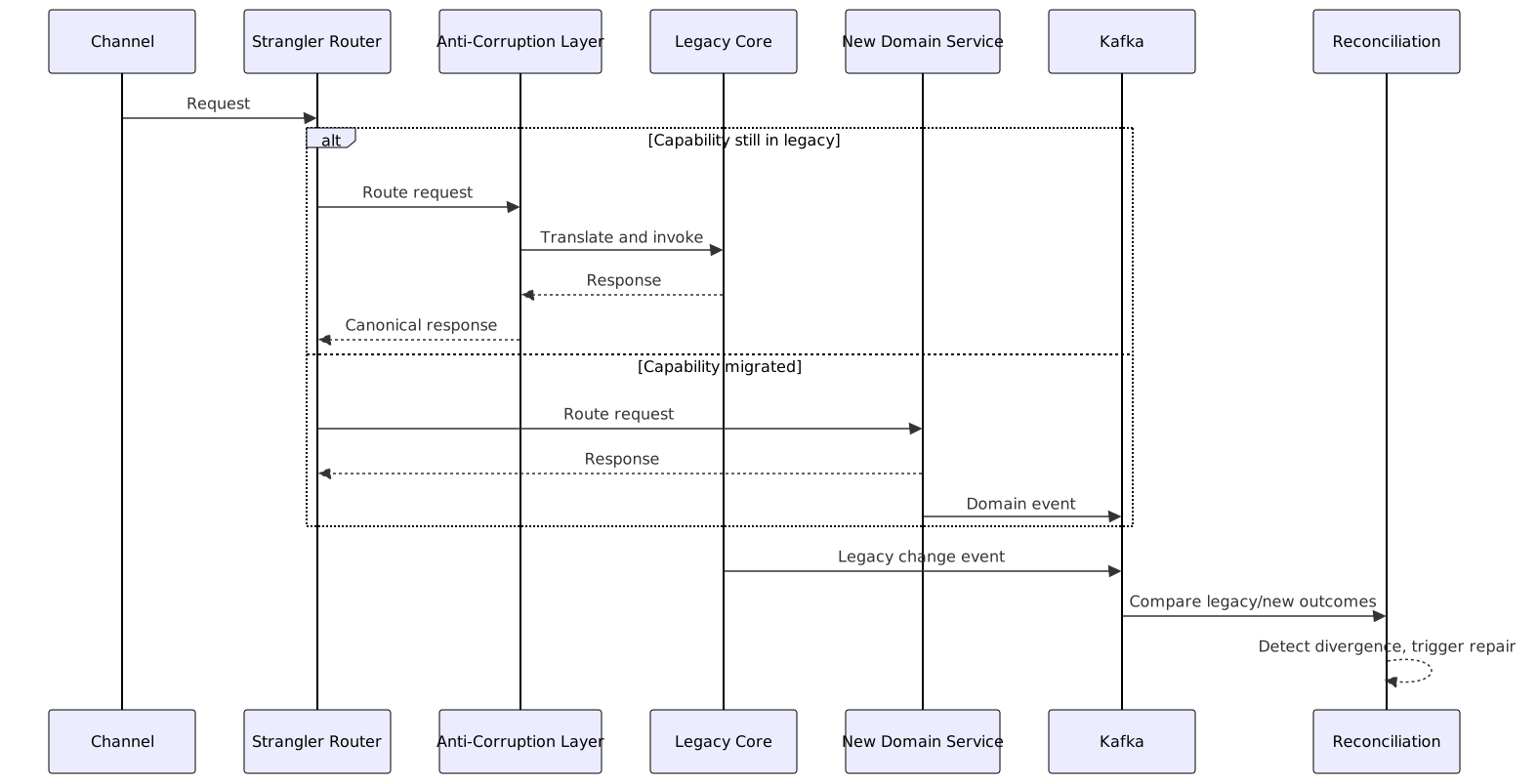
A progressive strangler migration moves business capabilities from the legacy core to new services one domain slice at a time. Routing, event capture, anti-corruption layers, and reconciliation are used to contain inconsistency while old and new coexist.
Done well, this reduces blast radius. Done badly, it creates a permanent dual-write swamp.
Architecture
Here is the shape I prefer for a risk-aware distributed system in the enterprise: domain-aligned services, explicit ownership of authoritative data, Kafka for asynchronous integration where semantic lag is acceptable, synchronous APIs where immediate decisions are required, and a separate reconciliation capability that sees across service boundaries.
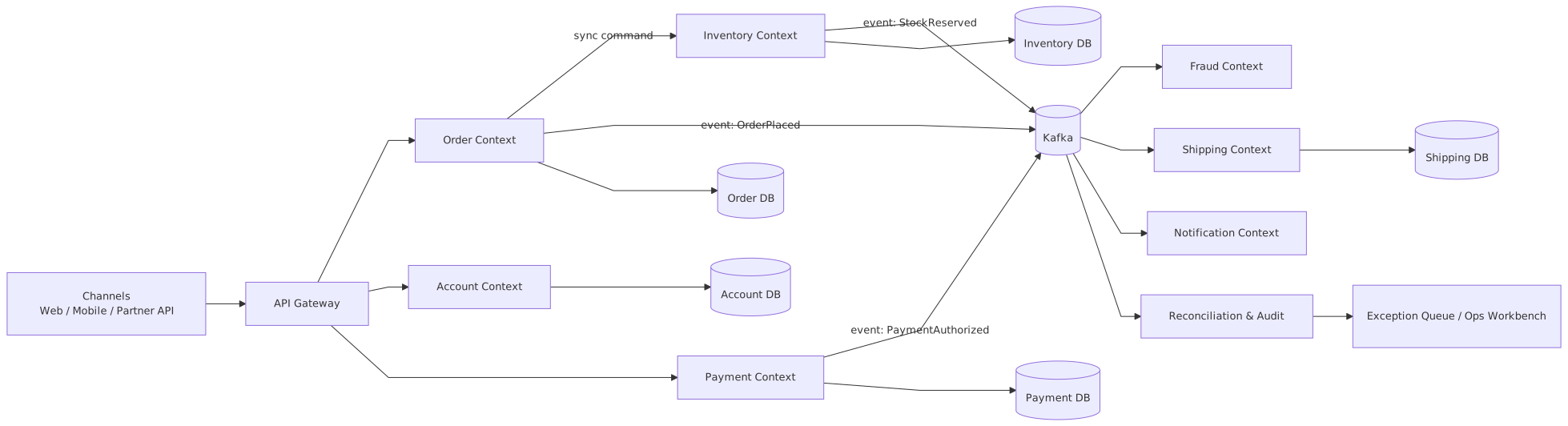
This architecture is not trying to make everything asynchronous. That is a rookie mistake dressed as sophistication. It distinguishes between commands that need immediate adjudication and facts that can be propagated.
For example:
- Placing an order may synchronously validate account state and inventory feasibility.
- Payment authorization may require a synchronous result to confirm the customer interaction.
- Shipment creation and notifications can often happen asynchronously.
- Fraud scoring might begin asynchronously but insert a hold before fulfillment depending on domain rules.
Notice what matters here: the interfaces are chosen by business semantics, not technical fashion.
Domain semantics and bounded contexts
This is where many distributed systems quietly go wrong. They share event names like CustomerUpdated or OrderChanged without shared semantic discipline. Those events become integration confetti.
In DDD terms, each bounded context owns its model. “Customer” in marketing is not “customer” in billing. “Order accepted” in commerce is not “settled” in finance. The architecture should preserve those distinctions.
A better event model uses business facts with context-specific meaning:
OrderPlacedInventoryReservedPaymentAuthorizedShipmentDispatchedSettlementConfirmed
These are not mere technical state changes. They are commitments. They imply who is authoritative, what happened, and what downstream consumers may infer.
Risk heatmap view
A component diagram tells you shape. A heatmap tells you where to worry.
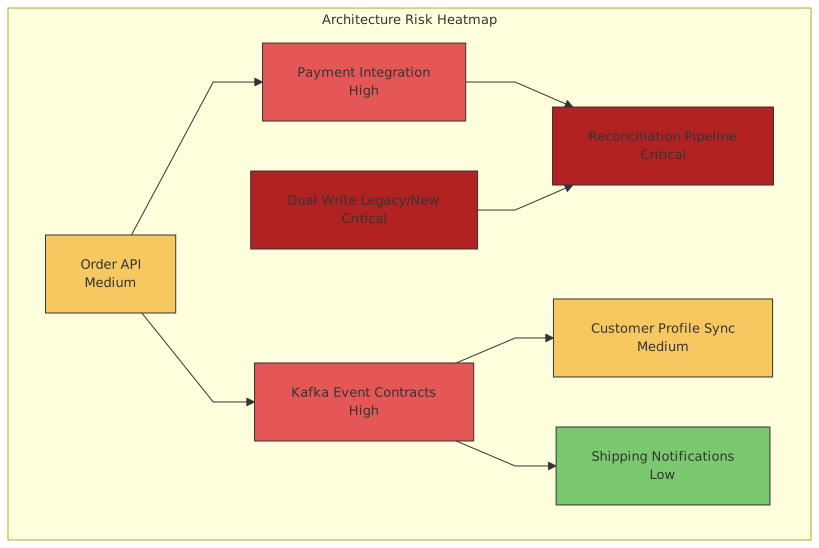
This heatmap is crude by design. That is good. Risk models that require a PhD to interpret are usually ignored by the people running the system at 2 a.m.
In practice, I score risk surfaces along a few dimensions:
- business criticality
- coupling type: sync, async, shared data, migration overlap
- change frequency
- operational detectability
- recoverability
- ownership clarity
You do not need precision. You need visibility.
Migration Strategy
Most enterprises do not get to build these systems fresh. They inherit. Which means architecture is as much a migration discipline as a design discipline.
The progressive strangler pattern is the sensible move here, but only if you understand what is being strangled: not servers, but responsibilities.
A migration should carve along bounded contexts or subdomains, not technical layers. Pulling out a “customer service” because everyone has one is often wrong. Pulling out “returns eligibility,” “pricing,” or “shipment tracking” may be far more coherent if those match business capability boundaries.
The migration usually proceeds in phases:
- Map domain seams and current truth sources
- Introduce an anti-corruption layer around the legacy system
- Mirror events or changes out of the legacy core
- Move a narrow capability to a new service
- Route selected traffic to the new path
- Reconcile old and new outcomes continuously
- Retire legacy responsibility once confidence is high
Here is the pattern.
Why reconciliation is central during migration
Because coexistence creates disagreement by default.
During migration, you will have:
- different validation rules
- different timing behavior
- different identifiers
- different retry patterns
- different interpretations of partially completed workflows
If you do not explicitly compare outcomes between legacy and new paths, you are migrating blind. The first sign of failure will come from finance, customer support, or an auditor. None of them are ideal observability tools.
A mature migration defines reconciliation rules upfront:
- What constitutes equivalence?
- Which system is authoritative during each phase?
- How are mismatches categorized?
- Which mismatches auto-heal?
- Which require manual intervention?
- What is the SLA for unresolved divergence?
This is architecture, not housekeeping.
Dual writes: just don’t, unless cornered
The highest-risk move in migration is the naive dual write: update the legacy database and publish to the new service in the same application flow, hoping retries and goodwill will handle the gaps.
They won’t.
If you are forced into dual writes, contain them behind a narrow component, make side effects idempotent, persist intent before dispatch, and accept that reconciliation is mandatory. Better alternatives are outbox patterns, change data capture, or routing one capability fully to one system while the other consumes derived facts.
Enterprise Example
Consider a global retailer modernizing order fulfillment.
The legacy estate had a large commerce platform handling order capture, payment orchestration, inventory allocation, shipment requests, and customer emails in one massive transactional core. It was stable in the way an oil tanker is stable: very hard to tip, very hard to turn.
The business wanted faster release cycles for fulfillment, better regional inventory logic, and partner integration through APIs. Leadership chose microservices and Kafka. Sensible enough. The danger was obvious: if they decomposed around technical functions rather than domain semantics, they would turn a known monolith into an unknowable mesh.
We started with domain mapping. The important bounded contexts were not “customer,” “product,” and “order” in the generic sense. They were:
- Order Capture
- Payment Authorization
- Inventory Reservation
- Fulfillment Planning
- Shipment Execution
- Customer Notification
- Financial Settlement
That distinction mattered. Payment authorization and settlement were especially sensitive because the business invariants differed. Authorization is about permission to proceed. Settlement is about money actually moving and being accounted for. Conflating them would have made every downstream workflow ambiguous.
The first migration slice was Shipment Execution, not payment or order capture. Why? Because it had strong business value, manageable invariants, and could tolerate asynchronous propagation from upstream order and inventory events. It was a good candidate for controlled strangling.
The team introduced Kafka topics for OrderReadyForShipment, ShipmentCreated, and ShipmentDispatched. The new shipment service became authoritative for carrier booking and tracking, while the legacy system continued to own order state and payment. A reconciliation service compared expected shipments from the order stream against actual carrier confirmations. Exception queues flagged missing or duplicate shipments.
This uncovered a classic failure mode: legacy order amendments arriving after shipment creation. In the old monolith, a shared transaction path had hidden that race. In the distributed design, it became visible. Good. Visibility is painful, but curable.
The fix was domain, not technology. The business introduced an explicit fulfillment hold window and defined amendment semantics after handoff. Some changes triggered compensation workflows; others became customer service exceptions. The architecture improved because the business policy became explicit.
Later, Inventory Reservation was extracted. This was harder. Inventory has ugly semantics: reservations expire, stock counts drift, warehouse systems lag, and “available” often means “available unless reality objects.” The team resisted the urge to make inventory fully synchronous with every order operation worldwide. Instead, they kept immediate reservation decisions local to the inventory context and published reservation outcomes through Kafka, while a reconciliation process compared warehouse confirmations against reservation intent.
The biggest lesson from that program was not about microservices. It was about truth. Every successful step reduced ambiguity about who owned what business fact and how disagreement was repaired.
That is enterprise architecture at its best: less magic, more honesty.
Operational Considerations
Distributed systems become enterprise systems only when they can be operated by people who did not design them.
That sounds obvious. It is surprisingly rare.
Observability must follow business flows
Metrics on CPU, request rates, and Kafka lag are necessary but insufficient. Operations needs to see business progress:
- orders placed but not paid
- payments authorized but not settled
- inventory reserved but not shipped
- shipments dispatched but not acknowledged by downstream systems
- reconciliation exceptions by type and age
Trace IDs are useful. Business correlation IDs are essential.
Idempotency is not optional
Kafka consumers will reprocess. APIs will retry. Humans will click twice. If your operations model assumes “exactly once” in the business sense from infrastructure guarantees, you are building on folklore. Design commands and event handlers to be idempotent where possible, and store enough intent to recognize duplicates.
Exception handling needs a home
There must be an operational workbench for stuck, divergent, or compensating flows. Not just logs. Not just dashboards. A real place where support or operations can inspect a case, understand the causal chain, and trigger safe repair actions.
Contract discipline matters more over time
The older a distributed estate gets, the more expensive casual contract changes become. Event schemas, API semantics, and topic versioning need governance, but lightweight governance. Bureaucracy can kill delivery; no governance can kill trust. EA governance checklist
Data lifecycle and auditability
Reconciliation data, replay logs, and event histories have retention costs, privacy implications, and compliance consequences. Especially in regulated environments, you need explicit policy for:
- what facts are immutable
- what can be redacted
- how replay interacts with deleted or changed data
- how audit trails are preserved across migrations
Tradeoffs
There is no risk-free architecture. There is only honest tradeoff.
Microservices reduce some risks and increase others
They reduce deployment coupling, improve local ownership, and can align well with bounded contexts. They also increase network dependence, version drift, duplicated data, and operational complexity.
Kafka is powerful but easy to romanticize
Kafka is excellent for durable event distribution, decoupled consumption, and stream-based integration. It is not a substitute for domain modeling. If the events are semantically muddy, Kafka scales confusion very efficiently.
Reconciliation improves correctness but adds cost
It adds storage, processing, operational workflows, and the need for clear authority models. But if you rely on eventual consistency in business-critical flows, not having reconciliation is simply deferred cost with interest.
Strong consistency simplifies some business flows but constrains scaling and autonomy
Sometimes that is the right answer. Especially in domains with tight invariants. Architects too often avoid strong consistency because it feels old-fashioned. Consistency is not old-fashioned when money is missing.
Failure Modes
These are the failure modes I see most often, and they are worth naming plainly.
1. Service boundaries that ignore the domain
Teams split by CRUD entities or org charts rather than business capabilities. Result: chatty interfaces, duplicated rules, constant coordination.
2. Event-driven architecture without event semantics
Everything emits “updated” events. Consumers guess what changed and whether it matters. Over time, every consumer embeds different assumptions. The estate becomes semantically unstable.
3. Migration that preserves every old coupling
The legacy system remains the hidden orchestrator while new services pretend to be autonomous. You end up with a distributed monolith plus extra failure points.
4. No authoritative source model
Different services believe they are system of record for overlapping data. Incidents become philosophical debates.
5. Missing reconciliation
Discrepancies accumulate until finance closes the month, support opens a major incident, or auditors ask unpleasant questions.
6. Human workflow ignored
The architecture handles the happy path beautifully and leaves exceptions to email and spreadsheets. Eventually the spreadsheet is the real system.
7. Retry storms and compensating chaos
A downstream dependency slows, upstream retries increase load, duplicate processing creates more inconsistency, and compensations trigger further downstream work. It looks like resilience until the whole thing catches fire.
When Not To Use
A distributed, event-heavy, microservice-oriented architecture is not the default good.
Do not use this style when:
- the domain is small and cohesive enough for a modular monolith
- the team is too small to support independent service ownership
- business invariants demand tight transactional consistency across most operations
- the organization lacks operational maturity for observability and incident response
- migrations are politically impossible, making long-term dual operation unavoidable
- the main pain is poor code structure rather than deployment coupling
A well-structured modular monolith often has a smaller risk surface than a fashionable microservice estate. That is not a compromise. It is often the professional choice.
The right question is not “Should we use microservices?” It is “Where does distribution reduce business risk more than it creates operational risk?”
If you cannot answer that, you are not ready.
Related Patterns
Several patterns pair naturally with a risk-surface approach:
- Bounded Contexts for semantic clarity and ownership
- Anti-Corruption Layer for shielding new models from legacy semantics
- Strangler Fig for progressive migration
- Outbox Pattern for reliable event publication
- Saga / Process Manager where multi-step workflows need explicit coordination
- CQRS when read models need separate optimization and can tolerate eventual consistency
- Event Sourcing in selective domains where auditability and state reconstruction matter
- Bulkheads and Circuit Breakers to reduce failure propagation
- Operational Workbench as a practical support pattern for human-in-the-loop recovery
These patterns are not a menu to order all at once. They are tools. Use them where they reduce risk, not where they improve conference talks.
Summary
The architecture risk surface in distributed systems is not about counting services or drawing better boxes. It is about understanding where business truth can fracture.
That fracture usually appears at boundaries:
- between bounded contexts
- between synchronous expectations and asynchronous implementation
- between old and new systems during migration
- between local success and global correctness
Domain-driven design helps because it gives those boundaries meaning. Progressive strangler migration helps because it reduces change blast radius while making responsibility shifts explicit. Kafka helps when you use it to propagate meaningful facts, not vague state noise. Reconciliation helps because eventual consistency without repair is just inconsistency with branding.
If there is one line worth keeping, it is this:
In distributed systems, reliability is not the absence of failure. It is the presence of credible repair.
That is the architectural standard that matters. Not elegance in isolation. Not service count. Not platform slogans. Credible repair, grounded in domain semantics, visible through operations, and exercised during migration before the business depends on it.
That is how you reduce the risk surface without pretending it disappears.
Frequently Asked Questions
What is a service mesh?
A service mesh is an infrastructure layer managing service-to-service communication. It provides mutual TLS, load balancing, circuit breaking, retries, and observability without each service implementing these capabilities. Istio and Linkerd are common implementations.
How do you document microservices architecture for governance?
Use ArchiMate Application Cooperation diagrams for the service landscape, UML Component diagrams for internal structure, UML Sequence diagrams for key flows, and UML Deployment diagrams for Kubernetes topology. All views can coexist in Sparx EA with full traceability.
What is the difference between choreography and orchestration in microservices?
Choreography has services react to events independently — no central coordinator. Orchestration uses a central workflow engine that calls services in sequence. Choreography scales better but is harder to debug; orchestration is easier to reason about but creates a central coupling point.