⏱ 19 min read
Most cloud transformation programs do not fail because the technology is hard. They fail because the architecture story is incoherent.
That is the uncomfortable truth.
Teams buy a landing zone, spin up Kubernetes, deploy Kafka, connect IAM, and announce they are “on the cloud journey.” Six months later, nobody can answer basic questions with confidence: Which business capabilities actually improved? What applications are still coupled to the mainframe? Where is identity enforced? Which data flows cross regulatory boundaries? Why does every domain team have a different definition of “platform”?
This is exactly where ArchiMate earns its keep. Not as a modeling hobby. Not as a compliance tax. And definitely not as a poster-making exercise for architecture review boards. ArchiMate matters because cloud transformation creates complexity faster than most organizations can reason about it. If you cannot describe the enterprise coherently across business, application, technology, and change, your cloud program becomes a collection of expensive local optimizations.
So here’s the simple explanation early: ArchiMate is a visual enterprise architecture language that helps architects connect strategy, business capabilities, applications, data, technology, and transformation work in one consistent model. In cloud transformation initiatives, that means you can show how a business goal like faster customer onboarding connects to IAM changes, Kafka event streams, core banking services, cloud hosting patterns, and migration work packages.
That sounds neat in theory. In practice, it is even more useful than most architects realize—and also easier to misuse than the tool vendors admit. EA governance checklist
Why ArchiMate actually matters in cloud transformation
Cloud transformation is not a hosting decision. It is an operating model decision disguised as infrastructure modernization.
A lot of organizations still approach the cloud as if they are moving boxes from one room to another. They model servers, VPCs, subnets, maybe some platform services, and then call that architecture. But the real transformation is not “VM to container” or “data center to AWS/Azure/GCP.” The real transformation is this:
- business capabilities become more modular and measurable
- delivery teams become more autonomous
- integration moves from point-to-point to event-driven and API-based
- IAM becomes a first-class architectural concern
- resilience, observability, and policy move into the platform
- risk and control models need redesign, not just rehosting
ArchiMate gives you a way to represent all of that, with traceability.
And traceability is the part people skip because it feels boring. Until the audit happens. Or the outage. Or the budget review. Or the executive asks why the “cloud-native customer platform” still depends on a nightly file transfer from the old core banking stack.
In a serious enterprise, architecture is not just about describing systems. It is about proving relationships. ArchiMate is useful because it forces discipline around those relationships. ArchiMate modeling guide
The mistake people make: they use ArchiMate too late
One of the most common mistakes architects make is bringing ArchiMate in after major cloud decisions are already made. ArchiMate tutorial
At that point, the model becomes a documentation artifact. It records what happened. It does not shape what should happen.
That is backwards.
If you want ArchiMate to help a cloud transformation initiative, use it at three moments:
- Before solution design, to frame the transformation and expose dependencies
- During target-state and transition-state design, to align teams and sequence change
- During governance, to assess whether delivery is still consistent with enterprise intent
If you only use it in stage three, you’re basically drawing autopsy diagrams.
What ArchiMate gives you that PowerPoint never will
Architects love PowerPoint because it is fast, flexible, and socially accepted. Executives love it because it looks finished. Delivery teams tolerate it because they know it will be obsolete in two weeks.
But PowerPoint is not a modeling language. It does not enforce semantics. It does not distinguish between a business process, an application service, a technology service, and a work package. It lets people blur concepts until architecture becomes storytelling without structure.
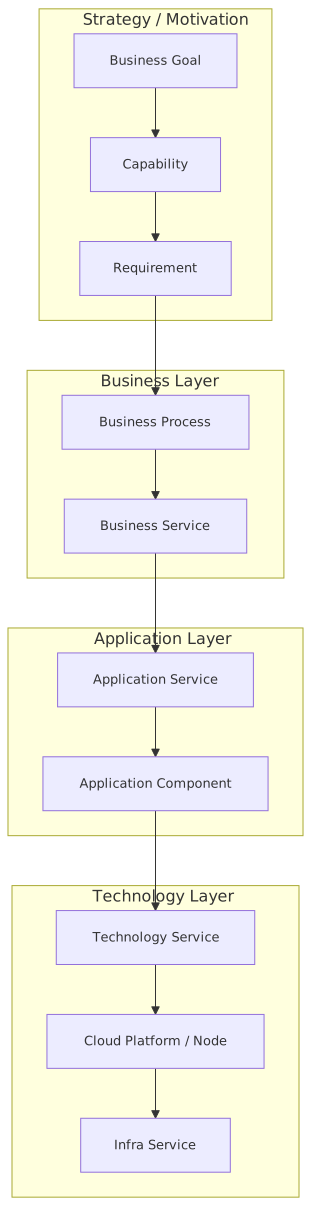
ArchiMate is better for cloud transformation because it gives you a disciplined way to answer different kinds of questions:
- Motivation: Why are we transforming?
- Strategy: What capabilities and outcomes are we targeting?
- Business: Which value streams and processes change?
- Application: Which systems and services support those changes?
- Technology: What cloud platforms, runtime environments, networks, and IAM components enable them?
- Implementation and migration: What changes first, what depends on what, and what remains transitional?
That matters in real architecture work because cloud programs are full of hidden coupling. You need a language that can expose it.
A practical way to use ArchiMate in cloud transformation
Let me be blunt: if your ArchiMate repository tries to model every cloud resource, every microservice endpoint, every CI/CD step, and every policy rule, you are building a museum, not an architecture capability. ArchiMate layers explained
The point is not exhaustive detail. The point is decision-relevant abstraction.
A practical use of ArchiMate in cloud transformation usually works at four levels. ArchiMate relationship types
1. Capability and outcome view
Start with business capabilities and measurable outcomes.
For example, in banking:
- Customer Onboarding
- Payments Processing
- Fraud Detection
- Identity and Access Management
- Regulatory Reporting
Then connect them to business outcomes:
- reduce onboarding time from 3 days to 20 minutes
- improve payment processing resilience
- reduce fraud response latency
- centralize access control and auditability
This is where many cloud programs are already in trouble. They start with infrastructure modernization without clarifying which capabilities need transformation. If the cloud initiative is not tied to capabilities, it turns into platform theater.
2. Application and integration view
Then map the applications and integration patterns that support those capabilities.
For example:
- mobile banking app
- customer onboarding portal
- core banking platform
- IAM platform
- Kafka event backbone
- fraud analytics engine
- API gateway
- document management service
Now the key thing: do not just list systems. Model services and relationships. Which application service exposes customer identity verification? Which events are published to Kafka? Which application components still rely on synchronous calls into the core banking stack? Which applications consume IAM tokens and policies?
This is where architecture becomes real.
3. Technology and cloud platform view
Next map the technology layer that matters:
- cloud landing zone
- Kubernetes platform
- managed Kafka or self-managed Kafka
- IAM federation with corporate directory
- secrets management
- network segmentation
- observability platform
- encryption and key management
- policy enforcement points
Again, not every resource. Just enough to show the operating model and the dependencies.
4. Transition architecture and migration view
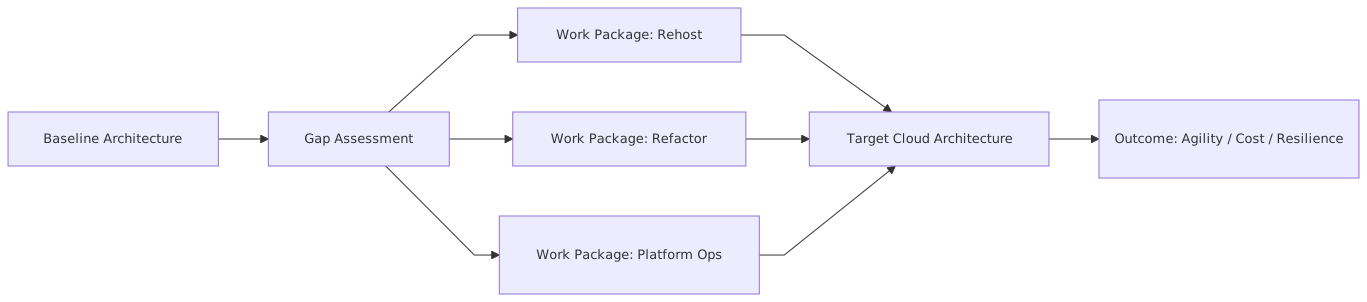
Finally, model how you move from current state to target state:
- what gets rehosted
- what gets refactored
- what gets retired
- which transitional integrations exist
- where dual-run patterns are required
- where data replication or event mirroring is temporary
This part is criminally under-modeled in many enterprises. Everyone draws current and target state. Almost nobody models the ugly middle. But the ugly middle is where cloud transformations live for years.
ArchiMate layers in plain English
Here’s the simple version for teams that are new to it.
That table may look obvious. Good. Enterprise architecture should make the important things obvious. That is half the job.
A real enterprise example: retail banking cloud transformation
Let’s use a realistic banking example because banking exposes all the hard bits: regulation, legacy systems, identity, eventing, resilience, data sensitivity, and organizational politics.
A mid-sized retail bank wants to modernize customer onboarding and payments servicing. The current environment looks familiar:
- a core banking platform hosted on-prem
- branch and contact center applications tightly coupled to that core
- a digital banking channel already partly in the cloud
- multiple IAM silos for employees, customers, and partners
- point-to-point integrations plus nightly batch jobs
- a Kafka cluster introduced by one ambitious engineering team, but not governed enterprise-wide
- cloud adoption happening unevenly across domains
The executive message is simple: “Move faster in the cloud.”
That is not a strategy. That is a slogan.
The architecture team uses ArchiMate to turn that slogan into an enterprise transformation model. ArchiMate modeling best practices
Step 1: model the drivers and outcomes
They identify drivers:
- customer abandonment during onboarding
- high operational cost of manual review
- inconsistent authentication across channels
- resilience concerns in payment servicing
- regulator scrutiny around access controls and audit trails
Then they model assessments and goals:
- fragmented identity architecture increases risk
- synchronous dependencies on the core banking platform reduce agility
- event-driven patterns can reduce coupling
- target goals include onboarding under 20 minutes, unified IAM controls, and improved service recovery
This is not bureaucracy. This is forcing clarity.
Step 2: model business capabilities, not just systems
The architects map capabilities:
- Customer Identity Management
- Customer Onboarding
- Account Servicing
- Payments Execution
- Access Governance
- Fraud Monitoring
Then they identify which capabilities need enhancement versus replacement versus stabilization.
This is important because not everything needs transformation. Some things need to be left alone. Architects who cannot say “no” end up designing fantasy landscapes.
Step 3: map the application services and dependencies
They model:
- digital onboarding application
- document verification service
- customer profile service
- IAM authentication service
- authorization policy service
- Kafka event streaming service
- payments orchestration service
- core banking customer master
- fraud analytics platform
Now they expose the real issues:
- onboarding still performs synchronous reads into the core banking customer master
- branch onboarding uses a separate IAM flow from digital onboarding
- fraud events are published to Kafka, but onboarding decisions are not
- payment servicing uses token validation in one channel and session-based auth in another
- audit logs are fragmented across cloud and on-prem platforms
Without ArchiMate, these facts often sit in different documents owned by different teams. With ArchiMate, they can be shown as one connected architecture.
Step 4: model the target architecture honestly
The target architecture includes:
- federated IAM with centralized policy decision and channel-specific enforcement
- Kafka as the enterprise event backbone for onboarding, customer lifecycle, and fraud signals
- onboarding services decoupled from direct core banking reads through a customer domain API and event projections
- cloud-hosted digital services running on Kubernetes
- core banking retained on-prem for now, exposed through controlled APIs and event publication
- centralized observability and audit pipeline
Notice what is not in the target:
- full replacement of the core banking platform
- immediate migration of all payment processing
- total elimination of legacy identity stores on day one
That restraint is what makes the architecture credible.
Step 5: model transition states
This is where ArchiMate becomes especially valuable.
The bank defines three transition architectures:
Transition 1: Foundation
- cloud landing zone hardening
- IAM federation established
- Kafka platform standardized
- API gateway and observability baseline implemented
Transition 2: Onboarding modernization
- digital onboarding moved to cloud-native services
- onboarding events published to Kafka
- customer profile projection introduced
- branch onboarding integrated with the same IAM policies
Transition 3: Payments servicing optimization
- payment status events exposed through Kafka
- servicing portal moved to cloud platform
- fraud and service operations consume common event streams
- legacy auth patterns retired progressively
This sequence is not just implementation planning. It is enterprise architecture with operational consequences.
How this applies in real architecture work
In real architecture work, ArchiMate is most useful when it helps answer contentious questions quickly.
For example:
“Can we migrate this application to cloud before the IAM redesign?”
Maybe. But ArchiMate can show whether the application’s business services depend on authentication and authorization services that are inconsistent across channels. If the migration would duplicate identity logic in the cloud, then no, you probably should not.
“Why are we investing in Kafka before refactoring all applications?”
Because event streaming is not just a technical preference. It may be a strategic integration capability that reduces coupling, supports domain autonomy, enables audit trails, and decouples cloud-native services from the core banking platform. ArchiMate lets you connect that platform decision to business and application outcomes.
“Which systems are in scope for zero trust policy enforcement?”
This is where many organizations wave their hands. A proper model can show which application services expose sensitive business services, which actors use them, which IAM and policy services govern access, and which technology services enforce controls.
“Why is this migration work package blocked?”
Because the model shows dependencies. Maybe the onboarding service migration depends on customer identity consolidation, which depends on IAM federation, which depends on directory cleanup and policy rationalization. Cloud programs often stall because people pretend technical dependencies are implementation details. They are not. They are architecture.
A good enterprise architect uses ArchiMate not to create pretty diagrams, but to create shared understanding in the face of disagreement.
Common mistakes architects make with ArchiMate in cloud programs
Let’s get into the painful part.
1. Modeling the cloud provider catalog instead of the enterprise
This is probably the most common mistake. Architects fill diagrams with load balancers, managed databases, container registries, functions, queues, and every branded service under the sun.
That is not enterprise architecture. That is a vendor brochure in diagram form.
Model what matters to enterprise decisions:
- platform services
- security and IAM dependencies
- integration patterns
- business-critical application services
- transformation sequencing
Leave the low-level resource inventory to infrastructure-as-code, CMDBs, or platform observability.
2. Skipping the business layer
Some architects say, “The business doesn’t care about ArchiMate.” Sometimes true. But if your model starts at application and technology layers, you have already limited its value.
Cloud transformation must connect to business capabilities and outcomes. Otherwise, every modernization effort sounds equally important, and funding becomes political instead of rational.
3. Treating IAM as a side concern
This one is especially bad in regulated sectors.
IAM is not a box on the edge of the diagram. It is an enterprise control plane. In cloud transformation, IAM touches customer experience, employee access, partner integration, audit, policy enforcement, and operational risk.
If your ArchiMate model cannot show how IAM services relate to business processes, application services, and technology enforcement, then your architecture is missing one of the most critical dimensions of cloud transformation.
4. Ignoring transition architectures
As I said earlier, many architects love current-state and target-state diagrams because they are emotionally satisfying. Transition states are messy. They reveal compromise, temporary duplication, and awkward dependencies.
That is exactly why you need them.
In banking especially, the transition state often lasts longer than the architects who designed it. If you do not model it, delivery teams invent their own local transitions. That is when risk multiplies.
5. Over-modeling and losing the audience
There is a special kind of architecture failure where the model is technically correct and completely useless.
Too many elements. Too many relationships. Too much notation purity. No narrative.
Real stakeholders need views tailored to decisions. Executives need capability impact and sequencing. Platform teams need technology and service dependencies. Security teams need IAM and control views. Domain architects need application collaboration and migration heatmaps.
ArchiMate is a language. It still needs editing. Not every sentence belongs in every conversation.
6. Confusing application integration with domain architecture
Using Kafka does not automatically mean you have a good architecture.
I have seen enterprises put Kafka in the middle of everything and call it decoupling, while still publishing badly designed events tied to legacy database structures. That just moves coupling into the event model.
ArchiMate helps if you model the right abstractions: business events, application services, consuming domains, and ownership boundaries. If you skip ownership and semantics, then Kafka becomes a distributed version of the same old integration mess.
Contrarian thought: not every cloud transformation needs a huge ArchiMate repository
There, I said it.
Some architecture teams act like maturity equals repository size. It does not.
If your transformation scope is relatively narrow—say, modernizing one customer-facing service with clear boundaries—you may need only a lightweight set of views:
- motivation and goals
- capability impact
- application cooperation
- technology deployment
- migration roadmap
That can be enough.
The value of ArchiMate is not in maximal coverage. It is in coherent cross-layer reasoning. A smaller, sharper model beats a giant stale repository every time.
Another contrarian point: sometimes a whiteboard conversation with a few well-chosen ArchiMate concepts is more valuable than a formally reviewed model built over three months. Architecture has to move at the speed of meaningful decisions, not at the speed of governance rituals.
How I would structure ArchiMate work in a real cloud program
If I were running architecture for a cloud transformation initiative, I would organize the modeling work like this.
Executive view
Shows:
- drivers
- goals
- capability impacts
- top transformation work packages
- major risks and dependencies
Purpose:
- funding alignment
- prioritization
- strategic clarity
Domain architecture views
Shows:
- business services
- application services
- domain ownership
- APIs and event streams
- dependencies on IAM and core platforms
Purpose:
- domain-level design decisions
- team autonomy with enterprise traceability
Platform architecture views
Shows:
- cloud platform services
- Kubernetes/runtime patterns
- Kafka platform service
- IAM federation and policy services
- observability and security controls
Purpose:
- standardization
- platform roadmap
- reusable patterns
Migration views
Shows:
- current to transition to target
- work packages
- plateaus
- implementation events
- dependencies and retirement points
Purpose:
- sequencing
- governance
- reducing hidden transformation risk
That is enough structure to make ArchiMate useful without turning it into a religion.
The relationship between ArchiMate and cloud architecture standards
A lot of architects ask whether ArchiMate replaces cloud reference architectures, solution diagrams, C4 models, BPMN, or security patterns. BPMN 2.0 training
Of course not.
ArchiMate is the connective tissue, not the entire body.
Use cloud-native diagrams for deployment specifics. Use BPMN when process detail matters. Use C4 when software teams need application structure. Use security control models for detailed enforcement design. But use ArchiMate when you need coherent enterprise traceability across those concerns. how BPMN and UML complement each other
If you try to force ArchiMate to do everything, people will hate it. Fairly.
If you use it to connect strategy to execution in a cloud transformation, people start seeing why enterprise architecture exists.
A practical modeling checklist for cloud transformation
Here is a simple checklist I would actually use with a team.
That checklist is not glamorous. It is useful. I’ll take useful every time.
What good looks like
A good ArchiMate model for cloud transformation has a few clear characteristics:
- it starts with business outcomes, not cloud products
- it shows application and integration dependencies honestly
- it treats IAM as central, not peripheral
- it distinguishes target state from transition state
- it is opinionated about platform standards
- it is selective about detail
- it can be explained verbally without sounding like notation training
And maybe this is the most important one: it helps teams make trade-offs.
Because architecture is mostly trade-offs.
Should the bank move onboarding first or unify IAM first?
Should Kafka be expanded now or after domain ownership is clarified?
Should payments stay hybrid for two years to reduce risk?
Should the core banking dependency be abstracted through APIs before eventing is expanded?
These are architecture questions. ArchiMate does not answer them automatically. But it gives you a disciplined frame to evaluate them.
Final thought
Cloud transformation is messy, political, and full of confident nonsense.
Vendors oversimplify it. Delivery teams localize it. Executives sometimes romanticize it. Architects, if they are not careful, can make it worse by producing either abstract theory or over-engineered documentation.
Used properly, ArchiMate cuts through that.
It gives enterprise architects a way to connect business change, application design, cloud platform choices, Kafka-based integration, IAM control models, and migration sequencing without pretending the enterprise is simpler than it is.
And that is the point. Not elegance for its own sake. Not notation purity. Coherence.
If your cloud transformation initiative lacks coherence, ArchiMate can help.
If your architecture team cannot explain the transformation from business capability to IAM policy to Kafka event flow to migration work package, then you do not have an architecture. You have fragments.
In enterprise work, fragments are expensive.
FAQ
1. Is ArchiMate too heavyweight for cloud transformation programs?
Not if you use it properly. It becomes heavyweight when teams try to model everything. For most cloud initiatives, a focused set of views around capabilities, applications, IAM, integration, platform services, and migration is enough.
2. How does ArchiMate help with Kafka-based architectures?
It helps by showing why Kafka exists, which application services publish and consume events, how domains are decoupled, and where event streaming supports business capabilities. It stops Kafka from becoming just another technical island.
3. Where should IAM appear in an ArchiMate cloud model?
Everywhere it matters. Not just in the technology layer. IAM should connect to business actors, application services, access policies, audit requirements, and cloud enforcement points. In regulated industries, that visibility is essential.
4. Can ArchiMate work in hybrid cloud and legacy-heavy environments?
Yes. In fact, that is where it is often most valuable. Hybrid environments are full of transition complexity, and ArchiMate is strong at showing dependencies between on-prem systems, cloud platforms, and migration work packages.
5. What is the biggest mistake in using ArchiMate for cloud architecture?
Modeling infrastructure detail without connecting it to business and application change. If your diagrams are mostly cloud components and arrows, you are doing technical inventory, not enterprise architecture.
Frequently Asked Questions
How is ArchiMate used for cloud transformation?
ArchiMate models cloud transformation by comparing baseline and target architectures across all layers. Cloud platforms appear as Technology Services, workloads as Application Components assigned to Technology Nodes. The Implementation and Migration layer models transition plateaus, work packages, and migration events — producing a traceable cloud roadmap.
How does ArchiMate align with DevOps practices?
ArchiMate supports DevOps by modeling the CI/CD pipeline as Application Behavior elements, infrastructure as code as Technology Artifacts, and deployment topology as Technology Nodes. Traceability from requirements through design to deployed infrastructure helps DevOps teams understand architectural constraints and governance requirements.
What cloud architecture patterns can be modeled in ArchiMate?
ArchiMate can model cloud-native patterns including: multi-region active-active deployments, event-driven integration via messaging platforms, API-led integration architectures, zero-trust network topology, container orchestration (Kubernetes), and hybrid cloud connectivity. Each pattern maps to specific Technology and Application layer elements.