⏱ 19 min read
There is a moment in every growing system when the old shape stops fitting the business.
At first, scaling feels mechanical. Add more CPU. Add another node. Put a load balancer in front. Tweak a database index. The graph dips, everyone relaxes, and the platform limps forward. But then the business changes faster than the infrastructure can pretend to be simple. One part of the system is red-hot while another sits mostly idle. One domain needs low latency; another can tolerate eventual consistency. One team releases daily; another needs a two-week compliance gate. Suddenly “scale” is no longer a number. It is a topology problem.
That is the mistake many enterprises make. They talk about scaling as though it were horsepower. In practice, scaling is geometry. It is the shape of responsibilities, the boundaries of domains, the flow of messages, the placement of state, and the way failure spreads. The topology you choose determines not only whether the system survives success, but whether the organization can still reason about it six quarters later.
A scaling topology is not a diagramming exercise. It is a business design decision wearing infrastructure clothes.
This article looks at service scaling topologies in cloud architecture through that lens: not as a menu of patterns, but as a set of architectural choices with consequences. We will cover the problem, the forces that drive topology choices, architectural options, migration paths, reconciliation, Kafka and microservices where they fit, and the grimly practical questions enterprise teams always face: what breaks, what costs more than expected, and when not to do any of this at all. event-driven architecture patterns
Context
Most enterprises do not begin with a scaling topology. They inherit one.
It usually starts as a tidy transactional application. A few services, maybe a modular monolith, a relational database, synchronous APIs, and some batch integration around the edges. This is fine, even healthy, when business volume is moderate and domain complexity is still mostly centralized. But scale rarely arrives evenly. Pricing explodes during promotions. Inventory checks spike during peak shopping windows. Fraud scoring gets compute-heavy as models mature. Reporting workloads batter operational databases. Internal teams demand autonomy. External partners require different SLAs. The platform starts behaving like a city built for bicycles that woke up one morning to six lanes of trucks.
That is where scaling topologies matter.
A topology is the structural arrangement by which a system handles growth in traffic, data volume, processing variability, team autonomy, and fault isolation. Horizontal scaling is only one dimension. Others matter just as much:
- Functional scaling: different business capabilities scale independently.
- Read/write scaling: reads, writes, and derived views need different treatment.
- Geographic scaling: proximity and data residency shape design.
- Organizational scaling: teams need bounded autonomy.
- Event processing scaling: asynchronous throughput becomes first-class.
- State scaling: transaction boundaries and persistence models fragment.
The key point is simple: if all parts of a system must scale the same way, you have probably modeled the business poorly.
Domain-driven design helps here because it forces the obvious but often neglected question: what part of the business is actually under pressure? Not “what server is hot,” but “what domain behavior is growing, changing, or becoming strategically important?” That distinction is the difference between an architecture that reflects enterprise reality and one that merely reacts to symptoms.
Problem
The core problem is not how to make one service bigger. The problem is how to scale a system whose parts have fundamentally different economics.
A checkout domain values correctness and transactional integrity. A catalog domain values read performance and cacheability. Recommendations value throughput and probabilistic freshness. Settlement values auditability over latency. Identity values security and regulatory controls. If these are forced into the same operational, deployment, and data model, the system becomes hostage to its most constrained component.
This creates familiar enterprise pain:
- Hotspots form around shared databases.
- Release cadence collapses to the slowest team.
- Traffic spikes in one domain trigger cascading failures elsewhere.
- Reporting and analytics poison transactional workloads.
- Retry storms amplify latency incidents.
- “Temporary” integration code becomes the architecture.
- Platform cost grows faster than business value.
The old answer was usually vertical scaling and central governance. Buy a larger box. Add a bigger database cluster. Put stricter change control around everything. This works longer than architects like to admit. But eventually the mismatch between business semantics and technical structure shows through. EA governance checklist
What fails first is not compute. It is coherence.
When a returns workflow, a customer profile update, a shipment event, and a pricing recalculation all compete inside a single synchronous transaction model, the architecture stops representing the business. It becomes a traffic accident with APIs.
Forces
Good architecture lives in tension. Scaling topologies are shaped by forces that pull in different directions, and pretending otherwise is how you end up with a Kafka cluster running in front of a monolith no one can explain.
Here are the forces that actually matter.
1. Domain semantics
This is the most important force and the one enterprises skip when they are in a hurry.
Not every capability deserves independent scaling. Some belong together because they share invariants. Others should be separated because they differ in load, criticality, or change rate. Bounded contexts are not just a design nicety; they are scaling boundaries.
For example:
- Order capture and payment authorization may need strong coordination.
- Customer notifications should not sit inside the same failure domain.
- Search indexing should almost certainly be asynchronous and independently scalable.
- Inventory reservation might need careful contention management and explicit reconciliation.
Scaling topology follows business meaning. If the domain model is vague, the topology will be arbitrary.
2. Latency vs consistency
Synchronous calls are attractive because they are easy to reason about—until they create dependency chains that turn partial slowdown into total outage. Asynchronous messaging increases resilience and decoupling, but it introduces eventual consistency and reconciliation. You are always paying somewhere: either in latency and coupling, or in complexity and delayed truth.
3. Operational independence
Independent scaling is only useful if services can also be operated independently. Separate autoscaling groups, deployment pipelines, observability, and on-call ownership matter. Otherwise you have merely produced more endpoints.
4. Data gravity
State is stubborn. Shared databases destroy autonomy, but fragmented data models create duplication and sync problems. Data gravity often dictates where topologies can bend and where they snap.
5. Failure isolation
A topology should limit blast radius. If a recommendations engine can starve order placement, you have built a business hazard, not an architecture.
6. Cost and platform maturity
Some topologies look elegant on whiteboards and become ruinously expensive in cloud bills, operational headcount, and cognitive load. Not every scaling problem deserves a service mesh, a multi-region event backbone, and six storage technologies.
7. Regulatory and audit constraints
Financial services, healthcare, telecom, and public sector architectures cannot treat topology as purely technical. Traceability, residency, retention, and control evidence shape how systems may scale.
Solution
The pragmatic solution is to move from uniform scaling to topology-aware scaling.
That means designing different parts of the system to scale in different ways based on domain behavior. In practice, most mature cloud architectures use a mix of the following topologies: cloud architecture guide
- Clone-and-balance topology for stateless request handling.
- Cell-based or shard-based topology for partitioned workloads and blast-radius control.
- Event-driven topology for asynchronous processing and independent throughput scaling.
- Read/write separated topology for query-heavy domains.
- Domain-isolated microservice topology where business capabilities evolve and scale independently.
- Regional or edge topology where geography and residency matter.
No single topology wins everywhere. Real systems are hybrids.
A useful way to think about this is as layers of scaling intent:
- At the edge, stateless API capacity scales horizontally.
- In the core, bounded contexts scale according to domain load and invariants.
- Around the core, event streams absorb bursts and decouple processing.
- In data, storage patterns reflect access asymmetry and consistency needs.
- Across regions, cells or partitions constrain failure spread.
That hybrid structure gives enterprises room to grow without forcing every problem through the same mechanism.
Architecture
Let’s make this concrete.
Topology 1: Stateless front door with independently scaled domains
This is the baseline cloud pattern. API gateways and stateless services scale horizontally behind load balancers, while domain services scale based on their own demand profiles.
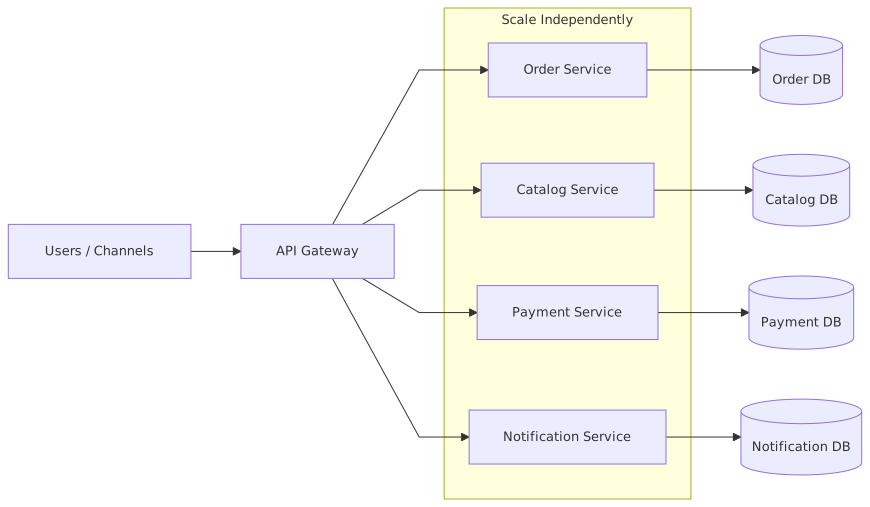
This works well when services are already reasonably separated and most interactions are request/response. It is simple, understandable, and often enough for many enterprises. The trap is assuming this is “microservices done right” and stopping there. If every user action still synchronously calls five services in sequence, your scaling story is brittle. microservices architecture diagrams
Topology 2: Event backbone for burst absorption and decoupled throughput
When throughput becomes uneven, asynchronous eventing becomes essential. Kafka is often the right fit here, not because event streaming is fashionable, but because it gives you a durable, replayable backbone for high-volume domain events.
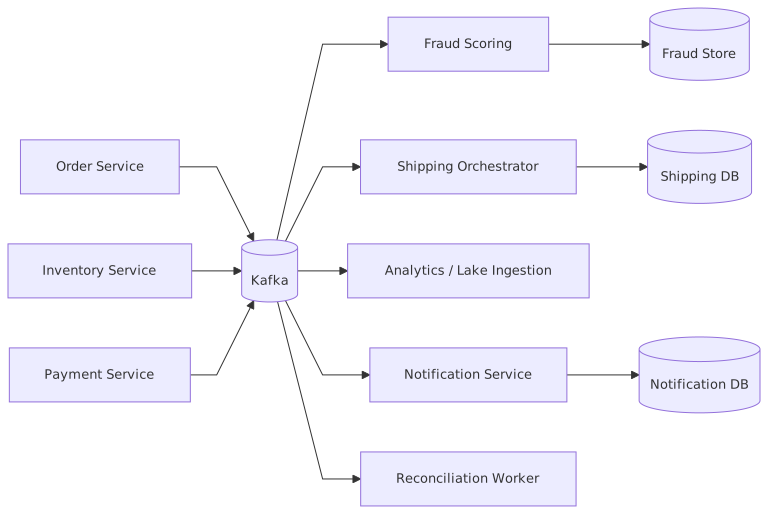
Here the topology changes the economics of scale. Fraud scoring can scale consumers independently. Analytics no longer drags on operational transactions. Notifications can lag briefly without affecting checkout. Reconciliation can replay from Kafka when downstream services recover.
This is where domain semantics matter again. The event backbone should carry meaningful domain events—OrderPlaced, PaymentAuthorized, InventoryReserved—not thinly disguised CRUD updates. Otherwise you are just exporting database coupling into a log.
Topology 3: Cell-based scaling for fault containment
For very large systems, especially those with high tenancy or regional segmentation, cells are the grown-up answer. A cell is a mostly self-contained slice of the system with its own compute, data, and often event processing. Traffic is routed to cells based on tenant, geography, or partition key.
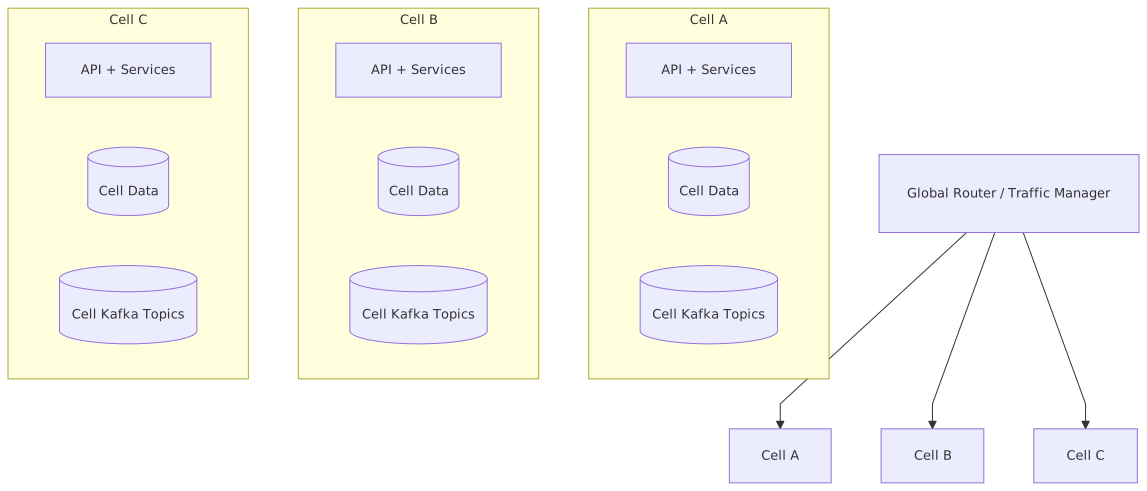
Cells are not glamorous. They are repetitive by design. That is their virtue. They limit blast radius, localize noisy neighbors, and make regional compliance easier. They also add routing, partitioning, and operational overhead. You do not jump to cells because your dashboard looks crowded. You use them when failure containment and high-scale partitioning become existential.
Migration Strategy
Most enterprises cannot simply redraw the topology and start over. They migrate from what they have, and what they have is usually a tangle of shared databases, synchronous workflows, and a handful of critical transaction paths that nobody dares touch.
This is where the progressive strangler migration earns its keep.
Start at the domain seams, not the technology seams. The right first extraction is rarely “user service” because user data is shared everywhere. Better candidates are capabilities with clear semantics, isolated demand, and obvious scaling pain: notifications, search indexing, fraud scoring, document generation, product availability views, shipment tracking.
A sensible migration path often looks like this:
- Identify hotspots by domain, not by server metrics alone.
Find where business load and technical load overlap.
- Create an anti-corruption layer around the legacy core.
New services should not absorb old data model pollution.
- Extract side-effect-heavy or asynchronous capabilities first.
Notifications and analytics are classic starting points.
- Introduce domain events.
Publish meaningful business events from the legacy system, even if initially via outbox pattern.
- Build read models outside the core.
Query load is often easier to peel away than transactional writes.
- Move selective commands into new bounded contexts.
Once read models and events stabilize, shift ownership of writes.
- Add reconciliation before you trust eventual consistency.
Every migration lies to itself at first. Reconciliation tells you where.
- Only then decompose critical transaction paths.
By now you know where the semantic boundaries really are.
The strangler pattern is not about replacing the old system quickly. It is about changing the center of gravity without losing control of the business.
Reconciliation is not optional
This deserves blunt language: eventual consistency without reconciliation is just denial.
As systems move toward event-driven topologies, especially with Kafka and independently scaled microservices, mismatches will happen. Events arrive out of order. Consumers fail after side effects but before commit. Duplicate delivery happens. A downstream service lags for hours. A schema change is interpreted differently across versions. None of this is hypothetical.
That is why serious enterprise architectures include reconciliation explicitly:
- Periodic comparison of source-of-record and derived state
- Compensating workflows for incomplete multi-step processes
- Dead-letter handling with business-level triage
- Replayable event logs
- Idempotent consumers
- Audit trails linking commands, events, and resulting state
Reconciliation is what turns “eventual consistency” from a slogan into an operating model.
Enterprise Example
Consider a large omnichannel retailer modernizing its order platform.
The company began with a centralized commerce suite: web, stores, fulfillment, promotions, and customer service all running against a shared database cluster. During normal periods the system held together. During seasonal peaks it became a hostage situation. Catalog reads exploded, inventory checks thrashed the database, promotion calculations slowed checkout, and batch exports collided with daytime transactions. Every scaling decision affected everything else.
The first instinct was to split the monolith into dozens of microservices. That would have been a mistake. The retailer instead mapped its bounded contexts carefully:
- Catalog: read-heavy, cacheable, frequent content changes
- Pricing and promotions: compute-intensive, volatile business logic
- Order management: transactional, audit-sensitive
- Inventory availability: contention-prone, near-real-time
- Customer notifications: asynchronous
- Fulfillment orchestration: event-driven, long-running workflows
The initial migration did not touch order writes. Instead, the team introduced Kafka and an outbox pattern from the existing core. OrderPlaced, OrderCancelled, InventoryAdjusted, and ShipmentDispatched events became the backbone for new consumers.
Catalog was moved to a separate topology with aggressive caching and its own read model. Notifications became fully asynchronous. Fulfillment orchestration consumed domain events and drove long-running workflows independently. Analytics ingestion shifted off transactional replication onto streaming events. A reconciliation service compared order state, inventory reservations, and shipment milestones daily, then hourly, then near real time as confidence improved.
Only after these patterns stabilized did the enterprise split order capture from the old suite. Payment authorization remained tightly coordinated with order acceptance, but shipment planning and notification no longer sat in the same synchronous transaction path. Eventually the company introduced regional cells for high-volume markets, reducing the blast radius of peak-season incidents.
The result was not “a microservices transformation.” It was a topology transformation. That is the phrase people should use more often.
The business outcomes were clearer than the technical ones:
- Peak traffic was absorbed without scaling the entire platform uniformly
- Promotion changes no longer risked destabilizing core checkout
- Analytics no longer punished transactional latency
- Teams owned bounded capabilities with separate release cadences
- Incident impact was constrained to specific domains or cells
Notably, the company also discovered where not to decompose. Payment settlement and financial ledgering stayed relatively centralized because auditability and invariant complexity outweighed scaling benefit. That restraint saved them from a great deal of distributed nonsense.
Operational Considerations
A scaling topology is only real when operations can support it.
Observability must follow domain flow
Metrics by container and pod are table stakes. Enterprise systems need tracing and event lineage aligned to business semantics. You want to answer questions like:
- Why is
OrderPlacednot resulting inShipmentCreated? - Which consumers are lagging on
InventoryAdjusted? - Which bounded context is the source of truth for refund status?
- How many reconciliations are failing by domain and reason code?
That means correlation IDs, event version tracking, consumer lag monitoring, and business-level dashboards.
Capacity planning changes in event-driven systems
With Kafka-backed microservices, the bottleneck shifts from request concurrency to partitioning, consumer throughput, storage retention, and replay behavior. Architects often underestimate partition design. Too few partitions and you throttle concurrency. Too many and you create operational drag, rebalance pain, and broker overhead. Partition keys should reflect domain access patterns and ordering needs, not whatever field happened to be handy.
Idempotency is infrastructure for adults
Any service consuming events or retries must be idempotent where feasible. Otherwise transient faults turn into data corruption. Duplicate payment authorization, duplicate shipment requests, duplicate customer emails—these are not exotic edge cases. They are Tuesday.
Schema evolution needs discipline
Event contracts drift. Services evolve at different speeds. Without schema compatibility rules and a proper registry, one team’s harmless refactor becomes another team’s outage.
Security and compliance get harder
Topology fragmentation increases attack surface and control complexity. Secrets management, identity federation, mTLS, data classification, and audit logging all become more important as service count and data duplication rise.
Runbooks must include reconciliation
Most enterprises document failover and restart procedures but neglect semantic recovery. A proper runbook should include how to reprocess events, how to identify business inconsistencies, and which system is authoritative in each scenario.
Tradeoffs
There is no free scaling topology. There are only choices about where you want pain to live.
What you gain
- Independent scaling of high-demand capabilities
- Better fault isolation
- Team autonomy aligned to business domains
- Flexibility in persistence and processing models
- Better support for bursty and asynchronous workloads
- Cleaner path to regionalization and tenant partitioning
What you pay
- Eventual consistency
- More complex debugging
- Harder governance of data and contracts
- More infrastructure to secure and operate
- Higher cognitive load for teams
- Reconciliation and replay complexity
- Risk of over-decomposition
This is why domain-driven design matters so much. Without bounded contexts, teams tend to split systems by technical layer or organizational chart. That creates distributed coupling, the worst of both worlds: all the complexity of microservices with none of the autonomy.
A service topology should be justified by meaningful difference in business behavior, not by a vague desire to “modernize.”
Failure Modes
Architectures fail in patterns. It pays to know them by name.
Distributed monolith
Services are separate in deployment but tightly coupled in runtime. Every request fans out synchronously. Independent scaling is largely illusion. Failures cascade.
Shared database trap
Teams claim service ownership but continue sharing tables. This destroys bounded contexts and makes schema changes political events.
Event soup
Kafka is introduced, but events are low-semantic change notifications or duplicated integration noise. No one knows which event is authoritative or what ordering guarantees apply.
Partition skew
A small subset of keys receives disproportionate traffic, creating hotspots in Kafka partitions, database shards, or service instances. On paper the topology scales; in production one customer or SKU melts a partition.
Reconciliation blindness
Systems drift, but there is no process to detect or correct divergence. Support teams become manual reconcilers of last resort.
Control-plane overload
Too many services, topics, pipelines, alerts, and configuration variants swamp the platform team. The architecture can theoretically scale, but the organization cannot.
Cell leakage
Cell-based topologies lose their value when shared services creep back in. A “global dependency” on identity, pricing, or reporting becomes the hidden common failure domain.
These failure modes are not just technical. They indicate a mismatch between topology and enterprise discipline.
When Not To Use
This is the section architecture articles usually dodge. They should not.
Do not pursue elaborate scaling topologies if:
- Your workload is moderate and predictable.
- The real bottleneck is bad SQL, not topology.
- Your domain boundaries are unclear.
- Your teams cannot yet operate services independently.
- You lack observability and release discipline.
- Regulatory constraints make data fragmentation dangerous.
- A modular monolith would meet current and near-term needs.
A well-structured monolith with a clean domain model beats a badly decomposed microservices landscape every time. It is cheaper, easier to debug, and often faster to change. Enterprises should earn distributed complexity, not inherit it from fashion.
Likewise, Kafka is not mandatory. If your workflows are low volume, tightly transactional, and need immediate consistency, synchronous processing may be the right call. Not every business event deserves a topic. Sometimes a database transaction and an API are all the architecture required.
And cell-based topology? Do not touch it unless blast radius, tenancy isolation, or geo-distribution truly demand it. Cells solve very real problems by introducing very real duplication.
Related Patterns
Scaling topologies rarely stand alone. They tend to work with a family of adjacent patterns:
- Strangler Fig Pattern for incremental migration
- Outbox Pattern for reliable event publication from transactional systems
- CQRS for separating read-heavy and write-heavy concerns
- Saga Pattern for long-running distributed business processes
- Bulkhead Pattern for isolating resource consumption
- Circuit Breaker for managing synchronous dependency failure
- Cell-Based Architecture for blast-radius containment
- Sharding / Partitioning for data and workload distribution
- Materialized Views for independent query scaling
- Anti-Corruption Layer to protect domain semantics during migration
Used together, these patterns form a practical toolkit. Used indiscriminately, they form an expensive mess.
Summary
Service scaling topologies are not about making everything bigger. They are about giving different parts of the system the shape they need.
That shape should follow domain semantics first, infrastructure mechanics second. A checkout path is not the same as a notification flow. Inventory contention is not the same as catalog browsing. Analytics is not the same as settlement. If the topology treats them alike, the architecture is flattening business reality instead of expressing it.
The right cloud architecture usually ends up hybrid:
- stateless horizontal scaling at the edge,
- domain-isolated services in the middle,
- Kafka or event streaming where asynchronous throughput and decoupling matter,
- reconciliation to keep eventual consistency honest,
- and cells or partitions only when scale and failure containment justify the overhead.
Migration should be progressive, strangler-style, with bounded contexts as the guide rail. Reconciliation should be designed from the start, not bolted on after the first data drift incident. And every topology choice should be weighed against operational maturity, compliance realities, and the brutal truth that complexity compounds faster than teams expect.
The memorable line here is a simple one: systems do not scale because servers get bigger; they scale because responsibilities get clearer.
That is the heart of the matter. In enterprise architecture, topology is just another word for clarity under pressure.
Frequently Asked Questions
What is cloud architecture?
Cloud architecture describes how technology components — compute, storage, networking, security, and services — are structured and connected to deliver a system in a cloud environment. It covers decisions on scalability, resilience, cost, and operational model.
What is the difference between availability and resilience?
Availability is the percentage of time a system is operational. Resilience is the ability to recover from failures — absorbing disruption and returning to normal. A system can be highly available through redundancy but still lack resilience if it cannot handle unexpected failure modes gracefully.
How do you model cloud architecture in ArchiMate?
Cloud services (EC2, S3, Lambda, etc.) are Technology Services or Nodes in the Technology layer. Application Components are assigned to these nodes. Multi-region or multi-cloud dependencies appear as Serving and Flow relationships. Data residency constraints go in the Motivation layer.