⏱ 20 min read
Distributed systems fail in the seams.
Not usually in the places architects like to draw on slides—inside the neat boxes called platform, microservices, data lake, or cloud. They fail where one assumption stops and another begins. At the branch office with patchy connectivity. On the retail device that must keep selling when the WAN drops. In the factory where milliseconds matter more than consistency slogans. At the hospital trolley, oil rig, airport gate, wind turbine, or truck.
That is the real conversation about edge computing boundaries. Not whether the edge is fashionable. Not whether 5G, Kubernetes, or AI inference made it inevitable. The hard question is simpler and far more architectural:
What business decisions belong near the point of action, and what decisions belong in the core?
Get that wrong and you build a distributed system that is expensive, brittle, and semantically confused. Put too much in the core and the edge becomes a dumb terminal with glamorous outages. Put too much at the edge and you create a federation of tiny kingdoms, each with its own truth, each reconciling badly with headquarters three hours later.
The boundary between edge and core is not a network diagram. It is a domain decision.
That is the thesis of this article. Edge computing architecture is fundamentally about bounded contexts, autonomy, latency, reconciliation, and operational failure. The edge is not just “compute outside the data center.” It is a place where the business must continue acting under partial knowledge. The core is not merely “central cloud.” It is where the enterprise creates coherence across places, products, customers, and time.
If you remember one line, remember this:
The edge decides locally; the core decides globally.
Everything else is implementation.
Context
Most enterprises did not arrive at edge computing by strategy alone. They were pushed there by physics, cost, regulation, or operational reality.
A retailer needs stores to trade during network disruptions. A manufacturer needs line control close to machines because a round trip to the cloud is too slow and too fragile. A logistics company wants route and vehicle decisions made in motion, not after the truck reaches good coverage. A bank wants fraud signals enriched centrally but card-present authorization to degrade gracefully. An energy company must manage remote assets where bandwidth is scarce and intermittent.
In each case, the architecture stops being a pure cloud story.
The old centralization reflex says: keep logic in the core, stream data up, let central systems decide. That works until the world reminds you that latency is real, links fail, and local operations cannot always wait for headquarters. The opposite reflex—push everything outward into autonomous edge nodes—creates another class of problems: fragmented policy, duplicated logic, difficult upgrades, and endless reconciliation.
So the architect’s job is not to pick a side. It is to draw a responsible boundary.
This is where domain-driven design helps. Edge and core are not only deployment topologies; they often map to different bounded contexts. The context nearest the physical event usually speaks in local operational semantics: shelf scan, machine vibration, turnstile open, prescription dispensed, parcel loaded. The core speaks in enterprise semantics: inventory position, maintenance policy, access compliance, medication audit, shipment status.
Those are not the same thing. They should not share a model casually.
Problem
The problem appears innocently enough. Teams want “real-time” systems. They add event streaming, Kafka, cloud analytics, microservices, and maybe a few edge gateways. Then they discover they have built a single business process that spans unstable networks, inconsistent clocks, different trust zones, and mismatched data models. event-driven architecture patterns
Now the questions start:
- Should the edge create orders or merely capture intent?
- Can the edge allocate stock locally?
- What if central pricing changes while a store is offline?
- Which side is authoritative for customer identity, entitlements, or safety rules?
- Can edge devices issue commands, or only recommendations?
- How are duplicates, out-of-order events, and conflicting updates reconciled?
- What happens when a hundred stores come back online and flood the core with buffered events?
These are not technical footnotes. They are the architecture.
A lot of edge projects fail because they blur command, event, and policy responsibilities. They let the edge behave as if it owns enterprise truth, or they force the core into operational loops it cannot reliably execute under poor connectivity. The result is often one of two anti-patterns:
- Remote-control architecture
The edge is operationally dependent on the core for decisions that must be local. Outage equals business stoppage.
- Federated chaos architecture
Every edge node accumulates logic, data, and special cases until the enterprise loses a consistent operating model.
The cure is not a framework. It is sharper boundaries.
Forces
A good architecture article needs tension. Edge computing has plenty.
Latency versus consistency
A local decision often needs sub-second responsiveness. Enterprise consistency often needs central comparison across many actors. You rarely get both perfectly.
A store can approve a basket sale immediately; enterprise inventory accuracy may be corrected later. A factory cell can stop a machine instantly; enterprise maintenance optimization can wait. The edge handles immediacy. The core handles convergence.
Availability versus control
If the edge must continue operating when disconnected, it needs local autonomy. But autonomy means some decisions are made without the latest global context. The enterprise gives up some control to preserve continuity.
Cost versus capability
Shipping every raw event to the core is expensive. Processing everything at the edge is operationally expensive in a different way: device management, software rollout, security posture, and fragmented observability.
Domain fidelity versus standardization
Edge contexts are full of physical-world nuance. The core wants common models, canonical terms, and governance. Too much standardization erases useful local semantics. Too little creates semantic drift. EA governance checklist
Security versus usability
Edge locations are often less trusted. Devices can be tampered with, credentials mishandled, and patching delayed. Yet local operators still need systems that work under pressure.
Regulatory locality versus enterprise integration
Certain data may need to remain local due to privacy, sovereignty, or contractual constraints. But the enterprise still needs aggregate visibility.
These forces do not disappear. Architecture is the art of choosing which pain to feel where.
Solution
The pragmatic solution is to treat the edge and the core as distinct but collaborating bounded contexts, each with explicitly different responsibilities.
Here is the opinionated version:
- Put time-sensitive operational decisions at the edge.
- Put cross-site coordination, optimization, policy management, and enterprise truth in the core.
- Exchange events and intentions, not shared mutable state.
- Design for reconciliation as a first-class capability, not as a cleanup job.
- Assume intermittent connectivity as normal behavior, not exceptional failure.
- Keep domain semantics local where they matter, and translate into enterprise semantics deliberately.
That sounds neat. The devil is in the partitioning.
What belongs at the edge
Edge services should own the decisions that are:
- immediately tied to local physical operations
- intolerant of WAN latency
- required during disconnected operation
- scoped to a site, device cluster, vehicle, or facility
- based on locally observable data
Examples:
- local device control
- transaction capture
- short-horizon buffering and filtering
- temporary stock reservation at a store
- local safety interlocks
- inference close to sensors
- queueing and batch uplink
- operator workflows required during outage
What belongs in the core
Core services should own decisions that are:
- cross-site or enterprise-wide
- policy-driven and centrally governed
- dependent on broader context
- analytical, optimizing, or regulatory
- authoritative for long-lived records
Examples:
- enterprise inventory position
- customer master and identity
- pricing policy publication
- replenishment optimization
- compliance audit
- fleet-wide maintenance planning
- model training and rollout governance
- settlement and finance
This partition is easier to see in a picture.
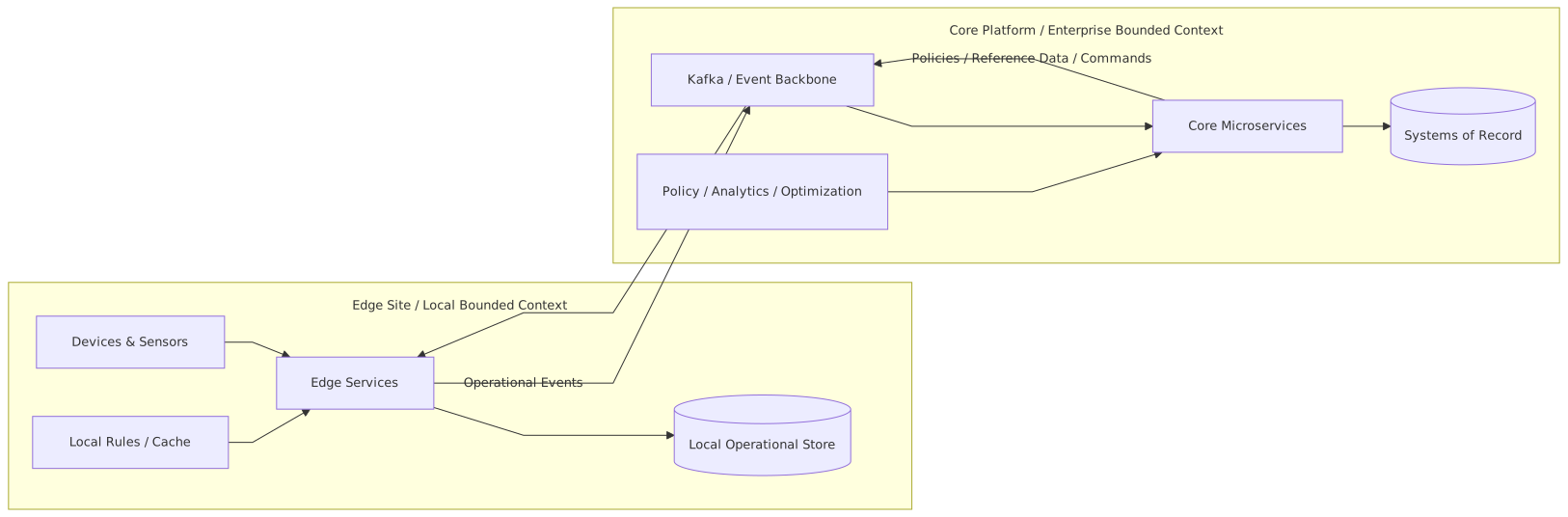
Notice what is absent: synchronous dependency from every edge action to the core. That omission is deliberate. If your edge cannot make progress without a stable round trip to central services, you do not have edge computing. You have remote UI with delusions of grandeur.
Architecture
Let’s make the structure more concrete.
1. Separate local operational models from enterprise models
In domain-driven design terms, the edge and core often belong to different bounded contexts. The local model is shaped by the site’s operational reality. The core model is shaped by enterprise coherence.
For example, in retail:
- Edge context: basket scanned, lane suspended, local stock decrement, store till shift
- Core context: sales order, inventory ledger, promotion policy, customer loyalty account
Trying to force one canonical schema across both is a common mistake. Canonical models are attractive in governance meetings and miserable in production. Better to use translation at the boundary. ArchiMate for governance
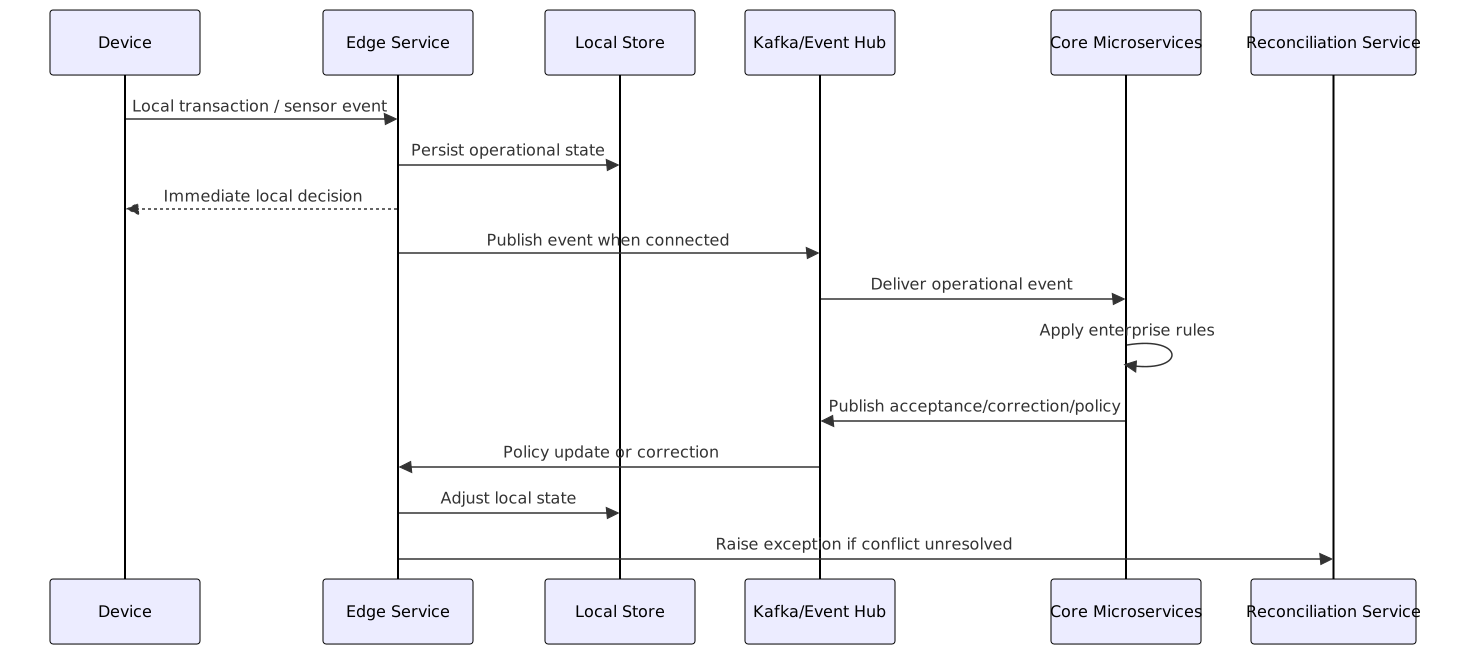
2. Use event-driven collaboration
Kafka is useful here, not because every architecture needs Kafka, but because edge-core boundaries benefit from durable, replayable event streams. Events allow the edge to publish facts when connectivity permits, and the core to process them asynchronously. They also support reprocessing and audit when reconciliation inevitably becomes necessary.
Typical event flows:
- edge publishes operational events
- core publishes policy updates and reference snapshots
- reconciliation services publish correction events
- monitoring publishes health and lag signals
Microservices in the core can consume edge events independently: inventory, pricing compliance, fraud, analytics, maintenance, finance. The edge should not know who all the consumers are. It should publish business facts in its own language or a translated integration language.
3. Introduce a local source of operational truth
The edge needs a local store. This is not heresy; it is survival. The local store holds operational state needed for continuity: queued transactions, local allocations, device state, recent reference data, retry markers, and idempotency tokens.
This local store is not the enterprise system of record. It is the site’s working memory.
4. Reconciliation is part of the design
This deserves blunt language: if your edge architecture lacks explicit reconciliation flows, it is incomplete.
The edge will act on stale data sometimes. Events will be delayed. Policies will change mid-disconnection. Duplicate submissions will happen. Clocks will drift. The business process must know how to reconcile local decisions with enterprise truth later.
Reconciliation patterns include:
- idempotent event processing
- versioned policies and reference data
- conflict detection rules
- compensating actions
- site-level exception queues
- central review workflows
- temporal business rules such as “valid under policy version X at transaction time”
5. Keep commands scarce and explicit
Events age well. Commands age badly across weak networks.
Use commands from core to edge only when necessary and only when semantics are precise: update policy, quarantine device, request snapshot, stop process, push model version. Avoid conversational command chains that assume immediate acknowledgment and pristine connectivity.
6. Design for autonomy envelopes
An autonomy envelope defines what the edge is allowed to decide when disconnected or degraded. This is one of the most useful architectural devices in edge systems.
For example:
- store may sell items if local price cache is younger than 12 hours
- local machine controller may continue with last approved parameters for 30 minutes
- vehicle may use locally cached route policy until next connectivity window
- clinic device may accept locally authenticated users with cached credentials for a short period
Past that envelope, the edge must degrade, stop, or ask for operator intervention.
That is architecture with adult supervision.
Migration Strategy
Most enterprises do not get to build this cleanly from scratch. They have branch applications, legacy middleware, central ERP dependencies, brittle APIs, and operational teams already exhausted by too much change. So migration matters.
The right move is usually progressive strangler migration, not a heroic rewrite.
Step 1: Identify the operational seams
Start with business capabilities that are already suffering from latency or disconnection:
- store transactions during WAN outage
- remote asset telemetry filtering
- local line control
- mobile field workflows
- site-level stock reservation
Map where the current architecture performs synchronous remote calls that should be local.
Step 2: Carve out a local capability
Introduce an edge service for one capability with a clear autonomy envelope. Keep the blast radius small. Give it a local store and a well-defined event interface to the core.
This is not “move the whole application to the edge.” It is “extract the decision that must survive distance.”
Step 3: Dual-run and observe
For a while, let the old core flow and the new edge flow coexist. Compare outputs. Measure event lag, duplicate rates, reconciliation counts, and business exceptions. This is where architects earn their pay—by making migration observable rather than dramatic.
Step 4: Shift authority gradually
As confidence grows, move authority for selected operational decisions to the edge. Keep enterprise authority in the core. This is subtle. You are not moving everything; you are moving the right things.
Step 5: Build reconciliation before broad rollout
Do not wait until rollout to discover how the business resolves conflicts. Reconciliation rules should be tested as a primary feature. In real life, the reconciliation queue is not a corner case. It is a production capability.
Step 6: Retire synchronous dependencies
Once event flows and local autonomy are stable, remove or isolate central runtime dependencies from the edge path. This is where the strangler pattern completes its work.
A migration view helps.
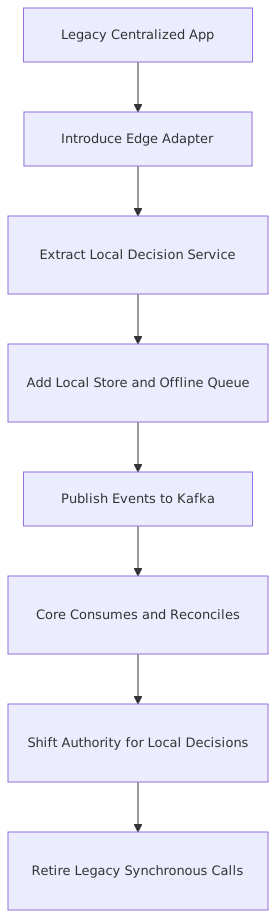
A warning here: many migrations stall because teams modernize transport before semantics. They add Kafka topics and container platforms but leave the old assumptions intact—central truth required for every action, overloaded shared schemas, no autonomy envelope, no conflict rules. That is modernization theater.
Enterprise Example
Consider a national grocery retailer with 1,200 stores.
The old architecture is classic centralized retail: point-of-sale terminals call central services for pricing validation, promotion lookup, loyalty checks, and inventory updates. Most of the time this works. Then connectivity blips. During promotions. On payday. In city centers and rural towns alike. Checkout queues grow. Staff switch to paper procedures. Finance later spends days reconciling.
The business says it wants edge computing. The wrong response would be to replicate the whole retail platform into every store. That would create 1,200 mini-enterprises with endless drift.
A better architecture defines two bounded contexts:
Store Operations bounded context at the edge
Responsible for:
- basket capture
- local price and promotion application from cached policy versions
- local tender workflow within approved envelope
- temporary stock decrement for store-visible inventory
- offline transaction queueing
- local device and lane management
Retail Core bounded context in central platform
Responsible for:
- enterprise inventory ledger
- pricing and promotion policy publication
- loyalty account authority
- fraud analytics
- settlement
- replenishment
- cross-store optimization
Operationally, each store runs edge services on local infrastructure. They maintain a versioned cache of pricing policy, loyalty fallback rules, and reference data. Transactions are persisted locally and published to Kafka when links are available. Core microservices process sales, update enterprise inventory, trigger replenishment, and issue correction or exception events where needed. microservices architecture diagrams
Now the important part: reconciliation.
Suppose a store goes offline for two hours during a promotion change. Local sales continue under policy version P17. Meanwhile central publishes P18. When connectivity returns, transactions arrive late. Core processing does not simply reject them because the current promotion is different. It evaluates them under the policy version valid at transaction time and store autonomy rules. Some are accepted, some adjusted, some flagged for review.
That is the difference between architecture and wishful thinking.
This retailer also uses Kafka streams to aggregate edge telemetry: lane health, queue lengths, device faults, and event backlog. The core does not micromanage checkouts in real time, but it does use central analytics to improve staffing and promotion design. In other words, the edge keeps the shop running; the core makes the chain smarter.
This pattern generalizes well to manufacturing, logistics, healthcare, and energy. The specific nouns change. The boundary logic does not.
Operational Considerations
Edge architecture is won or lost in operations.
Observability must include absence
In centralized systems, monitoring usually observes what arrived. In edge systems, you also need to observe what did not arrive:
- missing heartbeats
- replication lag
- stale policy caches
- event backlog age
- site drift from approved versions
- local store growth
- repeated duplicate suppression
A site that is silent may be healthy, offline, partitioned, or dead. You need to know which.
Version everything that matters
Policies, schemas, ML models, reference data, and edge software all need explicit versioning. Reconciliation depends on knowing which version informed a local decision.
Idempotency is not optional
Edges retry. Networks duplicate. Operators click twice. Devices resend. Core services must process duplicate events safely. Idempotency keys, immutable events, and deterministic correction flows matter.
Security is a field problem, not just a platform problem
Edge nodes live in messy environments. Secure boot, certificate rotation, secrets handling, tamper detection, local encryption, and least-privilege device identities all matter. So does practical recovery when a site is half-managed by operations staff, not cloud engineers.
Data retention and uplink economics
The edge needs rules for what to keep, aggregate, or discard. Not every raw event deserves a permanent life in central storage. A lot of money is wasted shipping noise uphill.
Deployment discipline
Rolling out edge software is harder than rolling out cloud services. Some sites are inaccessible. Some update windows are narrow. Some devices cannot tolerate restarts during business hours. Canary deployment, staged rollout rings, local rollback, and compatibility between old edge versions and new core contracts are essential.
Tradeoffs
There is no free lunch here. Edge computing buys resilience and responsiveness by spending complexity elsewhere.
What you gain
- lower latency for local decisions
- continuity during disconnection
- reduced bandwidth use
- better alignment with physical operations
- local autonomy where business needs it
What you pay
- more moving parts
- harder deployment and patching
- reconciliation complexity
- split-brain risk between local and enterprise views
- expanded security surface
- more subtle domain modeling
This is why I am skeptical of simplistic “edge-first” rhetoric. It often ignores the cost of distributed authority. The enterprise architecture question is not “can we run this at the edge?” It is “can the business responsibly live with the resulting divergence and operational burden?”
Sometimes the answer is yes. Often it is partly yes. That is enough.
Failure Modes
The failure modes in edge-core architecture are depressingly predictable.
1. Boundary collapse
The edge keeps acquiring enterprise logic because “it was easier.” Soon every site contains pricing exceptions, customer rules, and finance workarounds. Upgrades become political events.
2. Central dependency disguised as edge
The application runs on a local box but still calls central services synchronously for key decisions. One WAN issue later, the illusion breaks.
3. No reconciliation model
Teams assume eventual consistency as if it were a magical property rather than a design obligation. Conflicts then emerge in production with no business-approved resolution.
4. Shared canonical model everywhere
A single schema is enforced across edge telemetry, operational workflows, and enterprise records. Local meaning gets flattened. Teams either bypass the model or abuse it.
5. Topic sprawl without semantic ownership
Kafka appears, and suddenly every team publishes vaguely named events with unclear contracts. Event-driven architecture without bounded contexts is just distributed confusion at speed.
6. Stale reference data
The edge continues operating with outdated policies beyond safe autonomy limits. Business users then discover locally valid actions that are enterprise-invalid.
7. Replay disasters
Buffered edge events replay after outage and overload downstream services, duplicate settlements, or trigger stale workflows.
These are not exotic failures. They are Tuesday.
When Not To Use
Edge computing is not a mark of architectural sophistication. Sometimes it is the wrong answer.
Do not use a serious edge pattern when:
- the business process tolerates latency
- connectivity is stable and inexpensive
- there is no real need for local autonomy
- the domain has low physical-world coupling
- the cost of operating distributed nodes outweighs the benefit
- the organization lacks discipline for versioning, reconciliation, and field operations
An internal HR workflow is usually not an edge computing problem. Neither is a typical finance approval process. If all roads lead safely to the core and can wait a second or two, keep the system simpler.
Likewise, if the enterprise cannot stomach local divergence under any circumstance—for legal or financial reasons—then edge autonomy should be tightly constrained or avoided. There are domains where disconnected operation is more dangerous than delayed operation.
Related Patterns
Several patterns sit naturally beside edge-core boundary design.
Bounded Context
The most important one. Edge and core should often have separate models, terms, and responsibilities.
Strangler Fig Pattern
Ideal for migration from centralized legacy systems to progressive edge autonomy.
Event-Driven Architecture
Useful for asynchronous collaboration, decoupling, replay, and audit. Kafka is often a practical backbone.
CQRS
Helpful where local command handling at the edge differs from centralized read models or enterprise analytics.
Saga / Process Manager
Relevant when multi-step business processes span edge and core and require compensating actions.
Cache-Aside and Reference Data Replication
Common for pushing policies, prices, product catalogs, or device configuration to the edge.
Store-and-Forward
A foundational pattern for intermittent connectivity.
Digital Twin
Sometimes useful in industrial settings, though often overused. A local twin can model equipment state, while the core maintains fleet-level representations.
These patterns are tools, not a religion. Use them where the domain pressure justifies the extra machinery.
Summary
Edge computing boundaries are not about where servers sit. They are about where the business is allowed to decide.
That is why domain-driven design matters so much here. It gives us a language for separating local operational semantics from enterprise-wide truth. It reminds us that bounded contexts are not paperwork; they are survival mechanisms in distributed systems.
The edge should own decisions that must happen near the action, under latency and disconnection constraints. The core should own policies, enterprise records, optimization, and coordination across sites. Kafka and microservices can help, but only if the semantics are clean. Events are useful. Shared mutable truth at a distance is not.
Migration should be progressive, not theatrical. Strangle one decision at a time. Give it a local store. Make autonomy explicit. Build reconciliation early. Measure drift, lag, and conflict. Then retire the synchronous assumptions that no longer belong.
And never forget the central lesson: the danger in edge architecture is not distribution by itself. It is ungoverned distribution of business meaning.
In the end, good edge architecture is humble. It accepts that networks fail, clocks disagree, sites diverge, and enterprises still need coherent truth. It does not pretend those tensions can be engineered away. It gives each side—edge and core—the responsibilities it can carry well.
That is the boundary worth drawing.
Frequently Asked Questions
What is a service mesh?
A service mesh is an infrastructure layer managing service-to-service communication. It provides mutual TLS, load balancing, circuit breaking, retries, and observability without each service implementing these capabilities. Istio and Linkerd are common implementations.
How do you document microservices architecture for governance?
Use ArchiMate Application Cooperation diagrams for the service landscape, UML Component diagrams for internal structure, UML Sequence diagrams for key flows, and UML Deployment diagrams for Kubernetes topology. All views can coexist in Sparx EA with full traceability.
What is the difference between choreography and orchestration in microservices?
Choreography has services react to events independently — no central coordinator. Orchestration uses a central workflow engine that calls services in sequence. Choreography scales better but is harder to debug; orchestration is easier to reason about but creates a central coupling point.