⏱ 19 min read
Architecture governance has a branding problem.
For years, people heard the word governance and pictured a committee in a beige room, reviewing PowerPoint decks no one wanted to make. They imagined checklists, standards binders, and architects acting like customs officers at the border of delivery. Nothing ages faster than that style of control. In modern enterprises, where platforms shift quarterly, regulations tighten unexpectedly, and product teams ship continuously, governance that behaves like a gate becomes a liability. It slows change while providing only the illusion of safety.
The better way to think about governance is not as approval, but as feedback. EA governance checklist
That small shift matters. It changes architecture governance from a periodic inspection into a living loop. Teams make decisions, systems emit signals, those signals are interpreted against architectural intent, and the organization adjusts. Some corrections happen in code, some in policy, some in platform capabilities, and some in the domain model itself. Governance stops being a ceremony and starts behaving like a control system. ArchiMate for governance
That is the heart of evolutionary architecture. An architecture is evolutionary not because it uses microservices, Kafka, or cloud-native tooling. Those are just instruments. An architecture becomes evolutionary when the organization can change important characteristics of the system safely, repeatedly, and with visibility. Governance is what closes that loop. event-driven architecture patterns
The deepest mistake I see in enterprises is treating governance as something outside the architecture. It isn’t. Governance is part of the architecture, just as observability, testability, and deployment are part of the architecture. If your architecture has no practical way to detect drift, compare reality against intent, and respond, it is not governed. It is merely hoped for.
This is where domain-driven design becomes essential. Governance that ignores domain semantics quickly degenerates into generic controls: naming conventions, tool mandates, technology whitelists, and reference architectures that are technically tidy but operationally useless. Real governance has to understand the shape of the business. It must know the difference between customer identity and customer profile, between an order and a shipment, between a payment authorization and a settlement event. Otherwise, the organization governs syntax while the business suffers semantic chaos.
In large enterprises, semantic drift is often more dangerous than technical drift. Services compile. Pipelines pass. Dashboards are green. But one bounded context means “active customer” as someone with a contract, another means someone with a login, and a third means someone with recent payment activity. The integration still works. The business interpretation does not. Governance must catch that kind of fracture early, because once it leaks into events, APIs, data products, and reports, reconciliation becomes a permanent tax.
So let’s be blunt: architecture governance should operate as a feedback system across code, runtime, data, and domain meaning. It should guide change rather than freeze it. It should make policy executable where possible, observable where not, and reviewable only where judgment is required. And it should be designed with the same seriousness as any other critical enterprise capability.
Context
Enterprises now live in a world of continuous partial change. They are never done migrating, never done integrating, never done modernizing. There is always a core platform being decomposed, a data landscape being rationalized, a compliance model being tightened, a channel strategy being expanded, or an operating model being restructured.
That means architecture is no longer a one-time design exercise. It is a long-running negotiation between intent and reality.
In the old model, governance fit the project world. A solution architect produced diagrams. An architecture review board approved them. Delivery teams implemented over many months. Production issues were reported afterward, usually too late to alter the fundamental shape. This worked, after a fashion, when release cycles were slow and the number of architectural decisions was limited.
But with digital platforms, product-aligned teams, cloud infrastructure, APIs, event streaming, and machine-assisted deployment, important architecture decisions are made every week. Teams choose communication patterns, data boundaries, resiliency strategies, event schemas, deployment models, storage technologies, and observability standards continuously. A quarterly review board cannot keep up. Worse, it incentivizes document theater: teams optimize for passing review, not for producing healthy systems.
This is why governance must become ambient. It needs to be in pipelines, platform defaults, telemetry, service contracts, event schema controls, fitness functions, and review rituals that focus on exceptions rather than every decision. The aim is not to centralize all authority. It is to centralize intent while distributing action.
And that intent must be grounded in the domain.
If architecture governance is reduced to “all teams must use the same stack,” the organization will get consistency but not coherence. Domain-driven design teaches us that coherence comes from bounded contexts, explicit language, and clear ownership of business concepts. Governance should reinforce those boundaries. It should prevent accidental coupling across contexts. It should detect when integration patterns undermine domain autonomy. And it should ensure that the enterprise model is not flattened into one giant anemic taxonomy in the name of standardization.
Problem
Most governance fails for one of three reasons.
First, it is too late. Reviews happen after decisions are embedded in code, data models, and team habits. At that point, architecture corrections are expensive and political.
Second, it is too generic. Rules are stated at the technology layer without understanding business semantics. Teams comply mechanically while introducing hidden domain inconsistency.
Third, it is too manual. Human review is reserved for everything, so the process becomes overloaded and shallow at the same time.
The result is familiar. Delivery teams see governance as friction. Architects see teams “going rogue.” Security and risk functions bolt on additional controls. Platform teams respond by trying to standardize even more. Meanwhile the estate accumulates service sprawl, schema drift, duplicate business capabilities, inconsistent events, and brittle point-to-point integrations.
Kafka often enters the scene as both cure and accelerant. Done well, event streaming gives the enterprise decoupling, replay, lineage, and temporal truth. Done badly, it becomes a high-speed semantic pollution engine. A poorly governed event backbone spreads weakly defined domain events faster than any API gateway ever could. If one team publishes CustomerUpdated, ten others may subscribe, each inferring different meaning, retention expectations, and reconciliation rules. You have not created an event-driven architecture. You have created asynchronous confusion.
The governance challenge, then, is not merely controlling technical change. It is maintaining architectural integrity while allowing local autonomy. That means making the right things easy, the dangerous things visible, and the truly exceptional things discussable.
Forces
Several forces shape this problem, and they pull in opposite directions.
Autonomy vs consistency. Product teams need room to optimize for their domain, cadence, and user outcomes. The enterprise needs enough consistency to operate, secure, and evolve the estate.
Speed vs assurance. Continuous delivery demands fast decisions. Regulators, auditors, and critical business operations demand evidence and traceability.
Local models vs enterprise semantics. Bounded contexts should model their own language. But the business still needs cross-domain understanding, especially in finance, risk, identity, and operations.
Decoupling vs reconciliation. Event-driven systems and asynchronous processing reduce runtime coupling, but they increase the need for reconciliation, idempotency, temporal handling, and operational discipline.
Platform leverage vs one-size-fits-none. Central platforms can encode good defaults and reduce cognitive load. But if the platform overreaches, teams start bypassing it.
Migration urgency vs architecture purity. Legacy landscapes rarely permit greenfield ideals. Teams must move incrementally, often with coexistence, duplicated flows, anti-corruption layers, and compromises around data ownership.
This is where architects earn their keep. Not by pretending these tensions can be eliminated, but by designing systems and governance loops that make the tensions productive.
Solution
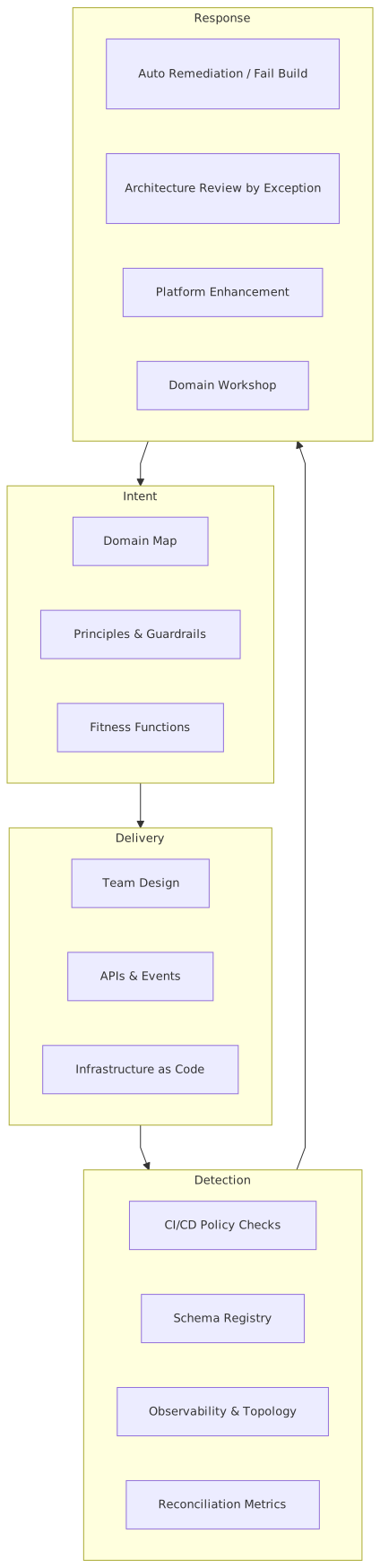
The practical solution is to treat architecture governance as a multi-level feedback loop.
At the top level, enterprise architecture defines architectural intent: target qualities, domain boundaries, integration principles, data ownership rules, resiliency expectations, security posture, and migration guardrails. This is not a giant standards manual. It is a small number of consequential decisions stated clearly.
At the delivery level, teams turn that intent into systems, APIs, events, data stores, and operational runbooks. Most of this should happen without waiting for a committee.
At the runtime level, systems emit evidence: deployment metadata, dependency graphs, schema changes, event contract versions, service-level indicators, policy violations, resilience behavior, reconciliation exceptions, and architectural drift signals.
At the governance level, the organization compares evidence against intent and responds. Some responses are automatic: fail a build, reject an event schema, block an unsafe dependency, require encryption, flag cross-context database access. Some are social: architecture coaching, domain workshops, exception review, platform enhancements, or strategic policy change.
That loop is governance.

The important thing here is that feedback must operate at different speeds.
Some controls need to be immediate. If a team tries to publish an event without schema compatibility checks, that should fail in the delivery pipeline. If a service reads another bounded context’s database directly, dependency analysis should catch it quickly.
Some controls are trend-based. If a domain begins to fragment into duplicate services or a Kafka topic gains many consumers with inconsistent semantics, that may not require an immediate stop. It does require architectural attention.
Some controls are strategic. If repeated exceptions occur around identity, consent, or ledger semantics, the problem may be the enterprise model, not team behavior. Governance then feeds back into architecture strategy itself.
This is why feedback beats gatekeeping. Gates ask, “May I proceed?” Feedback asks, “What is reality telling us, and what should change?”
Architecture
A workable governance architecture has five elements.
1. Architectural intent model
This is the smallest useful set of decisions that define what the enterprise is trying to preserve while it changes. Typical categories include:
- bounded contexts and ownership
- approved interaction patterns
- eventing and API standards
- data ownership and mastership rules
- non-functional fitness functions
- security and compliance controls
- migration principles and exit criteria
This should be written in business-aware language. “Customer identity is owned by Identity Management; profile enrichment belongs to Customer Engagement” is better than “all customer services must use canonical schemas.”
2. Executable guardrails
Anything repeatable should be automated. Examples:
- policy-as-code in CI/CD
- schema validation and compatibility checks
- infrastructure baselines
- dependency rules between services and domains
- event topic naming and retention policy enforcement
- API linting and versioning rules
- secrets, encryption, and network policy validation
These controls should be biased toward prevention of obvious harm, not enforcement of every preference.
3. Runtime sensing
Most governance dies because it only inspects design-time artifacts. Real architectures drift in production. Runtime sensing should include:
- service dependency maps
- Kafka topic lineage and consumer sprawl
- schema version adoption
- failure and retry patterns
- reconciliation queue growth
- data duplication hotspots
- latency and error budgets by critical user journey
- policy exceptions and waiver aging
The runtime is where architecture stops being theory.
4. Domain governance
This is often missing. Domain governance ensures that changes preserve semantic integrity. It includes:
- bounded context reviews
- event meaning and lifecycle stewardship
- ubiquitous language alignment
- anti-corruption layer design
- cross-context contract ownership
- reconciliation semantics for eventual consistency
This is especially important in microservices and Kafka ecosystems. Technical event compatibility is not enough. A JSON schema can be valid and still be semantically wrong. microservices architecture diagrams
5. Exception handling and learning
No enterprise architecture survives contact with reality without exceptions. The key is to make exceptions visible, time-bound, and informative. Every significant waiver should answer:
- what rule is being broken?
- why now?
- what is the operational risk?
- what is the sunset date?
- what future architecture learning does this reveal?
An exception register is not bureaucracy if it teaches the organization where the architecture is mismatched to delivery pressure.
Here is a more detailed view.
Migration Strategy
Governance gets tested hardest during migration, because migration is where architectures are least tidy and most political.
A progressive strangler approach works well here. Not because it is fashionable, but because it matches how enterprises actually move: one capability, one journey, one bounded context seam at a time. Governance in migration should not demand immediate purity. It should govern the shape of transition.
The first step is to identify domain seams, not just technical components. A monolith may contain dozens of business capabilities, but not all are clean candidates for extraction. Some have tangled transactional dependencies. Some are mostly CRUD wrappers around shared data. Some have stable semantics but terrible runtime characteristics. The best extraction points are usually places where the domain language is already distinct and where the business can tolerate eventual consistency or controlled dual-running.
Then introduce an anti-corruption layer. This is not optional when legacy semantics are muddy. It protects the new bounded context from inheriting the monolith’s accidental concepts. If the legacy platform uses “account” to mean customer relationship, billing unit, and authentication principal depending on the screen, the new service must not replicate that ambiguity.
As the strangler grows, governance should focus on four migration concerns:
- Contract discipline. New APIs and events must be explicit, versioned, and owned.
- Data mastership. During coexistence, ownership must be unambiguous even if replication exists.
- Reconciliation. Every asynchronous handoff needs a clear plan for mismatch detection and correction.
- Exit criteria. Transitional flows need a measurable retirement trigger.
Reconciliation deserves special attention because enterprises underestimate it constantly. In event-driven migration, dual writes, delayed consumers, replayed events, and reference data drift can all produce mismatch between source and target systems. A mature governance loop tracks these mismatches as first-class architectural signals. Reconciliation is not a back-office clean-up step. It is an architectural mechanism for preserving trust during change.
Consider a simple migration pattern:

In practice, progressive strangler migration often means running command authority in one place and read projections in another before full cutover. Governance should allow this if the ownership rules are explicit and the reconciliation path is instrumented. Purists hate transitional duplication. Operators prefer systems that survive Tuesday.
Enterprise Example
Take a global insurer modernizing claims processing.
The legacy estate consists of a large core claims platform, document management, policy administration, payment processing, customer CRM, and a data warehouse. Over time, dozens of interfaces were added. The word “claim” means slightly different things in each system. In policy administration, it means a reported loss record. In claims operations, it means a case file. In finance, it means a reserving object. In analytics, it means a reporting grain. Everything integrates. Nothing agrees.
The insurer wants to move toward microservices with Kafka as the event backbone. A naïve approach would decompose the legacy claims platform into technical services and start publishing broad events like ClaimCreated, ClaimUpdated, and PaymentIssued.
That would be a disaster.
A better approach begins with domain-driven design. The enterprise identifies bounded contexts such as First Notice of Loss, Claim Case Management, Coverage Decisioning, Fraud Assessment, Settlement, and Financial Posting. It accepts that there is no single canonical “claim” object that works across all of them. Instead, each context owns its semantics. Governance establishes translation and contract stewardship between contexts.
For example, First Notice of Loss publishes an event that a loss has been reported. Claim Case Management subscribes and creates a case if triage rules are met. Coverage Decisioning does not rely on the same event payload as finance. Settlement emits payment intent events, but Financial Posting owns ledger semantics and publishes accounting entries. Kafka becomes the transport for bounded-context events, not a dumping ground for vaguely named enterprise nouns.
Governance as feedback shows up in several ways:
- The schema registry enforces compatibility rules and ownership metadata.
- CI/CD checks prevent direct database reads across claims and finance domains.
- Runtime telemetry detects that too many downstream consumers depend on the First Notice topic, triggering a review of semantic leakage.
- Reconciliation dashboards show mismatches between settlement intents and posted ledger entries.
- Exception reviews reveal repeated waivers around customer identity resolution, leading the enterprise to create a dedicated identity bounded context and shared platform capability.
This is real enterprise architecture: not perfect diagrams, but a system of guided adaptation.
The result is not complete decoupling. The insurer still has transitional dependencies, duplicated reference data, and manual interventions in edge cases. But the governance loop makes those realities visible and governable. That is a far better place to be than pretending they do not exist.
Operational Considerations
If governance is feedback, operations are part of governance.
That means the operating model must include architectural telemetry, not just infrastructure health. Good operational governance typically tracks:
- topic lag and dead-letter volume in Kafka
- schema drift and consumer compatibility
- retry storms and poison message patterns
- cross-context call chains and hidden coupling
- reconciliation backlog age and resolution rates
- exception inventory and expiry
- fitness function trends such as latency, recovery time, and deployment safety
The architecture team should not own all of this directly, but it must ensure someone does.
A common blind spot is ownership of reconciliation. Teams often build asynchronous flows and assume operations can “monitor them.” That is wishful thinking. Reconciliation needs business-aware ownership. Someone must define what counts as a mismatch, how long inconsistency is acceptable, what can be repaired automatically, and when human intervention is required. This is a domain concern as much as an operational one.
Another issue is governance fatigue. If every dashboard becomes a governance artifact, teams drown. Pick signals that matter. A useful rule is this: track signals that reveal architectural integrity, not every implementation detail.
Platform engineering also matters here. The easiest way to improve governance is to make the compliant path the cheapest one. If teams can create a service with built-in observability, policy checks, event templates, and secure defaults in an hour, most will use it. If the platform is slow, rigid, or detached from domain reality, teams will route around it and governance becomes adversarial again.
Tradeoffs
There is no free architecture.
Governance as feedback improves adaptability, but it introduces machinery: policy engines, telemetry, schema controls, exception workflows, domain stewardship, and platform investment. If done badly, this becomes a distributed bureaucracy.
It also does not eliminate judgment. Executable policy catches the obvious and the repeatable. It cannot resolve every domain ambiguity or strategic compromise. You still need experienced architects, product leaders, and domain experts.
There is also a tradeoff between strict domain autonomy and enterprise interoperability. Strong bounded contexts prevent semantic pollution, but too much isolation can make enterprise workflows harder and increase translation overhead. Sometimes a shared kernel is justified. Usually it should be small and fiercely governed.
Kafka and microservices amplify this tradeoff. They can reduce direct coupling while increasing operational and semantic complexity. The gain is flexibility under change; the cost is more explicit contracts, more observability, more reconciliation, and more discipline around ownership. If your organization wants the decoupling benefit without paying the discipline cost, it is buying on credit.
Another tradeoff appears in migration. Transitional architectures often violate target principles: temporary duplication, synchronized APIs over an event-first future, manual reconciliation, or centralized orchestration around legacy seams. Governance should tolerate these selectively. Refusing all compromise stalls migration. Accepting every compromise ensures the transition becomes permanent.
Failure Modes
Several failure modes show up repeatedly.
Governance by document. Teams produce compliant-looking diagrams while runtime architecture drifts away.
Over-automation. The enterprise encodes every preference into policy checks, creating brittle pipelines and resentment. Automation should focus on consequential controls.
Semantic neglect. Technical standards are enforced, but domain meaning is not governed. Event contracts become syntactically valid nonsense.
Topic sprawl in Kafka. Teams publish too many poorly scoped events, consumers proliferate, and ownership becomes ambiguous.
Exception amnesty. Temporary waivers never expire. The target architecture becomes a rumor.
Platform dogmatism. Central teams force patterns that do not fit domain needs, so business-critical teams bypass the platform.
No reconciliation discipline. Eventual consistency is declared as an article of faith without operational mechanisms for mismatch detection and repair.
Architecture detached from migration reality. The target state is elegant, but there is no governed path from legacy to there.
The common theme is simple: governance fails when it is either too abstract to matter or too rigid to survive contact with delivery.
When Not To Use
Not every environment needs elaborate governance loops.
If you have a small product organization with a handful of teams, modest regulatory pressure, and a relatively coherent codebase, lightweight architectural stewardship may be enough. A few experienced engineers, good tests, regular design reviews, and strong platform defaults can carry you a long way.
Likewise, if the domain is simple and the system is operationally contained, introducing a heavy feedback-governance mechanism can be overkill. You will spend more time measuring architecture than improving it.
This approach is also a poor fit for organizations that have not yet established basic delivery hygiene. If there is no reliable CI/CD, no meaningful observability, no service ownership, and no product-aligned team model, governance as feedback has nothing solid to attach to. In such cases, start with engineering fundamentals and operating model clarity before building sophisticated governance loops.
And if leadership really wants command-and-control approval boards because that is how power is exercised, do not pretend you have evolutionary architecture. Call it what it is. Architecture follows incentives.
Related Patterns
Several patterns complement this approach:
- Fitness functions for continuously testing architectural characteristics.
- Bounded contexts from domain-driven design to preserve semantic integrity.
- Anti-corruption layers for protecting new models during migration.
- Strangler fig migration for incremental modernization.
- Policy as code for executable governance.
- Schema registry and contract testing for event and API discipline.
- Platform engineering for paved roads and reduced cognitive load.
- Architecture decision records for durable rationale.
- Operational reconciliation for eventual consistency and dual-run transitions.
These are not separate tricks. They are parts of the same control loop.
Summary
The old picture of governance as a gate is finished. It belongs to the era of long projects, stable platforms, and architecture by decree.
Modern enterprises need something else. They need governance that behaves like feedback: clear intent, distributed action, continuous sensing, and timely response. They need governance that understands the domain, not just the tech stack. They need migration guardrails that accept transitional mess without surrendering architectural direction. They need reconciliation because asynchronous reality is never as neat as the diagram. And when they use Kafka, microservices, APIs, or cloud platforms, they need semantics and ownership to be governed as seriously as code.
The memorable line is this: governance should not stand in front of change; it should stand inside it.
That is how evolutionary architecture becomes real. Not as a slogan, but as an enterprise capability to steer while moving.
Frequently Asked Questions
What is enterprise architecture?
Enterprise architecture aligns strategy, business processes, applications, and technology in a coherent model. It enables impact analysis, portfolio rationalisation, governance, and transformation planning across the organisation.
How does ArchiMate support architecture practice?
ArchiMate provides a standard language connecting strategy, business operations, applications, and technology. It enables traceability from strategic goals through capabilities and services to infrastructure — making architecture decisions explicit and reviewable.
What tools support enterprise architecture modeling?
The main tools are Sparx Enterprise Architect (ArchiMate, UML, BPMN, SysML), Archi (free, ArchiMate-only), and BiZZdesign. Sparx EA is the most feature-rich, supporting concurrent repositories, automation, scripting, and Jira integration.