⏱ 20 min read
Most architecture diagrams lie.
They pretend the world is made of boxes and arrows, as if the hard part were drawing services and databases in neat rows. But in any serious enterprise system, the truth lives in motion. Orders move. Risk decisions move. Inventory reservations move. Claims move. Money moves. Exceptions move. The architecture is not the boxes. The architecture is the flow.
That sounds obvious until you watch how large organizations actually build software. Teams split a monolith into microservices, introduce Kafka, add APIs, and congratulate themselves for becoming event-driven. Six months later they have a distributed tangle: duplicated business rules, orphaned events, endless reconciliation jobs, and operational dashboards that explain nothing about what the business is actually doing. They modernized the plumbing and lost the story.
A better framing is this: architecture in distributed systems should be designed around the lifecycle of business facts as they flow across bounded contexts. Not just request paths. Not just data pipelines. Business flow. That means domain semantics first, transport technology second. It means being precise about what happened, who owns the decision, when a state transition becomes authoritative, and how downstream systems converge when the world is messy—as it always is.
This is where flow architecture earns its keep.
Flow architecture is not a product. It is not just event-driven architecture in better clothes. It is an architectural style that treats the end-to-end movement of domain state as the primary design unit. Services, topics, APIs, databases, and workflow engines are all supporting actors. The main character is the business journey: quote to bind, cart to order, authorization to settlement, claim intake to adjudication.
And once you start looking at systems this way, several truths become unavoidable.
First, not all flows are equal. Some are command-heavy and require tight control of invariants. Some are event-heavy and tolerate eventual consistency. Some are long-running, with human steps and compensations. Some are analytical, where the flow is less about transaction completion and more about insight generation. Treating all of these as “messages on Kafka” is how architecture gets lazy. event-driven architecture patterns
Second, distributed systems fail in the seams. The danger is rarely inside a single service. The danger is between services, between domains, between truth in one place and truth in another. A flow architecture makes those seams explicit. It names ownership. It defines handoffs. It accepts that reconciliation is not an embarrassing afterthought but a first-class design concern.
Third, migration matters as much as destination. Enterprises do not wake up on a greenfield meadow. They carry core platforms, batch jobs, brittle integrations, reporting dependencies, and decades of business policy buried in places nobody dares touch. Flow architecture is useful precisely because it gives you a path to modernize incrementally, often using a progressive strangler pattern, without pretending that a clean rewrite is realistic.
Context
Distributed systems became fashionable because organizations needed speed, scale, and team autonomy. The monolith could no longer contain every change. Different business capabilities evolved at different rates. Customer channels demanded real-time responses. Partners wanted APIs. Data platforms wanted streams. Operations wanted resilience. Compliance wanted traceability. enterprise architecture with ArchiMate
So enterprises decomposed.
Sometimes wisely, around clear domain boundaries. More often by technical instinct: carve out authentication, create a payments service, stand up Kafka, and hope autonomy follows. But decomposition without domain semantics creates distributed ambiguity. You have more deployables, but not necessarily better architecture.
In a healthy enterprise system, every meaningful business flow crosses multiple domains. An e-commerce order touches pricing, promotions, inventory, payments, fraud, fulfillment, customer communications, and finance. A lending journey moves through onboarding, identity, risk, offers, underwriting, document processing, funding, and servicing. None of these domains should be flattened into one giant orchestrated machine. Yet neither can they behave as isolated islands. The business cares about the journey, not your service boundaries.
That tension is the context for flow architecture.
Domain-driven design helps here because it gives us the right unit of thought: bounded contexts with explicit language and ownership. “Order accepted” in Sales may not mean the same thing as “order committed” in Fulfillment. “Payment authorized” is not “funds settled.” “Policy issued” is not “policy active.” If these distinctions are vague, the architecture will be vague too. And vague semantics in distributed systems turn into defects with expensive suits on.
Problem
The central problem is simple to describe and painful to solve: how do you preserve coherent business flow across independently evolving distributed components?
Traditional layered architectures assume one transactional center of gravity. Distributed systems do not have that luxury. State is fragmented. Decisions are local. Communication is asynchronous as often as it is synchronous. Failures are partial. Retries happen. Messages arrive late. Humans intervene. Regulations demand auditability. The business still expects a single operational story.
Without an explicit flow model, enterprises fall into familiar traps:
- Services emit low-value technical events instead of business facts.
- Kafka topics become shared databases with better marketing.
- Teams duplicate workflow logic in multiple places.
- Synchronous APIs sneak back in because nobody trusts asynchronous completion.
- Reconciliation is discovered during production incidents rather than designed upfront.
- Reporting and operational views disagree about reality.
- The migration from legacy becomes a long period of double-writing and crossed fingers.
The result is not agility. It is distributed confusion.
A flow architecture addresses this by defining how domain facts emerge, how they travel, how they trigger decisions, how they are observed, and how correctness is recovered when—not if—the path breaks.
Forces
Several forces pull the architecture in opposite directions.
Autonomy versus coherence. Teams need local ownership, but the enterprise needs end-to-end outcomes. A service can own payment authorization. It cannot unilaterally define what an order means to fulfillment.
Consistency versus availability. You can make a few steps strongly consistent if they live together, but once a flow crosses contexts, eventual consistency usually wins. The art lies in placing hard invariants inside the right boundary and making the rest convergent.
Business semantics versus integration convenience. It is easy to publish “row changed” events from a database. It is much harder—and much more valuable—to publish “inventory reserved for shipment wave 2026-03-27.” One scales integration effort; the other scales understanding.
Orchestration versus choreography. Centralized workflow can make a process easy to visualize but can quietly become a god-service. Pure choreography can look elegant and quickly become impossible to reason about. Most enterprises need both, used deliberately.
Migration speed versus risk. A strangler path gives safety and learning. It also means living with duplicate flows, split truth, and temporary complexity.
Auditability versus throughput. Financial services, healthcare, insurance, and public sector systems need evidence, lineage, and explainability. The fastest design is often not the most defensible.
These are not academic tradeoffs. They are the daily weather of enterprise architecture.
Solution
The solution is to design around domain flows as explicit, observable, recoverable business pathways.
At a practical level, that means a few strong opinions.
1. Model flows from domain events, not technical changes
Start with business facts. A customer placed an order. Fraud review requested additional verification. Payment authorization expired. Shipment allocated. Claim assessed. These facts belong to bounded contexts and carry business meaning.
Do not begin with table updates or generic CRUD events. They create downstream coupling because consumers must reverse-engineer business intent. That is brittle and contagious.
2. Put invariants where they belong
Every distributed system has some rules that cannot be violated. Inventory cannot be oversold beyond policy. A refund cannot exceed captured payment. A claim cannot be paid twice. These rules should live inside the bounded context that owns them, often behind a command boundary with local transactional guarantees.
Flow architecture is not an excuse to spray important decisions asynchronously across services and hope eventual consistency will save you. Eventual consistency is a coordination model, not absolution.
3. Use events for fact propagation, commands for responsibility assignment
An event says something happened. A command asks a specific owner to decide or act. Confusing the two causes social as much as technical damage. Teams end up inferring obligations from events that were never contractual.
Use commands when there is one clear responsible party. Use events when the fact should be shared more broadly.
4. Make reconciliation a first-class feature
This is the part people leave out in conference talks.
Any meaningful distributed flow needs a way to detect divergence and repair it. Messages can be lost before publication. Consumers can fail after side effects. Human interventions can bypass normal paths. Upstream systems can resend malformed payloads. A ledger may be right while a search index is wrong. A warehouse system may ship despite a payment reversal race.
Reconciliation is how grown-up systems stay honest. That usually means:
- durable source-of-truth records
- idempotent consumers
- replayable event streams where feasible
- periodic consistency scans
- exception queues with business context
- operator tooling for retry, compensate, or re-drive
If your architecture depends on every message arriving exactly once and being processed perfectly, your architecture depends on fiction.
5. Observe the flow, not just the nodes
Traditional monitoring asks whether a service is up. Flow monitoring asks whether a business journey is progressing. How many orders are stuck between authorization and allocation? How long from claim intake to first adjuster action? Which payment captures have no settlement confirmation after four hours?
This is where architecture becomes operationally useful. The business does not care that Kafka cluster CPU is 43%. It cares that funds are not reaching merchants.
Architecture
A typical flow architecture in an enterprise distributed system combines bounded-context services, an event backbone such as Kafka, selective synchronous APIs, materialized views for journey visibility, and explicit reconciliation processes.
Here is the core shape.
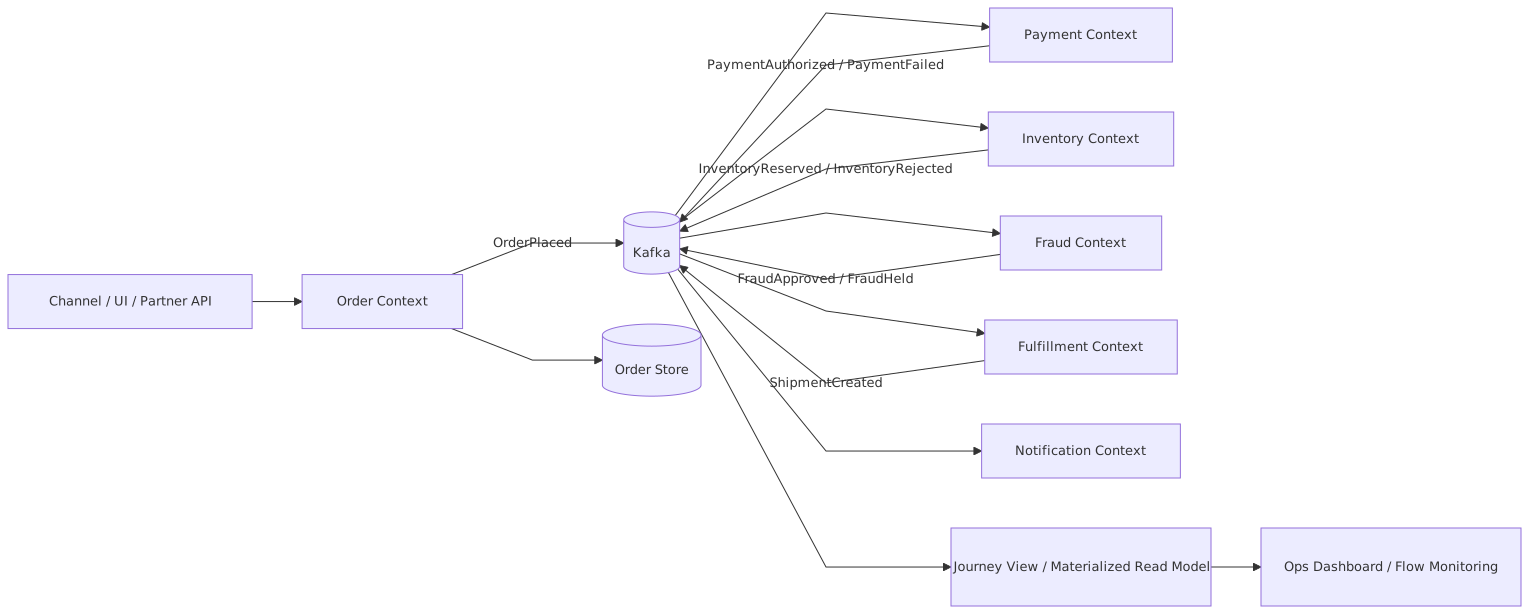
This diagram matters less for its technology than for its discipline. Each context owns its own model and emits business facts. Kafka acts as a transport and buffering mechanism, not a magical source of business truth by itself. A journey view assembles the cross-context story for operations and customer support. That read model is not the transactional authority; it is the operational lens.
That distinction matters. One of the great mistakes in event-driven programs is forgetting which component is authoritative for which business decision. “We saw an event” is not the same as “the business state is valid.”
Bounded contexts and domain semantics
Flow architecture works only when language is crisp. Consider an order flow:
- OrderPlaced means the customer submitted intent and the order context accepted the request.
- PaymentAuthorized means the payment provider has reserved funds, not captured them.
- InventoryReserved means stock has been held against a reservation policy, not shipped.
- OrderConfirmed may be a derived business milestone once policy conditions are met.
- ShipmentCreated means logistics accepted a fulfillment task, not that the parcel moved.
These distinctions sound picky. They are the difference between recoverable systems and expensive surprises.
DDD gives us the discipline to avoid semantic collapse. Every bounded context publishes events in its own ubiquitous language. Downstream contexts map those events into their own terms rather than sharing one false universal model. Integration should preserve meaning, not erase it.
Orchestration and choreography
In real enterprises, pure choreography is overrated. It looks clean until one business process needs timeout handling, human approval, SLA escalation, legal holds, or multi-step compensation. Then everyone quietly reinvents workflow in consumers and topic naming conventions.
My view is straightforward: use choreography for fact propagation and loosely coupled reactions; use orchestration for long-running, policy-heavy journeys that need explicit state and control.
For example, payment and inventory may react independently to OrderPlaced. But if the business has a strict process for high-value orders—fraud review, manual release, split shipment handling, authorization refresh—an orchestrated process manager or workflow engine is often the sane choice.
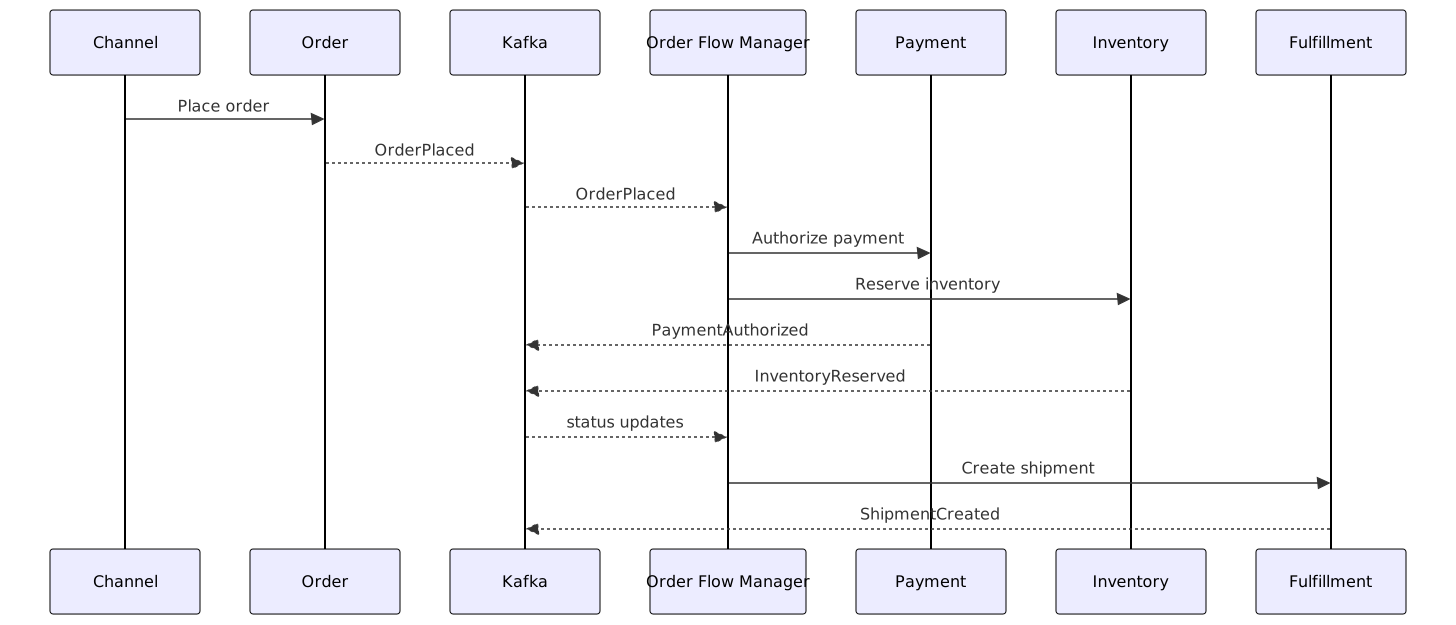
The flow manager here is not a central brain for the whole enterprise. It is a local coordinator for a specific journey. Keep it narrow. Keep domain ownership intact. Use it where process semantics genuinely matter.
Data and state
A flow architecture needs more than one kind of state:
- transactional state inside each bounded context
- event state in the message backbone
- read state for journey monitoring and operational queries
- control state for orchestration if used
- reconciliation state to track mismatches and repair actions
That may sound like duplication, because it is. Distributed systems trade duplicated representations for autonomy and scalability. The discipline lies in knowing which representation is authoritative for what purpose.
Migration Strategy
This is where architecture meets reality.
Most enterprises already have a monolith or a package platform that handles the core journey end to end. You do not replace that in one move. You strangle it progressively by carving out parts of the flow where bounded context ownership can be separated safely.
A practical migration path often looks like this:
Step 1: Identify the dominant business flow
Pick a journey that matters commercially and operationally. Order-to-fulfillment. Quote-to-bind. Claim intake-to-payment. Map the existing flow in painful detail, including batch jobs, manual steps, side effects, and reporting consumers. If you skip this, legacy behavior will ambush you later.
Step 2: Define semantic milestones
Name the business facts that matter across the journey. These become candidate events and control points. Be ruthless about semantics. “StatusChanged” is not a business event. It is laziness serialized.
Step 3: Introduce event publication at the edges of legacy
Use CDC, application hooks, or integration adapters to publish trustworthy business facts from the legacy platform. This gives downstream consumers a stable way to build new capabilities without invasive changes to the core.
Step 4: Strangle one decision point at a time
Move a bounded capability outward where it can own a clear rule set. Fraud review is often a good candidate. Notifications too. Then perhaps pricing, inventory reservation, or payment orchestration depending on constraints. Avoid ripping out the heart first.
Step 5: Run dual flow with reconciliation
For a period, both legacy and new components participate. This is the dangerous middle. Build comparison mechanisms that verify outcome equivalence or explain divergence. Reconciliation is not optional during migration; it is the control system for trust.
Step 6: Shift system of record deliberately
Only when a new bounded context reliably owns its invariants, publishes stable events, and supports operational recovery should it become the authoritative source for that part of the flow.
Here is a simple strangler picture.
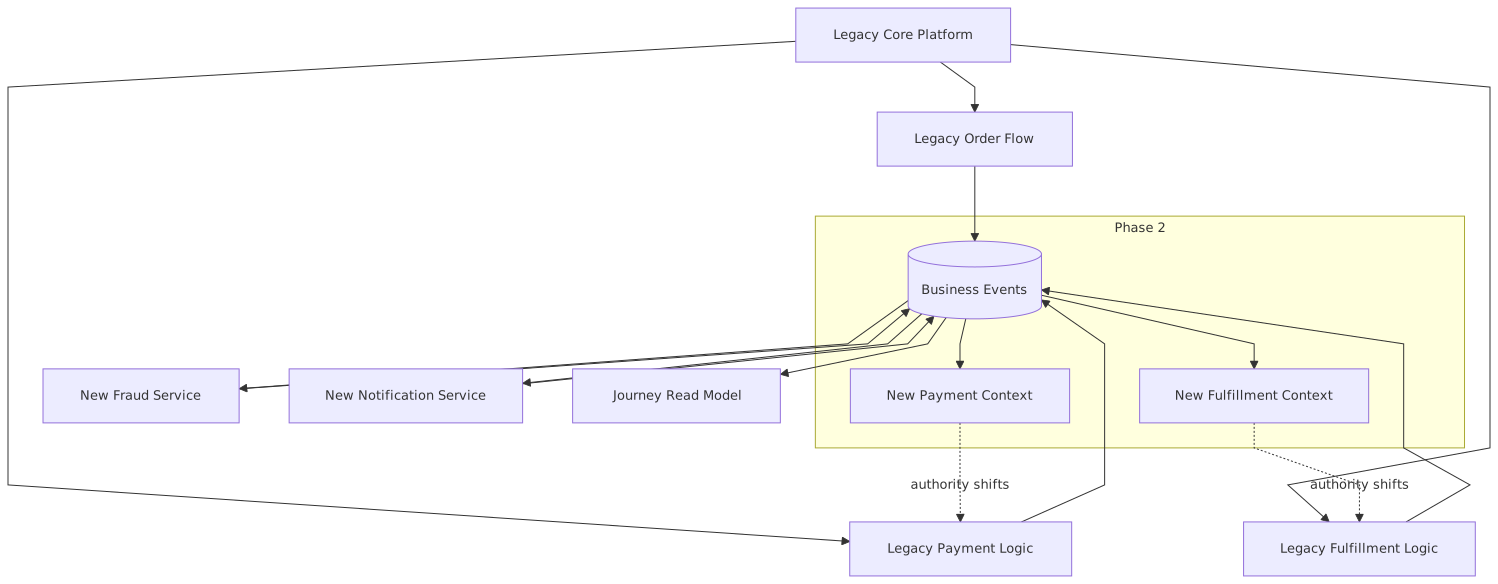
This is not glamorous. It is enterprise modernization as trench work. But it works.
Migration reasoning
Why this gradual path? Because distributed flow is as much about discovered semantics as technology. Legacy systems often encode rules nobody has documented: reservation expiry windows, silent fraud thresholds, fiscal posting sequences, customer communication timing, partner-specific exceptions. A rewrite tends to miss these. A strangler migration lets you expose them through flow observation and reconciliation before they become production outages.
Enterprise Example
Consider a global retailer modernizing order management across stores, web, and marketplace partners.
The legacy platform was a large packaged OMS with custom extensions. It managed order intake, payment handoff, inventory allocation, fulfillment requests, returns, and finance extracts. It also generated nightly feeds for customer service and warehouse planning. The business problem was not that the platform failed completely. It was that every change took too long, marketplace onboarding was painful, and real-time visibility into order exceptions was poor.
The first instinct from some teams was to “move to microservices with Kafka.” That phrase should make any architect slightly nervous. It says more about preferred tools than business design. microservices architecture diagrams
Instead, the architecture team modeled the dominant flows:
- digital order placement
- store pickup reservation
- split shipment allocation
- post-order payment reauthorization
- cancellation and refund
- return initiation and financial adjustment
They identified bounded contexts: Order Capture, Payment, Inventory Promise, Fulfillment, Customer Notification, and Financial Posting. Crucially, they did not force a single canonical order model across them all. Each context carried its own semantics.
The first services carved out were Notification and Fraud Screening. Low blast radius, high business value. Events were published from the legacy OMS using application hooks and, where unavailable, CDC plus rule enrichment. A Kafka backbone provided durable transport, replay for selected consumers, and decoupling from point-to-point interfaces.
Next came a journey read model that assembled order milestones into an operational dashboard. This alone changed the support model. Instead of calling three teams to understand why an order was delayed, customer operations could see the flow state: authorized, inventory pending at node X, fraud released, awaiting shipment wave. Visibility is architecture. People forget that.
The harder move was inventory promise and reservation. The retailer had store-level stock peculiarities, safety stock rules, and channel prioritization logic that lived partly in the OMS and partly in batch planning jobs. The team introduced a new Inventory Promise context beside the legacy system, first running in shadow mode. Every reservation decision was compared against the legacy outcome. Mismatches were classified: benign timing differences, hidden business rules, stale stock feeds, or genuine defects. That reconciliation phase lasted months. It was the most valuable part of the migration.
Eventually the new inventory context took authority for digital channels. Legacy still handled some store processes and financial extracts. Then payment orchestration moved out, allowing better handling of authorization expiry for delayed shipments. Fulfillment remained partially legacy for longer because warehouse integrations were brittle and expensive to disturb.
The result was not a pure greenfield event-driven paradise. It was better: a flow-centered architecture with clear ownership, observable business state, incremental migration, and the ability to evolve key capabilities without dragging the entire enterprise with them.
Operational Considerations
Flow architecture lives or dies in operations.
Flow observability
You need business-level telemetry:
- milestone latency by flow type
- in-flight counts by stage
- exception backlog by cause
- reconciliation mismatch rates
- compensation rates
- timeout breaches
- dead-letter volume by domain event type
Distributed tracing is useful, but it is insufficient. Traces show request paths. They do not automatically show business progress over hours or days.
Idempotency and replay
Every consumer that can see duplicates must be idempotent. That is not optional with Kafka or any serious messaging system. Replays should be possible, but not blindly. Some consumers can safely rebuild read models. Others trigger external side effects and need guarded re-drive procedures.
Schema evolution
Business events evolve. New fields arrive. Semantics sharpen. Old consumers lag. Use versioning discipline and compatibility policies. More importantly, manage semantic evolution socially: teams must know when a field is merely additive and when a meaning has changed.
Governance without suffocation
Enterprises often react to event chaos by creating a central review board for every topic and schema. This solves one problem by creating another. Governance should define principles—naming, ownership, contract standards, lineage, retention, PII handling—not turn every domain event into a committee meeting. EA governance checklist
Security and compliance
Flow architectures spread data. That means access control, encryption, retention policies, consent boundaries, and audit trails need explicit design. Kafka in particular can become a graveyard of over-shared sensitive data if nobody governs event content.
Tradeoffs
Flow architecture is powerful, but not free.
It improves adaptability and observability at the cost of more moving parts. It allows domain autonomy but demands stronger semantic discipline. It handles scale and decoupling well but often makes consistency a design exercise rather than a default property.
There is also a people tradeoff. Teams must think beyond their service boundary. They need to understand event contracts, business milestones, and downstream impact. Some organizations want distributed architecture but still operate with siloed accountability. That combination ends badly.
Another tradeoff is tooling temptation. Kafka, workflow engines, schema registries, stream processors, outbox frameworks—they are useful, but they can seduce teams into overbuilding. A simple synchronous API between two well-bounded services is often better than manufacturing a topic for every interaction.
Failure Modes
Let us be blunt. Flow architectures fail in recognizable ways.
Event soup. Too many low-level events, no stable business meaning, impossible consumption patterns.
Shared topic coupling. Multiple teams depend on accidental details of event payloads and partitions as if Kafka were a shared database.
Phantom completion. Upstream marks a journey complete because it emitted an event, while downstream critical work has silently failed.
Orchestrator empire. A workflow service starts coordinating everything and becomes a centralized bottleneck with hidden domain logic.
No reconciliation path. The system detects mismatch but offers no practical way to repair or replay with business safety.
Semantic drift. Event names stay the same while the business meaning changes underneath.
Migration double-write corruption. Legacy and new systems both update overlapping state, and divergence grows quietly until finance notices.
These are common because they emerge from good intentions without enough architectural discipline.
When Not To Use
Do not use a full flow architecture everywhere.
If you have a small system with a tight team, modest scale, and strong transactional needs inside one domain, a well-structured monolith is often superior. If the business process is simple and latency-sensitive with little need for asynchronous decoupling, synchronous calls may be enough. If the organization lacks event literacy, operational maturity, and discipline around domain ownership, adding Kafka and multiple services will multiply confusion.
Flow architecture also makes less sense when the dominant problem is analytical data movement rather than operational business coordination. In that case, a data platform pattern may be the better primary design.
And if you cannot invest in observability and reconciliation, do not build a flow-centered distributed system. You will create a machine nobody can trust.
Related Patterns
Several patterns sit naturally beside flow architecture:
- Outbox pattern for reliable event publication from transactional state
- Saga / process manager for long-running business coordination
- CQRS for journey read models and operational views
- Strangler fig for progressive migration from legacy
- Event sourcing in selected domains where full event history is a strategic advantage, though certainly not everywhere
- CDC as a migration bridge, but preferably not the final semantic contract
- Materialized views for support, reporting, and flow observability
These patterns are tools, not dogma. The right combination depends on domain shape, failure tolerance, and organizational maturity.
Summary
In distributed systems, architecture should be understood as the design of business flow across bounded contexts.
That is the central idea, and it is more demanding than drawing boxes. It requires domain-driven design thinking so that events mean something. It requires careful placement of invariants so that autonomy does not become an excuse for inconsistency. It requires migration discipline, usually through a progressive strangler path, because legacy systems do not disappear on command. And it requires reconciliation, because real systems drift and honest architecture plans for that from the beginning.
Kafka and microservices can be excellent enablers in this style. They are not the style itself. The value comes from making the journey explicit: what happened, what it means, who owns the next decision, how we observe progress, and how we recover when the flow breaks.
The best enterprise architectures are not static pictures. They are living traffic systems for business intent.
Design the flow well, and the boxes become manageable.
Design only the boxes, and the flow will punish you.
Frequently Asked Questions
What is a service mesh?
A service mesh is an infrastructure layer managing service-to-service communication. It provides mutual TLS, load balancing, circuit breaking, retries, and observability without each service implementing these capabilities. Istio and Linkerd are common implementations.
How do you document microservices architecture for governance?
Use ArchiMate Application Cooperation diagrams for the service landscape, UML Component diagrams for internal structure, UML Sequence diagrams for key flows, and UML Deployment diagrams for Kubernetes topology. All views can coexist in Sparx EA with full traceability.
What is the difference between choreography and orchestration in microservices?
Choreography has services react to events independently — no central coordinator. Orchestration uses a central workflow engine that calls services in sequence. Choreography scales better but is harder to debug; orchestration is easier to reason about but creates a central coupling point.