⏱ 19 min read
Cloud architecture has a habit of turning simple questions into loaded ones. “Should this service be stateless?” sounds innocent, almost hygienic, like asking whether code should be tested or systems should be observable. But state is not grime to be scrubbed away. State is memory. It is obligation. It is the record of what the business promised yesterday and must honor tomorrow.
That is why the debate between stateful and stateless services is usually mishandled. Teams frame it as a technology preference when it is really a question of domain semantics, operational risk, and where the enterprise chooses to carry its truth. You can build a beautiful fleet of stateless microservices and still create a brittle system if the meaning of state gets scattered across caches, topics, databases, retries, and user sessions. Equally, you can keep state inside services and end up with operational gravity so heavy that every deployment feels like moving a bank vault. microservices architecture diagrams
The real architectural question is not “stateful or stateless?” It is this: where should state live, who owns it, how is it recovered, and how does that placement reflect the business domain?
That question matters more in cloud systems because the cloud rewards disposability. Instances restart. Pods are rescheduled. Zones fail. Traffic surges. New versions are rolled out by replacing old units, not nursing them along. Stateless services fit this environment naturally because they treat compute as temporary. Stateful services resist that model because they carry durable history. But “resist” is not the same as “wrong.” Some business capabilities are, in fact, made of durable history. Pretending otherwise creates systems that look modern in slides and chaotic in production.
Context
In enterprise architecture, state appears in several forms, and lumping them together is the first mistake.
There is business state: an order accepted, a claim approved, a payment settled, a reservation held. This is the state the business cares about. It has meaning, auditability, lifecycle, and consequences.
There is process state: where a workflow currently sits, what compensation is pending, whether an orchestration has timed out, what step must happen next.
There is session state: user carts, authentication context, navigation preferences, temporary drafts.
There is technical state: caches, connection pools, in-memory aggregates, offset positions, local indexes, replica logs, queue visibility timers.
These are not equal. Domain-driven design helps here because it forces a distinction between what belongs to the domain model and what is merely an implementation detail. If an order’s lifecycle is central to the order management bounded context, then that state deserves explicit ownership and durable representation. If a recommendation score can be recalculated from source events, then its local materialization is not sacred truth; it is expendable technical state.
The cloud conversation often collapses these categories into one slogan: “make services stateless.” That slogan is useful in the same way “eat healthy” is useful. Sensible, broad, and inadequate for difficult decisions.
In practice, modern enterprises run a mix:
- stateless APIs over durable data stores
- event-driven microservices with local state stores
- stateful stream processors
- distributed caches
- workflow engines carrying process state
- databases, object stores, and logs as durable system memory
So the real design work is not choosing one camp. It is placing each kind of state in the right place.
Problem
The problem is state placement.
Put too much state inside a running service instance and you make scaling, failover, deployment, and recovery painful. A single pod restart becomes a business event. Horizontal scaling becomes suspicious because replicas are no longer equivalent. You start pinning traffic, adding sticky sessions, and negotiating with the scheduler instead of letting the platform do its job.
Put too little state near the behavior that needs it and you create chatty systems, weak transactional boundaries, and accidental distributed monoliths. Every decision requires five network hops and a prayer. Latency rises. Consistency gets fuzzy. Teams compensate with retries, caches, duplicated stores, and eventually folklore.
Most enterprise failures in this area do not come from choosing stateful or stateless. They come from being vague about what state is authoritative.
If a payment microservice writes to its database, publishes a Kafka event, updates a cache, and calls an accounting service, which representation is the truth? If one step fails, how is the system reconciled? If two bounded contexts disagree about an invoice status, which one wins? If a user session says the basket contains an item but inventory says the hold expired, what does the business want to happen?
Architects who dodge these questions end up with systems that are formally distributed and practically confused.
Forces
Several forces pull in opposite directions.
Elasticity versus locality
Stateless services are easy to scale because any instance can handle any request. The platform can add or remove capacity with little ceremony. Stateful services prefer locality: data near the compute, warmed caches, partition ownership, affinity. That can produce strong performance, but it constrains mobility.
Durability versus disposability
The cloud likes disposable compute. Business processes like durable commitments. The more business truth you keep in memory or on local disks tied to a node, the more fragile your commitments become during failure and redeployment.
Consistency versus availability
State placement determines consistency boundaries. If a service owns its state in one transactional store, consistency is easier inside that boundary. Spread the process across services and you gain autonomy but lose easy atomicity. Then you need sagas, reconciliation, idempotency, and eventual consistency discipline.
Domain ownership versus enterprise integration
Domain-driven design says each bounded context should own its model and invariants. Enterprise integration says systems must exchange information. Those two ideas are not enemies, but they are often implemented as if they were. Teams either centralize state into a shared database, destroying domain autonomy, or replicate it everywhere, creating semantic drift.
Performance versus recoverability
Keeping materialized state close to execution can reduce latency dramatically. Stream processors, fraud engines, and recommendation services benefit from this. But every local state store introduces recovery complexity. You need replay, checkpointing, snapshots, and bounded rebuild times.
Auditability versus simplicity
Regulated domains need a durable trail: who changed what, when, and why. Stateless request handlers over append-only logs or transactional systems can provide that cleanly. Hidden mutable in-memory state cannot.
Solution
My view is blunt: default to stateless services for request handling, and place durable business state in purpose-built stores owned by bounded contexts. Use stateful services deliberately, where local state is part of the capability rather than an accidental convenience.
That sentence carries the whole approach.
Stateless services are the safest default in cloud architecture because they align with autoscaling, immutable deployment, blue-green release, and routine failure. A stateless service should be able to disappear and come back without the business noticing. It delegates durable memory to a store: relational database, document database, object store, event log, or workflow engine, depending on need.
But some services are stateful for good reasons. A Kafka Streams application holding partitioned local state, a Flink job maintaining windows, a workflow engine storing execution state, or a low-latency rules engine with warm in-memory context can be the right design. The trick is to make their state model explicit: event-driven architecture patterns
- What is durable?
- What can be rebuilt?
- What is authoritative?
- How is state checkpointed?
- How is ownership partitioned?
- What is the recovery time objective?
- What reconciliation process exists when state diverges?
This is where state placement becomes an architecture decision rather than a coding style.
Architecture
A healthy cloud architecture usually separates behavioral statelessness from durable state ownership.
The service layer remains stateless in its runtime behavior: requests can hit any instance, deployments are rolling replacements, and no customer outcome depends on one pod’s memory. The bounded context still owns its data, but that ownership is represented in a durable store and exposed through behavior, not through shared tables.
Here is the basic pattern.
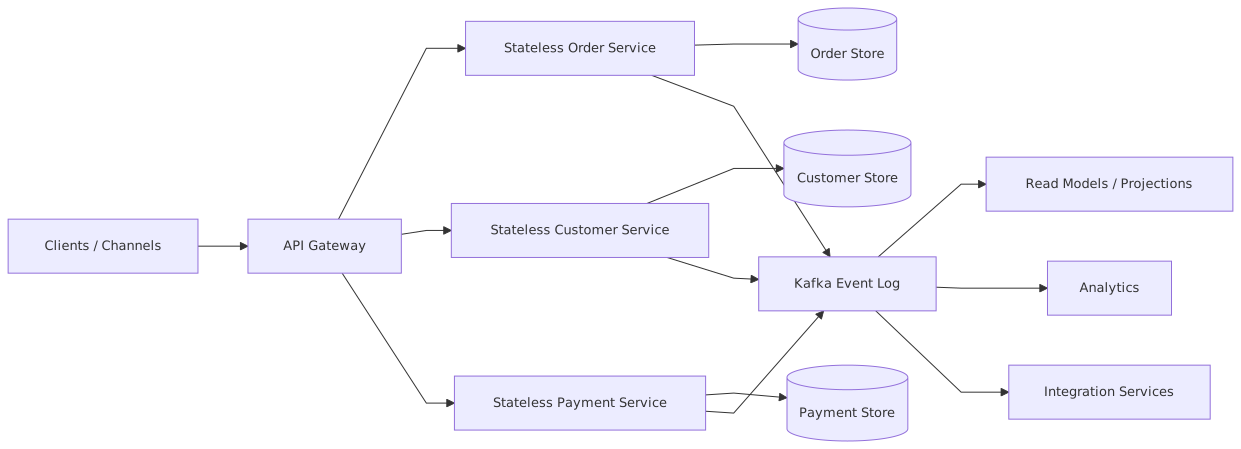
This pattern works because it is disciplined about ownership. Each service owns its store. Events are used to communicate facts, not to pretend there is no state. Read models and downstream integrations consume those facts and build their own views.
The anti-pattern is just as common: “stateless” services all sharing one giant database. That is not stateless architecture. That is a distributed presentation layer over a monolith database. The runtime is cloud-shaped; the ownership model is not.
Stateful components in the same landscape
Now consider where stateful services legitimately fit.
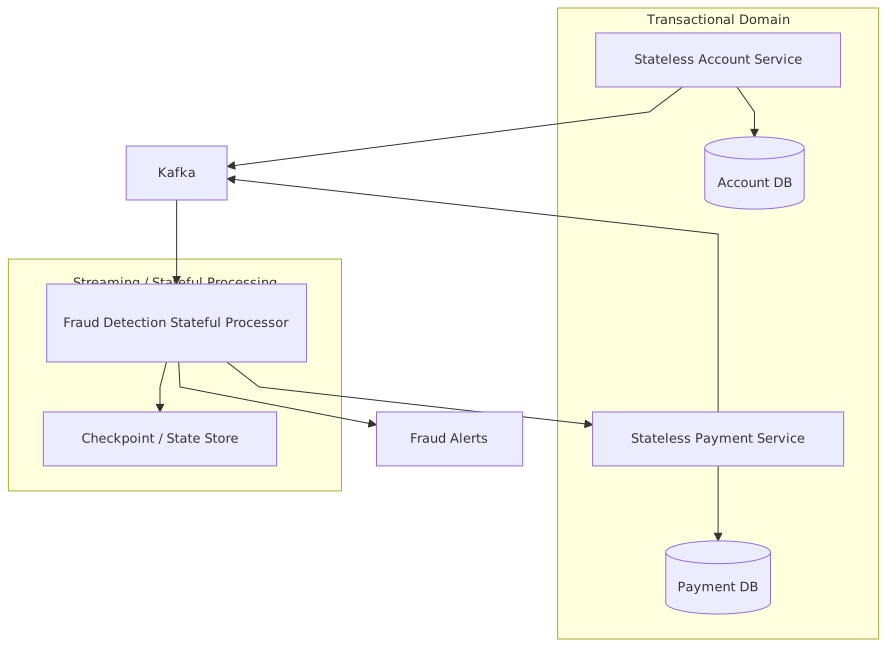
The fraud processor is stateful because it maintains windows, aggregates, and correlation context that would be clumsy and slow to reconstruct per request. That is acceptable, even desirable, as long as checkpointing, replay, partitioning, and recovery are designed intentionally.
This is the key distinction: stateless services often own durable state externally; stateful processors often own computational state locally plus durable recovery state externally.
Domain semantics matter
The placement of state should follow domain semantics, not middleware fashion.
An insurance claim is not just a row in a table. It has a lifecycle, evidence, adjudication rules, fraud indicators, correspondence, and regulatory retention rules. The claim bounded context owns the meaning of those transitions. It may expose a stateless API, but the underlying state is emphatically not generic.
A shopping cart is different. It is often soft state: useful, customer-facing, but recoverable or time-bound. You may keep it in a distributed cache with persistence or a document store with expiration. If it vanishes, the business impact is unpleasant but usually survivable.
A payment authorization hold is different again. That state is contractual and time-sensitive. It needs durable storage, auditability, and explicit reconciliation with external payment networks.
The architecture should reflect these differences. One of the oldest architect mistakes is treating all state as if it deserved the same guarantees, or worse, as if none of it did.
Migration Strategy
Most enterprises are not starting from a green field. They have large systems where state and behavior are tangled together: session-heavy application servers, monoliths with shared schemas, batch jobs encoding hidden process state, integration middleware holding routing context, and hand-built caches no one fully trusts.
This is where progressive strangler migration matters. Not because it is fashionable, but because state migration is dangerous. You do not cut over stateful behavior in one theatrical weekend unless you enjoy reconciliation war rooms.
A sensible migration has stages.
1. Find the real state boundaries
Map the current state, not the conceptual one from PowerPoint. Where is truth actually stored? Which reports are trusted when systems disagree? Which tables are overloaded with multiple domains? Which nightly jobs repair inconsistencies? These ugly corners are often the real architecture.
Use DDD to identify bounded contexts and domain ownership. Name the aggregates and lifecycle transitions that matter. The migration unit is not “customer module”; it may be “credit exposure decisioning” or “order fulfillment promise.”
2. Externalize session and technical state first
The easiest wins often come from removing fragile runtime affinity:
- move HTTP session state to token-based or shared session infrastructure
- externalize file uploads and binary blobs to object storage
- move caches out of process where appropriate
- eliminate local disk assumptions for user-facing services
This does not solve business state, but it makes the application cloud-operable.
3. Introduce authoritative APIs around legacy state
Before replacing storage, wrap legacy data behind clear service boundaries. This stops direct coupling from spreading. Even if the old database remains underneath for a while, new consumers should come through domain-oriented APIs or events.
4. Publish domain events
Use Kafka or similar infrastructure to publish meaningful business facts from the legacy core and then from the new services. Not table-change gossip if you can avoid it. Facts with business semantics. OrderAccepted, PaymentAuthorized, ShipmentDispatched are useful. RowUpdated is not.
5. Build projections and sidecar capabilities
Create new read models, search indexes, notification flows, and reporting capabilities from events. This lets you prove the event backbone and observe semantic gaps before moving core write responsibilities.
6. Strangle write paths gradually
Move one command flow at a time. For example:
- new orders handled by the new Order Service
- amendments still handled in the monolith
- then cancellations
- then returns
This is slower than executives want and faster than disasters permit.
7. Reconcile continuously
During coexistence, dual writes and duplicate state are almost unavoidable. So reconciliation becomes a first-class capability, not a shameful script.
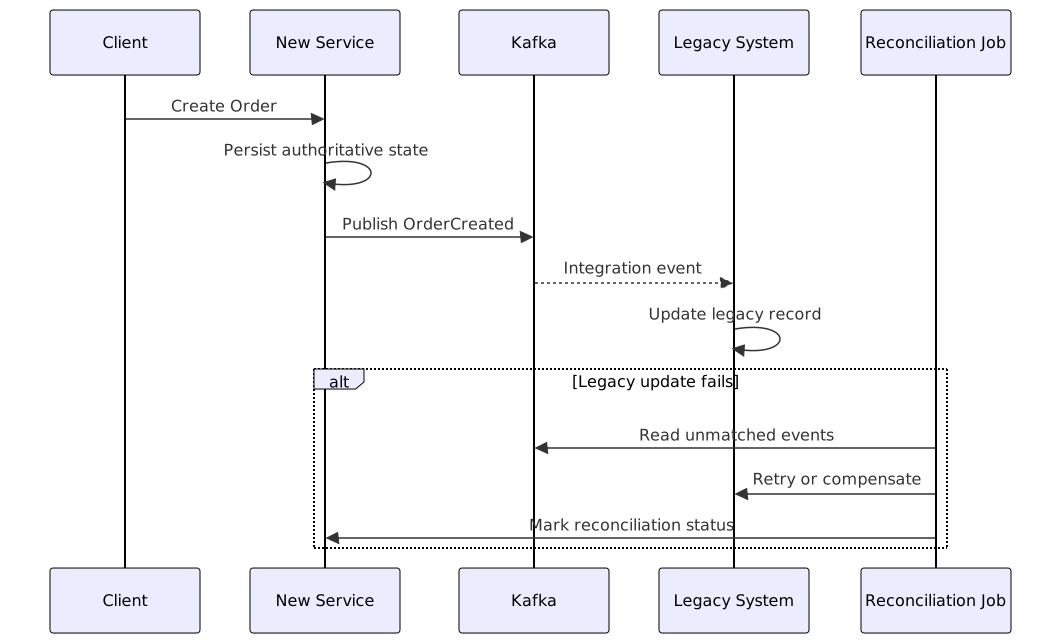
Reconciliation is not an admission of bad design. In enterprise migration, it is a mark of honesty. Networks fail. External systems reject messages. Old platforms have outages. If your migration plan assumes perfect dual propagation, your migration plan is fiction.
8. Decommission by proving semantic equivalence
Do not retire the old path merely because traffic stopped hitting it. Retire it when downstream obligations, audit trails, reports, and exception handling have all been validated. In enterprise systems, the graveyard is full of “unused” functions that turned out to drive finance, compliance, or operations.
Enterprise Example
Consider a global bank modernizing its payments and ledger-adjacent services.
The legacy world is familiar: a large payments hub on an application server cluster, sticky sessions, shared Oracle schema, nightly reconciliation jobs, and message queues feeding anti-fraud, notifications, settlement, and regulatory reporting. Everyone calls it monolithic, but the real issue is not size. It is that business state, process state, and technical state are all mixed together. Session failover causes duplicate submissions. Deployment windows are negotiated like peace treaties. One schema change breaks five departments.
The bank wants cloud-native microservices. Predictably, some teams propose “make everything stateless.” That would be half right and fully dangerous. cloud architecture guide
The better architecture separates capabilities:
- Payment API services become stateless request handlers.
- Payment state remains durable in a bounded-context-owned store with strong audit history.
- Ledger posting stays in a system of record with strict consistency and accounting controls.
- Fraud screening runs as a stateful stream-processing capability over Kafka, keeping local correlation windows and checkpointed state.
- Reconciliation services compare payment intentions, network acknowledgments, ledger postings, and external settlement files.
- Workflow/process state for exceptions and manual review lives in a workflow engine, not hidden in application memory.
In this architecture, no one pod is precious, but the business records certainly are.
The migration starts with payment initiation. New channels send requests to a stateless Payment Initiation Service. That service writes an authoritative payment instruction record, emits a PaymentInitiated event, and invokes legacy posting for downstream obligations still not moved. Fraud screening consumes the event stream and can block or release progression based on checkpointed stateful analysis. If the legacy posting path fails, reconciliation flags the gap and operations can intervene or replay safely because commands are idempotent and events are durable.
What changed here was not simply hosting. The state model changed from hidden and coupled to explicit and owned.
That is what enterprises pay architects for.
Operational Considerations
State placement always surfaces in operations. This is where pretty diagrams meet 3 a.m.
Scaling
Stateless services scale horizontally with little friction. Add instances, distribute load, remove instances. For user-facing APIs and command handlers, this is gold.
Stateful services scale by partitioning, sharding, and affinity. That can work very well, but you need to understand skew. One hot partition can ruin a clean design. Kafka consumers, stream processors, and actor-based systems all live or die by partition discipline.
Deployment
Stateless deployments are straightforward: rolling, blue-green, canary. Stateful deployments require version-aware migration of state schemas, checkpoint compatibility, and controlled movement of partition ownership. Restart time matters because warm state may need rebuilding.
Disaster recovery
For stateless services, disaster recovery is mostly about restoring backing stores and infrastructure configuration.
For stateful services, disaster recovery includes:
- restoring persistent state or checkpoints
- replaying event logs
- validating offset positions
- ensuring no duplicate side effects occurred
- verifying cross-system reconciliation after recovery
If replaying six months of Kafka events takes 19 hours, then your architecture is telling you something about operational reality.
Observability
You cannot manage state you cannot see. At minimum, observe:
- command success and duplicate rates
- event lag and replay rates
- reconciliation backlog
- cache hit ratios
- state store size and checkpoint age
- drift between projections and source of truth
- saga age and timeout metrics
In stateful landscapes, observability must include semantic health, not just CPU and latency. “Payment created but not posted within 5 minutes” is a business-health metric. It matters more than pod memory pressure.
Security and compliance
Durable state brings retention, residency, masking, and audit concerns. Stateless APIs may simplify runtime handling, but the stores behind them still need policy enforcement. Stateful processors often replicate or materialize sensitive data locally; teams forget this and secure only the primary database. Regulators do not care that the leaked data lived in a RocksDB state store or cache cluster. They care that you leaked it.
Tradeoffs
There is no free architecture here.
Stateless services give you:
- easier scaling
- simpler failover
- cleaner deployments
- better platform alignment
- fewer hidden runtime dependencies
But they can also bring:
- more network chatter
- higher latency for state-heavy decisions
- complex distributed transactions
- pressure to overuse caches
- temptation to centralize all truth into one database
Stateful services give you:
- low-latency local decisions
- strong locality for streams and partitioned workloads
- rich in-process context
- efficient aggregation and correlation
But they cost:
- harder recovery
- more operational complexity
- slower deployments
- uneven scaling
- trickier testing and versioning
The practical tradeoff is this: if the capability needs durable memory to perform its job efficiently and correctly, make that state model explicit and engineer it well. If it does not, keep the runtime stateless and let durable stores carry the burden.
Failure Modes
Architects should talk about failure modes with the same energy they use for target diagrams. Systems fail in characteristic ways.
Hidden state in “stateless” services
The service is called stateless, but user affinity is required because in-memory caches, session fragments, or pending workflow markers are not externalized. Restarting pods causes phantom behavior. This is common and embarrassing.
Shared database masquerading as microservices
Services appear independent but coordinate through a common schema. One team changes a table and breaks another’s invariant. Runtime statelessness does not compensate for ownership chaos.
Event publication without authority
A service emits events but its local database is not clearly the source of truth, or events are derived from CDC on unstable tables. Downstream consumers build on semantic quicksand.
Irreconcilable eventual consistency
Teams adopt asynchronous integration but skip reconciliation, idempotency, and compensating logic. They call the result “eventual consistency” as if time itself were a repair mechanism. It is not.
Replay storms
Stateful processors depend on replay after failure, but throughput and retention assumptions are wrong. Recovery takes too long, downstream systems receive duplicates, or stale side effects are repeated.
Hot partitions
One customer, region, or product line creates disproportionate load, saturating the partition owner. Stateless services can diffuse traffic more easily; stateful partitioned systems feel the hotspot acutely.
Semantic drift between contexts
Customer status means one thing in CRM, another in billing, another in risk. Events replicate labels without aligned meaning. Data is synchronized; understanding is not.
This is why DDD matters. Bounded contexts are not just modeling niceties. They are defenses against semantic drift.
When Not To Use
Do not force statelessness everywhere.
Avoid the “all stateless” ideal when:
- you need stream processing with low-latency local aggregation
- your workload is naturally partitioned and benefits from state affinity
- process execution state is central and better handled by a workflow engine
- rebuilding local state per request would be wasteful or impossible
- event-sourced or analytical patterns require long-lived materialized state
Likewise, do not choose stateful services when:
- the state is really just session convenience
- the platform team is not prepared to run and recover them
- the business does not need the latency benefit
- state can be cleanly owned in a durable store behind stateless compute
- horizontal elasticity and frequent deployment are more important than local context
And do not use either style as ideology. Architecture by slogan is how teams inherit expensive regrets.
Related Patterns
Several adjacent patterns show up around state placement.
Event Sourcing
Useful when the event history itself is the source of truth and auditability matters. Powerful, but not a default. It amplifies the importance of semantic event design and replay discipline.
CQRS
Often paired with stateful/stateless discussions. Separating command and query models can reduce coupling and support projections. But CQRS is not an excuse to duplicate data without ownership.
Saga / Process Manager
Essential when state transitions span bounded contexts without distributed transactions. Sagas make process state explicit and compensations deliberate.
Outbox Pattern
A practical answer to the old problem of updating a database and publishing an event reliably. It helps keep state changes and emitted facts aligned.
Materialized Views / Projections
Very useful for read-heavy systems. They are derived state, not primary truth, and should be treated as rebuildable.
Strangler Fig Pattern
Still the best migration metaphor in enterprise architecture. New capabilities grow around the old core, gradually taking over. With stateful systems, the emphasis must be on controlled authority transfer and reconciliation.
Summary
State is where architecture stops being decorative and starts becoming accountable.
Stateless services are the right default for cloud-facing compute because they align with resilience, scaling, and deployment reality. But durable business state does not disappear just because compute is disposable. It must live somewhere explicit, owned, and recoverable. Stateful services are not an anti-pattern; they are a specialized tool, best used when local state materially improves the capability and when the team is ready to operate the complexity that follows.
The winning design principle is simple to say and hard to do: place state according to domain meaning, not technical fashion.
Use domain-driven design to decide ownership. Use bounded contexts to prevent semantic confusion. Use Kafka and event-driven patterns where business facts need propagation, not where hand-waving needs a transport. Migrate progressively with a strangler approach. Assume coexistence. Build reconciliation on purpose. Plan for failure before the failure introduces itself.
In the end, stateful versus stateless is not a binary choice. It is an exercise in architectural honesty. A good system knows where its memory lives. A bad one keeps forgetting.
Frequently Asked Questions
What is cloud architecture?
Cloud architecture describes how technology components — compute, storage, networking, security, and services — are structured and connected to deliver a system in a cloud environment. It covers decisions on scalability, resilience, cost, and operational model.
What is the difference between availability and resilience?
Availability is the percentage of time a system is operational. Resilience is the ability to recover from failures — absorbing disruption and returning to normal. A system can be highly available through redundancy but still lack resilience if it cannot handle unexpected failure modes gracefully.
How do you model cloud architecture in ArchiMate?
Cloud services (EC2, S3, Lambda, etc.) are Technology Services or Nodes in the Technology layer. Application Components are assigned to these nodes. Multi-region or multi-cloud dependencies appear as Serving and Flow relationships. Data residency constraints go in the Motivation layer.