⏱ 23 min read
Most architecture roadmaps lie.
Not because the people drawing them are foolish. Quite the opposite. They’re usually smart, hardworking people trapped by a bad framing. They describe architecture as if it were a sequence of decisions moving neatly from current state to future state. Boxes become cleaner. arrows become straighter. the target state looks inevitable.
Real enterprises don’t change like that.
They change like cities. A new district appears before the old one is demolished. Utilities run in parallel for years. The map says one thing; the streets tell another story. A team adopts Kafka because their customer event flow is collapsing under batch integration. Another team still depends on nightly file drops because the finance reconciliation process cannot tolerate ambiguity. Security introduces a policy engine in one area while another region is still waiting for identity federation. Nobody is wrong. The enterprise is simply evolving under uneven pressure.
That is where an architecture change radar becomes useful.
Not as a vanity diagram. Not as a technology popularity chart. But as a disciplined way to see architectural change as a living portfolio of decisions across domains, capabilities, risks, and migration horizons. In an evolutionary architecture, the radar is less a picture and more an operating instrument. It shows where movement is happening, where friction is accumulating, and where the business is paying for architectural indecision.
The key idea is simple: architecture changes at different speeds in different parts of the organization, and the cost of pretending otherwise is enormous. Domain boundaries blur. Migration plans turn into multi-year sinkholes. Platform teams optimize for consistency while product teams optimize for speed. Integration patterns proliferate. Reconciliation logic leaks into places where no one intended it to live. If you want architecture to evolve safely, you need a mechanism for sensing, prioritizing, and sequencing change. That mechanism can be a radar.
Done well, an architecture change radar helps answer questions executives often ask badly:
- Which changes are strategic versus merely fashionable?
- Where are we carrying the most legacy coupling?
- Which domains deserve autonomy now?
- Where should event-driven architecture be introduced, and where should it absolutely not?
- Which migration paths are reversible?
- What needs reconciliation because consistency will be delayed by design?
These are not diagramming questions. They are business design questions expressed through software and operating models.
This article digs into the architecture change radar as a pattern inside evolutionary architecture. I’ll cover the problem it addresses, the forces acting on it, how to structure one, how it supports domain-driven design, and why it matters during progressive strangler migration. I’ll also cover Kafka and microservices where they genuinely help, not where they merely decorate slides. And because enterprise architecture is where optimism meets procurement, I’ll talk plainly about failure modes, operational realities, and when not to use this approach.
Context
Most large organizations are not trying to invent architecture. They’re trying to survive it.
They have ERP platforms that nobody can switch off, customer channels growing faster than core systems can support, acquisition landscapes full of duplicated capabilities, and delivery teams under pressure to modernize without interrupting cash flow. The architecture is not a greenfield. It is a negotiation between what the business needs, what the systems can tolerate, and what the organization can actually change.
In this world, architecture cannot be managed as a static target state. It has to be managed as a stream of intentional changes.
That is the core promise of evolutionary architecture: preserve strategic direction while allowing local adaptation. Fitness functions, incremental modernization, bounded change, and feedback loops all matter. But there is still a practical gap in many enterprises. Teams have principles. They may even have standards and technology radars. What they often lack is a way to represent change pressure across the architecture landscape.
A technology radar tells you what tools are worth trying or adopting. Useful, but incomplete.
An architecture change radar tells you where the architecture is moving, why it must move, what constraints shape the move, and how migration will occur without breaking the business.
That distinction matters. Architecture is not just technology selection. It is the arrangement of responsibilities, semantics, dependencies, data ownership, integration style, and operational commitments. When those things are changing unevenly across domains, a radar becomes a strategic control surface.
This also aligns naturally with domain-driven design. Enterprises do not modernize as one monolithic unit. They modernize capability by capability, often according to different business urgency. Customer onboarding may need rapid experimentation. General ledger may need precision and auditability above all else. Claims handling may sit somewhere in between, with heavy workflow, policy complexity, and cross-system orchestration.
A meaningful architecture radar therefore needs to reflect domain semantics, not just infrastructure trends.
Because in the end, software architecture is a model of business behavior under load.
Problem
Enterprises usually struggle with architecture change in one of three ways.
First, they centralize all decisions and slow everything down. The result is consistency without momentum. Architecture becomes a committee sport. Teams spend more time seeking approval than delivering value.
Second, they decentralize without a shared map. Every team modernizes in isolation. One area adopts microservices, another uses packaged SaaS extensions, another introduces Kafka topics with no semantic governance, and a fourth wraps a legacy platform with APIs while still relying on batch truth. The enterprise gets movement, but not coherence. event-driven architecture patterns
Third, they confuse change backlog with strategy. A hundred modernization initiatives exist, each locally justified. Yet there is no clear visibility into which changes are foundational, which are opportunistic, which are risky, and which are creating hidden reconciliation cost.
The practical symptoms are painfully familiar:
- duplicated domain logic across channels and services
- data ownership disputes
- integration spaghetti disguised as event-driven architecture
- brittle migration plans
- endless coexistence between old and new systems
- delayed reconciliation becoming permanent business policy
- fragmented observability and operational accountability
- architecture reviews that assess solutions but not the change landscape itself
In short, the enterprise can describe systems, but not the movement of systems.
That is a serious weakness. Because change is where the risk lives.
A core banking platform and a new servicing API can coexist for years. The dangerous part is not that both exist. The dangerous part is when no one has explicit visibility into the migration pressure between them, the semantic mismatches they create, the reconciliation burden they impose, and the thresholds for decommissioning.
Without an architecture change radar, enterprises tend to optimize for local deliverables while accumulating global entropy.
Forces
Several forces make this problem stubborn.
1. Domain variance
Different business domains move at different speeds. Customer engagement, pricing, fraud, settlement, reporting, and compliance each have different volatility, different regulatory exposure, and different tolerance for inconsistency.
This is why bounded contexts matter. They are not just a modeling technique. They are a migration reality. If you ignore domain boundaries, your architecture roadmap becomes fiction.
2. Legacy gravity
Core systems have mass. They hold critical data, institutional knowledge, and operational trust. They often survive not because they are elegant, but because they are dependable in the places that matter most.
A migration strategy that ignores legacy gravity usually ends as a rewrite obituary.
3. Distributed consistency costs
As soon as you decompose systems, consistency gets expensive. Kafka can decouple producers and consumers beautifully. It can also create a cheerful illusion that semantics no longer matter. In reality, they matter more. Events need ownership, versioning, lineage, and business meaning. Otherwise reconciliation logic spreads like mold.
4. Organizational topology
Architecture follows communication paths more faithfully than it follows PowerPoint diagrams. Platform teams, domain teams, security teams, and operations all shape how change actually happens. A radar must account for this. If it doesn’t reflect team reality, it becomes decorative.
5. Regulatory and audit constraints
Financial services, healthcare, telecom, and public sector environments cannot always “eventually” anything. Reconciliation, traceability, non-repudiation, and policy controls are first-order design concerns. The radar needs to show where those constraints are binding, not treat them as afterthoughts.
6. Investment asymmetry
Some changes unlock many others. Identity modernization, canonical customer resolution, observability platforms, data product governance, and API mediation often have cross-cutting leverage. But they also have diffuse ownership, which means they are easy to underfund. A radar helps make that leverage visible. EA governance checklist
Solution
An architecture change radar is a structured view of architectural change candidates and active transitions, organized by domain and by adoption horizon, with explicit attention to semantics, dependencies, migration posture, and risk.
Think of it as a hybrid between an architectural portfolio map and an evolutionary planning instrument.
At minimum, a useful radar should classify change items along these dimensions:
- Domain or bounded context
- Type of change: decomposition, event enablement, data ownership shift, platform standardization, policy enforcement, API modernization, workflow extraction, retirement, etc.
- Change horizon: assess, trial, adopt, stabilize, retire
- Business driver: growth, resilience, compliance, cost, time-to-market, acquisition integration
- Migration pattern: strangler, façade, anti-corruption layer, dual-write avoidance, event sourcing introduction, batch-to-stream transition
- Operational burden: observability, support model, reconciliation, latency sensitivity, rollback complexity
- Failure risk: semantic drift, duplicate processing, partial migration, ownership confusion
- Fitness signal: what evidence would show this change is working
This is not merely taxonomy. It changes behavior.
A radar forces architecture conversations to become explicit about what is changing, why now, and what must coexist during transition. It also prevents the common trap of treating all modernization items as equivalent. They are not. Extracting a pricing rules engine from a legacy product core is not the same move as introducing event streaming for click telemetry. One alters business semantics. The other alters data distribution.
Here is a simple conceptual model.
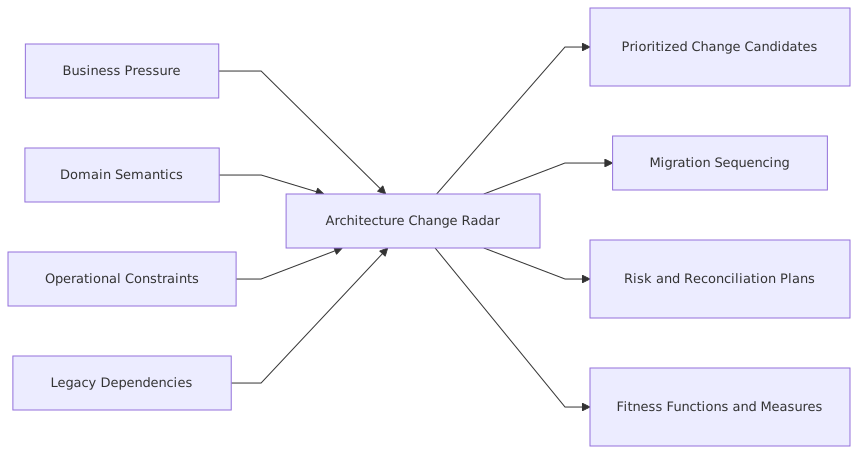
The radar should be reviewed regularly, not annually. Quarterly is usually a sensible cadence. Monthly for volatile portfolios. It becomes the bridge between enterprise architecture, platform strategy, domain modernization, and portfolio funding.
Most importantly, it should distinguish between adoption of a pattern and readiness of a domain.
This is where many architecture practices go wrong. They say “we are moving to microservices” as if microservices were a destination. They are not. They are one option for assigning responsibility and deployment autonomy. The radar asks a better question: which domain capabilities are mature enough, stable enough in semantics, and operationally supported enough to justify decomposition?
That is architecture with adult supervision.
Architecture
A practical architecture change radar needs both a visual and a governance model. ArchiMate for governance
The visual often uses rings and quadrants. That’s fine, provided the categories mean something operationally. For enterprise architecture, I prefer quadrants that reflect the nature of architectural movement rather than pure technology categories:
- Domain Model & Semantics
- Integration & Eventing
- Platform & Runtime
- Governance, Risk & Operations
And rings such as:
- Assess
- Trial
- Adopt
- Retire
The radar is only the front door. The substance sits behind each item in a change record: context, impacted domains, migration path, constraints, owner, reconciliation requirements, and success signals.

Domain-driven design as the spine
The radar should be anchored in domain-driven design rather than technical component inventories.
Why? Because architecture changes become durable when they align with business meaning.
If your radar says “adopt Kafka in trial ring,” that is too shallow. Kafka for what? Publishing order lifecycle events from the order management bounded context? Streaming payment authorization outcomes to fraud and customer notification services? Replacing overnight extracts for inventory position? The semantics matter. Event streams are not architecture confetti. They are commitments about business facts.
A DDD-informed radar asks:
- What is the bounded context?
- Who owns the source of truth?
- What language does this domain use?
- Which upstream and downstream contexts depend on it?
- Is the current integration preserving or distorting domain meaning?
- Can this capability be isolated without creating semantic duplication?
Architecture records behind the radar
Every radar item should link to a short architecture note that captures:
- problem statement
- impacted business capability
- current-state constraints
- target-state hypothesis
- migration strategy
- reconciliation requirements
- success metrics
- kill criteria
The last one matters. Good architecture changes need an explicit condition for stopping. Enterprises are littered with “temporary” coexistence patterns that quietly became permanent because nobody wrote down what failure would look like.
Reconciliation as a first-class concern
In evolutionary architecture, reconciliation is not an edge case. It is the tax you pay for moving without stopping the business.
Whenever a domain is split, whenever events flow asynchronously, whenever read models lag writes, whenever two systems temporarily maintain overlapping responsibility, reconciliation must be designed consciously. That means:
- event idempotency
- duplicate detection
- ledger-style audit trails
- compensating action rules
- business exception queues
- human-in-the-loop workflows for unresolvable mismatches
A radar should highlight where reconciliation burden is rising. That often reveals hidden design debt earlier than uptime dashboards do.
Migration Strategy
The best radar in the world is useless if it does not shape migration.
And migration, in enterprise modernization, is rarely a heroic cutover. It is usually a progressive strangler migration with long coexistence.
The strangler pattern works because it respects legacy gravity. Instead of replacing a core system in one motion, you route new behavior around it, extract capabilities incrementally, and reduce dependency surface over time. The radar helps determine where strangling is feasible, where it is dangerous, and what sequencing creates leverage.
A common sequence looks like this:
- Expose and stabilize interfaces
- Introduce anti-corruption layers
- Extract specific domain capabilities
- Publish events from legacy facts or CDC streams
- Build new consumers and localized services
- Shift command ownership carefully
- Retire redundant paths only after reconciliation confidence is proven
That middle section is where many transformations wobble. Organizations happily extract reads and notifications, but hesitate on writes because ownership becomes politically and operationally sensitive. That hesitation is understandable. Write authority is where accountability lives.
This is why the radar should classify changes by migration posture:
- read-side modernization
- write-side extraction
- workflow orchestration split
- data ownership transition
- reporting separation
- decommission readiness
Those are very different beasts.
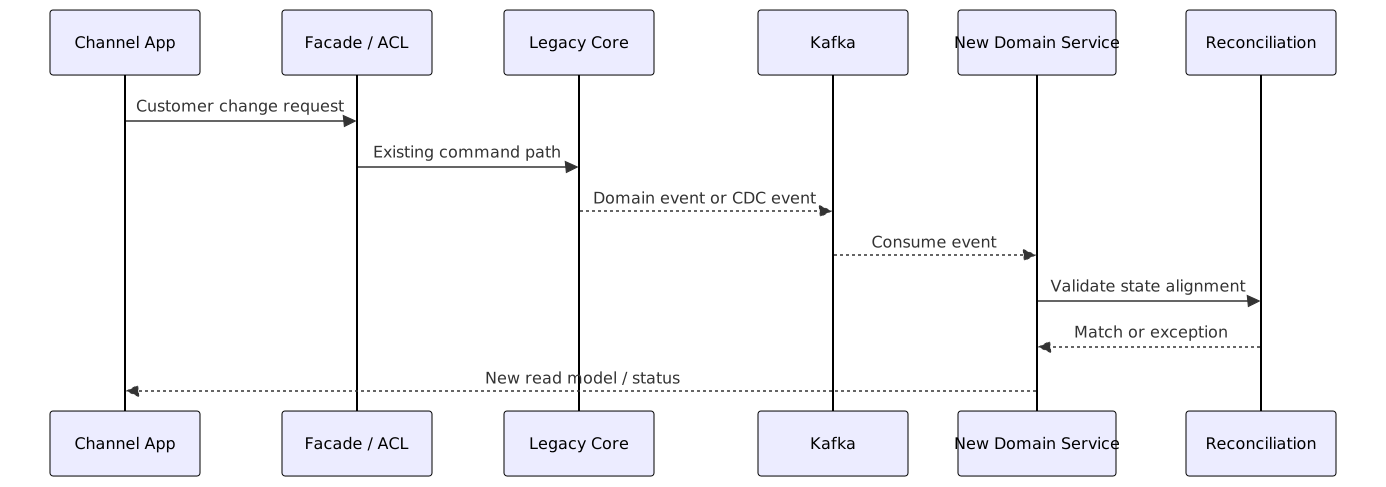
Progressive migration and semantics
A strangler migration is not just traffic routing. It is semantic transfer.
Suppose a legacy policy administration platform treats “policy activation” as a single status transition. The new architecture may discover that activation actually spans underwriting completion, payment confirmation, document issuance, and regulatory notification. If you migrate behavior without clarifying semantics, you simply move confusion into shinier components.
That is why bounded context mapping matters during migration. The radar should flag areas where a capability appears technically extractable but semantically unstable. Those items stay in assess or trial until the language is made explicit.
Kafka in the migration path
Kafka is often useful in migration because it provides durable event distribution and decouples consumers from source systems. But it should not be romanticized.
Use Kafka when you need:
- event fan-out across multiple consumers
- replayability
- decoupled integration over time
- stream processing or derived read models
- operational visibility into domain event flow
Do not use Kafka as a substitute for unresolved domain ownership. If five services consume a “customer updated” topic but none agree what customer identity means, you do not have event-driven architecture. You have broadcast confusion.
One of the strongest uses of Kafka in progressive migration is to turn legacy state changes into enterprise-observable facts while gradually shifting downstream consumers away from batch extracts and direct database dependencies. That can buy time and optionality. But write ownership still needs an endgame.
Reconciliation during coexistence
During migration, reconciliation becomes both technical and business-facing.
Technical reconciliation covers missing messages, out-of-order processing, duplicate events, delayed updates, and schema evolution. Business reconciliation covers mismatched balances, inconsistent statuses, conflicting customer records, and cross-channel discrepancies.
You need both.
A radar item for any migration involving asynchronous propagation or dual representation should include a reconciliation strategy:
- authoritative source at each phase
- comparison frequency
- tolerance thresholds
- exception handling workflow
- sign-off criteria for ownership transfer
This is not bureaucracy. It is how you stop coexistence from becoming institutionalized ambiguity.
Enterprise Example
Consider a global insurer modernizing its claims platform.
The legacy world consists of a large claims administration suite, regional document systems, nightly finance settlement feeds, and a customer portal that increasingly needs real-time updates. Claims is not a single thing here. It includes first notice of loss, adjudication, fraud screening, reserve calculation, payment, subrogation, and regulatory reporting. Different countries have different compliance rules. Some products are simple. Others are deeply specialized.
The organization initially tried a broad “claims microservices program.” It failed to gain traction. Why? Because “claims” was too blunt a category. Teams decomposed technology without decomposing domain meaning. Fraud events overlapped with adjudication updates. Customer communications read from stale replicas. Payment and reserve semantics diverged. Finance refused to trust downstream numbers without overnight reconciliation.
So the architecture office introduced an architecture change radar grounded in claims subdomains.
In the Domain Model & Semantics quadrant, they identified:
- reserve calculation ownership ambiguity
- inconsistent claim status vocabulary across countries
- weak separation between adjudication and payment authorization
In Integration & Eventing, they identified:
- CDC from legacy claims tables into Kafka as an adoption candidate
- retirement of file-based customer notification feed
- trial for event contracts around claim intake and document receipt
In Platform & Runtime, they identified:
- observability stack adoption for claim lifecycle tracing
- standardized API gateway policy enforcement
- deferred service mesh because the operational team was not ready
In Governance, Risk & Operations, they identified:
- mandatory reconciliation dashboards for claim payment events
- policy-as-code trial for regional data residency enforcement
- retirement of direct database reporting access over time
The migration path then became far more precise.
They began by strangling first notice of loss from the monolith, since that domain had high business demand and relatively clear semantics. A façade routed new digital intake into a dedicated service while still posting canonical records back to the legacy claims suite. CDC events fed Kafka, which allowed document services, fraud screening, and customer notification to consume changes asynchronously.
They did not immediately extract payment. That was the right call. Payment involved reserve integrity, external banking controls, and audit-heavy finance workflows. Instead, they built read-side modernization and event observability first, then introduced reconciliation dashboards between claim-approved, payment-requested, and payment-settled states.
Over time, they discovered a subtle failure mode: different regions interpreted “claim closed” differently. Some meant no further customer interaction. Others meant no financial exposure. Because the radar had semantic review built in, this issue was surfaced before payment services were separated. The enterprise avoided a nasty class of financial inconsistency by confronting domain language early.
The result was not glamorous. It was better. Digital intake moved faster. Fraud integration improved. Customer updates became near-real-time. Finance retained trust because reconciliation remained visible. Most importantly, the enterprise modernized claims one bounded context at a time instead of declaring war on a noun.
That is what a radar should do. It should turn ambition into sequence.
Operational Considerations
Architects love the elegance of change. Operators inherit its consequences.
An architecture change radar must therefore be tied to operational readiness. Every major change item should answer practical questions:
- Who supports this in production?
- How will failures be detected?
- What is the rollback or containment strategy?
- What dashboards, traces, and alerts are required?
- How are schema and contract changes governed?
- What is the runbook for reconciliation exceptions?
Observability
In a world of microservices and Kafka, observability is not optional. It is the memory of the system.
Distributed tracing should allow teams to follow a business transaction across APIs, event streams, enrichment services, and persistence layers. Metrics should include not just latency and errors, but semantic indicators: event lag by topic, reconciliation mismatch counts, stale read model age, duplicate processing rate, and exception queue growth.
Data lineage and audit
Where architecture change touches regulated processes, lineage is essential. You need to know where a business fact originated, what transformed it, and where it was consumed. This is especially true when CDC, event enrichment, and derived projections are introduced.
Ownership and support boundaries
A radar item that introduces a new service or stream without clear ownership is a future incident. Domain teams must own domain behavior. Platform teams should provide enabling capabilities, not absorb business accountability by accident.
Fitness functions
Evolutionary architecture needs measurable guardrails. A few examples:
- no direct database access from outside owning bounded context
- critical claim event propagation under 5 seconds p95
- reconciliation mismatch rate below agreed threshold
- decommission candidate achieves 90% traffic reduction before retirement approval
- contract-breaking changes blocked in CI/CD pipeline
The radar should reference these fitness functions so change is not just approved, but tested continuously.
Tradeoffs
This approach has costs.
First, it creates management overhead. Maintaining a useful radar takes discipline. Someone has to curate items, remove dead ones, and force uncomfortable conversations about semantics and migration readiness.
Second, it can expose organizational conflict. Good. That conflict already exists. The radar just removes the camouflage. But don’t underestimate the discomfort. Questions of ownership, prioritization, and decommissioning often reveal turf boundaries faster than any operating model workshop.
Third, it may slow premature modernization. Also good. Some teams will find that the answer is not “extract a microservice now” but “stabilize domain language first” or “introduce an anti-corruption layer before decomposition.” That can feel frustrating to delivery teams under deadline pressure. microservices architecture diagrams
Fourth, it requires nuanced judgment. Not every item belongs on the radar. If everything is strategic, nothing is. The radar is for meaningful architecture change, not every technical improvement.
Finally, it can be abused as bureaucracy. If it becomes a stage-gate artifact rather than a sensing mechanism, people will game it. They’ll fill it with compliance theater and stop using it to think.
The tradeoff is simple: a little structured visibility now, or a lot of accidental complexity later.
I know which bill is smaller.
Failure Modes
A radar is not immune to failure. In fact, there are predictable ways it goes wrong.
Radar as trend board
The first failure mode is turning it into a technology fashion chart. “GraphQL in trial.” “Service mesh in assess.” “Kafka adopt.” That is not architecture change management. That is a shopping list.
No domain semantics
If radar items are detached from bounded contexts and business capability, the enterprise loses the reason for change. Migration then becomes component churn.
Missing reconciliation planning
This one is common and expensive. Teams model target-state architecture beautifully but treat reconciliation as an implementation detail. Then production reveals duplicated events, inconsistent balances, and customers seeing stale statuses. The architecture was not wrong; it was incomplete.
Coexistence without exit criteria
Temporary APIs, transitional data stores, mirrored topics, shadow writes, and compatibility adapters all have a way of surviving. If the radar lacks explicit retirement criteria, coexistence metastasizes.
Too much central control
If every radar update requires a formal architecture review board to bless it, the instrument becomes stale. The point is visibility and guided evolution, not command-and-control paralysis.
No operational tie-in
If SRE, support, and operations are not part of the radar conversation, architectural change gets approved with no production muscle behind it.
When Not To Use
Not every organization needs a formal architecture change radar.
If you are a small company with one product, one or two teams, and a fairly cohesive codebase, this may be overkill. A lightweight architectural backlog and regular technical strategy reviews are probably enough.
If the business is in a genuinely stable environment with low integration complexity and limited regulatory pressure, a full radar may also be unnecessary.
And if the organization lacks the maturity to act on the insights, the radar can become a performative artifact. Better to start with bounded context mapping, migration principles, and a small set of fitness functions than to launch an elaborate framework nobody trusts.
Also, do not use this approach as camouflage for indecision. Some enterprises create sophisticated planning instruments because they are reluctant to make hard calls about legacy retirement, domain ownership, or platform standards. A radar should support decision-making, not postpone it.
Related Patterns
Several patterns pair naturally with an architecture change radar.
- Bounded Context Mapping
Essential for understanding where semantics differ and where migration seams exist.
- Strangler Fig Pattern
The practical workhorse for progressive replacement of monoliths and legacy platforms.
- Anti-Corruption Layer
Critical when preserving domain integrity during coexistence with legacy models.
- Event-Driven Architecture
Useful when domain facts need decoupled distribution, especially with Kafka, but only with disciplined event semantics.
- CQRS and Materialized Views
Helpful for read-side modernization during migration, especially where legacy writes remain temporarily authoritative.
- Fitness Functions
The enforcement mechanism for architectural intent in an evolutionary system.
- Architecture Decision Records
The local memory behind radar items, particularly for documenting migration rationale and retirement criteria.
These patterns are not alternatives to the radar. They are the machinery the radar points toward.
Summary
An enterprise architecture is never just the systems it has. It is the pattern of changes it can survive.
That is why the architecture change radar matters in evolutionary architecture. It gives shape to movement. It shows where domains are ready for change, where semantics are still muddy, where Kafka and microservices can help, where reconciliation must be explicit, and where migration should proceed through a progressive strangler rather than a heroic rewrite.
Its real value is not in the diagram. The diagram is just the handle. The value lies in making architectural change visible as a portfolio of domain-sensitive, operationally grounded, migration-aware decisions.
Use it to connect enterprise strategy with bounded contexts. Use it to sequence modernization by business semantics, not by technical fashion. Use it to expose reconciliation burden before it becomes financial distrust. Use it to force clarity on who owns what, when coexistence ends, and how success will be measured.
And be honest about the tradeoffs.
This is not architecture as art. It is architecture as navigation through uneven terrain. Some domains will move fast. Others should move carefully. Some changes unlock the rest. Others should remain in assess forever.
That is perfectly fine.
A good enterprise architect is not the person who draws the cleanest future state. It is the person who can see change arriving early, name its consequences clearly, and guide the organization through it without losing the plot.
That is what the radar is for.
Frequently Asked Questions
What is enterprise architecture?
Enterprise architecture aligns strategy, business processes, applications, and technology in a coherent model. It enables impact analysis, portfolio rationalisation, governance, and transformation planning across the organisation.
How does ArchiMate support architecture practice?
ArchiMate provides a standard language connecting strategy, business operations, applications, and technology. It enables traceability from strategic goals through capabilities and services to infrastructure — making architecture decisions explicit and reviewable.
What tools support enterprise architecture modeling?
The main tools are Sparx Enterprise Architect (ArchiMate, UML, BPMN, SysML), Archi (free, ArchiMate-only), and BiZZdesign. Sparx EA is the most feature-rich, supporting concurrent repositories, automation, scripting, and Jira integration.