⏱ 20 min read
Distributed systems fail in the places architects prefer not to look: between regions, between teams, between assumptions. Most data architecture diagrams are suspiciously clean. Boxes line up. Arrows behave. The latency numbers look respectable. Then the business goes live across three geographies, one of the zones gets noisy, a compliance team bans cross-border replication for customer records, and suddenly the “global platform” is really a series of local truths stitched together with retries and hope.
That is where topology-aware data placement earns its keep.
This is not just a storage concern. It is not merely about putting data physically near users. It is about making placement a first-class architectural decision, tied to domain semantics, failure boundaries, legal constraints, service ownership, and the ugly economics of distributed coordination. Good architects know that “where data lives” shapes “what the system can promise.” If your write model spans regions thoughtlessly, your availability story is fiction. If your read model ignores locality, your customer experience becomes a tax on geography. If your event streams disregard jurisdiction and affinity, your compliance and cost profile eventually become a board-level issue.
A lot of teams discover this too late. They start with a single database, grow into a shared cluster, then replicate it globally as if scale were just a larger version of sameness. It isn’t. Geography is not a detail. Network topology is not an implementation footnote. In distributed systems, topology is policy wearing infrastructure clothing.
So let’s treat it that way.
This article looks at topology-aware data placement as an architecture pattern for distributed systems: when to use it, how to reason about it with domain-driven design, how Kafka and microservices fit into the picture, how to migrate toward it without detonating the estate, and where it goes wrong in the real world. event-driven architecture patterns
Context
Distributed enterprises rarely have one clean center of gravity. They have customers in multiple regions, operational units with local autonomy, regulatory boundaries, different latency envelopes, and products that evolved through acquisition. The technology estate reflects that reality. There are monoliths in one corner, SaaS systems in another, Kafka somewhere in the middle, and a brave but uneven microservices initiative trying to impose order. microservices architecture diagrams
In that environment, data placement decisions tend to emerge accidentally. A team deploys in one region because that is where the first customer was. Another team replicates data because the analytics platform needs it. A third team creates region-specific databases because legal says they must. Nobody designed a coherent placement model; they accumulated one.
That accumulation becomes expensive. Writes travel too far. Reads cross continents. Replication floods networks. Reconciliation jobs multiply. Incident response becomes archaeology.
Topology-aware data placement is the deliberate answer. It says: place data according to the domain’s natural boundaries and the system’s operational topology. Keep data close to the business process that owns it. Replicate only what is justified. Prefer local decisions over global coordination. Accept that some truths are local, some are derived, and some should never be synchronized in real time.
The point is not elegance. The point is survivability.
Problem
Most distributed systems architecture starts with logical decomposition and postpones physical placement. We define services, APIs, events, and databases, then trust deployment tooling to sort out the runtime details. That works for a while.
Then one or more of these problems appears:
- Latency-sensitive transactions cross regions because the write path depends on data hosted elsewhere.
- Jurisdictional rules conflict with replication because personal or financial data cannot freely move.
- Shared databases create hidden coupling across services and geographies.
- Global consistency requirements destroy availability under network partition.
- High-volume event streaming overwhelms inter-region links and amplifies failure blast radius.
- Operational ownership becomes unclear because no team knows which copy of the data is authoritative.
- Reconciliation becomes permanent architecture rather than temporary repair.
This is the heart of the problem: distributed systems often separate service boundaries from data locality, and the mismatch causes both technical and organizational pain.
A customer order created in Singapore should not need a synchronous pricing lookup in Frankfurt and an inventory lock in Virginia unless there is no other way. A claims system in Europe should not replicate sensitive medical details into a US analytics lake because “the platform standard says everything goes to Kafka.” An airline seat allocation service should not pretend to have one universal state machine if airport operations still behave locally under disruption.
When architects ignore topology, the business eventually notices through slow response times, outage cascades, compliance escalations, or costs that have the decency to be very measurable.
Forces
Topology-aware placement is a response to competing forces, not a universal rule. The interesting part is the tension.
Latency vs consistency
The closer data is to the user or process, the faster local reads and writes become. But local copies invite divergence. A globally synchronized write model gives stronger consistency, yet it pays in latency and fragility. There is no magic here. A system cannot be both fully local and globally coordinated at all times without cost. CAP is not a slogan; it is rent.
Domain autonomy vs enterprise visibility
A bounded context should own its data and evolve independently. But enterprises still need cross-context visibility for reporting, compliance, customer support, and operational intelligence. The temptation is to centralize everything. The better answer is usually to keep operational ownership local and publish derived views where needed.
Regulatory boundaries vs platform standardization
Platform teams love uniformity. Regulators do not care. If customer data must remain in-region, topology is not optional. Your “single global cluster” may be operationally neat and legally absurd.
Write optimization vs read optimization
Data placement follows access patterns. But write and read patterns are often different. The order service may need local writes by market, while the customer support portal wants a global read view. You should not contort the operational model to satisfy reporting needs. Build localized sources of truth and project read models.
Simplicity today vs resilience tomorrow
A single database is simpler until it isn’t. Region-aware partitioning, event replication, and reconciliation increase complexity. But so does every incident rooted in central dependency. Architecture is often a choice between explicit complexity and hidden complexity. Hidden complexity is more dangerous because people budget for neither.
Team ownership vs shared infrastructure
Data placement only works if operational ownership aligns with service boundaries. If one central DBA team controls all schema changes and one platform team manages every replication policy, “decentralized architecture” is theater.
Solution
The core solution is straightforward to state and hard to do well:
Place authoritative data according to domain ownership and operational topology, then propagate only the minimum necessary data to other locations using events, projections, and bounded consistency.
That breaks into a few architectural principles.
1. Identify the authoritative location for each domain concept
Not all business entities deserve the same placement strategy. In domain-driven design terms, ask which bounded context owns the invariant.
For example:
- Orders may be owned by the commerce context in the market where the order is created.
- Inventory availability may be owned per fulfillment node or warehouse region.
- Customer profile may have jurisdiction-specific ownership, with local master records and globally shareable subsets.
- Reference data like product catalog may be centrally managed but regionally replicated.
This is where domain semantics matter. “Customer” sounds like one thing, but in practice it fragments into identity, consent, loyalty, billing profile, risk classification, and support history. Those pieces have different legal, operational, and latency characteristics. Architects who treat “customer data” as a single placement unit usually build pain into the model.
2. Prefer local writes, global reads via derived views
A common mistake is to make the write path satisfy every consumer. Don’t. Keep writes local to the owning context where possible. Then distribute change events and build read models optimized for other uses.
Kafka is often the right nervous system here. Not because Kafka is fashionable, but because append-only event streams fit the problem of propagating state changes across topology boundaries. A local service commits its business transaction, emits a domain event through an outbox or transactional messaging pattern, and downstream consumers materialize what they need in their own region.
This gives us a better contract: authoritative local write, eventually consistent distributed consumption.
3. Partition by business affinity, not just by hash
Hash partitioning is convenient for infrastructure, but domain-aware partitioning is often better for operations. Partition by region, market, warehouse, legal entity, airline station, store network, or customer domicile when those boundaries align with business processes and failure containment.
This is where topology-aware placement differs from generic sharding. The partitions are not just data buckets. They correspond to meaningful business boundaries that teams understand and can operate.
4. Replicate data selectively
There are several replication modes:
- Full replication for small, low-risk reference data
- Subset replication for only the fields needed elsewhere
- Event propagation without full state copy
- On-demand fetch for rare, non-latency-sensitive interactions
- No replication at all where regulation or business design forbids it
Selective replication is discipline. Every replicated field creates a future reconciliation burden.
5. Design reconciliation as part of the architecture
Eventually consistent systems are not eventually correct by goodwill alone. Events can be delayed, duplicated, reordered, or lost across intermediate steps. Services change schemas. Consumers lag. Region failovers create split histories.
So reconciliation is not an afterthought. It is a first-class capability:
- compare authoritative and projected state
- detect drift
- replay events
- repair missing projections
- surface lineage and timing gaps
- support compensating actions where invariants were temporarily violated
A mature topology-aware design assumes disagreement and invests in repair.
Architecture
A typical topology-aware architecture in an enterprise microservices environment looks something like this:
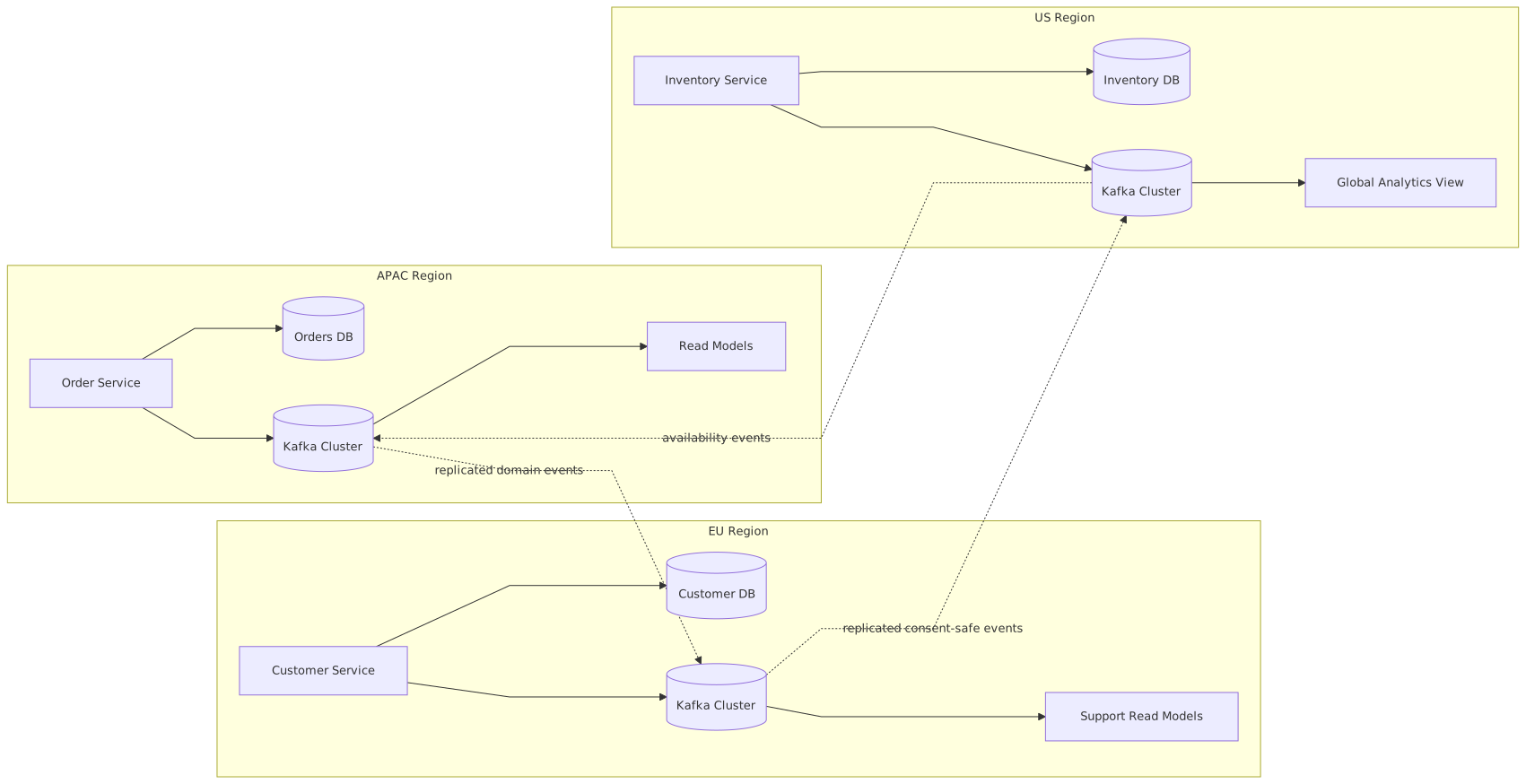
There are a few things worth noticing in this pattern.
First, the primary database for each service remains local to the region or topology segment where the service operates. This is not accidental. The local service should be able to continue functioning even if cross-region links degrade.
Second, Kafka clusters may be local per region rather than one global cluster. That usually reduces blast radius and respects network realities. Inter-region event replication is then explicit and policy-driven. This matters. “One global Kafka” sounds elegant until one network issue turns replication lag into a company-wide conversation.
Third, read models are distinct from authoritative stores. This preserves bounded context ownership while giving the enterprise what it needs.
Domain semantics and placement units
A useful trick is to define placement units that are semantically meaningful. These are the chunks of data and process affinity you decide to keep together.
Examples:
- all order aggregates for a market
- all inventory facts for a warehouse
- all consent records for a legal jurisdiction
- all claims for a payer region
- all seat allocations for a flight segment operation center
This is where domain-driven design helps enormously. Bounded contexts tell you ownership. Aggregates tell you transactional consistency boundaries. Ubiquitous language tells you whether a concept is truly global or merely presented globally.
A placement decision should answer: who owns this truth, where is it most naturally changed, and what other parties only need a projection of it?
Placement patterns
There are a handful of common patterns:
- Single-writer regional ownership
One region owns writes for a data partition. Others consume projections.
- Hub-and-spoke reference distribution
Central master for relatively static data, replicated outward.
- Local operational state with global analytical lakehouse
Operational systems stay local; events feed centralized analytics through sanitized pipelines.
- Jurisdictional split model
Sensitive fields remain in-region; non-sensitive derivatives replicate globally.
- Edge-local cache with origin authority
Useful for read-heavy workloads, but dangerous if teams blur cache and authority.
Here is a more focused placement diagram:
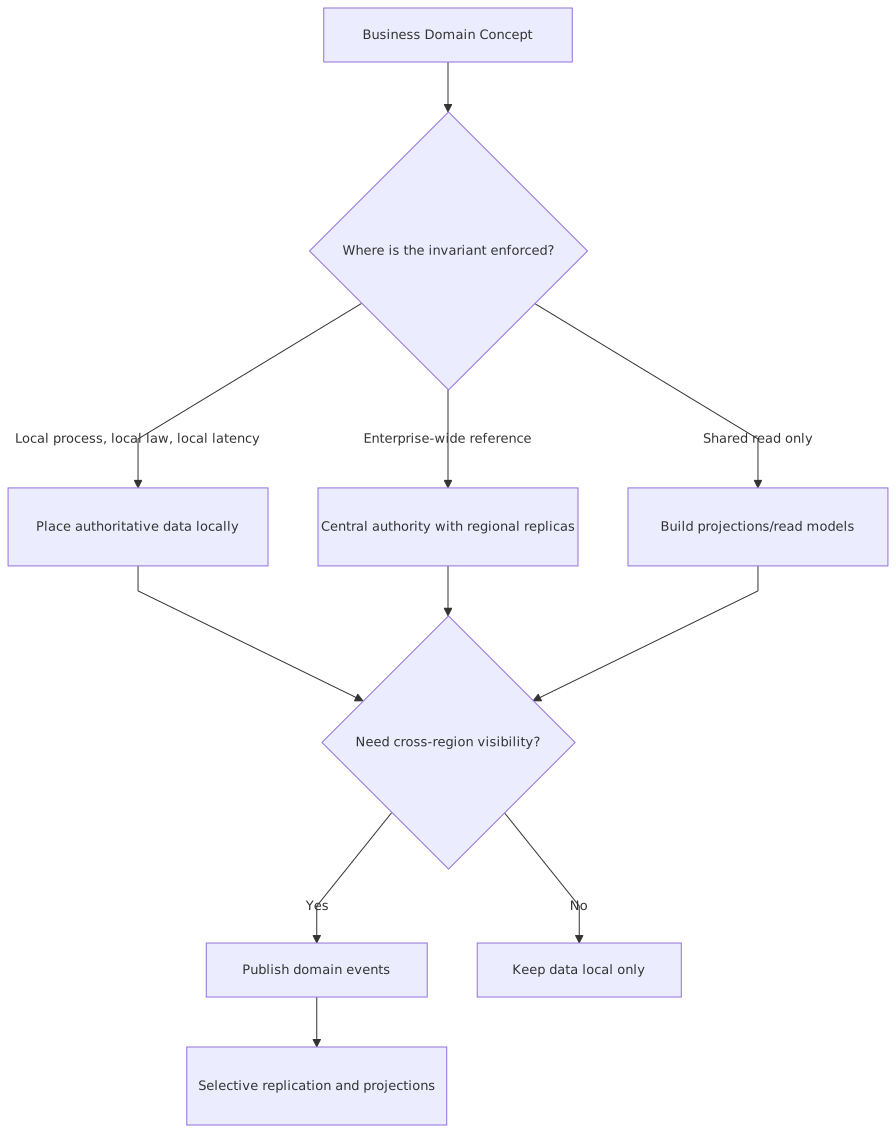
This is less glamorous than many platform strategies, but more honest.
Migration Strategy
Nobody starts with topology-aware placement neatly in place. Enterprises inherit centralized databases, shared schemas, region-agnostic services, and “temporary” ETL jobs that have lasted seven years. So migration matters as much as target design.
The right approach is usually a progressive strangler migration. Not a grand rewrite. Not a heroic cutover. A sequence of controlled extractions where new locality-aware capabilities grow around the old estate until the old center loses relevance.
Step 1: Map domains to current data gravity
Before moving anything, identify:
- authoritative sources
- actual write paths
- cross-region dependencies
- hidden synchronous calls
- data regulated by geography
- reconciliation jobs already in existence
You are looking for mismatch. The current system often already reveals natural locality through operational pain.
Step 2: Choose one bounded context to localize
Start with a context where:
- ownership is clear
- latency matters
- cross-region coupling is painful
- the blast radius is manageable
Orders by market, warehouse inventory, and regional customer consent are common starting points.
Step 3: Introduce event publication from the legacy core
If the old monolith still owns writes, use change data capture, an outbox, or carefully managed domain event publication to expose business changes. Kafka is useful here because it allows old and new worlds to coexist. The key is to publish business meaning, not just row diffs whenever possible.
Step 4: Build regionalized read models first
This is the safest opening move. Let new local consumers read from projected models while writes still happen centrally. It proves the replication model, event contracts, and operational topology without moving invariants yet.
Step 5: Shift write authority for one partition
Then move write ownership for a defined partition—say APAC orders—to a local service and local store. The old system becomes a consumer for that partition instead of the owner. This is the decisive move in a strangler. Authority changes hands.
Step 6: Reconcile aggressively during dual-running
During migration, dual-write is seductive and dangerous. Better to establish a single writer per partition whenever possible, then reconcile downstream copies. Use comparison jobs, event replay, idempotent consumers, and repair workflows. Measure drift in business terms, not just technical counts.
Step 7: Expand partition scope gradually
Move one market, one warehouse group, one legal jurisdiction at a time. Migration by meaningful business slices works better than migration by random customer IDs because support teams and operations can reason about impact.
A migration view often looks like this:
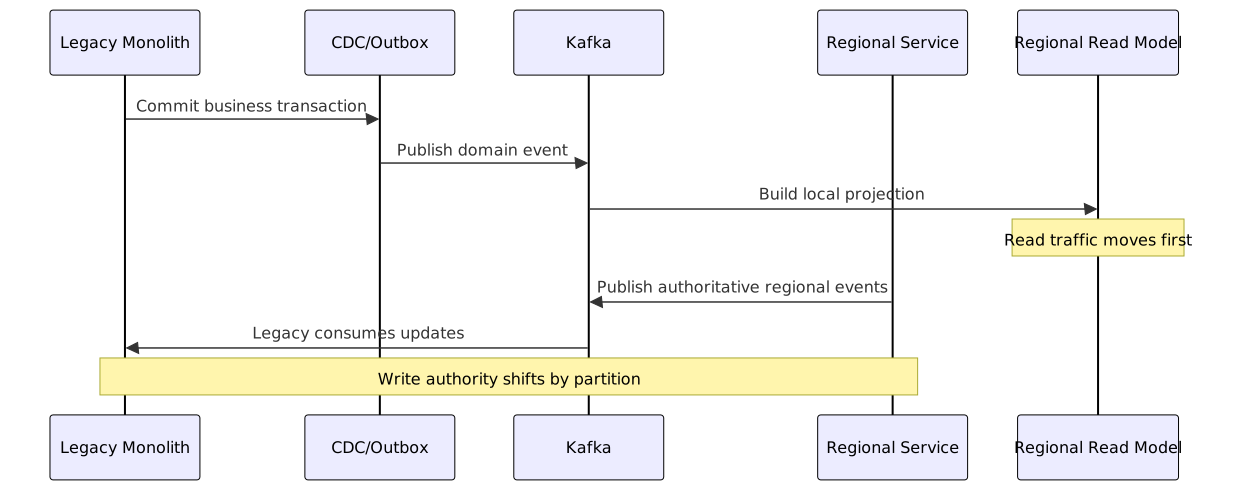
That is how strangler migration should feel: less surgery, more rerouting.
Enterprise Example
Consider a global retailer operating e-commerce, stores, and regional fulfillment centers across North America, Europe, and Asia-Pacific. The legacy architecture has a central order management platform in the US, one large customer database, and nightly replication to regional reporting marts. It worked when international volume was modest. Then APAC growth accelerates, same-day fulfillment becomes strategic, and privacy regulations tighten in Europe.
Symptoms appear quickly:
- APAC checkout latency is poor because order creation and fraud checks route through US systems.
- Inventory reservations fail during transpacific network disruptions.
- EU customer data exports to US analytics are challenged by compliance.
- Store operations cannot trust central stock views during regional outages.
- Incident teams spend more time reconciling delayed feeds than solving root causes.
The enterprise does not need a slogan. It needs a placement model.
The redesign
The retailer rethinks data around bounded contexts:
- Order Management becomes region-owned by market. Orders are authored in-region.
- Inventory is owned by fulfillment node and replicated as availability signals rather than universal transactional state.
- Customer Identity and Consent are split. Identity claims needed globally are tokenized and replicated selectively. Consent and regulated profile fields remain jurisdiction-local.
- Product Catalog remains centrally curated but regionally replicated because it is mostly reference data with local pricing overlays.
- Analytics consumes sanitized domain events into a central platform, with field-level controls.
Kafka is deployed per major region. Event replication policies are explicit: order lifecycle events replicate globally for customer support and enterprise reporting, but customer PII does not. Each region maintains local operational stores and read models. A global customer support application reads federated views assembled from region-safe projections.
The result
Did they eliminate complexity? Of course not. They moved it to a place where it can be managed.
Checkout latency drops because order writes are local. Regional outages stop taking down unrelated markets. Compliance posture improves because data movement is narrowed and explainable. Reconciliation still exists, but now it is focused on projection repair and inventory signal drift, not existential disagreement about where orders came from.
This is what good enterprise architecture often looks like: not less complexity, but better-placed complexity.
Operational Considerations
Topology-aware placement changes operations as much as design.
Observability must show authority and lag
It is not enough to know a service is “up.” Operators need to know:
- which store is authoritative
- replication lag by topic and region
- projection freshness
- divergence rates
- replay backlog
- partition ownership status
- failover mode currently active
Without this, teams misdiagnose stale data as application defects.
Idempotency is not optional
Cross-region event delivery will produce duplicates eventually. Consumers must be idempotent. So must repair jobs. Replay should be normal, not feared.
Schema governance matters
Once events cross topology boundaries, careless schema changes become distributed outages. Use versioned contracts, compatibility rules, and clear deprecation windows.
Data classification must be embedded
Field-level classification—PII, financial, health, export-controlled, operational metadata—should drive replication policy. Otherwise platform teams end up creating accidental data exfiltration systems with admirable throughput.
Capacity planning must include network economics
Inter-region traffic costs money and introduces risk. Teams often budget for compute and storage while ignoring replication overhead, consumer fan-out, and replay storms.
Disaster recovery becomes more nuanced
A topology-aware design should define whether a region can:
- continue locally in isolation
- queue outbound events until links recover
- operate in degraded read-only mode
- transfer partition ownership to another region
These are business decisions masquerading as technical ones.
Tradeoffs
Let’s be plain: topology-aware data placement is not free.
What you gain
- lower local latency
- stronger regional autonomy
- reduced blast radius
- better legal alignment
- clearer domain ownership
- more scalable write paths
- more honest consistency boundaries
What you pay
- more architectural complexity
- eventual consistency semantics
- reconciliation tooling
- operational sophistication
- more careful schema and event design
- harder ad hoc querying across the whole estate
- deeper collaboration between domain and platform teams
The biggest tradeoff is psychological. Many organizations say they want decentralized systems, but what they actually want is decentralized delivery with centralized certainty. They want each team to move independently while preserving a single universal truth available instantly everywhere. That desire is understandable and mostly impossible.
Topology-aware placement demands a more mature bargain: local authority, shared understanding, bounded inconsistency, and explicit repair.
Failure Modes
This pattern goes wrong in predictable ways.
1. Topology-driven design without domain semantics
Teams partition by region because infrastructure says so, while the domain actually requires cross-region invariant enforcement. The result is endless compensations and policy exceptions. If the business concept is inherently global, pretending otherwise creates chaos.
2. Everything becomes an event, nothing is modeled
Publishing every table change to Kafka is not architecture. It is exhaust. Without domain events and ownership clarity, consumers build dependencies on incidental data and topology complexity multiplies.
3. Replication without minimization
Teams copy entire records everywhere “just in case.” Costs rise, compliance risk grows, and reconciliation becomes impossible to reason about.
4. Dual-write migrations linger forever
The organization never completes authority transfer. Both old and new systems write, drift becomes permanent, and every incident becomes a debate over which system is right.
5. Reconciliation is treated as batch housekeeping
If repair is slow, opaque, or manual, eventual consistency degrades into operational distrust.
6. Global read models are mistaken for global truth
Support portals and analytics views are derivatives. If operators use them to drive operational decisions without understanding freshness and lineage, bad things happen quietly.
When Not To Use
There is a temptation to apply topology-aware placement simply because the system is “distributed.” Resist that.
Do not use this pattern when:
- your system is small, single-region, and unlikely to change soon
- domain invariants require strong global consistency on nearly every transaction
- regulatory constraints do not justify the complexity
- the team lacks operational maturity for event-driven repair and reconciliation
- the business cannot tolerate eventual consistency in dependent processes
- your current bottleneck is product ambiguity, not topology
A single well-run database is still one of the great engineering bargains. Architects should not apologize for simplicity. If there is no real geography, no real autonomy need, no meaningful legal separation, and no severe latency problem, topology-aware placement may be theater with invoices.
Likewise, if your organization cannot define bounded contexts, event contracts, and ownership, adding multi-region data placement will not make it more disciplined. It will simply spread confusion over a wider area.
Related Patterns
Topology-aware data placement rarely stands alone. It sits among a family of patterns.
- Bounded Contexts: define ownership and language boundaries.
- CQRS: separate local write models from distributed read models.
- Event Sourcing: sometimes useful where event history is the real asset, though not required.
- Outbox Pattern: reliable event publication from local transactions.
- Saga / Process Manager: coordinate business flows without global ACID transactions.
- Data Mesh: relevant for analytical domains, though operational data ownership should not be conflated with analytics product thinking.
- Sharding: infrastructure-level partitioning, best when aligned with business affinity.
- Federated Query / API Composition: useful for assembling global views, though poor as a substitute for well-designed projections.
- Strangler Fig Pattern: the pragmatic migration path from centralized legacy systems.
These patterns work best when the architecture starts from domain semantics. Technology is an amplifier. If the model is wrong, Kafka will help you be wrong at enterprise scale.
Summary
Topology-aware data placement is the discipline of making geography, jurisdiction, and operational boundaries part of the data model rather than treating them as deployment trivia. It asks a simple but powerful question: where should this truth live, and why?
The answer should come from the domain.
Use bounded contexts to identify ownership. Keep authoritative writes close to the business process that enforces the invariant. Replicate selectively through events. Build read models instead of centralizing operational truth. Design reconciliation from the start. Migrate progressively with a strangler approach. And be honest about the tradeoffs: you are exchanging hidden central fragility for explicit distributed complexity.
That is usually a good deal in a real enterprise.
Because in distributed systems, distance is never just distance. It is latency, law, cost, failure, ownership, and trust—all folded into one architectural choice. The teams that recognize this early build systems that bend without breaking. The teams that don’t end up discovering topology the hard way, usually during a major incident, with everyone asking why the data was there in the first place.
Frequently Asked Questions
What is a service mesh?
A service mesh is an infrastructure layer managing service-to-service communication. It provides mutual TLS, load balancing, circuit breaking, retries, and observability without each service implementing these capabilities. Istio and Linkerd are common implementations.
How do you document microservices architecture for governance?
Use ArchiMate Application Cooperation diagrams for the service landscape, UML Component diagrams for internal structure, UML Sequence diagrams for key flows, and UML Deployment diagrams for Kubernetes topology. All views can coexist in Sparx EA with full traceability.
What is the difference between choreography and orchestration in microservices?
Choreography has services react to events independently — no central coordinator. Orchestration uses a central workflow engine that calls services in sequence. Choreography scales better but is harder to debug; orchestration is easier to reason about but creates a central coupling point.