⏱ 20 min read
A cache stampede is one of those failures that makes a system look foolish in public.
Everything is calm until a hot key expires. Then a thousand perfectly reasonable requests all do the same unreasonable thing: they miss the cache, rush the backend, and turn a small gap in latency into a full-blown incident. The database buckles, downstream services start timing out, thread pools saturate, autoscaling arrives too late, and somewhere a dashboard tells a comforting lie for five minutes before the real graphs catch up. What looked like a cache problem was never just a cache problem. It was an architecture problem.
That distinction matters.
In enterprise systems, caches are often treated like tactical plumbing. Add Redis, sprinkle TTLs, and call it resilience. But distributed caching lives in the seam between domain semantics, consistency expectations, and traffic behavior. If the architecture ignores those seams, the cache becomes a volatility amplifier. The harder the traffic pushes, the more the system punishes itself.
Stampede mitigation, then, is not a bag of tricks. It is a way of making expiration, freshness, ownership, and regeneration explicit in the architecture. The best designs understand that not all data is equal, not all staleness is harmful, and not all recomputation should happen at request time. A customer profile, a pricing rule, and a real-time fraud score should not share the same caching policy merely because they all fit in the same Redis cluster. That is cargo cult architecture, and cargo cult architecture always invoices the operations team later.
This article takes the long view. We will look at the problem through domain-driven design, distributed systems tradeoffs, and migration strategy. We will talk about Kafka where event-driven invalidation makes sense, microservices where ownership boundaries matter, and strangler-style migration where reality refuses big-bang rewrites. We will also talk about failure, because every cache strategy sounds elegant until the lock service stalls, the invalidation topic lags, or stale data escapes into a customer-visible workflow. microservices architecture diagrams
Context
Distributed caching exists because the core systems of record are too expensive to hit for every request. Sometimes the expense is latency. Sometimes it is cost. Sometimes it is outright survivability. In large enterprises, a cache often sits in front of several things at once: relational databases, search indexes, pricing engines, third-party APIs, feature stores, entitlement systems. The cache becomes a shared memory of recent truth.
That phrase — recent truth — is more honest than “truth.”
The minute data is copied into a cache, the system has admitted that freshness is negotiable. What remains to be designed is how negotiable, for whom, and under what conditions. Those are domain questions, not infrastructure defaults.
In a domain-driven design sense, cache behavior should align with bounded contexts. A product catalog context might tolerate a few minutes of staleness because merchandising changes are operationally managed and eventually propagated. An identity and access context may tolerate almost none for revocations. A payments context may cache reference data aggressively but should hesitate before caching mutable authorization state. Treating these contexts identically is how teams accidentally build consistency bugs under the banner of performance optimization.
The enterprise wrinkle is that caching rarely belongs to one team. A digital channel team may own the edge cache, a platform team may own Redis, a domain team may own the source service, and a data team may publish invalidation events through Kafka. Stampede mitigation has to survive these seams. If the design only works when a single team controls request flow, cache policy, source data, and event timing, it does not work in an enterprise. event-driven architecture patterns
Problem
A cache stampede happens when many requests attempt to regenerate the same missing or expired value simultaneously.
At small scale this appears as a spike. At enterprise scale it can become a cascading failure:
- A hot key expires.
- Thousands of concurrent requests miss.
- Each request triggers the same expensive backend computation or database query.
- The backend saturates.
- Request latency rises.
- Retries amplify load.
- The cache refill itself slows down.
- More requests pile into the same regeneration path.
- Now the cache is not absorbing pressure; it is synchronizing it.
The nasty part is that stampedes often emerge from otherwise sensible local decisions.
A team sets a five-minute TTL. Another team launches a marketing campaign that makes one key extremely hot. A microservice introduces retries with jitter, but no request coalescing. A Kafka consumer responsible for invalidation falls behind, so teams lower TTLs “for safety.” Lower TTLs mean more expirations. More expirations mean more synchronized misses. Small choices compose into ugly behavior.
The classic symptom is backend load disproportionate to business activity. You do not see a tenfold increase in users; you see a tenfold increase in repeated work. Every distributed system has some waste. Stampedes create theatrical waste.
Forces
Good architecture begins by naming the forces honestly.
Freshness versus survivability
Fresh data feels correct. Surviving peak traffic is also correct. In many systems, the choice is not between fresh and stale, but between slightly stale and entirely unavailable. Architects should say that aloud. Teams often hide this tradeoff behind default TTLs, and then act surprised when the system picks availability in the worst possible way.
Read amplification versus write complexity
You can reduce cache misses by proactively warming or event-driven updating, but that pushes complexity onto writes and invalidation flows. You can keep writes simple with time-based expiration, but then reads bear the regeneration cost. There is no free lunch, only different invoices.
Domain semantics versus platform standardization
Platform teams want one reusable caching library. Domain teams need policies shaped by business meaning. Both are right. The platform should provide primitives — locking, stale-while-revalidate, jittered TTL, negative caching, event hooks — while domains choose semantics. A universal “cache wrapper” with one TTL strategy is the software equivalent of a hotel breakfast buffet: broad, convenient, and unsatisfying.
Central coordination versus local autonomy
A global distributed lock can prevent duplicate recomputation, but it introduces lock contention, failure modes, and dependency on a coordination mechanism. Local in-process request collapsing is simpler and faster, but only helps within one instance. In a fleet of 400 pods, local coalescing alone is a polite gesture, not a solution.
Consistency versus cost
Event-driven invalidation via Kafka can reduce staleness and avoid synchronized expiry, but it requires reliable event publication, ordering thinking, consumer idempotency, and reconciliation. If the cache is optional and the domain value is cheap to recompute, that machinery may be excessive.
Solution
There is no single mitigation. There is a pattern language.
A robust architecture usually combines four moves:
- Prevent synchronized expiration
- Coalesce regeneration
- Serve stale data safely where the domain allows
- Move regeneration off the critical request path when possible
Those sound simple. In implementation, they are where the architectural judgment lives.
1. Prevent synchronized expiration
The first rule is brutal and useful: never let all hot keys die at once.
Use randomized TTL jitter so that keys with nominally identical TTLs expire over a spread of time. This does not solve stampedes for a single hot key, but it avoids herd behavior for cohorts of keys created together. It is table stakes.
For truly hot data, prefer soft TTL and hard TTL rather than a single expiry. Soft TTL means the data is eligible for refresh; hard TTL means it is too old to serve. Between those thresholds, stale-while-revalidate can keep traffic moving while one actor refreshes in the background.
2. Coalesce regeneration
If one request is already refreshing a key, others should not repeat the work.
This can be done at several levels:
- In-process single flight: collapse concurrent requests within one application instance.
- Distributed lock or lease: allow only one instance to regenerate a key across the fleet.
- Token-based ownership: assign refresh responsibility to a designated worker or service.
Be careful with locks. A distributed lock is not a silver bullet; it is a loaded weapon with better documentation. If lock expiry is too short, another node may start duplicate regeneration. If too long, failures delay refresh and stale data lingers. If the lock store degrades, your cache strategy now depends on another unstable distributed system.
Leases are often safer than absolute locks. The holder gets temporary permission to refresh, and stale serving continues for others during the lease period. The architecture shifts from “block everyone” to “let one actor work while others degrade gracefully.”
3. Serve stale data safely
This is where domain semantics matter most.
Serving stale product descriptions is usually harmless. Serving stale account balances can create support cases or worse. The architecture must classify cached data into freshness categories, ideally by bounded context and business consequence.
A practical taxonomy looks like this:
- Reference data: can be stale for minutes or hours.
- Customer experience data: can often be stale briefly if visibly non-critical.
- Operational decision data: may tolerate seconds, but needs explicit rules.
- Financial or security-sensitive data: stale serving often restricted or prohibited.
This classification should be embodied in code and configuration, not buried in tribal memory.
4. Regenerate off the request path
Request-time regeneration is expensive because it turns user traffic into background maintenance.
For hot keys, use asynchronous refresh:
- scheduled warming,
- event-driven updates from source-of-truth changes,
- background refresh workers,
- precomputation pipelines.
Kafka is particularly useful here. When a source service publishes domain events — PriceChanged, CatalogItemUpdated, EntitlementRevoked — consumers can update or invalidate caches proactively. That shifts refresh from “when the first unlucky customer asks” to “when the domain changes.” This is usually better architecture.
Usually, not always. Event-driven invalidation introduces eventual consistency and demands reconciliation. Events can be delayed, duplicated, or lost at integration boundaries. If the cache is operationally important, you need replay, compaction strategy where relevant, idempotent consumers, and periodic anti-entropy checks to detect drift.
Architecture
A practical stampede-resistant architecture uses multiple defensive layers.
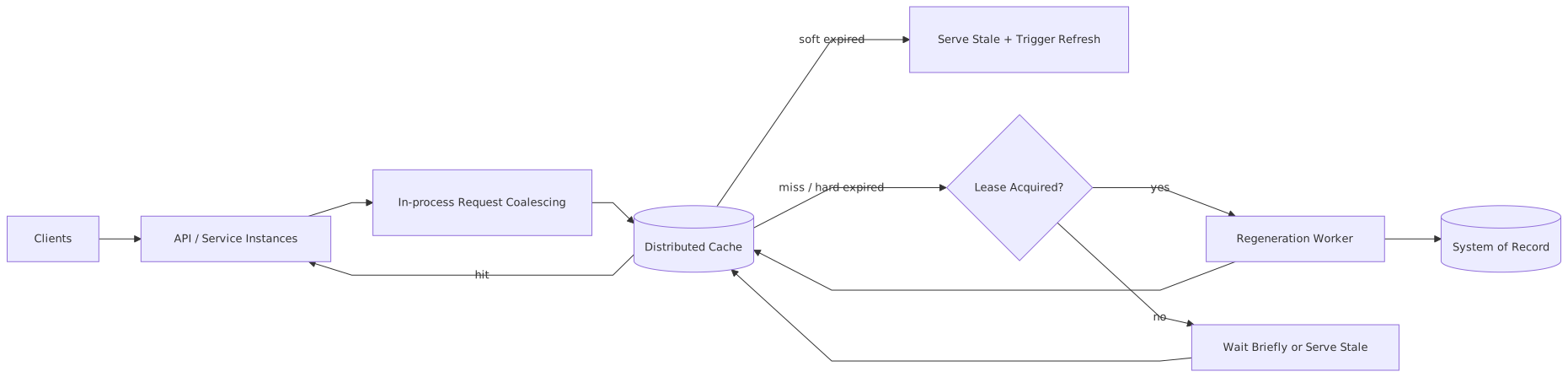
This is the shape I like:
- Application instances first attempt local single-flight coalescing.
- Distributed cache stores value, soft TTL, hard TTL, and sometimes metadata like version or refresh timestamp.
- Lease mechanism ensures only one actor performs expensive regeneration for a given key across the cluster.
- Stale-serving policy lets non-owner requests continue with bounded degradation.
- Asynchronous refresh path handles proactive warming and event-driven updates for hot or business-critical keys.
Notice the point: we are not merely optimizing the cache. We are reducing synchronized work across the system.
Cache entry model
A cache entry in this architecture is richer than “value + expiry”. It often includes:
- value
- domain version or ETag
- soft expiry timestamp
- hard expiry timestamp
- last refresh timestamp
- provenance or source context
- optional negative-cache marker
- refresh status metadata
That metadata supports operational decisions. It helps answer whether a response is current enough, whether an event update should overwrite it, and whether a background worker is already refreshing it.
Event-driven invalidation and refresh
For domains with clear ownership, Kafka can become the refresh backbone.
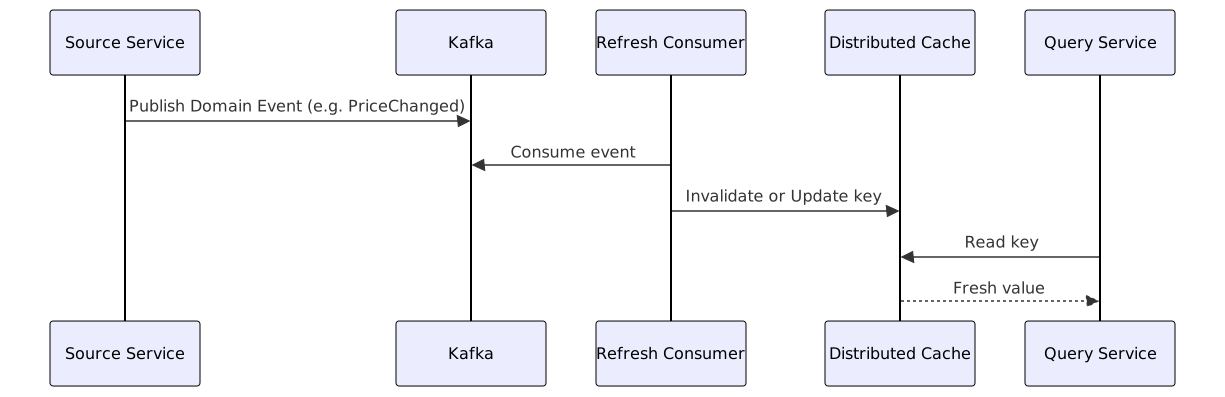
There are two common approaches:
- Invalidate on event: delete the key so the next read fetches current data.
- Update on event: compute and write the new cache representation directly.
I prefer update-on-event when the transformation is well understood and deterministic. It avoids the “next request pays” problem. But invalidate-on-event is simpler and sometimes necessary when the read model aggregates several sources.
Domain semantics and bounded contexts
This is where DDD earns its keep. Caching should not be designed around technical object types alone — UserDTO, OrderSummary, ProductView. It should be designed around domain meaning.
An OrderSummary in the customer support context may tolerate slight lag for readability. The same data in a fraud review context may require stronger recency guarantees. Same shape, different semantics. Different semantics, different cache policy.
A mature enterprise platform will expose cache primitives, but bounded contexts decide:
- TTL strategy
- stale serving allowance
- event-driven update policy
- negative caching rules
- reconciliation cadence
- observability thresholds
Migration Strategy
Nobody begins with the ideal architecture. Most enterprises start with “Redis + TTL + hope.” That is normal.
The right migration is progressive, not heroic. This is a strangler fig exercise: wrap the dangerous behavior, shift hotspots first, and let evidence steer the next move.
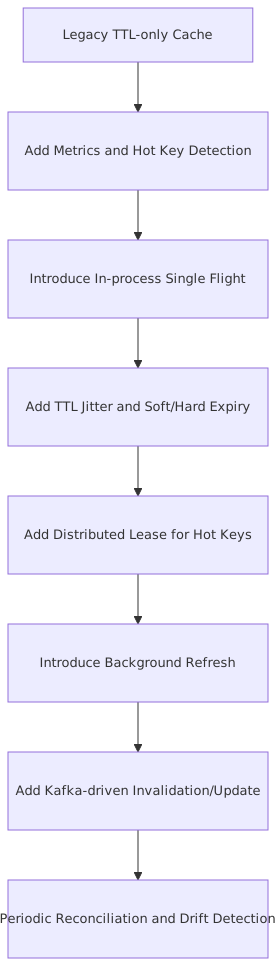
Step 1: Instrument before you optimize
Measure:
- hot key frequency,
- miss rate by key class,
- regeneration cost,
- backend amplification ratio,
- stale serve count,
- lock contention,
- event lag if using Kafka.
Without this, teams optimize folklore.
Step 2: Classify domains
Define data classes by business criticality and acceptable staleness. Do this with domain teams, not just platform engineers. The migration will go faster once everyone agrees that some data may safely be stale and some may not.
Step 3: Add local request coalescing
This is low-risk and often yields immediate benefit. It does not solve distributed contention, but it cuts duplicate work per node and improves latency spikes.
Step 4: Introduce soft TTL and jitter
Again, low risk. This changes expiration behavior without restructuring ownership. It is often the cheapest meaningful improvement.
Step 5: Add lease-based distributed regeneration for the top hot keys
Do not put every key behind a distributed lock on day one. That is architecture by panic. Start with the handful of keys that dominate traffic or regeneration cost.
Step 6: Move hot keys to asynchronous refresh
Once the hot paths are known, background workers or event consumers should own refresh for those keys. Request paths should become consumers of prepared state, not participants in regeneration.
Step 7: Add event-driven invalidation/update
Bring Kafka in where source changes are already evented or should be. Publish domain events from the owning bounded context. Consumers update cache projections. This is where the architecture starts to resemble an intentional read model rather than a random speed layer.
Step 8: Reconcile
Because event pipelines are mortal.
Use periodic reconciliation jobs to compare cache metadata against source-of-truth versions, especially for critical domains. Reconciliation catches:
- dropped events,
- consumer lag side effects,
- transformation bugs,
- stale negative cache entries,
- cross-service drift after partial outages.
A cache without reconciliation is a polite fiction.
Enterprise Example
Consider a global retail bank with a digital channels platform serving mobile and web traffic. The customer dashboard aggregates account nicknames, balances, offers, card controls, and recent transactions from multiple microservices. Redis is used as a distributed cache in front of an aggregation service. Kafka carries domain events from product, accounts, and customer profile services.
Originally, the aggregation team used a simple 300-second TTL on dashboard summaries. During a major marketing campaign, morning login traffic surged. Millions of customers opened the app between 8:00 and 8:15. A handful of hot account segments generated extremely skewed access patterns. At 8:05, a large cohort of cache entries expired together because they had been bulk-warmed at deployment time. The aggregation service flooded account and offers services. Those services retried to downstream systems. The result was a familiar enterprise opera: elevated latency, partial data on dashboards, noisy alerts, and a support center asking why card controls were unavailable when the card system itself was healthy.
The fix was not “increase Redis capacity.” That would have treated smoke as fuel.
The bank introduced:
- per-instance request collapsing in the aggregation service,
- TTL jitter on dashboard fragments,
- soft TTL with a 2-minute stale-while-revalidate window for non-critical sections like offers,
- lease-based refresh for hot customer segments,
- Kafka-driven refresh for profile and offer changes,
- strict no-stale policy for card control state and near-real-time balances,
- reconciliation jobs every 15 minutes for high-risk fragments.
This is important: they split the dashboard cache by domain fragment, not by page. That is domain-driven design in action. Offers could be stale briefly; card controls could not. Recent transactions had a short hard TTL but could show a banner if temporarily stale. The user experience became semantically graceful instead of technically arbitrary.
Within two releases, backend amplification during cache turnover fell dramatically. More importantly, incidents became understandable. Teams could say which bounded context was stale, for how long, and why that was acceptable or not. Architecture had replaced superstition.
Operational Considerations
Stampede mitigation lives or dies in operations.
Hot key detection
You need visibility into key popularity. A cache cluster can look healthy overall while a tiny set of keys causes most backend pain. Track top keys, miss frequency, regeneration duration, and skew. Averages are traitors here.
Observability
Instrument:
- cache hit/miss by domain,
- stale served count,
- stale age distribution,
- regeneration attempts,
- coalesced request count,
- lease acquisition success/failure,
- backend calls per cache miss,
- Kafka consumer lag,
- reconciliation drift rate.
The best metric in this space is often backend amplification factor: how many backend operations result from one logical cacheable value under load. If that number rises above 1 meaningfully, your stampede defenses are leaking.
Capacity and eviction policy
Cache eviction can trigger stampede behavior just as easily as TTL expiry. If memory pressure evicts hot keys, the system gets surprise misses at the worst times. Choose eviction policies with hot-key behavior in mind, and reserve memory headroom. Cache clusters run happiest before they look full.
Negative caching
For frequently requested absent data, cache the absence briefly. This prevents repeated expensive misses for non-existent entities. But keep negative TTLs short and domain-aware. Negative caching can make newly created records appear missing if events are delayed.
Timeout and fallback discipline
Requests waiting on a lease holder should wait briefly, not romantically. Timeouts should be short, and fallback should prefer stale data where allowed. Waiting longer under load often worsens the collapse.
Security and compliance
Cached data may carry regulatory constraints. Some sensitive domains should cache only derived or redacted forms. Stampede mitigation is not an excuse to replicate sensitive state everywhere with long lifetimes.
Tradeoffs
Good architects do not sell certainty where there is only choice.
Complexity
Every mitigation adds moving parts: locks, leases, metadata, workers, event consumers, reconciliation jobs. If your workload is modest and your misses are cheap, a simple TTL may be enough. Complexity is not resilience by itself.
Staleness
Stale-while-revalidate improves survivability but explicitly allows stale reads. That is a business tradeoff. If stakeholders cannot articulate acceptable stale windows, the architecture is not ready for this pattern.
Coordination overhead
Distributed leases reduce duplicate work but create dependency on a coordination mechanism. Under partial failure, this can become its own bottleneck.
Eventual consistency
Kafka-driven refresh moves work off the request path, but now correctness depends on event delivery and consumer health. You trade synchronous read pressure for asynchronous consistency management.
Cost distribution
You can pay in request latency, operational complexity, or engineering effort. Most enterprises eventually pay all three unless they choose deliberately.
Failure Modes
This is where many articles go soft. They should not.
Lease holder crashes mid-refresh
If one node acquires the lease and dies, others may continue serving stale data until lease expiry. If hard TTL is exceeded before a new refresh succeeds, requests may fail. This is why hard TTL should reflect realistic outage tolerance, not optimism.
Lock storms
If many nodes repeatedly contend for the same key lease, the lock service or cache itself can become hot. Use backoff and avoid aggressive polling.
Stale forever
A bug in refresh logic, event consumption, or metadata handling can leave values perpetually stale but technically present. Without stale age alerts and reconciliation, this can go unnoticed for days.
Event lag or loss
Kafka consumers can lag during peaks or deployments. Producers can fail to publish at source boundaries unless the architecture uses outbox or equivalent reliability patterns. If invalidation depends on fragile publication, the cache will drift.
Negative cache poisoning
A transient source error interpreted as “not found” can be cached and suppress legitimate data briefly or, in the worst case, for far too long.
Regeneration overload
If refresh computation itself is expensive, a handful of hot keys can monopolize workers. Prioritization matters. Not all refreshes deserve equal urgency.
Cache cluster partition or failover
During cache instability, the system may fall back to direct source access and recreate the very surge the cache existed to prevent. Rate limiting and degraded modes should be part of the design, not emergency improvisation.
When Not To Use
Not every system needs sophisticated stampede mitigation.
Do not reach for this pattern when:
- the dataset is small and can be fully preloaded cheaply,
- cache misses are inexpensive and backend capacity is ample,
- request rates are low and burst behavior is minimal,
- the domain cannot tolerate staleness and source reads are already efficient,
- the operational maturity to run leases, event consumers, and reconciliation does not exist.
Also, do not force event-driven refresh into a domain with weak ownership boundaries. If nobody clearly owns the source-of-truth event stream, Kafka will not rescue the design. It will merely distribute confusion at scale.
Sometimes the right answer is to remove the cache, optimize the query, add read replicas, or materialize a proper read model. Architects should remember that a cache is often a symptom treatment. If the root problem is an overloaded transactional model being asked analytical or highly aggregated questions, then CQRS or materialized views may be a better answer than increasingly elaborate cache rituals.
Related Patterns
Stampede mitigation sits near several adjacent patterns:
- Cache-aside: application loads and populates cache on demand.
- Read-through cache: cache infrastructure handles misses and loading.
- Refresh-ahead: proactively refresh before expiry.
- Stale-while-revalidate: serve stale data while refreshing asynchronously.
- CQRS: separate write and read models, often reducing dependence on ad hoc caching.
- Outbox pattern: reliably publish domain events for Kafka-driven invalidation.
- Bulkhead and rate limiting: protect source systems when cache behavior degrades.
- Strangler fig migration: incrementally replace TTL-only caching with domain-aware refresh architecture.
These patterns are complementary. In fact, the strongest enterprise designs often stop calling the result “just a cache.” It becomes a read model delivery mechanism with explicit freshness policy.
Summary
A cache stampede is not really about expiration. It is about synchronized regret.
Too many systems let request traffic discover stale data all at once, then ask the backend to recover in public. That is avoidable. The architecture should spread expiration, collapse duplicate work, serve stale data where the domain allows, and shift regeneration off the request path whenever possible. Domain-driven design matters here because freshness is business semantics wearing infrastructure clothes. A customer dashboard, a fraud decision, and a card control toggle are not just values with TTLs. They are promises with consequences.
The migration path should be progressive: instrument, classify, coalesce, add soft TTLs, introduce leases for hot keys, move refresh asynchronously, bring in Kafka for event-driven updates, and reconcile continuously. Reconciliation is not optional in serious systems. Sooner or later, the event stream lies, the consumer lags, or the metadata goes stale. Good architecture assumes this and contains it.
And that is the real point. Stampede mitigation is not a clever Redis trick. It is the discipline of designing for uneven truth under uneven load. Done well, it makes systems calmer, incidents smaller, and tradeoffs explicit. Done badly, it creates a faster path to the same outage.
In enterprise architecture, explicit tradeoffs beat accidental behavior every time.
Frequently Asked Questions
What is a service mesh?
A service mesh is an infrastructure layer managing service-to-service communication. It provides mutual TLS, load balancing, circuit breaking, retries, and observability without each service implementing these capabilities. Istio and Linkerd are common implementations.
How do you document microservices architecture for governance?
Use ArchiMate Application Cooperation diagrams for the service landscape, UML Component diagrams for internal structure, UML Sequence diagrams for key flows, and UML Deployment diagrams for Kubernetes topology. All views can coexist in Sparx EA with full traceability.
What is the difference between choreography and orchestration in microservices?
Choreography has services react to events independently — no central coordinator. Orchestration uses a central workflow engine that calls services in sequence. Choreography scales better but is harder to debug; orchestration is easier to reason about but creates a central coupling point.