⏱ 21 min read
Most architecture debates sound technical on the surface and political underneath. Policy-as-code is one of those debates.
Teams start with a simple ambition: “We want rules in code so they are versioned, testable, and consistently enforced.” Sensible enough. Then the real question arrives, usually late, and with more consequences than people expect:
Where does policy actually live?
At the API gateway? In each microservice? In Kubernetes admission control? In the CI/CD pipeline? In Kafka consumers? In an identity layer? In some central policy decision point nobody trusts yet? In all of them? event-driven architecture patterns
This is not a tooling question. It is a placement question, and placement is architecture. Put policy in the wrong place and the enterprise gets something worse than inconsistency: it gets false confidence. A dashboard glows green while exceptions leak through side paths, batch jobs, internal APIs, event consumers, and human-operated scripts. The front door is guarded. The windows are open.
That is why policy-as-code placement deserves a deeper treatment than “use OPA” or “put rules in the gateway.” Enterprises don’t run on one request path. They run on many seams: synchronous APIs, asynchronous event flows, batch reconciliations, data pipelines, third-party integrations, service mesh traffic, admin consoles, and legacy systems that continue to matter long after everyone has stopped admitting it. microservices architecture diagrams
A good policy architecture respects domain semantics, not just infrastructure topology. It knows the difference between authorization, compliance, entitlement, data handling, workflow constraints, and business invariants. It understands that some policies are about access, some are about behavior, and some are about truth in the domain model itself.
That distinction changes everything.
Context
Policy-as-code became popular because enterprises got tired of rules being scattered across wiki pages, tribal knowledge, IAM consoles, custom middleware, and a thousand if statements. Regulators demanded auditability. Security teams demanded consistency. Platform teams demanded reuse. Delivery teams demanded speed. And everyone, quietly, demanded that policy stop being a last-minute manual review.
Cloud architecture made the problem sharper. In a monolith, policy could hide in one codebase and still be accidentally coherent. In distributed systems, every boundary multiplies the chances of drift. A customer onboarding rule may be checked in the web app, skipped in a mobile backend, interpreted differently by a batch import job, and entirely ignored by a Kafka consumer replaying old events.
That is why modern enterprises reach for policy engines, policy repositories, admission controllers, service meshes, IAM layers, and governance pipelines. They are all useful. None is sufficient on its own. EA governance checklist
The practical challenge is this: policy evaluation flow must align with the lifecycle of business decisions. If a decision is made in the wrong place, too early, too late, or without the right context, then formalizing it in code merely automates the mistake.
Domain-driven design helps here because it forces a healthier question than “where can we technically enforce this?” It asks: which bounded context owns the meaning of this rule? The answer is rarely “the platform team” for everything.
A fraud policy in Payments is not the same kind of thing as a tenant isolation policy in the platform. A data retention policy in Customer Records is not the same as an API rate-limit policy in Edge Traffic. They may all be expressed as code. They should not all be governed as one giant undifferentiated blob.
Problem
The central problem of policy-as-code placement is that enterprises mix together different classes of policy and then try to enforce them at one architectural layer.
That fails for predictable reasons.
An API gateway is excellent at enforcing edge concerns: authentication, coarse authorization, schema validation, throttling, geo restrictions, and some request-level checks. It is terrible at evaluating deep domain state unless you turn it into a chatty, stateful, fragile mess.
A microservice can evaluate rich domain policies because it owns the aggregates, workflows, and invariants. But if every service writes its own policy logic from scratch, consistency disappears, auditability weakens, and rule changes become expensive.
A centralized policy engine promises reuse and governance. Sometimes it delivers. Sometimes it becomes a remote if statement with latency, partial outages, stale data, and a change queue managed by people far from the domain.
Meanwhile, asynchronous systems complicate the picture further. In Kafka-based architectures, policy is not only a request-time concern. It also appears at publish time, consume time, replay time, and reconciliation time. A service may have been allowed to emit an event yesterday under policy version 12. Should a downstream consumer reject it today under policy version 15? The answer depends on business semantics, not technical purity.
This is where many policy programs get into trouble. They talk about “centralized enforcement” as if the enterprise were a hallway with one security checkpoint. It is not. It is a city.
Forces
Several forces pull policy placement in different directions.
1. Consistency versus context
Centralized policy improves consistency. Local policy improves contextual accuracy.
The enterprise architect’s job is not to choose one side. It is to separate the policies that genuinely need global consistency from those that depend on rich domain knowledge.
For example:
- “Only workloads from approved registries may deploy to production” is a platform policy.
- “A platinum customer may override a shipment hold under dual approval” is a domain policy in Order Fulfillment.
- “PII fields must be masked when viewed by external support agents” is a cross-cutting data handling policy with domain-specific exceptions.
If these are all jammed into the same layer, the result is either over-centralization or local reinvention.
2. Decision latency versus correctness
Remote policy calls add latency and failure risk. Embedded policies reduce latency but can drift.
This matters especially in low-latency transaction paths and event streaming systems. A Kafka consumer doing policy lookup on every message can turn a resilient pipeline into a distributed dependency chain. On the other hand, stale local copies of policy can silently make the wrong decisions for hours.
3. Governance versus team autonomy
Security and compliance teams want control, auditability, and provable enforcement. Product teams want delivery speed and domain ownership.
If policy-as-code becomes a centralized gatekeeper model, teams route around it. They add hidden side paths, manual overrides, or “temporary exceptions” that become permanent. If policy is left entirely to local teams, governance fragments.
4. Preventive control versus detective control
Not every policy should block action in real time. Some are better applied as preventive controls; others as post-fact reconciliation and exception management.
Architects who insist every policy must be synchronously enforced usually create brittle systems. Some decisions need a hard stop. Some need review, quarantine, compensation, or reporting.
5. Runtime flow versus deployment flow
There are really two policy evaluation flows:
- delivery-time evaluation: in CI/CD, infrastructure provisioning, Kubernetes admission, image signing, Terraform scanning
- runtime evaluation: at API invocation, service orchestration, event handling, data access, user workflows
These are related, but not interchangeable. A deployment policy cannot ensure a business discount rule. A runtime policy cannot stop an unapproved network egress from being deployed.
Solution
The sound approach is layered policy placement with explicit policy classes, anchored in domain ownership.
That sounds obvious. It rarely is.
The architecture should classify policies into at least four groups:
- Platform policies
Infrastructure guardrails, deployment constraints, cluster admission rules, service-to-service identity, network posture, runtime platform hardening.
- Edge policies
API authentication, coarse-grained authorization, throttling, request schema validation, tenant routing, basic request filtering.
- Domain policies
Business rules, entitlements, workflow approvals, financial controls, fraud rules, data visibility semantics, domain invariants.
- Data and event policies
Publish/subscribe authorization, topic-level access, event filtering, message validation, replay handling, retention, masking, reconciliation constraints.
The key move is this:
Policy evaluation should happen as close as possible to the decision point, but policy definition should live with the domain that owns its meaning.
That is the balance.
A platform team can provide common policy tooling, policy libraries, sidecars, decision APIs, testing harnesses, observability, and governance pipelines. But it should not become the semantic owner of every rule in the business. The meaning of policy belongs in bounded contexts.
A practical placement model
- Put preventive infrastructure and deployment rules in CI/CD and admission control.
- Put coarse request admission at the gateway or edge.
- Put business decision policy in domain services, optionally calling a policy decision component that is domain-owned or domain-scoped.
- Put event-time policy at both producer and consumer boundaries where semantics require it.
- Add reconciliation and detective controls for anything that cannot be safely or cheaply enforced inline.
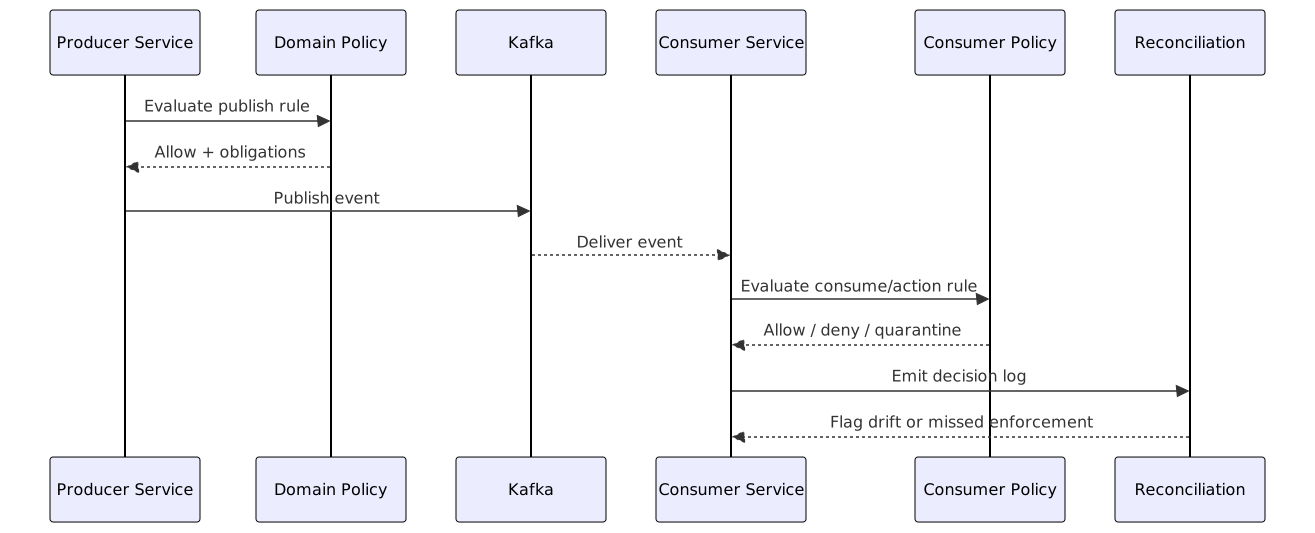
This leads to a policy evaluation flow that looks more like choreography than checkpointing.

This is not a single control point. It is a chain of decisions, each with different semantics.
Architecture
A strong architecture for policy-as-code placement usually has the following characteristics.
Policy domains, not one giant repo
Enterprises love central repositories because they create the illusion of order. But one giant policy repo often becomes the policy equivalent of a shared database: heavily governed, poorly understood, and feared by everyone.
A better pattern is federated ownership:
- shared platform policy repositories for global guardrails
- domain policy repositories owned by bounded contexts
- common test libraries and policy schemas
- enterprise-wide observability and attestation
In DDD terms, policy should be part of the ubiquitous language of the bounded context. If Claims says “high-risk payout,” that term should appear in policy artifacts, tests, and decision logs exactly as the domain uses it. Not translated into generic platform jargon.
Decision points and enforcement points are different things
This distinction matters more than most teams realize.
- Policy Decision Point (PDP): evaluates rules and returns a decision
- Policy Enforcement Point (PEP): actually allows, blocks, transforms, quarantines, or annotates behavior
A gateway can be a PEP. A service method can be a PEP. A Kafka consumer can be a PEP. A Kubernetes admission controller is a PEP. The PDP may be embedded, sidecar-based, library-based, or remote.
The trap is pretending a single PDP can sensibly adjudicate every kind of decision with no local domain model. It cannot.
Domain semantics first
If a rule depends on aggregate state, workflow stage, contractual entitlement, risk score, or exception history, then the service owning that domain should remain in the loop. This may mean:
- evaluating policy locally against domain facts
- constructing a policy input document from domain state
- keeping some rules in code because they are inseparable from invariants
Not everything belongs in a generic declarative engine. Some business rules are better expressed in regular code because they evolve with the domain model and require rich behavior, not just predicates.
A useful rule of thumb:
If the policy changes the meaning of the aggregate, it is domain logic. If it governs the safe operation of the platform, it is platform policy.
There is overlap, but the distinction is healthy.
Event-driven architecture and policy
Kafka complicates policy placement because events outlive the moment they were produced. They are facts, commands, notifications, and integration contracts all at once, depending on how badly the enterprise has named them.
There are several places where policy matters in event flows:
- who may publish to a topic
- what payloads are valid
- whether sensitive fields must be masked
- whether a consumer is entitled to act on the event
- how replays interact with newer policy versions
- whether rejected events go to dead-letter queues, quarantine streams, or compensating workflows
A clean pattern is:
- producer enforces domain legitimacy before publishing
- broker enforces transport security and ACLs
- consumer enforces local entitlement and action policy
- reconciliation detects policy drift and historical anomalies
That last part is often forgotten.
Reconciliation is not a consolation prize
In enterprise systems, reconciliation is architecture, not cleanup.
Some policies cannot be fully enforced inline because:
- upstream data arrives late
- authoritative data is split across systems
- remote policy calls are too expensive
- asynchronous flows require eventual decisions
- business tolerates temporary acceptance with later correction
So you design for reconciliation explicitly:
- maintain decision logs
- store policy version used at decision time
- emit policy evaluation outcomes as events
- run periodic checks across state and event history
- trigger compensations, alerts, holds, or case management workflows
This is especially important in financial services, insurance, healthcare, and large B2B operations, where “deny immediately” is often less practical than “accept provisionally, then settle truth through workflow.”
Migration Strategy
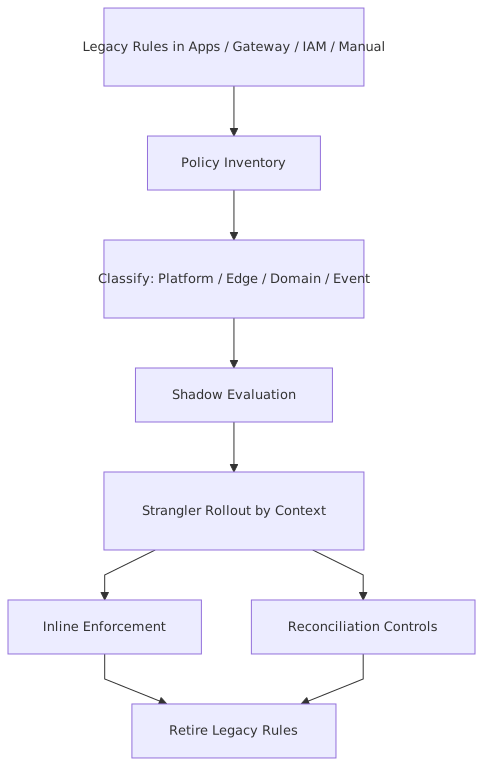
Policy-as-code placement is almost never greenfield. The real work is migration.
Legacy estates contain policy in:
- application code
- API gateways
- IAM groups and roles
- BPM/workflow engines
- ETL jobs
- database triggers
- spreadsheets
- manual approval queues
- tribal knowledge in operational teams
A big-bang rewrite is usually fantasy dressed as bravery. Use a progressive strangler migration instead.
Step 1: Inventory policy by semantic class
Do not begin with tools. Begin with a policy inventory:
- what is the rule
- who owns its meaning
- where is it enforced today
- what is the blast radius if it fails
- is it preventive or detective
- what facts does it require
- how fast must it decide
- what evidence is required for audit
This reveals duplicate rules, contradictory interpretations, and “policies” that are really downstream compensations for bad master data.
Step 2: Externalize low-risk, high-value rules first
Start with policies that are:
- well understood
- frequently changed
- easy to test
- currently duplicated
- not deeply coupled to imperative domain behavior
Common candidates:
- edge authorization checks
- environment guardrails
- simple entitlement rules
- schema and contract validation
- deployment policies
Do not begin with the gnarliest workflow exception logic in the oldest core system. That path produces theology, not progress.
Step 3: Introduce side-by-side evaluation
Before turning on enforcement, run policy in shadow mode:
- evaluate existing path and new policy path
- compare decisions
- log divergences
- explain mismatches with domain teams
- tune inputs and semantics
This is especially important for customer-impacting decisions and Kafka consumers.
Step 4: Strangle by entry point and bounded context
Migrate policy placement one seam at a time:
- edge first for coarse controls
- selected services for domain-owned decisions
- event publishers/consumers for asynchronous paths
- reconciliation for backstop coverage
Do not centralize all legacy rules into one engine and call that modernization. You will simply move the mess.
Step 5: Build policy observability before broad enforcement
A mature migration includes:
- decision logs
- policy versions
- input hashes or snapshots
- latency metrics
- allow/deny/error rates
- fallback counts
- override reports
- drift dashboards
Architects often underinvest here because observability feels secondary. It is not. Without it, policy becomes superstition.
Enterprise Example
Consider a multinational insurer modernizing claims processing across web channels, partner APIs, and internal operations.
The estate includes:
- a legacy claims platform
- new microservices for FNOL, fraud scoring, payments, and document processing
- Kafka for event integration
- a cloud API gateway
- Kubernetes for runtime
- multiple regional compliance obligations
At first, the company tries to centralize “all policy” into a single policy engine behind the gateway. It works for:
- authentication
- partner tier access
- request validation
- coarse regional restrictions
Then things break in more interesting ways.
A claim payout approval depends on:
- claim type
- policy coverage terms
- fraud score
- adjuster seniority
- local regulation
- previous exceptions
- whether documents were submitted through a broker or a direct channel
- whether this is first settlement or final settlement
The gateway does not own these facts. Pulling them into the edge turns every request into a distributed join. Latency climbs. Caching introduces stale decisions. Support cannot explain denials because the policy input assembled at the gateway differs from the domain’s current state. Worst of all, Kafka-driven payment release jobs bypass the gateway entirely.
So the architecture changes.
Revised design
- Gateway handles partner authentication, tenant routing, coarse access checks, and request quotas.
- Claims service owns payout decision policy because it understands claim state and workflow semantics.
- Fraud service provides risk facts, not final business authorization.
- Payments service enforces disbursement controls at execution time, including consumer-side checks on Kafka events.
- Kubernetes admission enforces operational guardrails.
- Reconciliation service periodically checks claims approved under old policy versions against current exception lists and regulator changes.
This is a far better enterprise design because it matches policy to meaning.
There is also a subtle DDD lesson here. “Can this payout be approved?” is not one policy. It is a composition of bounded-context concerns:
- Claims decides workflow eligibility
- Fraud contributes risk assessment
- Payments decides execution control
- Compliance defines regional obligations
- Identity decides actor authenticity
Trying to collapse that into one global rule file produces brittle coupling and organizational conflict.
Operational Considerations
Policy architecture lives or dies in operations.
Versioning
You need explicit versioning for:
- policy bundles
- policy inputs
- decision contracts
- reference data sources
When a customer challenges a denial or an auditor asks for evidence, “we applied the latest rule” is not an answer. You need to know which rule, with which inputs, at which time.
Explainability
A deny without explanation is just a ticket generator.
Policy decisions should return structured reasons:
- matched rule identifiers
- missing attributes
- obligations or remediation steps
- confidence or advisory status if appropriate
This matters for support, audit, and debugging. It matters even more in enterprises where human override processes coexist with automated decisions.
Caching and staleness
Caching is tempting in remote PDP models. It is also dangerous.
Cache only when:
- policy input can be safely normalized
- staleness tolerance is explicit
- invalidation strategy is credible
- failure semantics are defined
Otherwise you get one of the classic cloud architecture mistakes: a highly available source of confidently outdated truth. cloud architecture guide
Fail-open or fail-closed
Every policy path needs a declared failure mode.
- Fail-closed fits high-risk access and safety decisions.
- Fail-open may fit low-risk advisory policies or noncritical enrichments.
- Quarantine is often the right answer for event processing.
- Retry with idempotency matters for transient remote PDP issues.
Do not leave this to runtime accidents.
Testing
Policy-as-code requires more than unit tests. You want:
- rule tests
- contract tests for policy input schemas
- golden datasets from production scenarios
- shadow mode comparisons
- property-based tests for edge cases
- replay testing for Kafka event histories
Without replay and reconciliation testing, event-driven policy remains guesswork.
Tradeoffs
There is no perfect placement. Only explicit tradeoffs.
Centralized PDP
Pros
- consistency
- auditability
- reusable tooling
- clearer governance
Cons
- latency
- remote dependency risk
- domain abstraction leaks
- temptation to over-centralize ownership
Embedded policy in services
Pros
- rich domain context
- lower latency
- team autonomy
- easier alignment with aggregates and invariants
Cons
- duplication risk
- uneven maturity
- fragmented governance
- harder enterprise-wide visibility
Gateway-heavy enforcement
Pros
- simple rollout
- immediate edge coverage
- strong coarse-grained controls
Cons
- bypass risk
- poor fit for deep business logic
- dangerous false confidence
- limited asynchronous coverage
Reconciliation-heavy design
Pros
- resilient to eventual consistency
- practical for batch and event-driven systems
- supports compensating workflows
Cons
- delayed enforcement
- operational complexity
- harder customer messaging
- requires strong case management
The right architecture usually combines all four in different places. Purity is overrated. Clarity is not.
Failure Modes
Policy-as-code programs fail in very recognizable ways.
1. The one-engine fantasy
Everything is pushed into one central engine. The engine becomes overloaded with domain semantics it cannot reliably understand. Teams work around it. Exceptions multiply. Trust falls.
2. Policy without domain language
Rules are written in technical terms nobody in the business recognizes. Validation becomes impossible because semantics have been translated out of existence.
3. Edge-only enforcement
The gateway blocks the obvious path while internal services, batch jobs, and Kafka consumers continue doing whatever they did before.
4. No reconciliation
Inline checks are treated as enough. Then stale reference data, delayed events, and race conditions create silent breaches no one notices until audit.
5. Hidden policy in data and workflows
Teams externalize some rules but leave crucial decisions in BPM tools, SQL scripts, and manual operations. The architecture diagram says one thing. The enterprise does another.
6. Undeclared failure semantics
A remote PDP times out. One service fails open. Another fails closed. A third retries forever. Congratulations: you no longer have policy. You have roulette.
When Not To Use
Policy-as-code is not a universal solvent.
Do not force it when:
- the rule is deeply embedded algorithmic behavior better expressed in regular code
- the domain model is still unstable and semantics change weekly
- the overhead of external policy evaluation exceeds the value
- the organization lacks ownership clarity for rule meaning
- the runtime path is so latency-sensitive that remote decisions are unacceptable
- a simple static configuration is enough
Likewise, do not use a centralized policy platform as a substitute for fixing broken domain boundaries. If five services need the same rule because their responsibilities are muddled, the first problem is decomposition, not policy syntax.
And in small systems, be honest. A few well-tested authorization checks and configuration-driven rules may be perfectly adequate. Not every application needs a policy control plane worthy of a multinational bank.
Related Patterns
Several related patterns often appear alongside policy-as-code placement.
Sidecar or local agent PDP
Useful when you want shared policy execution with lower latency and better resilience than a remote call.
Backend for frontend and gateway policy
Good for channel-specific admission and presentation-layer entitlements, but should not own core domain policy.
Saga orchestration with policy checkpoints
Helpful in long-running workflows where policy must be re-evaluated between steps.
Outbox and event-carried decision context
Allows producer services to include policy metadata or decision evidence alongside events, with care to avoid over-coupling.
Reconciliation and compensating transaction patterns
Essential where eventual consistency and delayed truth are normal.
Strangler fig migration
The right default for introducing policy-as-code into legacy estates without a dangerous rewrite.
Summary
Policy-as-code placement is one of those architecture decisions that looks tactical until it starts shaping the whole operating model.
The right answer is not “put policy in one place.” The right answer is put each class of policy at the point where its meaning and enforcement both make sense.
Use platform controls for platform guardrails. Use edge controls for admission. Keep business policy close to the bounded context that owns its semantics. Treat Kafka and asynchronous processing as first-class policy paths, not side notes. Add reconciliation because the enterprise is not perfectly synchronous, no matter what the architecture review deck says.
Above all, respect domain language. If policy cannot be explained in the vocabulary of the business, it will not survive contact with reality.
A good policy evaluation flow is not a wall. It is a sequence of well-placed decisions, each owned by the right part of the enterprise, each observable, testable, and honest about its limits.
That is the architecture worth building.
Frequently Asked Questions
What is cloud architecture?
Cloud architecture describes how technology components — compute, storage, networking, security, and services — are structured and connected to deliver a system in a cloud environment. It covers decisions on scalability, resilience, cost, and operational model.
What is the difference between availability and resilience?
Availability is the percentage of time a system is operational. Resilience is the ability to recover from failures — absorbing disruption and returning to normal. A system can be highly available through redundancy but still lack resilience if it cannot handle unexpected failure modes gracefully.
How do you model cloud architecture in ArchiMate?
Cloud services (EC2, S3, Lambda, etc.) are Technology Services or Nodes in the Technology layer. Application Components are assigned to these nodes. Multi-region or multi-cloud dependencies appear as Serving and Flow relationships. Data residency constraints go in the Motivation layer.