⏱ 19 min read
There is a particular kind of fragility in distributed systems that doesn’t show up in architecture diagrams. The boxes look clean. The arrows look tidy. The interfaces are documented. Everyone says the systems are “loosely coupled.” And then one service slows down, another is briefly unavailable, a third changes a workflow, and suddenly the business process behaves like a row of falling dominoes.
That fragility is temporal coupling.
Not just coupling of schema. Not just coupling of technology. Coupling in time. One system must be available now because another system needs it now. One decision must be made in this transaction because the next step assumes it. One API call is not merely a request for information; it is a demand that another bounded context participate immediately in your business flow.
This is where many distributed systems become accidental monoliths stretched over a network. They look modern because they use microservices, Kafka, gateways, and cloud platforms. But underneath, they are still synchronized around a shared timeline. And time, unlike code, is not something you can easily refactor away after the fact. event-driven architecture patterns
If you are building enterprise systems, especially ones shaped by order lifecycles, customer state, payments, inventory, claims, bookings, or policy decisions, temporal coupling is not an edge concern. It is one of the main architectural forces. Ignore it, and your API portfolio becomes a brittle choreography of “just-in-time” dependencies. Handle it well, and you get resilience, clearer domain boundaries, and systems that can survive partial failure without dragging the business to a halt.
This article digs into temporal coupling in APIs through a practical enterprise lens: domain-driven design, microservices, Kafka-backed integration, migration from synchronous estates, reconciliation, failure modes, and the tradeoffs nobody escapes. microservices architecture diagrams
Context
Most enterprise architecture conversations begin with interface style: REST or events, synchronous or asynchronous, request-response or pub/sub. Useful questions, but secondary.
The deeper question is this: does this business interaction require immediate co-participation from multiple bounded contexts, or are we merely modeling it that way because it is convenient for developers?
That distinction matters.
A lot of API design quietly assumes a single business timeline. The customer places an order, so Order Service calls Pricing, Inventory, Promotions, Fraud, Customer Profile, and Payment in sequence. The happy path works in demos. Then the real world arrives: a pricing rule engine has a 1.8-second spike, inventory is eventually updated from a warehouse system, fraud scoring runs on delayed data, and payment authorization occasionally times out. What looked like orchestration is really a chain of temporal obligations.
In domain-driven design terms, this often means one bounded context is reaching across others to complete its own invariants. That is a warning sign. A bounded context should protect its own language and rules. If it constantly needs other contexts to be online and current at the exact instant of a command, then either the domain truly demands that coordination or the model is leaking.
There is no virtue in pretending all temporal coupling is bad. Some business decisions are inherently immediate. You should not ship goods before a payment authorization policy is satisfied if the business requires authorization up front. You should not confirm a seat assignment without checking seat availability in the authority context that owns it. But enterprises often overuse synchronous APIs for things that only feel urgent because of user interface expectations or inherited transaction thinking from a monolith.
The result is coupling not merely in structure, but in time, throughput, latency budget, deployment cadence, and failure blast radius.
Problem
Temporal coupling appears when a service cannot complete useful work unless another service responds within the same operational window.
A simple GET dependency is already a form of temporal coupling. A command that triggers a sequence of blocking API calls is worse. A distributed transaction that expects several services to succeed atomically is worse still.
The practical consequences are familiar:
- availability of the whole flow collapses toward the least reliable dependency
- latency accumulates across hop chains
- retry behavior amplifies load during incidents
- deployment coordination increases because interface changes are consumed immediately
- domain boundaries erode because services ask each other for runtime decisions instead of owning policies locally
- backpressure becomes contagious
A team will often say, “But these are independent microservices.” If every user action fans out to six runtime dependencies, they are independent in source control, not in operations.
This problem becomes sharper in event-driven estates too. People assume Kafka removes coupling. It does not remove temporal coupling by magic; it changes where coupling lives. You can reduce runtime blocking and still remain semantically coupled if a downstream process must react within strict deadlines, or if upstream producers and downstream consumers disagree on meaning, ordering, idempotency, or completeness.
Temporal coupling is therefore not just a transport concern. It is a domain semantics concern.
Forces
Several forces pull architects toward temporal coupling, even when they know better.
Business demand for immediacy
Users expect instant responses. Sales channels want immediate confirmation. Contact centers do not want to say, “We accepted your request and will reconcile later.” Businesses optimize for perceived certainty, and synchronous APIs create the illusion of certainty.
Sometimes that is right. Often it is simply expensive theatre.
Legacy transaction thinking
Many enterprises grew up on ACID transactions inside a single database or ERP suite. When they decompose systems, they preserve the old workflow shape. What used to be a local method call becomes a remote API call. What used to be a single transaction becomes a multi-hop synchronous chain. The architecture changes form but not habit.
Domain ambiguity
If teams do not agree on domain ownership, they query each other at runtime to settle arguments. Who owns customer eligibility? Who owns available credit? Who owns product salability? Ambiguity produces chatty APIs because nobody has committed to where truth lives.
Compliance and control
Audit, fraud, credit, pricing, and policy controls often require business decisions before progression. These are legitimate forces. The mistake is to assume every control must be a synchronous inline decision instead of distinguishing pre-decision, provisional decision, and post-fact reconciliation.
Operational simplicity for developers
A synchronous API is easy to reason about locally. Request in, response out. Error codes. Immediate test feedback. Event-driven processing requires idempotency, outbox patterns, dead-letter handling, replay, and reconciliation. Those are real costs. Temporal decoupling is not free.
Organizational structure
Conway wins again. If teams are funded and measured around their own services, they expose APIs and let consuming teams compose business flows. Without strong domain governance, this encourages runtime dependency webs instead of purposeful domain collaboration. EA governance checklist
Solution
The core solution is not “use async everywhere.” That slogan creates as many problems as it solves.
The real solution is to design around domain time, not network convenience.
Start by asking which business decisions must be made synchronously because they protect an invariant at the point of interaction, and which can be made asynchronously with compensation, reconciliation, or eventual confirmation.
That leads to a few practical architectural moves:
- Keep synchronous APIs for true immediate invariants.
Use them where the business genuinely requires a now-or-never answer.
- Replace informational runtime dependencies with replicated domain views.
If a service constantly calls another for reference data or status that can tolerate staleness, publish events and maintain a local read model.
- Model workflows as state transitions, not remote call scripts.
The domain object should progress through meaningful states: PendingValidation, ProvisionallyAccepted, Confirmed, Rejected, Reconciled.
- Use asynchronous commands or events for cross-context collaboration.
Especially when one context informs another rather than asks permission from it.
- Build reconciliation deliberately.
Eventual consistency without reconciliation is wishful thinking.
- Accept that some processes are sagas.
Not everything deserves distributed transactions. Most enterprise flows are better expressed as long-running processes with explicit compensations and timeout rules.
Temporal decoupling is not merely a resiliency technique. It is often a better expression of the business. Real businesses live with pending states, delayed confirmations, manual exceptions, and adjustment processes all the time. Architecture should tell the truth about that.
Architecture
A useful way to think about temporal coupling is through bounded contexts and decision rights.
If Order needs Customer Profile online at runtime just to know a customer’s segment, that is often poor design. Customer events could project the segment locally. If Order needs Payment Authorization now because the business refuses to reserve goods without funds hold, that may be legitimate synchronous coupling. The difference is domain semantics, not engineering taste.
Here is the common anti-pattern.
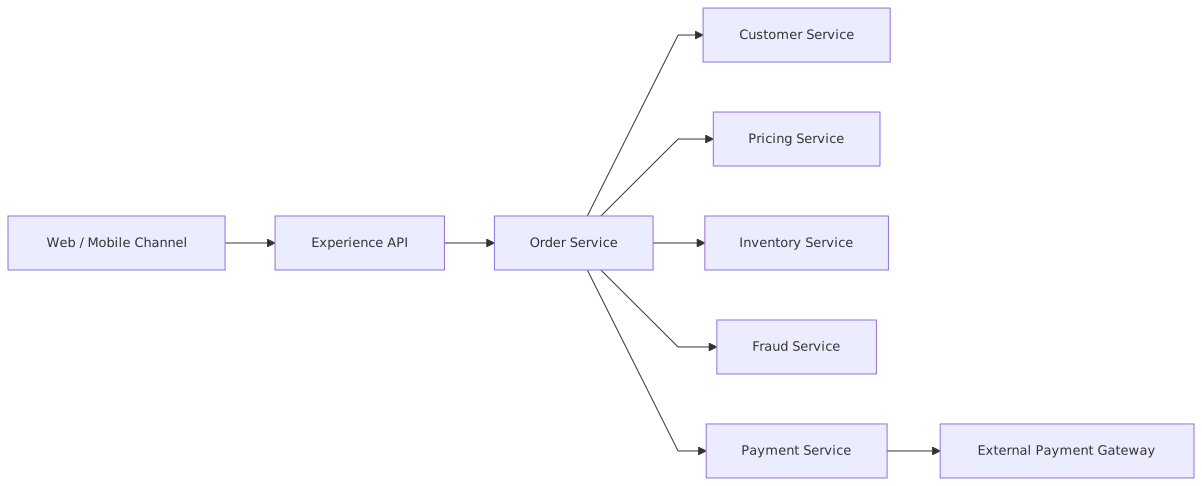
This looks normal because it is normal. It is also where resilience goes to die. Every dependency is on the critical path. Every timeout becomes a business outage. Every retry multiplies pressure. And Order becomes less a bounded context than a traffic controller.
A better architecture separates command acceptance from cross-domain completion where the business allows it.
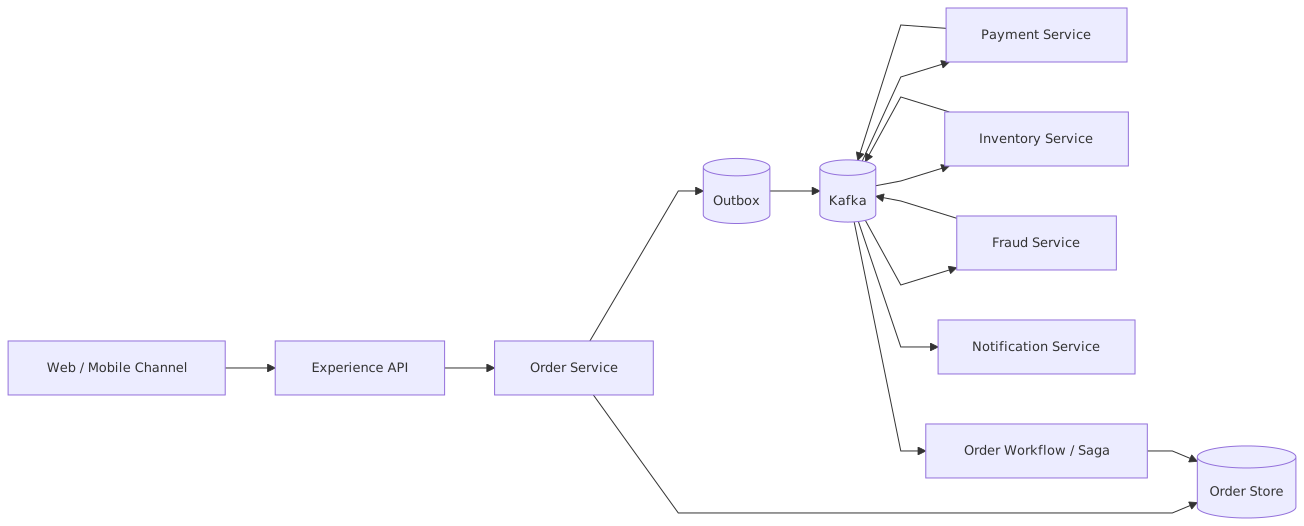
In this model, Order accepts a command, persists intent, publishes an event through an outbox, and a workflow or saga coordinates subsequent state changes. Payment, inventory, and fraud each respond in their own time. The order may be provisional at first, then confirmed when enough evidence arrives.
This approach does three important things.
First, it narrows the synchronous boundary. The business interaction with the user may still be fast, but only because the accepted commitment is narrower and honest. “We received your order” is not the same as “Everything across the enterprise has completed.”
Second, it lets each bounded context own its language. Payment authorizes. Inventory reserves. Fraud assesses. Order does not impersonate all three.
Third, it creates room for replay and reconciliation. In a synchronous chain, once a timeout occurs, you often do not know what happened downstream. In an evented flow with durable state and process tracking, uncertainty is explicit and resolvable.
Domain semantics and local truth
A common mistake is to create APIs that expose domain internals as runtime lookup services. “Can I sell this product?” sounds simple, but who decides? Product? Inventory? Commercial Policy? Regulatory Rules? Channel? The answer is usually contextual.
DDD helps here. A bounded context should not become a universal question-answering service for all semantics touching its data. Instead, contexts should publish facts and own decisions in the language of their domain. Other contexts may derive local policies from those facts.
For example:
- Catalog publishes
ProductActivated,ProductWithdrawn,ProductAttributesChanged - Commercial Policy publishes
ProductSellabilityChanged - Inventory publishes
StockPositionChanged - Order owns
OrderAccepted,AwaitingReservation,Confirmed,Backordered
Now the system reflects business meaning rather than a tangle of “checkX” APIs.
Sync where it belongs
There are still places for synchronous APIs:
- customer interaction that needs immediate acknowledgment
- narrow validation at trust boundaries
- authoritative decision points with strict legal or financial rules
- query APIs for user-facing reads where freshness matters and the source system truly owns the read
The point is discipline. Make synchronous coupling the exception you can justify, not the default you inherit.
Migration Strategy
You rarely get to redesign from scratch. Most enterprises begin with a stack of tightly coupled APIs and a list of incidents blamed on “network instability.” The migration has to be progressive.
The strangler pattern is the right instinct, but in temporal coupling work it needs one extra dimension: you are not just replacing endpoints; you are changing when decisions are made.
A practical migration sequence looks like this:
1. Map the coupling timeline
Inventory current APIs not only by dependency graph but by timeline:
- which calls are on the customer request path
- which are hard blockers
- which are lookups
- which are command side effects
- what timeout budgets exist
- what retries and circuit breakers do during incidents
This produces a far more useful picture than a static service map.
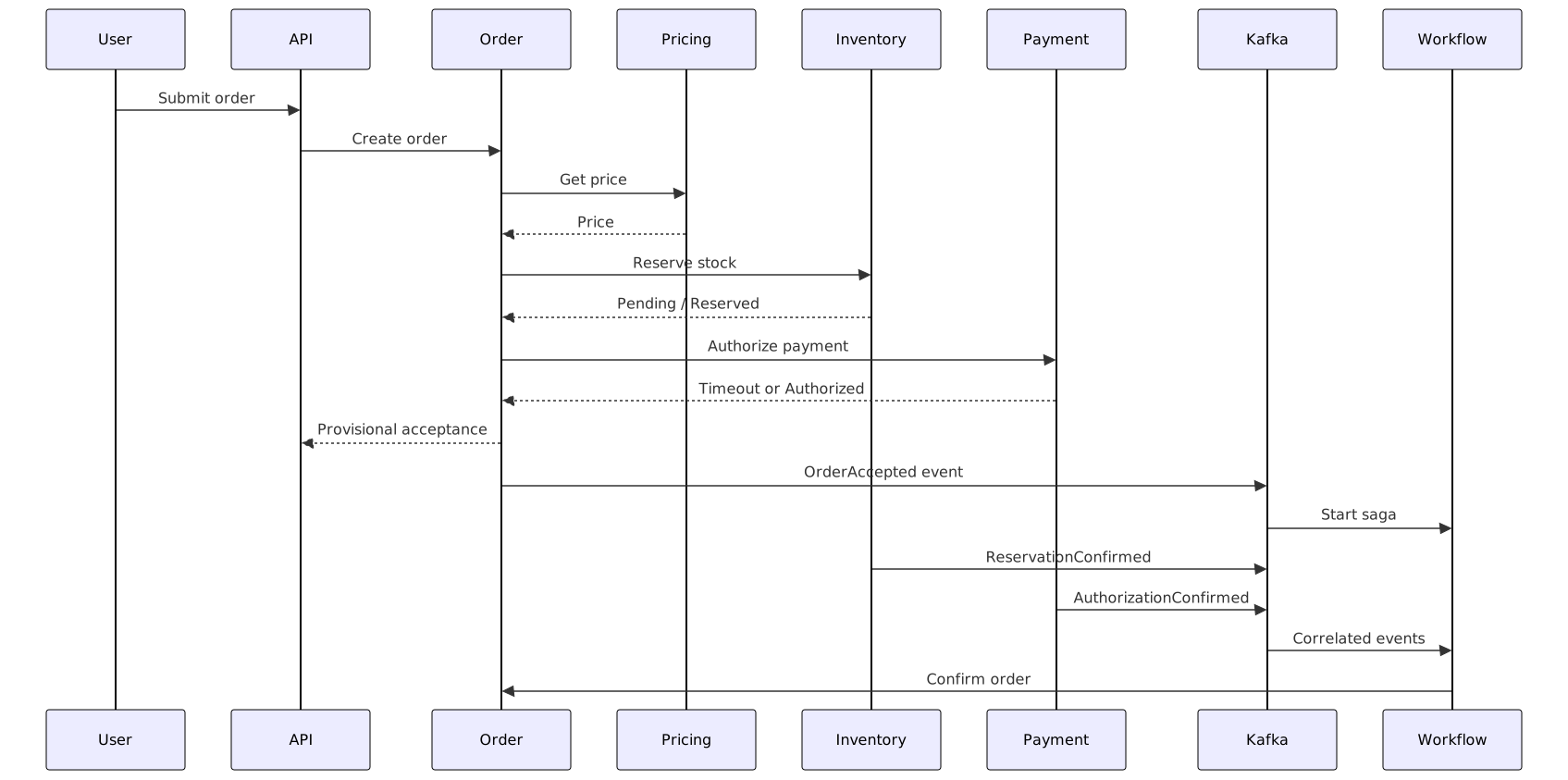
That sequence captures the hybrid reality many enterprises need during transition.
2. Identify lookup calls to replace with local projections
The easiest wins are informational GET calls. If Order repeatedly calls Customer, Catalog, or Pricing for mostly stable facts, project those facts into local read models from Kafka topics or change events. This removes load and latency from the critical path without changing user-visible behavior too much.
Do not mirror entire source schemas. Project only what the consuming context needs. Otherwise you build a distributed reporting mess.
3. Introduce outbox and event publication at service boundaries
Before changing process flow, make service state changes publishable reliably. The outbox pattern is the workhorse here. Without it, event-driven migration becomes hand-waving around dual writes.
4. Split acceptance from completion
Next, change command semantics. Instead of “place order and synchronously complete everything,” move to “accept order intent, then complete through workflow.” This is the pivotal step. It affects UI messages, SLAs, operational dashboards, and business expectations.
5. Add workflow tracking and reconciliation
You need a process manager, saga orchestrator, or at least explicit state transition logic. More importantly, you need reconciliation jobs:
- detect accepted commands without downstream confirmations
- detect duplicate or late events
- detect mismatches between source-of-record and projections
- trigger compensations or manual review
6. Retire inline dependencies one by one
As confidence grows, remove synchronous blockers from the request path, keeping only those that truly protect immediate invariants.
7. Change contracts, not just plumbing
A migration fails when the backend becomes asynchronous but the API contract still promises synchronous certainty. If your architecture says “provisional” but your API says “confirmed,” operations will pay for the lie.
Enterprise Example
Consider a large retail bank modernizing credit card servicing.
Originally, a customer address update from digital channels triggered a synchronous chain:
- Customer Profile API updates core CRM
- CRM API calls Compliance Screening
- Compliance calls Fraud Risk
- Customer Profile calls Card Operations
- Card Operations calls Statement Delivery
- Statement Delivery calls Print Vendor integration
The channel expected a single success response meaning “address changed everywhere.”
It worked until it didn’t. A print vendor outage blocked profile changes. Fraud screening latency caused mobile timeouts. Duplicate retries created conflicting updates in downstream systems. Meanwhile, the business reality was simpler: the bank needed to acknowledge receipt of a customer address change immediately, apply it to the system of record, and ensure downstream obligations were completed with auditability.
The redesigned approach looked different.
Customer Profile became the authority for the customer address change command. It wrote the change, emitted CustomerAddressChanged, and marked downstream obligations as pending. Compliance, Fraud, Card Operations, and Statement Delivery subscribed and acted within their own bounded contexts. A servicing workflow tracked completion. Any downstream mismatch raised reconciliation tasks. The channel returned a response such as “address updated; related services may take a short time to reflect the change.”
That sounds less elegant than a one-shot synchronous success. It was much better architecture.
Why?
- profile updates no longer failed because a print integration was down
- downstream teams could scale independently
- audit became clearer because each context recorded its own action against the event
- late or duplicate vendor responses could be reconciled instead of hidden behind API retries
- the customer-facing truth aligned with the business process
The tradeoff was also real. Some service representatives disliked the pending state. Operations needed dashboards for in-flight obligations. Reconciliation queues required care and staffing. But this is adult architecture: replacing fake simplicity with managed complexity that matches reality.
Operational Considerations
Temporal decoupling shifts work from the request thread into the operating model.
Observability by business flow
Technical tracing is not enough. You need correlation IDs tied to domain identifiers such as order ID, payment ID, claim ID, or customer ID. Dashboards should show where a process is waiting: payment authorization, inventory reservation, fraud review, external partner acknowledgment.
If you cannot answer “where is this business transaction now?” your architecture is unfinished.
Idempotency
Asynchronous systems redeliver. Producers retry. Consumers restart. External partners send duplicates. Every command handler and event consumer touching meaningful state should be idempotent or guarded by deduplication keys and version logic.
Ordering and partitioning in Kafka
Kafka helps with durable event distribution, but it does not solve semantics for you. Event ordering is only guaranteed within a partition. Choose keys by aggregate or process identity where ordering matters. Cross-aggregate workflows need explicit correlation rather than assumptions of global sequence.
Schema and contract evolution
Temporal decoupling often lengthens coexistence between old and new contracts. Versioning becomes a business issue because consumers may process delayed messages long after producers deploy. Favor additive event evolution, preserve semantic stability, and avoid leaking internal model churn into public contracts.
Reconciliation
Reconciliation deserves more respect than it gets. In many enterprises, it is the difference between eventual consistency and permanent inconsistency.
Useful reconciliation mechanisms include:
- replay from Kafka topics
- daily or hourly source-of-record comparison jobs
- exception queues for unmatched or late events
- compensating commands for partial completion
- human-in-the-loop worklists for irreducible ambiguity
A clean architecture has a place for mess. Reconciliation is that place.
SLAs and user messaging
If completion is asynchronous, product and business teams must shape user promises accordingly. “Submitted,” “processing,” “confirmed,” and “action required” are not copywriting details. They are part of the architecture.
Tradeoffs
Temporal decoupling buys resilience and autonomy, but it comes with costs.
The big win is reduced blast radius. A dependent service outage no longer necessarily blocks command acceptance. The system can continue ingesting work, then catch up.
Another win is domain clarity. Teams stop asking each other for runtime permission on every step and instead collaborate through facts and bounded decisions.
But the costs are not cosmetic.
You introduce:
- eventual consistency
- pending states in user journeys
- reconciliation logic
- operational dashboards
- replay and deduplication concerns
- harder end-to-end testing
- more nuanced business conversations
This is the central tradeoff: synchronous designs centralize complexity in runtime coupling; asynchronous designs distribute complexity into state management and operations.
Neither eliminates complexity. They move it around.
My view is opinionated: enterprises usually underestimate the cost of runtime temporal coupling because it is hidden inside “simple API calls,” and overestimate the cost of asynchronous design because its machinery is visible. Visibility is not the same thing as burden. Hidden coupling is often worse because it explodes during incidents.
Failure Modes
Poorly handled temporal coupling fails in predictable ways.
Cascading timeout storms
A slow dependency causes upstream retries, saturating thread pools and connection pools. Latency spreads like smoke through the system.
Phantom uncertainty
A synchronous call times out, but the downstream action may have completed. The caller retries, producing duplicates or inconsistent compensations. This is common in payment and fulfillment flows.
Semantic drift in replicated views
Teams replace runtime APIs with local projections but copy data without shared semantic discipline. Eventually they hold stale or misinterpreted facts and make bad decisions faster.
Saga sprawl
In reaction to synchronous pain, teams build orchestration for everything. The result is a central workflow engine becoming a distributed brain that knows too much about every domain. That is just temporal coupling disguised as process management.
Reconciliation denial
The team says the system is eventually consistent but never implements actual reconciliation. Late, missing, or malformed events become silent corruption.
User promise mismatch
The UI says “confirmed” when the backend only accepted intent. This eventually turns into customer complaints, operational fire drills, and loss of trust.
When Not To Use
Temporal decoupling is not a religion.
Do not introduce asynchronous workflows and replicated views when:
- the domain requires a strict immediate invariant and delay is unacceptable
- the process is simple, local, and safely contained within one service or database
- the organization lacks operational maturity for event-driven systems
- business stakeholders cannot tolerate provisional states and there is no compensation model
- the transaction volume and criticality do not justify the added machinery
A small internal line-of-business app with a handful of tightly related functions may be better served by a modular monolith with local transactions. That is not a failure of modernity. It is architecture with a sense of proportion.
Likewise, if two capabilities are not meaningfully separate bounded contexts, splitting them into microservices and then repairing the resulting temporal coupling with Kafka is self-inflicted injury.
Related Patterns
Several patterns sit naturally around this topic.
- Saga / process manager: coordinate long-running state transitions across services
- Outbox pattern: publish state changes reliably without dual-write hazards
- CQRS read models: maintain local query views to remove synchronous lookups
- Strangler fig migration: progressively redirect traffic and behavior from tightly coupled legacy flows
- Bulkhead and circuit breaker: contain synchronous dependency failure where sync remains necessary
- Retry with idempotency: essential, but only when semantics are safe
- Compensating transaction: undo or offset previous actions in long-running workflows
- Event sourcing: sometimes useful, though not required, where replay and audit are first-class needs
- Anti-corruption layer: shield new domain models from legacy API semantics during migration
These are not independent tricks. They form a toolkit for moving from a shared runtime timeline to bounded, resilient collaboration.
Summary
Temporal coupling is one of the quiet killers of distributed systems. It turns a collection of services into a system that must breathe in unison. The architecture may be distributed, but the dependency on shared timing makes it behave like a fragile machine.
The cure is not dogmatic async messaging. It is better domain thinking.
Use domain-driven design to decide where authority belongs. Reserve synchronous APIs for true immediate invariants. Move informational dependencies to local projections where staleness is acceptable. Model workflows as explicit states, not as invisible call chains. Publish events reliably. Reconcile relentlessly. Migrate progressively with a strangler mindset, changing not just interfaces but the timing assumptions beneath them.
And above all, tell the truth in your contracts.
A system that says “accepted” and later confirms is often healthier than one that says “done” only because six downstream services happened to respond before a timeout. In enterprise architecture, honesty beats elegance. Every time.
Frequently Asked Questions
What is a service mesh?
A service mesh is an infrastructure layer managing service-to-service communication. It provides mutual TLS, load balancing, circuit breaking, retries, and observability without each service implementing these capabilities. Istio and Linkerd are common implementations.
How do you document microservices architecture for governance?
Use ArchiMate Application Cooperation diagrams for the service landscape, UML Component diagrams for internal structure, UML Sequence diagrams for key flows, and UML Deployment diagrams for Kubernetes topology. All views can coexist in Sparx EA with full traceability.
What is the difference between choreography and orchestration in microservices?
Choreography has services react to events independently — no central coordinator. Orchestration uses a central workflow engine that calls services in sequence. Choreography scales better but is harder to debug; orchestration is easier to reason about but creates a central coupling point.