⏱ 21 min read
Most migration failures are not technical failures. They are cartographic failures.
A company looks at its estate, sees “applications” and “servers,” and designs a migration around infrastructure topology alone: move this VM, split that database, put an API gateway in front, call it modernization. Six months later the org has newer plumbing and the same old problems, now distributed across three clouds and an observability bill no one wants to discuss.
Topology migration is not merely about where software runs. It is about how business behavior is rearranged without tearing the fabric of the enterprise. That means the unit of movement is not the server, and often not even the service. It is the business capability, the transaction boundary, the aggregate of meaning. If you get the domain wrong, no amount of Kubernetes will save you.
This is where cloud architecture gets interesting, and messy. Enterprises rarely migrate from a neat monolith to a neat microservices landscape. They move through awkward intermediate topologies: shared databases with split read paths, Kafka-backed reconciliation loops, anti-corruption layers, temporary dual writes, event-carried state transfer, federated ownership, and islands of old and new that coexist longer than anyone planned. The migration topology diagram on the whiteboard matters because it tells you not just where components live, but how responsibilities, semantics, and failure blast radius shift over time.
The core question is brutally simple: what should move together, what must stay coherent, and what can tolerate inconsistency for a while?
That is the essence of topology migration patterns in cloud architecture. cloud architecture patterns
Context
Most enterprises are not building greenfield systems. They are inheriting decades of operational compromises. Core order processing still depends on a shared Oracle schema. Customer service workflows live across CRM, custom Java services, and nightly batch jobs. Product data is duplicated in five places because every reorg created a “strategic platform” and none were retired.
Then cloud migration arrives with executive sponsorship. Sometimes the driver is cost. More often it is speed: release faster, scale better, decouple teams, unlock AI, reduce data center commitments. But the estate does not cooperate. Dependencies are undocumented. Domain boundaries are fuzzy. Critical business invariants are enforced by code no one dares touch. The result is predictable: migration plans drawn as infrastructure moves collide with application reality.
A topology migration pattern is a way to structure that transition. It describes how old and new systems coexist while capabilities are moved, split, re-routed, synchronized, or re-owned. Good topology patterns preserve business continuity while changing the shape of the system. Bad ones create distributed ambiguity.
Cloud architecture adds pressure. Elastic runtime makes decomposition easier technically, but also hides design mistakes for longer. Messaging platforms like Kafka make asynchronous integration cheap, which tempts teams to publish events before they understand the semantics of those events. Managed databases lower operational toil, but shared persistence remains a trap if the domain is still tangled. The cloud is an amplifier. It rewards clarity and magnifies confusion.
So topology migration is not a lift-and-shift afterthought. It is the central architecture problem.
Problem
The real problem is not moving software from one place to another. It is changing system structure without breaking business meaning.
Legacy systems often concentrate multiple bounded contexts inside one deployable unit. A billing platform may contain pricing, invoicing, collections, tax calculation, and customer account logic, all sharing one schema and one release cycle. To migrate “billing” to the cloud is not one problem. It is a nest of problems.
Three tensions show up immediately.
First, technical topology and domain topology are misaligned. Teams think in terms of applications and databases because that is what they can see. But business change happens around concepts like order, claim, policy, subscription, shipment, ledger entry. Migration decisions made at the wrong level create awkward half-splits where infrastructure is separated but responsibilities remain tangled.
Second, transactional integrity gets weaponized by the past. The legacy platform often relies on local ACID transactions across many concerns. Once capabilities move into cloud-native services, those same flows become distributed, and consistency must be redesigned. Some invariants remain synchronous and hard. Others can become eventual and soft. If you don’t make that distinction intentionally, the system makes it accidentally.
Third, migration itself creates a temporary architecture that may live for years. The in-between state is not a brief inconvenience. In large enterprises, it is the operating model. That means temporary bridges, reconciliation jobs, dual-routing, and anti-corruption layers must be engineered as first-class architecture, not disposable scaffolding.
This is why simplistic advice fails. “Break the monolith into microservices” is not a migration strategy. It is a slogan. Topology migration needs sequence, semantics, and a sober view of what can go wrong. microservices architecture diagrams
Forces
Every useful architecture pattern emerges from forces in tension. Topology migration patterns are shaped by a particularly unforgiving set.
Domain cohesion versus delivery speed
Domain-driven design tells us to decompose along bounded contexts, not technical layers. That is right. But domain discovery takes time, and migration programs are under pressure to show progress. Enterprises are tempted to move what is easiest technically rather than what is coherent semantically. You can carve out the notification service in weeks. Carving out order orchestration may take months of argument because no one agrees where order ends and fulfillment begins.
Consistency versus autonomy
Cloud-native designs favor independent deployment and data ownership. The business, however, may require immediate consistency for key invariants: stock cannot go negative, double payment is unacceptable, policy issuance must satisfy regulatory checks. Some contexts can tolerate eventual consistency with reconciliation. Others cannot. Migration patterns must preserve hard invariants while allowing softer dependencies to decouple.
Safety versus simplification
Bridges reduce risk early and increase complexity later. Anti-corruption layers, event relays, sync adapters, and parallel run topologies allow migration to proceed incrementally. They also produce more moving parts, more failure modes, and more operational drag. Enterprises often keep these “temporary” components much longer than intended.
Team ownership versus platform centralization
Migration usually shifts runtime responsibilities toward platform teams: Kubernetes, service mesh, Kafka, IAM, observability. That can help. It can also centralize too much power and create hidden coupling. If every new service depends on a platform committee, topology improves on paper and stagnates in practice. event-driven architecture patterns
Data gravity versus service boundaries
Data is stubborn. Shared schemas outlive org charts. Historical records, reporting feeds, and regulatory archives create reasons to keep data centralized even when service boundaries want separation. A migration topology has to respect where data truly belongs, not just where it is currently stored.
Cost discipline versus strategic optionality
Parallel run costs money. Duplicate infrastructure, replicated data pipelines, idempotent consumers, comparison reports, support playbooks, rollback mechanisms—none of these are free. But eliminating them too early makes migration brittle. The enterprise architect earns their keep by choosing where optionality is worth paying for.
Solution
The practical solution is a progressive topology migration built around domain seams, explicit semantic contracts, and temporary coexistence mechanisms designed for controlled decay.
In plainer language: migrate by business capability, not by server group; isolate with anti-corruption layers; use events and APIs to bridge old and new; keep reconciliation visible; and retire transitional topology aggressively once confidence is established.
This almost always resembles some form of the strangler pattern, but the phrase is often used too loosely. A real progressive strangler migration is not simply routing more traffic to new services over time. It is reassigning authority over business decisions in stages.
A capability moves through a series of states:
- Legacy authority — old system remains source of truth and execution.
- Shadow or observe — new service reads events or copies of data, computes outcomes, but does not decide.
- Partial authority — new service owns selected operations or channels.
- Primary authority — new service decides; legacy is updated through integration.
- Legacy retired — old pathways are removed or turned into historical access only.
That progression matters because it exposes semantics before it changes accountability.
A sound migration topology usually combines several mechanisms:
- API façade or anti-corruption layer to stabilize upstream consumers.
- Event streaming, often Kafka, to propagate state changes and decouple read models.
- Reconciliation pipeline to compare old and new state during coexistence.
- Selective command routing by channel, tenant, product line, or operation type.
- Bounded context extraction with independent persistence.
- Fallback and rollback paths with explicit business constraints.
The migration is not complete when traffic reaches the new service. It is complete when the enterprise no longer depends on the old semantic model.
Architecture
A useful migration topology has two views: the structural view and the semantic view. Most diagrams only show the first.
Structurally, you see the monolith, the new cloud services, the event backbone, the databases, the gateway. Semantically, you must understand who owns what decision: who validates an order, who computes pricing, who confirms payment, who emits the business event that the rest of the enterprise should trust.
Here is a common starting point.
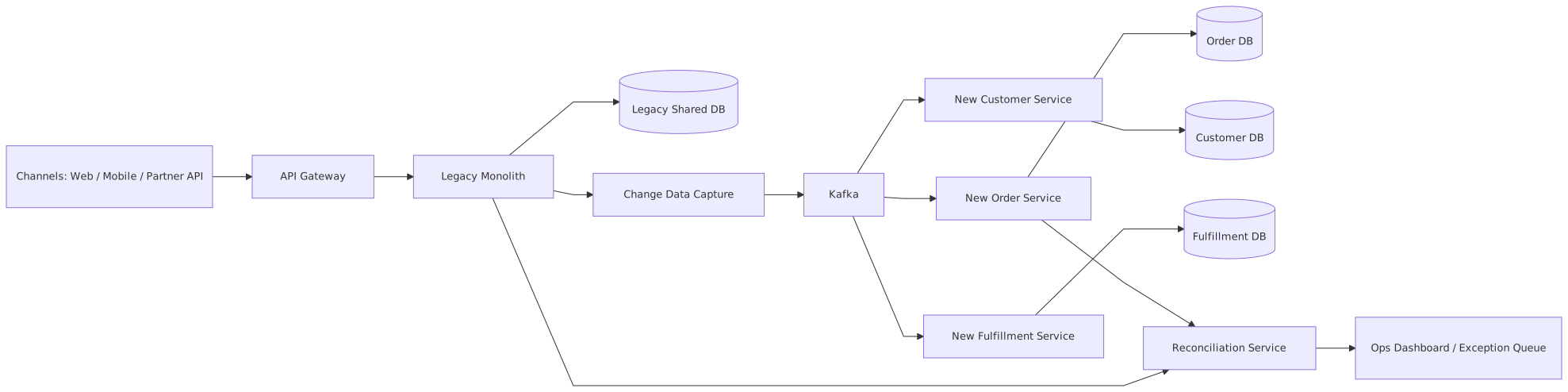
This is the classic coexistence shape. The monolith still handles production traffic. Change data capture or domain event extraction publishes activity onto Kafka. New services consume those streams, build state, and begin to model the domain in cleaner bounded contexts. Reconciliation compares outcomes or records drift.
This works well when you need to learn the domain before assuming control. It works badly if teams mistake replicated state for true ownership. A service that passively consumes events is not yet the authority, no matter how modern its codebase looks.
The next stage introduces selective command routing.
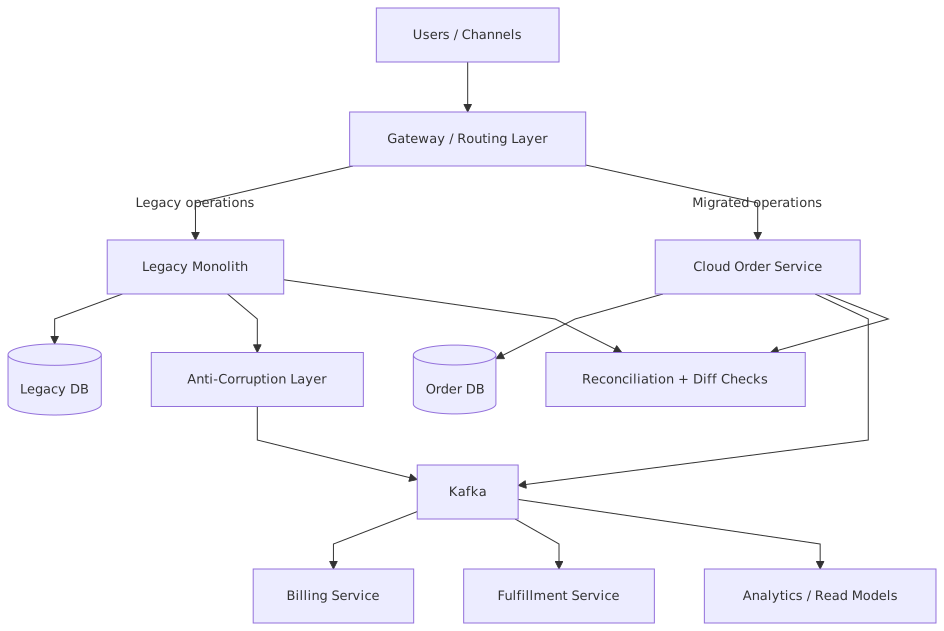
Now the topology changes in a meaningful way. Certain operations—perhaps new digital orders in one region—are routed directly to the cloud order service. Legacy still handles everything else. The anti-corruption layer translates legacy concepts into cleaner events and shields the new domain model from old schema leaks.
This is where domain-driven design earns its place. The cloud order service should not inherit legacy terms blindly. If the old system conflates quote, basket, and order because of historical convenience, the new bounded context should separate them if the business actually does. Migration is not archaeology. It is refactoring the enterprise’s model of itself.
Eventually, the architecture reaches a point where the old topology becomes downstream.
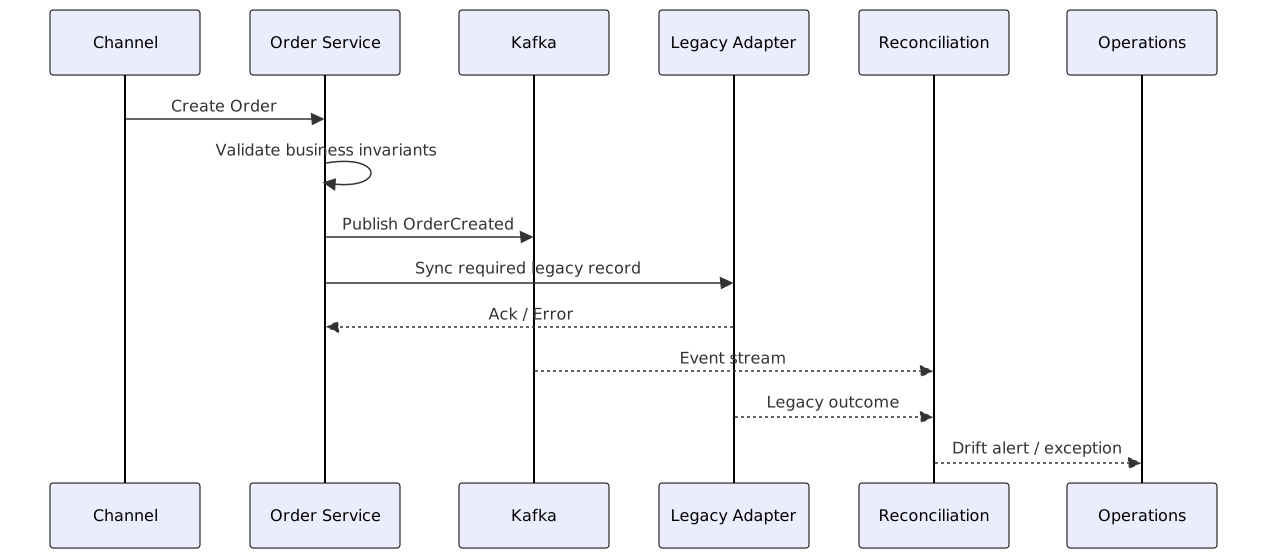
In this stage the new service is primary authority. Legacy receives synchronized updates only because dependent systems still need them. Reconciliation remains essential because reality will not line up perfectly. Integration lag, semantic mismatches, retries, operator interventions, and hidden downstream rules all produce divergence.
The point of topology migration is to make this divergence manageable, visible, and ultimately unnecessary.
Migration Strategy
A sensible migration strategy is staged, explicit, and biased toward learning.
1. Discover bounded contexts, not just interfaces
Start with business capabilities and domain semantics. Event storming, operational walkthroughs, exception handling analysis, and support ticket archaeology are often more valuable than reading source code. Ask:
- What business decisions happen here?
- Which invariants are non-negotiable?
- What concepts are overloaded?
- Where do teams argue over vocabulary?
- Which consumers rely on side effects no one documented?
This is domain-driven design in practical clothes. You are not chasing purity. You are looking for seams where authority can move.
2. Identify migration units
A migration unit should align to a bounded context or a meaningful subdomain, not a technical layer. “Customer profile reads” can be a migration unit. “All customer functionality” usually is not. “Pricing calculation for one product family” can be a migration unit. “The pricing application” is usually too coarse.
Good units have:
- clear ownership
- observable inputs and outputs
- manageable invariants
- an escape hatch if rollout goes wrong
3. Stabilize entry points
Before deep extraction, stabilize how traffic enters the system. API gateway, façade, or routing layer—pick your mechanism. The point is to avoid every consumer integrating directly with both legacy and new systems. A stable ingress buys you sequencing freedom.
4. Introduce event streams carefully
Kafka is often the right backbone for migration because it decouples producers and consumers, supports replay, and enables new services to build state without synchronous dependency. But use it with discipline.
Do not publish table-shaped events just because CDC made it easy. Publish domain events where possible, or at least wrap raw changes with semantics. “ORDER_STATUS_CD changed from 4 to 6” is a cry for help, not an event contract.
Where true domain events cannot yet be emitted, be honest: call it a replication stream, not event-driven architecture.
5. Build reconciliation from day one
Reconciliation is not an operations afterthought. It is a migration control system.
During coexistence you need to answer:
- Did both systems see the same business input?
- Did they derive the same key outcome?
- If not, which differences matter?
- Can the mismatch be auto-healed, ignored, or escalated?
A mature reconciliation design includes identity matching, tolerances, temporal windows, semantic comparison rules, and an exception workflow. The worst migrations are the ones where teams discover divergence only through customer complaints.
6. Move authority gradually
Use progressive strangler migration. Start with shadow reads or shadow decisions. Then route a narrow slice of commands: one region, one partner channel, one product SKU, one customer segment. Increase scope only when operational evidence supports it.
This is not cowardice. It is architecture with a memory of production.
7. Retire transitional topology aggressively
Once a capability is stable, remove duplicate routes, stop dual writes, simplify event mappings, and cut off direct legacy access. Transitional components decay into institutional clutter if left unattended. Every temporary adapter should have an owner, a retirement criterion, and a date that makes someone uncomfortable.
Enterprise Example
Consider a global retailer migrating its order management landscape.
The legacy estate was familiar: a central order monolith running in two data centers, backed by a shared relational database. It handled cart conversion, order creation, allocation, shipment initiation, customer notifications, and returns coordination. Over time, regional e-commerce teams added side integrations and local customizations. The system still worked, but every change was expensive and risky.
The business goal sounded simple: move order capabilities to the cloud, improve release speed, support regional experimentation, and integrate marketplace partners faster.
If they had migrated by application decomposition alone, they would have made the common mistake of extracting technical services—notification, payment connector, inventory adapter—while keeping the semantic knot of order management intact. Instead, they began with domain mapping.
What they discovered was revealing. “Order” meant different things to different teams. For customer service, an order was a customer-visible commitment. For warehouse operations, it was a set of fulfillable lines. For finance, it was the precursor to invoice and settlement. For marketplace integrations, it was an externally acknowledged transaction with partner-specific lifecycle states. The old monolith collapsed all of these views into one sprawling data model.
They chose a migration topology centered on bounded contexts:
- Order Capture
- Order Orchestration
- Fulfillment
- Returns
- Customer Order View
The first move was not to replace all order processing. It was to create a cloud-based Customer Order View service fed from Kafka. CDC from the monolith produced record changes; a translation layer assembled domain events; the new service created a clean read model for digital channels. That delivered immediate value without taking transactional risk.
Next came Order Capture for one region’s web storefront. The gateway routed those create-order commands to a new service. That service validated the digital sales flow, persisted its own order aggregate, emitted events, and synchronized a reduced representation to the legacy monolith because downstream warehouse systems still depended on it.
This is where reconciliation became central. The company built a reconciliation service comparing:
- order identity and line counts
- totals and taxes within tolerance
- payment authorization references
- state transitions within a defined time window
- shipment creation consistency
Drift was common at first. Some differences were benign. The new service represented split shipments differently. Legacy rounded tax at line level; the new platform rounded at document level. Marketplace orders had hidden enrichment rules in old batch jobs. Reconciliation forced these semantics into the open.
Over 14 months, the retailer progressively expanded routing:
- first one web region
- then mobile app orders
- then partner channels with simpler fulfillment paths
- finally selected returns scenarios
Kafka played a useful but bounded role. It became the backbone for domain events and read model propagation, but they resisted the temptation to orchestrate all business logic through streams. Hard business decisions, such as acceptance of an order and irreversible payment steps, remained inside services with explicit APIs and transactional boundaries. Events informed the estate; they did not replace decision-making.
The migration succeeded because topology and domain evolved together. It also left scars. They carried the legacy sync adapter two years longer than planned because a finance reconciliation batch still depended on old tables. That is enterprise reality. The point is not to avoid compromise. The point is to know exactly where the compromise lives.
Operational Considerations
Migration topology is an operational architecture as much as an application architecture.
Observability must follow the business flow
Distributed tracing is useful, but during migration you need business observability: order IDs, policy numbers, claim references, invoice IDs, correlation across old and new paths. If your monitoring can tell you CPU usage but cannot answer “where did this customer order diverge?”, you are not operating the migration; you are watching infrastructure.
Idempotency is non-negotiable
Retries happen. Kafka consumers replay. adapters time out. API gateways duplicate requests under edge conditions. Every command handler, event consumer, and synchronization path must tolerate duplicates or detect them explicitly. Enterprises often rediscover this the hard way, usually through duplicate customer notifications or double-booked financial transactions.
Data lineage matters
During coexistence, the same conceptual entity may exist in multiple forms across systems. Operators need to know source of truth by capability and by time. “Customer address” may be authoritative in legacy for commercial accounts but in the new service for digital retail users. Without lineage discipline, support teams invent their own truths.
Exception handling needs product thinking
Reconciliation queues become hidden products. Someone must define severity, triage rules, repair actions, and escalation paths. Otherwise the queue turns into a swamp of “known issues” and migration confidence evaporates.
Security and identity often get overlooked
New cloud services may use modern IAM and token propagation while legacy systems rely on shared credentials or coarse service accounts. During migration, identity context is frequently lost crossing the old/new boundary. That becomes a compliance issue quickly in regulated industries.
Tradeoffs
No migration topology pattern is free.
A progressive strangler migration reduces big-bang risk but increases interim complexity. You trade one dangerous cutover for a long season of duality. That is usually the right trade in enterprise settings, but not always.
Event-driven coexistence with Kafka improves decoupling and auditability, but it introduces eventual consistency and operational burden. Consumers drift. Schemas evolve. Replay can save you or break you, depending on how well you designed idempotency and contract governance.
Anti-corruption layers preserve domain clarity, which is valuable, but they can become semantic dumping grounds. If every legacy oddity is “handled in the ACL,” you may simply be relocating the monolith’s confusion into a new service nobody wants to own.
Independent databases per service improve autonomy, but reporting, compliance, and cross-domain queries become harder. Enterprises that previously leaned on one giant SQL query to answer everything must invest in data products, analytical pipelines, or federated read models. That is healthy architecture, but it is a real cost.
And then there is the hardest tradeoff: speed of migration versus quality of domain model. If you insist on perfect bounded contexts up front, you may never move. If you ignore the domain, you move quickly into a badly partitioned future. Architecture is choosing the least regrettable path.
Failure Modes
Topology migrations fail in recognizable ways.
The shared database trap
Teams split services but keep one shared operational schema “temporarily.” Temporary becomes permanent. Deployments remain coupled. Domain ownership stays ambiguous. You get distributed systems overhead without autonomy.
Fake events
The organization declares itself event-driven, but the event stream is just raw database change records. Downstream systems infer business meaning from storage mutations. Semantics become brittle, replay becomes dangerous, and schema changes cause widespread breakage.
Dual write fantasy
A service writes to its own database and the legacy database in the same request path without robust retry, deduplication, or reconciliation. It works in testing, then fails under partial outage. Data diverges silently. Operations inherit the mess.
Premature orchestration through Kafka
Teams push too much decision logic into asynchronous event choreography before they understand the business invariant boundaries. Now failures become temporal puzzles: the order was accepted, but allocation lagged, payment retried, shipment failed, customer got three emails, and no one knows which service “owns” the incident.
Transitional architecture with no exit
Adapters, sync jobs, comparison reports, and feature flags accumulate. No retirement criteria. No simplification milestones. The migration “finishes” and the temporary topology remains for years, consuming budget and cognitive load.
Ignoring domain semantics
This is the most common root cause. The new architecture mirrors old technical structure rather than business meaning. The enterprise ends up with cloud-shaped legacy.
When Not To Use
Not every migration needs progressive topology patterns.
Do not use a complex strangler approach when the system is small, well-bounded, and low risk to replace in one cutover. A compact internal application with limited integrations may be better rebuilt or rehosted directly.
Do not lean heavily on Kafka-driven coexistence when the organization lacks event governance, operational maturity, or the appetite for eventual consistency. A simpler API-based migration may be safer.
Do not decompose into microservices just because cloud migration is funded. If the domain is tightly coupled, the team model is centralized, and release friction is acceptable, a modular monolith in the cloud may be a superior target. There is no prize for scattering confusion across containers. cloud architecture guide
And do not attempt parallel authority topologies for domains with extremely tight, non-negotiable consistency requirements unless you have a very deliberate design. Core ledgers, safety-critical control systems, or real-time risk engines often punish casual coexistence patterns.
A good architect knows when not to reach for their favorite pattern. Style is not strategy.
Related Patterns
Topology migration patterns sit alongside several established architecture ideas.
- Strangler Fig Pattern: the backbone of progressive replacement, but most useful when interpreted as shifting authority, not just rerouting traffic.
- Anti-Corruption Layer: crucial for insulating new bounded contexts from legacy semantics.
- Event-Carried State Transfer: useful for building downstream read models and synchronizing state during coexistence.
- Change Data Capture: practical in early migration, though not a substitute for proper domain events.
- Saga Pattern: relevant where long-running distributed processes replace local transactions, but dangerous if used to paper over poor domain boundaries.
- Branch by Abstraction: helpful inside codebases and service façades to change implementation behind stable contracts.
- Parallel Run: often necessary for confidence, especially in regulated or financially sensitive domains.
- Modular Monolith: sometimes the right destination before, or instead of, broad microservice decomposition.
These are not menu items to stack indiscriminately. They are tools. A disciplined migration uses just enough pattern language to preserve clarity.
Summary
Topology migration in cloud architecture is the art of moving business authority through changing technical shapes without losing meaning.
That is the whole game.
The migration topology diagram matters because it reveals more than deployment. It shows coexistence, authority, synchronization, and risk. The best migrations begin with domain-driven design thinking: identify bounded contexts, preserve business semantics, and move coherent capabilities rather than infrastructure fragments. They use progressive strangler migration to shift responsibility in stages. They accept reconciliation as a first-class concern. They use Kafka and microservices where those tools help decouple and scale, not as badges of modernity.
The tradeoffs are real. Interim complexity rises. Operational discipline must improve. Data divergence becomes a design topic instead of a hidden accident. Some temporary bridges will stay longer than planned. Some domain boundaries will be discovered only after production teaches the lesson.
But there is a sharp difference between complexity you choose and complexity you inherit blindly.
Choose it well. In enterprise architecture, the shape of the migration becomes the shape of the future, at least for a while. And in large organizations, “for a while” has a habit of becoming architecture.
Frequently Asked Questions
What is cloud architecture?
Cloud architecture describes how technology components — compute, storage, networking, security, and services — are structured and connected to deliver a system in a cloud environment. It covers decisions on scalability, resilience, cost, and operational model.
What is the difference between availability and resilience?
Availability is the percentage of time a system is operational. Resilience is the ability to recover from failures — absorbing disruption and returning to normal. A system can be highly available through redundancy but still lack resilience if it cannot handle unexpected failure modes gracefully.
How do you model cloud architecture in ArchiMate?
Cloud services (EC2, S3, Lambda, etc.) are Technology Services or Nodes in the Technology layer. Application Components are assigned to these nodes. Multi-region or multi-cloud dependencies appear as Serving and Flow relationships. Data residency constraints go in the Motivation layer.