⏱ 19 min read
There is a moment in every large enterprise data platform when someone says, with perfect innocence, “Can’t we just join the streams?” enterprise architecture with ArchiMate
That sentence has started more architectural trouble than most technology fads. Because a join sounds harmless. In a relational database, it is almost boring: define keys, write SQL, let the engine suffer on your behalf. But in a distributed streaming architecture, a join is not a mere query. It is a claim about time, ownership, consistency, business meaning, and failure. It is where the clean boundaries of microservices meet the stubborn reality that businesses are made of connected facts. microservices architecture diagrams
And that is the real issue. Organizations do not operate as isolated event producers. Orders depend on customers. Payments depend on orders. Shipments depend on inventory, addresses, and risk decisions. The business domain is relational even when the architecture is distributed. So if your system is built from Kafka topics, microservices, and bounded contexts, joins do not disappear. They simply move. They move into stream processors, materialized views, read models, reconciliation jobs, and occasionally the darkest corners of application code. event-driven architecture patterns
A join in streaming is never just a technical choice. It is a statement about where domain truth lives.
This article lays out the architecture of distributed join strategies in data streaming: what problem they solve, the forces that shape them, the topologies that work, and the traps that catch teams who treat distributed joins like database joins with extra networking. We will cover domain-driven design, progressive strangler migration, reconciliation, operational concerns, tradeoffs, and failure modes. We will also be honest about when not to use these patterns at all.
Context
Modern enterprises increasingly run on event-driven architecture. Kafka is the transport backbone. Microservices own slices of business capability. Data products are published as streams. Analytical and operational workloads blur together. Real-time decisioning becomes a business expectation, not a luxury.
In that world, data streaming joins show up everywhere:
- enriching an order event with customer risk profile
- correlating payment authorization with checkout session
- combining shipment status with warehouse events
- fusing IoT telemetry with asset metadata
- building real-time customer 360 views
- detecting fraud by joining transactions with historical patterns and account state
The old monolithic database used to hide this complexity. All entities sat in one place. The cost was centralized coupling and change paralysis, but joins were easy. Distributed systems reverse that deal. They give teams autonomy and scalability, but the relationships between facts now stretch across services, streams, and time.
This is where architecture must become explicit.
A useful lens is domain-driven design. In DDD terms, joins often cross bounded contexts. That should make any architect pause. If Order Management must continually join with Customer Master and Payment Risk just to function, perhaps the boundary is wrong. Or perhaps the domain really is split correctly, and the join is part of a downstream read model rather than core transactional behavior. Those are very different situations.
The first law here is simple: not every join is legitimate just because it is technically possible.
Problem
The core problem is straightforward to state and unpleasant to solve: how do you combine related events or state from distributed systems in real time without destroying autonomy, correctness, or operability?
A distributed join in streaming introduces several hard realities:
- The records arrive at different times.
- The records may be out of order.
- One side may be missing entirely.
- The key may not be stable.
- The semantic meaning of “latest” may vary by domain.
- Different services may disagree for a while.
- Reprocessing may produce different results if reference data changed.
This means a streaming join is both a data topology problem and a semantics problem.
Teams usually stumble because they start with syntax. They ask whether to use stream-stream join, stream-table join, global table replication, CDC enrichment, or external cache lookup. Those are valid implementation choices, but they are downstream from the real question: what are we joining, and why?
If the purpose is operational decisioning, latency matters more than perfect completeness. If the purpose is billing, auditability and replay correctness dominate. If the purpose is customer analytics, eventual convergence may be enough. One join strategy can be elegant for fraud detection and reckless for financial accounting.
That is why join architecture must be grounded in domain semantics.
Forces
Several forces push against each other in streaming join design.
1. Domain ownership vs integrated views
Microservices want clear ownership. The enterprise wants integrated business outcomes. These two desires are often in tension. The more you join at runtime across contexts, the more you leak coupling back into the estate.
2. Low latency vs complete information
A fraud score computed in 200 milliseconds with partial context may be commercially useful. A monthly revenue statement built on partial joins is a career-ending event. Some domains can tolerate approximation and later reconciliation. Others cannot.
3. Event-time truth vs processing-time convenience
Streams do not arrive in neat chronological order. Late events are normal. Network partitions, retries, and upstream backlogs happen. Architectures that pretend otherwise work beautifully in demos and badly in production.
4. Local autonomy vs reference data replication
To join efficiently, downstream processors often need local copies of reference data: customer profiles, product catalogs, account status. Replication improves latency and resilience but creates versioning and staleness issues.
5. Replayability vs mutable enrichment
One of streaming’s great promises is replay. But if you enrich an event using mutable external state, replay next week may not reproduce yesterday’s result. That is not a bug in Kafka. It is a bug in your architecture.
6. Simplicity vs flexibility
A single denormalized event is operationally simple. A network of independently evolving topics is more flexible. Enterprises usually need both, but not in the same place for the same reason.
Solution
The practical solution is not “use joins carefully.” That is management-speak disguised as architecture. The real solution is to choose join strategy by semantic role.
There are four dominant distributed join strategies in streaming systems:
- Producer-side enrichment
- Stream-table enrichment
- Stream-stream correlation
- Read-model composition with reconciliation
Each has a proper home.
Producer-side enrichment
Here, the producing service emits events already enriched with the data consumers need. This is often the simplest and most robust option when the enriched fields are part of the producer’s domain responsibility at event creation time.
For example, if an OrderPlaced event always needs customer tier and sales channel as understood at order time, then including those values in the event is usually better than asking downstream consumers to join later.
This is not duplication in the bad sense. It is domain capture. The event should carry the business facts that mattered when the event occurred.
But this strategy fails when enrichment requires data not owned by the producer, especially if that data changes independently and often. Then you are either introducing synchronous coupling at write time or embedding stale assumptions into the event.
Stream-table enrichment
This is the workhorse pattern in Kafka-based systems. One stream carries the fact events; another topic represents the latest state of reference data, materialized as a table. The processor joins incoming events against the local state store.
This pattern works well when one side is naturally “current state”: customer profile, account standing, product metadata, pricing configuration.
It is fast, scalable, and operationally reasonable. It also has a sharp edge: you are joining a point-in-time fact with whatever reference state happens to be local when processing occurs. If business meaning requires historical as-of correctness, naive stream-table join is insufficient.
Stream-stream correlation
This strategy joins two streams of events using windows and keys. It is useful when both sides are facts in motion: order placed with payment authorized, shipment dispatched with warehouse pick completed, login event with MFA challenge result.
This is where timing rules become architecture. Join windows, grace periods, out-of-order handling, and duplicate suppression are not implementation details. They are business policy in technical clothing.
Read-model composition with reconciliation
This pattern accepts that perfect real-time joining is not always possible or desirable. Instead, the platform builds a materialized view, possibly incrementally, then runs reconciliation to fix incompleteness, repair drift, and close audit gaps.
This is common in enterprise settings with multiple legacy systems, CDC feeds, and staggered modernization. It is less glamorous than pure event-stream dogma and far more realistic.
A grown-up architecture often uses all four strategies, but each for a specific reason.
Architecture
Let us look at a reference topology.
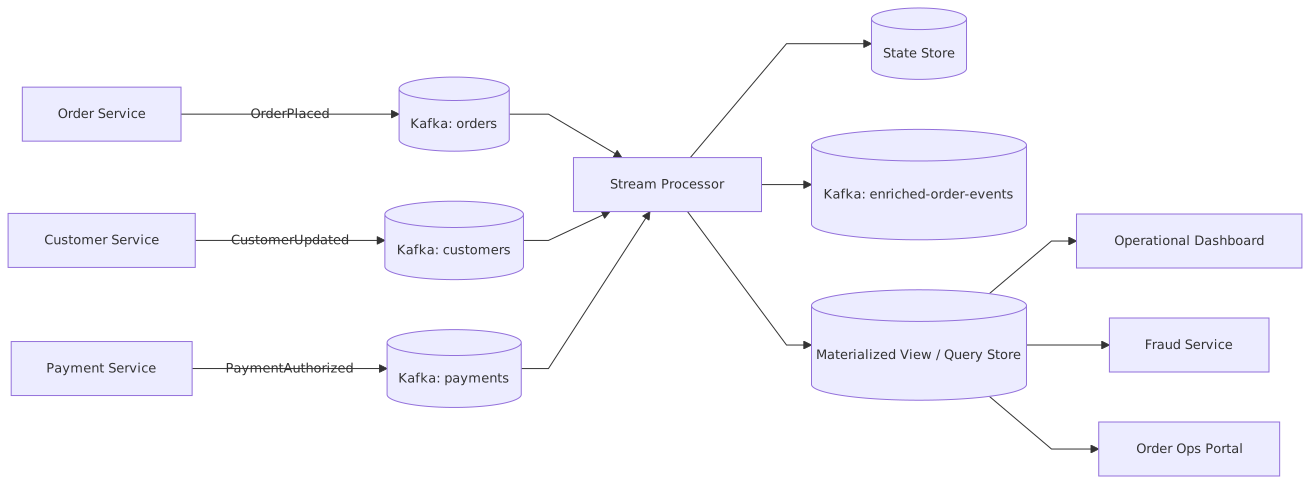
This pattern has three layers of concern:
- fact streams: immutable business events
- reference or state streams: latest known state by key
- derived views: purpose-built outputs for operational or analytical use
The architecture works when each layer stays honest about its role.
Join topology choices
A useful way to think about join topology is by cardinality and temporal behavior.
One-to-one temporal correlation
Example: OrderPlaced joined with PaymentAuthorized within 15 minutes by orderId.
This is a stream-stream join. The design questions are:
- what if payment arrives before order?
- what if payment arrives after the window?
- what if multiple authorizations occur?
- what is the business definition of “matched”?
These are not coding questions. They belong in domain workshops.
Many-to-one reference enrichment
Example: Transaction events enriched with latest account status.
This is usually stream-table. The state topic for account status is compacted, materialized locally, and used for low-latency enrichment. It works well when “latest status” is what the business actually means.
Many-to-many composite views
Example: customer 360 combining profile, preferences, interactions, service issues, and transaction history.
This is not one join. It is a composition problem. Trying to solve it as one streaming join graph often creates fragile complexity. Better to build layered materialized views and use reconciliation to manage lag and completeness.
Here is a more explicit join topology.
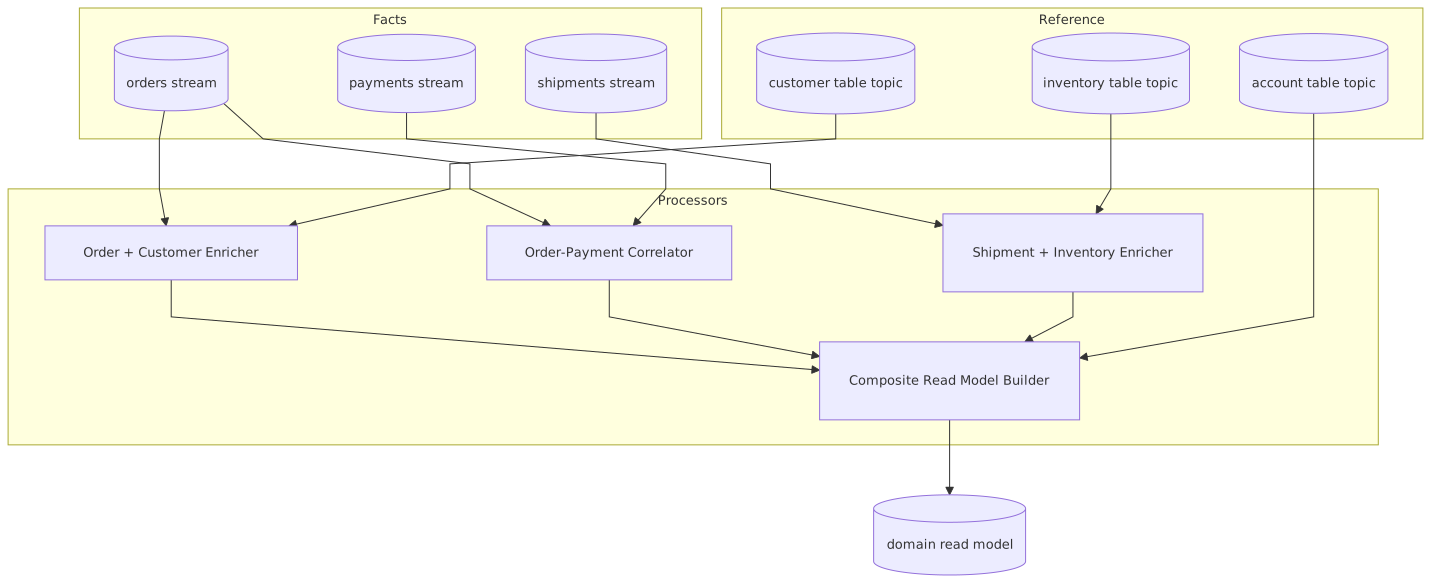
The point is architectural separation. Different joins have different semantics. Putting them all in one processor because “it’s all Kafka anyway” is the streaming equivalent of the old integration database. Convenient at first. Toxic later.
Domain semantics first
DDD helps here because it forces language. Ask these questions:
- Is the joined attribute part of the event’s meaning at the moment it happened?
- Is the attribute owned by the same bounded context?
- Is downstream use operational, analytical, or regulatory?
- Must the result reflect historical truth or latest known truth?
- Is incompleteness acceptable temporarily?
- Who owns correction when sources disagree?
If you cannot answer these, your join strategy is not designed. It is improvised.
A useful heuristic:
- facts of the moment belong in the event
- latest reference context belongs in stream-table enrichment
- cross-fact correlation belongs in stream-stream joins
- enterprise synthesis belongs in read models plus reconciliation
Migration Strategy
Most enterprises do not begin with elegant domain events and clean bounded contexts. They begin with a haunted landscape: shared databases, nightly ETL, CDC from mainframes, over-eager ESB integrations, and APIs that carry undocumented semantic debt.
So the migration to distributed join strategies should be progressive, not revolutionary. This is a classic strangler move.
Start by identifying a high-value read model or operational flow where real-time integration matters: fraud screening, order visibility, account alerting, logistics tracking. Do not start with the whole enterprise customer 360. That path ends in steering committees.
Stage 1: expose event streams from systems of record
Use CDC where necessary, but be clear about semantics. CDC emits data changes, not business intent. A row update in ORDERS is not automatically an OrderPlaced event. Sometimes CDC is enough for reference tables; often it is not enough for domain facts.
Stage 2: build one purpose-specific join flow
Pick a narrow case, such as order enrichment for fulfillment visibility. Materialize the required customer or product reference data into compacted topics. Create a stream-table join. Publish a derived topic for downstream consumers.
Stage 3: add reconciliation
This is where many teams stop too early. They get the happy path working and declare victory. But distributed joins drift. Messages arrive late. Reference data updates race event processing. A replay finds differences. Reconciliation is not a patch; it is part of the architecture.
You need batch or periodic repair jobs that:
- identify unmatched or partially enriched records
- re-evaluate them against updated state
- emit correction events or overwrite read models
- produce exception metrics and audit trails
Stage 4: strangle legacy dependent consumers
As new materialized views become trusted, retire direct database joins and brittle service call chains. Consumers should move from assembling their own composite views to subscribing to domain-aligned outputs.
Stage 5: refine domain boundaries
Migration teaches. Repeated joins between the same contexts may indicate one of two things:
- the join is a legitimate downstream read concern
- the bounded contexts are wrong or incomplete
Architects must be willing to revisit boundaries. DDD is not a one-time workshop artifact.
Here is a simple strangler path.
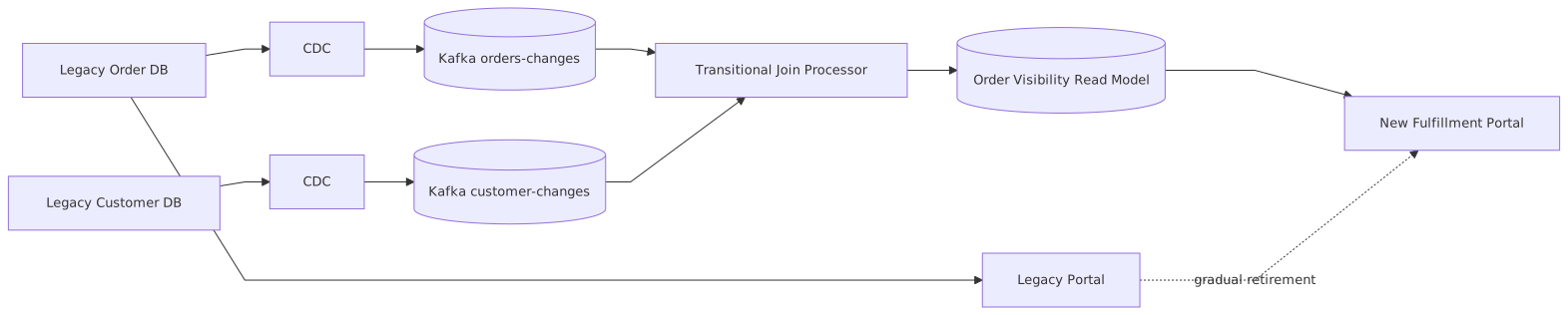
The key word is transitional. During migration, your first joins may be semantically imperfect because source systems were never designed for streaming truth. That is acceptable if you label the limitations, add reconciliation, and improve the model over time.
Enterprise Example
Consider a global retailer modernizing its order-to-cash platform. The organization has:
- e-commerce order service on Kafka
- customer master in a legacy CRM
- payments on a separate platform
- warehouse events from regional systems
- finance ledger downstream with strict audit requirements
The business wants a real-time “order health” view: every order should show current customer status, payment state, fulfillment milestone, and exception flags.
A naive approach would create one giant processor joining orders, customers, payments, and shipment streams in real time. That would be a mistake.
Instead, the architecture should split the problem.
- OrderPlaced includes facts known at order time: customerId, market, currency, channel, cart totals, loyalty tier snapshot if used in pricing.
- Customer master publishes a compacted state topic for operational reference fields: fraud watchlist flag, account hold status, consent status.
- Payment events remain a fact stream correlated to orders within a defined lifecycle window.
- Warehouse updates feed fulfillment state transitions, not a free-form stream of technical messages.
- A domain read model builder assembles the order health view incrementally.
Why this split?
Because finance later needs historical truth. If the customer goes on hold tomorrow, that should not retroactively change what was known at order placement for revenue recognition. But the operations team does want today’s hold status for customer service escalation. So the read model must carry both:
- order-time snapshot facts
- latest operational reference state
This is the sort of nuance that separates architecture from plumbing.
Reconciliation then becomes essential. Payment authorization may arrive late. Some regional warehouse systems may only emit batched events every few minutes. CRM flags may be corrected after the fact. A reconciliation pipeline scans “orders in unresolved state” and repairs the materialized view. It also raises business exceptions where expected correlations never occur.
The result is not a perfect single truth stream. It is something better: a transparent, operable system that distinguishes between immutable facts, mutable context, and corrected outcomes.
Operational Considerations
Streaming joins live or die in operations.
State management
State stores are not an implementation footnote. They are part of your data estate. They need backup strategy, disk sizing, restore testing, and awareness of changelog topic retention. If restoring a processor takes six hours, your “real-time” platform has a six-hour blind spot after failure.
Key design
Bad keys kill joins. Natural keys often mutate. Surrogate keys may not exist across systems. Composite keys may need normalization. If different services use different identity schemes, the join problem is upstream of Kafka and must be solved with identity mapping, not optimism.
Event contracts
Versioning matters more in joined systems because one side changing shape can silently corrupt downstream enrichment. Schema registry, compatibility rules, and semantic version discipline are basic hygiene.
Time handling
Use event time deliberately. Define lateness thresholds based on business tolerance, not arbitrary defaults. Expose metrics for late arrivals, dropped joins, and unmatched records. If you do not measure join miss rates, you do not control the system.
Replay and determinism
Ask a brutal question: if we replay the last month, do we get the same result? If not, why not? Sometimes non-determinism is acceptable, but then the architecture must preserve enough lineage to explain differences. Mutable external lookups during processing are the usual culprit.
Data quality and observability
For joined topologies, observability must include:
- join hit rate
- null enrichment rate
- state store lag
- input skew by partition
- reconciliation backlog
- correction event volume
- duplicate correlation rate
Without these, your platform is driving at night without headlights.
Tradeoffs
There is no free join.
Denormalized events vs lean events
Denormalized events reduce downstream joins and improve autonomy for consumers. But they can embed stale or duplicated data and increase event contract size. Lean events preserve separation but push complexity downstream.
My bias: include business-critical facts that define the event at creation time; do not stuff every conceivable reference attribute into the payload.
Stream-table vs external lookup
Local state joins are fast and resilient. External lookups keep data current but introduce latency, availability risk, and replay inconsistency. For high-volume operational pipelines, local state almost always wins.
Real-time completeness vs eventual correction
Immediate output with later reconciliation is usually the right enterprise compromise. But in regulated financial flows, deferred correction may not be enough. There, slower but more deterministic processing may be the better choice.
Centralized composite service vs distributed read models
A centralized service can simplify consumer access but may become the new monolith. Distributed read models preserve autonomy but can multiply data products and operational sprawl. This is where governance matters. EA governance checklist
Failure Modes
Distributed joins fail in predictable ways. Good architects learn to spot the shape of the wreckage before it happens.
Silent semantic corruption
The worst failure is not a processor crash. It is a join that succeeds technically and lies business-wise. Example: enriching historic transactions with current customer segment, then using that result for retrospective profitability reporting.
Window mismatch
A payment arrives 20 minutes late, but the join window is 15. The order is marked unpaid, triggers exception handling, and downstream teams scramble. The issue was not “late data.” The issue was a business lifecycle mis-modeled as a technical timeout.
Hot partitions and skew
If one customer, seller, warehouse, or account generates disproportionate traffic, partition-local state and joins become uneven. One partition burns while others nap. Streaming systems are distributed, but bad keys centralize pain.
Reprocessing drift
A topic is replayed after reference data has evolved. Outputs differ from original runs. If there is no lineage showing which reference version was applied originally, audit discussions get tense very quickly.
Zombie dependencies
A service is said to be event-driven but still performs synchronous lookups during enrichment fallback. Under load or outage, the “streaming” platform stalls behind an API dependency everyone forgot existed.
Endless unresolved records
Teams often build dead-letter topics for unmatched joins and then never operationalize them. That is not resilience. That is a data landfill.
When Not To Use
Sometimes the right answer is not a distributed join at all.
Do not use streaming joins when:
- the use case is low frequency and can tolerate batch
- the source semantics are too poor to support reliable correlation
- the business requires strict transactional consistency across contexts
- the join logic is so volatile that every rule change forces pipeline redesign
- the organization lacks operational maturity for stateful stream processing
- the result is a broad analytical dataset better served by lakehouse or warehouse modeling
Also, be wary when teams use streaming joins to paper over bad domain boundaries. If two services constantly need each other’s internals to do basic work, you may not have microservices. You may have distributed confusion.
A memorable rule: if the join is essential to making the transaction valid, it probably belongs before the event, not after it.
Related Patterns
Several adjacent patterns matter.
CQRS and materialized views
Most enterprise streaming joins are really about building query-side models optimized for a specific workflow. CQRS gives this a proper home.
Event-carried state transfer
Useful when producers can safely include enough context in their events to avoid downstream joins for common consumers.
CDC-based reference propagation
A practical bridge for migrating legacy master data into stream-table enrichment patterns, especially during strangler transitions.
Saga orchestration and choreography
These are not join patterns, but they often coexist. Correlating saga state across events can resemble stream-stream joins, though the business concern is process state rather than analytical enrichment.
Reconciliation and repair pipelines
Underrated, unglamorous, indispensable. Especially in estates with legacy sources and eventual consistency.
Summary
Distributed joins in data streaming are where enterprise architecture gets real. Not because the algorithms are mysterious, but because the business semantics stop hiding. Time matters. Ownership matters. Correctness has flavors. And every join is a bet on what kind of truth the organization actually needs.
The mature approach is not to avoid joins entirely. It is to place them deliberately.
Use producer-side enrichment for facts that define the event. Use stream-table joins for latest reference context. Use stream-stream joins for temporal correlation with explicit business windows. Use read-model composition with reconciliation when the enterprise landscape is messy, because it usually is.
Bring domain-driven design into the room early. Boundaries should guide joins, not merely survive them. Migrate progressively with a strangler approach. Add reconciliation before someone asks for audit evidence. Measure join quality as a first-class operational concern. And know when to stop: some problems belong in batch, some in databases, and some in redesigned domains rather than clever topologies.
A database join is a query.
A distributed streaming join is a commitment.
Treat it with the seriousness it deserves.
Frequently Asked Questions
What is event-driven architecture?
Event-driven architecture (EDA) decouples services by having producers publish events to a broker like Kafka, while consumers subscribe independently. This reduces direct coupling, improves resilience, and allows new consumers to be added without modifying producers.
When should you use Kafka vs a message queue?
Use Kafka when you need event replay, high throughput, long retention, or multiple independent consumers reading the same stream. Use a traditional message queue (RabbitMQ, SQS) when you need simple point-to-point delivery, low latency, or complex routing logic per message.
How do you model event-driven architecture in ArchiMate?
In ArchiMate, the Kafka broker is a Technology Service or Application Component. Topics are Data Objects or Application Services. Producer/consumer services are Application Components connected via Flow relationships. This makes the event topology explicit and queryable.