⏱ 20 min read
Production systems do not fail the way architecture diagrams fail.
On whiteboards, things break cleanly. A service goes down. A queue backs up. A database becomes unavailable. In real enterprises, failure arrives like bad weather over a city: partial, uneven, and politically inconvenient. One region gets slow. One consumer group lags. One retry policy turns a transient outage into a self-inflicted denial-of-service attack. And somewhere, an executive asks why “resilience” did not look so resilient this morning.
That is why failure injection architecture matters. Not as theater. Not as a trendy chaos engineering badge. But as an explicit architectural capability: a deliberate way to introduce faults into a live or production-like system so that teams can learn how the system behaves under stress, verify recovery paths, and expose the hidden coupling that normal success-path testing politely ignores.
The core mistake many organizations make is to treat chaos injection as tooling. They buy a fault injection platform, script a few experiments, and declare themselves mature. They are not. The hard part is not introducing failure. Any fool can kill a pod. The hard part is introducing the right failures, in the right bounded context, with enough semantic understanding to learn something useful without turning the exercise into vandalism.
A serious failure injection architecture sits at the intersection of domain-driven design, observability, platform engineering, and operational governance. It has to know what matters in the business, where the seams are in the system, how recovery actually works, and what forms of disruption are safe enough to test. It also needs a migration path, because very few large enterprises can jump from fragile legacy estates to controlled fault experimentation overnight.
This article lays out that architecture, the tradeoffs behind it, and the cases where you should resist the urge to use it.
Context
Chaos engineering has matured from “let’s randomly terminate instances” into something more disciplined. In modern cloud platforms, container orchestration, service meshes, Kafka-based integration, and microservices have made distributed systems easier to scale and harder to reason about. The failure surface has exploded. We now have network partitions, message duplication, stale caches, delayed events, exhausted connection pools, poisoned consumers, inconsistent read models, rate-limited dependencies, dead-letter drift, and all the wonderfully boring ways enterprise software corrodes under load.
The systems that matter most are also the least suited to naive fault injection. Banking platforms, insurance claims systems, airline operations, retail inventory networks, and healthcare coordination platforms all carry domain obligations. A delayed message is not just a delayed message. It may be a missed fraud alert, a double shipment, an unpaid claim, or a phantom appointment slot. Domain semantics matter because resilience is not technical in the abstract; it is always resilience of something that the business cares about.
That is where domain-driven design earns its keep. If you understand bounded contexts, aggregates, domain events, invariants, and anti-corruption layers, you can inject failure in a way that maps to real business risk. If you do not, chaos engineering quickly becomes an expensive hobby for infrastructure teams.
The practical question is simple: how do we design an enterprise architecture for failure injection that is safe, meaningful, observable, and evolvable?
Problem
Most organizations test happy paths and document disaster scenarios. They do not test the ugly middle.
They may run unit tests, integration tests, and even load tests. They may have synthetic probes and a respectable set of SLOs. But those mechanisms mainly validate known behavior under expected conditions. They rarely answer the nastier questions:
- What happens when payment authorization succeeds but the downstream order event is delayed by 17 minutes?
- What happens when one Kafka partition is healthy and another accumulates consumer lag because of a serialization mismatch?
- What happens when retries amplify pressure on a dependency that is already degraded?
- What happens when a timeout is shorter than a business transaction window but longer than a customer’s patience?
- What happens when reconciliation is the only path back to correctness?
In many enterprises, failure behavior is effectively accidental architecture. Timeouts, retries, circuit breakers, bulkheads, compensating transactions, dead-letter queues, replay tools, and reconciliation jobs exist, but as a patchwork. Each team builds its own defensive machinery. The result is uneven maturity. One domain is robust. Another is held together by log scraping and hope.
Failure injection architecture addresses this by making resilience mechanisms first-class and testable. But to do that, it must confront several forces that push in different directions.
Forces
The first force is business safety versus learning velocity. The best experiments happen close to production reality. The worst incidents also happen there. You need enough realism to expose emergent behavior without creating unacceptable customer harm.
The second is technical fault models versus domain semantics. Infrastructure teams naturally think in CPU, latency, packet loss, node death, and broker unavailability. Domain teams think in late settlement, duplicate fulfillment, stale policy state, and inventory drift. Both are right. The architecture must bridge them.
The third is central control versus federated autonomy. Enterprises want governance, auditability, blast-radius limits, and compliance evidence. Product teams want to run experiments without opening three architecture review tickets and waiting six weeks.
The fourth is determinism versus distributed truth. In event-driven systems, especially with Kafka, many failures do not produce immediate inconsistency. They produce ambiguity. A consumer may process late. An event may be replayed. A read model may temporarily diverge. This means the architecture must support reconciliation, not merely prevention.
The fifth is legacy migration versus greenfield purity. Very few estates begin with elegant fault-injection hooks. You inherit brittle middleware, batch integrations, mainframe gateways, and shared databases. So the architecture must allow progressive adoption, often through a strangler-style migration.
And finally there is observability versus operability. You can inject failures all day, but if you cannot trace causality across services, events, and business outcomes, you are measuring noise.
Solution
The right solution is not a single product. It is an architectural capability made of five cooperating parts:
- Experiment Control Plane
Defines, schedules, authorizes, and audits failure injection experiments. This is where policy lives: who can run what, where, under what guardrails, and with what rollback conditions.
- Fault Injection Adapters
Concrete mechanisms that inject faults at different layers: network, compute, storage, API gateway, service mesh, Kafka producer/consumer, database access, feature flags, and business workflow steps. event-driven architecture patterns
- Domain Safety Model
The overlooked piece. A set of business-aware constraints that define safe blast radius and semantic risk. This includes customer segment limits, transaction class exclusions, bounded context rules, idempotency guarantees, and compensating action availability.
- Observability and Causality Fabric
Metrics, traces, logs, event lineage, and domain outcome indicators tied back to the experiment. Not just “service latency increased,” but “shipment confirmation lag exceeded customer promise threshold for premium orders in region north.”
- Reconciliation and Recovery Layer
Because some experiments will surface divergence, the architecture must include replay, reconciliation, state repair, and compensating workflows. In event-driven systems, resilience is often less about preventing inconsistency than about restoring correctness predictably.
In other words: inject faults deliberately, observe them semantically, and repair them systematically.
Architecture
A useful mental model is to separate technical fault planes from domain impact planes. We inject at the former and evaluate at the latter.
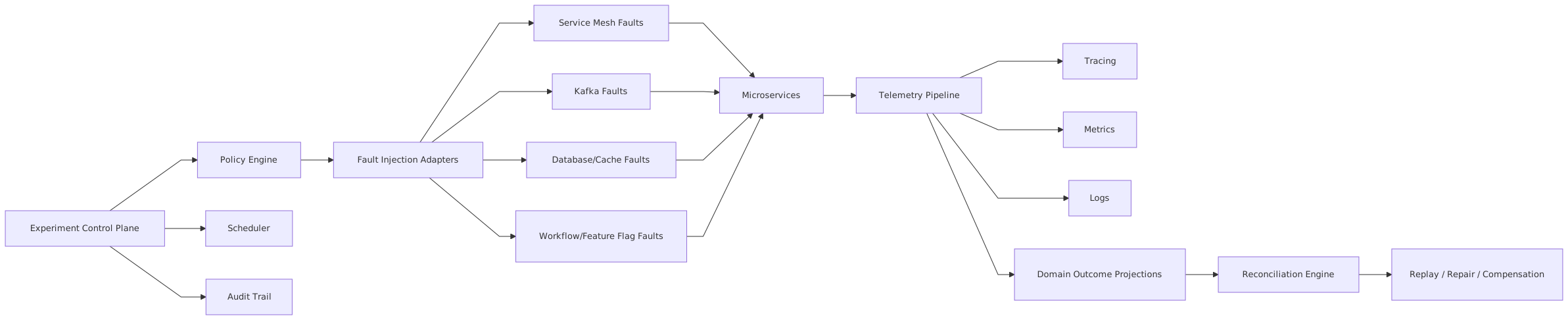
This is not just plumbing. The architectural trick is where to draw the seams.
Bounded contexts as failure boundaries
In domain-driven design, bounded contexts define where a model is consistent and meaningful. They are also the right places to define failure blast radius. You do not run a broad “payment failure” experiment across the enterprise. You run a specific experiment in the Authorization bounded context, perhaps by injecting latency into the external card network adapter, while preserving constraints in Settlement, Order Management, and Customer Notification.
That distinction matters because each context has different invariants. Authorization cares about approval windows and response codes. Order Management cares about reservation state. Customer Notification cares about communication timing, not transactional truth. If you inject one kind of failure and expect every context to interpret it the same way, you have already lost.
Kafka as both backbone and amplifier
Kafka is often where enterprise resilience either gets better or gets weird.
It helps because it decouples services in time and supports replay. It also amplifies subtle failure modes: partition skew, duplicate publication, consumer lag, tombstone mishandling, schema incompatibility, and out-of-order assumptions. A competent failure injection architecture should treat Kafka as a first-class injection surface.
Useful Kafka experiments include:
- producer acks degradation
- topic-level latency injection
- consumer pause or throttling
- selective partition unavailability
- schema registry timeout
- dead-letter queue overflow simulation
- duplicate event publication
- replay of delayed events into live consumers
But these should be evaluated in domain terms. A delayed PaymentAuthorized event is not inherently bad if the reservation hold window in the ordering context can tolerate it. The same delay may be unacceptable if it postpones fraud screening beyond regulatory thresholds.
Control plane and policy
The control plane should be declarative. Teams define experiments as code, version them, and submit them through a policy engine. Policies should encode environmental limits and domain rules. For example:
- never inject write-path database faults in quarter-end finance close
- only target canary tenants for customer-facing experiments
- block experiments where no reconciliation workflow exists
- require trace coverage and baseline SLOs before approval
- automatically abort if domain harm indicators cross threshold
This is architecture doing its actual job: making the safe path the easy path.
Reconciliation is not a side note
In event-driven enterprises, especially those using CQRS and asynchronous integration, failure injection will often reveal temporary or durable divergence between systems of record and derived projections. That is not a bug in the experiment; it is the point.
So the architecture must include reconciliation as a designed capability:
- compare source-of-truth aggregates with downstream projections
- detect missing, duplicated, or stale events
- support deterministic replay
- trigger compensating commands
- provide business-facing exception handling queues when automation cannot safely repair
If your architecture has no reconciliation story, your chaos program will either be cosmetic or reckless.
Here is a more domain-centered view.
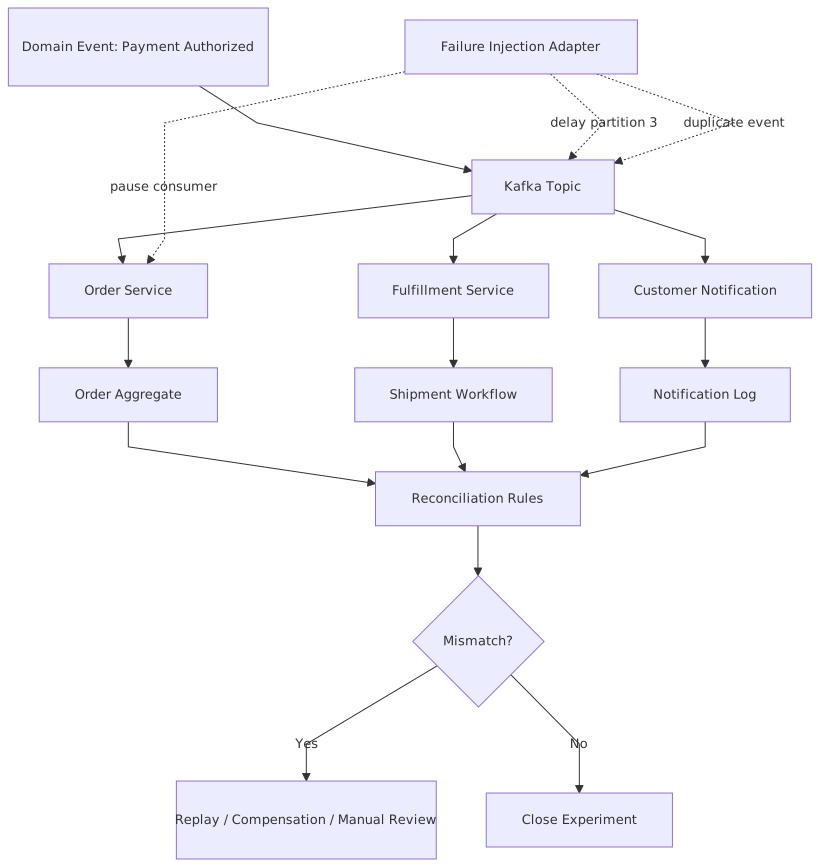
This architecture assumes something many organizations still resist: the system must be explicit about what “correct enough” means during disruption. Eventual consistency without reconciliation is just delayed confusion.
Migration Strategy
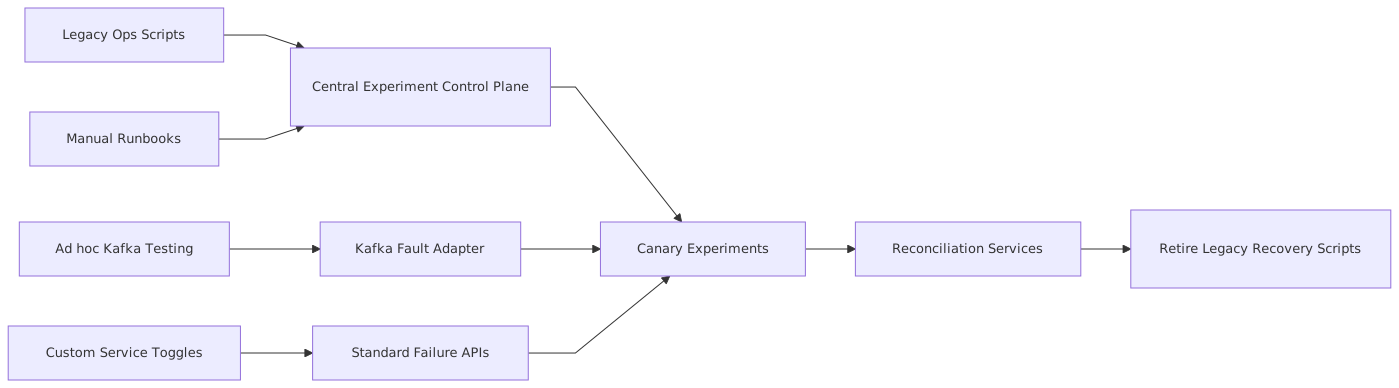
No large enterprise installs this architecture in one motion. You grow it through a progressive strangler migration.
Start with the edges. That is usually where you can introduce failure safely and learn the fastest.
Stage 1: Observability before injection
Do not begin by breaking things. Begin by understanding them. Instrument critical paths with distributed tracing, domain metrics, and event lineage. Identify business outcome indicators, not just technical telemetry. For an order platform, that might include order confirmation time, reservation expiry rate, duplicate shipment count, refund initiation lag, and reconciliation backlog.
Without this, every later experiment becomes interpretive dance.
Stage 2: Non-production semantic experiments
Most enterprises start with infrastructure faults in lower environments. That is fine, but too shallow. The better move is to run domain-semantic experiments in production-like staging: delayed events, partial dependency failures, consumer lag, duplicate messages, stale cache reads, and workflow step timeouts tied to realistic data.
Stage 3: Introduce a control plane alongside existing ops tooling
Do not rip out current runbooks and incident tooling. Add an experiment control plane that integrates with CI/CD, feature flags, identity, change management, and observability platforms. This is the strangler pattern in operational form: new experiments go through the control plane; old manual scripts remain temporarily in place.
Stage 4: Add adapters per bounded context
Not every domain needs the same injection points. Build context-specific adapters or policies. For example:
- Payment context: gateway timeout, duplicate callback, delayed settlement event
- Inventory context: stale stock read, message reordering, warehouse API throttling
- Claims context: document OCR service degradation, manual review queue overflow
This is where domain-driven design prevents generic chaos from becoming useless chaos.
Stage 5: Production canaries with blast-radius controls
Move into production with carefully scoped experiments:
- tenant-level
- region-level
- read-only path first
- internal user traffic first
- low-value transaction classes first
The key migration move is not bigger experiments. It is more meaningful ones.
Stage 6: Build reconciliation into the normal operating model
Eventually, the architecture should assume periodic divergence and institutionalize repair. Reconciliation jobs, replay tools, and exception queues become standard platform capabilities, not emergency improvisations.
A strangler migration works because it does not demand wholesale perfection. It replaces fragile, ad hoc failure handling with governed, observable, domain-aware experimentation over time.
Enterprise Example
Consider a global retailer with e-commerce, store fulfillment, and marketplace operations. Orders are accepted through digital channels, paid via external gateways, reserved against distributed inventory, fulfilled from stores or warehouses, and published into a Kafka event backbone for downstream services: shipping, customer communications, loyalty, finance, and analytics.
On paper, this is a modern microservices architecture. In practice, it had the usual scars. microservices architecture diagrams
Payment authorization was synchronous. Order reservation was event-driven. The customer confirmation email was triggered from a downstream projection. Finance consumed settlement-related events on a separate timeline. During peak periods, a single lagging consumer group in the order context caused delayed reservation confirmation, while payment had already succeeded. Customers saw “processing” screens, stores saw inconsistent pick lists, and customer service got the blame.
The retailer’s first instinct was classic enterprise behavior: add retries, scale Kafka consumers, and tune timeouts. This helped until it didn’t. The real issue was architectural ambiguity. The business had never explicitly defined what should happen if payment success and reservation confirmation diverged for more than a few minutes.
So they implemented a failure injection architecture.
They defined bounded contexts clearly: Payment, Order Management, Inventory Reservation, Fulfillment, and Customer Engagement. Then they introduced a control plane with policies limiting experiments to one geography and a subset of low-risk SKUs. Kafka fault adapters allowed partition-specific lag simulation and duplicate event publication. Service-level adapters could inject dependency timeouts and stale cache reads.
Most importantly, they created domain outcome metrics:
- paid but unreserved orders
- reservation expiry before fulfillment start
- duplicate shipment commands
- notification sent before reservation confirmation
- reconciliation time to correctness
Their first meaningful production canary simulated consumer lag on the PaymentAuthorized stream for one partition. The technical result was unremarkable: lag increased. The domain result was not. Orders for premium same-day delivery crossed a business threshold where promised fulfillment windows were impossible, but standard orders remained acceptable.
That single insight changed the architecture. They split handling policies by fulfillment promise class, introduced an intermediate “payment accepted, fulfillment pending” state in the order aggregate, and delayed certain customer notifications until reservation confirmation was observed or a compensating path triggered. They also implemented an automated reconciliation service that detected paid-but-unreserved orders and either reissued reservation commands or initiated refund workflows when the hold window closed.
This is the kind of result chaos engineering should produce: not a dashboard screenshot, but a better domain model.
Operational Considerations
A failure injection architecture lives or dies on operational discipline.
Guardrails
Every experiment needs:
- a blast-radius definition
- a hypothesis
- preconditions
- automatic abort criteria
- ownership
- a rollback or compensation path
- post-experiment review
If you cannot state the business hypothesis, you are not running chaos engineering. You are entertaining the platform team.
Identity and audit
In regulated enterprises, fault injection is effectively a controlled production change. Treat it that way. Integrate with IAM, approval workflows, and immutable audit trails. Record who ran the experiment, what was injected, which systems were affected, what guardrails were active, and what customer impact occurred.
SRE and product team collaboration
Platform teams should build the capability. Domain teams should define meaningful experiments. SRE alone cannot decide what business inconsistency is tolerable. Product managers alone cannot reason about Kafka partition behavior. This is one of those areas where architecture earns its salary by forcing the right conversations.
Baselines and steady-state definitions
Chaos experiments need a steady-state hypothesis. In enterprises, steady state should include both technical and domain indicators:
- p95 latency
- consumer lag
- error budget burn
- order completion rate
- duplicate transaction count
- reconciliation backlog
- manual exception queue growth
Tooling integration
The architecture should integrate with:
- service mesh policies
- API gateway controls
- Kafka administration and consumer controls
- feature flags
- CI/CD pipelines
- tracing and metrics platforms
- incident management tools
- runbook automation
- reconciliation services
If fault injection is disconnected from operational tooling, experiments will be rare, brittle, and distrusted.
Tradeoffs
Let’s be honest: this architecture is not free.
The first tradeoff is complexity versus confidence. You are building another platform layer. It introduces governance, policies, telemetry correlation, and reconciliation workflows. The payoff is a system that teaches you how it fails before customers do. In serious enterprises, that is a good bargain. In simpler environments, it may not be.
The second is speed versus safety. Strong controls prevent reckless experiments but can suffocate adoption if the process becomes bureaucratic. Too much centralization turns chaos engineering into annual theater. Too little turns it into operational graffiti.
The third is technical purity versus business relevance. Engineers enjoy low-level fault models. Business stakeholders care about outcomes. The right architecture keeps both, but there is tension. Some technically elegant experiments produce little business insight. Some valuable domain experiments are messy and difficult to automate.
The fourth is eventual consistency versus immediate assurance. In Kafka-centric architectures, allowing temporary inconsistency can be the right design. But then you must invest in reconciliation and customer communication patterns. That is not cheaper than pretending everything is synchronous; it is just more honest.
The fifth is federation versus standardization. Teams need freedom to model experiments per bounded context. The enterprise needs consistency in policy, telemetry, and audit. The architecture should standardize the control plane and observability contract while allowing domain-specific adapters and semantics.
Failure Modes
Failure injection architecture has its own ways to fail. And they are depressingly common.
Cargo-cult chaos
Teams run random pod kills, collect screenshots, and declare maturity. Nothing changes in the design. No domain model improves. No reconciliation path is added. This is performative resilience.
Tool-first implementation
An enterprise buys a chaos platform and assumes the architecture is done. It is not. Without bounded contexts, domain metrics, and operational guardrails, the platform merely makes it easier to break things.
Missing reconciliation
Experiments expose divergence, but no one owns repair logic. The result is manual cleanup, experiment fatigue, and eventually a quiet ban on production testing.
Overly broad blast radius
The experiment targets “the order system” instead of a narrow path, tenant, region, or context. Enterprises do not forgive broad, avoidable production impact.
Technical metrics only
Latency and error rates move, but no one knows whether customers were harmed or business invariants were violated. You learn less than you think.
Forgotten dependencies
A fault is injected in one service, but shared infrastructure, hidden batch jobs, or legacy gateways react in surprising ways. This is why dependency mapping and domain boundary understanding matter so much.
Retry storms and compensation loops
One of the nastier outcomes is finding that your resilience patterns attack each other. Retries trigger duplicate events. Compensation triggers more downstream retries. Reconciliation replays poison messages. The architecture must account for these second-order effects.
When Not To Use
This architecture is powerful, but it is not universal.
Do not use a full failure injection architecture when the system is small, tightly scoped, and operationally simple. A modest service with limited dependencies and low business criticality does not need an enterprise-grade control plane and reconciliation platform.
Do not use it where the domain risk is intolerant and compensating mechanisms are absent. If a single fault could create irreversible harm and you have no safe canary strategy, your first investment should be in safety architecture and simulation environments, not production chaos.
Do not start here if observability is immature. Fault injection without traceability is noise generation.
Do not apply broad chaos practices to legacy monoliths with shared-state side effects until you have identified seams, wrapped dangerous dependencies, and introduced anti-corruption layers. Otherwise you are testing the organization’s luck, not the architecture.
And do not confuse failure injection with reliability engineering as a whole. Capacity planning, simplification, dependency reduction, sound domain boundaries, and operational excellence still matter more. Chaos engineering reveals design truth; it does not substitute for design.
Related Patterns
Several architectural patterns pair naturally with failure injection architecture.
Circuit Breaker
Useful for containing dependency failure, but should be tested under real degradation, not assumed correct.
Bulkhead
Critical for reducing blast radius between contexts or workloads. Failure injection validates whether isolation really exists.
Retry with Backoff and Jitter
Necessary, but dangerous when applied blindly. Chaos experiments often reveal retry storms.
Outbox Pattern
Essential in microservices publishing domain events reliably. Fault injection should test delayed or duplicate outbox delivery.
Dead Letter Queue
A containment mechanism, not a solution. The architecture should connect DLQs to reconciliation and repair.
Saga / Process Manager
Relevant where long-running business workflows cross services. Failure injection should test compensations, timeouts, and partial completion.
Strangler Fig Pattern
Ideal for migrating from ad hoc resilience practices to a governed failure injection platform.
Anti-Corruption Layer
Important when legacy systems cannot safely participate in chaos experiments directly. Inject failure at the boundary, not inside the brittle core.
CQRS with Reconciliation
A natural fit where read models can drift. But only if reconciliation is designed, owned, and observable.
Summary
Failure injection architecture is not about breaking systems for sport. It is about learning where your enterprise architecture lies to you.
It exposes the gap between a neat microservices drawing and the messy reality of delayed events, duplicate messages, partial failures, and business commitments that refuse to wait for eventual consistency. It forces technical teams to speak in domain language. It forces domain teams to confront operational truth. That is healthy.
The best architectures for chaos engineering are opinionated in the right places. They use bounded contexts as blast-radius boundaries. They treat Kafka and asynchronous flows as first-class failure surfaces. They insist on observability tied to business semantics. They build reconciliation in as a normal capability, not an embarrassed afterthought. And they migrate progressively, using a strangler approach rather than betting the estate on a grand platform rewrite.
The memorable line here is simple: resilience is not proven by redundancy; it is proven by recovery.
If your architecture can inject a fault, observe the business consequence, reconcile divergence, and return to correctness predictably, then you are building something real. If not, your uptime may still look good, but your confidence is borrowed.
And borrowed confidence is one of the most expensive things an enterprise can run in production.
Frequently Asked Questions
What is enterprise architecture?
Enterprise architecture aligns strategy, business processes, applications, and technology in a coherent model. It enables impact analysis, portfolio rationalisation, governance, and transformation planning across the organisation.
How does ArchiMate support architecture practice?
ArchiMate provides a standard language connecting strategy, business operations, applications, and technology. It enables traceability from strategic goals through capabilities and services to infrastructure — making architecture decisions explicit and reviewable.
What tools support enterprise architecture modeling?
The main tools are Sparx Enterprise Architect (ArchiMate, UML, BPMN, SysML), Archi (free, ArchiMate-only), and BiZZdesign. Sparx EA is the most feature-rich, supporting concurrent repositories, automation, scripting, and Jira integration.