⏱ 20 min read
Most architecture diagrams lie.
They lie politely, with neat boxes and arrows, as if systems behave the way we drew them on a whiteboard. Production is less civilized. It is queues backing up at 2:13 a.m., a payment service timing out because a downstream dependency crossed a latency threshold nobody modeled, and a customer support team discovering a business outage before engineering does. If architecture is the set of important decisions, then operations is where those decisions are judged without mercy.
That is why observability-driven design matters. Not observability as a dashboarding afterthought. Not metrics as a technical exhaust stream. But observability as an input to architecture itself: a feedback loop where operational metrics influence system boundaries, service interactions, domain models, resilience mechanisms, and migration choices.
A lot of enterprises say they want “data-driven architecture.” What they often mean is more reports. What they need is architecture that listens to production. The difference is profound. In a healthy metric feedback loop, architecture is not just implemented and monitored; it is continuously corrected by the behavior of the running system.
This is especially relevant in large organizations moving from monoliths to microservices, event-driven platforms, and Kafka-based integration. The move is rarely blocked by lack of technology. It is blocked by poor semantics, hidden coupling, and no discipline for turning runtime signals into architectural change. Teams produce metrics, logs, and traces by the truckload, yet still make boundary decisions based on org charts and intuition. That is not architecture. That is educated guessing.
The better approach starts with a simple conviction: operational metrics are not merely for keeping systems alive. They are evidence about the shape of the business system. Queue depth says something about coupling. Retry rates say something about contract fragility. Reconciliation volumes say something about consistency assumptions. Customer-visible latency says something about the fit between domain workflow and technical design.
The architecture that emerges from this thinking is not static. It evolves through measured tension between domain semantics and operational reality.
Context
Modern enterprises live in a messy middle. They are not greenfield startups with one product and a handful of services. They are multi-channel businesses with legacy core systems, packaged applications, data platforms, regional variations, compliance obligations, and a backlog older than some employees.
In that world, observability has matured. Most organizations now collect infrastructure metrics, application logs, distributed traces, and business KPIs. They can tell you CPU utilization, p95 latency, message lag, error counts, and maybe conversion rates. Yet these signals often stop at the edge of operations. SRE teams use them to stabilize runtime. Product teams use them to optimize journeys. Architects glance at them during incident postmortems and then go back to roadmap planning.
That separation is a mistake.
Architecture should absorb operational signals in the same way a product team absorbs customer feedback. If incidents consistently emerge around a workflow, there is probably an architectural mismatch. If Kafka topics are filling with compensating events and reconciliation jobs are growing more complex every quarter, the event model may not reflect the domain. If one supposedly independent microservice cannot deploy without six others, then service autonomy is fiction, no matter what the repo structure says. microservices architecture diagrams
Observability-driven design treats metrics and traces as a language for discovering these mismatches. It asks not only “is the system healthy?” but “what is the system telling us about its design?”
There is also a domain-driven design angle here that many teams miss. Metrics are never neutral. The moment you decide to measure “order completion time” instead of “request processing duration,” you are choosing a domain concept. Good architecture begins when operational telemetry is expressed in business semantics rather than generic technical counters. A domain emits signals about reservations, settlements, shipment promises, policy endorsements, claims adjudication, stock allocation, and customer activation. Those signals are far more useful than a thousand unnamed timers.
This matters because architecture is fundamentally about managing change through boundaries. And boundaries are only meaningful when they align with domain semantics and can be validated against operational behavior.
Problem
The typical failure pattern goes like this.
An enterprise adopts microservices for agility. Teams split the monolith by function, expose APIs, add Kafka for asynchronous communication, and deploy a shiny observability stack. At first, everything looks modern. Then production begins to tell another story. event-driven architecture patterns
Lead times do not improve because every “independent” change still requires cross-team coordination. Incidents become harder to diagnose because business workflows are fragmented across services with inconsistent telemetry. Retry storms turn a minor dependency issue into a platform-wide event. Reconciliation jobs proliferate because asynchronous flows lose semantic clarity. Teams optimize local service metrics while customer outcomes deteriorate.
The root issue is not simply complexity. Complex systems are inevitable. The issue is that architecture decisions were made without a disciplined feedback loop from operations back into design.
Common symptoms include:
- services split on technical layers rather than bounded contexts
- metrics focused on infrastructure, not domain outcomes
- Kafka topics designed around database change events instead of business events
- APIs that expose internal models and amplify coupling
- no explicit architecture response when operational indicators worsen
- reconciliation treated as a nuisance script rather than a first-class capability
- incidents producing temporary fixes instead of boundary changes
This creates a dangerous illusion. The system appears observable because there are many dashboards. But the architecture is effectively blind, because those dashboards do not influence structural decisions.
Observability without architectural consequence is theater.
Forces
Several forces pull in different directions, and good design sits in the tension rather than pretending the tension does not exist.
1. Domain integrity versus operational simplicity
Domain-driven design teaches us to model around meaningful business capabilities and bounded contexts. But operational teams often want fewer moving parts, fewer hops, and simpler support models. The right service boundary for domain language may increase runtime coordination. The wrong boundary may reduce calls but create semantic confusion. This is a real tradeoff, not something solved by doctrine.
2. Synchronous certainty versus asynchronous scale
Synchronous APIs offer immediate feedback and straightforward user interactions. Kafka and event-driven designs offer resilience, scalability, and decoupling. But asynchronous workflows introduce eventual consistency, duplicate messages, ordering challenges, and reconciliation needs. If the business process cannot tolerate uncertainty, event-first architecture may be the wrong default.
3. Team autonomy versus end-to-end flow
Microservices promise independent delivery. Customers experience journeys, not services. The metric feedback loop has to expose both local service behavior and end-to-end business flow. Optimizing one at the expense of the other is common and costly.
4. Instrumentation cost versus architectural clarity
Rich domain metrics take effort. They require semantic naming, stable event contracts, trace correlation, and shared understanding between architects, developers, and operators. Many teams retreat to easy technical metrics because they are cheap to collect. Cheap metrics often produce expensive ignorance.
5. Legacy constraints versus target architecture
Enterprises do not get to redesign from scratch. Core systems may only expose batch interfaces. Some domains may be trapped in vendor platforms. Some operational metrics may be unavailable or misleading. Migration has to work with uneven terrain.
6. Local failures versus systemic patterns
An isolated timeout is an incident. A recurring timeout on a specific business path is architectural evidence. Organizations often get stuck firefighting local symptoms and never aggregate them into design decisions. The feedback loop must separate noise from pattern.
Solution
The core idea is straightforward: use operational metrics, traces, and reconciliation signals as first-class architecture inputs, organized around domain semantics.
That sentence sounds obvious. It is not commonly practiced.
In observability-driven design, each critical domain workflow has an explicit set of architectural fitness signals. These signals are not just SLIs in the SRE sense, though they may include them. They are indicators that test whether the architecture is serving the domain as intended.
For example, in an order fulfillment domain, the architecture may track:
- order acceptance to allocation latency
- inventory reservation conflict rate
- payment authorization retry rate
- shipment promise breach rate
- orphaned fulfillment event count
- reconciliation adjustments per thousand orders
- percentage of orders requiring manual intervention
These are not merely operational metrics. They are architecture probes. If manual intervention rises after splitting inventory and order orchestration into separate services, that is evidence the boundary may be wrong, the event model may be incomplete, or consistency handling may be underdesigned.
The metric feedback loop then works like this:
- Define domain outcomes and invariants.
What must be true for the business process to be successful? What can be eventually consistent, and what cannot?
- Instrument workflows in domain language.
Emit events and metrics around meaningful state transitions.
- Correlate operational behavior end-to-end.
Tie service metrics, Kafka lag, trace spans, and reconciliation results to the same business flow.
- Review architectural anomalies as design input.
Persistent retry storms, lag concentrations, and reconciliation drift are not just operations issues; they trigger boundary and interaction reviews.
- Adapt structure, not only configuration.
Sometimes the answer is a timeout change. Often the answer is a changed contract, a coarser service boundary, a saga redesign, or a different ownership model.
This is where domain-driven design and observability become natural allies. DDD gives us the language and boundaries. Observability gives us the evidence that those boundaries are healthy, unhealthy, or merely wishful thinking.
Architecture
A practical architecture for observability-driven design usually has four layers:
- domain services and workflows
- telemetry and correlation
- event backbone and state propagation
- architecture review and governance loop
At the domain level, services should emit business events, not just technical notifications. “InventoryReserved” is useful. “RowUpdated” is not. Events become part of the ubiquitous language. They carry trace context so an order journey can be followed across APIs, Kafka topics, and background processors.
At the telemetry level, every critical transaction should have:
- request and workflow correlation IDs
- domain event timestamps
- business state transition metrics
- service-level technical metrics
- reconciliation result records
Kafka is especially relevant here because it often becomes the circulatory system of the enterprise. But Kafka is neither architecture nor magic. It is a very effective mechanism for durable asynchronous communication. Used well, it supports event-driven bounded contexts. Used badly, it becomes a distributed confusion engine with excellent retention settings.
A healthy pattern is to use Kafka topics for domain events owned by bounded contexts, with consumers building local models rather than sharing central schemas as if Kafka were a remote database. The metric feedback loop then measures not only broker health and consumer lag, but semantic lag: how long it takes for a business fact to become actionable in downstream contexts.

Notice the important point: the feedback loop ends in architecture review, not just dashboards. Otherwise all you have built is a very expensive mirror.
Domain semantics discussion
If you want metrics to shape architecture, they must align with domain concepts. This sounds simple until you see how often enterprises fail at it.
A shipping domain should not primarily measure “POST /dispatch latency.” It should measure “dispatch commitment time,” “carrier acceptance failure rate,” and “manifest reconciliation drift.” Those terms reveal how the business actually works. They also reveal where architecture is helping or hurting.
Semantic instrumentation changes design conversations. Instead of saying “service X has a high error rate,” teams say “policy endorsement failures spike when underwriting referrals exceed threshold.” The second statement points toward domain policy, process boundary, and workflow architecture. The first only points toward a pager.
Reconciliation as architecture, not cleanup
In distributed systems, especially event-driven ones, reconciliation is unavoidable. Messages arrive late, external systems fail, records drift, and humans intervene. Enterprises often treat reconciliation as a hidden back-office task. That is a mistake.
Reconciliation is the architectural acknowledgment that eventual consistency has a cost. The cost must be visible and measured. If a workflow requires daily reconciliation to stay trustworthy, that workflow is not truly automated; it is partially automated with deferred human correction.
This does not make event-driven design wrong. It makes the tradeoff explicit.
A mature architecture includes reconciliation services, exception queues, audit trails, and repair workflows as first-class capabilities. It also measures reconciliation volume as an indicator of architectural health.
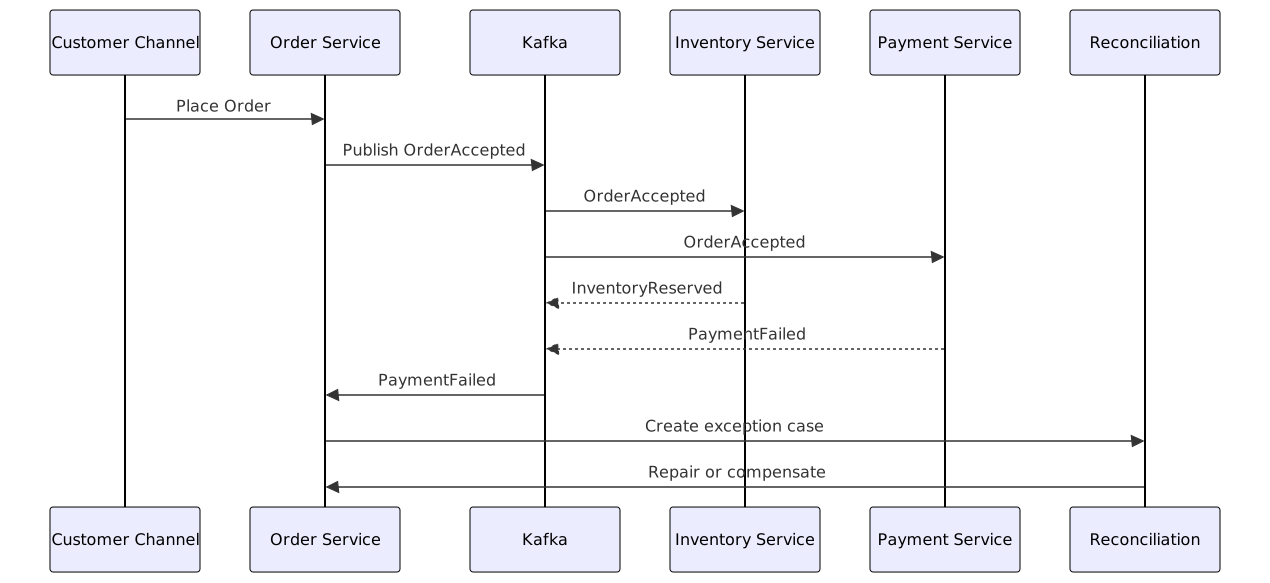
That little box called Reconciliation is where many real enterprises quietly spend their lives.
Migration Strategy
Big-bang rewrites are how architecture becomes folklore. The migration path here should be progressive, evidence-led, and intentionally strangled.
A sensible strategy starts by identifying one or two high-value business flows where operational pain is visible: onboarding, order fulfillment, claims processing, customer billing, loan origination. Pick flows where metrics already show instability, manual work, or customer dissatisfaction. Do not begin with a vanity platform initiative.
Then apply a progressive strangler migration:
Step 1: Instrument the monolith or existing flow
Before splitting anything, capture domain metrics around the current process. Measure latency, failure categories, rework, manual interventions, and reconciliation effort. This baseline matters. Without it, every migration story turns into mythology.
Step 2: Identify semantic seams
Use domain-driven design to find bounded contexts and places where business language changes. These are better extraction points than technical modules. If “pricing” and “contract issuance” use different policies, data lifecycles, and change rhythms, they may deserve different boundaries. If they are tightly coupled in every business conversation, splitting them early may be a mistake.
Step 3: Carve out one domain capability
Extract a bounded context behind an anti-corruption layer. Publish domain events from the old world if necessary. Use Kafka where asynchronous decoupling genuinely helps, not because it is fashionable.
Step 4: Build observability from day one
Every new service should emit domain and technical telemetry. Correlate old and new worlds in the same flow. During migration, hybrid visibility is critical.
Step 5: Compare metrics, then expand
Did the extracted capability reduce lead time, failure rates, or reconciliation load? Did it create new bottlenecks? Migration should proceed based on measured improvement, not architectural ideology.
Step 6: Introduce reconciliation intentionally
Where old and new systems coexist, drift is inevitable. Design reconciliation paths explicitly. Define source-of-truth rules. Measure divergence. This is not optional.
Step 7: Strangle by workflow, not by codebase percentage
A common anti-pattern is celebrating that “40% of the monolith has been moved.” Customers do not care. Move complete workflows or meaningful subdomains. Architecture value comes from changing business capability shape, not from deleting lines in the old repo.
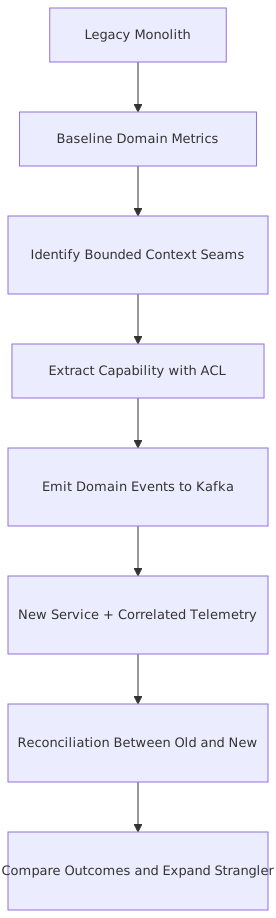
The strangler pattern works best when fed by evidence. Metrics tell you where to cut next, where to pause, and where to reverse.
Enterprise Example
Consider a global insurer modernizing claims processing.
The legacy estate includes a large policy administration platform, a claims monolith, regional document systems, and batch integrations to finance. The organization decides to move toward microservices and Kafka. The first instinct is predictable: split by technical domains such as document service, customer service, workflow service, rules service, and payment service.
That would have been a disaster.
Instead, the architecture team starts with operational evidence. Claims handling shows three severe issues:
- first-notice-of-loss intake latency varies wildly by region
- fraud referral cases create long-lived manual queues
- claim payment reconciliation with finance requires thousands of monthly adjustments
Rather than splitting by technical stack, the team applies domain-driven design to identify bounded contexts: Claim Intake, Coverage Assessment, Fraud Referral, Settlement, and Financial Posting. These contexts map to distinct business language, rules, and operational pain points.
They begin with Claim Intake and Fraud Referral.
Claim Intake is extracted first because it has high customer visibility and relatively clear event boundaries. The new intake service emits domain events like ClaimSubmitted, DocumentReceived, and ClaimRegistered. Kafka is used to fan out these events to downstream assessment and communication services. Metrics include intake completion time, abandonment rate, document mismatch rate, and registration retry count.
Fraud Referral is not fully automated. That is deliberate. The architecture models it as a separate bounded context with human workflow at the center. It emits metrics around referral age, queue depth by reason code, and false-positive rate. This is domain semantics, not just system monitoring.
Within three months, the team learns something important from production. Kafka consumer lag is not the main issue. The bigger issue is semantic ambiguity between Coverage Assessment and Settlement. Claim status events are too coarse. Downstream services cannot distinguish between “eligible for payment,” “pending evidence,” and “awaiting subrogation.” As a result, payment preparation creates noise, and reconciliation volumes rise.
The response is architectural, not operational. They redesign the domain event model, introduce clearer claim decision states, and move some policy interpretation logic back into Coverage Assessment instead of duplicating it downstream. One service becomes fatter. The architecture gets better.
That is the kind of move dogmatic microservice programs resist and mature enterprises embrace.
The result after a year is not a perfect service mesh fairy tale. It is more valuable than that:
- intake lead time reduced by 37%
- manual fraud queue aging reduced by 24%
- finance reconciliation adjustments reduced by 42%
- incident diagnosis improved because claims traces align with business workflow states
The key lesson is not “Kafka worked” or “microservices worked.” The lesson is that metrics in domain language exposed where architecture was truthful and where it was pretending.
Operational Considerations
An observability-driven architecture needs operating discipline.
First, define ownership. Someone must own domain metrics and the architectural response to them. If telemetry belongs only to platform engineering, semantic drift is inevitable. If business KPIs belong only to product teams, technical causality gets lost. Shared ownership across architecture, engineering, and domain teams works best.
Second, establish a metric hierarchy:
- platform metrics: broker health, CPU, memory, saturation
- service metrics: throughput, latency, errors, retries
- workflow metrics: state transition timings, handoff failures
- business metrics: completion rate, intervention rate, policy breaches
- reconciliation metrics: drift counts, repair success, time-to-consistency
Third, treat traceability as a design concern. Correlation IDs, event IDs, causation chains, idempotency keys, and audit references are not technical decoration. They are how you make a distributed business process explainable.
Fourth, build review cadences that connect metrics to architecture decisions. Monthly architecture boards that discuss only target-state diagrams are nearly useless. Review actual operational patterns: hot spots, dependency churn, queue accumulation, inconsistency trends, and domain event misuse. ArchiMate for governance
Fifth, watch for metric localism. Teams will optimize what they own. The payment service may improve p95 latency while increasing order abandonment because it rejects too aggressively under load. End-to-end metrics must overrule local vanity.
Tradeoffs
This style of architecture is powerful, but not free.
It increases upfront modeling effort. Teams must agree on domain language, event semantics, and instrumentation standards. That is slower than throwing logs into a central store and hoping dashboards tell the story later.
It also creates governance overhead. Not bureaucracy for its own sake, but discipline. Event contracts need stewardship. Metrics need curation. Reconciliation needs ownership. Without this, the feedback loop turns noisy. EA governance checklist
Kafka and asynchronous workflows improve decoupling and resilience, but they also distribute state across time. You gain elasticity and lose immediate certainty. The bill arrives as idempotency, ordering logic, backpressure handling, dead-letter policy, and reconciliation.
Sometimes the right move is to merge services, not split them. That offends teams who treat microservices as a maturity badge. But if two services change together, fail together, and reconcile endlessly, they may be one bounded context wearing two Dockerfiles.
There is no virtue in architectural fragmentation.
Failure Modes
Several failure modes show up repeatedly.
Dashboard abundance, insight scarcity
The organization has excellent tooling and terrible questions. Thousands of metrics, no semantic model, no architecture action. Production becomes a sea of telemetry with no compass.
Event taxidermy
Teams publish events that look business-friendly but are actually frozen database changes with polite names. Consumers infer meaning differently. Coupling returns through the side door.
Kafka as shared database
Services depend on topics as if they were reading another team’s internal tables. Schema churn, replay hazards, and hidden dependencies follow. This is one of the fastest ways to create distributed mud.
Reconciliation denial
Architects declare eventual consistency but never fund repair flows, exception handling, or drift metrics. Operations absorbs the pain manually. The architecture appears elegant only because human labor is hiding the cracks.
Overreaction to noisy signals
Not every spike deserves a redesign. Systems need trend analysis and judgment. Otherwise teams thrash architecture based on temporary anomalies.
Metric capture without domain collaboration
If telemetry is designed without business experts, labels drift toward technical convenience. You end up measuring what machines find easy instead of what the domain finds meaningful.
When Not To Use
Do not force observability-driven design everywhere.
If you have a simple internal application with low change frequency, a small user base, and modest operational risk, this level of semantic instrumentation may be unnecessary. A well-structured modular monolith with basic monitoring can be the smarter choice.
If the domain is not yet understood, be careful about overformalizing metrics too early. Early-stage product discovery often needs looser feedback loops and qualitative learning before semantic architecture hardens.
If your organization lacks the discipline to act on metrics, collecting more of them will not help. Observability-driven design only works when teams are willing to let runtime evidence challenge cherished architecture beliefs.
And if your real bottleneck is organizational politics rather than system behavior, no dashboard will save you. Some enterprises have architecture problems because decision rights are broken, not because traces are missing.
Related Patterns
Several related patterns complement this approach.
Domain-Driven Design is the foundation. Bounded contexts, ubiquitous language, and context mapping help ensure metrics are attached to meaningful business concepts.
Strangler Fig Pattern provides the migration path. It allows architectural evolution guided by measured outcomes instead of big-bang replacement.
Saga Pattern is relevant for orchestrating long-running distributed workflows, especially when Kafka and asynchronous messaging are used. But sagas should be instrumented around business states, not just technical steps.
Anti-Corruption Layer is essential during migration from legacy systems. It preserves semantics when old models and new bounded contexts do not align cleanly.
Outbox Pattern helps make domain event publication reliable when services update state and publish to Kafka.
Fitness Functions from evolutionary architecture are useful here, provided they include operational and domain metrics rather than purely static checks.
Summary
Good architecture does not end at deployment. It enters its most honest phase there.
Observability-driven design turns operational metrics into architectural feedback. It uses domain semantics, not just technical counters. It treats Kafka and microservices as tools for specific bounded contexts, not universal answers. It acknowledges reconciliation as a first-class architectural concern. And it evolves systems through progressive strangler migration guided by evidence.
This approach is demanding. It requires semantic discipline, ownership, and the courage to let production challenge design. But in real enterprises, that is the difference between architecture as a slide deck and architecture as a living system.
The memorable line is this: if your system can tell you it is in pain, but your architecture cannot hear it, you are not observing the system—you are ignoring it more efficiently.
That is the heart of the metric feedback loop.
Frequently Asked Questions
What are the three pillars of observability?
The three pillars are metrics (quantitative measurements over time), logs (discrete event records), and traces (end-to-end request paths across services). Together they let you understand system behaviour and diagnose issues without needing to predict every failure mode in advance.
What is distributed tracing?
Distributed tracing tracks a request as it flows through multiple services, correlating spans across service boundaries using a trace ID. Tools like Jaeger, Zipkin, or OpenTelemetry collect and visualise this data, making it possible to identify latency bottlenecks in complex service meshes.
How does observability differ from monitoring?
Monitoring checks known failure conditions — if metric X exceeds threshold Y, alert. Observability enables answering unknown questions about system state using telemetry. Monitoring is reactive to known unknowns; observability prepares you to explore unknown unknowns.