⏱ 20 min read
Most cloud transformation diagrams are useless.
That sounds harsh, but let’s be honest. In a lot of enterprises, “architecture for cloud” still means one of two things: either a vendor reference diagram with some logos pasted in, or a giant PowerPoint full of boxes nobody trusts after two weeks. It looks strategic. It feels architectural. But it does not help anyone make a hard decision when the pressure is on.
And cloud transformation is nothing but hard decisions.
What moves first. What stays on-prem. Where identity really lives. How event streaming changes integration. Which controls are inherited from the platform and which are still your problem. How to explain to a risk committee why Kafka in the cloud is not just “another middleware upgrade.” How to show that a customer onboarding capability depends on IAM modernization more than it depends on Kubernetes. That last one especially gets missed.
This is where ArchiMate can be very good. Not because it gives you another notation to memorize. Not because executives care about relationship types. They don’t. It matters because ArchiMate gives enterprise architects a disciplined way to connect strategy, operating model, applications, technology, and risk in one coherent view. If you use it properly, it becomes a decision tool. If you use it badly, it becomes architecture theater.
So let’s say the simple thing early.
What ArchiMate is, in plain English
ArchiMate is a modeling language for enterprise architecture. It helps you describe how the business works, which applications support it, what technology runs it, and how changes connect across those layers.
For cloud transformation, that means you can model things like:
- business capabilities moving to digital channels
- applications being rehosted, refactored, or retired
- IAM becoming a shared platform service
- Kafka acting as an integration backbone
- cloud landing zones, networks, and platform controls
- dependencies, gaps, ownership, and transition states
In other words: ArchiMate helps you show what is changing, why it is changing, and what that change impacts.
That’s the simple version. It’s also the SEO version. Fine.
But the real value is deeper than that. ArchiMate is useful in cloud transformation because cloud is not mainly a hosting change. It is an operating model change. And if your architecture language cannot connect operating model to technology reality, it will fail at exactly the moment the enterprise needs clarity. ArchiMate modeling guide
The first uncomfortable truth: cloud transformation is not an infrastructure program
A lot of organizations still treat cloud as if it were a data center exit plan. That’s already a mistake.
Yes, infrastructure matters. Landing zones matter. Connectivity matters. Guardrails matter. But the enterprise impact of cloud transformation is not primarily “we moved servers.” The impact is:
- teams consume shared services differently
- integration patterns change
- identity and trust boundaries change
- resilience models change
- cost ownership shifts
- release engineering changes
- control evidence changes
- product teams gain more autonomy, and central functions panic a little
That is exactly why ArchiMate is relevant. It allows you to trace the change from business capability to application service to technology service to implementation path. Without that traceability, cloud programs become a collection of local optimizations. ArchiMate tutorial
I’ve seen this repeatedly in banking. A program claims success because 60% of workloads are “in cloud,” while customer onboarding still depends on batch transfers, duplicated IAM logic, and a Kafka cluster nobody owns clearly. The migration metric looks good. The architecture got worse.
That is not transformation. That is relocation with branding.
Why ArchiMate works well for cloud, if you don’t overcomplicate it
ArchiMate has a reputation problem. Some architects make it too abstract, too pure, too obsessed with notation correctness. Then delivery teams tune out immediately. Fair enough.
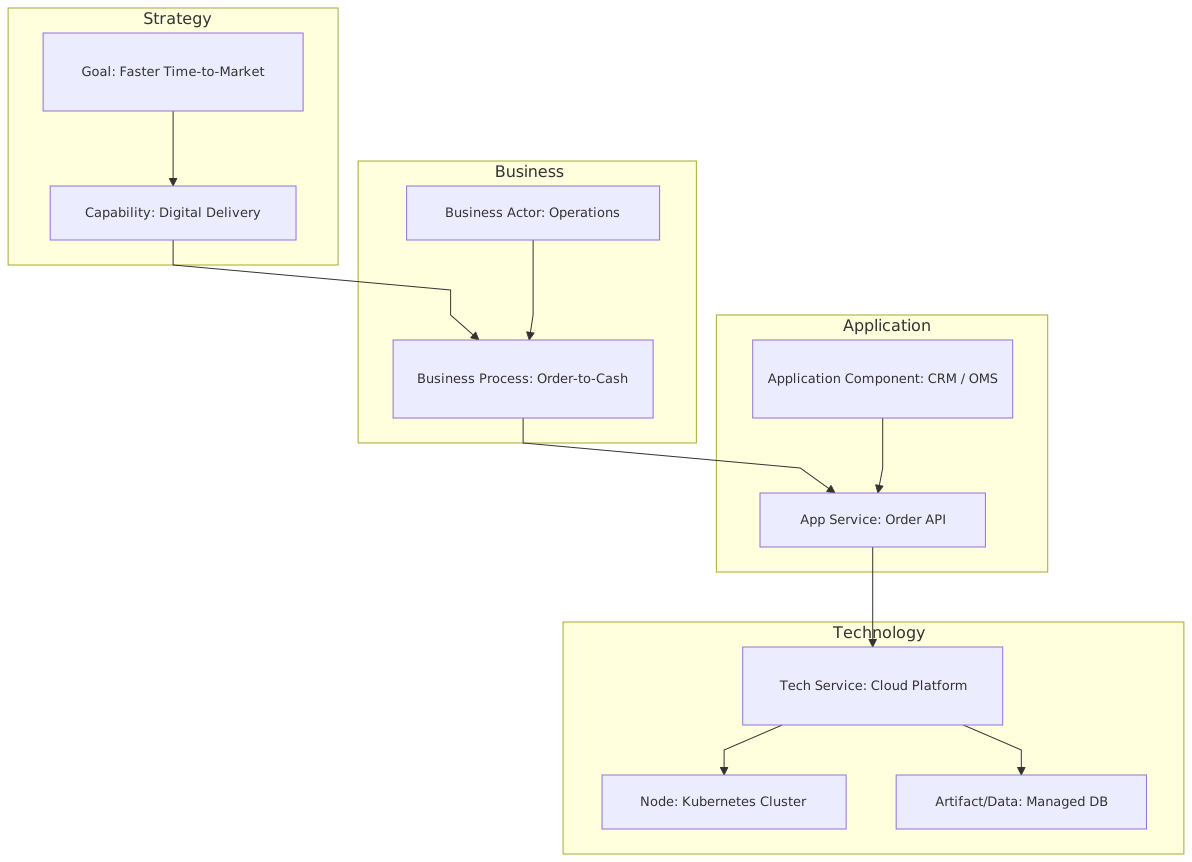
But at its best, ArchiMate gives you three practical advantages in cloud work.
1. It forces layered thinking
Cloud decisions are often made too low in the stack. A team decides on managed Kafka, or a cloud-native IAM pattern, or a container platform, before anyone has clearly described the business capability and service implications.
ArchiMate pushes you to ask:
- Which business capability is this change enabling?
- Which business processes or products are affected?
- Which application services are changing?
- Which technology services are becoming strategic platforms?
- What dependencies exist across teams and domains?
That structure matters. It prevents “platform-first” architecture that looks modern but solves the wrong problem.
2. It makes dependencies visible
Cloud transformations fail in the seams.
Not because the cloud platform is missing. Because the dependencies were hidden. Identity federation not ready. Event schemas unmanaged. Data residency assumptions wrong. Legacy mainframe still the system of record. Security model split across three control planes. Shared API gateway overloaded by every team at once.
ArchiMate is good at exposing those seams. Especially when you model not just target state, but transition architectures.
3. It supports communication across audiences
This one gets underestimated. Architects don’t just model systems. They translate between tribes.
- executives want outcomes and risk
- security wants controls and trust boundaries
- engineers want interfaces and deployment implications
- operations wants support ownership
- finance wants cost accountability
- regulators want traceability
ArchiMate can support all of those conversations if you create the right views. Not one mega-diagram. Different views from the same model. That is the key.
What this looks like in real architecture work
Let’s get concrete, because this is where many articles go soft.
In real enterprise architecture work, ArchiMate is not useful because you can produce a perfect repository model. Nobody has time for that. It is useful because it helps you answer recurring cloud transformation questions with evidence.
Here are common real-world questions:
- Which customer-facing capabilities are blocked by legacy IAM?
- Which applications can move to cloud now, and which depend on event decoupling first?
- Where should Kafka be modeled: application integration or technology platform? Trick question. Often both, in different views.
- Which controls are centralized in the cloud platform, and which remain application responsibilities?
- What is the blast radius if we modernize authentication for retail banking channels?
- Which teams consume shared identity services, and what breaks if token standards change?
- Which transition states are tolerable for 12 months, and which create unacceptable operational risk?
That is architecture work. Not drawing. Decision support.
A good ArchiMate model becomes the backbone for those discussions.
A practical way to model cloud transformation with ArchiMate
You do not need every element and relationship under the sun. In fact, please don’t.
For cloud transformation, I usually recommend a practical structure:
Start at capability level
Model business capabilities first. Not because capability maps are fashionable, but because they anchor the change in enterprise value.
For a bank, capabilities might include:
- Customer Onboarding
- Payments Processing
- Fraud Detection
- Identity and Access Management
- Regulatory Reporting
- Digital Channel Management
Then identify which capabilities are strategic, constrained, or being transformed.
Map business services and products
Show what the business actually delivers. For example:
- Retail Current Account
- Mobile Banking
- SME Lending
- Instant Payments
This matters because cloud transformation often affects products unevenly. A bank may modernize mobile banking rapidly while core lending remains tied to older platforms.
Connect to application services and applications
Now model the application layer:
- Customer Identity Service
- Authentication Service
- Event Publishing Service
- Payment Orchestration Service
- Consent Management Service
Then the applications behind them:
- IAM Platform
- Mobile Banking App
- API Gateway
- Kafka Event Platform
- Core Banking System
- Fraud Engine
This is where architects often get sloppy. They mix application service, application component, and technology service randomly. Then the model loses meaning.
Model shared technology services clearly
Cloud transformation depends heavily on shared platforms. Show them explicitly:
- Cloud Landing Zone
- Kubernetes Platform
- Managed Kafka Service
- Secrets Management
- Key Management Service
- Logging and Monitoring Platform
- Network Connectivity Service
- Identity Federation Service
Do not bury these as footnotes. Shared platforms are the architecture in cloud transformations.
Add implementation and migration views
This is where ArchiMate becomes truly useful. Show:
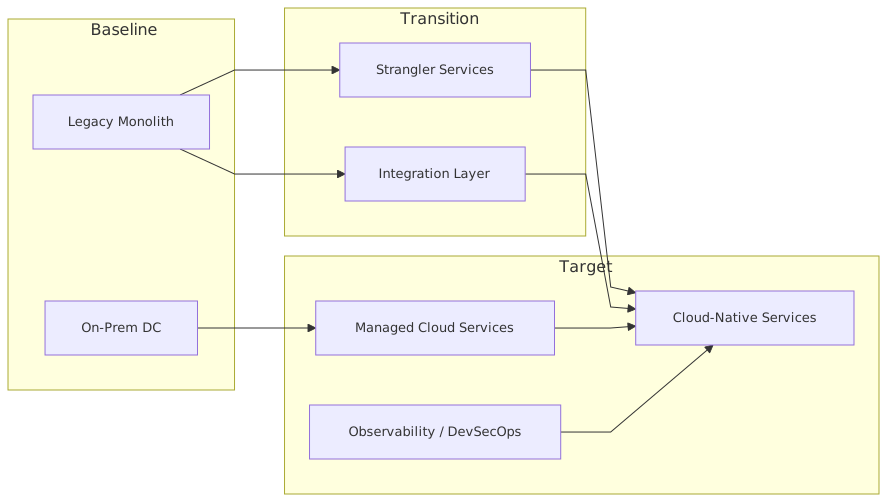
- baseline state
- transition state 1
- transition state 2
- target state
Because the target alone is almost never the hard part. The hard part is surviving the middle.
The banking example: customer onboarding in a cloud transformation
Let’s use a realistic enterprise example.
A mid-sized bank wants to modernize customer onboarding for retail customers. Today, onboarding is fragmented:
- front-end digital channels run partly in cloud, partly on-prem
- identity proofing is handled by a third-party service
- internal IAM is legacy, tightly coupled to branch and employee systems
- customer records are created in a core banking platform on-prem
- anti-fraud checks rely on a mix of synchronous APIs and nightly batch
- integration between systems is point-to-point with some aging middleware
The executive narrative says: “Move onboarding to cloud for agility.”
That sounds simple. It isn’t.
What the architecture actually shows
If you model this properly in ArchiMate, you quickly find that the critical dependencies are not compute and storage. They are:
- IAM modernization: customer identity lifecycle is inconsistent across channels
- event-driven integration: onboarding events need to trigger fraud, KYC, account setup, and notifications
- trust boundaries: third-party identity proofing, bank IAM, and cloud-native services need a coherent token and federation model
- legacy record creation: core banking remains the authoritative system for account creation
- control ownership: cloud platform team, IAM team, and product teams each own different parts of the risk posture
That changes the transformation roadmap completely. EA governance checklist
Instead of “lift onboarding to cloud,” the architecture should likely recommend:
- establish a canonical customer identity service
- modernize IAM and federation patterns
- introduce Kafka as the event backbone for onboarding domain events
- decouple fraud and notification services through event streaming
- keep core banking account creation on-prem initially, exposed through stable APIs
- migrate orchestration and customer-facing services to cloud in phases
That is a much better transformation design. And you can represent it clearly in ArchiMate.
Where Kafka fits in this picture
Kafka is another area where architects get lazy. They say “we’ll use Kafka for decoupling,” as if that solves architecture by itself.
No. Kafka is powerful, but it is not a strategy. It is a platform capability that needs proper placement in the model.
In this banking example, Kafka can be modeled as:
- a technology service when you want to show the managed event streaming platform
- an application service when you want to show event publishing/consumption capabilities exposed to applications
- a dependency in implementation views when teams are being onboarded to event-driven integration
The key is to be explicit about the viewpoint.
For onboarding, domain events might include:
- CustomerIdentityVerified
- KYCCompleted
- FraudCheckRequested
- FraudCheckCleared
- AccountCreated
- WelcomeNotificationTriggered
That event model is not just technical detail. It changes process design, resilience, auditability, and ownership. In a bank, those are architecture-level concerns.
Common mistakes architects make with ArchiMate in cloud programs
Let’s be blunt. Most ArchiMate problems are not tool problems. They are architect behavior problems.
Mistake 1: modeling the target state only
This is probably the biggest one.
Architects love target state because it is clean. Real life is not clean. Cloud transformations live in transition states for years. If you do not model those transitions, your architecture is decorative.
In banking especially, transition states matter because controls, customer journeys, and integrations can’t all move at once.
Mistake 2: confusing application and technology layers
This happens constantly with cloud services.
Is IAM an application or a technology service? Depends on what you are showing. Is Kafka infrastructure or integration capability? Depends on the viewpoint. Is an API gateway a platform service or part of the application landscape? Again, depends.
The mistake is not choosing one or the other. The mistake is being inconsistent and not stating the viewpoint clearly.
Mistake 3: drawing vendor architecture instead of enterprise architecture
A cloud provider’s reference architecture is not your enterprise architecture.
Your enterprise has:
- legacy constraints
- operating model issues
- ownership realities
- regulatory boundaries
- political constraints, yes those too
- uneven engineering maturity
If your ArchiMate model ignores those and just mirrors the vendor diagram, it is fantasy.
Mistake 4: ignoring identity until late
This is the classic cloud program failure mode.
Teams move applications, build APIs, set up event platforms, then discover identity is fragmented across workforce, customer, machine, and third-party contexts. Then everything slows down.
IAM is not a side concern. In many cloud transformations, IAM is the control plane for the whole architecture.
Mistake 5: making one giant universal diagram
Nobody wants this except maybe the architect who made it.
Create focused views:
- executive outcome view
- capability impact view
- application dependency view
- IAM trust boundary view
- migration roadmap view
- platform service consumption view
Same model, different views. That is how ArchiMate becomes usable.
A useful mapping: what to model for cloud transformation
Here’s a practical table I wish more teams started with.
This is the kind of table that helps teams stop arguing abstractly and start modeling what matters.
Contrarian view: ArchiMate is often worse than whiteboarding in the early phase
Yes, I said it.
In the first few workshops of a cloud transformation, whiteboarding is often better. Faster, messier, more honest. People reveal uncertainty more easily when they’re not staring at a formal notation.
The mistake is staying there too long.
Whiteboards are great for discovery. Terrible for sustained enterprise decision-making. They don’t preserve semantics, they drift, and every stakeholder remembers them differently. ArchiMate should come in after the first rough architecture thinking, not before. If you force notation too early, people disengage. If you never formalize, the program fragments.
So the mature position is not “ArchiMate everywhere.” It is: use informal thinking to explore, then use ArchiMate to stabilize, align, and govern.
That balance matters.
How to use ArchiMate with executives without boring them to death
Another practical point. Executives do not care about notation purity. They care about choices, implications, and risk.
So when presenting cloud transformation using ArchiMate-derived views, emphasize:
- which capabilities improve
- which risks reduce or increase
- which dependencies must be funded
- what sequencing is non-negotiable
- where shared platforms create leverage
- where legacy constraints still dominate
For example, instead of saying:
> “The target architecture introduces a federated identity application service serving multiple application components via event-driven application cooperation.”
Say:
> “We cannot scale digital onboarding safely until customer identity is centralized and federated. That change also unlocks reuse across mobile banking, fraud checks, and partner channels.”
Same architecture. Better communication.
IAM: the part everyone underestimates in cloud transformation
Let’s stay on IAM because it deserves stronger emphasis.
In many enterprises, the real cloud architecture is the identity architecture.
Not the VPC design. Not the Kubernetes clusters. Identity.
Who authenticates whom. Where tokens are issued. Which systems trust which claims. How service-to-service identity works. How privileged access is controlled. How customer and workforce identity differ. How third parties federate. How audit trails are generated. How policy enforcement is distributed.
If you don’t model IAM properly in ArchiMate, you are basically hiding the most important control structure in the cloud estate.
For a bank, I would typically model:
- customer identity service
- workforce identity service
- machine/workload identity patterns
- identity federation service
- authorization policy decision points
- token services
- privileged access management
- interfaces to cloud-native IAM controls
- consuming applications and channels
And critically, I would show which of these are transitional and which are strategic target-state components.
Because many banks end up with hybrid IAM for years:
- legacy LDAP or mainframe security still active
- cloud-native IAM for workloads
- CIAM for digital customers
- federation layers bridging the old and new
That complexity needs to be made visible, not hand-waved away.
Kafka: useful, overhyped, still necessary in many transformations
Now for another opinion.
Kafka is often overprescribed. Architects sometimes use it as a badge of modernity. “We’re event-driven now.” Great. Are you actually? Or did you just replace one central integration dependency with another one that has harder operational characteristics?
Still, in cloud transformation, Kafka can be genuinely transformative when used with discipline.
In our banking example, Kafka helps by:
- decoupling onboarding steps
- supporting asynchronous fraud and notification flows
- enabling audit-friendly event trails
- reducing brittle point-to-point integrations
- allowing cloud and on-prem systems to coexist during transition
But there are traps:
- no event governance
- no ownership of schemas
- too many shared topics
- unclear replay expectations
- pretending eventual consistency is acceptable where it isn’t
- weak access control on topics and consumers
Again, this is where ArchiMate helps. You can show the event platform as a shared service, identify consuming applications, and trace which business processes depend on event-driven behavior. That makes the implications visible before production incidents teach the lesson more painfully.
What good ArchiMate deliverables look like in a cloud program
If I join a cloud transformation and the architecture team says they use ArchiMate, these are the deliverables I expect to see within a reasonable period:
- Capability impact map
Which business capabilities are changing, and why.
- Application cooperation view
Especially around IAM, APIs, and event streaming.
- Technology platform view
Landing zone, IAM foundations, observability, Kafka, network, secrets, key management.
- Trust boundary view
Critical in banking. External identity proofing, customer channels, internal services, cloud controls.
- Transition architecture views
Not just baseline and target. At least one or two meaningful interim states.
- Roadmap linked to work packages
Because architecture that cannot influence sequencing is mostly performance art.
That may sound a bit cynical. It is, but only slightly.
A note on governance: ArchiMate should reduce bureaucracy, not increase it
This is another contrarian point. If introducing ArchiMate creates more governance overhead and less clarity, stop. ArchiMate for governance
The goal is not to produce more architecture content. The goal is to improve enterprise decisions.
A healthy pattern is:
- lightweight model governance
- strong viewpoint discipline
- clear ownership of shared concepts
- regular updates tied to portfolio and delivery milestones
- architecture reviews based on model evidence, not opinion alone
An unhealthy pattern is:
- central team policing notation
- endless debates on element types
- stale repository nobody trusts
- architecture disconnected from delivery
You know which one is more common.
So, should every cloud transformation use ArchiMate?
Not necessarily in a heavy way. But serious enterprise cloud transformations do need a coherent architecture language and model. ArchiMate is one of the best options because it spans business, application, technology, and change.
The real question is not “Should we use ArchiMate?”
The real question is:
Can we explain and govern cloud transformation across capabilities, applications, platforms, identity, risk, and migration states without a shared modeling discipline?
In a small environment, maybe. In a large bank with multiple platforms, regulatory pressure, Kafka-based integration, hybrid IAM, and years of coexistence? Usually not.
That’s where ArchiMate earns its keep.
Final thought
Cloud transformation is messy. Political, technical, operational, sometimes irrational. No modeling language fixes that. But a good one can stop the mess from becoming invisible.
That is what ArchiMate does when used well.
It gives architects a way to say: this business capability depends on this identity service, which depends on this cloud platform control, which changes this risk posture, which requires this migration sequence. That sentence alone is more valuable than a hundred cloud vendor diagrams.
So yes, use ArchiMate for cloud transformation. But use it like an architect, not like a documentation clerk.
Model the decisions. Model the dependencies. Model the ugly transition states. Show where IAM is the real bottleneck. Show where Kafka helps and where it complicates. Show where the cloud platform is a strategic service and where it is just plumbing.
And above all, stop drawing pretty pictures that avoid the hard parts.
FAQ
1. Is ArchiMate too complex for cloud transformation teams?
It can be, if you use all of it. Don’t. Use a pragmatic subset and create targeted views. Most teams do not need notation maximalism; they need consistent modeling of capabilities, applications, platforms, IAM, and migration states.
2. How should Kafka be modeled in ArchiMate?
Usually in more than one way depending on the view. As a technology service for the event platform, and as an application service when showing how applications publish and consume events. The viewpoint matters more than dogma.
3. Why is IAM so central in cloud transformation architecture?
Because identity defines trust, access, policy enforcement, and auditability across cloud and hybrid environments. In many enterprises, especially banks, IAM becomes the real control plane of transformation. If you model everything except identity, you are hiding the most important dependency.
4. What is the most common mistake when using ArchiMate for cloud programs?
Focusing only on target state. Real transformations live in transition for years. If you do not model interim states, dependencies, and coexistence patterns, your architecture will not help delivery or governance.
5. Can ArchiMate help with executive communication, or is it just for architects?
Yes, but only through the right views. Executives should not see notation-heavy diagrams. They should see capability impacts, risk implications, platform dependencies, and transformation sequencing derived from the model. The model is for rigor; the view is for communication.
ArchiMate for Cloud Transformation — Layered View
ArchiMate for Cloud Transformation — Transition / Dependency View
Frequently Asked Questions
How is ArchiMate used for cloud transformation?
ArchiMate models cloud transformation by comparing baseline and target architectures across all layers. Cloud platforms appear as Technology Services, workloads as Application Components assigned to Technology Nodes. The Implementation and Migration layer models transition plateaus, work packages, and migration events — producing a traceable cloud roadmap.
How does ArchiMate align with DevOps practices?
ArchiMate supports DevOps by modeling the CI/CD pipeline as Application Behavior elements, infrastructure as code as Technology Artifacts, and deployment topology as Technology Nodes. Traceability from requirements through design to deployed infrastructure helps DevOps teams understand architectural constraints and governance requirements.
What cloud architecture patterns can be modeled in ArchiMate?
ArchiMate can model cloud-native patterns including: multi-region active-active deployments, event-driven integration via messaging platforms, API-led integration architectures, zero-trust network topology, container orchestration (Kubernetes), and hybrid cloud connectivity. Each pattern maps to specific Technology and Application layer elements.