⏱ 19 min read
Architecture Fitness Functions in Evolutionary Architecture | feedback loop diagram
Architecture ages the moment it meets production.
That sounds harsher than it is, but every enterprise architect eventually learns the same lesson: the architecture diagram approved in a steering committee is not the architecture that survives contact with teams, deadlines, regulation, and real customer behavior. Systems drift. Coupling creeps in through convenience. “Temporary” decisions fossilize. New services appear because one team needs speed, while old systems stay alive because the business still needs certainty. Before long, the architecture you thought you had becomes a rumor.
This is where fitness functions matter.
A fitness function is not a fancy dashboard or a compliance checklist in disguise. It is a concrete, repeatable mechanism that tells you whether the architecture is still moving in the direction you intended. If evolutionary architecture is the idea that systems must change safely over time, fitness functions are the guardrails, tripwires, and thermometers. They turn architectural intent into feedback loops.
And feedback loops are the whole game.
In modern enterprises—especially those blending microservices, Kafka-based event streaming, cloud platforms, and stubborn legacy estates—the real challenge is not drawing a target architecture. The real challenge is keeping the architecture coherent while it evolves under pressure. That means measuring things that matter: coupling, latency, data ownership, deployment independence, resilience, security boundaries, team autonomy, and perhaps most neglected of all, fidelity to domain semantics.
Because architecture failure rarely begins with a server outage. It often begins when the language of the business and the shape of the software start to diverge.
Context
Evolutionary architecture has become popular for a good reason: very few enterprises can afford a clean-slate rewrite, and even fewer survive one. Large organizations live in a permanent in-between state. They are modernizing and operating. They are decomposing monoliths while onboarding acquisitions. They are introducing event-driven integration while still running nightly batches because a downstream regulator or finance process depends on them.
In that reality, architecture is less cathedral, more city planning.
Domain-driven design gives us a way to reason about that city. It tells us to organize software around business capabilities and bounded contexts rather than technical layers or organizational folklore. Fitness functions make that guidance enforceable. They answer questions like:
- Are services actually aligned to bounded contexts, or are they secretly sharing each other’s data?
- Is event choreography preserving domain meaning, or are we publishing generic integration sludge?
- Has the new customer onboarding service really become autonomous, or is it just a thin API over the old core platform?
- Are teams able to deploy independently without a release train masquerading as agility?
Those are not academic concerns. They are the daily mechanics of enterprise change.
A team can claim to own a domain. But if every release requires coordination with five other teams, if Kafka topics expose internal persistence structures, and if business policies are duplicated in three places, the architecture is telling the truth and the PowerPoint is lying. event-driven architecture patterns
Problem
Most architecture programs fail for one of two reasons.
First, they stop at principles. “We favor loose coupling.” “We adopt event-driven architecture.” “We align to business capabilities.” Fine sentiments. Useless on their own. A principle without a check is just a poster.
Second, they optimize for migration motion rather than architectural outcome. Enterprises love visible movement: services created, APIs published, events flowing, cloud spend rising in the name of transformation. But motion is not fitness. You can migrate a monolith into a distributed monolith and call it progress only if nobody inspects the blast radius of change.
The deeper problem is that architecture qualities decay gradually. No single commit destroys modularity. No single event topic ruins semantic clarity. Instead, hundreds of local decisions, each individually reasonable, pull the system off course. Shared databases appear because they are convenient. Teams subscribe directly to operational events because “we need the data now.” Services start reaching across domain boundaries because the customer journey crosses them. Before long, the architecture has all the costs of distribution with none of the benefits.
This is why fitness functions must be treated as first-class architecture mechanisms. They give the system a way to object when design intent is violated.
Forces
Several forces make this difficult in enterprise settings.
Business pressure for continuous change
The business wants faster delivery, but not at the cost of reliability. It wants product innovation, channel expansion, regulatory compliance, and operational efficiency all at once. The architecture must support change without inviting chaos.
Legacy gravity
Legacy systems do not merely contain old code. They contain old truth. Core policy rules, settlement logic, customer entitlements, pricing agreements, and audit histories often live there. You can wrap them, replicate from them, gradually retire parts of them—but you cannot pretend they are irrelevant.
Domain semantics are fragile
When teams decompose systems, they often decompose the code before they understand the business language. This is how you end up with “customer-service,” “customer-profile-service,” “customer-data-service,” and “customer-master-service,” all claiming the same noun and none owning the full meaning. Fitness functions must therefore look beyond infrastructure metrics and examine whether the architecture preserves domain boundaries and ubiquitous language.
Distributed systems trade consistency for autonomy
Microservices and Kafka can improve decoupling, but they introduce eventual consistency, message ordering issues, idempotency concerns, replay complexity, and operational overhead. Every gain comes with a bill.
Teams are architecture
Conway’s Law has no respect for your target-state diagram. If teams are structured around channels, technologies, or projects rather than bounded contexts, the software will reflect that. Some fitness functions must therefore be socio-technical: architecture conformance can depend on repository dependencies, ownership models, deployment patterns, and on-call structures.
Solution
A fitness function is an executable or measurable rule that evaluates whether the architecture exhibits a desired characteristic. In evolutionary architecture, these functions should be continuous, automated where possible, and tied directly to architectural intent.
That definition matters, because many organizations mistake general operational metrics for architecture fitness. CPU utilization is useful; it is not automatically a fitness function. A fitness function begins with a deliberate architectural concern:
- Services within a bounded context should not read another context’s database.
- Events on Kafka should express business facts, not internal CRUD changes.
- Customer onboarding must be deployable independently from policy administration.
- Critical workflows must tolerate asynchronous retries and duplicate message delivery.
- Sensitive data must remain inside approved trust boundaries.
- A user-facing transaction should degrade gracefully when a downstream recommendation engine is unavailable.
The best fitness functions work across four layers:
- Structural fitness — code dependencies, database access, API contracts, service boundaries.
- Behavioral fitness — latency, resilience, throughput, consistency, recovery behavior.
- Operational fitness — deployment independence, observability coverage, runbook readiness, SLO compliance.
- Semantic fitness — bounded context integrity, event naming quality, policy ownership, domain model consistency.
That last category is where many architecture programs become serious.
If your system says CustomerUpdated every time anything changes anywhere, you do not have domain events. You have a distributed side-effect machine. Semantic fitness functions force precision: CustomerAddressChanged, KycVerificationCompleted, PolicyRenewalPriced, ClaimRegistered. Words matter because integration follows words. Sloppy language produces sloppy coupling.
Here is a simple feedback loop view of fitness functions in an evolutionary architecture:
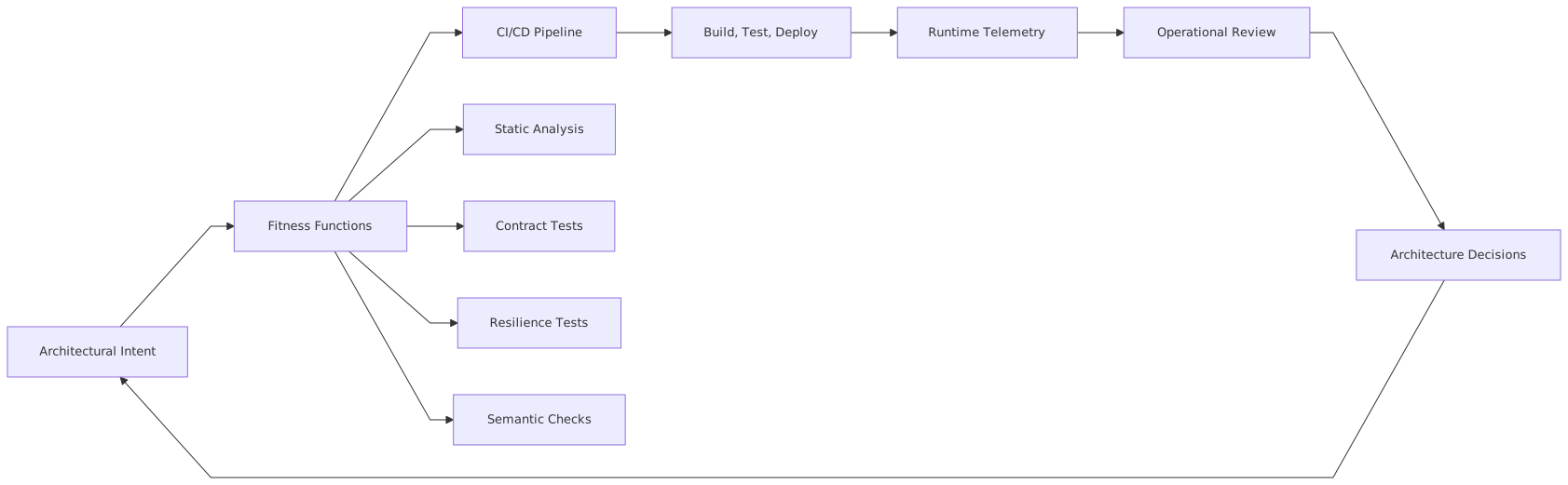
The point is not merely to detect defects. It is to create a closed loop where design intent is continuously tested against actual system behavior.
Architecture
A practical architecture for fitness functions usually combines pipeline checks, runtime verification, and architectural governance that is lightweight enough to survive reality. EA governance checklist
1. Encode bounded contexts as constraints
Domain-driven design gives us a strategic map: bounded contexts, relationships, published language, anti-corruption layers, and places where translation is required. Fitness functions should encode those boundaries.
Examples:
- Repositories in the Billing context may not import domain classes from Claims.
- Services in Customer Identity may publish identity verification events, but may not expose direct database access to CRM.
- Reporting systems may consume domain events from multiple contexts, but operational services may not use the reporting store as an integration shortcut.
These constraints can be checked with static analysis, repository scanning, schema access policies, and API gateway rules.
2. Treat events as domain contracts, not plumbing
Kafka is often introduced to decouple systems. It succeeds only if events carry stable business meaning. If teams publish table-change events or generic mutations, consumers become tightly bound to producers’ internal models.
Useful semantic fitness functions for Kafka-based systems include:
- Topic names must reflect domain events rather than technical verbs.
- Event schemas must have explicit ownership and versioning.
- Producers may evolve schemas only in backward-compatible ways unless a controlled migration path exists.
- No service may consume a topic from another context and then update that producer’s source-of-truth data directly.
This is where architecture and domain semantics meet. Event streaming is not a messaging style; it is a commitment to publishing facts the business recognizes.
3. Verify autonomy, not just decomposition
A service boundary is only meaningful if change can occur independently. A good enterprise fitness function asks: “Can this team release without negotiating a synchronized deployment?” If not, the architecture is still coupled, just more expensively.
Autonomy checks might include:
- Number of downstream services required for a successful deployment.
- Frequency of shared library changes forcing cross-team releases.
- Percentage of changes blocked by external schema or API dependency issues.
- Runtime dependence on synchronous calls across context boundaries for critical journeys.
A surprisingly good smell test: if every architecture discussion involves “just one more shared platform model,” autonomy is already leaking away.
4. Build reconciliation into the design
With Kafka, microservices, and progressive strangler migration, reconciliation is not a nice-to-have. It is how you survive reality.
During migration, data will differ. Events will be delayed. Retry storms will occur. Legacy and new systems will both believe they are authoritative for a while. Fitness functions should therefore include reconciliation measures:
- Can the system detect divergence between legacy and new sources of truth?
- Is there a replayable event log or compensating process?
- Are there domain-specific reconciliation tolerances?
- Are orphaned or duplicate business records detectable within agreed windows?
Reconciliation is not only technical. It is domain-driven. A mismatch in marketing preferences might tolerate a few hours. A mismatch in payment allocation may not tolerate five minutes.
Migration Strategy
Most enterprises do not introduce fitness functions after modernization. They need them during modernization.
The progressive strangler pattern is the pragmatic path here. You carve out one domain capability at a time, route traffic selectively, and move operational responsibility gradually from the legacy core to new services. But this only works if the migration has measurable architectural guardrails.
A good migration strategy usually has five stages.
Stage 1: Map the domain, not the system inventory
Start with event storming, capability mapping, and bounded context identification. Do not begin by listing applications. Applications tell you where software lives. Domains tell you where meaning lives.
Identify:
- core domains
- supporting domains
- shared kernels that should probably stop being shared
- places requiring anti-corruption layers
- candidate seams for strangler extraction
Stage 2: Define target fitness functions before carving out services
This is a subtle but crucial move. Before creating a new service, define the properties it must maintain:
- No direct reads from the legacy database after cutover.
- Domain events must be published for key state transitions.
- Deployment must be independent of the monolith release cycle.
- Business invariants must be preserved under eventual consistency.
- Reconciliation reports must show less than agreed divergence thresholds.
This prevents the all-too-common migration pattern where teams move code first and discover architecture obligations later.
Stage 3: Introduce anti-corruption and event translation
When strangling a legacy system, avoid leaking legacy semantics straight into the new model. The anti-corruption layer is not bureaucracy. It is linguistic protection.
A legacy “party record” may represent customer, broker, claimant, and policy holder in one overloaded structure. Your new domain probably should not. Translation is part of architecture.
Stage 4: Run dual writes rarely, dual reads carefully, reconcile always
Dual writes are seductive and dangerous. If possible, prefer publishing from one system and deriving views in another. If dual writes are unavoidable, isolate them, instrument them heavily, and define failure handling explicitly.
Dual reads during migration are often safer, but they still require deterministic precedence rules. Which source wins when records disagree? How is the discrepancy surfaced? Which domain experts sign off on tolerances?
Stage 5: Retire dependencies, not just traffic
A service is not truly strangled out of the monolith if runtime traffic has moved but data fixes, reporting extracts, and back-office processes still depend on the old path. Fitness functions should track dependency retirement, not merely API adoption.
A typical progressive strangler migration with feedback loops looks like this:
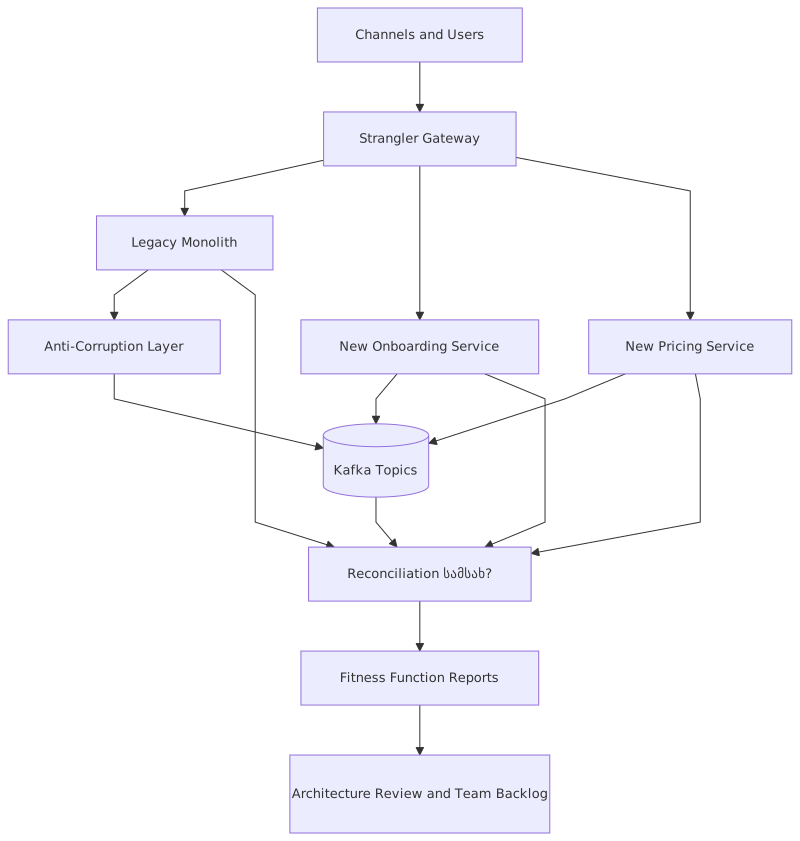
Let me correct the label artifact and provide the intended version cleanly:
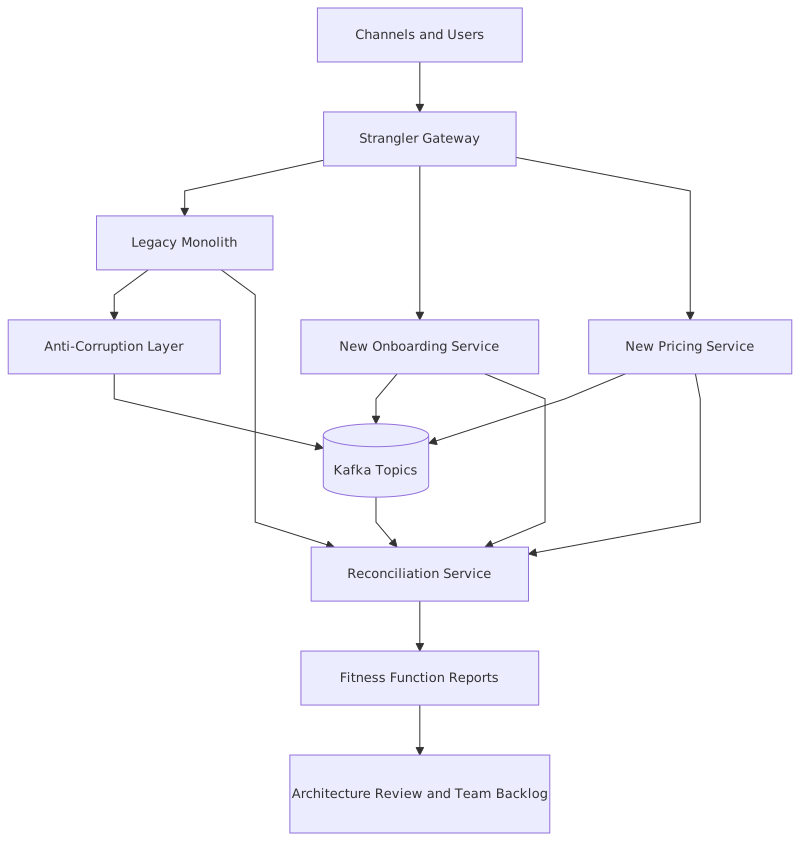
That loop matters. Migration without reconciliation is theater.
Enterprise Example
Consider a large insurer modernizing policy administration and claims intake across multiple countries.
The legacy platform was a monolith with a shared relational database, nightly batch interfaces, and channel-specific customizations that had accumulated for fifteen years. Business leadership wanted faster product launches and digital self-service. Technology leadership wanted cloud-native microservices and event streaming on Kafka. The first attempt failed in a familiar way: teams created dozens of services around technical layers—document service, rules service, workflow service, customer service, policy service—and nearly all of them remained coupled to the monolith database and a central release process.
The second attempt started differently.
The architecture team reframed the work around bounded contexts: Customer Identity, Policy Lifecycle, Pricing, Claims Intake, Document Evidence, and Billing. They used domain-driven design to clarify where language differed. “Customer” in claims was not the same as “policy holder” in policy administration, and pricing events had meanings that billing could consume but not reinterpret.
They then defined architecture fitness functions before building the next wave of services:
- No new service could directly access the monolith schema.
- Kafka events had to be reviewed against domain vocabulary and ownership.
- Services had to prove independent deployment in lower environments before production approval.
- Every critical event flow required idempotent consumers and replay validation.
- Reconciliation dashboards compared premium calculations and policy states between old and new systems during migration.
- Synchronous dependencies across bounded contexts in customer-facing journeys were limited by policy.
A new Pricing context was extracted first because it had clear business value and manageable boundaries. The team published domain events such as QuotePriced, DiscountEligibilityAssessed, and PolicyRenewalPriced. Billing consumed PolicyRenewalPriced, but could not call pricing internals or write pricing data.
Problems surfaced quickly, and this is exactly why fitness functions are valuable. One team proposed a generic PolicyUpdated event for convenience. The semantic fitness check rejected it. Another team tried to read a replicated operational table from Customer Identity because the API was “too slow.” The structural rule blocked production promotion. A resilience test showed quote journeys failed under a Kafka consumer lag scenario because downstream assumptions about immediacy were wrong. The team redesigned the user flow to show “pricing in progress” for edge cases rather than pretending synchronous certainty existed.
Within eighteen months, the insurer had not “finished transformation”—nobody ever does—but it had something better: a modernization path that was getting healthier instead of messier. Product launch lead times dropped, operational incidents became more diagnosable, and the architecture had evidence that bounded contexts were becoming real rather than ceremonial.
Operational Considerations
Fitness functions fail when they remain the pet project of architects.
They have to live where engineers work: source control, CI/CD pipelines, observability tooling, runtime policy engines, and team dashboards. A few practical considerations matter.
Make architectural checks fast enough to be tolerated
If a semantic schema validation takes forty minutes, teams will route around it. Some checks belong in pull requests, some in nightly builds, some in pre-production gates, and some in runtime monitoring. Put fast feedback early and heavier analysis later.
Separate hard gates from advisory signals
Not every architecture concern should block deployment. Use tiers:
- Hard gate: cross-context database access, schema incompatibility, missing encryption, lack of idempotency in critical consumers.
- Soft warning: rising dependency trends, increasing call-chain depth, overbroad event names, slow drift in service autonomy.
Architects who make everything a hard gate usually get ignored or overruled. The point is to shape behavior, not to build an empire of red lights.
Observe business flows, not only technical components
Traditional observability focuses on services and infrastructure. Evolutionary architecture needs observability around domain journeys: quote to bind, claim submission to adjudication, customer onboarding to activation. This is where semantic drift and reconciliation issues become visible.
Use architecture review as interpretation, not ceremony
Fitness functions generate signals. People still need to interpret them. A monthly review that examines recurring violations, migration hotspots, and domain boundary pressure is useful. A quarterly board that blesses slideware is not.
Tradeoffs
There is no free architecture.
Fitness functions add friction. That is their job. They make some unsafe choices slower or impossible. Teams may complain that semantic reviews delay event publication, that dependency rules complicate delivery, or that reconciliation reporting exposes uncomfortable ambiguity in business processes. They are often right. The discipline has a cost.
The tradeoff is between local speed and systemic integrity.
Automation also has limits. Some architectural qualities are easy to codify—dependency direction, schema compatibility, latency thresholds. Others are not. Semantic correctness often needs judgment. A badly designed fitness program can drift into pseudo-precision, where teams game metrics without improving architecture.
There is also a scaling tradeoff. The more distributed the architecture, the more sophisticated your fitness mechanisms must become. Kafka plus microservices plus multiple bounded contexts plus progressive migration can deliver extraordinary flexibility. It can also produce a sprawling estate of topics, contracts, retries, dead-letter queues, and reconciliation jobs. If the business domain does not benefit from that flexibility, you are paying for complexity you do not need.
Failure Modes
This is where the conversation gets real.
Fitness functions become compliance theater
Rules exist, reports are generated, nothing changes. Teams learn which alerts matter politically and ignore the rest. Architecture becomes performative.
Metrics measure proxies, not outcomes
A team can pass a rule of “no synchronous dependencies” and still build a terrible user experience with hidden coupling through shared data exports or brittle event chains. Bad metrics create false confidence.
Domain semantics are outsourced to the integration layer
Kafka topics become the de facto architecture, but nobody owns the meaning. Events proliferate, naming degrades, and consumers build their own interpretations. You get semantic fragmentation at scale.
Reconciliation is bolted on late
By the time migration teams think seriously about reconciliation, they have already created multiple inconsistent truth sources. Fixing this later is expensive and political, because discrepancies expose unresolved business ambiguity.
Fitness functions are too rigid during learning
Early in migration, teams are still discovering true bounded contexts. If rules are immovable from day one, architecture can harden the wrong boundaries. Some constraints should tighten over time as domain understanding improves.
The architecture optimizes for the pipeline and ignores runtime reality
A service can pass every static check and still fail under replay storms, consumer lag, poison messages, or partial regional outages. Runtime fitness matters as much as build-time elegance.
When Not To Use
Fitness functions are powerful, but they are not universally necessary at the same level of rigor.
Do not build an elaborate fitness-function program when:
- the system is small, stable, and handled by one team with direct communication
- the domain is simple and unlikely to evolve significantly
- the architecture is intentionally monolithic and that is the right tradeoff
- the organization lacks the engineering maturity to maintain automated governance
- the business case for microservices or event-driven decomposition is weak
In particular, do not introduce Kafka, domain-event governance, reconciliation frameworks, and a battery of architecture rules just because “modern architecture” says so. A well-structured monolith with clear module boundaries and a few targeted fitness checks is often a better enterprise decision than a fashionable distributed system. ArchiMate for governance
Likewise, if the domain language is still unsettled due to a merger, operating model redesign, or product strategy upheaval, be careful about encoding too many semantic rules too early. First understand the business. Then automate the constraints that matter.
Related Patterns
Fitness functions do not stand alone. They pair naturally with several related patterns.
Domain-Driven Design
This is the foundation. Bounded contexts, ubiquitous language, context maps, aggregates, and anti-corruption layers provide the semantic frame that fitness functions enforce.
Strangler Fig Pattern
Ideal for modernization. Fitness functions ensure the strangler path leads toward genuine autonomy rather than distributed dependency.
Anti-Corruption Layer
Essential when migrating from legacy systems with overloaded or inconsistent models. Fitness functions can verify that new services consume translated concepts rather than legacy leakage.
Event Sourcing and CQRS
In selected domains, event sourcing can make reconciliation and replay more natural. But it also increases cognitive load. Use it when auditability and temporal reasoning justify the cost, not as a reflex.
Contract Testing
Crucial for APIs and event schemas. Consumer-driven contracts can serve as fitness functions for integration stability.
Resilience Engineering
Chaos testing, fault injection, retry behavior checks, and bulkhead verification are behavioral fitness functions in all but name.
A simplified context view for a DDD-aligned event-driven enterprise might look like this:

Notice what is absent: direct database sharing, generic “updated” events, and magical canonical models pretending every context means the same thing by the same word.
Summary
Architecture fitness functions are how evolutionary architecture grows up.
They move architecture from aspiration to evidence. They turn principles into feedback loops. They help enterprises modernize with eyes open, especially when using microservices, Kafka, and progressive strangler migration across complex legacy estates. microservices architecture diagrams
But the important thing is not the mechanics alone. It is what those mechanics protect.
They protect bounded contexts from accidental erosion.
They protect teams from hidden coupling.
They protect migrations from becoming expensive redistribution of technical debt.
And they protect domain meaning, which is the one thing no platform can automate for you.
If I had to reduce it to one enterprise lesson, it would be this: design your architecture so it can change, then design your fitness functions so you notice when it changes in the wrong way.
That is the difference between an architecture that evolves and one that merely decays.
Frequently Asked Questions
What is enterprise architecture?
Enterprise architecture aligns strategy, business processes, applications, and technology in a coherent model. It enables impact analysis, portfolio rationalisation, governance, and transformation planning across the organisation.
How does ArchiMate support architecture practice?
ArchiMate provides a standard language connecting strategy, business operations, applications, and technology. It enables traceability from strategic goals through capabilities and services to infrastructure — making architecture decisions explicit and reviewable.
What tools support enterprise architecture modeling?
The main tools are Sparx Enterprise Architect (ArchiMate, UML, BPMN, SysML), Archi (free, ArchiMate-only), and BiZZdesign. Sparx EA is the most feature-rich, supporting concurrent repositories, automation, scripting, and Jira integration.