⏱ 20 min read
Architecture is not a set of boxes. It is a long chain of consequences.
That is the part many organizations learn too late. A team swaps a database, adopts Kafka, carves out a few microservices, and calls it modernization. Six months later, the order lifecycle is slower, finance cannot reconcile settlements, customer support is reading from three screens, and nobody can explain whether the change actually improved anything. The problem was never the lack of technology. The problem was the absence of a map connecting architectural decisions to business impact.
This is where an Architecture Decision Impact Map earns its keep.
Not as another governance artifact. Not as a prettier ADR repository. And certainly not as a compliance exercise to satisfy an architecture review board. An impact map is useful because it makes one uncomfortable truth visible: every decision in an evolutionary architecture changes the operating model of the business, not just the software. If you move fulfillment allocation into an event-driven service, you have not simply changed a deployment boundary. You have changed the semantics of inventory promises, exception handling, audit trails, and often the timing of revenue recognition.
That is architecture.
In an evolutionary environment, decisions are not isolated. They accumulate. They interfere. They amplify each other in ways teams rarely see when they focus only on local optimization. The impact map gives us a disciplined way to reason from business outcome to domain capability, from domain capability to technical decision, and from technical decision to operational consequence. It becomes the missing bridge between domain-driven design, migration strategy, and enterprise governance.
And yes, it also helps answer the most dangerous question in large organizations: “What happens if we do this?”
Context
Most enterprises are living in a mixed economy of architecture.
A few greenfield services. A decade-old ERP. A customer platform built around APIs. Some heroic integration logic in Kafka. At least one core system nobody wants to touch before quarter close. The architecture is “modern” at the edges and deeply historical at the center. This is normal. event-driven architecture patterns
Evolutionary architecture emerged as a pragmatic response to this reality. Instead of big-bang replacement, we evolve systems incrementally. We use fitness functions, bounded change, strangler patterns, and continuous delivery to move the estate in safer steps. That philosophy is sound. But many teams underestimate how difficult it is to reason about the impact of incremental change in a large enterprise.
A decision to externalize pricing might seem confined to a single bounded context. It rarely is. Pricing affects order capture, promotions, contracts, margin analysis, dispute resolution, and downstream reporting. If the domain language is muddy, one service’s “price” becomes another service’s “quoted amount” and finance’s “billable value.” Then reconciliation begins to fail in subtle ways.
This is why domain semantics matter so much. In domain-driven design terms, architecture decisions are meaningful only in relation to bounded contexts, ubiquitous language, and the invariants each context must protect. Without that, impact analysis degrades into technical dependency mapping. Useful, perhaps, but not enough.
An impact map works best when it starts with domain intent rather than infrastructure inventory.
Problem
Enterprises usually document architecture decisions in one of three inadequate ways.
First, they document almost nothing. Decisions live in slide decks, chat threads, and memory. The organization becomes dependent on oral tradition, which is charming in villages and disastrous in regulated operating models.
Second, they document the decision itself but not its blast radius. An ADR may say, “Adopt event-driven integration for order state changes.” Fine. But what does that mean for customer-visible consistency, exception recovery, compliance logging, SLA ownership, support workflows, and ledger reconciliation? Often, nobody writes that down.
Third, they create dependency diagrams that show applications, interfaces, and data stores but not the meaning of the change. Those diagrams can tell you which systems talk to each other. They cannot tell you whether splitting “shipment” from “order” creates a semantic mismatch that breaks promised delivery dates.
The result is predictable:
- Teams optimize locally and externalize costs elsewhere.
- Business stakeholders hear “decoupling” while operations experiences “fragmentation.”
- Migration programs underestimate reconciliation work.
- Event-driven systems multiply states faster than humans can reason about them.
- Decision governance becomes reactive, based on incidents rather than intent.
The core problem is simple: architectural decisions are rarely traced to business impact through domain semantics and operational behavior.
That gap becomes lethal in evolutionary change, because migration is not just a technical sequence. It is a period where old and new meanings coexist. During that coexistence, systems disagree, users improvise, and data needs reconciliation. If you do not map impact explicitly, you are not evolving architecture. You are merely moving uncertainty around.
Forces
Several forces push architecture decisions into ambiguity.
1. Local team autonomy versus enterprise coherence
We want teams to move independently. We also need coherent business behavior across the enterprise. This tension is healthy, but unmanaged autonomy creates semantic drift. One team emits an OrderConfirmed event when payment is authorized. Another assumes it means warehouse reservation succeeded. Both are reasonable within their local contexts. Together, they create a lie.
2. Domain boundaries versus end-to-end journeys
Domain-driven design tells us to respect bounded contexts. Customers, however, do not care about our bounded contexts. They care whether an order can be changed after confirmation, whether a refund appears on time, whether inventory shown online is real. Architecture must preserve local clarity without destroying end-to-end accountability.
3. Speed of migration versus integrity of records
The strangler pattern is attractive because it avoids big-bang risk. But progressive migration introduces duplication, lag, and ambiguity. For a while, the legacy system and the new services may both claim to be sources of truth for adjacent parts of the process. Reconciliation becomes a first-class architectural concern, not an afterthought.
4. Event-driven scalability versus operational understandability
Kafka and event streaming are powerful. They decouple producers and consumers, support scalable data movement, and fit evolutionary architectures well. But they also introduce asynchronous failure modes that traditional CRUD systems never had. Lost assumptions matter more than lost messages. The queue is often healthy while the business is confused.
5. Governance versus usefulness
Architecture artifacts tend to become ceremonial. If an impact map becomes a bureaucratic tax, teams will avoid it or fake it. If it is too informal, it will not influence investment decisions. The design must be lightweight enough to use and concrete enough to matter.
Solution
The Architecture Decision Impact Map is a structured artifact that links five things:
- Business outcomes
- Domain capabilities and bounded contexts
- Architecture decisions
- Operational and organizational impacts
- Migration and reconciliation implications
Think of it as a map of consequences, not components.
A good impact map starts with an architectural decision or candidate decision—say, “move inventory reservation out of the monolith into an event-driven service.” It then traces:
- Which business outcomes this supports or threatens
- Which domain invariants change hands
- Which upstream and downstream capabilities are affected
- Which operational metrics and failure modes appear
- Which migration stages are necessary
- Which reconciliation flows must exist while old and new coexist
This is not a replacement for ADRs. It complements them. The ADR records the decision and rationale. The impact map shows the terrain around the decision.
A practical impact map often answers questions like:
- What business KPI is expected to move?
- Which domain terms must be clarified before implementation?
- Where does eventual consistency become visible to users?
- Which teams need new support or ownership responsibilities?
- How will records be reconciled during transition?
- What can fail silently?
- What should remain in the legacy platform for now?
This last point matters. An impact map is as valuable for saying no as for saying yes. Many migrations should be postponed because the semantic seams are not ready. If the organization cannot define what “available inventory” means consistently across channels, introducing a distributed reservation service is usually premature. Technology will not rescue unclear business language.
A simple shape for an impact map
Below is a conceptual impact map structure.
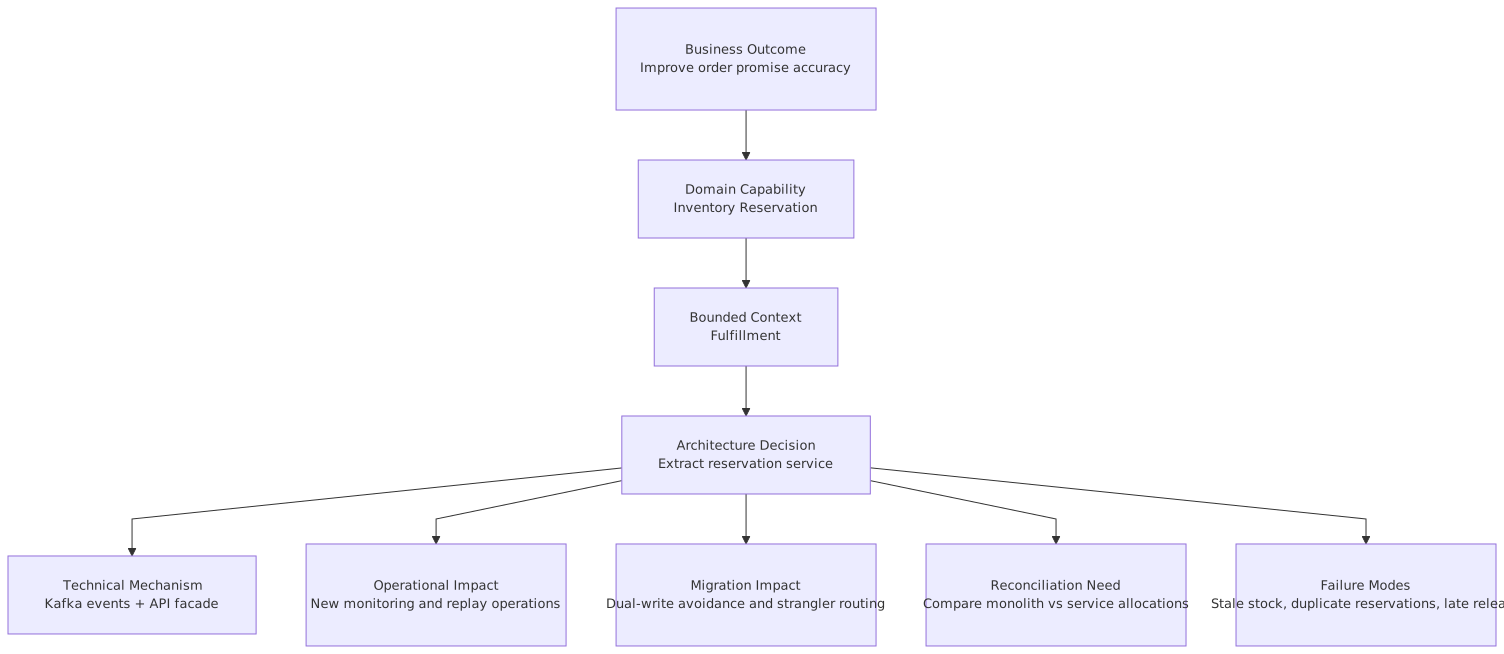
This is intentionally not a component diagram. It tells a story. That story is what architecture governance needs. EA governance checklist
Architecture
An impact map becomes especially powerful in evolutionary architecture when paired with domain-driven design.
The first move is to identify the bounded context in which the decision truly belongs. Not where the code currently lives. Where the meaning lives.
For example, in many enterprises “Order Management” is used as a catch-all for order capture, payment checks, inventory reservation, shipment planning, returns, invoicing, and customer notifications. That is not a bounded context. That is an admission of historical accumulation. An impact map forces decomposition by semantics.
Let us say we are modernizing order-to-fulfillment. We might identify:
- Sales Context: quote, promotion, customer commitment
- Order Context: order intent, lifecycle, amendments
- Fulfillment Context: reservation, pick-pack-ship, allocation constraints
- Billing Context: chargeable events, invoice generation, tax
- Ledger/Finance Context: accounting truth, settlement, reconciliation
A decision to extract reservation logic belongs primarily in Fulfillment, but it touches every other context. That is why a simple service decomposition diagram is not enough.
Impact map and bounded contexts

Notice the wording: “visible consistency change,” “promise accuracy change,” “reconciliation obligations.” These are semantic impacts, not just interfaces.
What goes into the architecture of an impact map?
At minimum, each mapped decision should capture:
- Decision statement
- Target business outcome
- Affected bounded contexts
- Domain invariants
- Data ownership changes
- User-visible behavior changes
- Integration pattern: synchronous API, event streaming, batch, CDC
- Migration mode: coexistence, strangler, parallel run, cutover
- Reconciliation strategy
- Operational fitness functions
- Failure detection and recovery approach
This is where Kafka often enters the story.
Kafka is useful when domain events need to be published reliably across bounded contexts, especially during migration. But teams should resist the fantasy that “put it on Kafka” is an architecture. Kafka solves transport and decoupling problems. It does not solve semantic ambiguity, idempotency, ordering assumptions, or business reconciliation.
In practice, for impact-heavy decisions, Kafka usually works best as part of a broader pattern:
- API facade for user-facing synchronous interactions
- Domain event publication for asynchronous propagation
- Canonical audit stream for traceability
- Reconciliation service or process for divergence management
- Strangler routing to control migration path
That architecture is not glamorous. It is enterprise-realistic.
Migration Strategy
Evolutionary architecture is migration architecture. If you cannot explain how the current world moves to the target world without breaking the business, you do not have a strategy. You have a wish.
For impact mapping, migration should be treated as a chain of temporary truths. Those temporary truths matter because they are where most failure lives.
The usual recommendation here is progressive strangler migration, and rightly so. But strangling a legacy capability is not merely redirecting requests. It is disentangling semantics, ownership, and historical data dependencies over time.
A sensible migration path often looks like this:
- Identify a stable domain seam
- Introduce a facade at the seam
- Emit events from the legacy system first
- Build read models and observers in the new world
- Introduce the new capability in shadow mode
- Run reconciliation between legacy and new outputs
- Route selected traffic to the new capability
- Expand confidence envelope
- Retire legacy responsibility
The word “reconciliation” belongs in the middle, not at the end.
Progressive strangler migration example
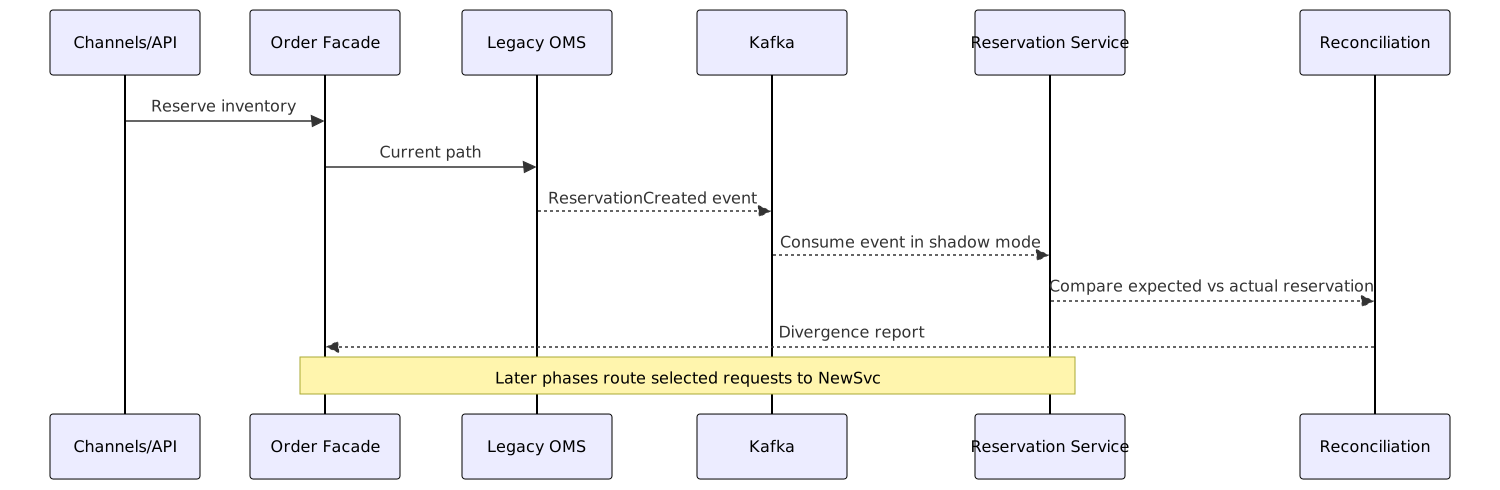
This sequence shows an important migration principle: before the new service becomes authoritative, it can observe and compare. That shadow phase surfaces semantic mismatches early.
Reconciliation is not bookkeeping glue
Too many teams treat reconciliation as a finance-only concern. In migration, reconciliation is an architectural safety mechanism.
There are several kinds:
- State reconciliation: does the new service match legacy state?
- Event reconciliation: were all meaningful events emitted and consumed?
- Financial reconciliation: do downstream billable or ledger entries align?
- Operational reconciliation: did support teams observe the same lifecycle as customers?
- Semantic reconciliation: are statuses and outcomes actually equivalent?
That last one is the trap. A status of RESERVED in a new service may not be equivalent to ALLOCATED in the legacy platform, even if teams pretend otherwise to speed up migration. Impact maps should expose these false equivalences.
A mature impact map will also document what must be reconciled, by whom, how often, and what happens when divergence exceeds tolerance.
Enterprise Example
Consider a global retailer modernizing its order fulfillment platform.
The retailer had an old monolithic OMS integrated with e-commerce, stores, warehouse systems, and SAP finance. Inventory availability was calculated centrally, but reservation logic was tangled with order orchestration, store transfer rules, and historical exceptions. During peak periods, online customers saw items as available that could not actually be fulfilled. The executive push was simple: “Move to microservices and Kafka.” microservices architecture diagrams
That sentence contains enough danger to keep an architect employed for years.
The real business goal was not microservices. It was improving order promise accuracy and reducing cancelled orders after checkout. The architectural decision under discussion was extracting inventory reservation into a dedicated fulfillment service backed by Kafka-based event propagation.
On paper, this looked obvious. In reality, the impact map changed the program.
Domain semantics discovery
Workshops quickly revealed that “inventory available” meant different things:
- E-commerce meant stock visible for sale
- Store operations meant stock not yet picked
- Warehouse meant stock physically present
- Finance meant stock recognized in inventory valuation
- Customer service meant stock likely to ship
That is not one concept. It is a family of related but different concepts. The team defined a more precise ubiquitous language:
- On-hand inventory
- Available-to-promise
- Reserved
- Allocated
- Picked
- Shipped
- Released
This alone prevented a bad migration. The original plan had assumed the new service could simply subscribe to stock updates and expose “availability.” Instead, the impact map made clear that the new service should own reservation semantics, not all inventory semantics.
Mapped impacts
The impact map showed consequences beyond fulfillment:
- Sales channels would experience eventual consistency on stock changes
- Customer promise dates needed recalculation logic
- Billing had to delay certain shipment-charge events until reservation confidence improved
- Finance required daily reconciliation between legacy and new allocation outcomes
- Support tooling needed a unified timeline across monolith and service events
- Operational teams needed replay and poison-event handling procedures
The organization had been ready to move directly to producer-consumer integration. The impact map forced an intermediate phase: legacy event publication plus shadow reservation calculation.
Migration in practice
For eight weeks, the new reservation service consumed Kafka events from the monolith and calculated what it would have reserved. A reconciliation process compared:
- SKU-level reservations
- Release timing
- Backorder decisions
- Cancellation causes
- Promise-date deltas
The results were sobering. Technically, message flow was healthy. Semantically, the new service diverged in 7% of edge cases, mostly around store pickup, split shipments, and promotions involving substitute products. Those were exactly the cases with highest customer dissatisfaction.
Without the impact map, the team would have gone live based on integration success and performance testing. Instead, they delayed cutover for one quarter, refined domain rules, and introduced explicit exception categories. That delay looked expensive. It was cheap compared with the cost of rolling out incorrect reservation semantics during peak season.
Outcome
After phased rollout, the retailer improved order promise accuracy, reduced post-checkout cancellations, and gained cleaner ownership boundaries in fulfillment. But just as importantly, finance and support were not surprised. They had already seen their impacts mapped, budgeted, and operationalized.
That is the point. Good architecture does not merely make systems work. It makes consequences visible soon enough to act.
Operational Considerations
If impact maps are created only for design time, they become stale décor. Their real value appears in operations.
Every material architecture decision should introduce or modify fitness functions. These are measurable indicators that tell us whether the decision is still serving its purpose in production. For a reservation-service extraction, suitable fitness functions might include:
- Promise accuracy rate
- Reservation divergence between legacy and new service
- Event lag by topic and consumer group
- Percentage of duplicate or replayed reservations handled idempotently
- Mean time to detect reconciliation drift
- Customer-visible stock discrepancy rate
- Time to replay and restore after downstream outage
Notice that half of these are not classic technical SLIs. They sit at the seam between domain outcomes and operational health. That is where enterprise architecture should live.
Observability must follow domain flow
A common anti-pattern is to monitor services and infrastructure but not domain journeys. Teams know CPU, memory, and consumer lag, but cannot answer: “Why did this customer order get cancelled after being promised?” In event-driven architectures, logs and traces are not enough unless they are correlated by domain identity and lifecycle.
For impact-heavy decisions, observability should include:
- Correlation IDs across bounded contexts
- Business event timelines
- Domain-state snapshots for reconciliation
- Explicit dead-letter and replay procedures
- Audit retention aligned with compliance needs
Support model changes
Microservices and Kafka often move operational burden from a central platform team to multiple product teams. That can be healthy. It can also create support chaos. When the impact map shows a decision crossing multiple contexts, ownership for incident diagnosis must be explicit.
In mature enterprises, the support design often includes:
- Product team ownership for service behavior
- Platform team ownership for Kafka clusters and shared tooling
- Business operations ownership for reconciliation review
- Finance or control teams ownership for monetary exceptions
- Architecture governance ownership for cross-context policy
If these responsibilities are not mapped, incidents become anthropological studies.
Tradeoffs
Impact maps are not free. Like every useful architectural technique, they impose discipline.
Benefit: better strategic decision-making
Cost: slower early-stage movement
An impact map takes time, especially if domain language is vague. Some teams will complain that this delays delivery. They are partly right. It does. But it delays the right thing: acting on false assumptions.
Benefit: exposes enterprise consequences
Cost: can trigger organizational discomfort
Good impact maps reveal that some “technical” decisions require business process changes, control changes, and support redesign. This can make sponsors nervous because it turns a software initiative into an enterprise change initiative. Again, that discomfort is earned.
Benefit: improves migration safety
Cost: more explicit temporary architecture
Strangler migrations become more honest when impact maps document coexistence and reconciliation. The downside is that temporary architecture becomes visible—and temporary architecture is usually messy. There is no elegant way to run two truths side by side. Better to document the mess than pretend it does not exist.
Benefit: supports domain-driven decomposition
Cost: requires semantic rigor
Many organizations want microservices but resist domain definition work. An impact map forces the conversation. If that rigor is culturally unwelcome, the artifact will be shallow and ceremonial.
Failure Modes
There are predictable ways impact maps go wrong.
1. They become dependency charts in disguise
If the map only shows applications and interfaces, it is not an impact map. The missing piece is semantic and operational consequence.
2. They are written by architects alone
Architecture done in isolation is just sophisticated guessing. Domain leads, product owners, operations, and control functions must participate. Finance often sees impacts before engineering does.
3. They assume event-driven means eventually fine
Event-driven systems often fail politely. Nothing crashes; things simply disagree. If the impact map does not identify visible consistency boundaries and reconciliation tolerance, the design is incomplete.
4. They ignore negative impacts
Some organizations use architecture artifacts to advertise benefits and hide costs. That is propaganda, not architecture. A serious impact map must state who pays for the change.
5. They are not updated during migration
The impact map is not static. As migration phases change, source-of-truth assumptions shift. If the map still reflects the original plan after three releases, it is lying.
6. They over-model speculative futures
There is also a reverse failure mode: the map becomes a grand theory of everything. Keep it tied to decisions that are real, funded, and near enough to matter.
When Not To Use
An Architecture Decision Impact Map is not mandatory for every choice.
Do not use it for small, reversible, low-blast-radius changes. If a team is changing an internal library, refactoring a stateless API, or replacing a build plugin, the overhead is not worth it.
Do not use it when the domain is trivial and tightly contained. A local reporting utility inside one bounded context rarely needs enterprise impact mapping.
Do not use it as a substitute for product discovery. If the business outcome itself is unclear, an impact map will give false confidence. First decide what problem matters. Then map the architectural consequences.
And do not use it where the organization lacks any appetite for cross-functional truth. In some enterprises, teams are rewarded for keeping complexity hidden. In that culture, impact maps will be politically neutered. Better to fix incentives than to produce decorative architecture.
Related Patterns
The impact map sits well with several established patterns.
Architecture Decision Records (ADRs)
ADRs capture the decision and rationale. The impact map extends this by showing consequence across domain, operations, and migration.
Domain-Driven Design
Bounded contexts, ubiquitous language, and context mapping are foundational. Without them, impacts are blurred and ownership is confused.
Strangler Fig Pattern
This is the natural migration companion. Impact maps make strangler strategies more precise by documenting temporary states and reconciliation obligations.
Event-Driven Architecture
Kafka, event streams, and asynchronous integration are often implementation mechanisms, especially for decoupling and migration. But the map ensures events are tied back to business meaning.
Fitness Functions
Operational and business fitness functions provide the measurable feedback loops that prove whether the decision’s intended impact is occurring.
Anti-Corruption Layer
Where legacy semantics are awkward or incompatible, an anti-corruption layer can protect the new bounded context from inheriting old confusion. Impact maps often reveal exactly where such a layer is necessary.
Summary
Architecture decisions are never just technical moves. They are bets placed against the future behavior of a business.
In evolutionary architecture, those bets are made repeatedly, under uncertainty, while legacy and new worlds overlap. That overlap is where most pain lives: semantic drift, partial migrations, inconsistent records, and operational confusion. An Architecture Decision Impact Map is valuable because it forces the organization to look directly at those consequences.
The map should connect business outcomes, bounded contexts, technical choices, migration stages, and reconciliation needs. It should be rooted in domain-driven design. It should treat progressive strangler migration as a series of temporary truths. It should include Kafka and microservices where they fit, but never mistake transport for meaning. And it should make tradeoffs visible enough that leaders can make informed choices rather than optimistic ones.
The best impact maps are not pretty. They are useful. They tell you where the architecture will hurt, where it will help, and what must be true for the change to be worth making.
That is real enterprise architecture: not drawing cleaner boxes, but making consequences impossible to ignore.
Frequently Asked Questions
What is enterprise architecture?
Enterprise architecture aligns strategy, business processes, applications, and technology in a coherent model. It enables impact analysis, portfolio rationalisation, governance, and transformation planning across the organisation.
How does ArchiMate support architecture practice?
ArchiMate provides a standard language connecting strategy, business operations, applications, and technology. It enables traceability from strategic goals through capabilities and services to infrastructure — making architecture decisions explicit and reviewable.
What tools support enterprise architecture modeling?
The main tools are Sparx Enterprise Architect (ArchiMate, UML, BPMN, SysML), Archi (free, ArchiMate-only), and BiZZdesign. Sparx EA is the most feature-rich, supporting concurrent repositories, automation, scripting, and Jira integration.