⏱ 20 min read
Distributed systems rarely fail in the places architects put on slides. They fail in the seams. In the handoff between one service and another. In the tiny assumptions hidden inside a routing rule. In the quiet belief that a request will always take the same path tomorrow that it took today.
That belief is expensive.
Most routing starts life as a simple concern: send traffic from A to B. Then the business changes. Regions come online. Regulations tighten. One customer tier needs lower latency. Another workload is so noisy it can sink a shared cluster. A legacy platform still owns part of the truth. A new event-driven service owns another part. Suddenly “where should this request go?” is no longer a networking question. It is a domain question, an operational question, and, if you wait too long, a political one.
This is where adaptive routing matters.
By adaptive routing, I do not mean only load balancers choosing a healthy node. That is table stakes. I mean routing decisions that respond to business context, service health, topology, policy, data gravity, event lag, tenancy, and migration state. Routing that is aware of semantics, not just endpoints. Routing that can send one order to the legacy fulfillment stack, another to the modern orchestration service, and a third through a compensating workflow because inventory confidence is degraded in one region.
In other words: routing as architecture, not plumbing.
This article looks at adaptive routing strategies in distributed systems with a practical enterprise lens. We will look at the forces that shape these systems, the architecture choices that work, the tradeoffs that sting, and the failure modes that show up at 2 a.m. We will also look at how adaptive routing intersects with domain-driven design, Kafka-based event flows, progressive strangler migration, and reconciliation patterns. Because in real enterprises, routing is often the mechanism by which you survive modernization without stopping the business. event-driven architecture patterns
Context
In a monolith, routing is often hidden inside code paths: a method calls another method. The route is implicit. Once you decompose into services, platforms, channels, and regions, routing becomes explicit and therefore architectural.
The common trigger is scale, but scale is only half the story. The real trigger is variation. Different requests need different treatment. A platinum customer in Frankfurt may need local data residency. A bulk pricing update may need asynchronous handling via Kafka rather than direct REST calls. A fraud review request might need to be routed to a model version approved for a specific jurisdiction. During migration, “customer lookup” might route to the old CRM for one segment and the new customer platform for another.
This is why adaptive routing sits at the crossroads of API gateways, service meshes, event brokers, workflow engines, and domain orchestration. It is a pattern that spans layers. microservices architecture diagrams
A useful way to think about it is to separate transport routing from business routing:
- Transport routing decides which network destination receives traffic.
- Business routing decides which capability should handle a request based on domain semantics.
Confusing the two is one of the oldest mistakes in distributed architecture. If your routing strategy only understands URLs, ports, and health checks, it will crumble as soon as the business asks for “route all returns over $5,000 through enhanced review unless the originating market is exempt and the inventory source is external consignment.”
Networks do not understand that sentence. Domains do.
That is where domain-driven design earns its keep. Adaptive routing should be rooted in bounded contexts, aggregate ownership, and explicit domain policies. Otherwise, it devolves into a brittle pile of rules in an API gateway that nobody dares touch.
Problem
The problem is deceptively plain: how do you route requests, commands, and events across distributed systems when the right path depends on changing conditions?
Static routing assumes a stable world. In enterprise systems, the world is not stable.
Conditions shift because:
- service health changes
- region capacity changes
- tenancy rules differ
- compliance policies evolve
- migrations are in progress
- data freshness varies
- event lag appears
- external providers degrade
- some capabilities remain in legacy platforms
The deeper problem is that routing decisions often combine concerns that evolve at different speeds. Infrastructure health may change by the second. Domain rules may change weekly. Migration policy may change monthly. Compliance boundaries may change by market. When these are jammed into one routing mechanism, every change becomes risky.
Another wrinkle: routing is rarely only synchronous. Modern enterprises route:
- HTTP/API requests
- asynchronous commands
- Kafka events
- batch feeds
- workflow tasks
- human escalations
The architecture must cope with all of them.
And one more hard truth: adaptive routing does not merely distribute traffic. It distributes inconsistency. If one path writes to a new service and another still writes to the old system, then reconciliation becomes part of routing whether you planned for it or not.
Forces
Several forces pull this design in opposing directions.
1. Domain semantics vs infrastructure simplicity
The infrastructure team wants a clean, generic routing layer. The domain team needs rules that reflect customer tiers, product types, regions, and lifecycle states.
Both are right. But if you push domain semantics too low into the platform, you create a giant ball of mud at the edge. If you push them too high into every service, you duplicate routing logic everywhere.
The sweet spot is usually a policy-driven routing layer that understands a thin slice of domain intent while preserving bounded context ownership.
2. Low latency vs decision richness
The more context-aware your routing becomes, the more data it may need: customer profile, entitlement status, inventory confidence, fraud score, model availability, regional policy.
That makes every decision smarter and slower.
Adaptive routing that needs five remote calls to decide where to send one request is not architecture. It is choreography for a traffic jam.
3. Availability vs consistency
If one route can proceed with stale data and another requires fresh confirmation, your routing strategy is implicitly defining consistency models. In practice, teams discover this too late.
Routing to a local read model may improve latency. Routing to the system of record may improve correctness. Sometimes you must choose based on the business consequence of being wrong.
4. Migration speed vs operational safety
During strangler migrations, routing is the lever used to shift traffic from legacy to modern services. The faster you move traffic, the faster you learn. The faster you move traffic, the bigger the blast radius.
This is not a technical puzzle alone. It is a risk allocation decision.
5. Centralized control vs team autonomy
A central routing platform promises consistency, observability, and governance. But too much centralization turns it into a bottleneck. Teams start filing tickets to change domain behavior. That is a smell. EA governance checklist
A routing platform should provide capabilities, not become the owner of everyone’s policy.
Solution
The practical solution is to treat adaptive routing as a policy-driven decision layer spanning synchronous and asynchronous interactions, with domain-aware rules, runtime signals, and explicit migration states.
There are four key ideas.
1. Separate routing policy from service implementation
Routing criteria should not be hardcoded deep inside every service. Put decision logic in an explicit policy layer or routing engine, backed by clear inputs:
- request metadata
- tenant context
- domain attributes
- health and latency telemetry
- migration cohort
- compliance constraints
- event lag or replication freshness
This keeps routing changeable without redeploying every downstream service.
2. Make routing domain-aware, but bounded
The routing layer should understand business-relevant concepts, not raw database fields sprayed from everywhere. This is where DDD matters.
For example, route based on concepts like:
CustomerTierOrderChannelFulfillmentModeMarketMigrationCohortRiskBand
Not based on obscure persistence artifacts like cust_tbl.segment_cd.
This sounds obvious. In enterprise architecture, it is apparently not obvious enough.
3. Support multiple routing modes
Adaptive routing typically combines:
- deterministic routing: based on explicit policy
- health-based routing: based on availability/latency
- weighted routing: for canary or migration
- capability routing: based on feature ownership by service
- data-locality routing: based on region or residency
- event-path routing: based on topic, consumer group state, or lag
One mechanism will not cover all of these elegantly. Use the right tool at each layer.
4. Build reconciliation into the design
If different routes can produce or observe different states, reconciliation is mandatory. It is not a cleanup task for later. It is the price of adaptive routing in heterogeneous estates.
That means:
- idempotent handlers
- correlation IDs
- versioned events
- compensating actions
- periodic reconciliation jobs
- audit trails that capture routing decisions
Without these, adaptive routing becomes adaptive confusion.
Architecture
A robust architecture usually has three layers of routing responsibility.
- Edge routing for channels and APIs
- Service-to-service routing for runtime topology and policy
- Message/event routing for asynchronous flows
Here is a representative shape.

The API gateway handles concerns like authentication, coarse-grained endpoint selection, tenant extraction, and request shaping. It should not become a graveyard of business rules.
The routing policy engine evaluates domain and operational context. Sometimes this is a dedicated service. Sometimes it is embedded in an orchestration layer. Sometimes it is split: simple policies at the edge, richer decisions in a domain orchestrator. I prefer keeping it explicit. Hidden routing logic is hard to reason about and even harder to migrate.
The service mesh provides topology-aware transport routing, retries, and resilience patterns. It should own traffic engineering, not business semantics.
Kafka or another event backbone handles asynchronous distribution and decoupling. But note the subtlety: event routing is not just “publish and hope.” Topic taxonomy, partitioning strategy, consumer isolation, and replay behavior all shape adaptive routing outcomes.
Domain semantics and bounded contexts
Suppose you have Order Management, Fulfillment, Pricing, and Customer as separate bounded contexts. Routing should respect ownership:
- Pricing rules should not be decided in Customer.
- Fulfillment capability routing belongs near Fulfillment.
- Customer tier may influence routing, but Customer should expose it as a stable domain concept, not as leaking internal structure.
A healthy architecture often uses a domain policy catalog: a managed set of decision inputs and policies that can be used by routing components without stealing ownership from bounded contexts. This can be implemented through APIs, cached policy materialization, event-fed reference data, or a rules service.
The point is not tooling. The point is language. Shared language prevents routing from becoming a dumping ground for hidden coupling.
Synchronous and asynchronous adaptive routing
Not every decision should happen on the request path.
Use synchronous routing when:
- immediate user response matters
- the chosen handler must process now
- fallback paths are safe and bounded
Use asynchronous routing when:
- load shaping matters
- process duration is variable
- external systems are unreliable
- eventual consistency is acceptable
- retries and replay are first-class needs
For example, order submission may route synchronously to the correct orchestration service, but inventory reservation and fraud enrichment may be routed asynchronously through Kafka topics to specialized processors.
Dynamic routing diagram for migration-aware flow
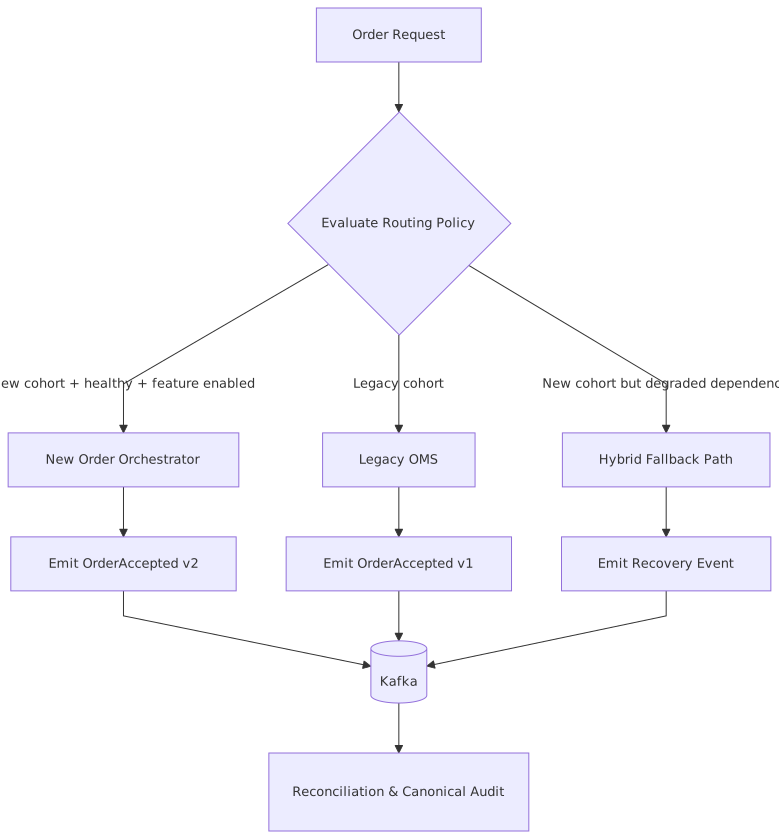
This is the pattern many enterprises actually need: not a binary old/new split, but a migration-aware router that can choose new, old, or hybrid paths based on policy and health.
Migration Strategy
Most enterprises do not adopt adaptive routing in a greenfield landscape. They discover they need it while escaping a legacy platform.
This is where the progressive strangler migration comes in.
The strangler pattern is often described too neatly: place a facade in front, gradually divert capabilities, retire the monolith. In reality, migrations are messier. Capability boundaries overlap. Data ownership changes in stages. Some commands move before some queries. Events appear before authoritative writes move. And the route for a transaction may depend on customer cohort, market, product family, or regulatory regime.
Adaptive routing becomes the control point for this transition.
A practical migration sequence
- Introduce a stable ingress layer
Put an API gateway or facade in front of legacy and new services. Do not expose migration complexity to channels.
- Externalize routing decisions
Move route selection into policy, not controller code or gateway scripts scattered across teams.
- Start with low-risk cohorts
Route internal users, test markets, or low-value transactions first.
- Dual emit before dual write, if possible
It is usually safer to emit canonical events from legacy and new paths than to write to both systems synchronously. Dual write is where confidence goes to die.
- Add reconciliation early
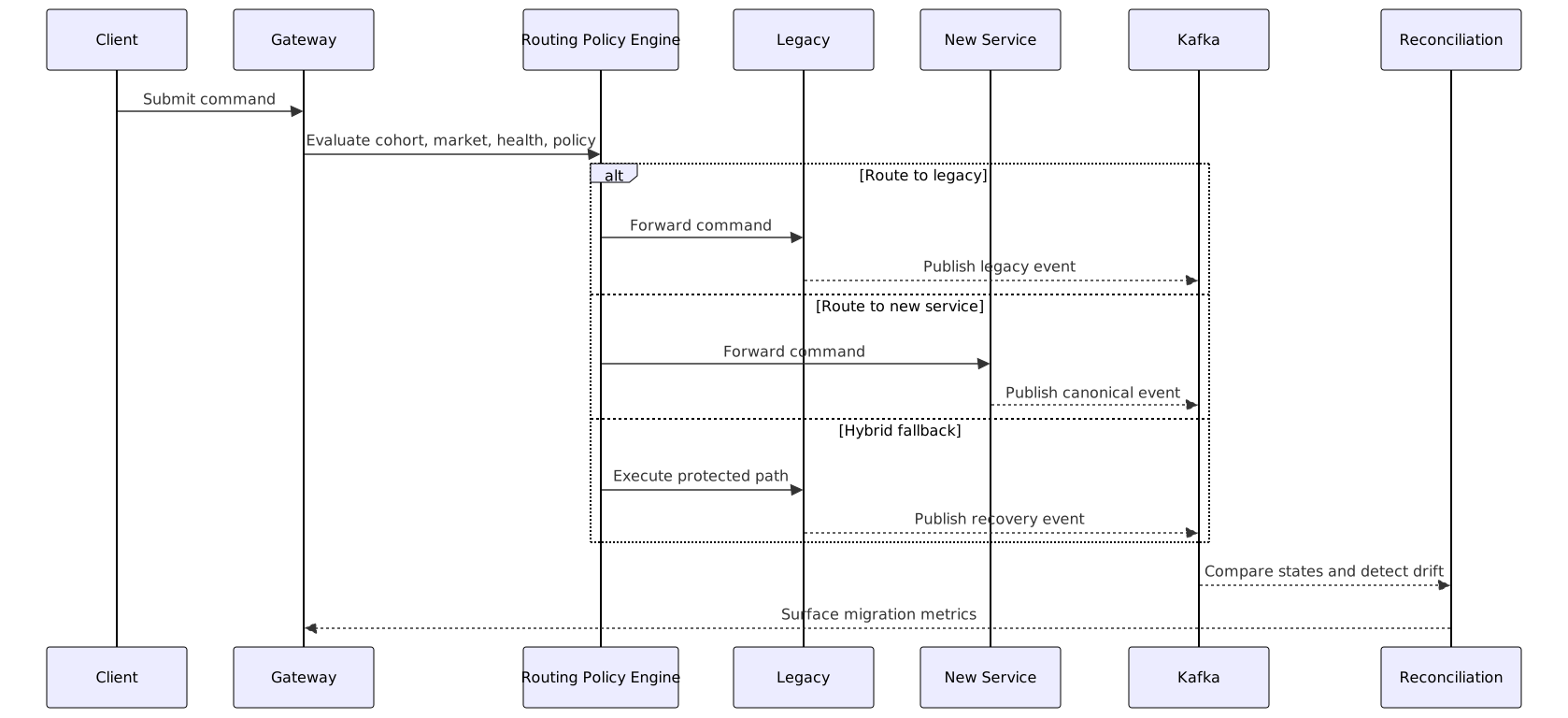
Compare outcomes between legacy and new paths. Reconcile order state, balances, or inventory reservations. Measure semantic drift.
- Increase traffic by capability and cohort
Shift not just percentages, but meaningful slices of the domain.
- Retire policy branches aggressively
Migration policies have a terrible habit of becoming permanent architecture.
Here is a migration-oriented view.
Reconciliation is not optional
In migration architecture, reconciliation is the adult in the room.
If a customer update routed to the new profile service while a billing preference still routed to the legacy account platform, you have split truth. Reconciliation detects divergence, applies compensations where possible, and gives you the confidence to expand traffic.
Good reconciliation needs:
- a canonical business key
- route decision logs
- event versioning
- deterministic state comparison rules
- business-owned tolerances for mismatch
This is where domain semantics matter again. You do not reconcile raw tables. You reconcile meaning: order accepted, payment captured, entitlement active, shipment allocated.
Enterprise Example
Consider a multinational retailer modernizing its order management landscape.
The retailer has:
- a legacy OMS running in a central data center
- new microservices for checkout, order orchestration, inventory, and fulfillment
- Kafka as the event backbone
- regional regulatory requirements in EU and APAC
- store orders, marketplace orders, and direct-to-consumer orders with different SLAs
At first, the team uses static routing:
- all web orders go to the new orchestrator
- all store orders stay in legacy
- APAC goes to one region, EU to another
This works for a quarter. Then reality arrives.
Marketplace orders require fraud screening via a provider only approved in selected markets. Some inventory sources are still mastered in legacy. During peak periods, the new fulfillment planner in one region suffers lag due to a Kafka consumer backlog. Premium customers need order confirmation within tighter latency budgets. Returns over a threshold require legacy financial controls still not rebuilt.
Now static routing becomes a liability.
The retailer introduces a routing policy engine with inputs from:
- order channel
- market
- product category
- customer tier
- inventory source
- feature enablement flags
- downstream health and consumer lag
- migration cohort
Routing outcomes include:
- direct new orchestration path
- legacy OMS path
- hybrid route where new checkout accepts the order but legacy allocates inventory
- asynchronous route through Kafka for non-immediate enrichment
A policy might read, in plain business language:
> Route direct-to-consumer EU orders to New Orchestrator if Inventory Confidence is high and Fulfillment Planner lag is below threshold.
> Route marketplace luxury orders through Legacy Financial Controls.
> Route APAC orders with restricted data residency to regional services only.
That is a business-routing policy. It reflects domain semantics and operational reality. It is not a dumb traffic rule.
Over six months, the retailer progressively shifts:
- first, low-risk domestic web orders
- then premium segments in selected markets
- then inventory-owned categories
- finally store-assisted orders after reconciliation confidence passes threshold
Kafka plays two roles here:
- distributing business events across old and new estates
- surfacing lag and delivery health as a routing input
That second role is often missed. Event lag is not just an observability metric. In adaptive architectures, it can be a routing signal. If your new allocation service is behind by 20 minutes, sending fresh allocation-dependent work its way may violate business guarantees.
The retailer also builds a reconciliation service that compares:
- order state transitions
- reserved inventory quantities
- payment authorization references
- shipment creation events
Mismatches trigger:
- automated compensation for safe cases
- manual review queues for high-value orders
- migration scorecards visible to product and operations leaders
That last point matters. Migration confidence is not only technical. It is organizational trust made visible.
Operational Considerations
Adaptive routing increases runtime power and operational complexity in equal measure. Anyone selling only the upside has not run one in production.
Observability
You need to observe not just service behavior, but decision behavior.
Capture:
- why a route was chosen
- what policy version was applied
- what telemetry inputs were considered
- correlation across sync and async paths
- route success/failure rates by cohort
A routing decision without an audit trail is a ghost story. Everyone has theories. Nobody has facts.
Policy lifecycle
Routing policy is code in all but syntax. Treat it accordingly:
- version it
- test it
- review it with domain owners
- deploy it safely
- roll it back cleanly
A mature setup includes simulation: replay historical requests and see which route current policy would choose.
Performance
Policy evaluation must be fast and mostly local. Cache reference data. Avoid fan-out calls on the hot path. Use precomputed signals where possible.
If your router depends on live calls to six systems, it becomes the least reliable thing in the estate.
Kafka considerations
Where Kafka is involved:
- partition on stable business keys
- maintain ordering where domain rules require it
- isolate high-risk consumers
- monitor lag as a first-class SLO
- make replay safe with idempotent consumers
Adaptive event routing sounds elegant until replay doubles all your compensations. Idempotency is not optional. It is rent.
Governance
Enterprises need guardrails:
- no hidden routing logic in random gateway plugins
- no business policy encoded only in infrastructure YAML
- no bypass path without audit
- no migration branch without an expiry target
The best governance is architectural clarity, not committee theater.
Tradeoffs
Adaptive routing is powerful, but it is not free.
Pros
- better resilience under changing conditions
- safer modernization through cohort-based migration
- improved compliance and locality control
- more graceful degradation
- better use of specialized services and regional capacity
Cons
- increased cognitive load
- more moving parts in the control plane
- harder testing across route permutations
- risk of central policy becoming a bottleneck
- greater reconciliation burden
- hidden coupling if domain semantics are poorly managed
The central tradeoff is this: adaptive routing buys flexibility by making decision logic explicit. That is valuable. But explicit decisions must be designed, governed, observed, and eventually retired. Many organizations underestimate the “eventually retired” part.
Temporary routes are among the most permanent things in enterprise IT.
Failure Modes
This style of architecture fails in recognizable ways.
1. Smart router, dumb domains
The router knows too much. It embeds business rules that properly belong to bounded contexts. Over time, the routing layer becomes a shadow domain model. Teams fear changing it.
This is how architecture becomes archaeology.
2. Routing on stale signals
Health or lag inputs are delayed, cached poorly, or inconsistent across nodes. Traffic is routed based on yesterday’s truth.
When routing depends on telemetry, telemetry quality becomes part of correctness.
3. Route oscillation
A dependency flaps. The router keeps switching between new and legacy paths. This causes duplicates, inconsistent customer experience, and impossible debugging.
Use hysteresis, circuit breaking, and minimum decision windows.
4. Reconciliation blind spots
Some state transitions are compared, others are not. The architecture looks stable until a quarter-end financial close reveals semantic drift.
Reconciliation that ignores business meaning is accounting for theater.
5. Gateway rule sprawl
Dozens of teams add ad hoc conditions to an API gateway. No one owns the combined result. A simple request path becomes a legal document written by exhausted engineers.
This is not adaptive routing. It is distributed superstition.
6. Dual-write corruption during migration
Teams route commands to both old and new systems “for safety.” Race conditions, retries, and partial failures produce divergent states.
Prefer event comparison and staged authority transfer over naive dual writes.
When Not To Use
Adaptive routing is not a badge of architectural maturity. Sometimes it is unnecessary ceremony.
Do not use it when:
- your routing needs are static and simple
- one system clearly owns the capability
- domain variation is low
- latency budgets are too tight for policy evaluation overhead
- your operational maturity is weak
- you cannot support reconciliation and observability
- the migration window is short and a direct cutover is safer
A small internal platform with stable dependencies does not need a policy engine because someone read about service meshes on a plane.
Likewise, do not use business-aware adaptive routing if all you really need is standard load balancing and failover. Not every road needs a traffic control center.
Related Patterns
Adaptive routing sits near several patterns, but it is not identical to them.
API Gateway
Useful for ingress concerns and coarse route selection. Dangerous if overloaded with domain policy.
Service Mesh
Excellent for transport-level routing, resilience, and telemetry. Poor place for rich business semantics.
Strangler Fig Pattern
Often the migration context in which adaptive routing becomes essential.
Saga
Relevant when routes lead into distributed workflows with compensation across services.
Event-Driven Architecture
Critical where Kafka or similar platforms carry domain events and asynchronous route outcomes.
Anti-Corruption Layer
Essential when routing into legacy bounded contexts with incompatible models.
Policy Engine / Rules Engine
Helpful for externalizing decisions, but should not become a substitute for domain modeling.
The pattern language matters because teams often reach for one tool and expect it to solve every routing problem. It will not. The gateway, mesh, broker, and orchestrator each have a role. Good architecture is partly knowing where to stop.
Summary
Adaptive routing strategies in distributed systems are not about clever traffic tricks. They are about making routing decisions reflect the real shape of the enterprise: its bounded contexts, constraints, migrations, regulations, failure conditions, and operational signals.
The winning approach is usually clear and disciplined:
- keep domain semantics explicit
- separate policy from transport
- combine sync and async routing deliberately
- use Kafka and events where decoupling and replay matter
- support progressive strangler migration with cohort-based traffic shifting
- build reconciliation in from the start
- observe decisions, not just services
- retire temporary branches before they fossilize
If there is one memorable line worth keeping, it is this:
In distributed systems, the route is part of the business transaction. Treat it with the same seriousness as the transaction itself.
That is the heart of the matter. Once routing decisions carry business meaning, architecture can no longer pretend they are just infrastructure. They are part of the domain. Part of migration. Part of resilience. And, when done badly, part of the outage report.
Done well, adaptive routing gives enterprises a way to evolve without tearing the runway apart while the plane is still landing. That is not elegance for its own sake. That is survival.
Frequently Asked Questions
What is a service mesh?
A service mesh is an infrastructure layer managing service-to-service communication. It provides mutual TLS, load balancing, circuit breaking, retries, and observability without each service implementing these capabilities. Istio and Linkerd are common implementations.
How do you document microservices architecture for governance?
Use ArchiMate Application Cooperation diagrams for the service landscape, UML Component diagrams for internal structure, UML Sequence diagrams for key flows, and UML Deployment diagrams for Kubernetes topology. All views can coexist in Sparx EA with full traceability.
What is the difference between choreography and orchestration in microservices?
Choreography has services react to events independently — no central coordinator. Orchestration uses a central workflow engine that calls services in sequence. Choreography scales better but is harder to debug; orchestration is easier to reason about but creates a central coupling point.