⏱ 18 min read
Distributed systems don’t break because developers are careless. They break because we ask them to do something unnatural: act like one machine while being many. We spread data across services, regions, databases, brokers, caches, and teams, then act surprised when the truth arrives in installments.
That is where eventual consistency lives.
It is not a bug. It is not a compromise dreamed up by architects who dislike transactions. It is a design stance. A blunt admission that, in distributed systems, agreement has a travel time. The system is not wrong because two services disagree for a moment. The system is wrong when they never converge, or when the business has not decided what “converged” actually means.
This is the mistake many enterprises make. They debate infrastructure patterns before they have named the domain semantics. They ask, “Should we use Kafka?” before asking, “What can be temporarily inconsistent without harming the business?” That is like buying a fleet of trucks before deciding whether you are moving furniture or explosives. event-driven architecture patterns
Eventual consistency is best understood as a timeline of truth. At time T1, one part of the estate knows something happened. At T2, the event broker knows. At T3, downstream read models, caches, and partner systems have absorbed the fact. At T4, the business process can proceed as if the organization agrees. Convergence is not instantaneous. It is orchestrated drift toward a shared outcome.
This article takes that idea seriously. We will look at eventual consistency not as a slogan, but as an architectural shape: where it works, where it hurts, what migration looks like in brownfield enterprises, how reconciliation actually saves you, and when you should refuse to use it.
Context
Classic enterprise systems were built around a comforting fiction: one database, one transaction boundary, one version of reality. It worked because much of the application sat close to a relational core. ACID transactions gave you a clean mental model. Update customer, create order, reserve stock, write ledger entry, commit. If any step failed, roll back. One button. One truth.
Then enterprises changed the game.
They split monoliths into microservices. They adopted Kafka and event streaming. They introduced regional deployments, SaaS products, edge stores, mobile clients, and domain-aligned teams. They wanted independent deployment, local autonomy, and resilience. They also wanted all systems to agree immediately. microservices architecture diagrams
That combination is fantasy.
The moment you distribute ownership, you distribute knowledge. Every bounded context knows something first and something else later. Sales knows the order was submitted before Fulfillment does. Billing knows payment cleared before Customer Support sees the updated account standing. Inventory may think stock is available while the storefront still shows stale counts. In other words, time becomes part of the data model.
Domain-driven design helps here because it forces a discipline many technical programs avoid: naming the bounded contexts and their language. “Order placed” in Commerce is not automatically the same thing as “ready to allocate” in Warehouse. “Customer active” in CRM is not always “credit approved” in Finance. If you fail to model these semantic edges, eventual consistency feels chaotic. If you model them well, it becomes manageable.
The right question is not whether eventual consistency exists. It already does. The real question is whether your architecture acknowledges it honestly.
Problem
The problem appears when business processes span multiple systems of record, but the enterprise still expects transactional behavior across them.
Take a simple example. A customer places an order in an e-commerce platform. The platform must validate payment, reserve inventory, calculate tax, create shipment intent, notify fraud screening, update loyalty points, and expose order status to the customer. In a monolith with one database, you might try to handle much of this in one transactional unit or a tightly controlled process. In a distributed estate, those capabilities are often owned by different services and different teams, each with its own datastore and availability profile.
If you insist on strong consistency across all of them, you often end up with one of two bad outcomes.
First, you centralize orchestration into a bottleneck and effectively rebuild a distributed monolith. Services are “independent” on paper, yet operationally coupled through synchronous request chains. One timeout in fraud, one slow inventory query, and checkout stalls.
Second, you attempt cross-service distributed transactions. That path is littered with broken promises. Two-phase commit looks attractive in architecture diagrams and much less attractive under real load, in cloud environments, across heterogeneous technologies, with unreliable networks and teams that deploy at different speeds.
So enterprises move toward asynchronous messaging and event-driven architectures. One service commits its local transaction, emits an event, and others react. Availability improves. Decoupling improves. Throughput improves. Team autonomy improves.
But now inconsistency is visible.
The order service says “placed.” Inventory has not yet reserved stock. Customer service still shows “processing.” The warehouse may not see the order for thirty seconds because of consumer lag. The customer receives a confirmation email before fraud later rejects the payment. Nothing is technically “wrong,” yet everything feels unstable unless the business process and user experience are designed for delayed agreement.
That is the heart of the problem: eventual consistency is not a technical feature. It is a business timing contract.
Forces
A good architecture article should not pretend there is a single clean answer. There are forces here, and they pull in opposite directions.
Availability versus immediate agreement
If a service can commit locally and publish asynchronously, it stays responsive. That is good for customer-facing workloads and operational resilience. But the rest of the estate takes time to catch up.
Autonomy versus coordination
Independent teams owning bounded contexts is healthy. They evolve their own models, deploy on their own cadence, and select fit-for-purpose storage. But independent ownership means there is no magical global transaction manager keeping everyone synchronized.
Throughput versus ordering guarantees
Kafka is excellent for event streaming at scale. It gives partition ordering, durable logs, replayability, and decoupled consumers. But global ordering is expensive and usually unnecessary. Most domains need meaningful ordering within an aggregate or key, not everywhere. The trick is knowing the difference.
Domain truth versus local projections
In distributed systems, there is usually a system of record for a fact and multiple projections of that fact. The order service owns order intent. Inventory owns stock allocation. Search owns discoverability projections. Analytics owns aggregate reporting. Confusing a projection for the source of truth is one of the oldest failure patterns in event-driven estates.
User expectations versus process reality
Customers tolerate “your order is being confirmed” far better than architects think, if the UX is honest. They do not tolerate silent ambiguity. The domain and interface must expose state transitions that reflect asynchronous processing. If the product pretends consistency is instant when it is not, support volumes rise fast.
Simplicity versus scale
A single database transaction is simpler than asynchronous choreography. Full stop. If your problem can be solved inside one bounded context and one datastore, do not drag in brokers, outbox patterns, replay topics, and reconciliation jobs just to look modern.
Solution
The solution is not “use eventual consistency everywhere.” The solution is to place consistency boundaries inside bounded contexts, then propagate state changes through reliable asynchronous mechanisms so downstream contexts converge over time.
That means three things in practice.
First, each service commits changes atomically within its own boundary. This is local consistency. The Order service writes its order and outbox record in the same transaction. The Payment service writes authorization status in its own store. The Inventory service writes reservation state in its store. No service pretends to own the whole enterprise.
Second, changes are published as domain events or integration events. This distinction matters. Domain events express something meaningful inside the business language of the bounded context. Integration events are often a more stable external contract for other contexts. Mature systems usually need both, even if they begin with one.
Third, downstream services consume those events and update their local models. The estate converges through propagation, retries, idempotency, and reconciliation. Convergence is achieved, not assumed.
Here is the simplest way to visualize the timeline.
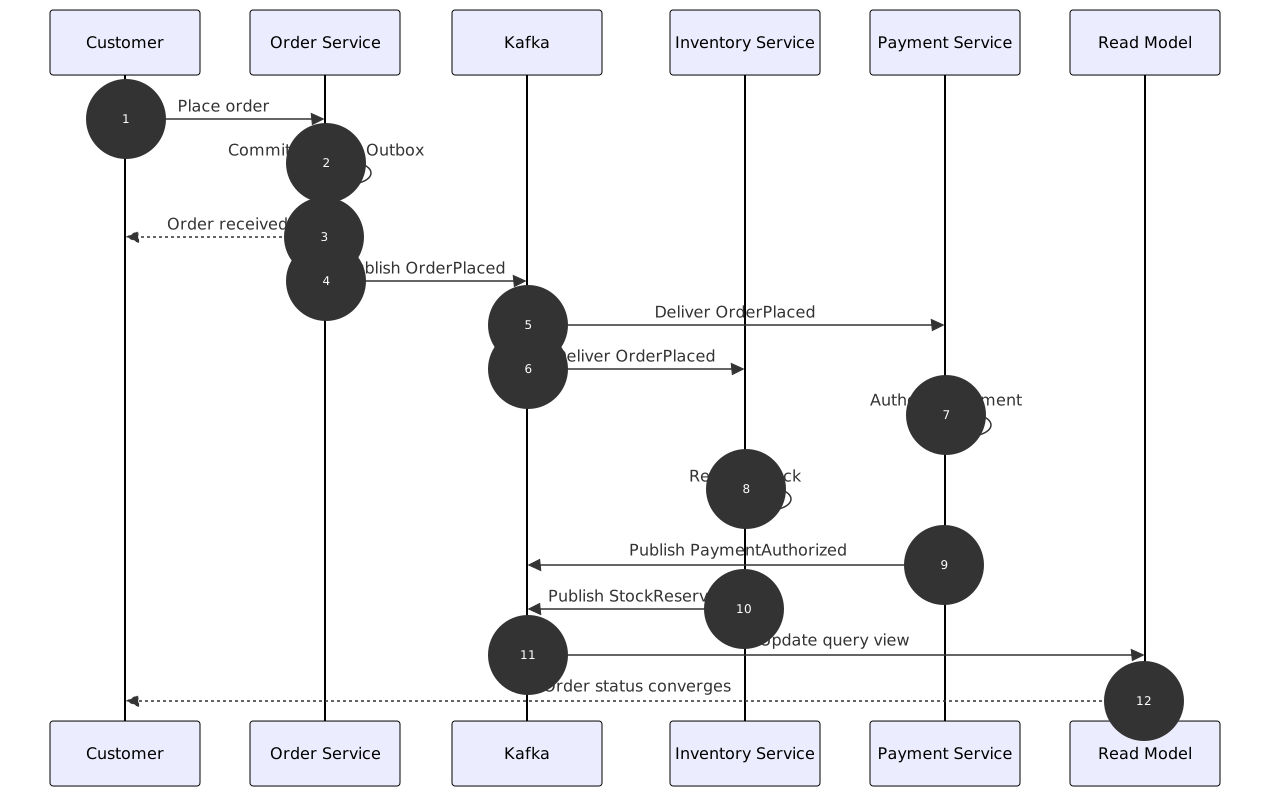
This picture hides an important truth: the customer may see several legitimate states between “received” and “confirmed.” Those states are not implementation leakage. They are domain semantics. The business should define them.
A good event-driven architecture names transitional states clearly:
- Order Received
- Payment Pending
- Stock Pending
- Confirmed
- Backordered
- Rejected
- Cancelled After Review
If you do not model those states explicitly, support teams will invent their own language, product managers will promise impossible outcomes, and engineers will hard-code assumptions into every channel.
Domain semantics first
This is where domain-driven design earns its keep. Eventual consistency works best when bounded contexts have clear invariants.
For example:
- The Order context guarantees an order request is durably captured once accepted.
- The Payment context guarantees authorization decisions are consistent with payment rules.
- The Inventory context guarantees reservations do not violate stock allocation rules within its own model.
- The Customer Notification context guarantees messages are sent based on subscribed event contracts, not on querying five services live.
What it does not guarantee is that every context reflects every change at the same millisecond.
That is a business design choice. And once stated that way, it becomes easier to reason about.
Architecture
A robust eventual consistency architecture usually contains a few recurring parts.
Local transaction plus outbox
Publishing directly to Kafka inside application logic is a trap. If the database commit succeeds but the publish fails, the event is lost. If the publish succeeds but the transaction rolls back, you emit fiction. The transactional outbox pattern exists to avoid this split-brain moment.
The service writes both domain data and an outbox record atomically. A relay process publishes the outbox record to Kafka and marks it delivered. This is not glamorous. It is simply how adults build event-driven systems.
Event broker as propagation backbone
Kafka is common because it handles high-volume ordered logs well, supports replay, and decouples producers from consumers. It is not the architecture by itself. It is the highway, not the traffic rules.
Partitioning should usually align with aggregate identity or another domain key that preserves meaningful ordering. If all events for an Order ID land in the same partition, consumers can reason about that order coherently. If you partition poorly, your downstream services inherit disorder and complexity.
Consumers with idempotency
At-least-once delivery is normal. Duplicate events are normal. Consumer retries are normal. Therefore side effects must be idempotent. Every serious event-driven system eventually rediscovers this lesson, usually after double-billing someone important.
Projections and read models
Not every service should query every other service synchronously. Query-side projections built from events reduce coupling and improve performance. But they are stale by nature, so consumers of those projections must understand freshness bounds.
Reconciliation
This is the quiet backbone of eventual consistency. Sooner or later, events are missed, consumers fall behind, schemas drift, or integrations fail in half-finished ways. Reconciliation compares source-of-truth state with downstream projections and repairs divergence. If your architecture deck celebrates events but says nothing about reconciliation, it is still in the honeymoon phase.
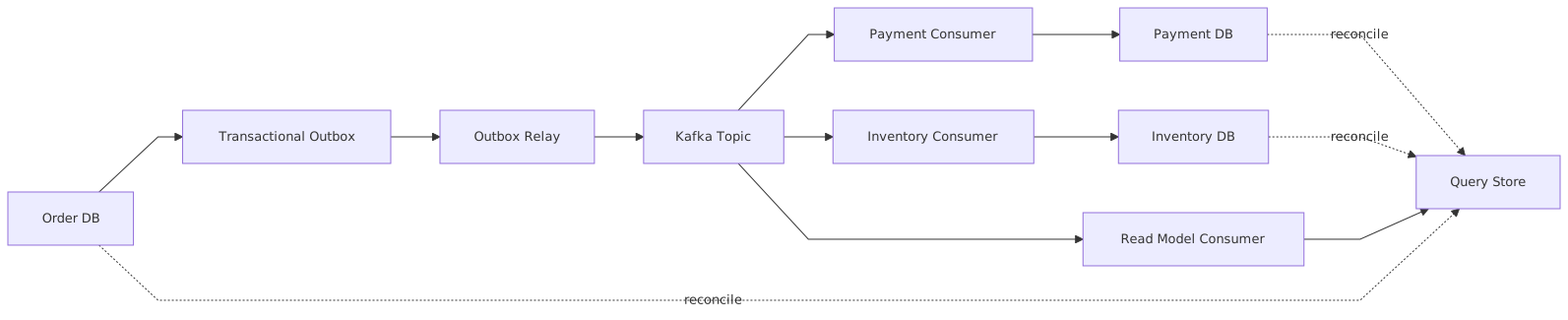
The dotted lines matter more than many teams admit.
Migration Strategy
Most enterprises do not start from a clean event-driven landscape. They start from a monolith, an ERP, a CRM, a mess of batch jobs, and a dozen “temporary” point-to-point integrations that survived three CIOs.
So migration must be progressive. This is where the strangler pattern earns its reputation.
Start by identifying seams in the business domain, not just technical components. A bounded context with high change frequency, clear ownership, and tolerable asynchronous behavior is a good extraction candidate. Order capture is often a better first move than general ledger. Customer notifications are often easier than credit risk. Pick a place where eventual consistency is survivable.
Then do not begin by rewriting everything. Begin by capturing events around the existing system. Change data capture, domain event publication from the monolith, or anti-corruption layers can expose useful facts without forcing an immediate core rewrite.
A practical path often looks like this:
- Keep the monolith as the system of record.
- Publish business events from changes in the monolith using outbox or CDC.
- Build new downstream services and read models from those events.
- Redirect selected capabilities to new services.
- Move write ownership of a bounded context from the monolith to the new service.
- Retire old paths incrementally.
This is not elegant. It is effective.
The hard part is preserving semantics while ownership shifts. During migration, two systems may appear to describe the same thing. That is dangerous. Decide which one is authoritative for each field, state, and process step. Migration fails less from code defects than from ambiguous authority.
Here is a progressive strangler view.
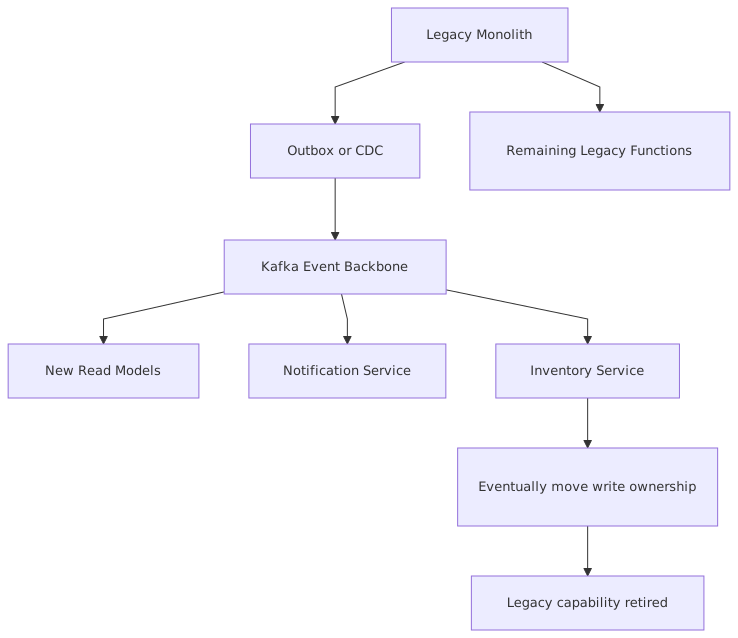
Migration reasoning
Why not big bang? Because enterprises are not labs. They have quarter-end freezes, audit windows, call centers, partner contracts, and systems nobody fully understands. Eventual consistency introduces new operational dynamics. You want those dynamics to emerge in controlled zones, not across the entire revenue chain at once.
Also, migration teaches the organization. Teams learn to define event contracts, measure lag, build idempotent consumers, and operate reconciliation. Those are muscles. You do not get them from PowerPoint.
Enterprise Example
Consider a global retailer modernizing its order management platform.
The legacy estate had an e-commerce monolith backed by Oracle, a warehouse management package, a payment gateway, SAP for finance, and a nightly reporting warehouse. Checkout used synchronous calls to payment and stock validation. During peak season, one slow dependency turned the entire order flow brittle. Support teams faced a familiar nightmare: customers saw one status online, agents saw another in CRM, and the warehouse had a third opinion entirely.
The retailer did not need every system to agree instantly. It needed a business process that converged reliably and transparently.
The architecture team carved the domain into bounded contexts:
- Order Management
- Payment
- Inventory Allocation
- Fulfillment
- Customer Communication
- Financial Posting
They began with order capture and customer communication. The monolith still accepted orders, but an outbox emitted OrderPlaced events to Kafka. A new communication service consumed events and drove confirmation emails and order-status read models. That alone removed a web of direct integrations.
Next came inventory allocation. Instead of synchronous stock reservation during checkout, the business changed semantics: checkout accepted orders into “Pending Confirmation,” and inventory allocation completed asynchronously within a target of a few seconds. For high-demand items, allocation could fail, triggering compensation paths like partial confirmation, backorder, or cancellation. Product owners initially resisted. Then they saw peak traffic stop collapsing the storefront.
Later, payment and fraud became event-driven too. The order timeline turned into a state machine visible both to internal teams and customers:
- Received
- Under Review
- Payment Authorized
- Stock Allocated
- Confirmed
- Shipped
This mattered. It turned technical asynchrony into business language.
Not everything moved. Financial posting to SAP remained more tightly controlled, with stronger consistency expectations and explicit reconciliation batches because accounting semantics demanded care over speed. That is a mature decision. Good enterprise architecture does not worship uniformity.
The biggest lesson was not Kafka throughput or consumer scaling. It was reconciliation. During holiday peaks, some consumer groups lagged. A handful of events failed due to schema evolution mismatches. Because the retailer had built daily and intra-day reconciliation between order truth, payment truth, and customer-facing status views, they repaired divergence before it became revenue leakage.
That is what convergence looks like in real enterprises: not perfection, but disciplined repair.
Operational Considerations
Eventual consistency is an operational model as much as a design model.
Measure convergence, not just uptime
A service can be “healthy” while the business is blind because downstream consumers are thirty minutes behind. Track broker lag, end-to-end event age, projection freshness, and reconciliation drift. Business SLOs should include convergence windows.
Dead-letter queues are not a strategy
A DLQ is a quarantine zone, not closure. Every dead-letter event represents unresolved business truth. You need triage, replay, correction, and ownership. Otherwise DLQs become digital basements full of haunted furniture.
Schema evolution is governance in disguise
Events live longer than APIs. Consumers may replay old topics months later. Versioning, compatibility rules, and contract discipline matter. This is where many microservice programs discover they did not decentralize architecture; they decentralized confusion.
Observability needs correlation
Trace IDs, causation IDs, and business keys like Order ID must flow through events. Without them, distributed troubleshooting becomes archaeology.
Reconciliation needs first-class funding
Do not leave reconciliation to a heroic operations engineer and a SQL script. Build explicit repair workflows. Some systems need automatic replay. Others need human review because repair changes money, inventory, or legal records.
Tradeoffs
Eventual consistency buys you resilience, scalability, and autonomy. It charges interest in complexity.
You gain:
- decoupled services
- local transactional safety
- better availability under partial failure
- scalable asynchronous processing
- replay and recovery patterns with Kafka
You pay with:
- more complex domain modeling
- transitional states in user journeys
- harder troubleshooting
- duplicate handling and idempotency requirements
- reconciliation and repair work
- broader operational maturity requirements
There is no free lunch here. Teams sometimes adopt eventual consistency to avoid difficult schema coupling, only to discover they have created process coupling hidden in events. The coupling did not disappear. It changed costume.
The key tradeoff is this: strong consistency simplifies correctness at the cost of flexibility and availability; eventual consistency simplifies distribution at the cost of temporal ambiguity.
Pick the ambiguity you can run.
Failure Modes
Architectures fail in predictable ways. We should say them out loud.
Lost events through naive publication
A service commits business data but fails before publishing. Downstream services never learn of the change. This is why outbox exists.
Duplicate side effects
Retries and reprocessing lead to duplicate shipments, notifications, or financial entries because consumers are not idempotent.
Semantic drift between producers and consumers
A producer changes event meaning without consumer coordination. The contract compiles; the business breaks.
Reordering across partitions
Teams assume total ordering where only partition ordering exists. Consumers process events in an invalid business sequence.
Stale read models treated as authoritative
Support or automation acts on a projection that has not yet converged, causing bad customer outcomes or operational mistakes.
Infinite compensation loops
One service reacts to another’s rollback or compensation event, triggering more compensations in a loop. This happens when process semantics are vague and event choreography becomes tribal knowledge.
Reconciliation absent or ignored
The estate drifts silently until month-end, when finance, operations, and customer service all discover different truths. This is the expensive version of denial.
When Not To Use
This is the part too many architecture articles skip.
Do not use eventual consistency when the business invariant must be globally enforced immediately and the cost of temporary divergence is unacceptable.
Examples:
- double-spend prevention in core ledger movements
- certain trading and risk controls
- hard inventory guarantees for scarce regulated assets
- legal or compliance records where delayed agreement is itself a violation
- small, cohesive applications where one datastore and one transaction boundary are entirely sufficient
Also do not use it when the organization lacks the discipline to operate it. If teams cannot manage event contracts, observe lag, build idempotent consumers, and invest in reconciliation, then eventual consistency will become eventual confusion.
And do not use it as a fashionable excuse to avoid modularizing a monolith properly. Many systems need better boundaries more than they need more brokers.
Related Patterns
A few patterns commonly travel with eventual consistency.
Saga
Useful for coordinating long-running business processes across services. Can be orchestration-based or choreography-based. Sagas are not magic. They move failure handling into explicit process logic.
Transactional Outbox
The standard answer for reliable event publication from a local transaction.
CQRS
Helpful when read models differ from write models and can be updated asynchronously. Overused when teams mistake read/write separation for architecture maturity.
Event Sourcing
Sometimes paired with eventual consistency, but not required. Event sourcing is about persisting state as a sequence of events. Many successful eventually consistent systems use ordinary state stores plus integration events.
Anti-Corruption Layer
Vital during strangler migration when new bounded contexts must shield themselves from ugly legacy semantics.
CDC
Pragmatic for brownfield estates when code-level event publication is hard. Useful, but be careful: table changes are not always domain events.
Summary
Eventual consistency is the art of letting distributed systems disagree briefly without letting the business lose control.
That sentence matters because it puts the emphasis where it belongs. The goal is not technical purity. The goal is reliable convergence. In a distributed enterprise, truth arrives as a sequence, not a snapshot. One bounded context knows first. Others catch up. Read models lag. Reconciliation repairs. Customers see state transitions that reflect real processing. The architecture succeeds when temporary inconsistency is both intentional and bounded.
The practical recipe is clear enough:
- define bounded contexts and domain semantics first
- keep strong consistency inside local transaction boundaries
- publish changes reliably with outbox-style patterns
- use Kafka or a similar backbone for asynchronous propagation where it fits
- design idempotent consumers and meaningful state models
- invest in reconciliation as a first-class capability
- migrate progressively with a strangler approach
- refuse the pattern where immediate global invariants truly matter
A distributed system is less like a choir singing one note at once and more like an orchestra following the same score from different chairs. Sound reaches you at slightly different times. That does not mean there is no music. It means timing is part of the composition.
Good architects know the difference.
Frequently Asked Questions
What is a service mesh?
A service mesh is an infrastructure layer managing service-to-service communication. It provides mutual TLS, load balancing, circuit breaking, retries, and observability without each service implementing these capabilities. Istio and Linkerd are common implementations.
How do you document microservices architecture for governance?
Use ArchiMate Application Cooperation diagrams for the service landscape, UML Component diagrams for internal structure, UML Sequence diagrams for key flows, and UML Deployment diagrams for Kubernetes topology. All views can coexist in Sparx EA with full traceability.
What is the difference between choreography and orchestration in microservices?
Choreography has services react to events independently — no central coordinator. Orchestration uses a central workflow engine that calls services in sequence. Choreography scales better but is harder to debug; orchestration is easier to reason about but creates a central coupling point.