⏱ 21 min read
Distributed systems do not fail because engineers forget ACID exists. They fail because the business wants two things at once: local autonomy and global consistency. The sales platform wants to approve the order now. The inventory service wants to reserve stock on its own terms. Finance wants a ledger that can survive an audit. Operations wants resilience under partial failure. Everyone is right, and that is exactly the problem.
Somewhere in the middle of this tension sits a pattern that many teams use without naming clearly enough: the model synchronization window. It is the bounded period in which two or more models of the same business reality are expected to drift, and then converge. Not instantly. Not magically. Intentionally.
That distinction matters.
Too many architecture discussions treat inconsistency as an embarrassing side effect. In practice, in modern event-driven systems, it is often a design choice. You allow one bounded context to move first, publish an event, and let downstream models catch up inside an agreed time window. If the system is healthy, the gap is tolerable. If it is not, the gap becomes a business incident.
A synchronization window is therefore not just a technical timing detail. It is a business contract expressed in architecture.
This article digs into that idea properly: where synchronization windows come from, how they shape microservice and Kafka-based architectures, how they intersect with domain-driven design, how to migrate toward them without burning down a monolith, and where they become a dangerous crutch. The point is not to celebrate eventual consistency like a religion. The point is to know when delayed convergence is a good bargain and when it is simply laziness wearing cloud-native clothes. cloud architecture guide
Context
In a single database application, synchronization is mostly hidden. One transaction updates a handful of tables, and everyone reads the same truth a few milliseconds later. Architects raised on that world often carry a dangerous assumption into distributed systems: if two things represent the same business concept, they should be updated together.
That assumption works until the organization starts scaling by domains.
A modern enterprise rarely has one “customer model,” one “order model,” or one “product model.” It has many. Customer exists in CRM, billing, fulfillment, fraud, identity, and support. Product exists in catalog, pricing, warehouse, merchandising, and analytics. These are not duplicates in the sloppy sense. They are contextual models. Each bounded context shapes the concept according to its own language, lifecycle, and invariants.
That is classic domain-driven design, and it is still one of the few lenses that keeps distributed systems sane. A bounded context is not just a service boundary. It is a semantic boundary. Once you accept that, synchronization stops being “keeping copies identical” and becomes “coordinating overlapping truths.”
This is why the synchronization window exists.
Suppose the Order domain accepts a purchase and emits OrderPlaced. Inventory builds a reservation view from those events. Customer Notifications builds a communication view. Fraud builds a risk posture. Analytics updates aggregates. None of those consumers need the same shape of data, and some of them should not even try. They need enough truth, soon enough, to perform their jobs.
The architecture question is not: How do we eliminate lag?
It is: What lag is acceptable for this business capability, and how do we control it?
That is a more serious question. It forces explicit thinking about semantics, tolerance, reconciliation, observability, and operational recovery.
Problem
The core problem is simple to state and painful to solve: multiple services maintain models that represent overlapping business facts, but those models cannot always be updated atomically.
There are several reasons.
First, distributed transactions across services are expensive, fragile, or simply unavailable. The industry learned this lesson repeatedly. XA gave people the illusion of control while quietly coupling failure domains. Most organizations that have lived through a few production outages become far less romantic about cross-service atomicity.
Second, bounded contexts legitimately need different models. The fulfillment service does not care about customer marketing preferences the same way the CRM does. The finance ledger does not want mutable convenience fields from the order API. Synchronization is not copying rows. It is translating domain events and state transitions into another context’s language.
Third, update rates and availability requirements differ. A checkout flow may require sub-second confirmation. Downstream reporting can tolerate minutes. Warehouse allocation might tolerate a short delay but not an hour. Audit posting may need strict completeness, even if user-facing projections do not.
So teams end up with event-driven propagation, replication pipelines, materialized views, CDC feeds, Kafka topics, retry queues, and reconciliation jobs. The architecture grows a circulatory system. The hard part is that circulation introduces lag, reordering, duplication, and partial failure. event-driven architecture patterns
Without discipline, the business hears “eventual consistency” and assumes “probably fine.” That phrase has excused more vague thinking than almost any other in software architecture.
A better framing is this:
- Which business action creates the authoritative change?
- Which downstream models must reflect it?
- How long may they diverge?
- What decisions are allowed during divergence?
- How is convergence verified?
- What happens when the window is exceeded?
If you cannot answer those questions, you do not have a synchronization strategy. You have a hope-based integration pattern.
Forces
Synchronization windows are born from competing forces. The architecture is a compromise, and good architects say that out loud.
1. Local autonomy vs enterprise coherence
Every service team wants to own its model and release independently. That is healthy. But enterprises also need coherent behavior across channels, regions, and back-office processes. Too much autonomy and the customer sees contradictions. Too much centralization and every change turns into committee theater.
2. Domain semantics vs technical convenience
It is easy to replicate a table. It is much harder to replicate meaning. A CustomerStatus=ACTIVE flag may mean “can log in” in one context, “can place credit orders” in another, and “not legally blocked” in a third. Synchronization that ignores semantics creates elegant pipelines full of nonsense.
3. Performance vs consistency
Real-time synchronization increases infrastructure pressure and failure sensitivity. Batch synchronization reduces cost and coupling but enlarges drift. This is never just a technical tuning issue. The acceptable delay depends on the business capability. Inventory allocation and quarterly BI reporting do not deserve the same treatment.
4. Availability vs correctness
Under network partitions or downstream outages, should the upstream workflow proceed? Sometimes yes. Sometimes absolutely not. If a loyalty projection is stale, checkout can continue. If the credit exposure model is stale, approving a large enterprise order may be reckless.
5. Change velocity vs governance
As systems evolve, event contracts, schemas, and semantics drift. Strong governance reduces accidental breakage. Too much governance calcifies the organization. Too little and you get topic sprawl, duplicate meanings, and endless reconciliation work. EA governance checklist
6. Operational simplicity vs resilience
One shared transactional system is operationally simpler than a web of asynchronous consumers. But the simple system eventually becomes the bottleneck for organizational scale. Distributed synchronization buys resilience and independent scaling at the price of more moving parts, more telemetry, and more ways to fail in slow motion.
That last phrase matters. Distributed systems often fail in slow motion. Messages back up. Lags creep. Retries churn. The damage is done long before anyone gets paged.
Solution
A model synchronization window is an explicitly defined interval during which downstream models are allowed to be stale after an authoritative domain change, provided they converge by the end of the window and business operations respect that temporary divergence.
The emphasis should be on explicitly defined.
A proper solution has several characteristics.
Define an authoritative source per business fact
Not per table. Not per enterprise data model. Per business fact.
For example:
- Order acceptance is authoritative in the Order domain.
- Payment capture is authoritative in the Payment domain.
- Physical stock movement is authoritative in the Warehouse domain.
- Journal posting is authoritative in the Ledger domain.
This is DDD discipline. Every important state transition has a home.
Publish business events, not data exhaust
When the authoritative domain changes, publish events that represent domain meaning: OrderPlaced, StockReserved, PaymentCaptured, AddressValidated, CustomerCreditLimitReduced.
Events should tell consumers what happened in business terms, not leak internal persistence deltas. CDC alone is often too low-level for cross-context synchronization. CDC can be useful infrastructure, but it is not a domain model.
Assign synchronization classes
Not all synchronization windows are equal. A useful enterprise approach is to classify them:
- Immediate: near-real-time, usually sub-second to a few seconds
- Operational: seconds to minutes
- Deferred: minutes to hours
- Scheduled: batch windows, often overnight
This creates architecture language executives can understand. “Inventory reservations are operational sync, under 30 seconds.” “Board reporting is deferred sync, under 2 hours.” Better this than a hand-wave about eventual consistency.
Separate operational decisions from read projections
A stale read model is acceptable only if no unsafe decision depends on it. If a projection is used to make commitments, then the synchronization window becomes part of the risk model. The important thing is not whether data is stale. It is whether stale data is making promises.
Reconcile deliberately
Asynchronous propagation without reconciliation is unfinished architecture. Every synchronization window needs a corresponding convergence mechanism:
- idempotent consumers
- replay capability
- compensating actions
- periodic consistency scans
- dead-letter handling
- mismatch reports by business key
- repair workflows, automated where possible
The glamorous part is Kafka. The unglamorous part is reconciliation. The unglamorous part is what keeps auditors and customers off your back.
Architecture
A common architecture uses an authoritative service, an event stream, one or more consuming bounded contexts, and a reconciliation process that detects or repairs drift.

This pattern is straightforward on the whiteboard and messy in production, because details matter.
Transaction and event publication
The first trap is losing the event after committing the source transaction. If the order is saved but OrderPlaced is never published, downstream models may never converge. The transactional outbox pattern exists because this failure happens in real systems, not just in conference slides.
The order service writes the order state and an outbox entry in one local transaction. A publisher then forwards outbox records to Kafka. This avoids dual-write inconsistency at the source.
Kafka as synchronization backbone
Kafka is often a good fit because synchronization windows benefit from durable ordered streams, replay, partitioning, and consumer isolation. But Kafka is not the pattern; it is an implementation choice. Use it when the scale, retention, replay, and decoupling justify the operational cost.
Kafka helps especially when:
- multiple consumers need the same domain events
- replay is needed for rebuilding projections
- throughput is high
- event retention supports recovery and audit
- teams need independent consumption speeds
But Kafka also tempts teams into topic sprawl and semantic drift. A topic named customer-updates-v2-final is not architecture. It is archaeology.
Consumer-side models
Consumers build local models optimized for their use cases. Inventory might maintain allocatable stock by SKU and region. Notifications might maintain a communication-ready order view. Analytics may consume events into a warehouse. Fraud might enrich and score.
These models are not “cache copies” in the trivial sense. They are downstream representations with their own invariants and retention rules. That is why synchronization must respect domain semantics. A consumer may need to ignore some upstream events, aggregate others, or derive new state entirely.
Synchronization window tracking
Good architectures make the window observable.
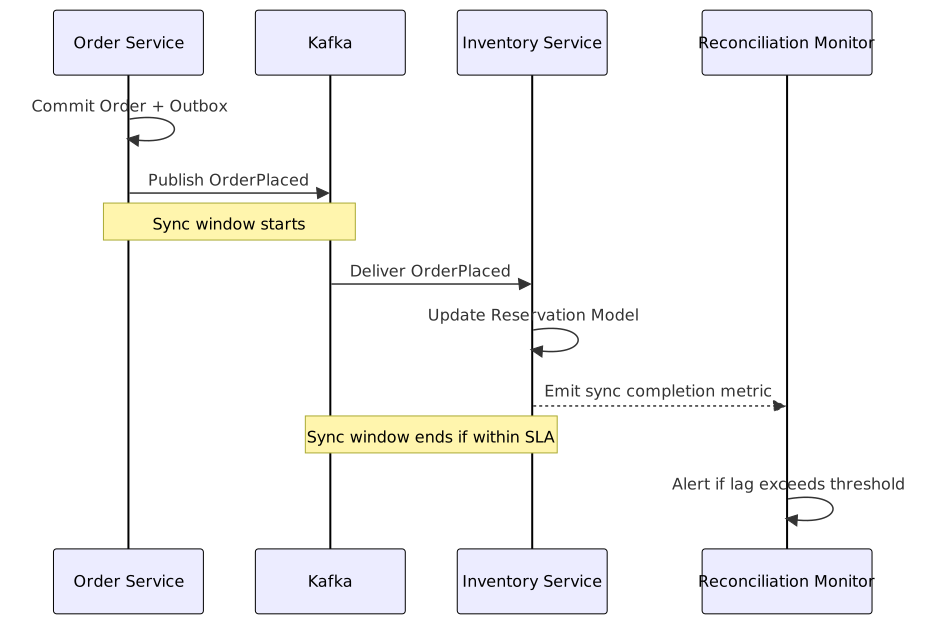
The system should record:
- event publication latency
- consumer lag
- processing latency per event type
- age of oldest unprocessed event
- convergence success rate
- mismatch counts found by reconciliation
- repair completion times
This turns synchronization from folklore into an operationally managed capability.
Domain semantics and anti-corruption
One of the most overlooked aspects of synchronization is translation. Downstream contexts should not absorb upstream language wholesale. If the CRM publishes CustomerSegmentChanged, the pricing engine may map that into eligibility tiers with its own rules. An anti-corruption layer is often necessary to preserve bounded context integrity.
This is especially important during migration, when legacy terms and new domain language coexist awkwardly. If teams skip semantic translation, they end up with distributed coupling disguised as event integration.
Migration Strategy
Most enterprises do not get to design synchronization windows from a blank sheet. They inherit a monolith, a shared database, and a portfolio of brittle batch jobs that “must not break month-end.” The migration question is therefore central.
The sane path is usually progressive strangler migration.
You do not rip out consistency mechanisms in one move. You carve bounded contexts out of the legacy estate, establish authoritative ownership for a few state transitions, and introduce synchronization windows where the business can tolerate bounded drift.
A practical sequence looks like this:
1. Identify candidate domains with tolerable drift
Start where temporary divergence is acceptable and understandable. Customer notifications, search indexes, analytics, recommendation views, and some inventory projections are often better early candidates than payments or regulated ledgers.
Do not start with the domain whose mistakes make headlines.
2. Make authority explicit before splitting systems
Many migration programs fail because they move code before clarifying ownership. If both monolith and new service can update the same business fact, synchronization becomes a political argument encoded in data races.
Pick one system of record for each fact, even if only temporarily.
3. Introduce events from the legacy boundary
In the early strangler stage, the monolith may remain authoritative. Publish domain events from it using an outbox or CDC-plus-mapping approach. Let new services build read models or perform secondary capabilities. This creates the first synchronization windows without breaking core transactions.
4. Build reconciliation before full cutover
This is where many teams get impatient. They want to move writes quickly. Bad idea. Before shifting authority to a new service, prove that downstream synchronization can be monitored, replayed, and repaired. If the only answer to drift is “rerun the job,” you are not ready.
5. Shift command ownership gradually
Once a new bounded context is stable, route specific commands to it. Keep old paths behind a feature toggle or routing layer. During the overlap period, use anti-corruption layers to prevent semantic leakage between legacy and new models.
6. Retire duplicate writes last
The last thing to remove is often the thing everyone hates: temporary duplicate update logic. Remove it only after synchronization windows are predictable and reconciliation results are boring. Boring is good. Boring means your architecture has stopped improvising.
Here is a simplified migration path.
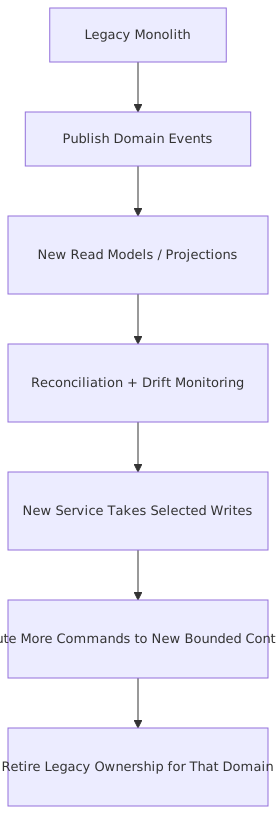
The important migration reasoning is this: synchronization windows are safest when introduced first for derived or supporting models, and only later for decision-making or financially sensitive models. Enterprises that reverse that sequence usually learn in public.
Enterprise Example
Consider a global retailer modernizing order fulfillment across e-commerce, stores, and regional warehouses.
The legacy estate has a central ERP and an aging commerce platform sharing overnight stock feeds and a handful of near-real-time APIs. Stock accuracy is good enough in stores, terrible online during promotions, and catastrophic during regional disruptions. Every channel argues with every other one because “inventory” means different things depending on who is speaking.
This is not unusual. It is Tuesday in retail.
Domain decomposition
The architecture team defines bounded contexts:
- Catalog owns sellable product presentation
- Pricing owns offer and price calculation
- Order owns order lifecycle and customer commitment
- Inventory owns allocatable stock view
- Warehouse owns physical stock movement
- Store Operations owns store-level availability realities
- Ledger owns financial postings
Notice the language: allocatable stock is not physical stock. That semantic distinction is the whole game. Warehouse knows what exists physically. Inventory knows what can safely be promised. Store Operations knows what a local manager has hidden in a damaged goods cage and will never fulfill. If you collapse those meanings into one “quantity available” field, the architecture will lie.
Synchronization windows by business capability
The retailer defines windows:
- Order to Inventory reservation: under 5 seconds
- Warehouse movement to Inventory update: under 30 seconds
- Inventory to Search availability projection: under 60 seconds
- Order to Ledger posting: under 2 minutes
- Inventory to executive reporting: hourly
That is architecture rooted in business semantics. Different truths, different tolerances.
Kafka-based event flow
Order emits OrderPlaced, OrderCancelled, and OrderExpired. Warehouse emits StockReceived, StockPicked, StockAdjusted. Store Operations emits StoreStockConfirmed and StoreStockException. Inventory consumes all of them to maintain allocatable stock by SKU, channel, and region. Search and customer-facing availability APIs consume from Inventory’s published events, not directly from Warehouse.
That last choice is crucial. Search should not infer promiseable stock from raw warehouse movements. Inventory is the domain that translates operational noise into commitment semantics.
Reconciliation
The retailer runs continuous reconciliation across three levels:
- event stream completeness by business key
- inventory model comparison against warehouse and order reservation facts
- periodic cycle-count adjustments from stores and warehouses
When mismatches appear, the system can:
- rebuild a SKU-region projection from retained Kafka events
- trigger compensating
InventoryCorrectedevents - route severe mismatches for manual investigation
- temporarily degrade online promise logic for affected regions
This is not pretty, but enterprise architecture is often the art of making reality survivable.
Business outcome
The result is not perfect consistency. It is something more useful: predictable inconsistency with controlled convergence. During peak promotions, customer-facing stock may lag a few seconds, but the organization knows the lag, measures it, and has policies for exceeding it. Reservation oversell drops sharply because the allocatable model is owned by a dedicated domain instead of being improvised across channels.
That is what good architecture buys: fewer surprises, not fewer complexities.
Operational Considerations
Synchronization windows live or die in operations.
Lag observability
If you cannot see drift, you cannot govern it. Track lag by event type, bounded context, partition, and business key class. Aggregate lag metrics are not enough. One hot partition or poison message can quietly violate the business window for a critical subset of customers.
Idempotency
Consumers must survive duplicates. In Kafka-based systems, duplicates are not scandalous; they are normal engineering conditions. Every state transition consumer should have a stable idempotency strategy keyed by business identity and version or event ID.
Ordering assumptions
Ordering is local, not global. Teams often overestimate what Kafka ordering gives them. Ordering within a partition is useful, but only if partition keys align with business invariants. If stock events are partitioned by warehouse but reservations are partitioned by order, then convergence logic must tolerate cross-stream timing differences.
Replay and rebuild
If a projection cannot be rebuilt, it is more brittle than people think. Keep retention and snapshot strategies aligned with recovery objectives. Rebuild procedures should be rehearsed, not merely possible in theory.
Backpressure and poison events
A bad event can clog a consumer group and silently stretch the synchronization window from seconds to hours. Build poison-message handling, quarantine flows, and bounded retries. Infinite retries are not resilience. They are denial.
Data quality ownership
Many drift problems are not transport failures. They are semantic mismatches, missing keys, bad mappings, and contract changes. Assign ownership for data quality at the domain boundary. Otherwise every discrepancy turns into a cross-team blame exchange with no closure.
Tradeoffs
This pattern is useful precisely because it accepts tradeoffs rather than pretending to erase them.
Pros:
- supports bounded context autonomy
- avoids fragile distributed transactions
- scales well with event-driven architectures
- enables specialized local models
- improves resilience through asynchronous decoupling
- works well in progressive modernization
Cons:
- introduces temporary inconsistency by design
- increases operational complexity
- requires serious reconciliation capability
- makes debugging cross-service state harder
- creates business risk if stale models drive commitments
- demands mature domain language and governance
The biggest tradeoff is psychological. Teams used to synchronous CRUD systems often feel uncomfortable making inconsistency explicit. Good. They should. The answer is not denial. The answer is to turn discomfort into policy.
Failure Modes
Synchronization windows fail in recognizably ugly ways.
Lost publication at source
The source transaction commits, but the event never reaches the stream. This is the classic dual-write failure. Use outbox patterns and monitor publication backlog aggressively.
Consumer lag exceeds business tolerance
The events exist, but downstream processing slows due to code regressions, partition imbalance, broker issues, or dependent service latency. This is one of the most common real-world failures because it degrades gradually.
Semantic drift between producer and consumer
The producer changes meaning without a proper contract evolution. Everything still “works” technically, but the consumer model becomes subtly wrong. These are the nastiest failures because dashboards may stay green while business logic rots.
Reconciliation blind spots
Teams assume replay is enough, but some mismatches require external facts or compensating workflows. If reconciliation only checks transport completeness and not business coherence, drift survives indefinitely.
Unsafe use of stale models
A read model meant for convenience starts being used for commitments. This happens through accidental reuse. Some team sees a handy projection and wires it into a decision flow. Months later, a stale stock promise or incorrect credit decision turns into an incident.
Window normalization
This is the cultural failure mode. The system regularly exceeds the synchronization SLA, but the organization adjusts expectations instead of fixing root causes. Soon “near real time” means “usually by lunchtime.” Architecture degrades one tolerated delay at a time.
When Not To Use
A synchronization window is not a universal pattern. Sometimes the right answer is still strong consistency.
Do not use this approach when:
- a business invariant must be enforced atomically across updates
- legal or regulatory controls demand immediate consistency
- financial double-entry posting cannot tolerate deferred convergence
- safety-critical decisions depend on the downstream model
- the domain is too poorly understood to define authoritative ownership
- the organization lacks operational maturity for monitoring and reconciliation
If your fraud approval, exposure limit, or payment capture logic depends on perfectly current shared state, you may need a different design: tighter service boundaries, a single consistency domain, or a transactional core with asynchronous satellites.
There is no virtue in distributing a model just because microservices are fashionable. Sometimes one service and one database are not a legacy smell. They are the correct boundary. microservices architecture diagrams
Related Patterns
A synchronization window often sits alongside several established patterns:
- Transactional Outbox: reliable event publication from local transactions
- Saga: coordination of long-running cross-service business processes
- CQRS: separate write models and read projections, often with explicit lag
- Materialized View: downstream models optimized for query use cases
- Event Sourcing: event log as source of truth, often with replayable projections
- Anti-Corruption Layer: semantic translation across bounded contexts
- Change Data Capture: infrastructure feed, useful when paired with domain mapping
- Strangler Fig Pattern: progressive replacement of monolith capabilities
- Reconciliation Batch: periodic verification and repair of drift
These patterns are complementary. The synchronization window is less a single pattern than an architectural lens across them.
Summary
Model synchronization windows are what mature distributed systems use when they stop pretending every truth can move at once.
The idea is simple but not simplistic: define which domain is authoritative for a business fact, allow bounded downstream drift, measure the acceptable delay, and build reconciliation so the system converges reliably. That means working from domain semantics, not just infrastructure. It means treating lag as a business contract, not an implementation accident. It means designing for repair as seriously as designing for flow.
In microservices and Kafka-based architectures, this pattern is often the difference between scalable autonomy and distributed confusion. But it only works when the enterprise is honest about tradeoffs. Temporary inconsistency is acceptable only when decisions remain safe, windows are observable, and failure handling is real.
The memorable line here is the important one: every distributed model drifts; architecture decides whether that drift is controlled or accidental.
Controlled drift can be a powerful tool. Accidental drift is just entropy with a budget code.
Frequently Asked Questions
What is a service mesh?
A service mesh is an infrastructure layer managing service-to-service communication. It provides mutual TLS, load balancing, circuit breaking, retries, and observability without each service implementing these capabilities. Istio and Linkerd are common implementations.
How do you document microservices architecture for governance?
Use ArchiMate Application Cooperation diagrams for the service landscape, UML Component diagrams for internal structure, UML Sequence diagrams for key flows, and UML Deployment diagrams for Kubernetes topology. All views can coexist in Sparx EA with full traceability.
What is the difference between choreography and orchestration in microservices?
Choreography has services react to events independently — no central coordinator. Orchestration uses a central workflow engine that calls services in sequence. Choreography scales better but is harder to debug; orchestration is easier to reason about but creates a central coupling point.