⏱ 21 min read
Latency is the tax every distributed system pays for ambition.
The first time a monolith becomes a network, people usually celebrate the flexibility and ignore the invoice. A call that used to be a method invocation becomes a DNS lookup, a TLS handshake, a queue wait, a network hop, a thread-pool decision, a database lock, a retry storm, and a dashboard someone stares at too late. Then the complaints arrive in business language: checkout feels sluggish, claims processing misses SLA, the trading desk sees stale positions, the call center starts apologizing.
Most teams respond with local heroics. They tune a query. They add a cache. They increase a timeout. They scale a cluster. Sometimes this helps. Often it merely moves delay from one layer to another, like squeezing a balloon. The system still disappoints because nobody has treated latency as a design budget with explicit allocation across the stack.
That is the core idea here: latency should be managed the way finance manages capital. Intentionally. By domain priority. With hard tradeoffs. And with the humility to admit that not every step in a distributed workflow deserves the same share of precious milliseconds.
A latency budget is not just an SRE number. It is a business commitment translated into architecture. If the domain says “card authorization must complete in under 300ms at p95,” then every bounded context and every hop in the request path is spending from the same account. If one service hoards time, another service goes bankrupt. That is why latency budget allocation belongs in enterprise architecture, not buried inside team-specific tuning guides.
This article walks through the architecture thinking behind latency stack breakdown, budget allocation, migration, operational governance, and where Kafka and microservices help or hurt. The important point is simple: if you do not allocate latency intentionally, the system will allocate it accidentally. event-driven architecture patterns
Context
Distributed systems rarely fail because any single component is slow in isolation. They fail because end-to-end delay emerges from composition.
A customer order might pass through an API gateway, authentication service, pricing engine, inventory service, fraud service, payment service, orchestration layer, event broker, and one or more data stores. Each hop may look acceptable on its own. Yet the customer experiences the sum, including queueing, retries, serialization, contention, and everything hidden in the tail.
This is where enterprise systems get into trouble. Architects often document functional flow but not temporal flow. We draw boxes and arrows and forget that time is also a dependency.
Domain-driven design helps here because it forces a more honest conversation about what the business actually cares about. Not every domain action is equally time sensitive. “Display recommended products” is not “confirm wire transfer.” “Publish analytics event” is not “reserve inventory.” Once you model bounded contexts clearly, you can assign different latency expectations to commands, queries, and domain events based on their semantic value.
That matters because latency is not a uniform engineering concern. It is domain-specific.
In retail, the add-to-cart path may have a different budget from payment authorization. In healthcare, patient lookup may tolerate slightly higher latency than medication conflict checking in a prescribing workflow. In logistics, shipment tracking can be eventually consistent, but route optimization during dispatch cannot drift for long without operational cost. You do not optimize “the system.” You optimize the promises your business makes.
Problem
Most organizations talk about performance in aggregates and design in fragments. That is a dangerous combination.
The common anti-pattern goes like this:
- Product defines a user-facing SLA, say 2 seconds for checkout completion.
- Teams independently build services with default timeouts and retries.
- Infrastructure adds sidecars, gateways, service mesh, encryption, observability, and policy enforcement.
- Integration teams introduce Kafka for resilience and decoupling.
- Data teams add validation, enrichment, and audit writes.
- Everyone assumes their contribution is small.
Then one day the path is 2.8 seconds at p95 and 8 seconds at p99, and nobody can explain where the time went with confidence.
The root problem is not simply “slow code.” It is the absence of a latency model.
Without a model, several things happen:
- Budgets are implicit. Teams optimize what they can measure locally, not what matters globally.
- Tail latency is ignored. Mean latency looks fine while p95 and p99 sabotage user experience and downstream throughput.
- Retries become latency multipliers. They create the illusion of resilience while consuming the time budget twice.
- Asynchronous messaging is misapplied. Kafka removes coupling but does not magically remove time; it changes where time is paid.
- Domain semantics are flattened. Critical commands and non-critical enrichments are handled with the same transport expectations.
- Migration amplifies inconsistency. As systems move from monolith to microservices, old synchronous assumptions survive in a networked world where they no longer fit.
If you do not allocate latency at design time, the system will express its own priorities. Usually badly.
Forces
Good architecture lives in the tension between competing truths. Latency budgeting is full of them.
User expectations vs system complexity
Users experience one interaction. Architects know it may involve twenty distributed components. The user is right to be impatient. The architecture is wrong if it requires them to care.
Domain correctness vs speed
Some operations can be speculative, stale, or eventually reconciled. Others cannot. A portfolio valuation can tolerate slight delay; securities execution cannot. A marketing event can be dropped; a payment confirmation cannot. Budgeting must reflect domain semantics, not technical symmetry.
Synchronous certainty vs asynchronous resilience
Synchronous calls provide immediate answers. Asynchronous messaging provides decoupling and survivability. Enterprises need both. The trap is to use synchronous flows for everything because they are easy to reason about, or Kafka for everything because it scales and looks modern. Neither extreme is architecture.
Throughput vs latency
Batching improves throughput and cost efficiency but often worsens response time. Fine-grained services improve team autonomy but add network overhead and serialization costs. Caching lowers read latency but introduces staleness and invalidation complexity.
Observability vs overhead
Tracing, logging, policy checks, encryption, and service mesh sidecars all consume time. This is not an argument against them. It is a reminder that non-functional controls are very functional when they affect the clock.
Legacy integration vs clean design
The monolith may be ugly, but it is often fast because in-process calls are cheap. Microservices may be cleaner organizationally but slower computationally. Migration must be justified in business terms, not by fashion. microservices architecture diagrams
These forces are why latency budget allocation cannot be a narrow tuning exercise. It is architectural accounting under pressure.
Solution
The practical solution is to define an end-to-end latency objective, decompose it into a stack breakdown, allocate explicit budgets to layers and bounded contexts, and govern every design choice against that budget.
This sounds simple. It isn’t. But it works.
Start with a business-facing operation, not a technical endpoint. “Authorize payment.” “Create claim.” “Search customer.” “Reserve inventory.” For each operation, define:
- target latency, usually p95 and sometimes p99
- correctness expectations
- consistency model
- fallback rules
- reconciliation obligations
- failure policy when budget is exceeded
Then allocate the budget across the request path. Not as fiction. As a contract.
A representative budget for a 300ms p95 payment authorization might look like this:
- edge and gateway: 20ms
- authentication and authorization: 15ms
- request validation and policy checks: 10ms
- orchestration and service coordination: 25ms
- payment domain logic: 60ms
- fraud screening call: 70ms
- data access: 40ms
- network overhead and serialization: 20ms
- observability overhead: 10ms
- contingency reserve: 30ms
Notice two things. First, the reserve matters. Real systems need slack because latency is not perfectly deterministic. Second, the budget is not evenly distributed. Nor should it be. Architecture is not democracy.
Budget by semantic class
Domain-driven design provides a sharper tool: classify operations by semantic importance.
- Critical commands: must complete within strict latency and correctness constraints. Example: authorize card, place trade, unlock account after MFA.
- Interactive queries: user-facing reads with low-latency expectations but some tolerance for staleness. Example: account summary, cart view.
- Deferred domain events: important for downstream consistency but not on the critical response path. Example: order-created event, ledger-update event.
- Non-critical enrichments: useful but optional in the synchronous path. Example: recommendations, marketing tags, secondary scoring.
This classification lets you reserve synchronous time for what truly matters and push non-essential work into asynchronous channels with Kafka or similar brokers.
Budget by path, not by service inventory
Many organizations allocate service-level SLOs independent of usage paths. That is insufficient. A service may participate in five workflows with completely different criticality. Budgeting should happen by end-to-end path and then be inherited by participating services per operation. The same customer service may have a 30ms budget for authentication lookup and 150ms for back-office profile retrieval.
Build for reconciliation
Once asynchronous patterns enter the picture, budget allocation must include reconciliation design. That means explicitly deciding how delayed or failed side effects are corrected.
For example, an order command may synchronously reserve inventory and accept payment within budget, while loyalty points, shipment estimation, and analytics emission are published via Kafka after the response. If the loyalty update fails, the customer still gets the order confirmation. But the enterprise owes a reconciliation process to restore consistency. Otherwise, you have merely hidden latency debt in the back office.
Here is a simple view of budgeted synchronous and asynchronous flow:
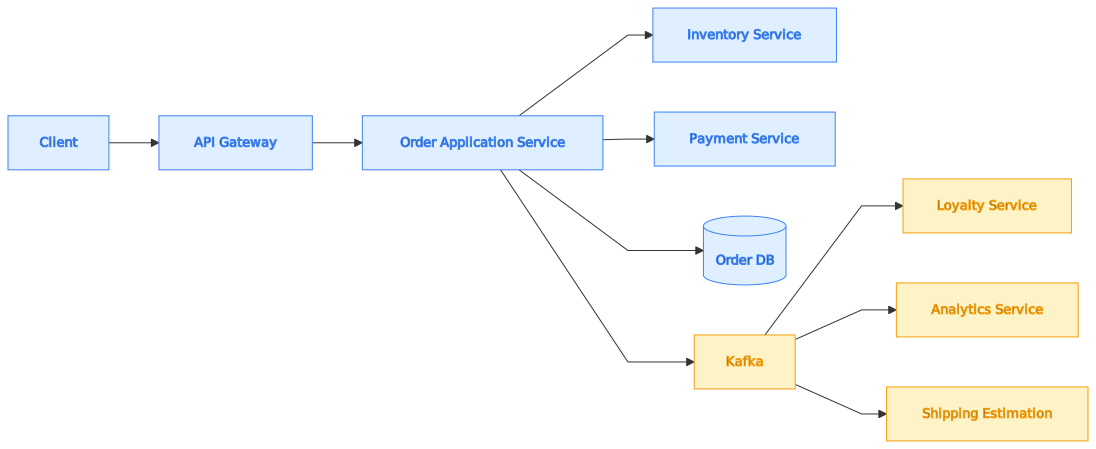
The point is not just topology. The point is to protect the critical path from work that does not deserve to live there.
Architecture
A sound latency-budget architecture typically has five elements.
1. A domain latency model
This is the foundation. For each bounded context, define which operations are latency critical, what consistency they require, and what fallback behavior is permissible.
Example:
- Payments bounded context: low-latency command processing, strict correctness, no speculative success.
- Catalog bounded context: low-latency query processing, tolerate cache staleness.
- Recommendations bounded context: optional enrichment, soft timeout acceptable.
- Analytics bounded context: asynchronous event consumption, no user-visible latency contribution.
This is where DDD earns its keep. It stops you from turning everything into generic “request processing” and forces you to model intent.
2. Explicit latency stack breakdown
Break each critical operation into layers:
- client to edge
- gateway and policy
- service-to-service network
- application logic
- cache lookup
- database call
- external dependency
- event publication
- observability and security overhead
- retry or timeout reserve
You want a stack breakdown because performance bottlenecks do not sit politely in one tier. A service can be “slow” because its downstream call is under-provisioned, because the mesh injected latency, because payload size increased, because partition rebalancing affected Kafka consumers, or because a thread pool is saturated.
3. Budget-aware orchestration
An orchestrator should not be a naive traffic cop. It should understand deadlines.
Each incoming request should carry a deadline or remaining budget. Downstream calls then get timeouts derived from the remaining budget, not arbitrary defaults. If the operation has 120ms left, it is architectural malpractice to issue three parallel calls each with a 100ms timeout and two retries.
A useful pattern is deadline propagation:
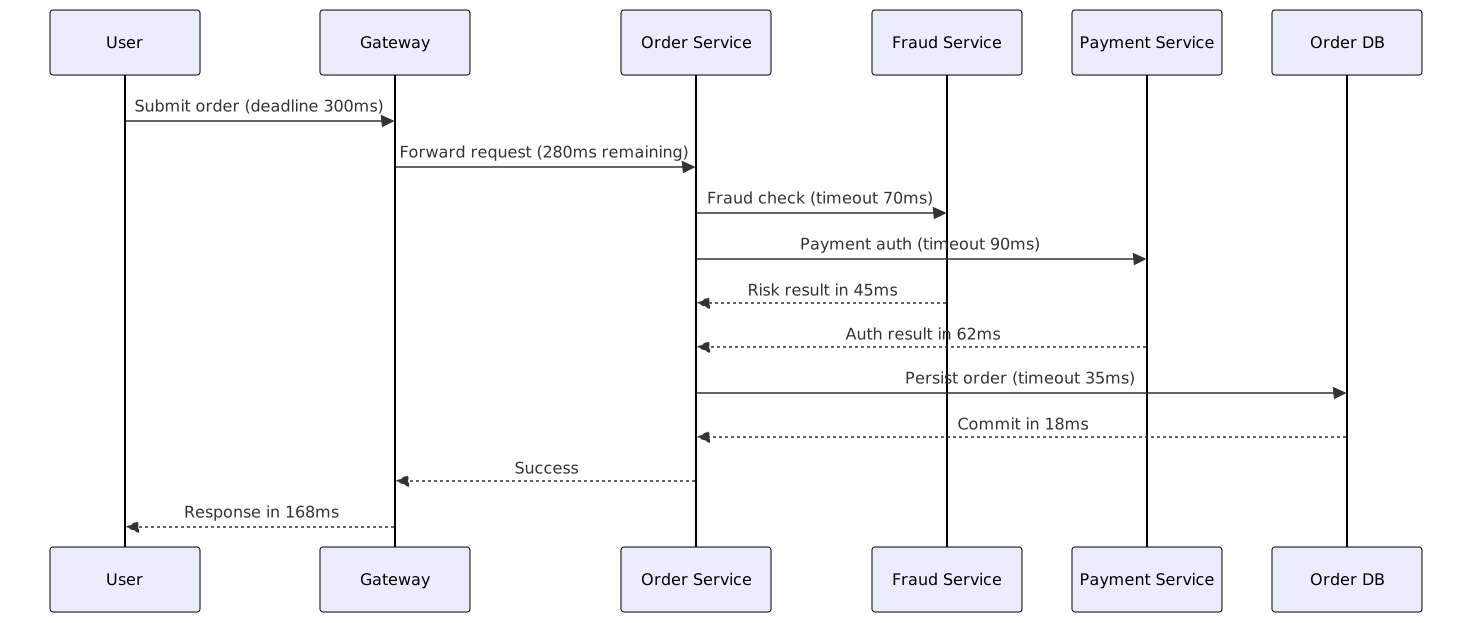
That simple discipline prevents downstream services from consuming time the caller no longer owns.
4. Asynchronous offloading with Kafka, but selectively
Kafka is powerful for latency architecture, but mostly as a way to remove work from the interactive path and to decouple recovery from request completion. It is not a magic low-latency machine.
Use Kafka when:
- the user does not need immediate completion of a side effect
- consumers can process independently
- replay and audit are valuable
- reconciliation is acceptable
- temporal decoupling improves resilience
Do not use Kafka to pretend a synchronous business obligation is now asynchronous. Payment captured later is not the same thing as payment authorized now. Inventory “eventually reserved” after the customer receives confirmation is how oversell incidents are born.
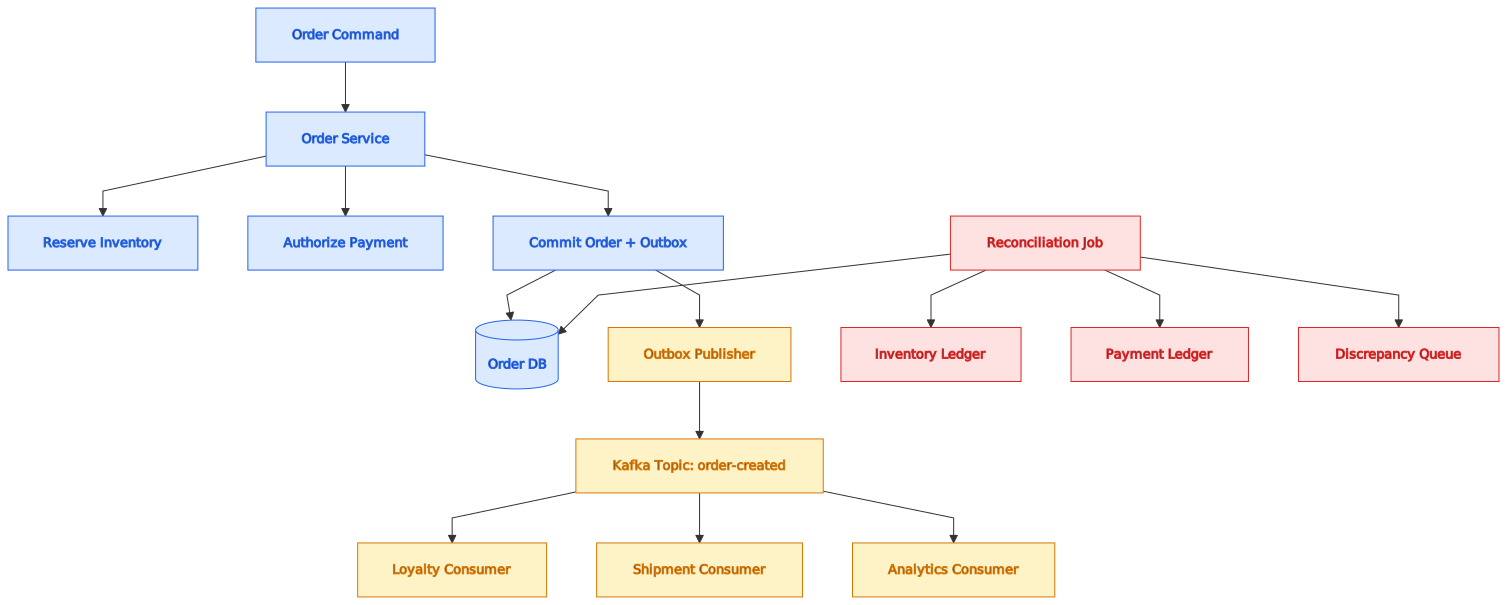
5. Reconciliation and compensating flow
Every deferred action needs a recovery model. If an event is lost, delayed, duplicated, or processed out of order, what restores truth?
That usually means:
- idempotent consumers
- outbox pattern for reliable event publication
- compensating commands
- periodic reconciliation jobs
- business-level discrepancy reports
A budgeted architecture is incomplete without a discrepancy strategy. Otherwise, your low latency is just deferred confusion.
Here is a more complete enterprise flow:
Migration Strategy
This is where theory usually collapses in the enterprise. You do not get to redesign from a blank sheet. You inherit a monolith, a pile of integrations, and a production calendar full of reasons not to be brave.
So migration must be progressive. Strangler fig, not big bang.
Step 1: Measure the monolith as an end-to-end system
Before carving anything out, establish a latency baseline for business operations. Not just average response time. Get p95, p99, queueing delays, dependency timing, and failure-retry behavior. Many monoliths are fast in-process and only become slow after decomposition. That does not mean “never migrate.” It means migrate with eyes open.
Step 2: Identify bounded contexts by domain seams, not by technical layers
Do not extract “customer database service” or “shared validation service” first because they look reusable. Shared technical services often become latency magnets and coupling centers. Instead, extract coherent business capabilities with clear language and ownership: pricing, inventory, payment, shipment.
Step 3: Externalize non-critical side effects first
The safest early move is to remove non-critical work from the synchronous path. Use outbox plus Kafka to emit domain events after commit. Start with analytics, notifications, recommendations, audit enrichments. This reduces user-visible latency without risking core correctness.
Step 4: Introduce deadline propagation and timeout governance
Before you have many microservices, establish deadline-aware calls, standard timeout policies, and retry rules. If you postpone this, every team will invent its own defaults and latency debt will calcify.
Step 5: Extract critical services only when the domain benefit outweighs network cost
Some domains deserve separate services because they have distinct scaling, release, compliance, or ownership needs. Payments often do. Fraud often does. Product catalog often does. But if a split only gives you organizational theater and adds three more hops, leave it in the monolith until there is a real reason.
Step 6: Add reconciliation before you need it
This is one of those unfashionable pieces of architecture that saves careers. As soon as you have asynchronous side effects, create discrepancy detection and replay capability. Enterprises regret not doing this.
Enterprise Example
Consider a large insurance company modernizing claims intake.
The legacy system was a monolithic claims platform handling first notice of loss, policy validation, fraud screening, document registration, customer communication, and regulatory audit. In-process it was ugly but reasonably fast. Average claim submission completed in 1.4 seconds. Leadership wanted more agility, separate team ownership, and better integration with external partners. So they began moving to microservices and Kafka.
The first release was a textbook failure.
Teams extracted policy validation, fraud scoring, customer profile, document registration, and notification services. An API gateway and service mesh were added. Kafka connected downstream processing. Everything looked clean in architecture diagrams. Yet p95 latency for claim submission jumped past 4 seconds, with intermittent spikes above 10 seconds. The business reaction was immediate: agents abandoned digital submission and fell back to manual channels.
What happened? Death by a thousand justified decisions.
- Fraud scoring had a 1-second timeout because the vendor API was unreliable.
- Policy validation retried twice.
- Customer profile was fetched synchronously for enrichment, though not required to accept the claim.
- Notification preferences were checked on the critical path.
- Mesh sidecars and tracing added measurable overhead.
- Kafka publication waited on a durability configuration that was appropriate for audit but unnecessary for the immediate response.
- Thread pools saturated under retry load.
The architecture was not broken because microservices are bad. It was broken because nobody had allocated a latency budget against domain semantics.
The recovery plan was far more disciplined.
The enterprise defined a p95 target of 1800ms for claim submission, with a sub-target of 700ms to return acknowledgment to the agent and defer non-essential work. Then they reclassified the domain flow:
Synchronous critical path
- policy existence and coverage validation
- basic fraud gate
- claim registration
- acknowledgment creation
Asynchronous post-acknowledgment
- document indexing
- customer profile enrichment
- advanced fraud analytics
- notification delivery
- downstream regulatory packaging
They introduced an outbox in the claims service, published domain events via Kafka, and built reconciliation jobs comparing claim ledger, fraud status, and downstream document registration. They also removed retries from the user path and replaced them with deferred retry workflows for non-critical consumers. Timeouts became deadline-aware. Optional enrichments got soft timeouts and fallback defaults.
The result was not glamorous. It was architecture doing its job. p95 claim acknowledgment dropped to 620ms, while the full downstream completion time varied by process but no longer blocked agent interaction. A few asynchronous discrepancies still occurred, but they were visible, recoverable, and operationally acceptable.
That is a good enterprise outcome: faster where the business cares, eventually consistent where it can tolerate it, and honest about the reconciliation burden.
Operational Considerations
Latency budgets die in operations if they are not made visible and enforceable.
Observability must be budget-oriented
Do not just emit spans. Tag traces with operation type, semantic class, and remaining budget. Dashboards should show budget consumption per hop, not merely total duration. You want to know whether fraud consumed 60% of available time, whether gateway policy drift added 15ms last month, and whether Kafka publish latency is now entering the user path because of a code regression.
Capacity planning should focus on queueing and tail behavior
Average CPU utilization is a poor proxy for latency health. Tail latency often comes from queueing under burst load, lock contention, garbage collection pauses, connection pool exhaustion, or noisy neighbors. Measure saturation points and graceful degradation thresholds.
Timeouts, retries, and circuit breakers need common policy
Retries are not free. In latency-sensitive paths, retries often worsen outcomes by increasing load and consuming budget. Use them sparingly and only where the remaining deadline supports them. Better to fail fast with a known fallback than to die slowly and take everyone with you.
Payload discipline matters
A surprising amount of latency comes from serialization overhead, oversized payloads, schema bloat, and unnecessary data fetching. Domain contracts should include temporal constraints. If a service only needs eligibility status, do not send the customer’s life story.
Data locality and cache design matter more than people admit
A cross-region call can blow a tight budget instantly. So can a cache miss storm after invalidation. Caches should be tied to semantic tolerance for staleness. Some read models can be eventually consistent projections. Some cannot.
Kafka operations are part of latency architecture
If Kafka is involved, watch producer acks, consumer lag, partition strategy, rebalancing behavior, and ordering constraints. Teams often say “it’s asynchronous, so latency doesn’t matter.” Wrong. It still matters for workflow completion, freshness, and reconciliation windows. Delayed events are delayed business outcomes.
Tradeoffs
There is no free lunch, only different invoices.
Allocating latency budgets improves focus and clarity, but it also imposes constraints teams may resist. A strict budget can force uncomfortable simplifications. Rich synchronous orchestration may need to be split. Some consistency checks must move out of band. A favorite shared service may need to be bypassed or replicated closer to the domain.
Microservices improve autonomy and deployment velocity but almost always worsen raw call-path latency compared with a monolith. That trade can be worth it for organizational scaling, compliance isolation, or independent evolution. But do not pretend the network is cheap.
Kafka can reduce coupling and smooth spikes, but it adds eventual consistency, ordering concerns, duplicate delivery, and reconciliation overhead. Again: useful, not magical.
Caching is seductive because it wins benchmarks. It also introduces staleness, invalidation complexity, and semantic ambiguity. If the domain cannot tolerate stale data, a cache is not optimization. It is corruption with good PR.
The strongest tradeoff is often this: do you want immediate certainty or timely acknowledgment with later completion? In many enterprise workflows, the right answer is hybrid. Accept quickly, confirm critical invariants, and reconcile the rest.
Failure Modes
Latency-budget architectures fail in recurring ways.
Budget fiction
Teams assign numbers to layers but never enforce them. Budgets become diagram decoration. If there is no deadline propagation, no timeout governance, and no reporting by budget consumption, the allocation is theater. EA governance checklist
Hidden synchronous work
A service looks asynchronous on paper but still blocks on event publication, schema registry checks, or downstream confirmations. This is common in Kafka-based designs with overly strict producer settings or transactional dependencies.
Retry storms
One slow dependency triggers retries across callers, saturating the dependency further and creating a positive feedback loop. Tail latency explodes, then availability collapses.
Shared service bottlenecks
An enterprise “common validation service” or “customer profile service” gets inserted into every critical path. It becomes a central latency tax and a single blast radius.
Reconciliation neglect
The system offloads work asynchronously but never operationalizes discrepancy handling. Weeks later, finance or operations discovers mismatches between ledgers, events, and customer-visible state.
Over-decomposition
Teams split domains into tiny services because bounded contexts were confused with nouns in the data model. The result is excessive chatty communication and budget death by serialization.
Misread domain semantics
Optional enrichments are treated as mandatory, or critical checks are deferred when they should not be. This is the architectural cost of weak domain modeling.
When Not To Use
Latency budget allocation is valuable, but not every system needs this level of rigor.
Do not apply heavy formal budgeting when:
- the system is small and mostly in-process
- user interactions are low volume and latency-insensitive
- batch processing dominates over interactive workflows
- there are few distributed hops
- organizational maturity is too low to maintain the governance overhead
Likewise, do not force asynchronous decomposition into domains that require immediate transactional certainty across steps and cannot tolerate compensation complexity. In such cases, a modular monolith or a coarse-grained service may be a better architecture than a fleet of microservices and Kafka topics.
And do not use latency budgets as a substitute for bad product decisions. If the business process itself requires ten approvals and three external institutions, no amount of timeout tuning will make it feel snappy.
Related Patterns
Several patterns naturally support latency budget allocation:
- Domain-driven design: for identifying bounded contexts and semantic criticality
- Strangler fig migration: for progressive modernization without big-bang replacement
- Outbox pattern: for reliable event publication after state commit
- Saga and compensation: for multi-step workflows with deferred consistency
- CQRS: for separating latency-sensitive reads from command processing
- Bulkhead isolation: for preventing one dependency from consuming all shared resources
- Circuit breaker: for fast failure under dependency distress
- Hedged requests: useful in selective read scenarios, dangerous if overused
- Request deadline propagation: essential for budget-aware call chains
- Materialized views: for low-latency read models when eventual consistency is acceptable
These are not a shopping list. They are instruments. Use only the ones the domain warrants.
Summary
Latency budget allocation is one of those disciplines that sounds operational but is really architectural. It forces the enterprise to answer hard questions: what is truly time-critical, where can we tolerate delay, which consistency guarantees matter now versus later, and what reconciliation are we willing to own?
The useful mental model is simple. Time is a shared resource across the request path. Spend it where the domain gets value. Stop spending it on work that can happen later. Protect the critical path with explicit budgets, deadline-aware calls, and semantic classification of operations. Use Kafka to decouple where decoupling is honest. Add reconciliation before asynchronous drift becomes a business incident. Migrate progressively with the strangler pattern, and never assume a distributed design is faster just because it is newer.
A distributed system without latency budgets is a city without traffic rules. Everyone keeps moving until nobody does.
Good architecture makes time visible. Great architecture makes it governable.
Frequently Asked Questions
What is a service mesh?
A service mesh is an infrastructure layer managing service-to-service communication. It provides mutual TLS, load balancing, circuit breaking, retries, and observability without each service implementing these capabilities. Istio and Linkerd are common implementations.
How do you document microservices architecture for governance?
Use ArchiMate Application Cooperation diagrams for the service landscape, UML Component diagrams for internal structure, UML Sequence diagrams for key flows, and UML Deployment diagrams for Kubernetes topology. All views can coexist in Sparx EA with full traceability.
What is the difference between choreography and orchestration in microservices?
Choreography has services react to events independently — no central coordinator. Orchestration uses a central workflow engine that calls services in sequence. Choreography scales better but is harder to debug; orchestration is easier to reason about but creates a central coupling point.