⏱ 20 min read
Cloud architecture has a bad habit of lying to us.
Not maliciously. More like an old city map pinned to the wall of a train station: useful in broad outline, dangerously wrong in the details. The official diagram says there are six services, two databases, a message broker, and a clean ingress path. Production says otherwise. Production says there are thirteen deployed variants, three side channels no one documented, a data export lambda created during an incident eighteen months ago, and a Kafka topic that now acts like a constitutional monarch—ceremonial in theory, decisive in practice. event-driven architecture patterns
This is the real problem of runtime topology visualization. Not drawing boxes and arrows. Any intern can draw boxes and arrows. The difficult thing is capturing the living structure of a cloud system as it behaves now, under load, under change, under failure, and under the slow drift that every enterprise platform accumulates. A topology map worth paying for is not an illustration. It is an operational instrument.
And like any operational instrument, it has to be grounded in domain meaning, not just technical telemetry. If your map can show that Service A called Service B, but cannot tell you that this call belongs to “credit reservation,” “shipment allocation,” or “identity proofing,” then you have built a traffic camera, not an architecture capability.
This article argues that runtime topology visualization should be treated as a first-class architectural capability in modern cloud estates. We will look at why static architecture diagrams keep failing, what forces shape a runtime topology map, how to design one in a domain-driven way, and how to introduce it through progressive strangler migration rather than a heroic replacement. Along the way we will talk about Kafka, microservices, reconciliation, drift, failure modes, and the awkward truth that sometimes the right answer is not to build this at all. microservices architecture diagrams
Context
Most enterprises now operate a mixed landscape: some legacy systems of record, some cloud-native services, some event-driven workflows, a bit of Kubernetes, a little too much Terraform, and a lot of inherited complexity. The architecture may be nominally “microservices,” but the runtime reality is usually more nuanced. There are APIs, scheduled jobs, stream processors, integration hubs, managed services, caches, object stores, and a long tail of dependencies that appear only when something breaks.
Static diagrams are still useful. They express intent. They show desired decomposition, ownership boundaries, and deployment zones. They are good for conversations. They are terrible for truth.
Runtime topology visualization emerges from that tension. Architects, operators, and platform teams want a map that answers practical questions:
- What is actually talking to what right now?
- Which dependencies are synchronous, asynchronous, or inferred through shared data?
- Where are the bounded contexts crossing awkwardly?
- Which services are central, brittle, or orphaned?
- What changed after the last deployment?
- Which business capability is affected by this incident?
- Where do retries, dead-letter flows, and compensations really happen?
- Which “temporary” integration has become structural?
These questions do not belong only to observability, and they do not belong only to architecture governance. They sit in the seam between runtime operations and design. That seam is where many enterprises lose control. EA governance checklist
A topology map, done well, becomes a bridge between architecture repository, service catalog, distributed tracing, event lineage, and domain model. Done badly, it becomes another dashboard nobody opens after the first quarter.
Problem
The canonical architecture documentation model assumes systems are designed first and operated second. Real cloud systems are closer to gardens than buildings. They grow, adapt, spread, and sometimes mutate in places no one intended.
Three things make runtime visibility especially hard.
First, communication patterns are mixed. A request might begin at an API gateway, fan into two synchronous service calls, emit a Kafka event, trigger a stream processor, update a projection store, and later launch a reconciliation batch when one of the downstream consumers lags. Traditional dependency maps struggle to represent this blend of request-response, pub/sub, batch, and data propagation.
Second, naming is usually awful. Service names reflect team history, not domain clarity. Topics are named after projects. Queues carry overloaded semantics. Databases are shared beyond what anyone admits in architecture review. So the raw runtime graph is noisy. Without domain semantics, it is nearly impossible to distinguish business-significant topology from incidental plumbing.
Third, cloud systems are dynamic. Containers scale in and out. Endpoints shift. Feature flags create parallel paths. Canary deployments split traffic. Infrastructure agents generate chatter that pollutes dependency graphs. Temporary failover routes become permanent. The topology is not a picture; it is a stream.
That is why topology visualization cannot be treated as a simple discovery exercise. Discovery tells you what exists. Architecture requires interpretation.
Forces
Several forces pull this problem in different directions.
Fidelity versus comprehensibility
A truthful runtime graph can be unreadable. Every pod, every sidecar, every topic partition, every ephemeral job—show it all and you have built a star map in a snowstorm. Compress too aggressively and you hide the very risks you hoped to expose.
Good topology maps manage multiple levels of abstraction: infrastructure nodes, deployable services, domain capabilities, bounded contexts, and end-to-end business flows. Architects need all of them, but not all at once.
Technical telemetry versus domain semantics
This is the central design issue. Runtime tooling naturally emits technical facts: spans, metrics, network connections, topic subscriptions, SQL calls. Enterprises need these facts interpreted through the language of the business.
A payment authorization service and a fraud screening service may both be just HTTP endpoints in telemetry. In the domain, they are separate responsibilities with different consistency rules, ownership, and risk profiles. A topology map that does not encode this distinction cannot support meaningful architecture decisions.
Change detection versus historical understanding
Operations teams want to know what changed this morning. Enterprise architects want to understand how the estate has evolved over twelve months. Compliance teams want evidence. Platform teams want drift detection. Engineering leads want blast radius analysis.
So the system needs both near-real-time topology updates and durable historical snapshots. One serves incident response; the other serves governance and migration planning.
Automatic inference versus curated truth
Fully automated discovery is attractive. It also overstates certainty. Runtime observation can detect that Service X consumes Topic Y. It cannot always infer whether that dependency is critical, optional, compensating, deprecated, or domain-incorrect.
Curated metadata matters: ownership, bounded context, lifecycle status, criticality, allowed communication patterns, data classification, and migration state. In other words, your topology engine needs human judgment in the loop.
Enterprise scale versus local usefulness
A global topology graph for a 2,000-service enterprise is interesting for slide decks and nearly useless for day-to-day engineering. Teams need scoped maps for the domains they own. Architecture leadership needs aggregate patterns. The design must support both local decisions and estate-wide governance.
Solution
The solution is to treat runtime topology visualization as a layered architectural capability, not a diagramming tool.
At the core is a topology knowledge model. This model ingests runtime signals, normalizes them into durable architectural entities, enriches them with domain metadata, and presents multiple views tailored to different concerns: operational dependencies, business capability flows, migration state, resilience paths, and data movement.
The key design move is this: separate observation from interpretation.
Observation gathers evidence from tracing systems, service mesh telemetry, Kubernetes APIs, cloud control planes, Kafka metadata, API gateways, CI/CD deployment records, and data lineage tools. Interpretation then reconciles that evidence into meaningful topology elements:
- service
- workload
- API
- event topic
- queue
- datastore
- bounded context
- domain capability
- integration contract
- deployment environment
- ownership team
- lifecycle state
This is where domain-driven design earns its keep. If topology is just technical adjacency, you get a messy graph. If topology is anchored in bounded contexts and domain events, you can tell a coherent story about the system.
For example, “Customer Profile,” “Order Management,” and “Fulfillment” are not just labels. They are semantic partitions that help you reason about why communication exists, whether it is appropriate, and where changes should be absorbed. A runtime topology map should reveal when teams have introduced a direct dependency that cuts across a domain boundary and quietly undermines the model.
A reference shape
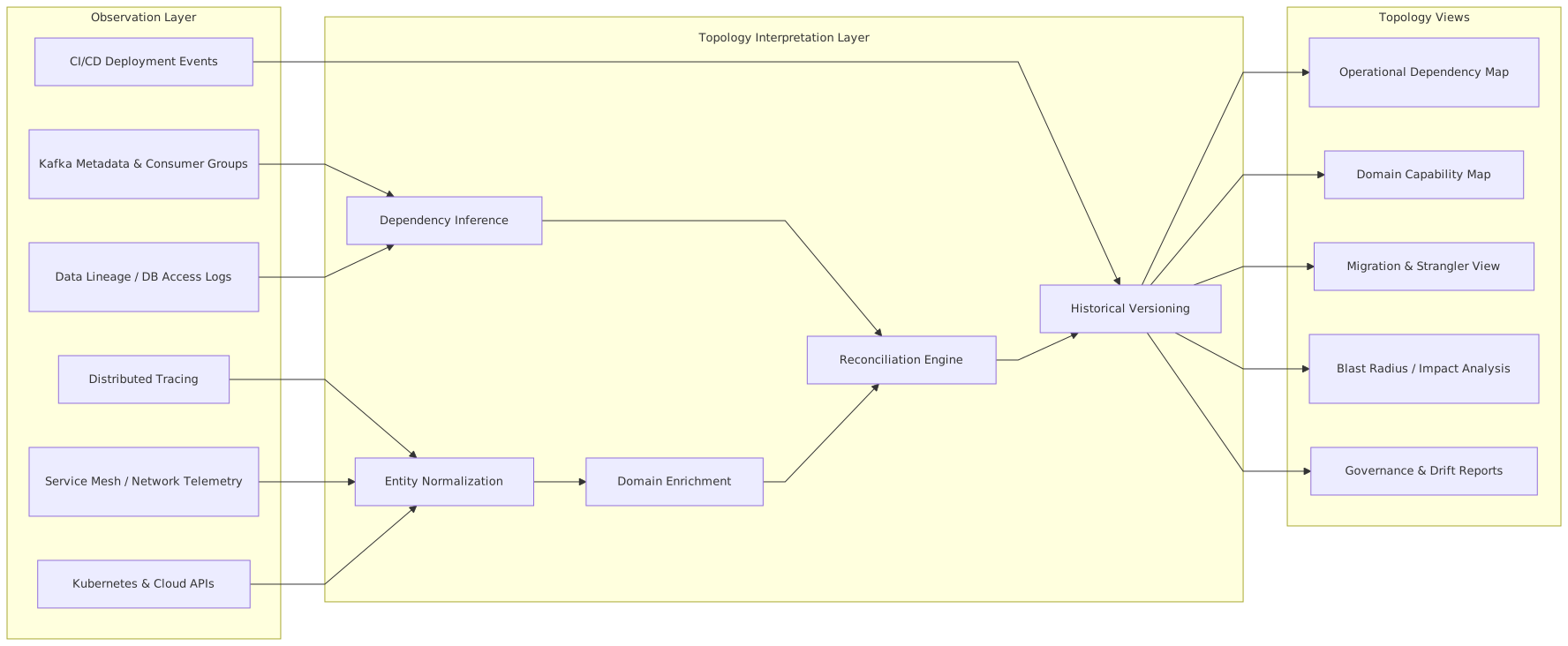
The reconciliation engine is the unsung hero here. Runtime evidence is incomplete, delayed, duplicated, and often contradictory. One source says a service exists; another says it has not received traffic in weeks. One trace implies a dependency; another suggests the path is feature-flagged. Kafka shows a consumer group subscription, but ownership metadata is stale. Reconciliation is how you turn “probably true” into “useful enough to act on.”
Architecture
Let us get concrete.
A runtime topology platform usually contains five major parts.
1. Signal collection
This layer gathers raw facts:
- OpenTelemetry traces and spans
- ingress and egress metrics
- service mesh edges
- Kubernetes resources: deployments, services, pods, namespaces, ingresses
- cloud resources: load balancers, functions, managed databases
- Kafka cluster metadata: topics, partitions, consumer groups, lag, ACLs
- API gateway route definitions
- database access logs or data access lineage
- build and deployment records from pipelines
The trap is to collect everything and drown in cardinality. The architect’s job is to define what counts as an architectural signal. Pod-to-pod chatter might matter for platform diagnostics, but not for domain-level topology. Equally, topic existence without producer and consumer relationships tells you little.
2. Canonical topology model
You need a model stable enough to outlive tools. This is enterprise architecture, not vendor tourism.
Typical entities:
ServiceApplicationWorkloadEndpointEventChannelsuch as Kafka topicDataStoreExternalDependencyTeamBoundedContextBusinessCapabilityContractEnvironmentRuntimeInstance
Typical relationships:
callspublishes_toconsumes_fromreads_fromwrites_toowned_bybelongs_to_contextimplements_capabilitydeployed_inreplaced_bydeprecated_byreconciles_with
Notice those last relationships. They matter during migration and operational recovery. A mature topology map can show not only current dependencies, but transition states and reconciliation loops.
3. Semantic enrichment
This is where raw systems become a map of the business.
Enrichment may come from:
- service catalog metadata
- architecture repository
- code annotations
- ADRs
- domain ownership registry
- platform templates
- manually curated mappings
A service that handles “Order Placement” should belong to a bounded context and a business capability. Its event channels should be associated with domain events, not just transport artifacts. “order-created” means something. “topic-72-prod” does not.
This is also where anti-corruption layers and translation services should be marked explicitly. They are often omitted from diagrams because they look inelegant. In reality, they are the hinges of migration.
4. Reconciliation and confidence scoring
No enterprise source of truth is singular. You need rules to reconcile competing evidence.
Examples:
- If tracing shows repeated calls for 30 days, infer active dependency.
- If deployment metadata says the service is retired but Kafka still shows a consumer group, mark as zombie consumer and reduce confidence.
- If a service writes to a datastore with no declared contract, flag as hidden data dependency.
- If no runtime traffic exists but a route remains configured, mark as dormant edge.
- If two systems produce the same domain event during strangler migration, identify overlap and require reconciliation logic.
Confidence scoring sounds bureaucratic until your map is used during a Sev-1 incident. Then uncertainty becomes a feature, not a weakness. Better to say “likely dependency, medium confidence” than project false precision.
5. Visualization by concern
One topology view is never enough.
You need at least:
- runtime dependency graph
- domain context map
- event flow map
- migration state map
- resilience/failure propagation map
- ownership and change view
Here is a simplified domain-oriented view for an event-driven retail platform:
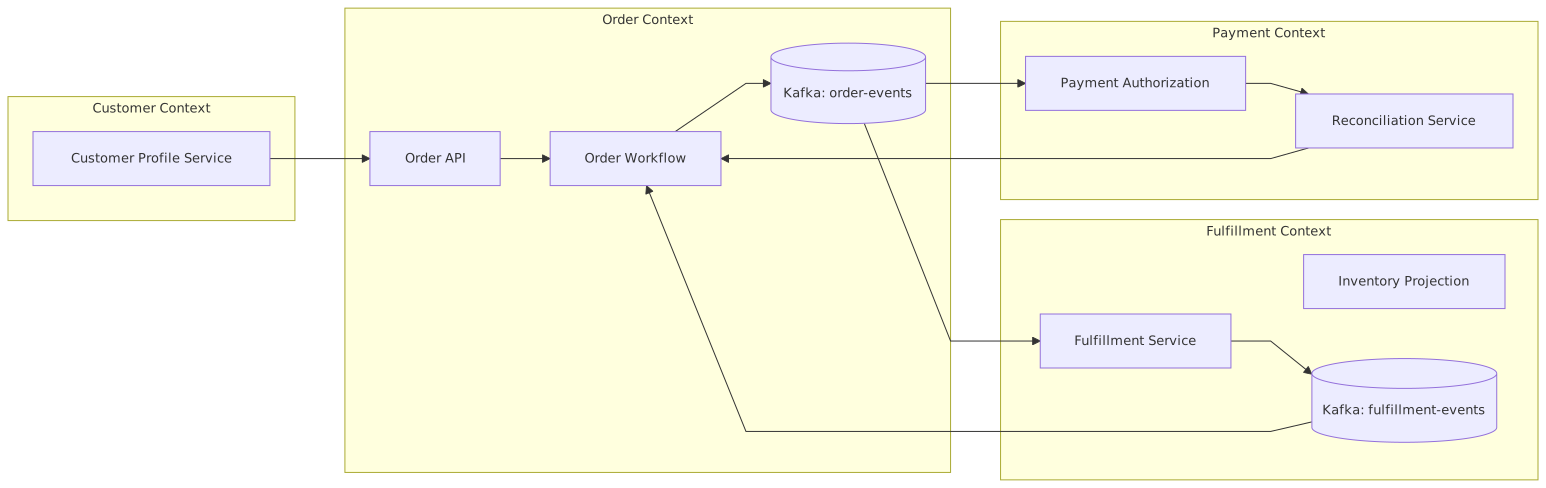
This is already more useful than a network map because it shows domain semantics, asynchronous relationships, and a reconciliation path.
Migration Strategy
Most enterprises do not need a greenfield topology platform. They need a way out of fragmented tooling and stale diagrams. This is where progressive strangler migration is the right pattern.
Do not try to replace all architecture documentation, observability tooling, and CMDB functions in one move. That is a transformation programme with all the usual symptoms: committees, taxonomy debates, and a launch date that slips into folklore.
Start with one painful use case. Usually one of these:
- incident blast radius analysis
- Kafka consumer dependency visibility
- migration tracking between monolith and services
- undocumented cross-domain calls
- production drift from approved architecture
Then layer capability around it.
Phase 1: Observe critical runtime paths
Ingest tracing, gateway, and Kafka metadata for a single bounded context or business journey. Build a map that teams can use during incidents. Keep it close to operations. If no one uses it in anger, it is not architecture; it is decoration.
Phase 2: Add domain semantics
Map services and topics to bounded contexts, ownership, and capabilities. This is where the DDD work happens. The payoff is immediate: suddenly teams can see not just dependencies, but inappropriate dependencies.
Phase 3: Introduce reconciliation and historical snapshots
Now the map can explain change over time. This is crucial in a strangler migration. During coexistence, legacy and new services often both participate in the same end-to-end flow. Without history and reconciliation, the map becomes ambiguous.
Phase 4: Strangle legacy architecture repositories
Not by deleting them. By making them optional.
When runtime-enriched topology becomes the place teams go for truth, old repositories naturally become reference archives rather than operational dependencies. That is the healthiest form of strangling: replacement by relevance.
A migration view often looks like this:

That dotted line is where many programmes quietly bleed money. During strangler migration, you often need both event export from legacy and state reconciliation back into the new service model. Topology visualization should make these awkward transition paths explicit. If the map hides coexistence, leadership will underestimate both cost and risk.
Enterprise Example
Consider a global retailer modernizing its order platform.
The original estate had a large order management suite running in two regional data centers, feeding downstream warehouse, payment, and customer communication systems. The modernization target was a cloud-native, event-driven architecture on Kubernetes with Kafka as the backbone for domain events. cloud architecture guide
On paper, the target architecture was elegant:
- order API
- pricing service
- payment service
- fulfillment orchestration
- customer notification service
- inventory projection
- domain events joining the whole thing together
In production, the reality was far messier.
The legacy suite still performed parts of returns processing.
A nightly batch synchronized customer-visible order states.
Two regions had different routing rules.
One warehouse system consumed Kafka through an integration adapter nobody had documented.
Payment reconciliation used a side database because the event stream was occasionally incomplete during regional failover.
A “temporary” dual-write had lasted nine months.
The topology platform began with one narrow aim: show runtime dependencies for the “order to ship” journey. Traces revealed synchronous bottlenecks. Kafka metadata exposed consumers not registered in the service catalog. Deployment data showed a supposedly retired service still handling 7% of traffic. Database access logs uncovered a direct write from a notification service into an order table—a textbook bounded context violation.
Once domain semantics were overlaid, the team could reason properly:
- Order Management owned order lifecycle state.
- Fulfillment owned pick/pack/ship commitments.
- Payment owned authorization and settlement.
- Customer Communication consumed events but should not influence core workflow state.
This sounds obvious. It was not obvious from the runtime graph alone.
The platform then added reconciliation visibility. That changed the migration conversation entirely. Leaders had assumed the new order service would become the source of truth quickly. The topology map showed otherwise: the real architecture still depended on legacy state for exception handling, returns, and financial adjustments. Reconciliation flows were not temporary edge cases; they were structural elements of the coexistence period.
That insight prevented a common enterprise mistake: declaring migration complete when traffic has moved, while operational truth still depends on the old core.
A good topology map does not flatter a programme. It embarrasses it into honesty.
Operational Considerations
Runtime topology visualization sits close to production, so operational design matters.
Sampling and cardinality
Tracing every request at enterprise scale is expensive and often unnecessary. For topology purposes, statistical sufficiency beats exhaustive collection. Use adaptive sampling and preserve high-value traces for rare paths, cross-context calls, and error cases.
Data retention
Keep raw telemetry separately from derived topology snapshots. Raw traces are forensic evidence. Topology snapshots are architectural memory. The latter should be retained longer and versioned at meaningful intervals.
Security and access control
A complete runtime topology map is sensitive. It reveals internal structure, data stores, privileged dependencies, and often external partner links. Role-based views are not optional. Architects, operators, auditors, and product teams should see different cuts.
Metadata stewardship
Someone must own the domain mappings. Otherwise the platform decays into an impressive graph of technical debt. In practice, the best model is federated stewardship: platform owns the engine, domain teams own semantic metadata, enterprise architecture defines standards and review rules.
Drift and alerting
The system should detect:
- undeclared dependencies
- new cross-bounded-context calls
- dormant components reappearing
- zombie consumers on Kafka topics
- data stores accessed outside contract
- increasing centrality of “temporary” adapters
This is where topology becomes governance with teeth.
Tradeoffs
There is no free lunch here.
The biggest tradeoff is effort versus insight. A topology capability with true domain semantics requires metadata discipline, service ownership clarity, and enough instrumentation maturity to observe real behavior. Enterprises weak in those basics may find the initiative exposes organizational debt faster than they can fix it.
Another tradeoff is precision versus actionability. If you wait for perfect data quality, you will never launch. If you publish low-confidence maps without clear uncertainty signals, teams will mistrust the whole system. Better to present confidence explicitly and improve iteratively.
There is also a centralization tradeoff. A single enterprise topology platform enables consistency and broad analysis. It can also become a bureaucratic bottleneck. The answer is usually a central model with decentralized publishing and ownership.
And then there is the cultural tradeoff. Topology transparency exposes hidden integrations, accidental architectures, and domain boundary violations. Some teams welcome that. Others experience it as surveillance. The framing matters: the goal is better decisions, not architectural policing for sport.
Failure Modes
The failure modes are predictable, which is good news. Predictable failure is manageable failure.
The pretty-picture trap
The team builds gorgeous diagrams but no operational workflow depends on them. Result: shelfware.
Telemetry absolutism
Everything observed is treated as architecturally meaningful. Noise overwhelms signal. Sidecars and probes become first-class citizens in maps that should have emphasized domain flows.
Metadata fantasy
The service catalog says every service has an owner and bounded context. Reality says half the records are stale. The topology engine trusts metadata blindly and becomes elegantly wrong.
No reconciliation model
During strangler migration or event-driven coexistence, the platform ignores duplicate producers, compensating flows, and state repair jobs. The map looks cleaner than production and is therefore dangerous.
Tool capture
An observability vendor’s data model becomes the architecture model. This works until the first major tooling change. Enterprise architecture should own the canonical topology concepts.
Enterprise-wide boil the ocean
The programme tries to map the entire estate before delivering value. It dies under taxonomy arguments and integration backlog.
When Not To Use
Here is the contrarian bit: not every architecture needs runtime topology visualization as a dedicated platform.
Do not build this if:
- your system landscape is small and stable
- a handful of services can be understood through ordinary tracing and a maintained service catalog
- your primary issue is poor domain decomposition rather than runtime visibility
- you lack basic instrumentation, ownership, or metadata discipline
- the estate changes so slowly that manual architecture curation is still cheaper
Also, do not mistake this pattern for a cure for monolith shame. If you have a well-structured modular monolith with clear boundaries and low operational complexity, a runtime topology platform may be needless theater. A good codebase and a few targeted diagrams are enough.
Likewise, heavily regulated environments with strict segregation may choose to limit runtime topology aggregation because the visibility itself becomes sensitive. In such cases, scoped or domain-local topology views are often safer than a central graph.
Related Patterns
Several adjacent patterns are worth calling out.
Service catalog
Provides ownership and lifecycle metadata. Useful, but static unless tied to runtime evidence.
Distributed tracing
Excellent for request paths, weak for long-lived architectural understanding unless normalized into durable topology.
Event storming
Helps discover domain events and bounded contexts. Very useful for defining semantic overlays on Kafka topics and async flows.
Context mapping
Essential from DDD. Runtime topology should reflect partnership, customer-supplier, conformist, and anti-corruption relationships, not just generic edges.
Strangler fig pattern
The right migration approach for introducing topology capability and for visualizing modernization itself.
Architecture decision records
Good source for intent. Better still when linked to actual topology changes and drift reports.
Data lineage
Complements service topology by revealing information movement and hidden coupling through data stores.
Summary
Runtime topology visualization matters because cloud systems are alive, and living systems refuse to stay inside static diagrams.
The winning approach is not to create a better picture. It is to build a layered capability that observes runtime behavior, interprets it through a canonical model, enriches it with domain semantics, reconciles conflicting evidence, and presents multiple views for operations, architecture, and migration.
The heart of the matter is domain-driven design. Without bounded contexts, business capabilities, and explicit semantic ownership, runtime topology is just traffic data. With them, it becomes a way to see architectural truth: where dependencies are healthy, where they are accidental, where migration is genuinely progressing, and where reconciliation has quietly become part of the design.
Kafka and microservices make this more urgent, not less. Event-driven systems hide coupling behind asynchronous elegance. Reconciliation jobs, dual writes, compensations, and zombie consumers are all topology, whether the official slide deck admits it or not.
If you adopt this capability, do it progressively. Start with a painful journey. Add semantics. Add reconciliation. Version the topology. Let the platform earn trust in incidents and migration decisions. Strangle old repositories by making them less useful than reality.
And remember the one line that matters most: an architecture map is only valuable when it tells the truth on a bad day.
Frequently Asked Questions
What is cloud architecture?
Cloud architecture describes how technology components — compute, storage, networking, security, and services — are structured and connected to deliver a system in a cloud environment. It covers decisions on scalability, resilience, cost, and operational model.
What is the difference between availability and resilience?
Availability is the percentage of time a system is operational. Resilience is the ability to recover from failures — absorbing disruption and returning to normal. A system can be highly available through redundancy but still lack resilience if it cannot handle unexpected failure modes gracefully.
How do you model cloud architecture in ArchiMate?
Cloud services (EC2, S3, Lambda, etc.) are Technology Services or Nodes in the Technology layer. Application Components are assigned to these nodes. Multi-region or multi-cloud dependencies appear as Serving and Flow relationships. Data residency constraints go in the Motivation layer.