⏱ 21 min read
Distributed systems always begin with a lie.
The lie is that one service can simply “call” another service, as if the network were a neat hallway between two polite office doors. In reality, services appear, disappear, scale sideways, restart under pressure, move across nodes, fail health checks, and get replaced while traffic is still in flight. The network is not a hallway. It is a city in bad weather.
That is why service discovery matters. Not as plumbing. Not as a Kubernetes footnote. But as one of the central mechanisms by which a platform decides what is alive, what is reachable, what is trusted, and what is safe to route to.
Most teams entering Kubernetes inherit one of three instincts.
First, the application team says, “Just use DNS.” That is often right, and often incomplete.
Second, the platform team says, “Let’s keep a registry.” That preserves explicit control, which enterprises love, but it may duplicate capabilities Kubernetes already gives away for free.
Third, someone proposes a service mesh. That can be a serious operational asset, or an expensive way to turn simple call paths into theology.
This article compares those three patterns—service registry, DNS-based discovery, and mesh-based discovery—through the lens of enterprise architecture. Not just what they are, but when they fit, how they fail, how they evolve, and what they mean for bounded contexts, migration paths, and operational reality. Because discovery is never merely technical. It encodes the shape of ownership in your system.
And in a large estate, ownership is the real architecture.
Context
Kubernetes changed the default answer to service discovery.
Before Kubernetes, many organizations built explicit service registries using tools like Eureka, Consul, ZooKeeper, or custom internal platforms. Services registered themselves on startup; clients queried a registry or consumed a sidecar library to locate healthy instances. This pattern emerged for good reasons: hosts were ephemeral, IPs were unstable, and load balancers were too coarse-grained for microservices at scale. microservices architecture diagrams
Then Kubernetes arrived and normalized a different mental model. A Service object became the stable identity. Pods could churn freely behind it. Cluster DNS resolved service names. Endpoints were reconciled continuously from labels, selectors, readiness, and pod lifecycle. Discovery moved from application code into the orchestration substrate.
That was a profound shift. Many teams missed how profound.
What changed was not just mechanics. The unit of discovery changed from “an instance registered itself” to “the platform declares a service identity and reconciles backing endpoints.” That is a different philosophy. One is more imperative. The other is more declarative.
Then service meshes entered the picture. Istio, Linkerd, Consul Connect, Kuma, and others extended discovery into traffic policy: retries, mTLS, canary routing, locality-aware balancing, failover, observability, and identity-aware communication. Discovery became one concern among many in a larger runtime fabric.
So now we have three broad patterns in play:
- Registry-based discovery: clients or sidecars consult a registry of available service instances.
- DNS-based discovery: clients resolve stable service names through Kubernetes DNS and communicate through virtual IPs or endpoint-aware routing.
- Mesh-based discovery: the platform’s data plane and control plane maintain service identity and instance awareness, with traffic behavior enforced by proxies.
Each pattern solves a real problem. Each also introduces a bias into the system.
Architects should care because these biases affect coupling, latency, migration options, team autonomy, and failure blast radius.
Problem
In Kubernetes, one service needs to find another. That sounds trivial until the requirements show up:
- instances are ephemeral
- health status changes quickly
- deployments happen continuously
- traffic must respect readiness and draining
- some paths need retries and failover
- cross-cluster communication may be required
- identity and trust matter
- some integrations are request-response, others event-driven over Kafka
- compliance may require auditable routing behavior
- legacy systems may still expect static endpoints or registry APIs
The problem is not “how do I resolve an IP address?” The problem is “how do I preserve domain behavior while the runtime underneath it constantly changes?”
That distinction matters.
If your Order service needs the Pricing service, what it really needs is not “some endpoint.” It needs the right capability in the right bounded context, with the right version, policy, and reliability guarantees. Service discovery is where technical addressing meets domain semantics. Good architecture keeps those separate enough to evolve, but connected enough to remain useful.
Too many teams blur the line. They let infrastructure names become domain concepts, or they force domain concepts into infrastructure labels. That always looks practical in quarter one and expensive by year three.
A service called customer-service-v2-blue is not a domain concept. It is deployment trivia leaking into the business vocabulary. Kubernetes lets this happen easily. Good architects do not.
Forces
Service discovery sits under several competing forces, and there is no free lunch here.
1. Simplicity versus control
DNS-based discovery is beautifully simple. You create a Kubernetes Service, and clients call http://payments.default.svc.cluster.local. Most teams can understand it. Most libraries can use it. Most production incidents are easier to reason about when there is less machinery.
But simplicity gives up some fine-grained control. If you need client-aware routing, custom subsets, advanced failover, weighted canaries, or per-route policy, DNS alone starts to feel blunt.
2. Platform-native versus application-managed
A registry usually pushes discovery logic closer to applications. Services may self-register, clients may cache endpoints, and libraries may implement balancing policies. This can be useful in heterogeneous environments, especially during migration. It is also a fantastic way to smuggle platform concerns into business services.
Kubernetes-native discovery moves responsibility to the control plane. That is generally healthier. The application asks for a name; the platform reconciles reality.
3. Explicitness versus hidden complexity
Registries feel explicit. There is a catalog. There are entries. You can query them directly. Operations teams often find that comforting.
Meshes feel magical until they don’t. They can centralize policy and observability, but they also insert sidecars, xDS updates, certificate rotation, CRDs, traffic rules, and a control plane into every request path. Meshes are not free abstraction. They are operational debt with benefits.
4. Local optimization versus enterprise consistency
A single product team can happily use plain DNS and ship quickly. An enterprise with hundreds of services, multiple clusters, regulatory zones, and platform standards may need stronger policy consistency, trust boundaries, and telemetry. Discovery then becomes part of governance. EA governance checklist
5. Synchronous calls versus event-driven interactions
Not every dependency should be discovered and invoked synchronously. Kafka changes the equation. If the business interaction is naturally asynchronous—say Order emits OrderPlaced and Fulfillment reacts—service discovery may be irrelevant for that integration path. Architects make mistakes when they over-engineer discovery for problems that should have been events.
A good rule: if you are solving discovery for a conversation that ought to have been a publication, you are paying interest on the wrong design.
Solution
The practical comparison looks like this:
Pattern 1: Registry-based discovery
A central registry stores service instances and metadata. Services register or are registered. Clients query the registry directly or via a local library/sidecar. Load balancing often happens client-side.
This pattern predates Kubernetes and still appears in hybrid estates.
Use it when:
- you have significant non-Kubernetes workloads
- you need a unified catalog across VMs, bare metal, and clusters
- existing services already depend on a registry API
- migration constraints make Kubernetes DNS insufficient in the short term
Avoid it when:
- all workloads are already native Kubernetes
- you are duplicating the cluster’s service model without clear value
- you want thin applications and thick platform capabilities
Pattern 2: DNS-based discovery in Kubernetes
Clients resolve service names via CoreDNS. Kubernetes Services represent stable virtual identities. EndpointSlices and kube-proxy or eBPF-based data planes route traffic to healthy pods.
This is the default and, frankly, should remain the default for most teams.
Use it when:
- services live mainly within a cluster
- simple north-south and east-west communication is enough
- your traffic policies are straightforward
- you want platform-native discovery with minimal application coupling
Avoid it when:
- you need sophisticated routing and policy beyond what the ingress and service layers provide
- you require cross-cluster service identity and failover as a first-class platform concern
- application teams are embedding discovery semantics that DNS cannot express safely
Pattern 3: Mesh-based discovery
A mesh builds on Kubernetes service identities but adds a control plane and proxy data plane. Discovery is no longer just “resolve a name”; it becomes “resolve an identity plus policy plus traffic behavior.”
Use it when:
- you need mTLS everywhere
- you need controlled canaries, traffic splitting, fault injection, circuit-breaking, and richer telemetry
- you operate at large scale with many teams and need consistent east-west controls
- multi-cluster service networking matters
Avoid it when:
- your estate is small and your traffic patterns are simple
- your team cannot support the operational complexity
- latency overhead or resource cost is unacceptable
- you are trying to compensate for poor service boundaries with network tricks
The mature answer in many enterprises is not choosing one forever. It is using them progressively, in layers, and retiring older patterns deliberately.
Architecture
The architecture depends on who owns truth.
With a registry, truth about instance availability often lives in the registry and the registration lifecycle. With Kubernetes DNS, truth lives in the Kubernetes control plane and its reconciliation loop. With a mesh, truth lives in both Kubernetes and the mesh control plane, which derive and distribute routing intent to proxies.
That last point is worth pausing on. Reconciliation is the quiet engine of cloud-native systems. Kubernetes continuously compares desired state with observed state and updates resources accordingly. Discovery in Kubernetes is therefore not an event of registration; it is a process of reconciliation. Pods become ready, EndpointSlices update, DNS names remain stable, traffic drains.
This makes Kubernetes discovery more robust than many homegrown registries because the system assumes drift and corrects it. A self-registration model often assumes the happy path: startup, register, heartbeat, deregister. Reality is ruder than that. Nodes die. Processes hang. Shutdown hooks do not fire. Partitions happen. Reconciliation is what turns orchestration from ceremony into resilience.
Registry-based architecture
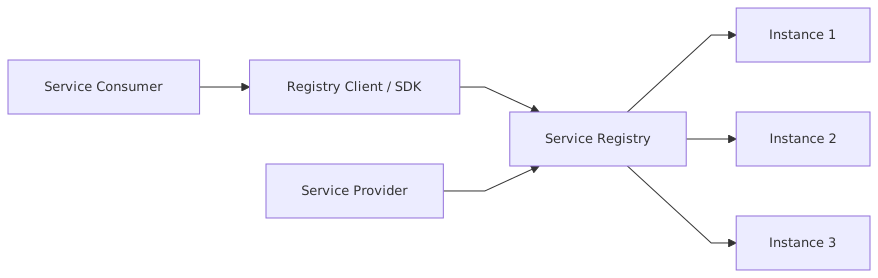
In this model:
- providers self-register or are registered externally
- consumers query registry entries
- balancing may happen in the client
- metadata can include zone, version, tags, or health
This architecture is explicit but creates coupling:
- consumer libraries know registry semantics
- service startup is tied to registration behavior
- stale entries become a real risk
- local caches may diverge from truth
DNS-based Kubernetes architecture
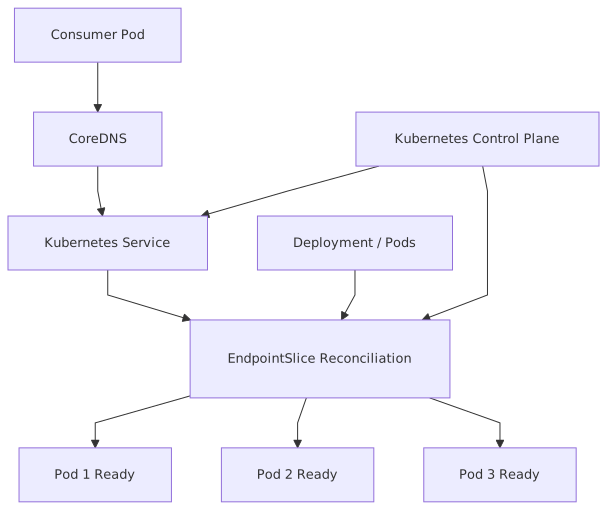
In this model:
- the service name is stable
- the platform maintains endpoint membership
- readiness gates traffic eligibility
- consumers remain largely ignorant of instance lifecycle
This is the cleanest split of concerns. Applications express intent using service names. The platform owns endpoint churn.
Mesh-based architecture
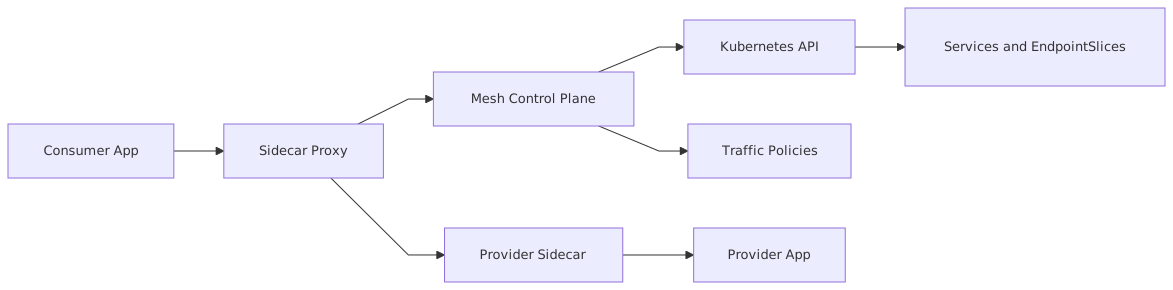
In this model:
- application code often remains unchanged
- sidecars or ambient dataplanes mediate calls
- discovery is enriched with policy
- retries, mTLS, routing, and observability are externalized
That is powerful. It is also another distributed system layered on top of the first one.
Domain semantics
This is where many articles go soft. They talk only about packets and names. Enterprises do not run on packets. They run on capabilities.
In domain-driven design terms, service discovery should point to bounded contexts and published capabilities, not implementation accidents. The Consumer should depend on Pricing, not on pricing-v2-us-east-blue. Versioning, canary slices, and locality belong in platform metadata and routing policy, not in the ubiquitous language of the business.
A good litmus test:
- If a business analyst overhears your service names, do they sound like business capabilities?
- If not, discovery is probably leaking deployment detail into the domain.
Discovery should preserve semantic stability while infrastructure changes. That is its real job.
Migration Strategy
Most large organizations do not get to start clean. They inherit registries, static hostnames, hand-built failover, shared middleware, and a landscape of half-finished modernization.
So the right migration is usually a progressive strangler, not a flag day.
Stage 1: Encapsulate the old registry
Keep the registry, but stop letting every new application bind to it directly. Introduce a thin platform abstraction or adapter layer. Existing services can continue to use registry semantics while new services target Kubernetes-native service identities where possible.
This matters because migrations fail when the old pattern remains the easiest pattern.
Stage 2: Move service identity into Kubernetes
Define Kubernetes Service resources as the authoritative stable names for containerized workloads. Let EndpointSlice reconciliation determine instance membership. Begin removing application-level self-registration for workloads fully managed by Kubernetes.
At this point, the registry may still mirror data for legacy consumers. That is acceptable. Temporary duplication is often the price of safe migration.
Stage 3: Bridge legacy and Kubernetes discovery
Use adapters:
- registry entries that point to Kubernetes Services
- ExternalName services where appropriate
- API gateways for selected legacy dependencies
- service catalog sync for hybrid environments
This bridge should be treated as scaffolding, not architecture.
Stage 4: Add mesh selectively
Do not roll out a mesh because the conference talk was impressive. Introduce it where policy consistency, mTLS, traffic shaping, or cross-cluster routing justify the cost. Common first candidates:
- regulated payment domains
- zero-trust internal networks
- high-change customer-facing paths requiring canary control
- multi-cluster active-active environments
Stage 5: Retire the registry for in-cluster workloads
Once Kubernetes and mesh patterns cover the necessary ground, remove direct registry dependencies from in-cluster applications. Keep a unified catalog only if hybrid reality still demands it.
A good migration leaves less behind than it creates.
Enterprise Example
Consider a global retailer modernizing its commerce platform.
The estate includes:
- legacy Java services on VMs using Eureka
- new Kubernetes-based microservices for cart, catalog, pricing, and promotions
- Kafka for order and inventory events
- strict PCI requirements for payment flows
- multiple regions with active-passive failover
At first, the retailer tried to preserve Eureka everywhere. New Kubernetes services self-registered on startup. Consumers used client-side load balancing. It worked, after a fashion. Then the cracks appeared.
Pods restarted often under autoscaling. Some instances failed before deregistering. Registry caches in clients held stale entries. Readiness in Kubernetes and health in Eureka diverged. During deployments, traffic occasionally hit terminating pods. Platform engineers now had two truths: Kubernetes thought one thing; the registry thought another. Incidents became arguments about which truth mattered.
That is always a bad smell.
So the architecture changed.
The retailer made Kubernetes Service objects the source of truth for all in-cluster service identities. Cart called Pricing via DNS. Catalog called Promotions the same way. Endpoint reconciliation aligned traffic with readiness. Deployment behavior became more predictable. Most teams needed nothing more.
For payments, however, they adopted a mesh. Why? Not because “mesh is modern,” but because the payment bounded context had stronger needs:
- mandatory mTLS
- fine-grained traffic control for risk-scoring model releases
- auditable policies
- richer telemetry for compliance and SRE review
Meanwhile, Kafka handled asynchronous domain interactions:
OrderPlacedInventoryReservedPaymentAuthorizedShipmentRequested
This was crucial. They deliberately reduced synchronous discovery dependencies where business flow allowed eventual consistency. The Order context did not need to discover the Shipment service synchronously just to continue the business process. That would have turned a domain event into a blocking network call for no good reason.
The final shape looked like this:
- DNS-based discovery for most east-west traffic
- selective mesh for high-control contexts
- Kafka for asynchronous integration across bounded contexts
- registry adapters only for VM-based legacy services during transition
That is what mature architecture looks like. Not ideological purity. Deliberate asymmetry.
Operational Considerations
Service discovery is easy to draw and hard to run.
Observability
With DNS-based discovery, troubleshooting often means looking at:
- service definitions
- EndpointSlices
- readiness probes
- DNS resolution behavior
- kube-proxy or CNI routing
With a registry, you also inspect:
- registration health
- heartbeat expiry
- client cache TTLs
- stale metadata
- split-brain risks
With a mesh, add:
- sidecar health
- control plane convergence
- certificate validity
- route config propagation
- policy conflicts
Every layer adds observability needs. Teams often adopt a mesh before they can even debug Kubernetes Services. That is like buying a jet before learning to drive.
Performance
DNS-based service discovery usually has the lowest conceptual overhead. Registry clients may introduce local balancing logic and metadata processing. Meshes add network hops through proxies, CPU and memory overhead, and configuration distribution costs.
This overhead is often acceptable, but never imaginary.
Security
Kubernetes DNS alone does not equal zero trust. It gives naming, not strong workload identity. You still need network policies, TLS strategy, secret handling, and authorization patterns. Meshes help here by making mTLS and identity propagation more systematic.
But security teams should be wary of magical thinking. A mesh does not fix weak domain boundaries or over-privileged services.
Multi-cluster and disaster recovery
DNS inside one cluster is easy. Across clusters, things get interesting. You may need:
- federated discovery
- global traffic management
- mirrored services
- locality-aware failover
- consistent naming across regions
Meshes often earn their keep here, though they also raise the complexity ceiling.
Governance and platform product thinking
In enterprises, service discovery is part of the platform product. Naming conventions, service ownership metadata, policy defaults, golden paths, and standard telemetry all matter. This is not merely infrastructure. It is the contract between teams and the runtime.
Tradeoffs
Here is the blunt version.
Registry
Pros
- works across heterogeneous estates
- explicit metadata model
- can bridge legacy and modern workloads
- useful during migration
Cons
- duplicates Kubernetes capabilities
- encourages application coupling to discovery mechanics
- stale registration is a constant risk
- often creates dual sources of truth
DNS in Kubernetes
Pros
- native, simple, well-understood
- aligns with reconciliation and readiness
- minimal application complexity
- usually enough for most service-to-service calls
Cons
- limited expressiveness for advanced routing
- weak by itself for richer policy and identity
- cross-cluster scenarios require extra design
- some teams misuse it for concerns that belong elsewhere
Mesh
Pros
- central policy enforcement
- mTLS, traffic shaping, retries, telemetry
- strong support for advanced runtime controls
- helpful for large-scale multi-team governance
Cons
- serious operational complexity
- added latency and resource overhead
- harder debugging
- easy to overuse as a substitute for better service design
A useful enterprise principle: choose the lightest discovery mechanism that preserves your domain and operational needs. Most of the time, that means DNS. Sometimes, it means DNS plus a mesh. Occasionally, during migration, it means a registry adapter on the side.
Failure Modes
This is where architecture earns its salary.
Registry failure modes
- Stale entries: instances die without deregistering.
- Heartbeat storms: scale events or network instability overload the registry.
- Client divergence: caches hold different views of available instances.
- Split brain: clustered registries disagree.
- Bootstrap dependency: services cannot start cleanly because the registry itself is unavailable.
The ugly irony of registries is that your mechanism for finding services can become the most fragile service of all.
DNS-based failure modes
- DNS caching surprises: client resolvers ignore intended TTL behavior.
- Readiness misconfiguration: pods are marked available too early or too late.
- Service abstraction misuse: headless vs ClusterIP confusion, or direct pod addressing leaks into clients.
- Control-plane lag: endpoint updates propagate slower than expected during churn.
- Cross-cluster ambiguity: names are stable only inside a specific scope unless you design more.
Mesh failure modes
- Config convergence lag: proxies receive policy updates at different times.
- Sidecar injection drift: some workloads run with proxies, others without.
- mTLS misalignment: policy and certificate states disagree.
- Retry storms: aggressive policies amplify outages instead of containing them.
- Opaque debugging: application team sees a 503 but the root cause is three layers away in proxy config.
- Control plane outage: existing traffic may continue, but change safety degrades rapidly.
One of the nastiest failure patterns in meshes is accidental resilience theater: retries, timeouts, and failover rules combine to make a struggling dependency look healthy just long enough to spread pain everywhere else.
When Not To Use
Do not use a registry in Kubernetes just because you used one before
History is not architecture. If Kubernetes already provides the discovery behavior you need, adding a registry is usually institutional nostalgia in a YAML costume.
Do not use a mesh for ordinary service-to-service calls in a small estate
If you have twenty services, one cluster, competent teams, and modest compliance demands, a mesh may be a tax you never recover.
Do not use synchronous discovery where events are better
If domain interactions are naturally asynchronous, Kafka and domain events can remove entire classes of discovery, routing, and timeout problems. That is not avoiding architecture. That is doing better architecture. event-driven architecture patterns
Do not let discovery express business workflow
Discovery should identify technical endpoints for domain capabilities, not encode process orchestration. “Call these five services in this sequence” is not a discovery concern. It is workflow, saga, or process management.
Do not expose infrastructure semantics as part of the ubiquitous language
The business does not care about sidecars, ClusterIPs, or registry leases. Keep those concerns in the platform where they belong.
Related Patterns
Service discovery does not stand alone. It lives beside several neighboring patterns:
- API Gateway: for north-south routing, security, and client-specific composition
- Backend for Frontend: when consumers need tailored API views
- Sidecar pattern: the execution model behind many meshes
- Strangler Fig migration: progressive replacement of legacy discovery and routing
- Saga / process manager: when orchestration spans bounded contexts
- Event-driven architecture with Kafka: reducing synchronous coupling
- Health check and readiness patterns: governing endpoint eligibility
- Circuit breaker and timeout policies: often mesh-implemented, but conceptually separate
- Service catalog / internal developer platform: providing discoverability to humans, not just machines
A subtle but important distinction: machine discovery and human discoverability are different things. Kubernetes DNS helps software find a service. A service catalog helps people understand whether they should call it at all.
Enterprises need both.
Summary
Service discovery in Kubernetes is not one pattern but a spectrum of responsibility.
A registry puts discovery logic in explicit catalogs and often in applications. It is useful in hybrid estates and during migration, but it tends to duplicate platform behavior and invite drift.
DNS-based discovery is the Kubernetes default for good reason. It aligns with reconciliation, keeps applications simpler, and is enough for most service-to-service communication. If you are in doubt, start here.
A service mesh extends discovery into policy, identity, routing, and telemetry. It solves real enterprise problems, especially in regulated, large-scale, or multi-cluster environments. It also introduces very real complexity. Use it where the control is worth the cost.
The most important architectural move is not picking the most fashionable pattern. It is preserving clean domain semantics while the runtime evolves underneath. Service names should represent capabilities, not deployment gossip. Synchronous discovery should not be forced onto asynchronous business interactions. Migration should be progressive, with reconciliation and strangler patterns doing the hard work quietly.
In short:
- prefer Kubernetes DNS by default
- keep registries as transitional or hybrid tools, not reflexes
- add a mesh selectively for policy-heavy contexts
- use Kafka and events where synchronous discovery is the wrong question
- let the platform own liveness and routing mechanics
- let the domain own meaning
Because in the end, service discovery is not about finding machines.
It is about finding the right responsibility, at the right time, without making the rest of the system pay for the journey.
Frequently Asked Questions
What is a service mesh?
A service mesh is an infrastructure layer managing service-to-service communication. It provides mutual TLS, load balancing, circuit breaking, retries, and observability without each service implementing these capabilities. Istio and Linkerd are common implementations.
How do you document microservices architecture for governance?
Use ArchiMate Application Cooperation diagrams for the service landscape, UML Component diagrams for internal structure, UML Sequence diagrams for key flows, and UML Deployment diagrams for Kubernetes topology. All views can coexist in Sparx EA with full traceability.
What is the difference between choreography and orchestration in microservices?
Choreography has services react to events independently — no central coordinator. Orchestration uses a central workflow engine that calls services in sequence. Choreography scales better but is harder to debug; orchestration is easier to reason about but creates a central coupling point.