⏱ 19 min read
Traffic is rarely polite.
It does not arrive in neat, forecastable lines. It surges. It stampedes. It piles into your front door because a marketing campaign worked, a payment deadline hit, a celebrity mentioned your product, or a regulator forced every customer to log in before midnight. Most systems are not destroyed by average load. They are broken by moments of success, panic, or obligation.
That is the heart of burst traffic architecture. Not “how do I scale forever?” but “how do I survive the ugly fifteen minutes when the world shows up all at once?”
A lot of cloud architecture writing treats scaling as a kind of clean algebra: add auto-scaling groups, put Kafka in the middle, wave at serverless, and the problem evaporates. In practice, burst traffic is more like crowd control than arithmetic. You are designing queues, limits, priorities, and recovery paths for a system that must stay coherent when demand outruns immediate capacity. The real question is not simply whether the platform scales. It is whether the business survives the surge without losing money, trust, or data integrity.
That distinction matters. A retailer can tolerate slightly delayed recommendation updates during a flash sale. It cannot tolerate charging a customer twice. A public-sector identity platform can defer audit report generation. It cannot lose authentication attempts or issue duplicate credentials. Architecture for burst traffic is therefore inseparable from domain semantics. The shape of the domain determines what must be synchronous, what can be buffered, what can be replayed, and what should be refused.
This is where good enterprise architecture earns its keep. Not by drawing prettier boxes, but by making hard decisions explicit: where to absorb pressure, where to shed load, where to preserve ordering, where to favor availability over immediacy, and where not to pretend cloud elasticity can save a badly designed system.
Context
Burst traffic appears in more places than people admit.
Sometimes it is predictable: Black Friday, tax filing deadlines, payroll runs, ticket releases, monthly billing cycles, public exam results, benefits enrollment. Sometimes it is semi-predictable: product launches, partner batch submissions, B2B end-of-day settlement. And sometimes it is pure chaos: fraud attacks, bot swarms, social media spikes, downstream retries gone wild.
Traditional enterprise systems were usually built for sustained throughput and operational stability. They were optimized around steady-state capacity, heavyweight databases, and synchronous integration. That works until demand behaves like a flood.
Cloud platforms changed the mechanics, but not the underlying truth. Yes, compute can scale faster. Managed services can absorb more than on-premises hardware ever could. But burst traffic still exposes bottlenecks in stateful stores, shared locks, serialized workflows, hot partitions, and chatty service calls. Auto-scaling a bad transaction path just creates more expensive failure.
The mistake I see repeatedly is treating burst traffic as an infrastructure problem. It is partly that, of course. But mostly it is a system design problem shaped by business semantics.
If your architecture assumes every customer request must synchronously traverse six microservices, update three databases, and call a payment gateway before the browser gets a response, then burst traffic will teach you humility. Quickly. microservices architecture diagrams
Problem
The problem is simple to state and stubborn to solve: how do you maintain useful service under sudden demand spikes without corrupting business outcomes?
That phrase “useful service” matters. In burst scenarios, total success for every request is often unrealistic. The architecture must decide what kind of degradation is acceptable. Queue it? Reject it? Offer a holding page? Accept intent now and process later? Execute a partial workflow? Serve stale data? Prioritize premium customers or regulated transactions?
These are not technical afterthoughts. They are product and domain decisions embedded in architecture.
A burst-safe cloud system usually needs to handle several things at once:
- absorb sudden request volume without immediate collapse
- protect critical paths from non-critical load
- preserve integrity for business invariants
- recover cleanly when downstream systems fall behind
- reconcile asynchronous processing with customer-visible state
- avoid turning retries into self-inflicted denial of service
- provide operators with levers, not just dashboards
And all of this has to happen in an enterprise setting where legacy systems still exist, data ownership is muddy, teams are unevenly mature, and the “one more integration” habit never really dies.
Forces
Burst traffic architecture is a game of competing forces. Ignore the tensions and the design becomes fantasy.
Elasticity versus state
Stateless compute scales beautifully. Stateful data stores do not. Most enterprise bottlenecks live in the parts that cannot elastically multiply without consequences: relational databases, inventory counters, account balances, ordering constraints, customer session state, and external dependencies.
Customer experience versus eventual consistency
Users want instant confirmation. Many back-end operations cannot safely complete instantly under burst. So you choose: either block and risk collapse, or acknowledge intent and process asynchronously. The latter is often right, but only if the business can explain pending state clearly and reconcile later.
Throughput versus correctness
It is easy to push more events through a pipeline. It is harder to ensure idempotency, ordering where required, deduplication, and exactly-once business outcomes. “At least once” delivery is not a problem in messaging. It becomes a problem when the domain model is weak.
Shared platforms versus bounded contexts
A central platform team wants reusable scaling patterns. Domain teams need autonomy because order processing, claims adjudication, and identity verification do not burst in the same way. Domain-driven design helps here: separate bounded contexts should own their own invariants and surge behavior, not inherit one generic pattern.
Cost versus resilience
Cloud burst capacity is not free. Overprovisioning, multi-region replication, premium messaging tiers, and aggressive concurrency all cost real money. Architecture should target business-critical burst cases, not chase theoretical infinity.
Legacy certainty versus modern decoupling
A monolith may be slow but operationally understood. Event-driven microservices may improve burst handling but introduce distributed failure modes and reconciliation complexity. Migration must be progressive, not ideological.
Solution
The broad solution is straightforward: place elasticity and buffering at the edges, keep domain integrity in the middle, and decouple expensive or slow work from customer-facing transactions.
That sounds obvious. The devil is in where you draw the lines.
A burst-resilient architecture usually has five characteristics:
- Fast admission control at ingress
- Durable buffering between intake and processing
- Bounded contexts with explicit ownership of state and invariants
- Asynchronous workflows for non-immediate work
- Reconciliation mechanisms for eventual consistency and recovery
In other words: do not let a traffic spike directly stampede your system of record.
The front door should be able to say one of four things very quickly:
- yes, accepted
- yes, accepted for later processing
- no, not now, retry later
- no, you are over limit or invalid
The worst answer is hanging around indecisively while expensive downstream calls pile up.
A good architecture turns burst traffic from a real-time execution problem into a controlled flow problem. That is why queues, streams, rate limiting, backpressure, and work partitioning matter so much. Kafka often appears here because it provides durable event storage, consumer isolation, replay, and high throughput. But Kafka is not magic. It is a traffic reservoir, not a substitute for coherent business design. event-driven architecture patterns
The architectural idea in one sentence
Accept demand at the speed of the internet, process it at the speed of your domain.
That is usually the right mental model.
Architecture
Let’s make this concrete.
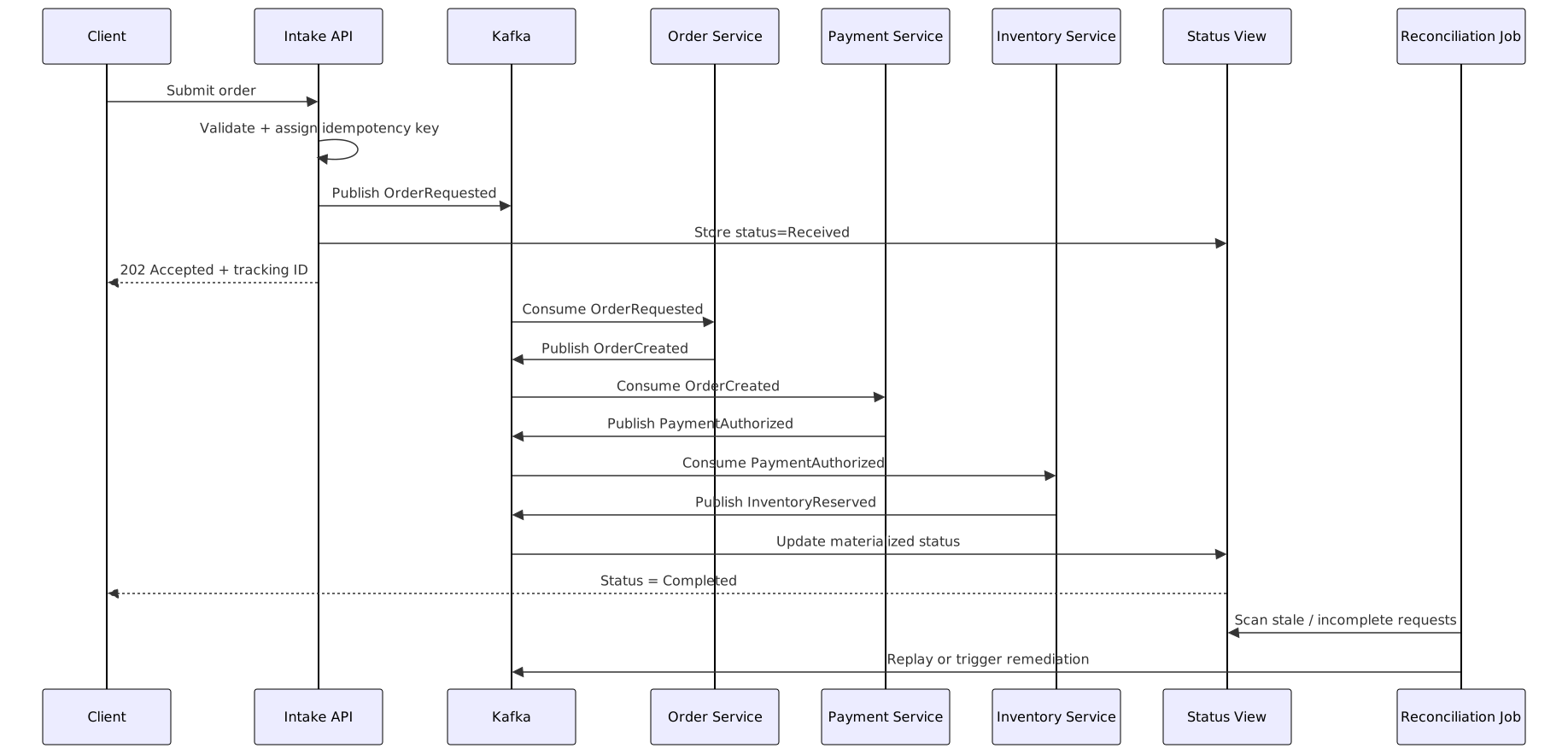
At a high level, a burst-tolerant cloud architecture separates request intake from business processing. APIs remain thin. The domain core owns decisions. Eventing absorbs pressure. Read models and status endpoints keep users informed. Reconciliation closes the gaps. cloud architecture guide

Ingress and admission control
Start at the edge. CDN, WAF, bot management, and API gateway throttling are not glamorous, but they prevent nonsense from consuming precious core capacity. You want early rejection for abusive patterns, token-based prioritization where appropriate, and per-tenant or per-channel quotas.
Then comes the intake service. This component should do as little as possible and do it reliably:
- authenticate and authorize
- perform lightweight validation
- assign an idempotency key or correlation ID
- persist request intent or enqueue it durably
- return a response quickly, often with a tracking reference
The intake service is not your business process engine. If it starts coordinating multiple downstream services synchronously, it becomes the bottleneck you were trying to avoid.
Durable buffering
This is where Kafka or an equivalent broker earns its place. Bursts create a mismatch between arrival rate and processing rate. Durable buffering absorbs that mismatch.
Kafka is especially useful when:
- throughput is high
- multiple consumer groups need the same event stream
- replay is important
- partitions can map sensibly to business keys
- independent scaling of consumers matters
For simpler workloads, managed queues can be better. Not every enterprise problem needs a streaming platform. A queue is often enough when you have straightforward work distribution without broad event fan-out.
Still, when using Kafka, the partitioning strategy becomes a business design issue, not just a platform choice. Partition by customer? By account? By order ID? Get this wrong and you create hot partitions or break ordering guarantees the domain assumed.
Domain-driven design in the middle
The center of the architecture should not be “microservices because cloud.” It should be bounded contexts that own specific business decisions and invariants.
An Order context decides whether an order request becomes a pending order, confirmed order, or rejected order.
A Payment context decides authorization and capture semantics.
An Inventory context decides reservation and release.
A Fulfillment context schedules shipment when dependencies are satisfied.
These contexts should communicate through well-defined domain events, not random synchronous calls whenever a developer needs data. Burst traffic punishes conversational architectures.
A useful test is this: if one bounded context slows down under burst, can the others continue usefully? If not, your service boundaries may be technical, not domain-based.
Command side and query side
For burst-heavy systems, separating write paths from read paths is often healthy. The write path should preserve integrity and move quickly to durable acceptance. The read path should provide status, progress, and eventually materialized outcomes.
Customers tolerate “Your request has been received and is processing” far better than a spinning wheel followed by a timeout. But only if the status model is trustworthy. That means explicit states such as:
- received
- validated
- pending payment
- payment authorized
- inventory reserved
- failed
- completed
- reconciliation required
This is domain semantics again. “Pending” is not a technical excuse. It is a business state.
Workflow and orchestration
Some enterprises prefer choreography through events alone. In burst-prone transactional systems, I am usually more pragmatic. A small amount of orchestration can bring sanity to complex flows, especially where business steps must be correlated and compensations applied.
But don’t turn the orchestrator into a new monolith. It should manage progress and coordination, not own every rule in the company.
Reconciliation
If you build asynchronous burst handling and do not build reconciliation, you have only moved your failure into the night shift.
Reconciliation is the discipline of proving that accepted intents, emitted events, domain states, and external outcomes line up. It catches missing events, duplicate processing, delayed downstream acknowledgements, and mismatched state between systems.
A serious burst architecture needs at least:
- idempotent consumers
- replay-safe processing
- dead-letter handling with triage
- periodic reconciliation jobs
- operational reports for “accepted but not completed”
- compensating actions where feasible
Here is the uncomfortable truth: eventual consistency without reconciliation is just wishful thinking.
Migration Strategy
Most enterprises do not get to start clean. They have a monolith, an ESB, a creaking relational database, and a batch scheduler older than some of the team. That is not a moral failing. It is just the starting point.
The right migration strategy is usually a progressive strangler, not a grand rewrite.
Begin by identifying the specific burst-sensitive journeys. Do not migrate the whole estate because “event-driven is the future.” Migrate the flows where burst pain is visible and economically significant: checkout intake, claims submission, identity verification requests, pricing requests, application submissions.
Then peel the architecture in layers.
Phase 1: Stabilize the edge
Introduce API gateway rate limiting, idempotency keys, and admission control in front of the existing system. This alone often reduces collapse under spikes because duplicate retries and abusive clients are tamed.
Phase 2: Buffer intent before execution
Create an intake service that accepts requests and places them on a queue or Kafka topic while still delegating eventual processing to the legacy system. At first, the monolith may simply consume from the buffer. That is fine. You have already separated arrival rate from processing rate.
Phase 3: Externalize status
Add a request status store and customer-visible tracking model. This is more important than many teams think. It changes the contract from “synchronous completion” to “accepted and progressing,” which buys architectural freedom.
Phase 4: Extract bounded contexts
Move the most burst-sensitive business capabilities out of the monolith one context at a time. Often this starts with order intake, inventory reservation, or asynchronous document processing rather than the entire core transaction stack.
Phase 5: Introduce reconciliation and replay tooling
Do not leave this until the end. As soon as asynchronous paths exist, you need tools to inspect, replay, and reconcile them.
Phase 6: Retire direct synchronous dependencies
As extracted services mature, reduce synchronous calls back into the monolith. This is the real strangling move. Until then, your “new” architecture still inherits legacy bottlenecks.
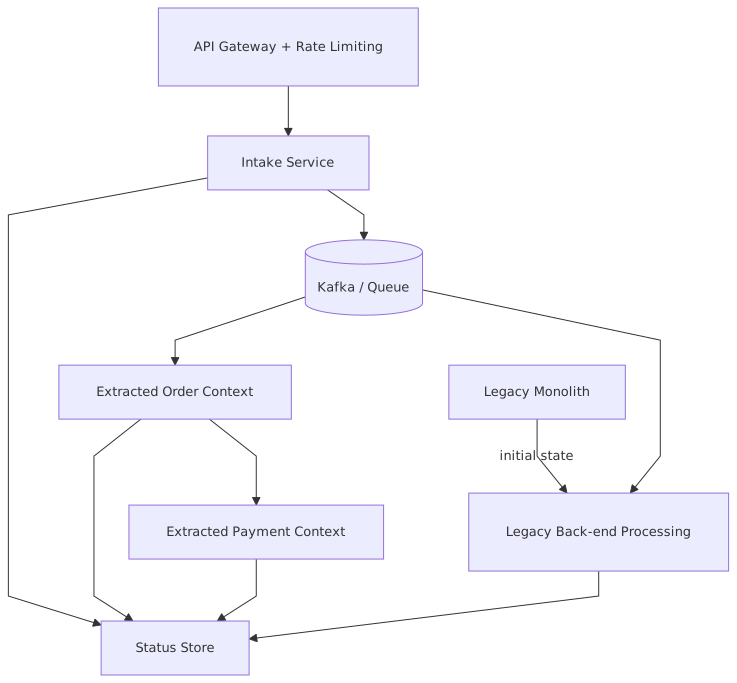
This style of migration is not glamorous, but it works because it reduces risk while preserving business continuity. Architects should have more affection for boring progress.
Enterprise Example
Consider a large insurer handling open enrollment and severe weather claims.
Two bursts, two different semantics.
During open enrollment, the spike is customer-driven and time-bounded. People submit policy changes, upload documents, and request eligibility calculations. Throughput matters, but most operations can be acknowledged and processed asynchronously as long as status is visible and legally required timestamps are preserved.
During severe weather events, claims volume surges dramatically. Here, triage matters more than raw orderliness. First notice of loss must be accepted quickly. Fraud checks, image analysis, policy verification, and adjuster assignment can happen downstream. Some claim types must be prioritized due to regulatory or humanitarian obligations.
A naïve microservices architecture might decompose the system into many fine-grained services, each making synchronous calls to customer profile, policy, pricing, fraud, document, and payment services. Under burst, the call chain amplifies latency and failure. One downstream slowdown infects the whole transaction.
A better design looks different.
The insurer introduces:
- an intake API for claim submission
- durable event streaming for accepted claim intents
- a domain status model visible to customers and agents
- separate bounded contexts for Claims, Policy Validation, Fraud, and Payout
- a priority lane for catastrophe claims
- reconciliation jobs for claims stuck in pending states
The Claims context owns the aggregate and lifecycle: received, triaged, verified, under review, approved, paid, or exception. The Policy Validation context confirms policy coverage rules. The Fraud context runs scoring asynchronously. The Payout context only proceeds when prerequisites are met.
Critically, the system records the legal acceptance time at intake before downstream validation completes. That is a domain decision with regulatory significance. It allows the insurer to survive burst traffic while still meeting compliance obligations.
Kafka is used because multiple consumers need the claim event stream: fraud, document processing, analytics, customer notifications, and operations dashboards. But the team is careful with partitioning. Claims are partitioned by claim ID for ordered processing within a claim, while catastrophe routing uses topic separation and priority-aware consumers to prevent lower-priority bulk work from starving urgent claims.
What changed the game was not simply adding Kafka. It was clarifying the business semantics of “claim received” versus “claim approved.” Once those states were explicit, the architecture could decouple safely.
That is classic domain-driven design in enterprise clothing.
Operational Considerations
Burst architecture lives or dies in operations.
Observability
Metrics must go beyond CPU and latency. You need business-flow observability:
- acceptance rate
- queue depth and age
- consumer lag
- time spent in each domain state
- stuck workflow counts
- reconciliation backlog
- duplicate suppression counts
- per-tenant or per-channel throttling events
A dashboard that says the cluster is healthy while 80,000 customer requests are stuck in “pending payment” is not helpful.
Backpressure and load shedding
Systems need explicit backpressure policies. When downstream payment providers degrade, do you stop accepting orders entirely, accept and queue them, or accept only premium customers? These policies should be rehearsed, not improvised during crisis calls.
Capacity planning
Auto-scaling is not enough. Warm-up times, connection pool limits, partition rebalancing, database write throughput, and external provider quotas all matter. Burst testing should model these realities, not just synthetic request floods against a mock service.
Multi-region concerns
Multi-region designs can improve resilience but introduce data consistency and routing complexity. For some domains, active-active works. For others, especially those requiring strong ordering or scarce resource reservation, it can create more pain than benefit.
Security and abuse
Burst traffic is not always legitimate. Credential stuffing, scraping, and fraud attacks mimic real surges. Edge protections, behavior analysis, and tenant-aware policies are part of the architecture, not side controls.
Tradeoffs
There is no free lunch here. Only more honest lunches.
Pros
A well-designed burst architecture:
- improves survival during sudden demand spikes
- decouples customer-facing responsiveness from back-end processing speed
- isolates bounded contexts and team ownership
- supports replay and recovery
- scales operationally as well as technically
- creates clearer business state models
Cons
It also:
- introduces eventual consistency
- requires more sophisticated operational tooling
- increases complexity in debugging and testing
- demands strong idempotency discipline
- shifts some failures from immediate transaction errors to delayed reconciliation work
- can cost more in platform and engineering effort
This is the tradeoff that matters: you exchange synchronous simplicity for asynchronous resilience. Sometimes that is a great deal. Sometimes it is not.
Failure Modes
Burst architectures fail in very predictable ways. Most are self-inflicted.
Queue as junk drawer
Teams dump everything into Kafka or a queue without clear event contracts, ownership, or retention strategy. Soon nobody knows which events are authoritative, and replay becomes dangerous.
Hot partitions
A poor partition key causes a few partitions to absorb most traffic, creating lag while the cluster appears underutilized. This is common in tenant-heavy B2B systems with one giant customer.
Retry storms
Clients retry. Gateways retry. services retry. Consumers retry. The whole estate becomes a machine for multiplying load. Idempotency keys and bounded retry policies are not optional.
Status lies
The UI says “processing” forever because the read model is stale or a workflow got stuck. Customers can forgive delay. They do not forgive ambiguity.
Reconciliation blind spots
Accepted requests vanish into dead-letter topics or partial failures without operational visibility. Finance discovers it first. That is never a pleasant meeting.
Legacy drag-through
A new asynchronous edge still funnels into a synchronous legacy bottleneck, merely delaying the collapse. This is common in half-finished migrations.
Over-fine microservices
Too many tiny services create network chatter and operational fragility. Under burst, every extra hop is another place for latency and failure to bloom.
When Not To Use
This style of architecture is not universal medicine.
Do not use a burst-buffered, event-heavy design when:
- the workload is modest and predictable
- the domain requires immediate, strongly consistent response for every transaction
- the team lacks operational maturity for asynchronous systems
- the business cannot tolerate pending states or delayed completion
- the complexity cost outweighs the occasional spike
- a simple scale-up or caching solution would solve the actual problem
A small internal application with moderate usage does not need Kafka, orchestration, reconciliation pipelines, and five bounded contexts just because the cloud made them fashionable.
Likewise, if a transaction truly requires strong linearizable consistency end-to-end, buffering the request may create more business risk than it removes. This is why architecture has to start from domain semantics, not platform enthusiasm.
Related Patterns
Several patterns frequently travel with burst traffic architecture.
Bulkheads
Isolate workloads so one class of traffic does not drown another. Separate queues, topics, consumer groups, and resource pools for critical versus non-critical work.
Rate limiting and quotas
Protect shared systems and enforce fairness, especially in multi-tenant environments.
Circuit breakers
Useful for downstream dependency protection, but remember they do not fix capacity mismatch. They just fail faster, which is often still valuable.
CQRS
Helpful where write optimization and read scalability diverge. Especially useful for customer status and operational dashboards.
Sagas and compensating transactions
Relevant when a burst-processed workflow spans multiple bounded contexts and not all steps can be rolled back atomically.
Outbox pattern
Essential in many systems to reliably publish domain events from transactional systems without dual-write inconsistency.
Strangler fig
The sensible migration pattern for replacing synchronous legacy flows incrementally.
Summary
Architecture for burst traffic is not really about scale. It is about controlled degradation, domain integrity, and operational truthfulness under pressure.
The winning design is usually not the one with the most fashionable cloud services. It is the one that understands which business facts must be immediate, which can be delayed, which events are authoritative, and which failures must be reconciled later. It puts buffering at the edges, keeps bounded contexts honest, and refuses to let temporary demand spikes trample systems of record.
If I had to compress the advice into a few lines, it would be this:
- make request acceptance cheap and fast
- protect the core with durable buffering
- model pending states as real business states
- use domain-driven design to decide service boundaries
- build reconciliation as a first-class capability
- migrate progressively, not heroically
- never confuse “we use Kafka” with “we are burst resilient”
Because in the end, burst traffic is not the enemy. Ambiguity is. Systems survive spikes when they know what they are promising, what they are postponing, and how they will make the books balance afterward.
Frequently Asked Questions
What is cloud architecture?
Cloud architecture describes how technology components — compute, storage, networking, security, and services — are structured and connected to deliver a system in a cloud environment. It covers decisions on scalability, resilience, cost, and operational model.
What is the difference between availability and resilience?
Availability is the percentage of time a system is operational. Resilience is the ability to recover from failures — absorbing disruption and returning to normal. A system can be highly available through redundancy but still lack resilience if it cannot handle unexpected failure modes gracefully.
How do you model cloud architecture in ArchiMate?
Cloud services (EC2, S3, Lambda, etc.) are Technology Services or Nodes in the Technology layer. Application Components are assigned to these nodes. Multi-region or multi-cloud dependencies appear as Serving and Flow relationships. Data residency constraints go in the Motivation layer.