⏱ 22 min read
Auditability is what organizations suddenly care about the morning after something goes wrong.
Not during the architecture review. Not when teams are excitedly splitting a monolith into services, wiring up Kafka, and congratulating themselves for being “event-driven.” Not when product wants faster delivery and operations wants fewer dependencies. Auditability arrives later, usually escorted by an angry customer, a regulator, a finance team that found a mismatch, or a legal department asking a devastatingly simple question:
“Can you show exactly what happened?”
That question breaks weak architectures.
In a single-process system with one database, the answer is often annoying but possible. In a distributed system, it can become a scavenger hunt across service logs, CDC streams, message brokers, stale replicas, side effects, retries, and conflicting definitions of truth. One system says an order was approved. Another says it was held. A payment service shows an authorization. The ledger shows no capture. Customer support exported a CSV proving something else entirely. Everyone has data. Nobody has the story.
That is the real problem. Auditability is not about storing more logs. It is about preserving business truth under distribution.
And business truth is not a technical concern bolted on at the end. It is a domain concern. If you cannot explain how a claim was adjudicated, how a trade was booked, how a refund was authorized, or why access to a customer record was granted, then your architecture has failed at something deeper than observability. It has failed to model accountability.
So let’s be blunt: if you are building distributed systems for financial services, healthcare, insurance, telecom, government, or any enterprise with serious controls, then auditability is not a side requirement. It is an architectural backbone. You should design for it with the same seriousness you design for consistency, resilience, and security.
This article lays out a practical architecture for auditability in distributed systems. It leans on domain-driven design, eventing, immutable records, reconciliation, and progressive migration. It also names the tradeoffs honestly. Because there is no free lunch here. Systems that can tell the truth tend to pay for that privilege in throughput, complexity, latency, and discipline.
That is still cheaper than not knowing what happened.
Context
Most enterprises did not start with a greenfield platform designed around immutable events and well-bounded domains. They started with packaged applications, integration middleware, a monolith or three, overnight batch jobs, and a reporting warehouse that somehow became “the source of truth” because it was the only place where all the numbers roughly lined up.
Then modernization began.
A customer platform became a set of microservices. Payments moved onto Kafka-backed workflows. Operational data was spread across bounded contexts. Teams got autonomy. Data products emerged. APIs multiplied. Some decisions became asynchronous by design. Others became asynchronous by accident. event-driven architecture patterns
This is usually good architecture. Distributed systems exist for valid reasons: scale, autonomy, resilience, independent deployment, and organizational alignment. But distribution comes with a tax. It fragments causality.
In a monolith, a transaction is often enough to establish what happened. In distributed systems, the “transaction” is a story told across time. The story lives in events, commands, state changes, compensations, retries, and human interventions. If those things are not intentionally captured, linked, and retained with domain meaning, audit becomes forensic archaeology.
And here is the trap: many teams confuse technical telemetry with auditability.
Logs help operators.
Metrics help SREs.
Traces help performance engineers.
None of them, by themselves, are a reliable audit record.
An audit record needs a different shape. It must answer business questions such as:
- Who initiated this action?
- Under what authority or policy?
- What decision was made?
- What data was used to make it?
- What version of the rules applied?
- What changed in the domain state?
- Which downstream effects occurred?
- Were there overrides, exceptions, retries, or reversals?
- Can we prove the sequence is complete and untampered?
That is not a logging problem. That is a domain model problem.
Problem
In distributed systems, business actions are decomposed into many technical actions. An order submission might involve:
- an API gateway
- an order service
- a pricing service
- an eligibility service
- a payment service
- a fraud service
- an inventory service
- a notification service
- one or more Kafka topics
- a data lake sink
- a support console used for manual override
Each component can emit some evidence. But evidence is not automatically auditability.
The central challenge is this:
How do we produce a trustworthy, queryable, domain-meaningful history of business activity across autonomous services without destroying the very benefits of distributed architecture?
The moment you try to solve this naively, you hit familiar problems:
- Local truth vs enterprise truth
Each service knows its own state transitions, but no service sees the full business process.
- Mutable state erases history
The latest row in a table rarely explains how it got there.
- Retries create ambiguity
Did the system process the command once, three times, or zero times with duplicated side effects?
- Asynchrony scrambles chronology
Event time, processing time, and user-perceived time drift apart.
- Schema drift destroys continuity
Over time, events evolve, fields are renamed, semantics shift, and old facts become hard to interpret.
- Cross-domain processes lack a common narrative
An “OrderApproved” event in one context may not mean financially committed in another.
- Manual interventions happen off the books
The support team fixes production through admin tools, spreadsheets, or batch scripts, and those changes are often poorly captured.
- Reconciliation is afterthought architecture
Mismatches are detected late, often by customers or auditors.
This is why many enterprises end up with a brittle patchwork: ELK for logs, OpenTelemetry for traces, a BI warehouse for reporting, and a separate compliance database maintained by painful ETL. It looks comprehensive. It often isn’t. When the hard question comes, teams still gather in war rooms and reconstruct history from fragments.
Forces
Good architecture emerges from forces in tension, not wishful diagrams. Auditability in distributed systems sits in the middle of several stubborn forces.
Regulatory and contractual pressure
Financial controls, SOX, PCI, HIPAA, PSD2, insurance claims regulations, public-sector retention rules—these are not optional. Enterprises must prove not only what happened, but that controls were followed.
Domain semantics matter more than raw events
A stream of technical events is not enough. An auditor does not care that payment-status-topic received offset 893442. They care that refund approval was granted by a supervisor under policy version 17, above threshold, due to fraud exception case 8219.
Team autonomy must survive
If auditability requires every microservice team to coordinate every schema change with a central platform committee, the architecture will collapse under process weight. microservices architecture diagrams
Throughput and latency still matter
You cannot put every user request through a giant serialized compliance engine unless your business is tiny or your tolerance for delay is enormous.
Truth must be tamper-evident
An audit trail people can rewrite is a diary, not a control.
Legacy reality exists
Most enterprises cannot stop the world and rebuild around event sourcing. They need a migration path from CRUD-heavy systems and packaged platforms.
Reconciliation is inevitable
In distributed systems, especially with Kafka, asynchronous messaging, and external integrations, drift will happen. Audit architecture must assume disagreement and provide mechanisms to detect and resolve it.
Storage and retention are not free
Long-lived immutable records become expensive at scale. Retention, archival, legal hold, and query performance must be designed, not wished into existence.
Solution
The most effective pattern I’ve seen is this:
Separate operational state from audit truth, but tie them together through domain events, immutable records, correlation identity, and reconciliation.
In other words:
- Let each bounded context own its operational model.
- Require meaningful domain events for business-significant state changes.
- Capture those events and key decision records in an immutable audit store.
- Use correlation and causation IDs to reconstruct business flows.
- Treat reconciliation as a first-class capability, not a support script.
- Preserve domain language so the audit trail explains the business, not just the plumbing.
This is not pure event sourcing, though it borrows from it. Nor is it just centralized logging. It is a hybrid architecture for real enterprises that must coexist with microservices, legacy systems, Kafka, relational databases, and human operations.
The design has a few core principles.
1. Audit records are domain artifacts
Every audit entry should be anchored in business semantics:
ClaimSubmittedClaimEligibilityAssessedManualOverrideAppliedTradeBookedPaymentCaptureRequestedRefundApprovedAccessGrantedToCustomerRecord
These records should contain:
- business identifiers
- actor identity
- action and outcome
- timestamp and effective timestamp
- policy/rule version
- source system
- correlation and causation metadata
- before/after references where needed
- integrity metadata such as hash chains or signatures if required
2. Not every state change deserves the same treatment
Auditability is selective, not indiscriminate. You do not need a shrine for every cache refresh. Focus on business-significant transitions, control decisions, data access, and human overrides.
That is where domain-driven design helps. Bounded contexts and aggregates help identify what counts as a meaningful fact.
3. The outbox pattern is your friend
If a service updates local state and emits an audit-worthy event, it must do so reliably. The transactional outbox pattern is usually the most pragmatic answer for microservices backed by databases.
4. Reconciliation closes the gap between “should have happened” and “did happen”
Even with outbox, consumers fail. Topics are misconfigured. Downstream systems fall behind. External providers lie. Audit architecture without reconciliation is optimistic fiction.
5. Query models for audit are different from operational read models
Audit users ask temporal and forensic questions. They need lineage, sequence, actor history, exceptions, rule versions, and evidence chains. Build for that explicitly.
Architecture
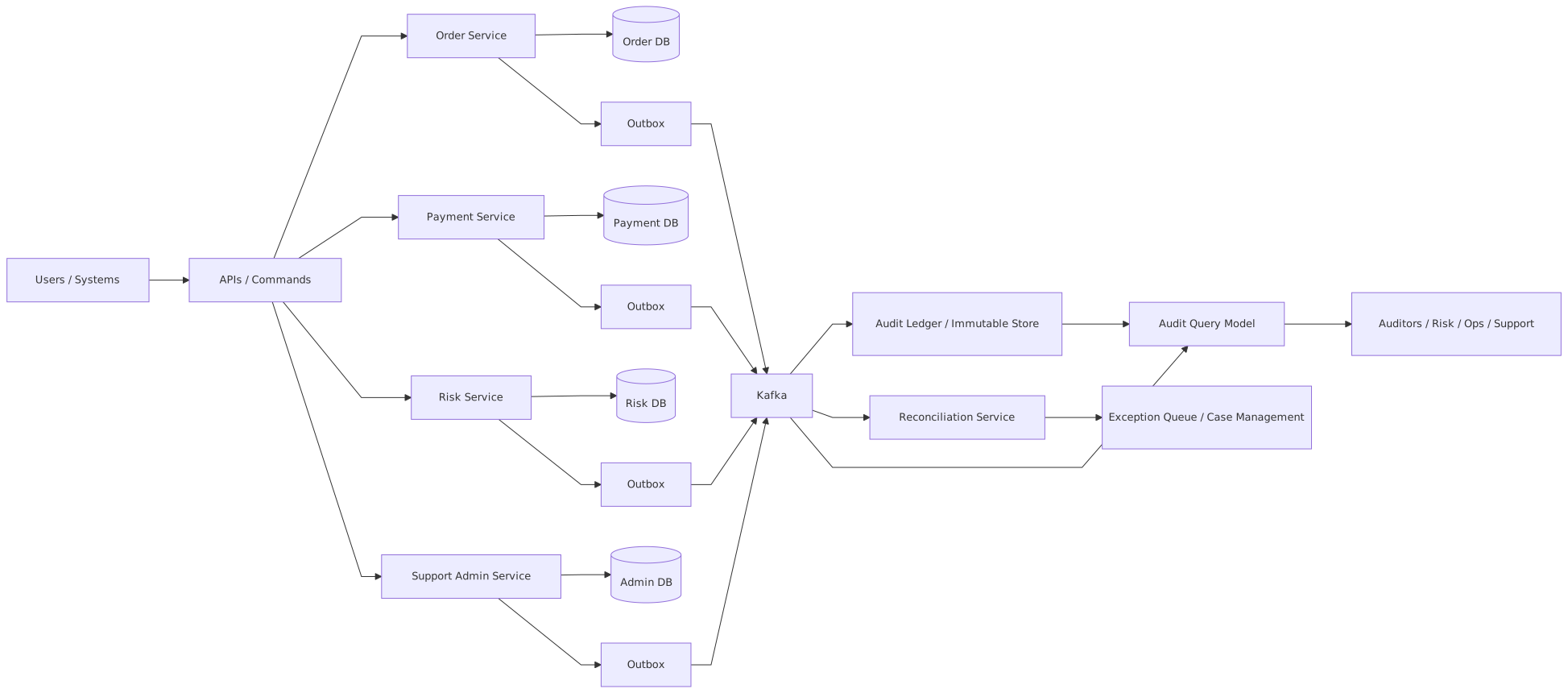
A practical auditability architecture usually has five layers:
- Operational services in bounded contexts
- Reliable event publication
- Central or federated audit ledger/store
- Reconciliation and exception management
- Audit query and evidence access
Here is the high-level shape.
Bounded contexts and domain semantics
Start with the domain, not the pipeline.
In DDD terms, auditability should respect bounded contexts. “Order,” “Payment,” and “Settlement” may be related, but they are not the same thing. The worst audit trails flatten these distinctions into generic records like “status changed.” That creates a swamp of low-value facts with no semantic rigor.
Within each bounded context, define:
- the business events that matter
- the aggregate roots whose transitions are significant
- the policies and rules whose application must be recorded
- the external commands and human actions that require evidence
For example, in a payment context:
PaymentAuthorizedAuthorizationDeclinedCaptureInitiatedCaptureFailedRefundRequestedRefundApprovedRefundRejectedChargebackReceivedManualPaymentReleaseApplied
Those are audit-worthy because they reflect business commitments, liabilities, control points, and exception handling.
Reliable publication with transactional outbox
A service writes its own state and an outbox record in one local transaction. A publisher then sends the event to Kafka. This prevents the classic split-brain where the database commit succeeds but the event publish fails.
If you skip this, your audit trail will drift silently, which is exactly the kind of failure that hurts months later.
Immutable audit ledger
The central audit store should be append-only. That does not necessarily mean blockchain. Most enterprises do not need a blockchain; they need discipline.
An audit ledger can be implemented with:
- an append-only relational table with integrity controls
- object storage with immutable retention and indexed metadata
- a dedicated event store
- a lakehouse pattern with WORM controls for regulated retention
- a tamper-evident ledger database if your compliance profile warrants it
The point is not fashion. The point is to preserve records, support temporal queries, and detect tampering.
A good audit record often contains both business payload and envelope metadata:
- event ID
- event type
- aggregate ID
- bounded context
- tenant/entity/account/customer reference
- actor ID and actor type
- command ID
- correlation ID
- causation ID
- event time
- processing time
- schema version
- rule/model version
- source system
- integrity hash
- payload
Correlation and causation
Correlation IDs are table stakes. Causation IDs are where the architecture starts to tell a story.
- Correlation ID links all records in the same business journey.
- Causation ID shows which prior event or command led to this one.
That distinction matters in audit reconstruction. It lets you distinguish “part of the same case” from “directly caused by.”
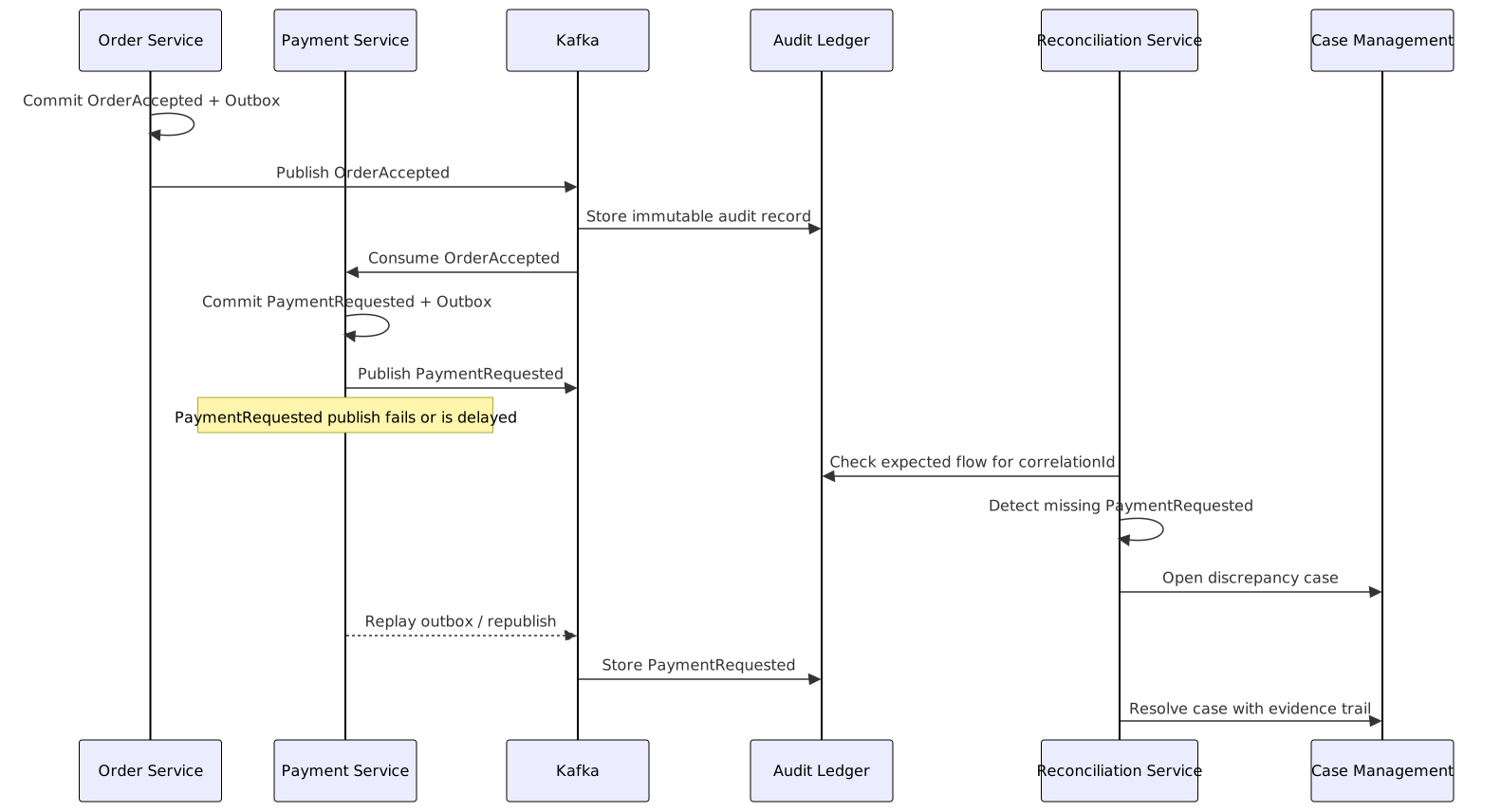
Reconciliation service
Reconciliation is the adult in the room.
It compares:
- expected events vs observed events
- source-of-record state vs downstream state
- monetary totals across contexts
- command outcomes vs side effects
- external provider acknowledgements vs internal commitments
It should not just raise alerts. It should create cases, annotate discrepancies, support replays, and record the resolution path.
Here is a typical reconciliation flow.
Audit query model
Do not point auditors at Kafka topics and wish them luck.
Build a query model optimized for:
- timeline reconstruction
- control evidence
- actor activity lookup
- policy version lookup
- before/after comparisons
- exception and override analysis
- legal or regulatory export
This model is usually denormalized and search-friendly. Elasticsearch, OpenSearch, columnar stores, or warehouse-backed marts can all work, provided the immutable source remains authoritative.
Migration Strategy
This is where architecture either becomes practical or remains decorative.
Most enterprises already have systems that were not built for auditability. Some emit logs. Some update rows in place. Some are vendor packages. Some still produce nightly files. You will not replace them all.
So use a progressive strangler migration.
Do not start by demanding “enterprise event sourcing.” Start by identifying high-risk, high-value business flows where audit pain is real: payments, customer access, claims adjudication, pricing overrides, account closure, trade lifecycle events.
Then migrate in layers.
Phase 1: Externalize business-significant events
From the existing monolith or legacy app, capture business events around key transactions. If the codebase is ugly, use CDC or interceptors carefully, but prefer explicit application events where possible. CDC is good at detecting data change; it is bad at explaining business meaning.
Phase 2: Establish audit identity standards
Introduce:
- correlation IDs
- causation IDs
- actor identity standards
- command IDs
- consistent event timestamps
- schema versioning
Without this, you are collecting puzzle pieces from different boxes.
Phase 3: Introduce immutable audit storage
Start storing the key records in an append-only repository, even if the operational systems remain unchanged.
Phase 4: Add reconciliation around critical flows
Reconciliation often delivers value faster than architectural purity. Enterprises can tolerate some legacy internals if they can reliably detect drift and explain discrepancies.
Phase 5: Strangle operational capability into bounded services
As domains are extracted into microservices, require outbox-based publication and domain event contracts from day one.
Phase 6: Retire fragile ETL-based audit reporting
Once the ledger and audit query model are trustworthy, decommission spreadsheet-driven and nightly batch-derived evidence processes.
Here is a migration view.
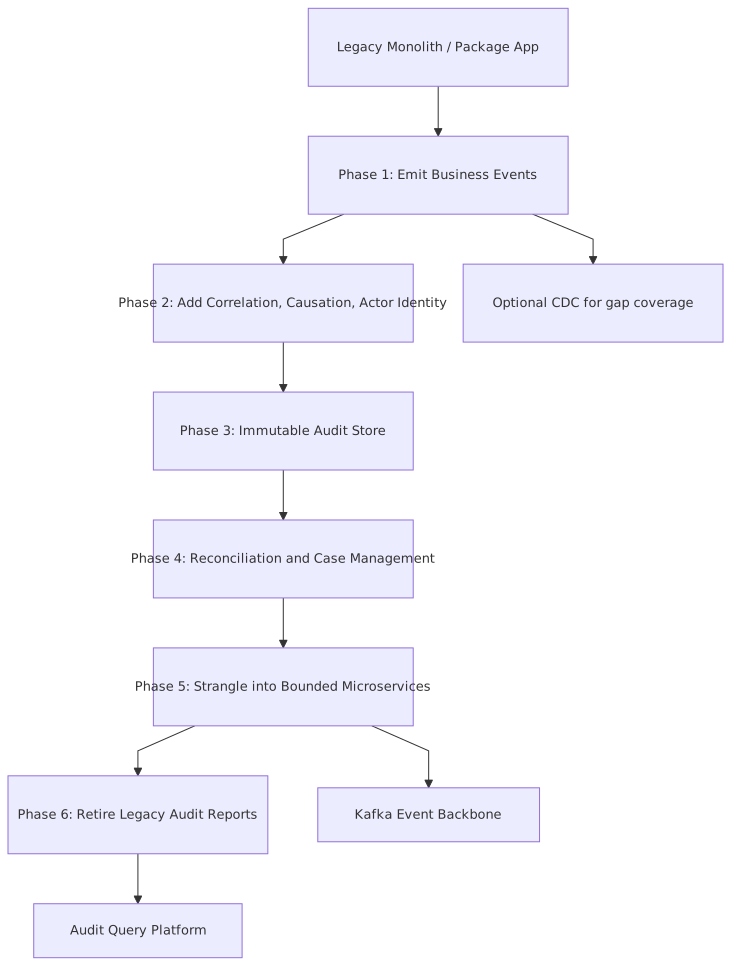
A hard truth: migration is as much semantic work as technical work. Teams must agree on what events mean, what constitutes completion, and who owns each truth. Otherwise you simply modernize the confusion.
Enterprise Example
Consider a multinational insurer modernizing its claims platform.
The old world was a core claims package, a document management system, a payment engine, and several regional portals. Audits were painful. To explain a single claim decision, teams had to pull data from six systems, compare timestamps from different time zones, and manually interpret whether an adjuster’s override happened before or after an automated fraud flag.
The modernization introduced microservices around bounded contexts:
- Claims Intake
- Eligibility
- Fraud Assessment
- Adjudication
- Payment
- Customer Communication
- Case Management
Kafka connected the flow. But they did one thing right early: they defined an audit domain.
Not a giant central business service that owned everyone’s data. That would have been a mistake. Instead, the audit domain defined:
- the canonical evidence model
- correlation standards
- actor model
- event taxonomy
- retention rules
- reconciliation contracts
- query and export capabilities
Each service still owned its own domain events. The audit platform consumed and preserved them.
A claim journey produced records such as:
ClaimSubmittedDocumentReceivedEligibilityAssessedFraudScoreCalculatedManualReviewRequestedOverrideAppliedClaimApprovedPaymentDisbursedNotificationSent
Crucially, OverrideApplied included:
- adjuster identity
- role and delegation authority
- original decision reference
- justification code
- free-text explanation
- policy version in force
- timestamp and workstation metadata
That one record saved them repeatedly.
Why? Because in real enterprises, the failure mode is rarely the happy path. It is the override, the exception, the reprocessing, the “temporary fix,” the spreadsheet import, the outage workaround. If those things are invisible, your audit architecture is performative.
They also implemented reconciliation between approved claims and payment disbursements. Every approved claim above threshold had to match a payment intent within a defined SLA. Missing or duplicated payment intents created cases automatically. This caught not only technical failures but process defects in regional operations.
The result was not magical perfection. Event contracts needed governance. Some legacy systems could only provide coarse-grained records. Historical backfill was messy. But audit preparation time dropped from weeks to hours, claims disputes were resolved faster, and internal control testing became evidence-driven instead of hero-driven. EA governance checklist
That is what good architecture looks like in the wild: not elegant in every corner, but truthful where it matters.
Operational Considerations
Auditability is easy to draw and hard to run.
Retention and legal hold
Different records have different retention needs. Financial records may need seven years or more. Privacy regulations may demand minimization. Those forces clash. The design must support:
- retention policies by event class
- legal hold
- archival tiers
- selective redaction where legally required
- referential continuity despite archival
PII and sensitive data
Do not dump raw personal data into every audit event. Store references, masked values, or encrypted fields where possible. Auditability does not justify careless data sprawl.
Schema evolution
Schemas will evolve. They always do. You need:
- versioned event contracts
- backward-compatible readers where possible
- event type registries
- semantic migration guidance
- metadata recording the schema and rule version used at the time
An audit trail that cannot interpret its own past is a museum with no labels.
Time semantics
Record:
- event occurrence time
- ingestion time
- processing time
- effective business date when relevant
Distributed systems lie about time in subtle ways. Make those distinctions explicit.
Access control
Audit data is sensitive. Ironically, the audit system itself often becomes one of the highest-risk assets because it centralizes evidence, actor activity, and potentially PII. Apply strict RBAC, ABAC, segregation of duties, and access audit on the audit platform itself.
Replay and reprocessing
If Kafka topics are retained and consumers are replayable, define the rules clearly:
- what can be replayed
- what creates new audit records
- how idempotency is enforced
- how replays are labeled to avoid confusing original processing with later reconstruction
Integrity controls
Depending on the regulatory environment, add:
- hash chains across records
- digital signatures
- immutability flags
- WORM storage
- separation between producers and audit-store administrators
Tradeoffs
There is no architecture for auditability without cost.
More storage
Immutable history grows without mercy.
More design discipline
Teams must model meaningful events and maintain contracts. This is harder than “just log something.”
More operational complexity
Now you have outbox publishers, Kafka topics, ledger storage, query models, reconciliation jobs, and case workflows.
Sometimes more latency
If controls demand synchronous evidence capture before acknowledging critical actions, your response times may suffer.
Governance overhead
Taxonomy, naming, retention, and access policies need stewardship. Too little governance creates chaos. Too much creates bureaucracy. ArchiMate for governance
Not all truth can be centralized
Some contexts need federated audit storage due to sovereignty, privacy, or platform boundaries. A single enterprise-wide ledger is appealing but not always realistic.
The key tradeoff is this: you are exchanging some simplicity in implementation for much greater confidence in explanation. In many enterprises, that is a bargain.
Failure Modes
Architects should be judged less by the happy path and more by the failure path they anticipated.
Logging masquerading as audit
Teams dump application logs into a SIEM and call it audit. Months later they discover log retention expired, fields are inconsistent, and no one can reconstruct the business flow.
CDC without semantics
Change data capture sees row updates, but often not the meaning behind them. A field changed from A to B. Why? Under what policy? Triggered by whom? CDC alone rarely answers that.
Missing manual actions
Admin consoles, scripts, bulk uploads, and support tools bypass the normal event path. This is one of the most common enterprise blind spots.
Correlation gaps
One service emits correlation IDs, another drops them, a third invents new ones. The trail is now broken.
Duplicates and idempotency failures
Kafka consumers retry, producers republish, downstream side effects happen twice, and the audit trail becomes contradictory unless deduplication and idempotent business handling are explicit.
Mutable audit stores
Someone “fixes” a bad record in place. Congratulations: you just destroyed evidence.
Query model treated as source of truth
Denormalized search projections drift from the immutable ledger. Analysts query the projection and assume it is authoritative.
Reconciliation deferred forever
Organizations promise to build reconciliation later. Later never comes. Then drift accumulates quietly until a major financial or compliance event exposes it.
When Not To Use
Architecture is partly about knowing when to stop.
Do not build a heavy audit ledger architecture if:
- the system is low-risk and internal with minimal compliance exposure
- the domain has little need to explain historical decisions
- the throughput and cost profile make event retention disproportionate
- a simpler transactional database with history tables is entirely sufficient
- the organization lacks the discipline to maintain event semantics and will merely create expensive noise
A small internal workflow tool probably does not need Kafka, outbox, immutable object storage, and reconciliation orchestration. A well-designed monolith with append-only history tables and access logging may be the right answer.
Likewise, do not force full event sourcing just because auditability matters. Event sourcing is powerful, but it changes development style, debugging habits, storage patterns, and operational assumptions. Many enterprises can get excellent auditability through domain events plus immutable audit records without making the event log the operational source of truth.
Use the least elaborate architecture that can still answer the hard question: show exactly what happened, and prove it.
Related Patterns
Several patterns sit close to this architecture.
- Event Sourcing
Strongest historical fidelity, but highest adoption cost. Useful when domain state is naturally event-shaped and temporal reconstruction is core.
- Transactional Outbox
Essential for reliable event publication from local transactions.
- Saga / Process Manager
Useful for long-running business processes; should emit state transitions and compensations into the audit trail.
- CQRS
Helpful when audit query needs differ sharply from operational reads.
- Data Lineage
Important where audit includes analytical or decisioning pipelines, especially with ML-based scoring.
- Reconciliation and Control Towers
Core pattern for detecting divergence across distributed systems.
- Strangler Fig Migration
The sensible path for evolving legacy estates without betting the company.
Summary
Distributed systems make accountability harder because they break the illusion that one database row can explain reality. Reality now lives in many places, at many times, under many local truths. If you do not design for that, your organization will eventually discover that it has built systems that can act but cannot explain themselves.
That is unacceptable in serious enterprises.
The architecture for auditability is not just “capture more logs.” It is a deliberate design that combines domain-driven thinking, immutable records, reliable event publication, correlation and causation metadata, reconciliation, and purpose-built query models. It respects bounded contexts while preserving enterprise evidence. It accepts that drift happens and plans to detect it. It gives special attention to exceptions, overrides, and human intervention, because that is where the bodies are usually buried.
The migration path matters as much as the target state. Start where the risk is real. Externalize business-significant events. Add identity and semantic standards. Create an immutable audit store. Introduce reconciliation. Then progressively strangle legacy operations into better-bounded services.
And be honest about the tradeoffs. This architecture costs money, discipline, and patience. But in regulated, high-value, high-consequence domains, it pays for itself the first time someone asks the question that really matters:
What happened?
A good audit architecture answers quickly.
A great one answers in the language of the business, with evidence, and without panic.
Frequently Asked Questions
What is a service mesh?
A service mesh is an infrastructure layer managing service-to-service communication. It provides mutual TLS, load balancing, circuit breaking, retries, and observability without each service implementing these capabilities. Istio and Linkerd are common implementations.
How do you document microservices architecture for governance?
Use ArchiMate Application Cooperation diagrams for the service landscape, UML Component diagrams for internal structure, UML Sequence diagrams for key flows, and UML Deployment diagrams for Kubernetes topology. All views can coexist in Sparx EA with full traceability.
What is the difference between choreography and orchestration in microservices?
Choreography has services react to events independently — no central coordinator. Orchestration uses a central workflow engine that calls services in sequence. Choreography scales better but is harder to debug; orchestration is easier to reason about but creates a central coupling point.