⏱ 20 min read
Distributed systems have a nasty habit of punishing neat ideas.
On a whiteboard, “we’ll just upgrade the model” sounds tidy. In production, that sentence usually means a dozen teams, three databases, two reporting systems nobody wants to touch, a Kafka topic with seven consumers, and one revenue-critical workflow that cannot be wrong even once. The model is never just a model. It is embedded in contracts, screens, audit trails, batch jobs, machine learning features, partner APIs, and the half-forgotten scripts operations uses at quarter end. event-driven architecture patterns
That is why model version coexistence matters. Not as a technical nicety, but as a survival skill.
In enterprise systems, we rarely get to replace one version of a domain model with another in a clean cut. Old and new often need to live side by side for months, sometimes years. A policy can be created under one definition and renewed under another. A payment event can be published in a newer schema while downstream reconciliation still depends on legacy fields. A customer identity service might move from “person plus accounts” to a richer party model, while dozens of surrounding systems still speak the old language.
This is not primarily a serialization problem. It is a domain semantics problem wearing a serialization costume.
The hard question is not “how do I support v1 and v2?” The hard question is “what does it mean for both versions to be true in the same business?” Once you ask it that way, the architecture gets sharper. You stop arguing about JSON shape and start discussing bounded contexts, translation, invariants, compatibility windows, migration sequencing, and where ambiguity is allowed to live.
That is the real work.
Context
Most enterprises evolve their models under pressure, not by leisure. Regulations change. Product managers split one concept into three because the business finally learned the difference. Acquisitions bring a second customer master. A fraud team introduces a risk state no one accounted for. Someone discovers that “order” means one thing in e-commerce, another in finance, and something else entirely in fulfillment.
Domain-driven design gives us the right lens here. A model is not a universal truth; it is a deliberate abstraction within a bounded context. Trouble starts when we forget that and treat a model as a global enterprise artifact. Then every change becomes organizational shrapnel.
Consider a common progression. A retailer starts with a simple Customer model. Later it needs householding, legal entities, delegated purchasing, and consent tracking. Suddenly Customer is not enough. The commerce team introduces Party, with Person and Organization variants. Good move inside that context. But billing, loyalty, fulfillment, marketing automation, and data warehouse pipelines still expect Customer. Both models now exist, each valid in its own context, but they overlap in messy ways.
That overlap is where architectures either earn their keep or collapse into tribal knowledge.
Distributed systems make coexistence harder because the model leaks through every integration seam: REST payloads, event schemas, topic contracts, database tables, caches, search indexes, ETL jobs, and partner file formats. Worse, some of those seams are synchronous, some asynchronous, some human-operated, and some effectively immutable.
So we should begin with a blunt truth: model version coexistence is normal in enterprise systems. If your architecture assumes synchronized migration, it is designed for a world that does not exist.
Problem
The core problem is simple to say and difficult to solve:
How do you allow multiple versions of a business model to operate concurrently across distributed systems without losing domain integrity, operational control, or migration velocity?
There are technical subproblems:
- versioning APIs and events
- evolving schemas safely
- migrating persisted data
- supporting old and new consumers
- reconciling state across services
- detecting semantic drift
But technical subproblems are downstream of semantic ones.
A model version is not merely a new structure. Often it expresses a new understanding of the business. Maybe Order.status = SHIPPED in v1 becomes separate fulfillment, invoicing, and settlement states in v2. Maybe a “single payment” model becomes “payment authorization plus capture plus refund ledger.” Maybe “account holder” becomes “party relationship.”
Those are not field additions. They are changes in meaning.
If we pretend they are only contract changes, we build brittle compatibility layers that preserve syntax while corrupting intent. The data still flows, but it lies.
That is a dangerous kind of success.
Forces
Several forces shape the design.
1. Business continuity beats architectural purity
Revenue systems cannot pause while architects tidy the model. Existing processes must keep running. Historical records must remain interpretable. Support teams need continuity. Finance needs numbers that reconcile across versions.
The enterprise will always choose continuity over elegance, and it is right to do so.
2. Semantic compatibility is harder than schema compatibility
Adding an optional field is easy. Changing the meaning of a concept is not. Backward-compatible JSON can still be business-incompatible. A v2 consumer may infer distinctions that v1 never captured. A v1 consumer may collapse states that v2 needs to keep separate.
Schema registries help. They do not solve semantics.
3. Migration is uneven and team-dependent
Some services move quickly; some are trapped by vendor products, annual release cycles, or regulatory validation. In large organizations, migration proceeds like a city roadworks plan: nothing happens all at once, and every route is partially blocked.
4. Event-driven systems amplify coexistence
Kafka makes decoupling easier, but it also means old facts remain in circulation. Events are durable. Consumers replay them. New consumers subscribe months later. Topic contracts become historical artifacts. Once a version is “out there,” it often survives far longer than anyone intended.
5. Reconciliation becomes a first-class concern
When both versions coexist, one side is usually derived from the other somewhere in the landscape. That introduces drift. Drift introduces reconciliation work. If the architecture does not acknowledge this explicitly, operations ends up doing it manually in spreadsheets.
6. Audit and compliance matter
In regulated domains, you cannot casually reinterpret historical data under a new model. You may need to preserve the original semantics under which a decision was made. That means coexistence is not temporary in the simple sense. Sometimes it becomes part of the permanent system record.
Solution
The right solution is not “support all versions everywhere.” That path leads to combinatorial misery.
The better pattern is this:
Let each bounded context evolve its model deliberately, keep one canonical model per context at a time, and manage coexistence at the boundaries through explicit translation, compatibility policies, and staged migration.
That sentence carries a lot of weight.
First, bounded contexts matter. If the new model only belongs in one context, do not force it enterprise-wide prematurely. Shared enterprise models sound efficient and usually create synchronized pain.
Second, translation must be explicit. Do not scatter ad hoc mapping logic across consumers. Put anti-corruption layers, translators, adapters, and published language contracts at the seams. Coexistence lives at the boundaries.
Third, compatibility needs policy, not hope. Decide:
- which versions can be produced
- which versions must be consumed
- how long old versions are supported
- whether translation is lossy
- what the system of record is during migration
- how reconciliation works when representations diverge
Fourth, migration should be progressive, usually with a strangler approach. New capabilities route through the new model first. Existing flows are peeled over piece by piece. Legacy is not ripped out by decree; it is starved of relevance.
This leads to a pragmatic architecture:
- a domain model owned by each service or bounded context
- external contracts versioned independently from internal models
- translators between old and new semantics
- dual-read or dual-write only when justified and tightly controlled
- event upcasting/downcasting where necessary
- reconciliation jobs and operational observability built in from the start
The point is not to avoid coexistence. The point is to contain it.
Architecture
A healthy coexistence architecture separates three concerns that teams often muddle together:
- Domain semantics
- Contract representation
- Persistence shape
These should change together only when truly necessary.
A service may adopt a richer internal domain model while continuing to publish a legacy-compatible event contract for a period. Or it may retain old persistence records while exposing a new API contract through translation. The architecture gains flexibility when these layers are decoupled.
Here is a typical pattern for side-by-side versions across microservices and Kafka consumers: microservices architecture diagrams
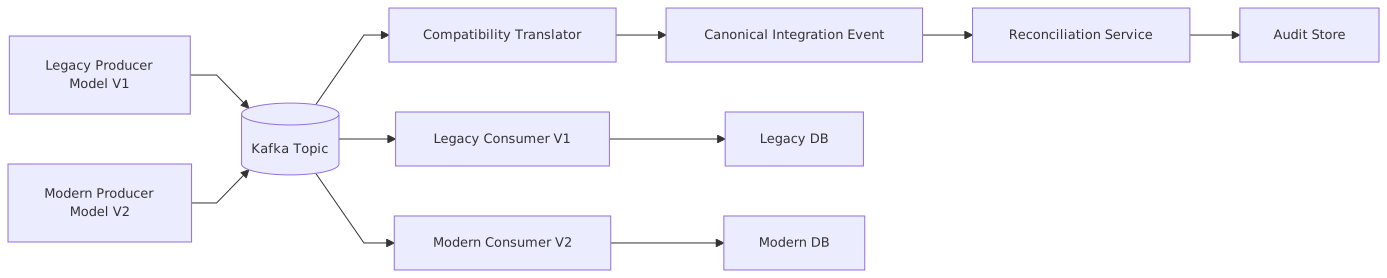
This diagram hides an important choice: where translation happens.
There are several options.
Producer-side translation
The producing service emits both v1 and v2 contracts, or emits one contract plus compatibility variants.
This can simplify consumers, but it loads semantic burden onto the producer. Over time producers become museums, preserving old meanings long after they understand them poorly.
Use this when one producer owns the domain truth and consumer migration is slow but predictable.
Consumer-side translation
Consumers accept old contracts and translate into their local model.
This respects bounded contexts and local autonomy. It also duplicates translation logic unless shared carefully. The danger is semantic fragmentation: every team translates differently.
Use this when consumers genuinely interpret events differently and need context-specific mappings.
Integration-layer translation
A dedicated compatibility or mediation layer normalizes contracts.
This can reduce duplication and centralize policy, but if overused it becomes the dreaded enterprise service bus in modern clothing. The trick is to keep it narrow: translation and compatibility, not hidden business logic.
Use this when many consumers need stable integration semantics and governance is important. EA governance checklist
My bias is clear: prefer translation at explicit boundaries close to ownership, and avoid giant centralized “smart pipes.” Distributed systems rot fastest when nobody knows where business meaning actually lives.
Domain semantics and aggregate boundaries
When model versions coexist, aggregate design matters more than people expect. If v2 introduces finer-grained invariants, you may need to split an old aggregate. A monolithic Order might become PurchaseOrder, Shipment, and Invoice aggregates with separate life cycles. In that case, translating v1 to v2 is not field mapping. It is decomposition.
That decomposition often cannot be perfectly reversible.
So be honest about lossy transformations. Mark them. Audit them. Design workflows to tolerate them.
For example:
- v1
CustomerType = BUSINESSmay map to v2Party = Organization - but v2 may also require legal representative relationships that v1 never had
- therefore an upcast from v1 to v2 may be partial, requiring enrichment or defaulting
- a downcast from v2 to v1 may collapse distinctions and lose meaning
If you do not state this explicitly, teams quietly invent defaults, and defaults are where enterprise bugs breed.
Contract versioning and Kafka
With Kafka, version coexistence tends to show up in three places:
- schema evolution on the same topic
- new topics for new versions
- canonical integration events emitted from source topics
Each has tradeoffs.
Same topic, evolved schema works when changes are backward or forward compatible and semantics remain close enough. Schema Registry and compatibility checks help. This is best for additive changes or careful evolution.
New topic per version gives clarity and isolation. It also multiplies operational overhead and consumer confusion. Good when semantics diverge materially and lifecycle control matters.
Canonical integration event can stabilize downstream consumers, but only if the canonical model is modest and genuinely shared. If it becomes an enterprise fantasy model, it will be ignored or distorted.
A practical pattern is:
- source topics owned by producing bounded contexts
- explicit event versions in schema metadata
- translation service for consumers that cannot yet move
- reconciliation stream to compare old and new interpretations during migration
Migration Strategy
Migration is where architecture meets reality, and reality usually wins.
A progressive strangler migration is the safest way to introduce a new model in a distributed estate. Instead of replacing the old model in one wave, you route selected capabilities through the new model, grow confidence, and gradually reduce the old system’s responsibility.
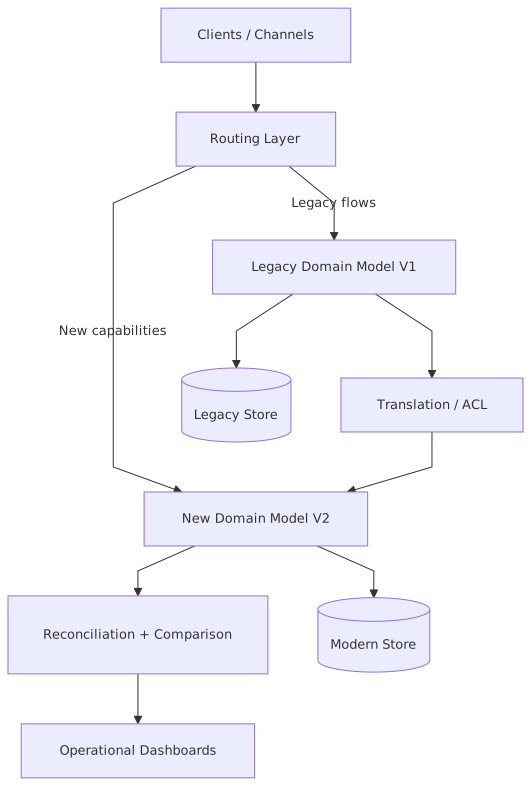
The migration usually has these phases.
Phase 1: Clarify semantics before touching code
This is where domain-driven design pays for itself. Gather domain experts and write down:
- what v1 means
- what v2 means
- which concepts are equivalent
- which are split or merged
- which invariants are new
- which mappings are partial or impossible
If you skip this, every team reverse-engineers semantics from payloads. That is organizational self-harm.
Phase 2: Introduce anti-corruption layers
Do not let the new model absorb legacy quirks directly. Put an anti-corruption layer between v1 and v2. Its job is to translate, validate, and make ambiguity visible.
This is especially important when a service is consuming legacy events from Kafka or integrating with a vendor platform whose model you cannot change.
Phase 3: Route low-risk flows first
Start where semantic drift is smallest and business blast radius is limited. Read-only use cases are ideal. Then move create flows, then update flows, and only later the deeply stateful, exception-heavy processes.
Architects who begin with the hardest flow usually end up proving only that migration is hard.
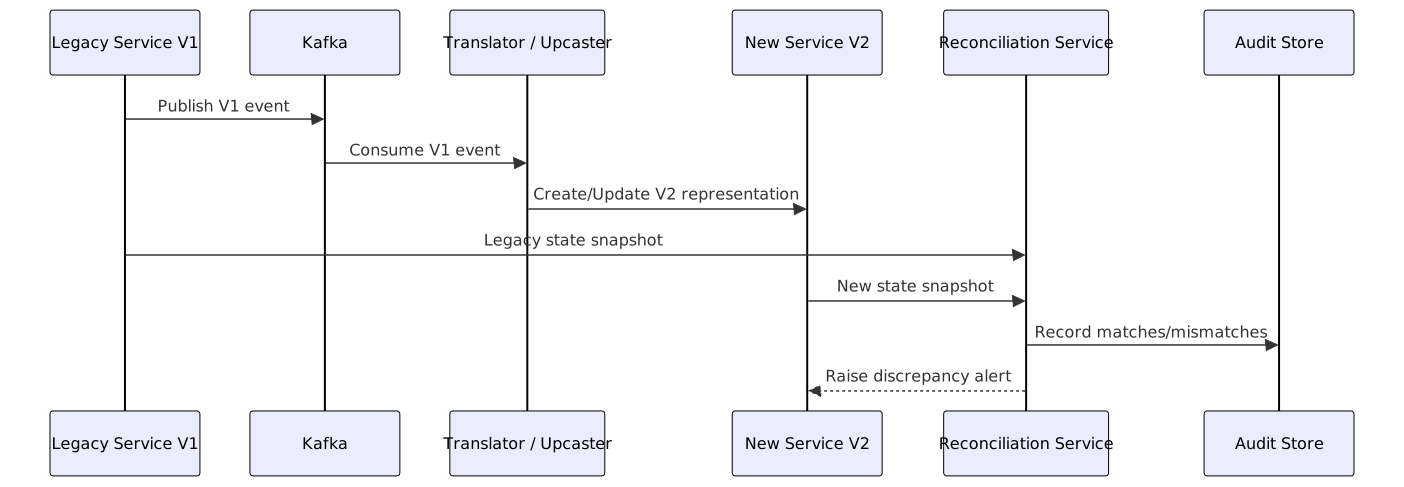
Phase 4: Run coexistence with reconciliation
During transition, both representations will exist. You need continuous comparison:
- counts
- state alignment
- key field equivalence
- missing mappings
- timing gaps
- business outcome deltas
Reconciliation is not a side utility. It is a core migration mechanism.
Phase 5: Shrink the old model’s authority
This is the strangler move that matters most. Pick a point at which v2 becomes the system of record for a given capability. Continue serving legacy consumers through translation if needed, but stop letting v1 remain the authoritative source.
Without this step, coexistence becomes permanent indecision.
Phase 6: Decommission with evidence, not optimism
Retire old paths only when:
- consumers have moved or are isolated behind adapters
- reconciliation discrepancies are understood
- historical access requirements are covered
- operational teams have updated runbooks
- compliance and audit stakeholders sign off
The last 10% of migration usually takes 50% of the calendar time. Plan for that. It is where rare cases, partner dependencies, and quarter-end processes hide.
Enterprise Example
Consider a global insurer modernizing policy administration.
The legacy platform models a Policy as a single aggregate with embedded coverage details, payment arrangements, named insured parties, and lifecycle status. It was built for personal lines. Over time, the insurer expanded into commercial products, broker relationships, mid-term endorsements, and region-specific compliance requirements. The old model became a suitcase with broken zippers.
The new architecture introduces bounded contexts:
- Policy Management
- Party and Relationship Management
- Billing
- Claims
- Distribution/Broker
In the new policy context, Policy remains important but no longer carries everything. Parties are externalized into a richer party model. Billing schedules become their own concern. Endorsements are handled as domain events and versioned policy snapshots rather than mutating the old record in place.
Sounds sensible. Now the hard part: the old claims and finance systems still consume the legacy policy contract. Broker systems still upload files with the old identifiers. Kafka topics already distribute policy-issued events to pricing analytics, data warehouse ingestion, and customer communications.
A naive team would announce a “policy model migration” and then discover six months later that every downstream process depends on slightly different interpretations of the old payload.
A better team does this:
- Defines semantic mappings between legacy
NamedInsured, newParty, and relationship roles. - Creates a compatibility event for
PolicyIssuedthat can be derived from the new model. - Introduces a policy translation service that emits both legacy-shaped and modern events during transition.
- Uses reconciliation to compare premium totals, coverage counts, billing schedule creation, and claims eligibility outcomes.
- Routes new commercial products only through the new model first, leaving personal lines on legacy until confidence grows.
- Gradually shifts policy issuance authority to the new platform, while preserving read access to historical legacy records for audit and servicing.
The trickiest issue in this example is not technical delivery. It is semantic asymmetry.
Legacy claims expects one primary insured. The new party model supports organizations, subsidiaries, and multiple insured roles. Downcasting from new to old requires selecting a primary party for old consumers. That is a business decision, not a mapper trick. If architects leave it to developers, the “primary party” rule will vary by team, and claims disputes will follow.
This is what model coexistence really means in enterprises: business decisions embedded in translation paths.
Operational Considerations
Most articles stop at the design. Production does not.
To run coexistence safely, you need operational mechanisms that are as deliberate as the model design.
Observability by version
Track traffic, latency, error rates, and business outcomes by model version. You want to know not just “is the service healthy?” but “is v2 producing different business behavior than v1?”
Useful dimensions include:
- events by schema version
- translation failures
- partial mappings
- reconciliation mismatches
- dual-write lag
- consumer version adoption
- idempotency conflicts
Replay and backfill
Kafka gives you replay, but replaying old events into a new model is not free. Upcasters may depend on reference data that has changed. Old assumptions may no longer hold. Build replay tooling that can pin translation logic to a historical ruleset when needed.
Otherwise replay becomes historical revisionism.
Idempotency and ordering
When v1 and v2 flows coexist, duplicate processing becomes easier to trigger. A legacy event may create a v2 object, then a direct v2 command updates it, then replay causes re-creation attempts. Use stable business keys, deduplication strategies, and careful ordering guarantees where the domain requires them.
Data stewardship
Someone must own unresolved mappings, ambiguous records, and exceptions. Often this lands on operations or data teams by accident. Better to design explicit stewardship workflows from the start.
Governance without paralysis
Version support windows, deprecation policies, schema review, and contract testing all matter. But beware process theater. The point is to reduce uncertainty, not build a committee economy.
Tradeoffs
There is no perfect coexistence strategy. There are only tradeoffs you choose openly or inherit badly.
Explicit translation vs direct compatibility
Explicit translators make semantics visible and testable. They also add components and latency. Direct compatibility inside each service feels simpler at first but spreads model debt everywhere.
I would take visible complexity over hidden complexity almost every time.
Dual-write vs asynchronous propagation
Dual-write can reduce lag during migration, but it is brittle. Partial failure creates inconsistency fast. Asynchronous propagation via Kafka is usually more resilient, but eventual consistency means reconciliation is mandatory.
If people are proposing dual-write casually, they have not lived through enough outages.
Canonical enterprise model vs bounded-context contracts
A canonical model can reduce interface sprawl for stable cross-cutting concepts. It can also become a political artifact that pleases governance and fits nobody. Bounded-context contracts preserve local clarity but increase translation work. ArchiMate for governance
Use canonical models sparingly, for genuinely shared language with narrow scope.
Long coexistence window vs forced migration
Long windows reduce business risk but increase operational burden and cognitive load. Forced migration accelerates simplification but can break downstream teams and operational stability.
A good architect balances urgency against institutional reality. Heroic deadlines are often just delayed incidents.
Failure Modes
Most coexistence efforts do not fail because versioning is impossible. They fail in familiar, avoidable ways.
1. Treating semantic change as field mapping
This is the classic error. Teams add adapters, keep payloads flowing, and miss the fact that business meaning changed. Everything looks green until reports disagree or a customer dispute exposes the gap.
2. Letting every consumer interpret versions differently
Without a clear translation policy, each microservice invents its own understanding. Soon there is no “v1 to v2 mapping,” only local folklore.
3. Permanent dual-write
Temporary dual-write has a way of becoming immortal. Then every outage becomes a consistency puzzle. If you must dual-write, put an expiry date on it and engineer toward removing it.
4. No reconciliation capability
If you cannot compare old and new outcomes systematically, you are migrating on vibes. That is not architecture. That is optimism with a dashboard.
5. Shared database shortcuts
When migration gets hard, teams tunnel under it by reading legacy tables directly. This preserves coupling, bypasses semantics, and usually delays the real work until it is more expensive.
6. Versioning everything forever
Infinite backward compatibility sounds customer-friendly. In practice it freezes evolution and creates a support burden nobody budgets for. Versions need retirement plans.
When Not To Use
Model version coexistence is a strategy, not a virtue. There are times not to lean into it.
Do not use prolonged coexistence when:
- the system is small enough for coordinated cutover
- the semantic change is minor and backward compatible
- there are very few consumers and all are under one team
- the legacy model is dangerously incorrect and continued use creates legal or safety risk
- operational maturity is too low to support reconciliation and observability
In some environments, especially smaller products, a planned cutover with brief disruption is better than months of coexistence machinery.
Also, do not build elaborate version coexistence infrastructure “just in case.” If your domain is stable and your team topology is simple, that architecture is overhead. The enterprise instinct to overprepare can be just as damaging as underpreparing.
Related Patterns
Several patterns work naturally with model version coexistence.
Anti-Corruption Layer
Essential when a new bounded context must interact with a legacy model without inheriting its semantics wholesale. This is usually the first pattern to reach for.
Strangler Fig Pattern
The migration backbone. New capabilities wrap around the old system and gradually replace it. Particularly useful when introducing a new domain model in a subset of flows first.
Event Upcasting
Useful in Kafka and event-sourced systems where old events need to be interpreted by newer consumers. But be careful: upcasting old syntax does not magically create missing semantics.
Parallel Run
Operate old and new paths simultaneously and compare outcomes. This is expensive but often justified for high-risk financial, insurance, or logistics processes.
Canonical Data Model
Sometimes helpful at integration boundaries, especially for stable enterprise concepts. Dangerous when used as a universal answer.
Saga and Process Manager
When coexistence spans multiple services and state transitions, sagas can coordinate workflows while models evolve asynchronously. But do not confuse workflow orchestration with semantic translation; they solve different problems.
Summary
Model version coexistence is one of those subjects that reveals whether an architecture is grounded in the business or merely arranged for diagrams.
The essential idea is straightforward: allow models to evolve without forcing the whole enterprise to move in lockstep. But the implementation is hard because the problem is not version numbers. It is meaning. Different versions often encode different understandings of the domain, and distributed systems spread those understandings across contracts, events, stores, and teams.
The way through is disciplined, not magical:
- treat models as bounded-context tools, not universal truths
- make translations explicit
- preserve one primary model per context
- use progressive strangler migration rather than synchronized replacement
- build reconciliation as a core capability
- monitor outcomes by version
- retire old versions deliberately
And above all, be honest about loss, ambiguity, and temporary inconsistency. Enterprises can tolerate complexity they can see. What they cannot tolerate for long is complexity that hides in adapters and only emerges during quarter close, audit season, or a major incident.
A good coexistence architecture does not promise a frictionless evolution. It creates controlled friction in the right places.
That is the difference between a migration that feels like surgery and one that feels like archaeology after an outage.
Frequently Asked Questions
What is a service mesh?
A service mesh is an infrastructure layer managing service-to-service communication. It provides mutual TLS, load balancing, circuit breaking, retries, and observability without each service implementing these capabilities. Istio and Linkerd are common implementations.
How do you document microservices architecture for governance?
Use ArchiMate Application Cooperation diagrams for the service landscape, UML Component diagrams for internal structure, UML Sequence diagrams for key flows, and UML Deployment diagrams for Kubernetes topology. All views can coexist in Sparx EA with full traceability.
What is the difference between choreography and orchestration in microservices?
Choreography has services react to events independently — no central coordinator. Orchestration uses a central workflow engine that calls services in sequence. Choreography scales better but is harder to debug; orchestration is easier to reason about but creates a central coupling point.