⏱ 20 min read
Distributed systems don’t fail in one place. They fray at the edges.
That’s the real observability problem. Not whether you have traces, metrics, and logs. Most serious enterprises already do. They’ve bought the platforms, instrumented the frameworks, pushed OpenTelemetry agents into half their estate, and built dashboards dense enough to frighten a pilot. And still, when an incident lands, the same question emerges in the war room:
Where did the request stop making sense?
That question is not about telemetry volume. It is about boundaries. The places where one domain hands work to another. Where synchronous becomes asynchronous. Where a business transaction becomes three technical transactions and two retries. Where the “customer order” in one service becomes a “shipment request” in another and a “settlement instruction” in a third. The cracks in a distributed system are rarely in the nodes themselves. They sit in the handoffs.
This is why observability boundaries matter. They are the seams that tell you where one unit of responsibility ends and another begins. Without them, tracing becomes a pretty line drawing of technical calls with very little business meaning. With them, observability starts to reflect the actual architecture: bounded contexts, ownership, contracts, failure isolation, compensations, and the awkward truth that not every process is one end-to-end transaction.
A lot of teams treat distributed tracing as if it were a universal solvent. Add trace IDs everywhere, stitch together spans, and somehow the whole system becomes intelligible. It doesn’t. A trace can cross too much. It can imply causality where there is only correlation. It can blur a business boundary that should remain explicit. Worse, it can create the illusion that all work belongs to one narrative, even when the business has already split it into separate commitments.
Observability should not erase architectural boundaries. It should illuminate them.
That’s the position of this article. If you’re operating microservices, event-driven systems, Kafka pipelines, or a hybrid estate that still includes batch, APIs, and a few majestic legacy systems that everyone is afraid to touch, then observability boundaries are one of the most practical architectural concepts you can adopt. They help define what should be traced continuously, what should be correlated indirectly, where reconciliation is required, and where operational accountability changes hands.
Context
In a monolith, the boundary story is boring. A request comes in, code executes in one process, data changes in one transaction scope, and if you’re lucky the logs are enough. Even there, internal module boundaries matter, but operationally the system behaves as one machine.
Distributed systems change the game. You split a business capability into services—perhaps sensibly around domain-driven design bounded contexts, perhaps less sensibly around team structures or fashionable decomposition. Calls now leave process space. State changes happen in different datastores. Events are published to Kafka. Consumers act later, maybe seconds later, maybe hours later. Retries occur. Duplicate messages occur. Partial failures become normal. event-driven architecture patterns
The result is that technical topology and business topology drift apart.
A customer places an order. To a human, that is one thing. To the architecture, it may involve:
- Order API validation
- Pricing service enrichment
- Inventory reservation
- Payment authorization
- Fraud screening
- Order persistence
- Event publication to Kafka
- Fulfillment orchestration
- Notification dispatch
Some of those happen synchronously. Some asynchronously. Some are best-effort. Some are legal commitments. Some can be retried safely. Some absolutely cannot.
If you don’t define observability boundaries, your telemetry model ends up accidental. One team propagates W3C trace context across HTTP. Another injects custom correlation IDs into Kafka headers. A third starts new traces for scheduled consumers because “that’s how the library works.” Soon your dashboards show either broken traces or giant octopus traces that look impressive and answer very little.
An enterprise architecture worth the name has to do better than that.
Problem
The central problem is simple to state and hard to solve:
In distributed systems, technical traces often cross boundaries that the business, the operating model, and the failure model do not.
That mismatch creates several practical problems.
First, incident diagnosis becomes confused. Teams can see that Service A called Service B, which emitted an event consumed by Service C, which triggered Service D. But they cannot tell whether those are parts of one business transaction, one eventual workflow, or merely related activities linked by a shared identifier.
Second, accountability gets muddy. If an order is accepted but fulfillment never starts, who owns the incident? The order team? The eventing platform team? The fulfillment team? The answer depends on where the responsibility boundary sits. A trace alone won’t tell you.
Third, SLOs become meaningless. If you publish a single “end-to-end latency” metric for a process that includes asynchronous waiting, manual review, queue delay, and external partner callbacks, you’re measuring a story, not a service. It may be useful for customer experience. It is terrible for operational management unless decomposed by boundary.
Fourth, data consistency problems get hidden. Enterprises often confuse observability with consistency. They’re related, but not the same. Seeing that a message was emitted does not prove downstream state is correct. At domain boundaries, especially asynchronous ones, you need reconciliation as a first-class discipline. Otherwise telemetry can reassure you while the books drift apart.
And finally, over-connected tracing can become dangerous. It increases storage costs, creates privacy risks, and encourages teams to couple implementation choices around trace continuity rather than sound domain design.
The hard truth: an uninterrupted trace is not always a good architecture outcome.
Forces
Several forces pull in different directions.
1. Business semantics versus technical flow
Domain-driven design tells us to model around business meaning. Bounded contexts exist because different parts of the enterprise use different language, rules, and data ownership. “Order,” “invoice,” “shipment,” and “payment” are not the same thing just because they happen in sequence.
Observability should respect these semantic boundaries. But tracing tools naturally favor technical adjacency: this request called that service, that service emitted this event. The tool sees continuity. The business sees translation.
2. Synchronous convenience versus asynchronous reality
HTTP tracing is straightforward. Context propagation is standardized. Span trees are intuitive. Kafka and event-driven systems are messier. One event may lead to many consumers. A consumer may process in batches. Retries may happen hours later. Replays may intentionally recreate history.
Trying to force a neat parent-child span model onto event streams usually ends badly.
3. Local optimization versus enterprise coherence
Individual teams optimize for local debugging. They want maximum visibility into their code path. Enterprise architects need a coherent operational model across dozens or hundreds of services. That means setting rules for where traces continue, where they stop, and what metadata bridges them.
4. Auditability versus observability
Business processes that matter—payments, claims, settlements, regulatory submissions—need audit trails, not just traces. Audit asks “what decision was made, by whom, on which business object, under which policy?” Tracing asks “what code path ran, when, and how long did it take?” They overlap, but they are not substitutes.
5. Low latency versus correctness
A boundary often introduces eventual consistency. That improves decoupling and resilience, but now correctness moves from transaction management to compensations and reconciliation. Observability must support this shift, otherwise incidents become accounting exercises performed by hand.
Solution
The core solution is to define observability boundaries aligned to domain and operational responsibility, not merely network hops.
An observability boundary is a deliberate point in the architecture where one of the following changes:
- business semantics
- ownership or team responsibility
- consistency model
- failure handling model
- SLA/SLO expectations
- security or compliance posture
At these points, you should decide explicitly whether to:
- Continue the same trace,
- Start a new trace but correlate via business identifiers, or
- Emit a domain activity record and rely on reconciliation rather than span continuity.
That decision is architectural, not incidental.
A useful rule of thumb:
- Inside a bounded context, continuous tracing is usually appropriate.
- Across bounded contexts via synchronous API contracts, trace continuation may be acceptable if the call is part of one immediate interaction and ownership expectations are clear.
- Across asynchronous domain events, prefer correlation over strict trace continuity.
- Across long-running workflows, batch, partner integrations, and human tasks, treat each stage as a separate observable unit connected by durable business identifiers and reconciliation controls.
This sounds subtle. In practice it’s liberating.
You stop trying to draw one perfect end-to-end line through the entire enterprise. Instead, you create a set of meaningful traces and a correlation fabric around them: order ID, payment ID, shipment ID, saga ID, customer ID, settlement batch ID. Technical telemetry tells you how each bounded piece behaved. Domain correlation tells you how the business process progressed.
That distinction matters enormously.
Architecture
Let’s make this concrete.
Imagine a commerce platform with these bounded contexts:
- Ordering
- Payments
- Inventory
- Fulfillment
- Customer Communications
Ordering accepts customer intent. Payments manages authorization and capture. Inventory manages stock commitments. Fulfillment manages physical dispatch. Communications sends emails and messages.
These are not just services. They are separate semantic worlds. A submitted order is not a payment authorization. A stock reservation is not a shipment. The architecture should reflect that, and observability should too.
Boundary model

Within Ordering, you can maintain a coherent request trace from API gateway through application services, policy checks, persistence, and event publication. That’s one local transaction scope, even if implemented with an outbox pattern.
When Ordering calls Payments synchronously to authorize a card before accepting the order, you have a choice. If this is truly part of the immediate user interaction and the operational expectation is direct dependency, then trace propagation across the call is reasonable. But the payment service should still record its own domain activity: PaymentAuthorizationRequested, PaymentAuthorized, or PaymentDeclined.
When Ordering emits OrderAccepted to Kafka, the game changes. Inventory and Fulfillment are not child spans in some neat call tree. They are independent bounded contexts reacting to a published fact. Their work should typically start new traces, linked by correlation metadata such as:
orderIdeventIdcausationIdcorrelationIdtenantIdcustomerIdwhere appropriate- event schema version
This gives you visibility without pretending a single transaction spans everything.
Trace boundary diagram
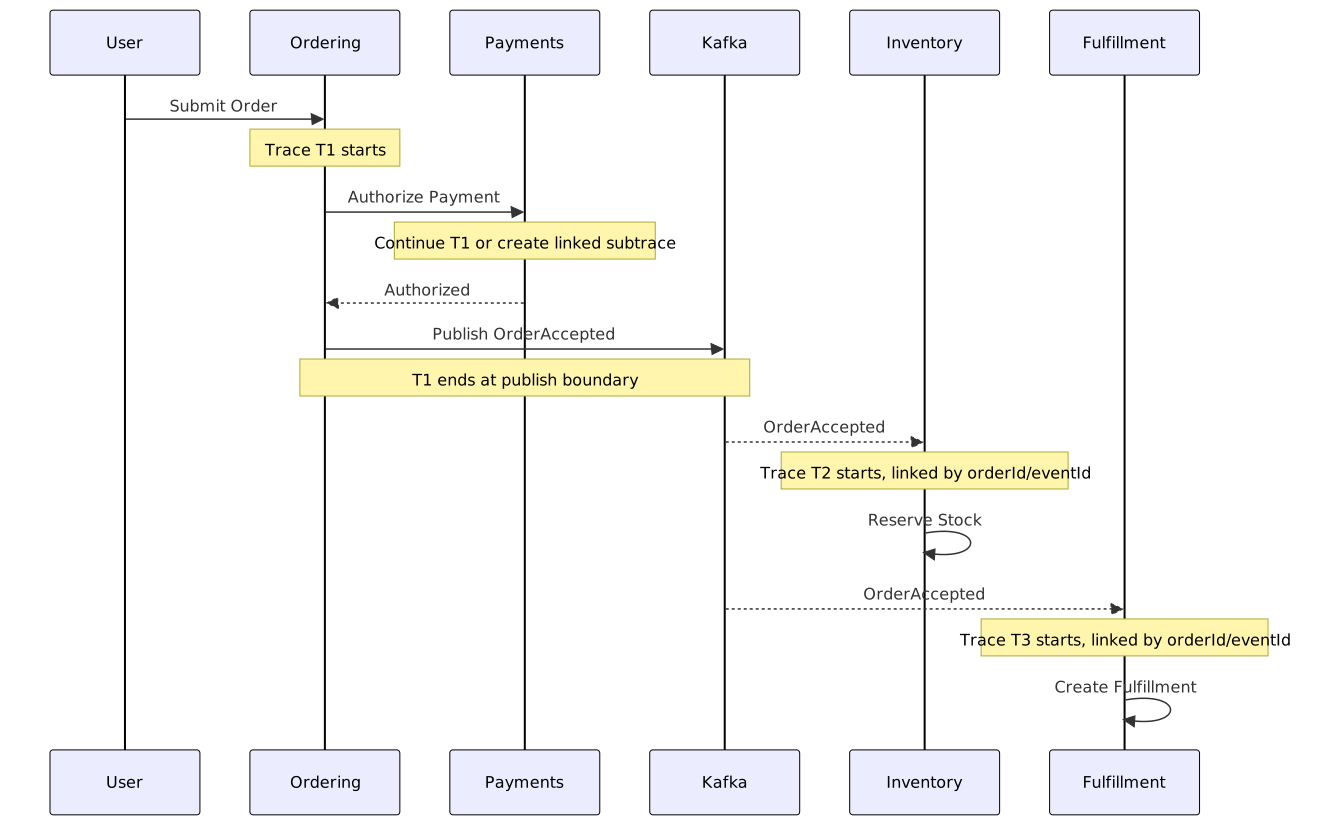
That “T1 ends at publish boundary” line is the heart of the matter. It says the ordering request has completed its responsibility when it has durably committed the fact that the order was accepted and published it reliably. Inventory and Fulfillment are downstream business reactions, not hidden continuation steps.
This model gives you sharper operational thinking:
- Ordering SLO: time to accept order and publish
OrderAccepted - Inventory SLO: time from consuming
OrderAcceptedto reservation outcome - Fulfillment SLO: time from consuming
OrderAcceptedto fulfillment creation - Business KPI: total elapsed time from order acceptance to shipment readiness
Notice the difference. Operational SLOs live within boundaries. Business KPIs span them.
That’s a much saner architecture.
Domain semantics over telemetry mechanics
A common anti-pattern is to define observability around middleware: “all incoming messages continue the parent trace if header X exists.” That’s easy. It’s also lazy architecture.
A better approach is to ask domain questions:
- Is this action still part of the same business commitment?
- Can the caller reasonably expect direct completion?
- If the downstream step fails later, does the upstream commitment remain valid?
- Is this handoff a translation into another bounded context’s language?
- Will recovery happen by retry, compensation, or reconciliation?
If the answer points to independent responsibility, break the trace and correlate.
Observability should follow the domain model, not bully it.
Migration Strategy
Most enterprises do not get to redesign observability from scratch. They inherit a tangle: some services emit spans, some don’t; Kafka headers are inconsistent; logs carry ten different correlation keys; legacy systems write flat files overnight and call it integration.
So migration must be progressive. This is a strangler problem as much as an instrumentation problem.
Stage 1: Identify business-critical seams
Start with the boundaries that hurt during incidents:
- order accepted to payment confirmed
- trade booked to settlement instructed
- claim registered to payout approved
- customer onboarding to account activated
Do not begin with every service. Begin with every painful handoff.
Map bounded contexts, event flows, APIs, and ownership lines. You’re not just cataloging telemetry. You’re defining where responsibility changes.
Stage 2: Standardize correlation vocabulary
Pick a small set of canonical identifiers:
traceIdspanIdcorrelationIdcausationId- domain object IDs such as
orderId,paymentId,claimId
Then define when each is required. In Kafka, put them in headers. In logs, put them in structured fields. In audit events, include the domain IDs and decision metadata. This is plumbing, but good plumbing changes lives.
Stage 3: Introduce publish-boundary discipline
For event producers, define the “done” point clearly. Usually this means transactionally persisting local state and ensuring event publication through an outbox or equivalent reliable mechanism. The producer trace ends there.
Do not let downstream consumer work determine whether the producer request is marked successful unless the business truly requires a synchronous guarantee.
Stage 4: Add consumer-local traces
Each consumer starts a new trace for its own processing. It links to upstream metadata but owns its own spans, retries, dead-letter handling, and timing.
Stage 5: Build reconciliation views
This is where many observability programs stop too soon. Traces tell you execution paths. Reconciliation tells you whether the business process is complete and consistent.
You need views like:
- orders accepted with no payment outcome after 15 minutes
- payment captured with no order marked paid
- shipment created without inventory reservation
- Kafka event published but no consumer completion record
These are not dashboards in the usual technical sense. They are cross-boundary control reports.
Strangler migration view
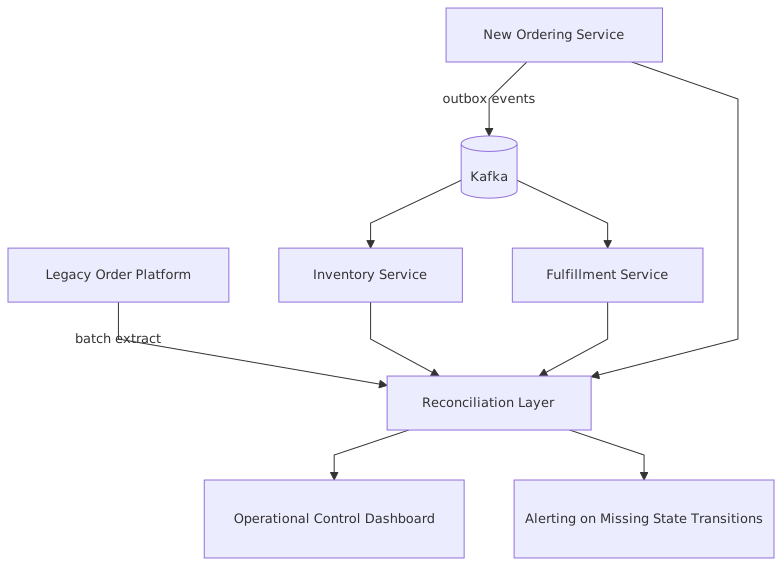
This pattern is deeply practical in migration. While strangling a monolith, you often cannot achieve perfect trace continuity across old and new systems. Fine. Don’t pretend. Build a reconciliation layer that compares expected state transitions across estates. That is frequently more valuable than forcing distributed tracing into legacy code that barely logs coherently.
Enterprise Example
Consider a large insurer modernizing claims processing.
The legacy claims platform handled claim registration, policy validation, fraud scoring, reserve calculation, adjuster assignment, payment approval, and regulatory reporting in one immense application. Over time, the insurer split capabilities into microservices and event-driven workflows. Kafka became the integration backbone. Everyone was pleased for about six months. microservices architecture diagrams
Then incidents started to reveal the cracks.
A claim would be registered successfully in the new Claims Intake service. A ClaimRegistered event would be published. Fraud screening might run quickly, or might be delayed by a scoring vendor outage. Reserve calculation could complete. Adjuster assignment might fail due to stale organizational data. Payment approval would only happen days later, after human review. Reporting to the regulator happened in another platform entirely.
The initial observability design tried to preserve a single end-to-end trace stitched through every possible step. It looked impressive in demos. In production it was nonsense.
Why? Because “claim processing” was not one operational unit. It was a set of bounded contexts:
- Claims Intake
- Fraud
- Policy Administration
- Reserving
- Adjusting
- Payments
- Regulatory Reporting
Each had different latency expectations, different owners, and different failure models. Some were immediate, some asynchronous, some human-in-the-loop.
The insurer changed the model.
Claims Intake retained a local trace from API request through claim creation and durable publication of ClaimRegistered. Fraud, Reserving, and Adjusting each started their own traces when consuming the event. They linked activity using claimId, correlationId, and causationId. Human tasks emitted domain activity records rather than long-lived spans. A control service built reconciliation views:
- claims registered with no fraud disposition after SLA threshold
- claims approved for payment but not settled
- payment issued with no general ledger posting
- regulator-notifiable claims missing reporting status
This changed operations dramatically. Incident calls no longer argued about “broken traces.” They discussed missed domain transitions. Teams owned the boundaries they actually controlled. Regulators got better audit evidence. And architecture reviews improved because they now asked, “What is the observability boundary here?” before approving new flows.
That’s what mature enterprise architecture looks like: less magic, more clarity.
Operational Considerations
SLO design
Define SLOs per boundary, not per fantasy end-to-end transaction. A service can own latency, availability, and error budgets inside its responsibility zone. Cross-boundary measures should be framed as customer journey KPIs or business process indicators.
Kafka specifics
Kafka introduces sharp edges:
- consumer lag is not processing success
- offset commit is not business completion
- reprocessing can duplicate side effects
- topic retention affects replay observability
- partitioning influences ordering guarantees
Your telemetry should therefore distinguish:
- event received
- event validated
- event business-applied
- side effects completed
- offset committed
- event dead-lettered
Do not compress these into one “processed” metric. That way lies deceit.
Reconciliation as an operational capability
At asynchronous boundaries, reconciliation is not a fallback. It is part of the design. You need periodic jobs or streaming control checks that compare source-of-truth states across bounded contexts. This is especially important for money movement, inventory, compliance, and customer communications.
Security and privacy
Trace and correlation metadata can leak sensitive data if badly governed. Keep personal data out of trace fields. Use opaque identifiers where possible. Apply retention policies. Observability estates are often less tightly controlled than transactional stores; architects who ignore that are building breach accelerators.
Sampling strategy
Head-based sampling often misses rare but important edge cases across boundaries. Tail-based sampling or rule-based retention for business-critical flows works better. But be selective. Capturing every span in a busy event mesh will produce heroic bills and mediocre insight.
Tradeoffs
There is no free lunch here.
The biggest tradeoff is between narrative simplicity and architectural honesty. One giant end-to-end trace is easy to explain but often wrong. Boundary-aware observability is more nuanced. It asks operators to think in terms of linked traces, domain events, and reconciliation states.
Another tradeoff is tooling convenience versus domain fidelity. Most observability products are better at request trees than long-running distributed business processes. You will likely need custom correlation views, domain event stores, or control dashboards. That is more work. It is also more useful.
There is also a governance tradeoff. Standardizing identifiers, event headers, and boundary rules can feel heavy to autonomous teams. But without that discipline, enterprises end up with telemetry Babel. EA governance checklist
And finally there is the migration tradeoff. You can spend years trying to retrofit perfect tracing into legacy systems, or you can establish coarse observability boundaries and backstop them with reconciliation. In large enterprises, the second option is often the better investment.
Failure Modes
This pattern fails in recognizable ways.
1. Trace absolutism
Teams insist every downstream action must remain in one trace. The result is sprawling, fragile, misleading telemetry and poor ownership clarity.
2. Correlation chaos
Everyone invents their own IDs. requestId, correlationId, transactionId, messageId, all inconsistently populated. Cross-system diagnosis becomes archaeology.
3. No business identifiers in telemetry
A beautiful trace with no orderId or claimId is a toy. Operations lives in domain objects, not span names.
4. Missing reconciliation
The architecture relies on eventual consistency but provides no systematic way to detect drift. Problems surface through customers, finance, or regulators. That is expensive feedback.
5. Boundary denial during migration
A monolith is decomposed, but observability assumptions remain monolithic. Teams still expect immediate, transactional certainty across asynchronous steps. Incidents then get misdiagnosed as platform issues rather than design realities.
6. Ownership gaps
A handoff exists but no team owns the control point. Messages are published, consumers exist, but nobody owns the “published but not acted upon” gap. This is one of the most common enterprise blind spots.
When Not To Use
Boundary-aware observability is not mandatory everywhere.
Don’t overcomplicate small systems. If you have a modest service estate with mostly synchronous calls and a stable ownership model, ordinary distributed tracing may be enough. Adding elaborate boundary policies and reconciliation layers would be architecture cosplay.
Don’t force this model onto low-value internal tooling where the business semantics are thin and the operational stakes are low.
And don’t use observability boundaries as an excuse for sloppy service design. If two services are so tightly coupled that they always succeed or fail together and share one operational owner, splitting the trace may just hide a bad decomposition. Sometimes the right answer is to merge services, not decorate the gap.
Also, if your event-driven architecture is immature—no idempotency, no outbox, no schema governance, no dead-letter strategy—then observability boundaries won’t save you. They make a good architecture visible. They do not create one. ArchiMate for governance
Related Patterns
Several patterns pair naturally with observability boundaries.
- Bounded Contexts from domain-driven design: the semantic backbone.
- Outbox Pattern: establishes a reliable producer-side publish boundary.
- Saga / Process Manager: coordinates long-running workflows while preserving local autonomy.
- Idempotent Consumer: essential for safe retries and replay.
- Dead Letter Queue handling: makes failures explicit at asynchronous boundaries.
- Control Tables / Reconciliation Reports: detect and correct drift across contexts.
- Strangler Fig Migration: modernize incrementally while preserving operational visibility.
- Audit Logging: complements tracing with business decision history.
A mature enterprise architecture often uses several of these together. That’s not over-engineering. That’s what reality costs.
Summary
Observability in distributed systems is not a matter of drawing longer traces. It is a matter of respecting boundaries.
The important boundaries are not network boundaries. They are domain boundaries, ownership boundaries, consistency boundaries, and failure boundaries. Inside them, trace deeply. Across them, correlate intentionally. Where time, autonomy, and eventual consistency dominate, reconcile relentlessly.
That gives you something better than technical visibility. It gives you operational truth.
If you remember one line, make it this:
A trace shows how work moved. A boundary explains who owns the meaning of that work.
That distinction is what turns telemetry into architecture.
And in the enterprise, architecture is not there to impress dashboards. It is there to help people run the business when the system is under strain, the queue is backing up, Kafka is red, a regulator is asking questions, and the war room wants an answer that is both technically precise and business-legible.
That is the standard worth designing for.
Frequently Asked Questions
What is a service mesh?
A service mesh is an infrastructure layer managing service-to-service communication. It provides mutual TLS, load balancing, circuit breaking, retries, and observability without each service implementing these capabilities. Istio and Linkerd are common implementations.
How do you document microservices architecture for governance?
Use ArchiMate Application Cooperation diagrams for the service landscape, UML Component diagrams for internal structure, UML Sequence diagrams for key flows, and UML Deployment diagrams for Kubernetes topology. All views can coexist in Sparx EA with full traceability.
What is the difference between choreography and orchestration in microservices?
Choreography has services react to events independently — no central coordinator. Orchestration uses a central workflow engine that calls services in sequence. Choreography scales better but is harder to debug; orchestration is easier to reason about but creates a central coupling point.