⏱ 18 min read
Distributed systems do not usually fail because the network is slow. They fail because we lie to ourselves about what kind of work is happening.
That sounds harsher than it is, but in enterprise architecture the expensive mistakes are often semantic mistakes, not technical ones. We build a platform as if every service must agree right now, when the business only needs eventual agreement by end of day. Or we go the other way and scatter everything through asynchronous messaging, then discover a customer checkout cannot “eventually” reserve inventory after payment has already been captured. The trouble is not sync versus async as a technical toggle. The trouble is coordination versus collaboration as a domain choice.
That distinction matters. A lot.
People often talk about distributed systems in transport language: REST versus messaging, HTTP versus Kafka, request-reply versus pub/sub. Useful, but incomplete. The more important question is this: are these components trying to decide something together, right now, under one business moment? Or are they contributing independent work toward a shared business outcome over time?
That is the line between coordination and collaboration.
Coordination is a tight moment. A decision must be made now, often with a single customer waiting on the other side of the screen. Collaboration is looser. Services act as domain participants, each doing their part, often on different clocks, with reconciliation mechanisms to make the whole business process coherent.
If you get this wrong, your architecture fights your business. If you get it right, your system becomes easier to evolve, easier to scale, and much more honest about failure.
Context
Modern enterprises live in a mixed world. They have digital channels that need immediate answers, back-office processes that can tolerate delay, legacy systems that still own core records, and growing pressure to decompose large platforms into domain-aligned services. Somewhere in the middle sits the architecture team, being asked to “make it event-driven” while also guaranteeing consistency, low latency, regulatory traceability, and zero outages. In other words, the usual impossible shopping list.
In that world, sync versus async is too shallow a framing. It encourages a technology-first conversation. Teams argue over whether Kafka should replace REST, whether microservices should call each other directly, whether sagas are better than distributed transactions. These are important details, but they come later. event-driven architecture patterns
The earlier question is domain-driven: what is the business interaction really asking for?
In domain-driven design terms, this is about the semantic boundary of a transaction and the autonomy of bounded contexts. If two capabilities belong to separate bounded contexts, we should be suspicious about forcing them into a single runtime decision unless the business genuinely requires it. Every synchronous dependency leaks one context into another. Every asynchronous handoff creates a time gap that must be explained in business language.
That is why architecture is not just plumbing. It is semantics made operational.
Problem
Teams building distributed systems often reach for one of two bad defaults.
The first bad default is accidental coordination. Everything calls everything else synchronously because it is easy to understand in code and easy to demo in a happy path. One service receives a request, then fans out to pricing, inventory, fraud, customer profile, tax, shipping, entitlement, loyalty, and payment authorization. The result looks clean in a sequence diagram and catastrophic in production. Latency stacks. Availability collapses to the weakest dependency. Retry storms spread like fire. A small timeout becomes a business outage.
The second bad default is careless collaboration. Architects embrace asynchronous messaging everywhere and call it decoupling. Events fly across Kafka topics. Services update independently. Then reality arrives: users demand a definitive answer, auditors ask who approved what and when, and finance notices that the order service says “confirmed” while fulfillment says “rejected” and billing says “pending review.” Event-driven does not remove consistency needs. It changes how and when you satisfy them.
So the real problem is not choosing a communication style. It is deciding where business coordination is truly required and where domain collaboration is enough.
Forces
This decision sits in the middle of several competing forces.
1. User expectation versus system autonomy
Some interactions need an immediate result. “Can I log in?” “Did my card authorize?” “Is this seat still available?” In these cases, delayed answers are not merely inconvenient; they violate the user experience or even the legal contract.
Other interactions are naturally collaborative. “Provision this enterprise customer across six downstream platforms.” “Update marketing preferences.” “Generate month-end partner settlement.” Here, the business is already used to a process unfolding over time.
2. Consistency versus availability
This is the old distributed systems bargain in enterprise clothes. Tight coordination gives stronger immediate consistency but costs resilience and scalability. Collaboration improves autonomy and failure isolation but demands eventual consistency, reconciliation, and richer operational tooling.
3. Domain ownership
Bounded contexts are meant to own their models. If one context must synchronously ask another to complete its own decision, autonomy is already compromised. Sometimes that is acceptable. Often it is a smell. A service that cannot decide without consulting five others is not autonomous; it is merely fragmented.
4. Legacy constraints
Real companies do not start from greenfield diagrams. They have ERP systems with nightly batch windows, customer master platforms with strong governance, and payment gateways with hard transactional semantics. Architecture must absorb these constraints without pretending they do not exist. EA governance checklist
5. Auditability and regulatory obligations
In many enterprises, it is not enough to reach the correct state eventually. You need evidence: what happened, in which order, under whose authority, with what compensations. Collaboration architectures need stronger event lineage and reconciliation controls than teams often anticipate.
Solution
Here is the opinionated answer: use coordination for business moments that require a single decision now; use collaboration for business processes that can converge over time.
That sounds simple. It is not simplistic.
A coordinated interaction is one where the system must present one coherent answer at a point in time. This usually fits synchronous request-reply, though it may still involve asynchronous internals behind a façade. The key is not the protocol. The key is the semantic commitment: the caller receives a definitive outcome for that business moment.
A collaborative interaction is one where bounded contexts contribute state changes or actions independently, using events, commands, workflows, or queued tasks, with reconciliation ensuring the overall business outcome reaches integrity. Here, eventual consistency is not a technical compromise. It is a deliberate model of the business process.
One useful test is this:
- If the customer or upstream system cannot proceed safely without an answer now, prefer coordination.
- If the business can proceed with a pending state and converge later, prefer collaboration.
Another test is domain ownership:
- If a service needs another domain’s authority to make a decision, maybe you need coordination.
- If a service only needs to inform or trigger another domain’s work, collaboration is usually better.
A simple mental model
Coordination is like air traffic control. Everyone must agree on a narrow shared moment or the runway becomes unsafe.
Collaboration is like building a house. Electricians, plumbers, framers, inspectors, and suppliers all contribute at different times. You still need a plan, status, and issue management, but not everyone has to stand in one room and vote on every nail.
Architecture
A healthy enterprise architecture usually contains both styles. The trick is to place them intentionally.
At the edge, user-facing journeys often need coordinated responses. Inside the estate, longer-running domain processes usually benefit from collaboration. This creates a layered shape: synchronous decisions where immediacy matters, asynchronous propagation and processing where autonomy matters.
Coordinated flow
A coordinated flow often uses API composition or orchestration. But this is where architects must be disciplined. Coordination should be narrow. It should involve only capabilities essential to the immediate business decision. If you synchronously call every system that might someday care, you have confused “need to know now” with “will care eventually.”
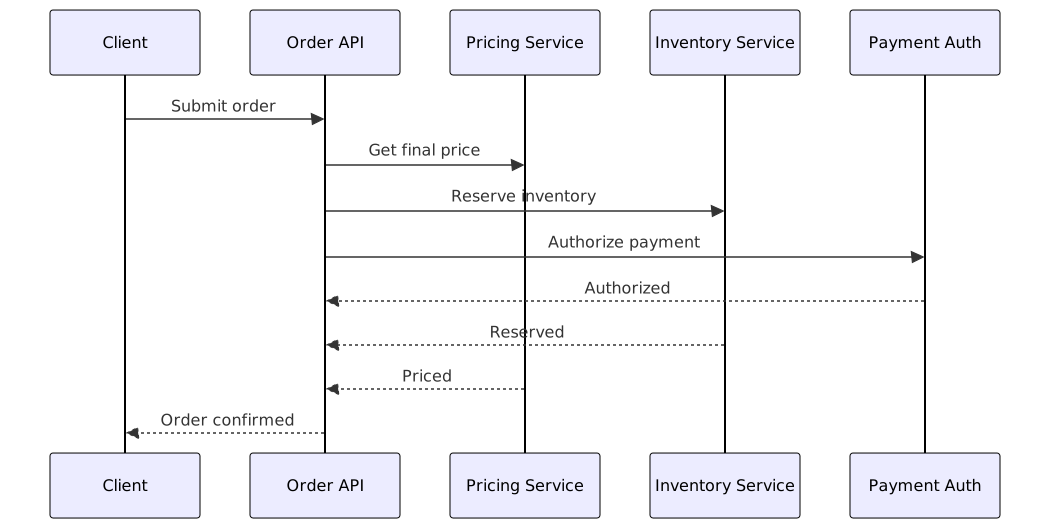
This is valid architecture when the domain genuinely demands it. Seat booking, payment authorization, identity verification, and inventory reservation often sit here. But there is a hard limit: every synchronous hop is an availability tax.
Collaborative flow
Collaborative architectures model the business process as state transitions over time. Services publish facts or receive commands asynchronously. Kafka is particularly useful here because it gives durable event streams, replay capability, and decoupling at scale. But Kafka does not do your thinking for you. It is only valuable if your events reflect domain semantics rather than technical noise.
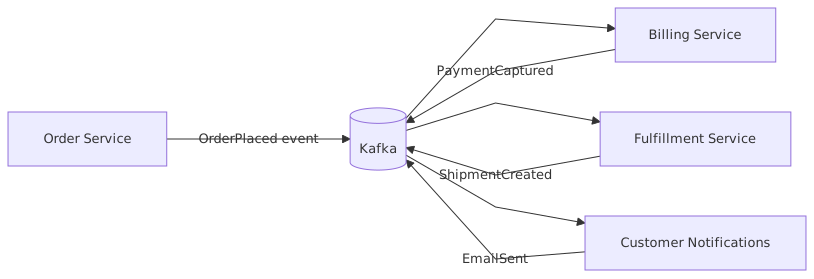
Notice what changes here. No central service waits for all participants before responding. Instead, each bounded context acts on domain events relevant to its own responsibilities. This is collaboration. The system reaches a business outcome through a sequence of independent but related steps.
The domain semantics discussion
This is the part many teams skip, then regret.
Events and synchronous calls must be named from the business, not the database. “CustomerUpdated” is often a lazy event because it says nothing about what changed or why. “CustomerCreditLimitApproved,” “DeliveryAddressCorrected,” or “KYCStatusChanged” are much more useful because downstream domains can reason about them.
Likewise, synchronous APIs should represent business decisions, not data fetches masquerading as services. “AuthorizePayment” is a domain action. “GetPaymentInfo” may just be a data leak across bounded contexts.
DDD helps here because it forces us to ask:
- What aggregate makes this decision?
- What invariants must hold immediately?
- Which bounded context owns the language and authority?
- What can be eventually consistent without harming the domain?
If you cannot answer those questions, you are not ready to choose sync or async. You are still drawing boxes.
Coordination with collaboration behind it
A common and practical pattern is to coordinate only the front-door decision, then collaborate for everything after. For example, confirm an order once price, stock reservation, and payment authorization are complete. Then asynchronously trigger fulfillment, invoicing, analytics, email, and CRM updates.
That keeps the user journey crisp while avoiding unnecessary coupling deeper in the estate.
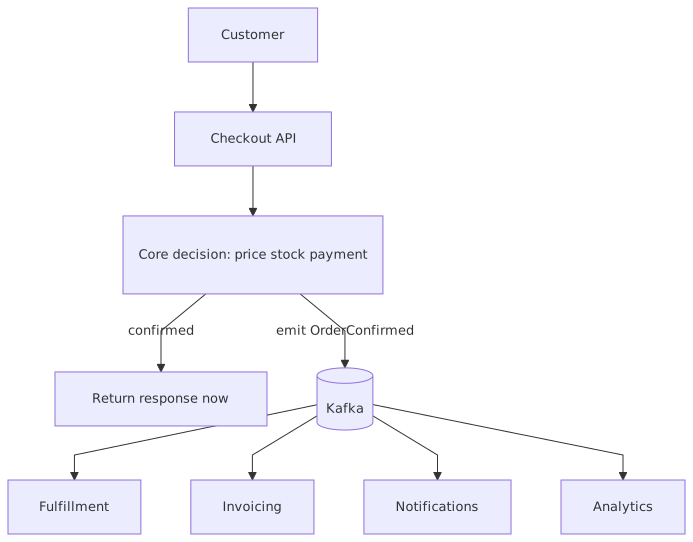
This hybrid style is the one I recommend most often in enterprises. It respects real business moments without turning the whole architecture into a chain of brittle synchronous dependencies.
Migration Strategy
No serious enterprise gets to redesign this in one move. You migrate by reducing accidental coordination and introducing collaboration where the business can tolerate it. This is classic strangler thinking, but with domain semantics as the guide rail.
Start by identifying journeys where synchronous chains are too long, too fragile, or semantically dishonest. Then separate the true immediate decision from downstream consequences.
Progressive strangler migration
- Map current runtime dependencies
Not the PowerPoint version. The real one. Which services call which, with what latency, retry patterns, timeout budgets, and operational failure rates?
- Find the business cut line
Ask what must be known now versus what can be pending. This is a domain workshop, not a technical backlog session.
- Introduce a stable façade
Keep the external contract steady while internal responsibilities shift. This lets you evolve from synchronous orchestration to event-driven collaboration without breaking channels.
- Publish domain events from the point of truth
Use outbox or transaction log capture patterns if needed. Do not rely on “best effort” event publishing after a database commit. That way lies phantom states.
- Move non-critical downstream actions off the synchronous path
Notifications, search indexing, CRM sync, reporting, and many fulfillment steps are common first candidates.
- Add reconciliation before you think you need it
Event-driven migration without reconciliation is optimism pretending to be architecture.
- Retire synchronous calls incrementally
Measure latency and error-budget gains. This helps prove the migration is improving business resilience, not just rearranging diagrams.
Reconciliation is not optional
In collaborative systems, things drift. Messages are delayed. Consumers fail. duplicates happen. Legacy endpoints reject updates. Someone deploys a bad transformation. This is normal. Reconciliation is how grown-up systems regain integrity.
Reconciliation can take several forms:
- comparing source-of-truth states across bounded contexts
- replaying Kafka events into repaired consumers
- compensating business actions
- periodic domain-specific balancing jobs
- exception queues with operational workflows
A useful enterprise rule is this: every asynchronous business process needs a declared reconciliation owner. If nobody owns mismatch detection and repair, the mismatch becomes permanent.
Data migration reasoning
One subtle migration trap is moving behavior before moving meaning. Teams extract services but continue to share the same relational schema or replicate tables blindly through events. That preserves technical motion while keeping domain confusion intact.
A better path is to migrate by capability:
- define bounded context ownership
- isolate write responsibility first
- publish domain events that describe business facts
- let downstream contexts build their own read models
- shrink shared data dependencies over time
This is slower than copying tables. It is also the only method that scales organizationally.
Enterprise Example
Consider a global retailer modernizing its order management platform. The legacy system is a large suite that handles checkout, inventory promises, payment, warehouse orchestration, customer messaging, and returns. Everything is tightly coordinated through synchronous calls and shared tables. During peak sales, one warehouse allocation slowdown causes checkout latency to spike globally. A customer-facing incident is triggered by a problem in a back-office dependency. That is a classic sign of accidental coordination.
The architecture team redraws the domain along bounded contexts:
- Checkout
- Pricing
- Inventory Promise
- Payment
- Fulfillment
- Customer Communications
- Returns
They ask the crucial question: what must be decided during checkout, and what can happen after the order is accepted?
The answer is not “everything.” It never is.
For this retailer, checkout must coordinate only:
- final price
- fraud screen
- payment authorization
- inventory promise at a sellable level
Warehouse selection, pick-wave planning, shipment notifications, loyalty posting, and marketing triggers do not belong in the immediate transaction. They are collaborative downstream activities.
So the new design keeps a narrow synchronous checkout path and publishes an OrderConfirmed event to Kafka. Fulfillment consumes that event and performs allocation and shipment planning asynchronously. Customer Communications listens for domain events like ShipmentCreated and BackorderDeclared rather than being called directly. Returns remains separate because its policies and timelines are different enough to justify a distinct bounded context.
What improves?
- Checkout latency becomes predictable because it no longer waits on warehouse planning.
- Peak resilience improves because fulfillment degradation does not immediately take down sales.
- Teams gain clearer ownership because bounded contexts stop reaching through each other’s databases.
- Reconciliation becomes explicit: if fulfillment cannot process an order, an exception flow raises a domain case rather than silently poisoning the synchronous chain.
What new work appears?
- The business must support “order accepted, fulfillment pending” as a first-class state.
- Customer service tools need visibility into asynchronous progress.
- Reconciliation dashboards and replay tooling become mandatory.
- Product managers must accept that not every downstream update is immediate.
That is the real trade: operational honesty in exchange for domain autonomy and resilience.
Operational Considerations
Architects often stop at interaction style. Operations is where the truth arrives.
Observability
Coordinated flows need distributed tracing, strict timeout budgets, and dependency health visibility. Collaborative flows need event lineage, consumer lag monitoring, dead-letter handling, and state transition dashboards. These are different operating models.
You do not monitor Kafka systems the same way you monitor synchronous APIs. Lag, replay safety, idempotency failure, schema drift, and out-of-order consumption matter deeply. If your platform team only offers HTTP dashboards, event-driven systems will become dark matter.
Idempotency
Asynchronous collaboration assumes redelivery will happen. Therefore business handlers must be idempotent or guarded by deduplication semantics. This is not just a technical concern. The domain must define what “same request twice” means. Two shipment commands might be duplicates or separate partial shipments. The model decides.
Schema evolution
Domain events need versioning discipline. Enterprise systems live longer than anyone expects, and topic contracts accrete consumers in hidden corners. Use backward-compatible schemas where possible, and govern event changes with the same seriousness as public APIs.
Timeouts and retries
In synchronous coordination, retries can amplify outages. Aggressive retry behavior across service meshes creates retry storms and queue collapse. Prefer bounded retries with circuit breakers and clear timeout budgets. In asynchronous systems, retries are more natural but still dangerous if poison messages loop endlessly. You need quarantine paths.
Security and compliance
Collaboration architectures spread data across more consumers. That means more governance work: PII minimization, event payload discipline, topic access controls, retention settings, and deletion strategies for regulated data. Event-driven does not remove compliance; it distributes it. ArchiMate for governance
Tradeoffs
There is no free architecture.
Coordination tradeoffs
Pros
- simple mental model for immediate business decisions
- strong consistency at the interaction point
- easier user-facing feedback
- often simpler debugging for a single request path
Cons
- tighter coupling
- compounded latency
- reduced availability
- difficult scaling under fan-out
- bounded contexts become less autonomous
Collaboration tradeoffs
Pros
- resilience and loose coupling
- better team autonomy
- natural fit for long-running business processes
- easier extension through new consumers
- stronger audit trail when events are modeled well
Cons
- eventual consistency
- harder debugging and support
- need for reconciliation and replay
- more operational tooling
- business stakeholders must accept pending and intermediate states
The right answer is usually not ideological. It is selective precision.
Failure Modes
Distributed systems are graveyards of elegant diagrams that ignored boring failures.
1. Synchronous dependency chain collapse
One downstream service slows, upstreams pile up, thread pools saturate, and suddenly the outage appears “platform-wide.” This is the classic accidental coordination failure.
2. Event publication gaps
A service commits local state but fails to publish the corresponding event. Now downstream domains never learn what happened. Without an outbox or CDC pattern, this is depressingly common.
3. Semantic drift in events
Teams publish weak events like OrderUpdated, then every consumer infers something different. The system decouples technically while coupling semantically through guesswork.
4. Orphaned process states
A saga-like process gets stuck halfway and no one notices because there is no timeout monitoring or reconciliation ownership. The customer sees “processing” forever.
5. Duplicate side effects
A retried message triggers the same payment capture or shipment creation twice. If the domain action is not idempotent, finance will discover the architecture before engineering does.
6. False autonomy
Teams split a monolith into microservices, but every request still synchronously traverses most services. They have all the complexity of microservices and none of the resilience benefits. microservices architecture diagrams
When Not To Use
Do not use broad asynchronous collaboration just because event-driven architecture is fashionable.
If your domain requires strong invariants across a small, tightly cohesive model, keep it together. A well-designed modular monolith often beats a distributed choreography of tiny services. If one team owns the capability, scaling is modest, and consistency needs are immediate, splitting into collaborating services may be performative architecture.
Likewise, do not use tight coordination across many domains when the business process is naturally long-running. If approvals, provisioning, and settlement happen over hours or days, pretending they are one transaction just creates brittle systems and angry operators.
And do not introduce Kafka because “we need decoupling” if you lack event governance, platform support, or operational maturity. Kafka amplifies good design and bad design equally.
Related Patterns
Several related patterns fit around this decision.
- Saga: useful for long-running multi-step business processes with compensations, though often overused as a buzzword.
- Outbox pattern: essential when publishing domain events reliably from transactional systems.
- CQRS: helpful when collaborative systems need specialized read models built from events.
- API Composition: appropriate for narrow synchronous aggregation at the edge.
- Process Manager / Orchestrator: useful when a collaborative process needs explicit control flow rather than pure event choreography.
- Strangler Fig: the practical migration pattern for reducing accidental coordination in legacy estates.
- Anti-Corruption Layer: critical when integrating bounded contexts with legacy models that do not share the same language.
These patterns are not substitutes for domain thinking. They are tools once the semantics are clear.
Summary
The important choice in distributed systems is not sync versus async. That is implementation detail too early in the conversation.
The real choice is coordination versus collaboration.
Use coordination when the business needs one answer now, under one shared moment, and the invariants truly matter immediately. Keep that path narrow, disciplined, and honest about its availability cost.
Use collaboration when bounded contexts can act independently toward a shared outcome over time. Embrace events, Kafka, retries, and eventual consistency—but pair them with reconciliation, observability, and clear domain semantics.
This is where domain-driven design earns its keep. It helps identify the real transaction boundary, the rightful owner of business decisions, and the places where time is part of the model rather than an inconvenience to hide.
The best enterprise architectures are not fully synchronous or fully asynchronous. They are explicit about which business moments require coordination and which business processes thrive through collaboration.
That is the line worth drawing.
Because in distributed systems, the architecture succeeds when the technology stops arguing with the business.
Frequently Asked Questions
What is a service mesh?
A service mesh is an infrastructure layer managing service-to-service communication. It provides mutual TLS, load balancing, circuit breaking, retries, and observability without each service implementing these capabilities. Istio and Linkerd are common implementations.
How do you document microservices architecture for governance?
Use ArchiMate Application Cooperation diagrams for the service landscape, UML Component diagrams for internal structure, UML Sequence diagrams for key flows, and UML Deployment diagrams for Kubernetes topology. All views can coexist in Sparx EA with full traceability.
What is the difference between choreography and orchestration in microservices?
Choreography has services react to events independently — no central coordinator. Orchestration uses a central workflow engine that calls services in sequence. Choreography scales better but is harder to debug; orchestration is easier to reason about but creates a central coupling point.