⏱ 20 min read
Distributed systems have a bad habit: they keep moving while you’re trying to understand them.
That sounds obvious, but it’s the root of a surprising number of enterprise failures. Teams build dozens of services, wire them together with Kafka, sprinkle in some event streams, add a reporting warehouse, and then act shocked when no one can answer a basic question like: What did the business look like at 10:04 a.m. yesterday? Not approximately. Not eventually. Precisely enough to support a regulator, a finance close, a customer dispute, or a recovery operation after a bad deployment.
This is where architecture snapshotting matters.
A snapshot is not just a backup with better branding. It is not merely a database dump, nor is it a poor man’s event store. Done properly, snapshotting is an architectural mechanism for capturing a coherent, time-bounded representation of business state across distributed components. It gives you something rare in modern systems: a stable surface to reason about.
And that’s the real issue. In a distributed estate, state is smeared across bounded contexts, message logs, caches, operational databases, search indexes, and downstream projections. You can reconstruct it if you have enough time, enough money, and enough tolerance for pain. Enterprises usually discover they have none of the three.
So snapshotting becomes a pragmatic answer to a hard truth: event streams tell you how you got here, but operations teams, auditors, finance, customer support, and recovery workflows often need to know what here was at a specific moment.
The mistake is to treat snapshotting as a technical afterthought. It is a domain problem first, an architecture problem second, and only then an infrastructure problem. If you snapshot the wrong semantics, you preserve nonsense very efficiently.
Context
In a monolith, “current state” often feels easy. The application talks to one database, maybe a few side tables, and the answer to “what is true now?” is usually one SQL query away, even if it’s a miserable one.
In distributed systems, that illusion disappears. State fractures.
An order may live partly in the Order service, payment authorization in a Payments service, shipment reservation in a Fulfillment service, customer credit exposure in a Finance domain, and downstream analytical truth in a warehouse refreshed every fifteen minutes. Kafka glues the whole thing together with admirable indifference to business semantics. Every service owns its data. Every team celebrates autonomy. Then quarter-end arrives. event-driven architecture patterns
The enterprise now needs:
- point-in-time reporting
- recoverable materialized views
- legal and audit evidence
- replay acceleration for event-sourced aggregates
- reconciliation baselines across domains
- migration checkpoints during strangler transitions
- disaster recovery for read models and derived state
Snapshotting sits in the middle of all of these.
But it must be framed correctly. There are at least four very different things people mean by “snapshot”:
- Infrastructure snapshot
Storage or VM-level image, useful for disaster recovery.
- Database snapshot
A point-in-time copy of a database or table set.
- Aggregate snapshot
Serialized state of a domain aggregate, often used in event sourcing to speed rehydration.
- Business-state snapshot
A coherent representation of domain-relevant facts across one or more bounded contexts at a defined moment.
Most architecture articles blur these together. That is dangerous. The whole design changes depending on which problem you are solving.
This article is mainly about the fourth kind, while drawing in the third where event sourcing and Kafka-heavy microservices make it relevant. microservices architecture diagrams
Problem
The core problem is straightforward to state and awkward to solve:
How do you capture and use a trustworthy snapshot of business state in a system where truth is distributed, asynchronous, and continuously changing?
That problem has teeth because distributed systems introduce three realities:
- there is no global transaction across everything that matters
- there is no single clock everyone agrees on
- there is no universal definition of “current state”
If your Payments service says an invoice is settled, but your Ledger service has not posted the journal and your Customer Account service still shows exposure, what exactly should a snapshot record?
This is not a technical race condition. It is a semantic one.
The wrong answer is to force all systems into one giant synchronized pause. That destroys throughput, increases coupling, and usually fails under load. The second wrong answer is to snapshot each service independently and pretend the resulting collection is coherent. It often isn’t. You end up with a bag of timestamps, not a meaningful picture.
A useful snapshot must define:
- scope: which bounded contexts or entities matter
- cutoff semantics: event time, processing time, business effective time, or publication offset
- consistency expectation: exact, convergent, or reconciled later
- purpose: reporting, replay, migration, compliance, recovery, customer support, etc.
Without these, teams build snapshot machinery that is fast, expensive, and misleading.
Forces
This is one of those areas where architecture gets shaped by competing forces rather than pure design taste.
1. Domain autonomy vs enterprise coherence
Domain-driven design tells us to respect bounded contexts. Quite right too. A payment is not an order, and a shipment is not a receivable. Each context has its own language, invariants, and lifecycle.
But enterprises still need cross-domain views. Finance wants exposure. Operations wants backlog. Regulators want historical state. The architecture must preserve bounded context ownership while still enabling a shared snapshot capability.
That tension never goes away.
2. Throughput vs point-in-time accuracy
Snapshotting can be intrusive. Lock too much and you hurt operational flow. Capture too loosely and you lose coherence. The tighter the snapshot semantics, the more coordination cost you impose.
3. Event history vs materialized state
Event streams are excellent for provenance. They are terrible when every operational question requires replaying years of events through brittle code that changed five times. Snapshotting is the compromise between preserving history and making systems operable.
4. Local correctness vs global truth
A service can be perfectly correct inside its own boundary and still contribute to an inconsistent enterprise view. Distributed systems fail this way all the time. Snapshot architecture must acknowledge that global truth is often assembled, not owned.
5. Recovery speed vs storage cost
Snapshots reduce recovery time dramatically. They also consume storage, complicate retention policies, and create versioning problems. The bill arrives later, usually in operations.
6. Purity vs pragmatism
Architects love elegant models. Enterprises need working systems. Sometimes a “good enough” reconciled snapshot with explicit staleness markers is more valuable than a theoretically perfect coordinated cut that nobody can operate.
Solution
My preferred pattern is this:
Treat snapshotting as a domain-aware, versioned, time-bounded representation of business state, assembled from bounded-context owned facts, usually via event streams and durable projections, with explicit reconciliation where exact global consistency is impossible.
That sentence does a lot of work.
The architecture usually has five moving parts:
- Context-owned state producers
Each bounded context emits domain events or exposes change data in a way that preserves business meaning.
- Snapshot orchestration
A coordinator defines the snapshot scope, cutoff, and version. It does not own domain logic. It owns the “when” and “what set,” not the “what does this mean.”
- Projection or capture pipeline
Kafka is often the backbone here. Events are consumed into snapshot-ready projections or persisted with offsets that allow deterministic reconstruction.
- Snapshot store
A versioned repository that stores either full snapshots, delta snapshots, or aggregate snapshots. This could be object storage, a document store, a warehouse table set, or a specialized snapshot repository.
- Reconciliation workflow
Because distributed systems are messy, a snapshot process must include validation and discrepancy handling. If Payments and Ledger disagree, the architecture must surface that, not hide it.
A simple way to think about it: snapshots are not just captures; they are claims about state. Claims need provenance.
Snapshot semantics
There are several useful semantic models.
- Processing-time snapshot
“State as observed by the platform at 12:00 UTC.”
Easy to implement, often sufficient for operational recovery, weak for business audit.
- Event-time snapshot
“State based on all business events effective up to 12:00 UTC.”
Better for analytics and compliance, harder with late or out-of-order events.
- Business-effective snapshot
“State valid for the business date or accounting period.”
Critical in finance, insurance, and supply chain where effective dates matter more than ingestion time.
- Offset-based snapshot
“State derived from Kafka partition offsets N..M.”
Excellent for deterministic reconstruction and migration checkpoints, but not inherently business-friendly.
Good architecture names which one it is using. Bad architecture says “snapshot” and hopes no one asks.
Architecture
A common enterprise design uses Kafka for propagation, local service databases for transactional truth, and a snapshot service that assembles coherent state from domain projections.

This structure separates concerns in a healthy way:
- services remain owners of their domain data
- Kafka carries facts, not snapshot commands
- projections translate streams into snapshot-ready structures
- orchestrator defines snapshot boundaries and versions
- reconciliation handles cross-context mismatch explicitly
That separation matters. If the snapshot service starts embedding all the enterprise logic, you have quietly built a new monolith in the reporting layer. I’ve seen this happen more than once. It begins as “just a utility service” and ends as the unofficial source of truth because everyone trusts its tables more than the actual domains. That’s an architectural smell.
Domain-driven design implications
Snapshotting should follow bounded contexts, not erase them.
For example:
- Order context snapshots order lifecycle facts.
- Payment context snapshots authorization, capture, settlement, refund state.
- Fulfillment context snapshots reservation, pick, ship, delivery milestones.
- Finance context snapshots ledger postings and exposure positions.
A cross-domain “Customer Order Position Snapshot” is then a composed view, not a replacement model. This distinction is crucial. The composed snapshot should preserve source lineage: which context asserted which fact under which version and cutoff.
In DDD terms, snapshots often sit in one of three places:
- inside an aggregate lifecycle, as optimization
- as read-model materialization in a context
- as a published language for enterprise reporting across contexts
The architecture should state which one is in play.
Snapshot granularity
There are three practical levels:
- Aggregate snapshots
Useful in event-sourced systems. A customer account aggregate with 50,000 events should not replay from birth every time.
- Context snapshots
Useful for domain reporting, migration, and local recovery.
- Enterprise snapshots
Useful for audit, reconciliation, business operations, and period close.
Most large firms need all three. They should not be forced through one mechanism.
Coordinated cut vs convergent snapshot
A coordinated cut tries to capture all participating contexts at a common boundary. This can be done with logical watermarks, event offsets, or “snapshot requested” markers in streams.
A convergent snapshot accepts that exact simultaneity is unrealistic. Instead, it captures the nearest trustworthy state and then runs reconciliation to produce a declared result: complete, partial, or exception-bearing.
In practice, coordinated cuts are attractive for narrow scopes and regulated workloads. Convergent snapshots are more survivable for broad enterprise landscapes.
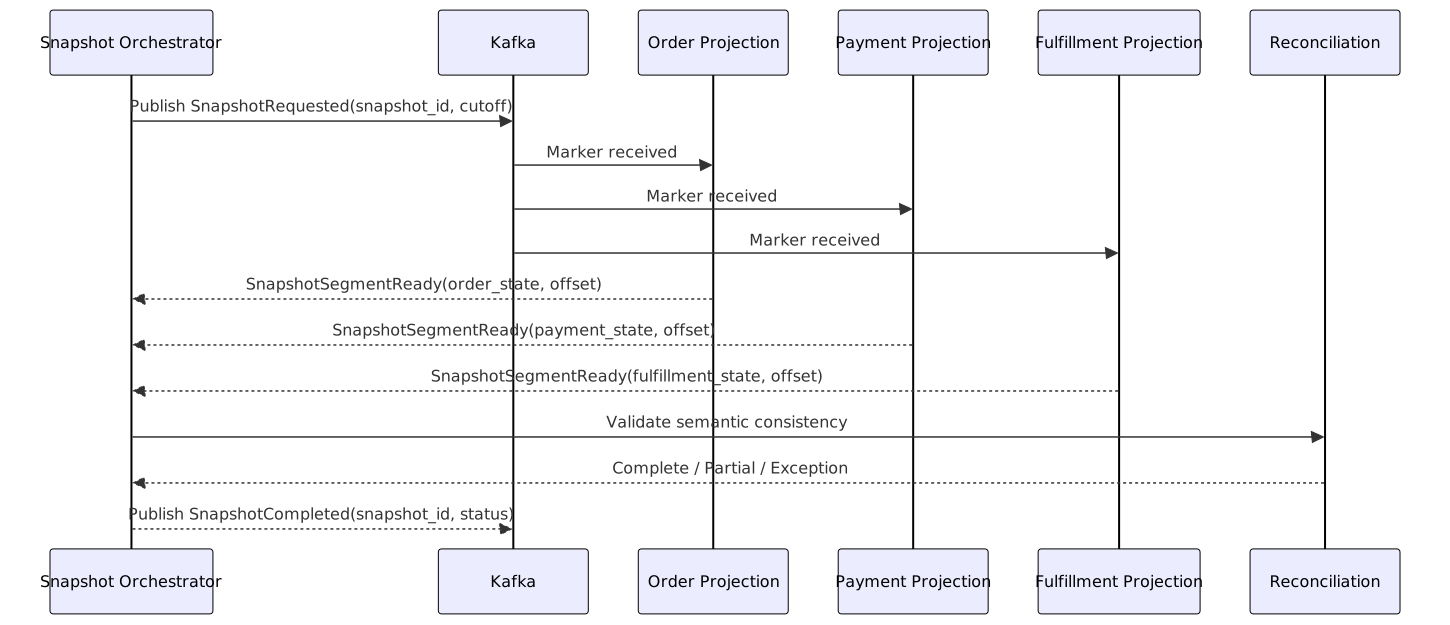
This pattern works well when services are already event-driven and can align around offsets or watermarks. It works less well when half the estate is still batch-fed from mainframe extracts.
Migration Strategy
Snapshotting becomes particularly valuable during migration, especially in progressive strangler patterns.
A strangler migration is not merely about routing traffic from old to new. It is about proving that the new system understands the business at least as well as the old one. Snapshotting gives you that proof surface.
The migration path I recommend looks like this:
1. Start with canonical business questions
Don’t begin with technology. Begin with hard questions the enterprise cannot currently answer safely.
Examples:
- What was a customer’s total credit exposure at close of business?
- Which orders were accepted but not financially settled?
- Which shipments were dispatched without a ledger-recognized invoice?
- What would we restore if the fulfillment read model were corrupted?
These questions define the snapshot semantics.
2. Snapshot the legacy before replacing it
A common migration mistake is to retire legacy data paths too early. Instead, establish snapshot baselines in the legacy platform first. This gives you a stable before-state.
3. Build parallel projections from legacy and new services
As the strangler grows, feed both old and new worlds into a reconciliation layer. Compare business snapshots, not just technical records. A one-to-one table comparison rarely tells the truth because the models differ.
4. Reconcile differences explicitly
Differences will appear. Some are bugs. Some are timing. Some are model mismatches. Some are business policy changes no one documented. Snapshot comparison is where those ghosts appear in daylight.
5. Promote by domain slice
Move one bounded context or one business capability at a time. Keep producing comparable snapshots until variance is below the accepted threshold.
6. Retire old snapshot dependencies last
Only when the new system can produce trusted snapshots independently should the legacy source be retired from the enterprise reporting and recovery path.
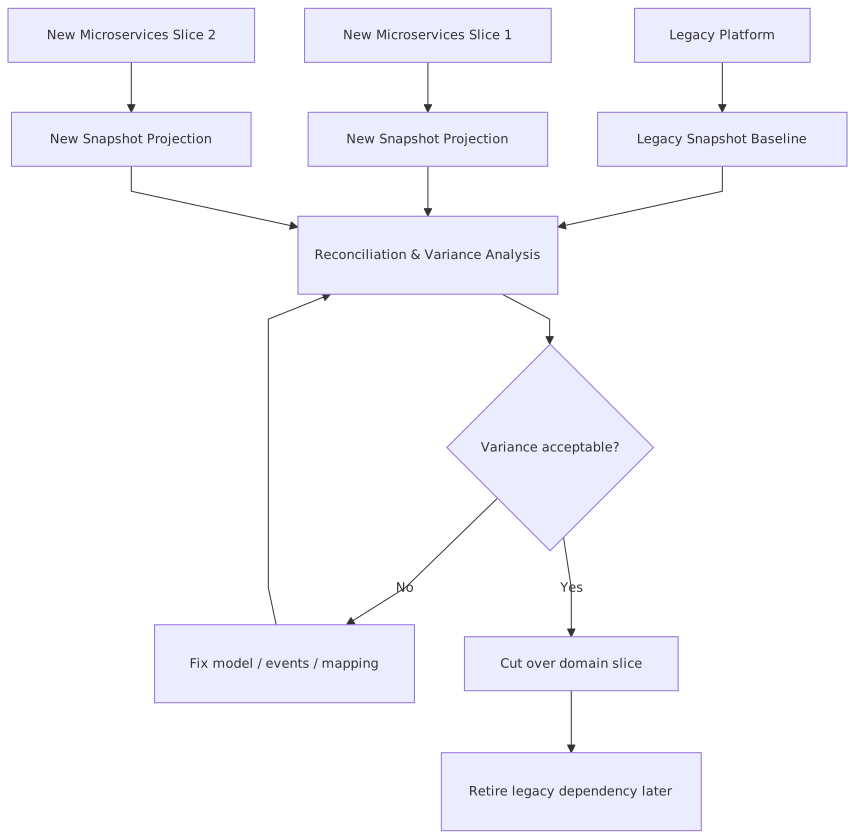
This is where reconciliation stops being an operational nuisance and becomes a migration weapon. Enterprises underestimate this. They treat reconciliation as a temporary testing activity. It should be a first-class migration capability.
Enterprise Example
Consider a global retail bank modernizing its loan servicing platform.
The legacy core is a large host-based system that owns loan accounts, schedules, accruals, and payment postings. Over time, the bank introduces microservices around customer channels, payment orchestration, collections, and regulatory reporting. Kafka becomes the integration spine. Everyone feels modern. Then the regulator asks for a historical explanation of loan status, delinquency classification, and customer exposure for a specific reporting date after a processing defect.
The bank discovers four things:
- The host has authoritative balances but limited historical explainability in accessible form.
- Kafka has rich event history but not enough stable semantic alignment between domains.
- New services expose current APIs but cannot reconstruct prior cross-domain business state reliably.
- The reporting warehouse is refreshed in batches and cannot serve as legal-grade operational evidence.
The solution they adopt is a snapshot architecture with three layers:
- Aggregate snapshots for event-sourced collections and payment orchestration services
- Daily business-effective context snapshots for loan servicing, payments, and collections
- Regulatory position snapshots composed across contexts with reconciliation status and source lineage
Key design choices:
- Loan status snapshots are business-date based, not processing-time based.
- Kafka offsets are stored alongside each context’s contribution to support deterministic replay.
- The snapshot store is immutable and versioned; corrections are additive, not overwrite-in-place.
- Reconciliation identifies unresolved mismatches between servicing balances and finance postings.
- During strangler migration, both host-derived and microservice-derived snapshots are compared for six months.
This is not glamorous architecture. It is grown-up architecture. It respects the fact that in banking, “close enough” can become a fine, a capital issue, or a board-level incident.
The most interesting outcome is not technical. It is semantic. The bank is forced to define what “loan exposure” means across domains. Before snapshotting, teams used the same words for different things. The snapshot program surfaced that confusion. In other words, the architecture improved the ubiquitous language.
That is classic domain-driven design in enterprise clothes.
Operational Considerations
Snapshotting is where many elegant whiteboard designs go to die. Operations decides whether the pattern becomes an asset or a burden.
Storage and retention
Full snapshots are easy to restore from and expensive to keep. Delta snapshots save space and complicate recovery. Most enterprises settle on a hybrid:
- periodic full snapshots
- incremental deltas in between
- retention rules by legal, audit, and operational class
Be very careful with retention conflicts. Audit wants forever. Security wants minimization. Privacy wants deletion. Finance wants period preservation. You need policy-driven retention, not whatever the storage bucket lifecycle rule happens to do.
Versioning
Snapshot schema changes are inevitable. If your snapshot format cannot evolve safely, your architecture is brittle.
Each snapshot should carry:
- schema version
- source context versions
- cutoff semantics
- lineage metadata
- reconciliation status
Versioning is not overhead; it is your future survival kit.
Performance impact
Snapshotting can overload databases, brokers, or projection pipelines if naively scheduled. Avoid “midnight batch madness” where every team snapshots at once and the whole estate coughs blood.
Use:
- partitioned capture
- backpressure-aware consumers
- read replicas where appropriate
- staggered schedules
- watermark-based completion
Security and privacy
Snapshots often concentrate sensitive data that was previously dispersed. That makes them dangerous. A snapshot store can become the perfect breach target.
Apply:
- field-level protection where required
- purpose-based access
- immutable audit trails
- encryption and key rotation
- deletion or tokenization strategies for regulated personal data
Observability
If you cannot answer “which facts are missing from this snapshot and why,” you do not have an operable system.
Track:
- lag to cutoff
- completeness by context
- reconciliation exceptions
- snapshot build duration
- offset or watermark positions
- restore test success rate
Restore tests matter. Many firms are excellent at creating snapshots and mediocre at proving they can use them.
Tradeoffs
Snapshotting is a trade machine. Pretending otherwise produces expensive disappointment.
Pros
- faster recovery for read models and aggregates
- stable point-in-time reporting
- improved auditability and explainability
- better migration checkpoints in strangler programs
- practical basis for cross-domain reconciliation
- reduced replay cost in event-sourced systems
Cons
- storage growth
- semantic complexity
- versioning burden
- reconciliation overhead
- risk of creating shadow truth outside domain ownership
- operational complexity around retention, privacy, and restore validation
The hardest tradeoff is between coherence and coupling.
If you demand tightly synchronized snapshots across many services, you create coordination and reduce autonomy. If you let every service snapshot itself independently, you preserve autonomy and weaken enterprise coherence. There is no free lunch here. Pick according to the business criticality of the use case.
For regulated financial positions, pay the coordination tax.
For internal operational dashboards, accept convergent snapshots and visible staleness.
Failure Modes
This pattern fails in predictable ways. Good architects name those failures up front.
1. Snapshot without semantics
Teams capture rows and call it architecture. Later they discover that the snapshot cannot answer business questions because it stores technical state, not domain facts.
2. Reporting layer becomes accidental source of truth
The composed snapshot is trusted more than the underlying services. Teams begin reading it for operational decisions. Now your derived model is driving the business. That is backwards and dangerous.
3. Hidden inconsistency
The snapshot process silently tolerates missing context contributions and still marks output “complete.” This is worse than an explicit failure because people trust bad data.
4. Unbounded replay dependency
The architecture assumes snapshots plus event replay can always recover state, but old event contracts, missing versions, or changed business logic make replay non-deterministic. Recovery then fails exactly when needed.
5. Schema drift chaos
Services change event shapes independently. Projections break. Snapshots become incomparable over time. Migration and audit both suffer.
6. Reconciliation theater
Organizations claim to reconcile but only compare counts or IDs. Real semantic mismatches remain hidden. This is common in large programs under deadline pressure.
7. Snapshot window overload
Too many data-intensive snapshots run at once, saturating brokers, databases, or storage systems. The very mechanism intended to improve resilience damages production.
The remedy in all these cases is the same: treat snapshotting as a first-class architecture capability with explicit ownership, service-level objectives, and domain stewardship.
When Not To Use
Snapshotting is useful, but it is not universal medicine.
Do not use heavy cross-system snapshotting when:
- the business only needs current local state within one service
- event replay cost is trivial and historical volume is small
- consistency requirements are loose enough for live queries
- retention and privacy constraints make snapshot copies legally awkward
- the domain model is still too unstable to define meaningful snapshot semantics
- your estate lacks the operational maturity to version, reconcile, and restore reliably
A particularly bad use case is early-stage microservices where teams have not yet stabilized their bounded contexts. Snapshotting too early can fossilize poor domain boundaries. First get the language and ownership right. Then preserve it.
Also, if all you need is disaster recovery of infrastructure, use proper infrastructure backup and replication. Don’t drag domain snapshot machinery into a simple recovery problem.
Related Patterns
Snapshotting lives near several adjacent patterns. They overlap, but they are not the same.
Event Sourcing
Event sourcing records state transitions as the source of truth. Aggregate snapshots are often used to reduce replay cost. But event sourcing alone does not solve cross-context business-state snapshots.
CQRS
CQRS separates write and read models. Snapshotting often materializes read models or preserves them for recovery. Again, useful but not sufficient for enterprise point-in-time coherence.
Change Data Capture
CDC is a capture mechanism. It can feed snapshot pipelines, especially in migrations from monoliths or packaged systems. But CDC emits data changes, not necessarily domain meaning.
Materialized Views
A snapshot can be a versioned materialized view with stronger temporal and lineage semantics. Materialized views are often the implementation vehicle.
Sagas
Sagas coordinate long-running transactions across services. Snapshotting complements sagas by making their distributed outcomes inspectable at a point in time.
Data Vault / Temporal Modeling
In analytical platforms, temporal modeling and historized data structures provide a durable basis for reconstructing state. They are often part of the snapshot backend for enterprise reporting.
Strangler Fig Pattern
During modernization, snapshots and reconciliation provide the confidence mechanism that makes strangler migration safe rather than theatrical.
Summary
Architecture snapshotting in distributed systems is really about trust.
Not trust in infrastructure. Trust in meaning.
When an enterprise asks what happened, what was true, what must be recovered, or whether the new platform is genuinely equivalent to the old one, it is asking for a trustworthy representation of business state under time and change. In distributed systems, that representation does not appear by accident. It must be designed.
The best snapshot architectures do a few things well:
- they respect bounded contexts and domain semantics
- they define explicit cutoff and consistency rules
- they use Kafka or equivalent event backbones pragmatically, not religiously
- they embrace reconciliation instead of pretending inconsistency does not exist
- they support strangler migration with evidence, not hope
- they remain operable through versioning, retention, observability, and restore testing
And they know their limits.
A snapshot is a photograph, not the living city. It captures enough truth to reason, recover, compare, and govern. But if you take the picture from the wrong angle, at the wrong time, with the wrong lens, all you preserve is confusion at scale.
That is the enterprise lesson. Distributed systems don’t merely need data capture. They need remembered meaning. Snapshotting, done well, is one of the few patterns that gives them exactly that.
Frequently Asked Questions
What is a service mesh?
A service mesh is an infrastructure layer managing service-to-service communication. It provides mutual TLS, load balancing, circuit breaking, retries, and observability without each service implementing these capabilities. Istio and Linkerd are common implementations.
How do you document microservices architecture for governance?
Use ArchiMate Application Cooperation diagrams for the service landscape, UML Component diagrams for internal structure, UML Sequence diagrams for key flows, and UML Deployment diagrams for Kubernetes topology. All views can coexist in Sparx EA with full traceability.
What is the difference between choreography and orchestration in microservices?
Choreography has services react to events independently — no central coordinator. Orchestration uses a central workflow engine that calls services in sequence. Choreography scales better but is harder to debug; orchestration is easier to reason about but creates a central coupling point.