⏱ 19 min read
Cloud systems rarely fail because a single server dies. They fail because the map no longer matches the territory.
That is the real problem behind deployment topology drift. Not a broken container image. Not a stale Terraform module. Not even “configuration drift” in the narrow operational sense. Topology drift is what happens when the intended shape of a system—its services, dependencies, runtime placement, network boundaries, data flows, failover paths, and ownership lines—quietly diverges from what actually runs in production. At first, the divergence is harmless. Then it becomes expensive. Eventually it becomes dangerous.
This is one of those architecture problems that hides in plain sight. Enterprises often talk about cloud transformation as if infrastructure were elastic clay: define it once, automate it, and let the platform do the rest. Reality is messier. Teams add sidecars to solve one local problem. A Kafka consumer gets moved to another cluster to meet a latency target. A “temporary” service mesh exception survives three budget cycles. New microservices appear, old ones never fully die, and suddenly the neat target architecture shown in PowerPoint has turned into a city built by zoning waivers. event-driven architecture patterns
The difficult part is that deployment topology drift is not merely technical entropy. It is a domain problem disguised as an operational one. When topology changes, the meaning of boundaries changes with it. Bounded contexts start bleeding into each other. Ownership becomes fuzzy. Event contracts become accidental integration mechanisms rather than explicit domain relationships. The runtime shape of the system starts to tell a different business story than the one the enterprise thinks it is operating.
That is why this topic matters to enterprise architecture. If architecture is the set of important decisions, then topology drift is what happens when those decisions are gradually overwritten by production reality.
Context
Most cloud estates do not begin as greenfield masterpieces. They begin with a line of business trying to ship something useful. Then another team integrates. Then compliance arrives. Then scale arrives. Then M&A arrives. Before long, the organization is managing a portfolio of applications spread across Kubernetes clusters, managed databases, event backbones, API gateways, edge services, SaaS integrations, and a few deeply embarrassing workloads still running on VMs named after people who left five years ago.
In this environment, deployment topology is more than a technical layout. It is the executable form of enterprise intent.
A topology answers practical questions:
- Which domain services must be isolated?
- Which components may scale independently?
- Which workloads can share trust zones?
- Which data products are published versus directly queried?
- Where are resilience boundaries?
- Which teams own which runtime responsibilities?
These are not small questions. They shape cost, speed, security, and changeability.
In a well-run cloud architecture, there is a living relationship between three views:
- The domain view — bounded contexts, capabilities, aggregates, events, policies.
- The logical application view — services, APIs, topics, workflows, data stores.
- The deployment view — clusters, namespaces, accounts, regions, VPCs, subnets, gateways, brokers, storage classes, and runtime placement.
Topology drift emerges when those views stop evolving together.
Problem
Teams usually notice topology drift late because the first symptoms are mundane.
A deployment pipeline becomes fragile. A service can no longer be moved without breaking three undocumented dependencies. Production and non-production environments no longer resemble each other. Kafka topics exist in one region but not another. Autoscaling works in theory but not under coordinated batch loads. A recovery exercise reveals that failover documentation describes a topology that no longer exists.
By then, drift is already systemic.
Let’s be precise. Deployment topology drift is the ungoverned divergence between intended deployment architecture and effective runtime architecture over time.
That divergence can appear in several forms:
- Placement drift: services end up in clusters, regions, or accounts different from architectural intent.
- Dependency drift: undocumented runtime connections emerge, often via direct database access, ad hoc HTTP calls, or shared caches.
- Boundary drift: trust zones, network segmentation, or tenant isolation erode.
- Redundancy drift: active-active, active-passive, and backup assumptions no longer match real deployment patterns.
- Messaging drift: event paths, Kafka topic ownership, retention policies, and consumer groups no longer reflect the domain model.
- Ownership drift: the runtime artifact is operated by a different team than the one accountable for the business capability.
- Lifecycle drift: old topology segments persist because the migration never actually finished.
The damage is cumulative. Costs rise because infrastructure is duplicated and underutilized. Security weakens because emergency exceptions become normal routes. Change slows because every release is now a topology negotiation. The architecture review board starts debating diagrams that have no relationship to production. That is when architecture becomes theater.
Forces
This problem persists because strong forces push systems toward drift.
1. Local optimization beats global coherence
Teams are measured on delivery, not on preserving the elegance of the enterprise landscape. If moving a service to another cluster avoids a queue bottleneck this quarter, it gets moved. The topology absorbs the scar.
2. Domain boundaries evolve, but infrastructure often lags
Domain-driven design teaches us that bounded contexts are discovered and refined over time. But deployment structures are sticky. Network policies, IAM boundaries, Kafka cluster layout, and data residency controls do not change cheaply. So the domain moves first, and the deployment topology becomes an archaeological site.
3. Platform abstraction creates false confidence
Infrastructure as code is useful, but many organizations mistake codification for control. A Terraform repository can describe a topology no one actually runs. Kubernetes manifests can capture a desired state inside a cluster while ignoring the fact that the cross-cluster interaction model has already drifted.
Desired state is not the same thing as actual truth.
4. Event-driven systems hide coupling elegantly
Kafka is especially relevant here. It is a magnificent tool for decoupling time, load, and ownership. It is also a splendid way to create invisible topology complexity. Cross-region replication, topic sprawl, schema evolution, dead-letter routing, and replay behavior all create deployment implications that don’t appear on simplistic service diagrams.
5. Migrations create long-lived hybrid states
Enterprises rarely replace one topology with another in a single move. They use progressive migration, coexistence patterns, side-by-side routing, and strangler facades. Sensible, yes. But hybrid states have a habit of becoming permanent.
6. Control planes and data planes drift differently
A topology may look aligned from a deployment automation perspective while runtime traffic takes entirely different routes because of service mesh policy, API gateway rewrites, DNS failover rules, Kafka MirrorMaker replication, or direct client-side endpoint configuration.
That mismatch is where many outages are born.
Solution
The solution is not “more diagrams,” though diagrams help. The solution is to treat deployment topology as a governed, reconcilable architectural model tied directly to domain semantics.
My advice is blunt: stop treating topology as an infrastructure afterthought. It is part of the system’s language. If your Order domain publishes OrderPlaced, that event is not just a payload on Kafka. It implies producer ownership, broker placement, retention expectations, replay constraints, consumer dependency patterns, and resilience boundaries. Domain meaning and runtime shape belong together.
A sound approach has five parts:
- Model topology as architecture, not inventory
- Anchor topology to bounded contexts and ownership
- Continuously reconcile intended state against runtime reality
- Use progressive strangler migration for topology changes
- Make drift visible in operational, financial, and domain terms
This is less glamorous than inventing a new platform acronym. It works anyway.
Architecture
The architecture for drift management should distinguish clearly between intent, observation, and reconciliation.
- Intent model: the approved target topology and permitted variants.
- Observed model: discovered runtime topology from clusters, brokers, cloud accounts, service registry, telemetry, network flows, and deployment metadata.
- Reconciliation engine: compares intent and observation, identifies drift, classifies severity, and triggers governance or automated correction.
- Domain map: links bounded contexts and capabilities to runtime assets.
- Migration layer: supports coexistence during topology reshaping.
Here is a practical high-level view.
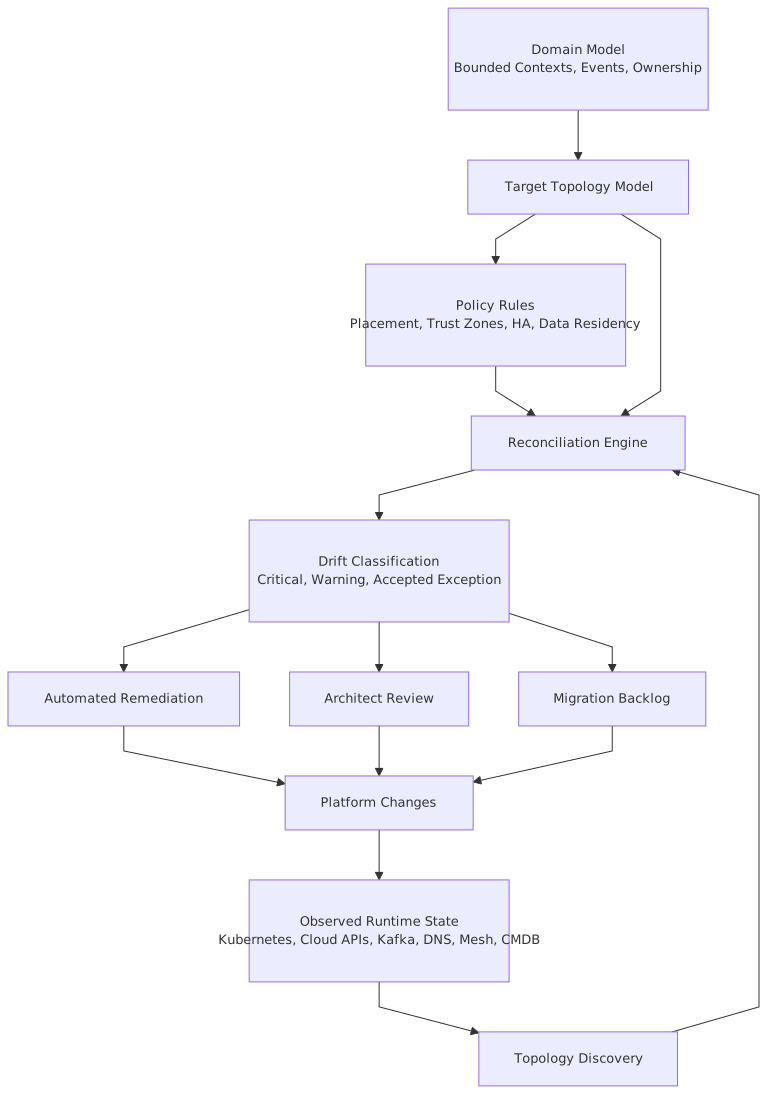
The key idea is simple: architecture intent should be machine-comparable with runtime fact.
That does not mean every drift must be auto-remediated. In fact, many should not. Some drift is deliberate. Some reflects valid local exceptions. Some is migration residue that should be tolerated temporarily. But it should be explicit, time-bound, and tied to accountable owners.
Domain semantics and topology
This is where many architecture articles become vague. Let’s not.
Deployment topology should reflect domain semantics in ways that matter operationally:
- Bounded contexts often deserve separate deployment and scaling boundaries.
- High-volatility domains benefit from looser operational coupling and independent release paths.
- Shared kernels should be rare; when they exist, their deployment blast radius must be tightly controlled.
- Domain events require clear topic ownership and schema governance.
- Policies and workflows may justify orchestration services but should not become accidental centralization points.
- Read models may be replicated close to consumers, but ownership of the source truth must remain explicit.
For example, if Pricing and Order Management are separate bounded contexts, but a “temporary” optimization causes Order to query Pricing’s private cache directly across clusters, the topology is now violating the domain. It may still work. That is the problem. Bad architecture often works right up until the bill arrives.
Kafka and microservices
Kafka deserves special attention because it often becomes the spinal cord of a modern enterprise topology.
Used well, Kafka supports bounded-context autonomy. A domain service publishes facts, consumers react asynchronously, and teams evolve independently. Used poorly, Kafka becomes an integration swamp where every service subscribes to everything and topic names replace actual governance. EA governance checklist
Topology drift around Kafka commonly includes:
- consumers running in unauthorized regions
- producers publishing to shared “enterprise” topics without clear ownership
- retention mismatches that break replay expectations
- mirrored topics used as if they were primary sources of truth
- consumer groups with no known business owner
- hidden dependency on ordering guarantees across partitions
If your event backbone is central to your architecture, it must be central to your topology model too.
A reference topology pattern
A practical pattern is to align the topology around domain platforms and controlled integration surfaces.
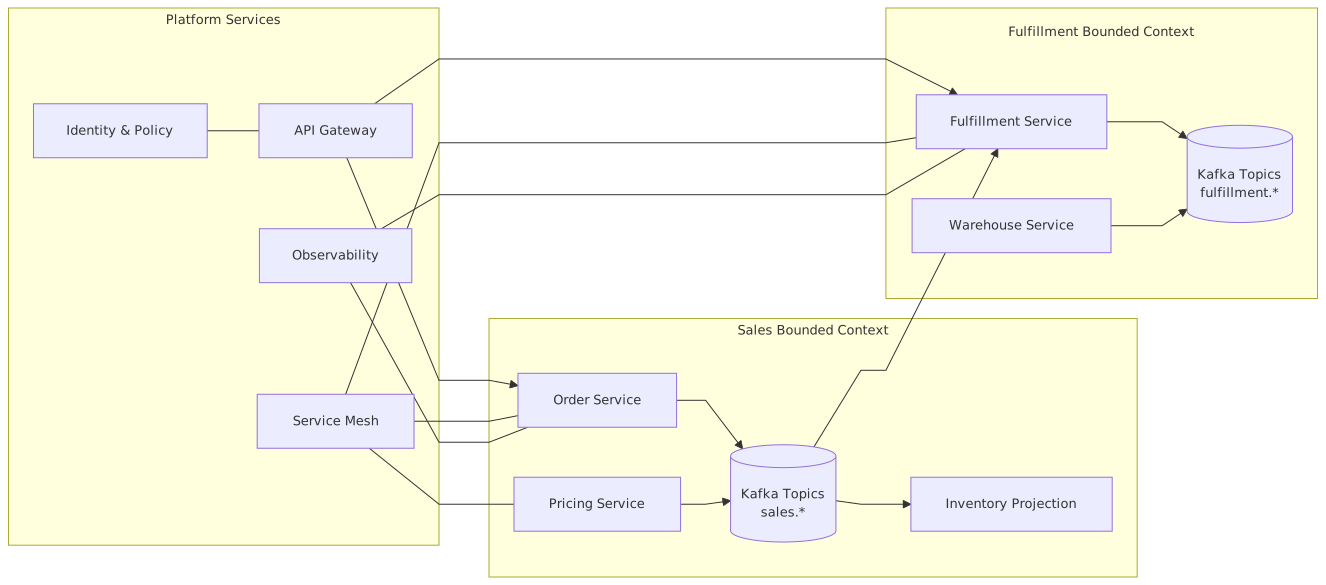
The important thing is not the boxes. It is the principle: domain-aligned deployment segments, explicit integration channels, and platform services that support rather than obscure boundaries.
Migration Strategy
You asked specifically for progressive strangler migration, and that is exactly the right instinct. Topology changes are rarely atomic. They should be staged, observable, and reversible.
There is a temptation in enterprise transformation to redraw the whole deployment diagram, announce a target operating model, and then attempt a heroic cutover. This works about as often as a big-bang ERP rollout: occasionally, and only after consuming a remarkable amount of money.
A better path is a topology strangler.
The strangler approach for topology
Instead of replacing the deployment shape wholesale, introduce a new topology alongside the old one and progressively reroute traffic, events, and operational responsibility.
Typical stages:
- Document and discover current topology
- Define target topology with domain ownership
- Create coexistence mechanisms
- Route selected capabilities to the new topology
- Reconcile continuously
- Retire old segments deliberately
This is not merely application migration. It includes DNS, ingress, Kafka topics, IAM, observability, failover configuration, and support model transitions.
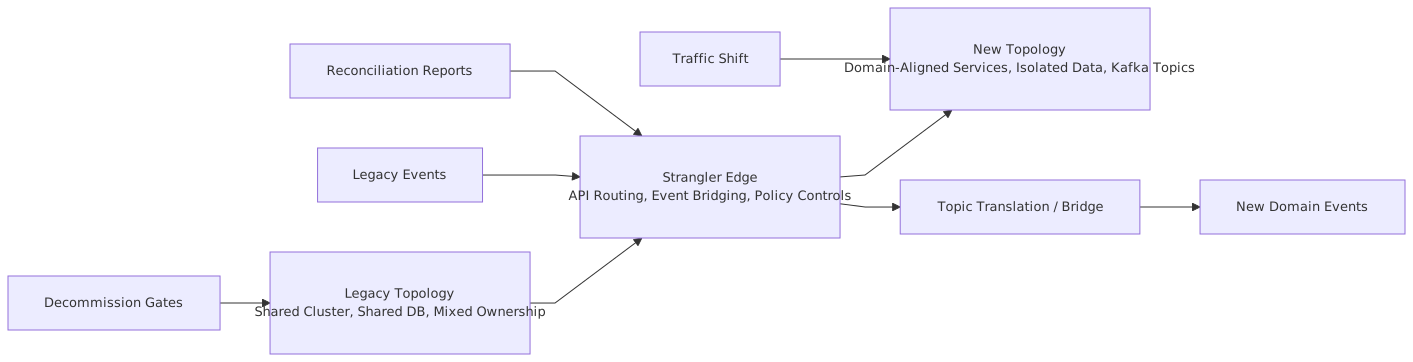
Reconciliation during migration
Reconciliation is the discipline that prevents a migration from becoming another source of permanent drift.
There are two forms:
- Structural reconciliation: Are services deployed where they are supposed to be? Are trust boundaries, regions, topics, and dependencies aligned with the target?
- Behavioral reconciliation: Does the new topology produce equivalent business outcomes? Are events complete, ordered as required, and semantically consistent?
Behavioral reconciliation matters because topology changes can preserve technical health while damaging the domain. A Kafka bridge may successfully forward messages while silently altering delivery timing in a way that breaks fraud detection or inventory allocation.
I would go further: in serious enterprises, topology migration should include business reconciliation checkpoints. Not just CPU, memory, and error rate. Check order completion, settlement matching, policy issuance, claim adjudication, customer notification latency. The business process is the only scoreboard that matters.
Enterprise Example
Consider a global insurer modernizing its policy administration platform.
The company began with a monolithic policy system deployed on regional VM farms. Over time, it introduced microservices for quoting, underwriting, billing, and claims. Kafka was added as an event backbone to support integration with digital channels and downstream analytics. Kubernetes arrived later, then an API gateway, then service mesh. Each move was rational on its own. microservices architecture diagrams
The problem was that the topology no longer reflected the business architecture.
- Underwriting services were split across two cloud accounts because different programs funded them.
- Billing consumers subscribed directly to policy events from both the monolith and new quote services.
- Claims analytics read mirrored Kafka topics in another region and treated them as source truth.
- A supposedly retired policy issuance path was still invoked by one broker portal through an undocumented DNS route.
- Disaster recovery procedures assumed active-passive failover, but three services had quietly become active-active while their backing data stores had not.
On paper, the enterprise had a target state with bounded contexts and domain ownership. In production, it had a hybrid topology where the runtime shape reflected project history rather than domain intent.
The remediation was not a big rewrite. It was a topology correction program.
First, the architect team mapped bounded contexts: Policy, Underwriting, Billing, Claims, Customer, and Distribution. Then they created a topology intent model specifying approved deployment zones, Kafka topic ownership, event replication policy, resilience class, and operational owner for each context.
Next, they built a discovery pipeline that pulled actual state from Kubernetes, cloud networking, Kafka metadata, gateway configs, and service catalog records. The reconciliation engine flagged drift such as:
- services deployed outside approved domain zones
- cross-context direct database access
- topics with no owning team
- consumers in prohibited regions
- resilience mismatches between service tier and storage tier
The migration then used strangler techniques:
- new broker traffic entered through a routing layer that directed only selected policy operations to the new domain-aligned services
- event bridges translated legacy policy events to canonical domain events
- billing consumers were moved off monolith topics onto owned Billing topics
- mirrored analytics feeds were reclassified as derived data products rather than operational truth
- decommission gates required zero traffic, zero active consumer groups, and signed business reconciliation
The result was not perfection. It was coherence. Lead time fell because teams could release within their domain boundaries. Recovery exercises became believable. Kafka governance improved because topic ownership matched actual business capability ownership. Most importantly, architecture diagrams began describing reality again. ArchiMate for governance
That is a bigger achievement than it sounds.
Operational Considerations
A topology drift strategy lives or dies in operations.
Discovery sources
You need more than CMDB records and Git repositories. Real discovery usually pulls from:
- Kubernetes API and namespaces
- cloud account and VPC metadata
- service mesh topology
- API gateway routes
- DNS and load balancer config
- Kafka brokers, topics, partitions, ACLs, consumer groups
- IAM policies
- network flow logs
- tracing and service dependency graphs
- deployment pipelines and artifact metadata
Each source lies in its own way. Reconciliation works by comparing lies until the truth emerges.
Drift classification
Not all drift is equal. A sensible classification model includes:
- Critical drift: security boundary violations, unsupported data residency, broken resilience architecture, unowned runtime assets
- Material drift: unauthorized dependencies, topic ownership gaps, unsupported cross-region flows
- Tolerated drift: approved migration exceptions with expiry
- Benign drift: runtime detail variations that do not violate architecture policy
Severity must drive action. Enterprises get into trouble when they treat every difference as a governance incident. Then teams stop listening.
SLOs and topology
Topology choices affect service levels directly. If you split a bounded context across regions or clusters, you may improve fault isolation but increase tail latency. If you centralize Kafka to simplify governance, you may create throughput concentration and blast-radius concerns. Architecture should connect topology drift to SLO compliance. Otherwise this becomes an abstract hygiene exercise.
FinOps
Drift has a cost signature.
Redundant environments, underused clusters, duplicated event replication, unnecessary egress, and oversized failover capacity all show up on the bill. FinOps teams often discover drift before architects do. That should tell us something.
Security and compliance
Topology drift is often a compliance issue before it is an engineering one. Cross-border data movement, trust-zone erosion, shadow consumers, and untracked service exposure are all audit risks. If your architecture governance and security governance are separate conversations, drift will exploit the gap.
Tradeoffs
There is no free architecture, and certainly no free governance.
A rigorous topology reconciliation model brings real benefits, but it also introduces costs.
Benefits
- clearer domain ownership
- more reliable migration planning
- better disaster recovery realism
- reduced hidden coupling
- stronger compliance posture
- lower long-term operating cost
- faster change within well-defined boundaries
Costs
- upfront modeling effort
- discovery and reconciliation tooling complexity
- governance friction for delivery teams
- temporary duplication during strangler migration
- need for stronger metadata discipline
- more explicit ownership accountability
The central tradeoff is between local team freedom and enterprise topology coherence. Too much freedom and the estate becomes a junk drawer. Too much control and the platform becomes a bureaucracy. Good architects do not eliminate this tension. They manage it honestly.
Another tradeoff sits between standardization and domain-specific optimization. Not every bounded context should be deployed the same way. Trading systems, analytics pipelines, customer portals, and batch finance workloads have different needs. A topology model must allow controlled variety. Uniformity is not architecture. It is laziness dressed as policy.
Failure Modes
Let’s talk about how this goes wrong, because it often does.
1. The model becomes stale immediately
If the intent model is maintained manually and updated only during architecture review boards, it will drift faster than the runtime. Then you have automated irrelevance.
2. Reconciliation is too shallow
If you compare only deployment manifests to cluster state, you miss actual traffic routes, data flows, and event dependencies. That gives a false sense of control.
3. Governance ignores domain semantics
A topology engine that flags “service in wrong namespace” but ignores “consumer reading another context’s private event stream” is policing furniture placement while thieves empty the vault.
4. Migration exceptions never expire
Every enterprise has “temporary” exceptions older than some employees. If exception handling has no owner, no end date, and no business rationale, it is not an exception process. It is architectural surrender.
5. Kafka becomes the dumping ground
Without strict topic ownership and lifecycle policy, event streams become shared integration sludge. Then topology drift is hard to detect because every service appears connected to everything.
6. Decommissioning is treated as optional
The old topology must actually die. If not, strangler migration just creates two production systems and doubles the uncertainty.
When Not To Use
This pattern is powerful, but not universal.
Do not build a full-blown topology reconciliation architecture when:
- you have a small system with a single team and simple deployment
- the domain is stable, low-risk, and operationally modest
- your platform footprint is narrow enough that ordinary infrastructure as code discipline is sufficient
- the cost of drift is genuinely lower than the cost of governance
- you are still discovering the core domain and need delivery speed more than structural precision
In a startup with half a dozen services and one Kubernetes cluster, topology drift may not justify an enterprise-grade response. A lightweight service catalog, good observability, and disciplined IaC may be enough.
Likewise, if a workload is short-lived, analytical, or isolated by nature, heavy domain-topology modeling can become decorative overengineering. The point is not to be impressive. The point is to remain in control.
Related Patterns
Deployment topology drift sits near several adjacent patterns.
Configuration drift management
Related, but narrower. Configuration drift focuses on parameter-level divergence. Topology drift deals with the larger runtime shape and dependency network.
Service catalog and ownership registry
Necessary but insufficient. A catalog tells you what exists and who owns it. It usually does not tell you whether the runtime relationships still reflect the architecture.
Strangler Fig pattern
Highly relevant for migration. In this context, the strangler is applied not just to application logic but to deployment boundaries, ingress, event channels, and operational responsibility.
Control plane reconciliation
The Kubernetes operator model is an inspiration here: desired state, observed state, reconciliation loop. Enterprises should apply similar thinking above the cluster level.
Event-carried state transfer
Useful in migration and domain decoupling, especially with Kafka. But it must be governed carefully so replicated state does not become accidental shared truth.
Cell-based architecture
A good fit in some large-scale platforms, especially where fault isolation and regional autonomy matter. It can reduce topology drift by making boundaries explicit, though it introduces its own duplication and governance overhead.
Summary
Deployment topology drift is what happens when the system you think you built is no longer the system you run.
That sounds obvious. It is not. In many enterprises, the architecture repository, the cloud estate, the event backbone, and the support model all tell different stories. Drift lives in the gaps between those stories. Left alone, it erodes resilience, confuses ownership, inflates cost, and turns migrations into permanent limbo.
The right response is not a prettier diagram or stricter review board. It is a disciplined architecture approach that ties topology to domain semantics, continuously reconciles intent with reality, and uses progressive strangler migration to move safely from legacy shapes to domain-aligned ones.
Be opinionated about boundaries. Be practical about coexistence. Reconcile constantly. Decommission ruthlessly.
Because in cloud architecture, the most dangerous system is not the one that is broken. It is the one whose shape no one can accurately describe.
Frequently Asked Questions
What is cloud architecture?
Cloud architecture describes how technology components — compute, storage, networking, security, and services — are structured and connected to deliver a system in a cloud environment. It covers decisions on scalability, resilience, cost, and operational model.
What is the difference between availability and resilience?
Availability is the percentage of time a system is operational. Resilience is the ability to recover from failures — absorbing disruption and returning to normal. A system can be highly available through redundancy but still lack resilience if it cannot handle unexpected failure modes gracefully.
How do you model cloud architecture in ArchiMate?
Cloud services (EC2, S3, Lambda, etc.) are Technology Services or Nodes in the Technology layer. Application Components are assigned to these nodes. Multi-region or multi-cloud dependencies appear as Serving and Flow relationships. Data residency constraints go in the Motivation layer.