⏱ 20 min read
Distributed systems rarely fail with a bang. They fail like two clocks on the same wall that were once synchronized and now disagree by six minutes. Nobody notices at first. A meeting starts late. A train is missed. Then someone misses a flight, and suddenly everyone is arguing about whose clock is “correct.”
That is what model drift looks like in an enterprise.
At the beginning, a domain model is usually coherent enough. A team has a sensible understanding of what an Order is, what a Customer means, when a Policy is active, which states are legal, and what events matter. Then the organization grows. Teams split. Services are extracted. Kafka topics appear. Integration layers multiply. One team adds a field. Another reinterprets a status. A third introduces a new lifecycle because “the old one didn’t fit our use case.” Nobody thinks they are changing the business. They think they are just shipping software. event-driven architecture patterns
But semantics leak. Meanings diverge. The model drifts.
This is one of the defining architectural problems of modern distributed systems, especially in organizations that embraced microservices faster than they embraced domain-driven design. The issue is not simply schema evolution, though schemas participate. It is not just data inconsistency, though inconsistency is a symptom. The deeper problem is that the enterprise loses a shared understanding of core concepts while still pretending it has one.
And once that happens, timelines diverge. The same customer is “active” in one service, “suspended” in another, “under review” in a third. The same payment is settled, reversed, and pending depending on which API you call. Reconciliation becomes a permanent tax. Reporting turns political. Audits get expensive.
This article is about that tax: why distributed domain models drift, how to design for divergence without surrendering control, and how to migrate an enterprise architecture toward something more honest, more resilient, and more governable.
The short version is blunt: stop pretending a distributed estate will preserve a single canonical model through goodwill alone. It won’t. You need explicit bounded contexts, deliberate semantic contracts, event lineage, reconciliation mechanisms, and a migration path that assumes drift is normal rather than exceptional.
Context
In a monolith, semantic disagreement is expensive but visible. The code sits in one place. You can grep for the enum, inspect the database, and argue in one room. In a distributed estate, disagreement becomes subtle and durable. It hides behind APIs, caches, replicated views, and event streams.
A common enterprise journey goes like this:
- Start with a large system of record.
- Break out capabilities into microservices.
- Use Kafka for domain events and integration.
- Let teams own their schemas and deploy independently.
- Discover six months later that “independent ownership” without semantic discipline means every service now tells a slightly different story.
This is not because microservices are bad. It is because distribution amplifies every ambiguity already present in the business. If the enterprise has not clearly separated domains, defined bounded contexts, and agreed where translation is allowed versus forbidden, then every service boundary becomes a breeding ground for semantic mutation.
Domain-driven design gives us the right lens here. A model is not a database schema. It is a language tied to a business purpose. The same real-world thing may be represented differently in different bounded contexts, and that is not only acceptable, it is often correct. A risk system’s notion of a Customer should not be identical to a billing system’s notion of a Customer if they solve different problems.
The mistake is not difference. The mistake is unmanaged difference.
Architects get into trouble when they oscillate between two bad extremes:
- The canonical fantasy: one enterprise-wide model will govern all systems.
- The local freedom fantasy: every team can model however it likes and integration will sort itself out.
The first centralizes too much and slows delivery. The second creates semantic entropy.
Good architecture lives in the tension between them.
Problem
Model drift in distributed domain models is the gradual divergence between representations, rules, and timelines of the same or related business concepts across services, data stores, and event streams.
That divergence happens across several dimensions.
Structural drift
Fields, entities, and relationships differ. One service stores customer_status, another stores account_state, another infers lifecycle from events. Sometimes this is healthy contextual modeling. Sometimes it is accidental fragmentation disguised as autonomy.
Behavioral drift
Rules diverge. One service allows cancellation after fulfillment if a refund is pending. Another rejects it. A third emits both OrderCancelled and RefundInitiated for the same workflow but in different order. Same nouns, different verbs.
Temporal drift
This one hurts the most. Distributed systems do not just disagree on what something is; they disagree on when it became that thing. Eventual consistency is not merely stale data. It is a timeline problem. The order in which services observe or derive truth differs.
Semantic drift
The word remains the same while the meaning changes. “Active” used to mean authenticated and billable. Now it means onboarded but not necessarily credit-cleared. The topic name stays. The contracts compile. The business semantics quietly mutate.
A schema registry will not save you from that.
Operational drift
Retry behavior, deduplication rules, compensation workflows, and reconciliation logic differ among services. Over time, the runtime semantics become as important as the design-time model.
If you want one memorable line, here it is: in distributed systems, semantics decay faster than syntax.
Forces
Architectural problems are interesting because sensible forces collide.
Team autonomy
Independent teams need freedom to evolve their services. That usually means local models, local storage, and release independence. All sensible. But autonomy without context mapping is just fragmentation with better branding.
Business variation
Different domains legitimately need different views. A claims platform, a payment ledger, and a CRM should not share a single “Customer” object. That is a coupling trap. Domain-driven design tells us to embrace bounded contexts because business language is situational.
Event-driven integration
Kafka and event streaming encourage decoupling through publish-subscribe. Good. But they also create the illusion that an event name equals a shared meaning. It does not. Two teams can subscribe to CustomerUpdated and derive entirely different truths, especially if the event is overloaded and under-specified.
Legacy gravity
Most enterprises do not begin with greenfield models. They begin with ERP systems, core banking packages, policy admin platforms, and decades of reporting assumptions. New services orbit those systems. Migration is constrained by contractual interfaces, batch jobs, and regulatory evidence trails.
Reporting and audit pressure
The business wants one number. Regulators want traceability. Finance wants close-of-business certainty. Distributed domain modeling can accommodate this, but not by magical thinking. You need explicit points of reconciliation and authoritative records for specific decisions.
Delivery speed
Every semantic governance mechanism costs time. Shared contracts, anti-corruption layers, event versioning, lineage metadata, and model review are not free. They slow careless change, which is precisely why they matter. EA governance checklist
Solution
The right solution is not to eliminate model divergence. It is to make divergence intentional, bounded, observable, and reconcilable.
That leads to a few architectural moves.
1. Define bounded contexts ruthlessly
Use domain-driven design properly, not decoratively.
A bounded context is where a model is internally consistent and linguistically coherent. It is not a team chart, not a Kubernetes namespace, and not whatever service someone happened to split out last quarter. The job is to identify where terms truly mean different things and let them differ there.
For example:
- In Billing, a Customer may mean a billable party with credit arrangements.
- In Identity, a Customer may mean a verified person or organization.
- In Support, a Customer may mean the party attached to a case and SLA.
- In Risk, a Customer may mean an exposure-bearing entity under review.
Same word, different semantics. Fine. But then you must map between them explicitly.
2. Prefer published language over shared entity reuse
Do not push internal entity models directly onto Kafka topics or shared APIs. Publish a stable language for integration. That language should be designed as a contract for consumers, with semantics, invariants, and lifecycle documented in business terms.
This is where many teams go wrong. They serialize their ORM object, call it an event, and move on. That is not architecture. That is accidental coupling with JSON.
3. Introduce semantic contracts, not just schema contracts
A schema says status is a string. A semantic contract says:
- valid values
- business meaning
- transition rules
- source of authority
- ordering assumptions
- idempotency expectations
- deprecation plan
If an event says OrderCompleted, define whether that means payment captured, fulfillment dispatched, customer notified, or some combination. In some enterprises those happen minutes apart. If you leave the semantics vague, drift is guaranteed.
4. Make timelines first-class
A distributed model needs more than state. It needs chronology.
Track:
- event time
- processing time
- source system time
- version or sequence where possible
- causation and correlation identifiers
Without these, you cannot reason about diverging models over time. You can only compare snapshots and argue. Timelines turn semantic disputes into diagnosable histories.
5. Build reconciliation as a product capability
Reconciliation is not an embarrassing afterthought. In enterprise architecture, it is a control mechanism.
When multiple contexts maintain derived views of a concept, establish:
- authoritative source by decision type
- comparison windows
- tolerances
- discrepancy workflows
- replay and repair tooling
This is especially important with Kafka-based propagation, where consumers may lag, replay, duplicate, or evolve independently.
6. Separate command truth from analytical truth
One of the worst habits in distributed systems is asking every operational service to also satisfy enterprise reporting semantics. Let operational contexts optimize for transaction correctness and business workflow. Then build curated read models, ledgers, or data products for cross-context reporting and audit.
Not everything needs to be solved in the transaction path.
Architecture
A practical architecture for controlling drift usually has four layers:
- Bounded context services
- Integration contracts and event streams
- Translation and anti-corruption layers
- Reconciliation and canonical reporting views
Here is a reference shape.
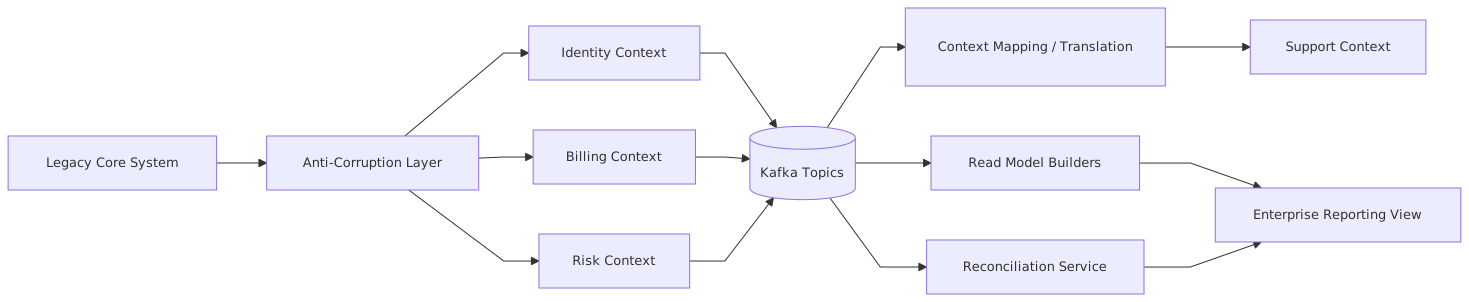
A few opinions here.
First, anti-corruption layers matter more than architects admit. Legacy systems are often semantically polluted. They encode old process assumptions, overloaded statuses, and hidden business rules. If you pipe those directly into Kafka, you do not modernize the estate; you industrialize confusion.
Second, Kafka should carry domain and integration events, but not every topic is a source of truth. Treat streams as transport plus historical evidence, not automatic business authority. Authority belongs to a context for a defined decision.
Third, read models are where cross-context convergence belongs. Do not force every producer to align on a global model simply because reporting wants a neat dashboard.
Diverging models timeline
The drift problem is easier to understand as timeline divergence.
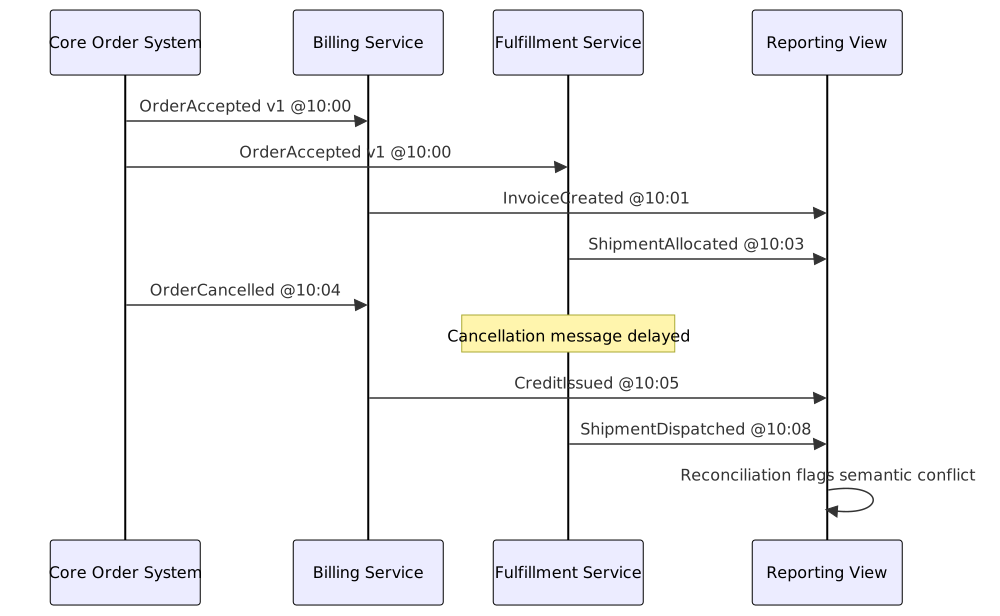
Notice what matters here. The issue is not merely stale data. Billing observed cancellation before fulfillment did. Reporting now has facts that are individually valid but collectively inconsistent. This is the normal operating condition of a distributed enterprise, not an edge case.
So the architecture must answer:
- Which context is authoritative for cancellation acceptance?
- What grace period exists before reporting closes a business day?
- How does reconciliation classify and resolve “dispatched after cancellation”?
- Is compensation operational, financial, or both?
If you do not design those answers, operations will invent them on Friday night.
Semantic context map
A context map is not a poster for a workshop room. It should drive interface design.
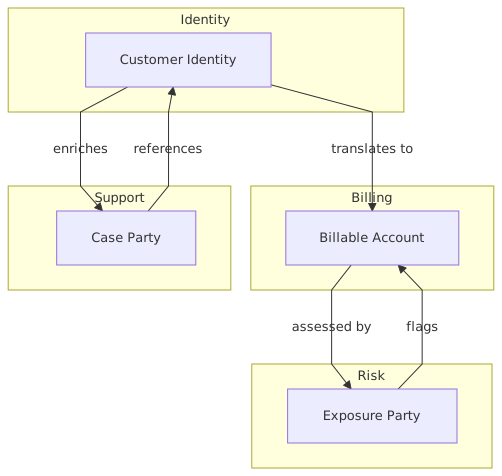
The key idea is that none of these are “the real customer.” Each is real in its bounded context. The translation rules between them are where architecture earns its keep.
Migration Strategy
This is not something you fix with a standards document. You migrate toward it.
The right migration pattern is usually a progressive strangler, but with semantic discipline. Not just endpoint replacement. Model replacement.
Step 1: Identify semantic hotspots
Look for places where:
- multiple systems own overlapping states
- statuses are reinterpreted by downstream consumers
- reconciliation effort is manual and recurring
- incidents are caused by out-of-order or duplicated events
- reporting uses terms no operational service can define consistently
These are signs that the estate has hidden bounded contexts or damaged ones.
Step 2: Name the bounded contexts
This sounds basic because it is basic. Most troubled estates have architecture diagrams full of services and almost no genuine context boundaries. Name the domains, define ubiquitous language within each, and list terms that are known false friends across contexts.
Step 3: Insert anti-corruption layers at legacy seams
Do not let the new world ingest legacy semantics raw. Build adapters that:
- translate statuses
- normalize identifiers
- enrich event metadata
- expose explicit invariants
- isolate ugly rules that should not spread
This is how you stop drift from compounding during migration.
Step 4: Publish versioned integration events
Move from database replication and ad hoc change capture toward deliberate events. But be strict:
- publish business-significant facts
- include event version and time semantics
- document authority and ordering assumptions
- maintain backward compatibility policies
Step 5: Build parallel read models and reconciliation
During strangler migration, old and new models will coexist. That is unavoidable. Use this period intentionally by running:
- shadow projections
- discrepancy reports
- replay tests
- close-of-day comparison jobs
Parallel run is not dead weight. It is the proof mechanism that your semantic migration is working.
Step 6: Shift authority in slices
Do not transfer all business authority at once. Move one decision at a time:
- customer onboarding status
- billable eligibility
- fulfillment release
- dispute resolution state
Authority migration is safer than service migration because it aligns with business semantics.
Step 7: Retire consumers of ambiguous contracts
This is the painful part. Old topics and APIs that carry overloaded meaning must die. If you leave them alive forever, drift remains institutionalized.
A good migration roadmap is less “replace system X” and more “move responsibility for meaning Y.”
Enterprise Example
Consider a multinational insurer modernizing claims and billing.
The estate began with a large policy administration platform that also acted, unofficially, as the source of truth for customer, policy, billing schedule, and claims relationship data. Over years, satellite systems grew around it: CRM, fraud detection, payment processing, document management, and a reporting warehouse.
Then came microservices. The company introduced Kafka and built separate services for:
- policy servicing
- billing
- claims intake
- fraud scoring
- customer profile
- collections
Everything looked modern on the slide deck. In production, the word “policy status” became a battlefield.
In policy servicing, ACTIVE meant the contract was in force.
In billing, ACTIVE meant invoices should be generated.
In claims, ACTIVE meant claims could be lodged.
In collections, ACTIVE meant debt recovery rules applied.
In reporting, ACTIVE meant any policy not lapsed, cancelled, or expired by period close.
Same word. Five meanings. All plausible. None interchangeable.
The first visible symptom was financial reconciliation. Billing generated invoices for policies claims considered suspended pending fraud investigation. Customer service saw one status in CRM and another in billing. Kafka topics propagated updates, but consumers interpreted them through local rules. Incident war rooms became translation sessions.
The firm corrected this by redesigning around bounded contexts:
- Policy Context owned contractual coverage state.
- Billing Context owned billable account state.
- Claims Context owned claim eligibility and case progression.
- Risk/Fraud Context owned investigation and risk disposition.
- Customer Context owned verified identity and contact preference.
They introduced explicit context mapping. Instead of publishing PolicyStatusChanged as a universal fact, they published narrower events such as:
CoverageActivatedBillingEligibilityChangedClaimLodgementPermittedChangedFraudReviewOpened
This looked verbose to developers. It saved the enterprise.
An anti-corruption layer sat between the old policy platform and the new event backbone. It translated overloaded legacy statuses into context-specific facts. A reconciliation service compared billing eligibility, coverage state, and claims permission nightly, with exception handling for timing windows and investigation holds.
The strangler migration lasted eighteen months. During that period, the old warehouse and new reporting projections ran in parallel. Discrepancies were categorized into:
- timing lag
- translation defect
- source data defect
- genuine business conflict
That categorization mattered. Without it, every mismatch would have looked like “bad data.” With it, architecture and operations could target the real cause.
The outcome was not a single grand model. It was a set of honest models with governed translations and measurable drift.
That is what success looks like in an enterprise. Not purity. Control.
Operational Considerations
Runtime behavior is where good domain modeling is either vindicated or exposed as theater.
Event ordering and replay
Kafka gives partition ordering, not universal truth ordering. If your semantics depend on total order across aggregates or contexts, you are building on sand. Design consumers to tolerate:
- duplicates
- gaps
- late arrivals
- replay
- reordered observations across topics
If not, model drift will appear as phantom state transitions.
Idempotency
Reconciliation and event reprocessing are impossible if consumers are not idempotent. Every business-significant state change should be safe to apply more than once or explicitly detected as already handled.
Versioning
Schema versioning is table stakes. Semantic versioning is harder. You need to know when a field addition is harmless, when a status reinterpretation is breaking, and when a lifecycle split requires a new event family rather than a new enum value.
Observability
Most observability stacks are good at latency and errors, weak at semantic health. Add domain observability:
- drift rate between projections
- reconciliation backlog
- conflicting state counts
- event contract adoption
- stale read-model age by context
If you cannot measure semantic divergence, you cannot govern it.
Data lineage
For audit and repair, retain lineage:
- source event id
- source system
- transformation version
- projection version
- reconciliation action history
In regulated industries, lineage is not a luxury. It is the evidence that your distributed model can be trusted.
Tradeoffs
There is no free lunch here.
More explicit context boundaries mean more translation work
That is real cost. Teams must design mappings, maintain anti-corruption layers, and document semantic contracts. But the alternative is hidden translation in consumers, which is worse because it is ungoverned and duplicated.
Reconciliation adds operational overhead
Yes. It adds jobs, dashboards, workflows, and exception management. But if your enterprise has overlapping truths, reconciliation exists whether you design it or not. The question is whether it lives in the architecture or in spreadsheets.
Rich event contracts slow casual change
Good. Casual change is how drift becomes systemic. Fast local change that silently breaks enterprise meaning is not agility. It is deferred outage.
Bounded contexts can frustrate platform standardization
A central data team often wants one enterprise object model. Domain teams want local optimization. The tradeoff is best resolved by standardizing integration conventions and governance, not forcing identical internal models. ArchiMate for governance
Failure Modes
A few patterns fail repeatedly.
The faux canonical model
The enterprise invents a universal customer, order, or policy model and mandates it everywhere. Teams comply on paper and translate in secret. The canonical model bloats, slows change, and eventually becomes a lowest-common-denominator artifact nobody truly owns.
Event as database dump
Teams publish row-change events or serialized aggregates and call that event-driven architecture. Consumers infer meaning from incidental fields. Drift explodes because the producer never expressed business intent.
Shared enums across contexts
This is a quiet killer. A shared package of statuses creates syntactic alignment while semantic divergence grows underneath. Nothing is more dangerous than a shared enum with different business meanings.
Strangler without semantic decomposition
A service is extracted, endpoints move, infrastructure improves, and the original semantic confusion remains untouched. Now the same bad model is just distributed, harder to reason about, and more expensive to change.
Reconciliation with no authority model
Teams build discrepancy reports but never define who is right for which decision. Reconciliation becomes endless comparison without closure.
When Not To Use
This approach is not universal.
Do not invest heavily in semantic contracts, reconciliation platforms, and rich context mapping when:
- you have a small system with one team and a coherent monolith
- the domain is simple, stable, and operationally low-risk
- the organization lacks the maturity to maintain bounded contexts
- there is no real need for independent deployment or data ownership
- the cost of occasional manual correction is lower than architectural complexity
Sometimes a modular monolith is the smarter move. In fact, often it is. If your main challenge is code organization rather than enterprise semantic divergence, keep the model together. Distribution is an amplifier. If the underlying domain understanding is weak, microservices will not improve it. microservices architecture diagrams
Also, if regulatory or financial correctness demands a strict transactional ledger with narrow variation, start with the ledger and surrounding modular services. Do not scatter authority prematurely.
Related Patterns
Several patterns sit naturally beside this approach.
Bounded Context
The foundation. Without it, distributed domain models become accidental clones and accidental forks at the same time.
Anti-Corruption Layer
Essential during migration and at legacy seams. It prevents old semantics from poisoning new models.
Event Sourcing
Useful when timeline and causality matter deeply. It is not required, but event-sourced aggregates can make semantic history explicit. Be careful, though: event sourcing preserves history; it does not automatically solve cross-context meaning.
CQRS
Helpful for separating operational commands from reporting and reconciliation read models. Particularly valuable when enterprise reporting needs convergence without imposing a shared write model.
Outbox Pattern
Important for reliable event publication from transactional systems. It reduces one class of drift caused by missed integration events.
Data Mesh and Data Products
Relevant for analytical convergence. Curated data products can provide enterprise-wide reporting semantics without forcing operational contexts into one model.
Saga / Process Manager
Useful where cross-context workflows require explicit coordination and compensation. But use carefully. A saga is not a license to hide semantic ambiguity inside orchestration.
Summary
Model drift in distributed domain models is not a niche integration issue. It is a core enterprise architecture problem. It emerges when systems distribute faster than meaning is governed.
The remedy is not to force one model across the enterprise. That way lies bureaucracy and fiction. Nor is it to let every team define reality independently. That way lies entropy. The answer is disciplined pluralism: bounded contexts, explicit semantic contracts, event timelines, anti-corruption layers, reconciliation, and migration by responsibility rather than by infrastructure alone.
If you remember one thing, remember this: different models are healthy; unexplained differences are not.
A good distributed architecture does not eliminate divergence. It gives divergence boundaries, names, evidence, and repair paths.
That is what keeps the clocks close enough for the business to catch its flight.
Frequently Asked Questions
What is a service mesh?
A service mesh is an infrastructure layer managing service-to-service communication. It provides mutual TLS, load balancing, circuit breaking, retries, and observability without each service implementing these capabilities. Istio and Linkerd are common implementations.
How do you document microservices architecture for governance?
Use ArchiMate Application Cooperation diagrams for the service landscape, UML Component diagrams for internal structure, UML Sequence diagrams for key flows, and UML Deployment diagrams for Kubernetes topology. All views can coexist in Sparx EA with full traceability.
What is the difference between choreography and orchestration in microservices?
Choreography has services react to events independently — no central coordinator. Orchestration uses a central workflow engine that calls services in sequence. Choreography scales better but is harder to debug; orchestration is easier to reason about but creates a central coupling point.