⏱ 21 min read
Distributed systems do not usually fail with a bang. They fail with a shrug.
A customer clicks Pay Now, and nothing obvious breaks. No exception splashes across the screen. No database catches fire. The request simply waits a little too long, trapped behind one slow replica, one overloaded network path, one noisy neighbor on a shared node, one garbage collection pause at the wrong moment. At scale, that kind of slowness is not an edge case. It is the weather.
This is where request hedging earns its place. Not as a clever optimization for benchmark enthusiasts, but as a practical response to a truth every enterprise architect eventually learns: average latency is a vanity metric; tail latency is what your users actually experience. If the 99th percentile is ugly, the system is ugly.
Request hedging is deceptively simple. If a request appears to be taking too long, issue the same request to another viable endpoint and use the first successful result. It sounds wasteful, and sometimes it is. It sounds risky, and sometimes it is. But in the right domain, under the right constraints, it can shave the long tail off latency distributions and turn a flaky user experience into a respectable one.
The pattern deserves more respect than it usually gets. Too often it is presented as a low-level resilience trick, somewhere between retries and load balancing. That misses the architectural point. Hedging is not just about infrastructure. It is about semantics. It is about knowing which requests can be duplicated safely, which business operations are idempotent, which consistency guarantees matter, and where duplicated work is cheaper than waiting. In other words, this is classic domain-driven design territory disguised as networking.
Let’s treat it that way.
Context
In modern enterprise platforms, a single business interaction is almost never served by a single machine. A retail checkout might involve pricing, promotions, inventory reservation, fraud scoring, payment authorization, loyalty adjustments, tax calculation, and order orchestration. A healthcare inquiry may traverse member eligibility, provider network lookup, policy rules, prior authorization checks, and audit enrichment. A bank transfer touches balance checks, fraud controls, ledger posting, notification, and compliance screening.
Most of these flows are built on microservices, message brokers like Kafka, caches, replicated datastores, service meshes, and cloud-managed infrastructure. The architecture diagrams look clean. The runtime behavior rarely is. event-driven architecture patterns
Latency in these environments is not evenly distributed. Most requests are fast enough. A minority are inexplicably slow. The causes are familiar:
- transient network congestion
- uneven load across replicas
- JVM pauses
- thread pool saturation
- lock contention
- disk jitter
- noisy neighbors in shared compute
- cache miss storms
- downstream retries amplifying demand
- regional link variability
This is the land of tail latency. If a user-facing request fan-outs to ten downstream calls, each with its own long-tail behavior, the combined probability of a slow overall response rises dramatically. Large systems become hostage to the slowest participating component.
Traditional responses help, but only up to a point:
- timeouts stop endless waiting but don’t improve completion speed
- retries recover from failures but often happen too late to protect user latency
- circuit breakers prevent cascades but can reduce availability
- load balancing spreads traffic but doesn’t eliminate replica variance
- caching helps reads, not every business operation
- autoscaling addresses sustained load, not transient stragglers
Request hedging addresses a narrower but painful class of problems: requests that are probably going to succeed, just not soon enough from the original path.
Problem
Some requests in a distributed system become stragglers. They are neither hard failures nor healthy successes. They are late.
That distinction matters. Hard failures are relatively easy to reason about. You detect them and invoke a fallback, retry, or error path. Stragglers are worse because they consume the one thing no system ever gets back: time. A customer waits. An upstream thread remains occupied. Deadlines get tighter. Retries stack on top of work still in-flight. What looked like a latency problem mutates into a capacity problem.
The naive answer is “just retry faster.” But a retry after timeout is often too late; by then the user experience is already damaged. And a blind immediate retry can double load for no reason.
Hedging changes the sequence. Instead of waiting for total failure, the caller sets a threshold based on observed latency—say the 95th percentile for that call. If the original request has not completed by then, a duplicate is sent to an alternate replica or route. Whichever response arrives first wins. The slower one is canceled or ignored.
It is the architectural equivalent of sending a second elevator when the first has clearly stopped on every floor.
The attraction is obvious. The danger is equally obvious. Duplicate requests can create duplicate side effects. They can multiply load during incidents. They can cause weird reconciliation problems when one path completes after the other. They can upset fairness and punish downstream systems already under stress.
So the real problem is not “how do I send a second request?” The real problem is:
How do I reduce tail latency without violating business semantics or destabilizing the platform?
That is the architect’s version of the question, and it is the only one worth answering.
Forces
Request hedging lives in tension. Every useful architectural pattern does.
1. Latency versus capacity
Hedging can reduce p99 latency dramatically. It does so by spending more resources. Two requests may run where one used to run. If done carelessly, the pattern becomes a latency tax paid by the entire platform.
2. Availability versus correctness
For read-only operations, choosing the first successful response is often straightforward. For state-changing commands—reserve inventory, create shipment, debit account—it can be dangerous. Duplicated execution is not an implementation nuisance; it is a domain error.
3. Generic infrastructure versus domain semantics
Platform teams love patterns that can be applied uniformly: “just let the service mesh handle it.” But hedging is not universally safe. The domain must declare whether an operation is idempotent, commutative, compensatable, or forbidden to duplicate. Infrastructure alone cannot infer that from HTTP verbs and status codes.
4. Fast-path optimization versus incident amplification
A small amount of selective hedging can tame stragglers. Aggressive hedging during partial outages can become a self-inflicted DDoS. Patterns that work in steady state can turn predatory in failure.
5. Local optimization versus end-to-end flow behavior
Improving one service call may not improve the business transaction if the real bottleneck sits elsewhere. Architects who optimize local hops while ignoring process semantics are just moving deck chairs around the latency graph.
6. Simplicity versus control
Hedging logic sounds simple but drags in percentile measurements, cancellation behavior, idempotency keys, observability, retry interactions, budget limits, and downstream protection. The implementation can become more complex than the service it protects.
These are not arguments against the pattern. They are the cost of honesty.
Solution
The basic pattern is this:
- Send the original request to the preferred endpoint.
- Wait for a short, policy-driven delay.
- If no response arrives and the request is hedge-eligible, send a duplicate to another healthy endpoint.
- Accept the first valid response.
- Cancel, discard, or safely reconcile the slower response.
This should not be described as “send duplicate requests.” That is mechanically true and architecturally misleading. The real solution is controlled speculative execution bounded by semantic rules and load budgets.
A good hedging policy has five ingredients.
Eligibility
Not every request qualifies. Eligibility must be based on domain semantics and technical behavior:
- safe reads
- idempotent queries
- deterministic computations
- commands protected by idempotency keys
- operations with explicit reconciliation support
A payment capture without idempotency should not be hedged. A product catalog lookup probably can be.
Trigger threshold
The delay before issuing a hedge should be data-driven. Common practice is to use a latency percentile such as p95 or p99 from recent measurements. Too early, and you waste capacity. Too late, and you miss the value.
Alternate target selection
A hedge should avoid the same fate as the original. That means routing to a different replica, availability zone, node pool, or even region where appropriate. Hedging to the same saturated execution pool is theater.
Cancellation and suppression
Once one request wins, the loser should be canceled if the stack allows cooperative cancellation. If not, the result must be ignored safely. This matters both for resource use and for side-effect suppression.
Budgeting and protection
Hedging must operate under strict budgets:
- maximum percentage of traffic eligible
- concurrency caps
- adaptive disablement during downstream stress
- interaction rules with retries and circuit breakers
Without budgets, hedging is just panic in nicer clothes.
Architecture
At architecture level, request hedging sits between client-side resilience and domain-aware execution control. It often belongs in one of three places:
- client library or SDK for internal service-to-service calls
- API gateway or service mesh for standardized, low-risk read paths
- domain service orchestration layer where semantic checks can be enforced
My bias: use infrastructure for the mechanics, but keep the eligibility policy in the domain. Platform teams should provide the gun; domain teams decide when it is legal to fire.
Core request flow
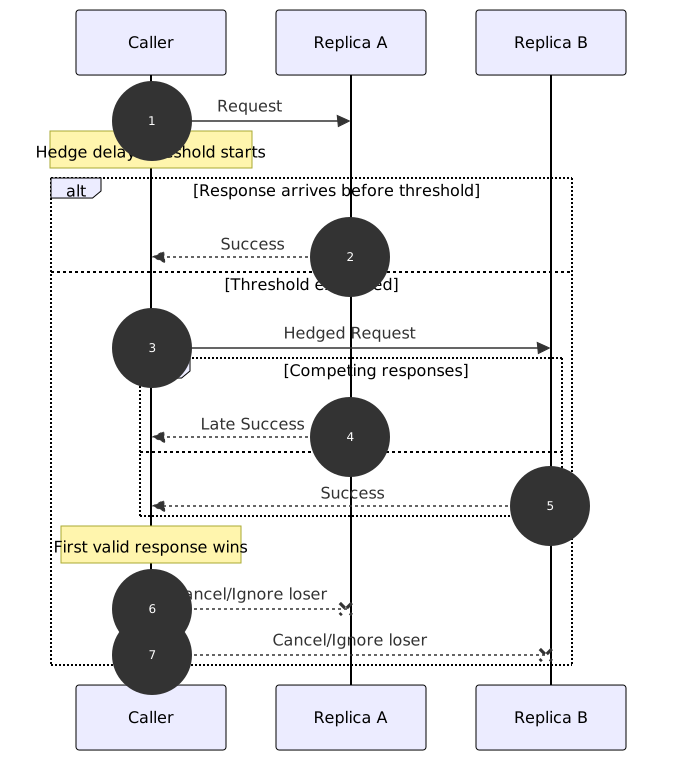
This is the happy diagram. Real systems need more.
Domain semantics layer
A robust architecture treats requests as one of several semantic classes:
- pure query: no side effects, hedge freely
- idempotent command: may be hedged if protected by idempotency key
- reservation command: hedge only with coordination and reconciliation
- non-repeatable command: do not hedge
This is where domain-driven design matters. Technical teams often flatten everything into “HTTP request.” The business does not. “Get inventory availability” and “reserve inventory” are different species. The ubiquitous language should name that difference plainly.
An Order domain, for example, may expose:
CheckInventory(sku, location)— query, hedge-safeReserveInventory(orderId, sku, qty)— command, hedge only with reservation token semanticsCapturePayment(paymentId, amount)— command, hedge only with payment-provider idempotency contractSendOrderConfirmation(orderId)— asynchronous side effect, usually not hedged synchronously
If your APIs do not express these distinctions, you are not ready for request hedging at scale.
Hedging with idempotency and reconciliation
For commands that can be duplicated, the architecture must support:
- unique command identifiers
- idempotency store or deduplication cache
- deterministic response mapping
- reconciliation workers for late-arriving effects
- audit trail of original and hedged attempts
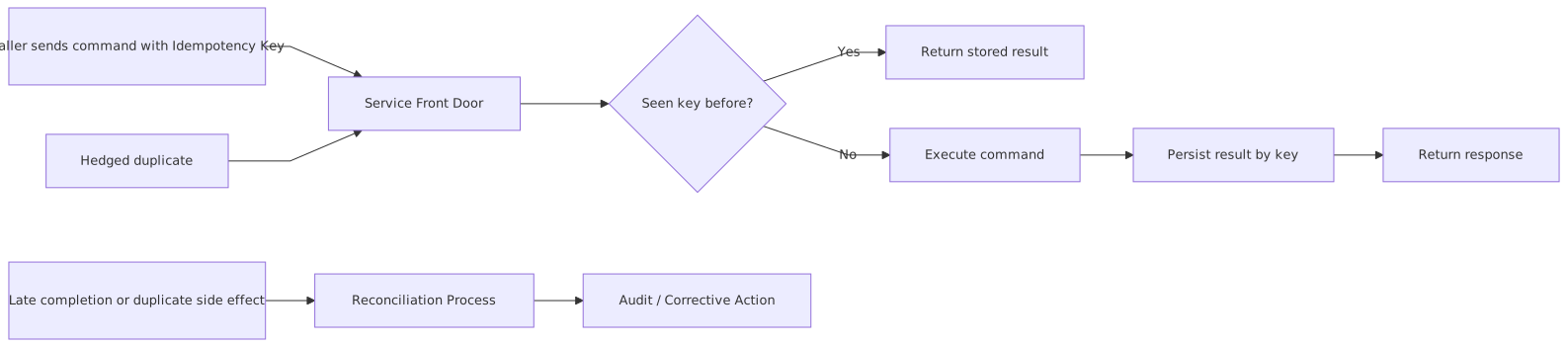
This is particularly important when the downstream system cannot guarantee cancellation. The first response may be returned to the caller while the losing request continues running in another node or another region. If that request can mutate state, reconciliation is not optional.
Kafka and asynchronous boundaries
Hedging is usually a synchronous request pattern, but enterprise systems are increasingly built around event streaming. That does not make the pattern irrelevant; it changes where it applies.
In a Kafka-centered architecture, hedging often belongs on:
- synchronous queries before command acceptance
- gateway-to-service calls
- service-to-cache or service-to-read-model access
- command submission to replicated stateless handlers
It generally does not belong on:
- duplicate event publication to Kafka topics without deduplication semantics
- consumers processing non-idempotent side effects
- saga steps with irreversible external interactions unless command keys exist
If a service hedges a command and both attempts publish domain events, downstream consumers may see duplicates. That is survivable only if the broader event-driven architecture already assumes at-least-once delivery and has deduplication or idempotent consumers. Many teams say they do. Fewer actually do.
Placement options
A practical enterprise architecture often mixes these placements:
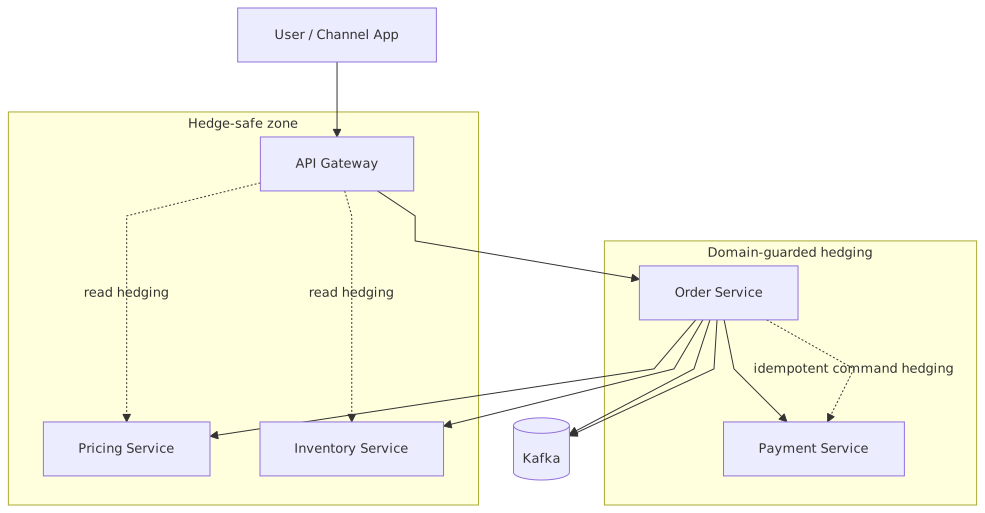
Notice the asymmetry. Pricing and inventory lookup may be hedged easily. Payment requires domain-guarded idempotency. Kafka remains a backbone, but not a place to spray speculative duplicates casually.
Migration Strategy
No sensible enterprise introduces request hedging everywhere in one release. That is how architecture patterns become incidents.
Use a progressive strangler migration.
Step 1: Measure tail latency honestly
Before changing behavior, instrument p50, p95, p99, timeout rates, and request fan-out paths. Identify where stragglers materially affect business outcomes. If your problem is median latency caused by chatty APIs, hedging is the wrong medicine.
Step 2: Classify operations by semantic safety
Build a service catalog with operation classes:
- safe query
- idempotent command
- command requiring reconciliation
- forbidden to hedge
This is not a technical spreadsheet exercise. It is collaborative domain modeling. Product owners, domain architects, and service owners need to agree on the meaning of duplicate execution.
Step 3: Start with read paths
Introduce hedging only for low-risk read operations behind a feature flag:
- customer profile reads
- catalog lookups
- availability checks
- recommendation retrieval
- policy or pricing queries
Prefer client-side or gateway-level implementation first, because the blast radius is easier to control.
Step 4: Add budgets and adaptive controls
Cap hedged traffic. Disable hedging automatically when downstream saturation indicators rise:
- queue depth
- thread pool exhaustion
- CPU pressure
- elevated error rates
- connection pool contention
This step is usually skipped by teams in a hurry. It should not be.
Step 5: Introduce idempotency for selected commands
For commands where latency matters commercially—payment auth, reservation, quote creation—add command IDs, result stores, and deduplication. Do not “turn on hedging” before this work exists.
Step 6: Reconcile and audit
Build reconciliation jobs and dashboards before expanding use. Late duplicates and ambiguous outcomes must have an operational home. Enterprise architecture is not just producing the fast answer; it is producing the explainable answer.
Step 7: Strangle legacy call paths
As services are modernized, route eligible operations through a new resilience-aware client or gateway while preserving old paths for non-eligible operations. Over time, migrate semantics into explicit contracts. The strangler pattern is appropriate here because safety comes from incremental clarification, not brute force replacement.
Enterprise Example
Consider a global retail platform during seasonal peaks. The checkout service orchestrates pricing, inventory, customer entitlements, fraud checks, and payment authorization. The company runs active-active in two regions, with Kafka carrying order and fulfillment events, and a mix of Java microservices behind a service mesh. microservices architecture diagrams
The business complaint is familiar: checkout success rate looks fine, but users see intermittent delays around 4–6 seconds. Conversion drops. Support calls rise. Engineering insists there is no outage.
Investigation shows the culprit is not one catastrophic dependency but several p99 stragglers:
- inventory query against a replicated stock service occasionally stalls on one replica
- pricing service suffers cache rebuild spikes
- fraud pre-check has periodic thread starvation
- payment authorization is usually fast but highly sensitive to network path jitter
The architecture team does not deploy blanket hedging. Instead, it models the domain.
Safe candidates
GetPriceContext(cartId, customerSegment)CheckStoreInventory(sku, storeId)GetPromotionEligibility(customerId, cartId)
These are read-oriented and can be hedged at the gateway or client layer.
Guarded candidates
AuthorizePayment(paymentRequestId, amount, token)CreateInventoryReservation(reservationId, orderId, lines)
These require idempotency keys and durable result mapping. The payment provider already supports idempotency headers. Inventory does not, so the team introduces reservation IDs as first-class domain concepts.
Not eligible
IssueGiftCardSendFraudEscalationCaseTriggerWarehouseManualOverride
These are side-effecting operations with external consequences and weak deduplication controls.
The rollout begins with inventory and pricing reads. Hedge delay is set dynamically at the recent p95 per endpoint, with a 5% traffic budget. Results are immediate: checkout p99 drops substantially, and average capacity overhead remains tolerable because only the slow tail is duplicated.
Next comes payment authorization. This is where real architecture work happens. The team adds:
paymentRequestIdas a stable command key- idempotency storage in the payment adapter
- response canonicalization so duplicate attempts return the same business result
- reconciliation workers to compare late provider callbacks against stored outcomes
- audit records tying original and hedged requests together
A month later, one regional network event causes a spike in payment latency. Hedging sends some requests to the alternate region and preserves conversion. But the architecture also reveals a hidden failure mode: a subset of “losing” requests are not canceled before the provider starts processing them. Because idempotency keys are in place, no double charges occur. Without those semantics, the incident would have been front-page bad.
That is the point. Hedging did not save the day by being clever. It saved the day because the domain model had been made explicit enough to absorb duplicate execution safely.
Operational Considerations
Request hedging is operationally hungry. If you can’t observe it, you shouldn’t run it.
Metrics that matter
Track at least:
- hedge attempt rate
- hedge win rate
- latency reduction by percentile
- extra downstream request volume
- loser cancellation success rate
- duplicate suppression count
- reconciliation backlog
- operation-level eligibility distribution
A hedge win rate that trends high can be good or bad. It may indicate effective tail reduction, or it may signal that the primary path is degraded and your hedge path is silently carrying the system.
Interaction with retries
Retries and hedging can combine into a load amplifier. Set clear rules:
- do not hedge and retry aggressively on the same call
- count hedged attempts against retry budgets
- use deadlines, not isolated timeout values
- prefer one hedge over multiple blind retries for tail latency scenarios
Connection pools and thread models
Hedging increases concurrency pressure. If the caller does not have headroom in connection pools, event loops, or worker threads, the pattern can move bottlenecks upstream. Architects should check bulkheads before celebrating p99 gains in a test harness.
Service mesh versus application code
A mesh can enforce timing and routing consistently, which is attractive for read-heavy calls. But meshes are semantically blind. Application code is semantically rich but implementation-heavy. The enterprise sweet spot is usually:
- mesh or client library for low-risk query hedging
- application-layer policy for commands
- shared platform telemetry across both
Governance
In large enterprises, request hedging should be a governed capability, not a tribal trick. Teams need:
- approved eligibility criteria
- standard idempotency patterns
- reconciliation playbooks
- testing guidance for duplicates and race conditions
- runbooks for disabling hedging during incidents
Tradeoffs
Request hedging is one of those patterns that feels magical when it works and irresponsible when it doesn’t. Both reactions are exaggerated.
Benefits
- meaningful reduction in tail latency
- improved user experience under transient slowness
- resilience to uneven replica performance
- better exploitation of redundant infrastructure
- protection against partial path degradation
Costs
- increased request volume
- more complex semantics for commands
- need for cancellation and result suppression
- added observability and governance burden
- risk of incident amplification
There is no free lunch here. Hedging buys responsiveness by spending redundancy. In domains where time is money—checkout, trading queries, booking flows, eligibility verification—that can be an excellent trade. In back-office workflows with loose SLAs, it may be overengineering.
A line worth remembering: hedging is not about making systems faster; it is about making slowness less random.
Failure Modes
This pattern has sharp edges. Architects should name them bluntly.
Duplicate side effects
The classic disaster. Two hedged commands both execute and mutate state. Without idempotency or deduplication, this means double charges, double reservations, duplicate shipments, duplicate notifications, or inconsistent ledgers.
Retry storms with a nicer logo
If hedging combines with retries, autoscaling lag, and broad timeouts, the system can self-amplify. Downstream latency rises, which triggers more hedges, which raises load, which increases latency further.
Same-path hedging
A hedge routed to the same overloaded replica pool is wasted overhead. The pattern only helps if alternate paths have independent failure characteristics.
Late loser effects
The losing request may complete after the winner has already responded. If cancellation is not cooperative, the loser can still write state, publish events, or consume scarce resources.
Inconsistent responses
Two replicas may not agree due to replication lag, stale caches, or divergent read models. Picking the first response may optimize speed while degrading correctness. This matters in domains with strict freshness expectations.
Broken observability
Without correlation IDs linking original and hedged requests, incidents become forensic nightmares. Teams see doubled traffic and odd state transitions but cannot reconstruct causality.
Semantic drift
Over time, an operation originally considered safe to hedge may gain side effects. A query endpoint starts warming caches, recording access metrics in a transactional path, or triggering recommendations. Infrastructure still hedges it, unaware the semantics changed. This is how accidental coupling turns patterns toxic.
When Not To Use
This pattern is useful, not universal.
Do not use request hedging when:
- the operation is non-idempotent and side-effecting
- the downstream system cannot tolerate duplicate execution
- the service is already capacity-constrained
- the main issue is median latency, not tail latency
- network and replica diversity are too weak to provide an alternate path
- consistency is more important than response time
- the operation already fans out heavily and duplicate work would be too expensive
- observability and cancellation support are immature
- the domain cannot support reconciliation
I would add a harsher rule: if the team cannot explain the business meaning of a duplicate request, the team has no business implementing hedging.
Related Patterns
Request hedging sits near several other resilience and performance patterns, but it is not interchangeable with them.
Retries
Retries react to failure or timeout after the fact. Hedging reacts to probable lateness before total failure. They solve adjacent problems.
Timeout budgets and deadlines
These define how long the system is willing to wait overall. Hedging should operate within a deadline, not ignore one.
Circuit breakers
Circuit breakers stop calls to unhealthy dependencies. Hedging assumes alternate paths may still succeed. Often both patterns are needed together.
Bulkheads
Bulkheads isolate resource consumption. Essential when hedging increases concurrency.
Request collapsing
Instead of duplicating requests, collapsing merges identical concurrent requests. This reduces load, often the opposite economic move from hedging.
Caching
Caching avoids downstream calls; hedging duplicates them. Use the cheaper answer first.
Sagas and compensating transactions
For hedged commands with side effects, reconciliation and compensation become part of the larger saga design.
Strangler pattern
Ideal for introducing hedging progressively around legacy dependencies while semantics are clarified and idempotency is added incrementally.
Summary
Request hedging is a sharp, valuable pattern for distributed systems living under the tyranny of tail latency. It works because real systems are not consistently slow; they are unpredictably slow. By sending a controlled duplicate request after a measured delay, we can often bypass stragglers and improve user experience dramatically.
But the pattern is not an infrastructure parlor trick. It is a semantic commitment.
To use hedging well, an enterprise must know which operations are safe to duplicate, which require idempotency keys, which demand reconciliation, and which should never be hedged at all. That pushes the conversation squarely into domain-driven design: commands and queries are not just transport shapes, they have business meaning. Architecture succeeds when it respects that meaning.
The migration path should be progressive. Start with read-heavy, low-risk calls. Instrument relentlessly. Budget hedged traffic. Introduce idempotency and reconciliation before touching critical commands. Use Kafka and event-driven patterns where they fit, but do not assume asynchronous architecture magically solves duplicate execution. It doesn’t.
The best enterprise implementations are disciplined and selective. They hedge inventory lookups, not everything. They hedge payment authorization only after making the command model explicit. They build audit and reconciliation before the incident, not after it. They understand the trade: a little extra work now to avoid a lot of waiting later.
And that is the enduring lesson. In distributed systems, speed is rarely about going faster in the average case. It is about refusing to let one slow path hold the whole business hostage.
Frequently Asked Questions
What is a service mesh?
A service mesh is an infrastructure layer managing service-to-service communication. It provides mutual TLS, load balancing, circuit breaking, retries, and observability without each service implementing these capabilities. Istio and Linkerd are common implementations.
How do you document microservices architecture for governance?
Use ArchiMate Application Cooperation diagrams for the service landscape, UML Component diagrams for internal structure, UML Sequence diagrams for key flows, and UML Deployment diagrams for Kubernetes topology. All views can coexist in Sparx EA with full traceability.
What is the difference between choreography and orchestration in microservices?
Choreography has services react to events independently — no central coordinator. Orchestration uses a central workflow engine that calls services in sequence. Choreography scales better but is harder to debug; orchestration is easier to reason about but creates a central coupling point.