⏱ 19 min read
Distributed systems rarely fail in one place. They fail like a rumor spreads in a large company: sideways, half-heard, distorted by handoffs, and always at the worst possible moment. A customer clicks Buy, the API returns 202 Accepted, the payment gateway approves, Kafka emits three events, one consumer retries twice, another silently drops an enrichment call, and support gets a screenshot that says only: Something went wrong. The business asks a simple question—what happened to order 847219?—and the architecture responds with twenty dashboards, six log stores, and no coherent story.
That is the real job of observability correlation IDs. Not decoration. Not a logging convention. They are the thread you can still hold when the sweater has already started to unravel.
People often talk about distributed tracing as though the trace itself is the universal answer. It is not. A trace is a technical artifact. A correlation flow is an operational and domain artifact. In real enterprises, work does not move only through synchronous HTTP calls where span trees look neat in a demo. It moves through queues, Kafka topics, scheduled jobs, compensation handlers, manual reviews, settlement batches, CRM updates, and email systems purchased by a different department eight years ago. If you do not think about correlation at the level of business semantics, your tracing story will be elegant and incomplete—the worst kind of architecture.
This article takes a firm position: correlation IDs should be designed as part of the domain and operating model, not bolted onto telemetry libraries after the platform team has already shipped tracing. We will look at the forces at play, the architecture that works, how to migrate there with a progressive strangler approach, where Kafka changes the game, how reconciliation fits in, and where this pattern becomes noise rather than help.
Context
Most enterprises now run some form of distributed architecture: microservices, event-driven integrations, packaged SaaS applications, internal APIs, and data pipelines sharing responsibility for a single business outcome. Observability tooling has matured. OpenTelemetry, Jaeger, Zipkin, Tempo, Datadog, New Relic, and others have made traces and spans familiar. Yet many organizations still struggle to answer basic questions:
- Which downstream operations belong to this customer action?
- Did all services process the same business transaction?
- Where did the work split, stall, retry, or get compensated?
- Can support search by order number, claim number, payment reference, or case ID?
- How do we connect logs, metrics, traces, and events across asynchronous boundaries?
The gap exists because the industry often conflates three different things:
- Request ID — identifies a technical request through a hop or chain of hops.
- Trace ID — identifies a distributed execution path within tracing infrastructure.
- Business correlation ID — identifies the business activity or aggregate lifecycle that operators and domain teams care about.
Those are not the same thing, and treating them as interchangeable creates operational confusion.
A trace ID is excellent for understanding one execution graph. But an order may have several traces: creation, payment authorization, warehouse allocation, shipping update, return, refund, and settlement. The business still sees one order journey. If your architecture lacks a durable business correlation concept, tracing alone becomes a microscope without a map.
This is where domain-driven design thinking matters. Correlation should reflect bounded contexts, aggregates, and domain events, not just network calls. In an Order Management context, the correlation key may be orderId. In Payments, it may be paymentInstructionId or authorizationId. In Claims, the meaningful anchor might be claimId plus caseId for sub-processes. You need to decide what work is being followed, by whom, and for what operational decisions.
Problem
The classic failure pattern looks like this.
A front-end generates a request, the edge API creates a trace, and downstream services happily emit spans. Then the process goes asynchronous. An event is published to Kafka, consumed by a worker later, forwarded to another topic, joined with another stream, retried by a dead-letter replay job, and eventually written to a back-office system via batch integration. Somewhere along the way: event-driven architecture patterns
- the original trace context is lost,
- different teams mint different IDs,
- logs include inconsistent fields,
- retries create duplicate traces,
- support teams cannot search telemetry by business key,
- reconciliation scripts become the only source of truth.
At that point, the architecture has observability data but not observability coherence.
A surprising number of enterprise incidents are not caused by complete outages. They are caused by correlation blindness. A system is “mostly working,” but no one can reliably explain which customer transactions are complete, stuck, duplicated, or orphaned. That is operationally expensive. Support escalations rise. Mean time to innocence rises too—every team proves their service worked locally while the end-to-end outcome remains unknown.
The problem deepens in event-driven systems because asynchronous processing breaks the intuitive shape of a trace. HTTP call chains are linear enough. Kafka is not. Messages branch, merge, replay, and arrive out of order. A single trace tree becomes an awkward representation for a business flow with fan-out, independent retries, and delayed processing. If you rely only on tracing semantics, you eventually force business questions into technical models that were never designed to answer them.
Forces
Several forces pull the architecture in different directions.
1. Technical tracing wants standardization
Platform teams want W3C Trace Context, OpenTelemetry propagation, standard log enrichers, and a single way to instrument everything. Sensible. Without standards, observability decays into tribal customs.
2. The business wants durable semantics
Operations teams search by order number, policy number, shipment number, invoice number. They do not think in trace IDs. Nor should they.
3. Asynchronous systems fracture context
Kafka topics, queue retries, CDC pipelines, ETL jobs, and scheduled compensation handlers all decouple execution in time and space. Context propagation is no longer automatic.
4. Privacy and compliance constrain identifiers
Some IDs are safe to propagate. Others are not. Correlation cannot casually use email addresses, account numbers, or regulated personal data in headers, logs, or topics.
5. Scale punishes verbose cardinality
Metrics systems hate unbounded labels. Log storage hates bloated payloads. Traces hate indiscriminate sampling. Correlation design needs discipline.
6. Teams own different bounded contexts
An enterprise is not one giant unified model. The Order domain, Payment domain, Fulfillment domain, and Finance domain each carry their own identities. Correlation must connect them without pretending they are identical.
7. Reconciliation is inevitable
Even with perfect propagation, some flows will fail, arrive late, duplicate, or diverge. Enterprises need reconciliation capabilities that operate on business correlation IDs, not ephemeral trace trees.
That is the tension. Too much technical purity and the business cannot operate. Too much business overloading and telemetry becomes inconsistent or unsafe.
Solution
The workable solution is a two-layer correlation model:
- Technical trace context for runtime execution visibility
- Business correlation context for domain flow visibility
These two layers travel together, but they serve different purposes.
Core principle
Every unit of work should carry both a trace identity and a domain-relevant correlation identity, with explicit rules for creation, propagation, transformation, and persistence.
That sentence sounds obvious. In practice, it changes architecture.
A good model usually includes:
trace_id: for distributed tracing systemspan_id: for local operationcorrelation_id: stable business flow identifiercausation_id: identifier of the immediate triggering event or command- domain keys: such as
order_id,payment_id,claim_id,shipment_id - optional
tenant_id/channel_idwhere operationally useful
The important move is not simply adding headers. It is defining semantics.
Semantic rules that matter
- Correlation ID survives retries and asynchronous hops.
If a payment authorization is retried five times, it should remain correlated to the same business flow.
- Trace IDs may change across asynchronous boundaries.
A new consumer execution may start a new trace while preserving the business correlation.
- Causation IDs describe immediate lineage.
Useful for event chains: event B was caused by event A.
- Domain keys are first-class, not hidden in payload-only search.
They should be structured log fields and trace attributes where safe.
- Correlation is not always one-to-one.
An order may spawn multiple shipments and invoices. That is a graph, not a string.
This is where domain-driven design sharpens the implementation. In DDD terms, a correlation strategy should align with aggregate boundaries and domain events. For example:
OrderPlacedcarriesorderIdas the primary correlation key in the Ordering context.PaymentAuthorizedintroducespaymentIdin Payments but still preservesorderIdif the domain relationship matters operationally.ShipmentCreatedintroducesshipmentIdwhile retainingorderId.
Now support can answer both questions:
- “Show me everything for order 847219.”
- “Show me why shipment SHP-66291 is delayed.”
That is better than a single generic ID sprayed everywhere.
Architecture
At runtime, correlation flow should be treated as a platform concern with domain hooks. Platform engineering provides propagation, enrichment, and storage patterns. Domain teams define which business identifiers matter.
Reference architecture
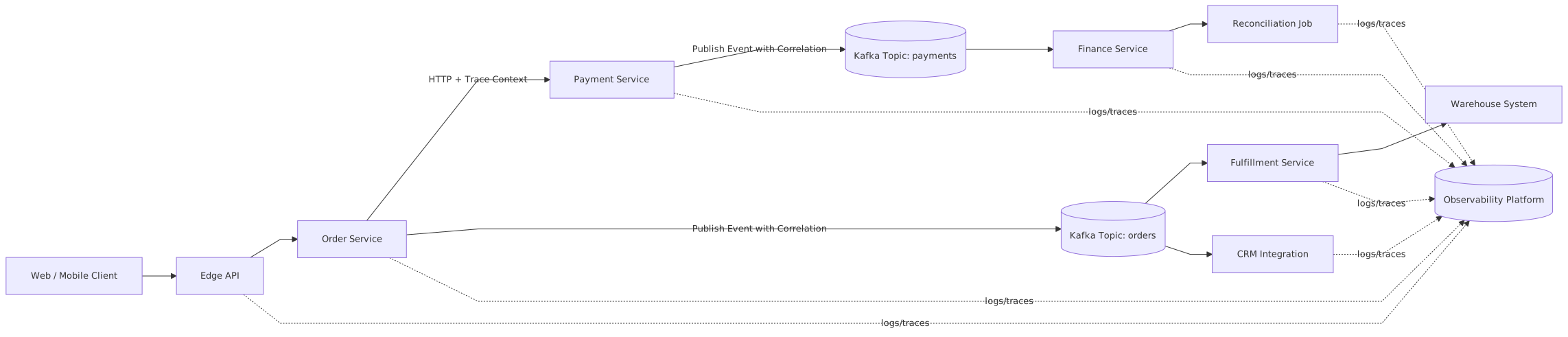
In this architecture:
- HTTP calls propagate W3C Trace Context.
- Events carry correlation metadata in headers and, where appropriate, in payload envelopes.
- Consumers create new spans or traces, but preserve
correlation_idand relevant domain identifiers. - Logs, traces, and selected metrics share the same structured fields.
- Reconciliation processes use durable business correlation, not just technical traces.
Event envelope pattern
For Kafka and similar brokers, a practical pattern is a standard event envelope:
Headers can carry the same metadata for transport-level propagation, but payload-level inclusion is often necessary for long-lived events, replay tools, audit, and downstream consumers that do not preserve transport headers reliably.
This is one of those uncomfortable enterprise truths: headers are elegant until a connector drops them. Payload metadata is ugly until the day it saves your incident response.
Correlation graph, not just linear chain
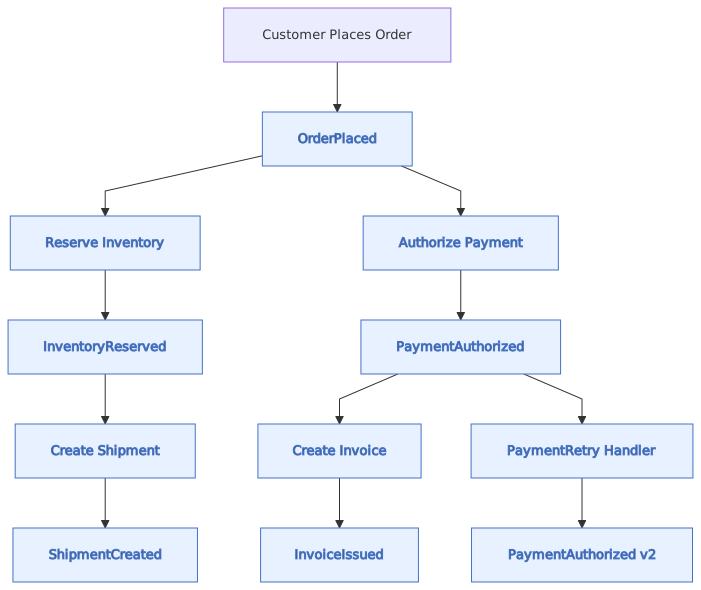
All of these steps may belong to the same business correlation flow, while existing in multiple traces and multiple bounded contexts. That distinction is the heart of the architecture.
Data model choices
A pragmatic enterprise setup typically does this:
- Logs: structured fields for
trace_id,correlation_id,causation_id, and domain IDs - Traces: span attributes include same fields, with domain keys tagged selectively
- Events: headers plus envelope metadata
- Operational data store: optional correlation index mapping business IDs to technical execution records
That last one is useful when observability tools alone are insufficient. Large organizations often build a small “flow ledger” or activity index keyed by business correlation IDs. Not glamorous. Very effective.
Migration Strategy
Do not attempt a flag day. Correlation architecture is not something you “roll out” in one quarter across 140 services and six integration platforms. That fantasy belongs in steering committee slides, not delivery plans.
Use a progressive strangler migration.
Phase 1: Define semantics before code
Start by agreeing on the taxonomy:
- What is a correlation ID in your enterprise?
- Which domain IDs are mandatory per bounded context?
- Where is correlation created?
- When does it fork?
- When is a new correlation ID legitimate?
- What is the retention and privacy policy?
If you skip this and jump straight to middleware, you will standardize confusion.
Phase 2: Instrument the edge
Introduce generation and propagation at system entry points:
- API gateway
- web backend
- batch ingress
- B2B inbound adapters
- event ingestion bridges
This gives every new flow a consistent root context.
Phase 3: Enrich logs and traces first
Before fixing every downstream async handoff, ensure each service can log and trace correlation fields consistently. This creates immediate debugging value.
Phase 4: Standardize event envelopes
For Kafka producers and consumers, add standard metadata handling libraries. Focus first on high-value domains: orders, payments, claims, shipments.
Phase 5: Build correlation-aware reconciliation
Introduce reports or jobs that can identify:
- orphaned flows,
- missing expected events,
- duplicate processing,
- stuck states.
This is where observability turns into operational control.
Phase 6: Strangle legacy paths
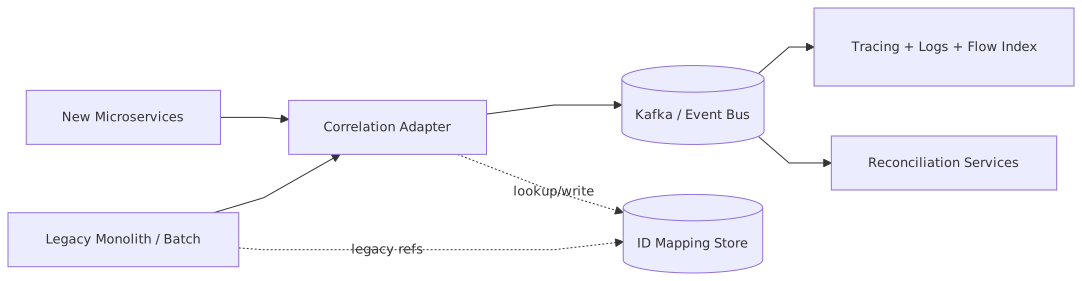
Wrap legacy integrations with adapters that map old identifiers to new correlation semantics. Over time, make the correlation contract mandatory for all new integrations.
Why strangler is the right migration shape
Because correlation touches everything: APIs, events, middleware, logs, support tooling, governance, and domain language. You need coexistence. EA governance checklist
Legacy systems often have their own transaction IDs, batch IDs, or case references. Do not throw them away. Map them. Preserve lineage. Let old and new identifiers coexist in a translation layer until the new model proves itself. Enterprises survive on continuity, not purity.
Reconciliation during migration
Migration creates a dangerous period where some flows are correlated and others are only partially correlated. This is exactly when reconciliation matters most.
Build temporary reconciliation capabilities such as:
- “Find all downstream events for order X, even if some paths only expose legacy batch reference Y.”
- “Detect payment events with no parent order correlation.”
- “Compare expected event sequence to actual event sequence.”
This is not wasted effort. In large migrations, reconciliation becomes the safety net that keeps leadership confident enough to continue.
Enterprise Example
Consider a global retailer with these domains:
- Commerce: cart, checkout, order creation
- Payments: authorization, capture, refund
- Fulfillment: warehouse allocation, shipment, delivery
- Customer Care: contact center case management
- Finance: invoice, settlement, chargeback
The organization had solid tracing for synchronous API calls. Yet support still struggled with one recurring problem: customers were charged but orders occasionally appeared “processing” for hours. Each team had telemetry showing their service was healthy. No one had end-to-end visibility.
What was happening
- Checkout created an order and called payment auth synchronously.
- Order service published
OrderPlacedto Kafka. - Fulfillment consumed it and attempted inventory reservation.
- On reservation timeout, the service retried and eventually succeeded.
- A downstream CRM integration dropped message headers.
- Customer Care systems only saw the CRM case ID, not the order correlation.
- In some scenarios, payment capture started from a separate event stream and created new traces with no business linkage to the original order journey.
Technically, traces existed. Operationally, the flow was fragmented.
The redesign
The retailer introduced:
correlationIdcreated at checkout and tied to the order journey- mandatory
orderIdfor all commerce and fulfillment events paymentIdadded in the payments bounded context while preservingorderId- event envelopes with
correlationId,causationId,traceId, and domain IDs - a lightweight flow index searchable by
orderId,paymentId, andcorrelationId - reconciliation jobs checking expected milestones:
- order placed
- payment authorized
- inventory reserved
- shipment created
- capture completed
Result
Support could search by order number and see:
- all traces associated with the order,
- all events emitted and consumed,
- retries and dead-letter occurrences,
- whether payment had progressed beyond order state,
- where manual intervention was needed.
The architecture did not eliminate failures. It made them legible. That is often the bigger win.
Operational Considerations
Correlation design lives or dies in operations.
Sampling strategy
If traces are heavily sampled, business-critical incidents may disappear from trace storage. Correlation IDs help, but only if logs and event records retain them consistently. For high-value business flows, use tail-based sampling or priority sampling keyed by domain importance.
Searchability
Support tooling should allow lookup by:
- correlation ID
- trace ID
- order ID / payment ID / claim ID
- tenant
- date range
- flow status
Do not force first-line operations teams into raw trace UIs if they think in business objects.
Kafka specifics
Kafka deserves special attention:
- Preserve correlation metadata in headers and payload where replay matters.
- Ensure retry, DLQ, and replay tooling keeps or restores original correlation.
- Distinguish between
eventIdandcorrelationId; duplicates should keep business correlation while event IDs remain unique. - Stream processors that join multiple inputs need explicit rules for which correlation survives or whether a new aggregate-level correlation is introduced.
Cardinality discipline
Putting every business identifier everywhere is a good way to break metrics economics. Use domain IDs in logs and traces; be selective in metrics tags. Correlation architecture is not a license for arbitrary high-cardinality labels.
Governance
Set enterprise standards for:
- allowed correlation fields
- naming conventions
- PII restrictions
- retention policy
- library usage
- event contract requirements
Without governance, one team will use x-corr-id, another correlation-id, another orderRef, and six months later your “standard” is folklore.
Human workflow
The best operational setups connect machine and human processes:
- incident tickets include correlation IDs,
- support case forms capture order or payment references,
- runbooks explain how to pivot between business IDs and traces,
- reconciliation outputs can trigger workflow tasks.
Observability is not complete until people can work with it under pressure.
Tradeoffs
This pattern is powerful, but not free.
Benefit: Better end-to-end diagnosis
You can connect technical behavior to business outcomes.
Cost: More metadata and more discipline
Every service, event producer, consumer, and adapter must play by the rules.
Benefit: Stronger support and reconciliation
Partial failures become visible and classifiable.
Cost: Schema evolution complexity
Event contracts and log schemas need governance. ArchiMate for governance
Benefit: Domain-aware observability
Bounded contexts keep their own semantics while still linking flows.
Cost: Upfront design work
You need serious thought about identity, lineage, and ownership.
Benefit: Useful in asynchronous systems
Especially where traces alone become fragmented.
Cost: Potential misuse
Teams may dump sensitive identifiers or too many IDs into telemetry.
The central tradeoff is simple: you exchange local convenience for enterprise legibility. That is usually a good trade in large organizations.
Failure Modes
Architects should be blunt about how this goes wrong.
1. One ID to rule them all
Teams try to use a single correlation ID for everything forever. It becomes meaningless. Different business lifecycles need distinct but linked identifiers.
2. Correlation generated too late
If the ID appears only after the first few hops, early failures remain invisible.
3. Lost context at async boundaries
A connector, serializer, replay tool, or integration product strips headers and the flow snaps.
4. Retry creates false lineage
Each retry gets a fresh correlation ID, making one failed transaction look like five unrelated attempts.
5. Sensitive data leaks into telemetry
Someone uses email or account number as correlation. Security teams get involved. Correctly.
6. Domain semantics are ignored
Everything is forced into a generic correlationId with no domain keys. Operators still cannot search by meaningful business references.
7. Reconciliation is omitted
Even with good propagation, failures, duplicates, and gaps still happen. Without reconciliation, correlation only tells you where the smoke is, not whether the books balance.
8. Trace and correlation are conflated
A new trace starts and someone assumes business context was lost, when in fact it should have been preserved separately.
These are not edge cases. They are the common path in poorly governed implementations.
When Not To Use
Correlation architecture is not universally necessary.
Do not overbuild this pattern when:
- you run a simple monolith with straightforward logs,
- the workflow is entirely synchronous and short-lived,
- the business process does not cross bounded contexts,
- you do not have operational teams needing cross-system diagnosis,
- the cost of governance outweighs the complexity of the system.
If your application has three services, no broker, no retries, and a single support team that can inspect one database, a business correlation framework may be needless ceremony. Use trace IDs, request IDs, and move on.
Also be cautious in highly privacy-sensitive environments where propagating business identifiers creates compliance risk. In those cases, use opaque surrogate correlation values and tightly control the mapping.
Architecture should solve today’s asymmetry, not tomorrow’s imagined conference talk.
Related Patterns
Several adjacent patterns pair well with correlation flow.
Distributed tracing
The obvious companion. Trace context shows execution paths; correlation adds durable business semantics.
Transactional outbox
Helps ensure events are emitted reliably from state changes, which preserves trustworthy lineage.
Saga / process manager
Long-running workflows need correlation to connect commands, events, compensations, and state transitions.
Event envelope
Provides a standard home for correlation and causation metadata.
Idempotency keys
Useful for distinguishing retries and duplicate submission handling from broader business correlation.
Dead-letter queue and replay
Must preserve original correlation metadata for diagnostics and safe reprocessing.
Reconciliation ledger
A store that tracks expected versus observed milestones in a business flow.
A mature enterprise architecture often uses several of these together. Correlation is the connective tissue.
Summary
Observability correlation IDs are not a minor implementation detail. They are part of how a distributed enterprise explains itself.
If you only propagate trace IDs, you will get beautiful technical diagrams and still fail to answer business questions. If you only carry business IDs without proper tracing context, you will know which transaction is broken but not how it broke. The right answer is a layered model: trace identity for execution, business correlation for meaning, causation for lineage, and domain IDs for bounded-context clarity.
Design correlation with domain-driven thinking. Let aggregates and domain events shape what gets carried forward. Use Kafka event envelopes that preserve both transport and durable metadata. Expect asynchronous boundaries to fracture traces and plan for it. Build reconciliation because retries, duplicates, delays, and partial failures are not bugs in the model—they are facts of enterprise life.
Migrate with a strangler approach. Start at the edges, standardize semantics, enrich logs and traces, then harden event contracts and reconciliation. Do not chase a perfect greenfield solution inside a brownfield company. Enterprises are won by controlled coexistence.
The final test is practical: when an executive, operator, or support lead asks, what happened to this order, payment, or claim? can your architecture answer with confidence?
If not, you do not yet have observability. You have fragments. Correlation flow is how those fragments become a story.
Frequently Asked Questions
What is a service mesh?
A service mesh is an infrastructure layer managing service-to-service communication. It provides mutual TLS, load balancing, circuit breaking, retries, and observability without each service implementing these capabilities. Istio and Linkerd are common implementations.
How do you document microservices architecture for governance?
Use ArchiMate Application Cooperation diagrams for the service landscape, UML Component diagrams for internal structure, UML Sequence diagrams for key flows, and UML Deployment diagrams for Kubernetes topology. All views can coexist in Sparx EA with full traceability.
What is the difference between choreography and orchestration in microservices?
Choreography has services react to events independently — no central coordinator. Orchestration uses a central workflow engine that calls services in sequence. Choreography scales better but is harder to debug; orchestration is easier to reason about but creates a central coupling point.