⏱ 19 min read
Distributed systems do not fail all at once. They fray at the edges.
A price changes in one service and appears eight seconds later in another. A customer updates their address, but the warehouse still ships to the old one. Finance closes the books while a late event is still wandering through a Kafka topic like a lost suitcase in an airport. Nobody notices at first because most synchronization lag does not announce itself with a dramatic outage. It arrives as a quiet corruption of trust. event-driven architecture patterns
That is the real problem with data synchronization lag. It is not merely technical latency. It is semantic drift across bounded contexts. One part of the enterprise believes one thing; another believes something slightly older, slightly different, or dangerously incomplete. And once those differences leak into customer interactions, accounting, compliance, or operations, the organization starts paying interest on architectural debt.
Architects often talk about eventual consistency as if it were a mature compromise. Sometimes it is. Sometimes it is just delay wearing a fancy suit.
This article looks at synchronization lag the way an enterprise architect should: not as a queue depth metric alone, but as a business design problem. We will walk through the forces that create lag, patterns for managing it, migration strategies for legacy estates, and the failure modes that matter in real organizations. We will use domain-driven design, event-driven architecture, Kafka-backed integration, and reconciliation patterns where they actually help. And just as importantly, we will say when not to use them.
Context
In a monolith, data synchronization is mostly a local concern. A transaction commits or rolls back. The database is the source of truth. The system may be ugly, but at least it is honest with itself.
Once an enterprise adopts microservices, packaged SaaS platforms, streaming pipelines, regional deployments, and data lakes, truth becomes negotiable. Customer data may live in CRM, order data in an order service, inventory data in warehouse systems, ledger data in finance platforms, and product data in a master data service. Every one of these systems has its own clock, storage engine, transaction model, and operational rhythm.
Synchronization lag emerges because we have traded direct consistency for autonomy, scale, and resilience. That trade is often rational. A warehouse service should not be blocked because the loyalty system is slow. A checkout path should not wait on an ERP round trip. A fraud model may consume events asynchronously because speed matters more than immediate completeness.
But enterprises often make this trade without doing the semantic accounting.
The first architectural question is not, “How do we reduce lag?” It is, “Which facts must be synchronized, to whom, in what form, within what business time window?” That is a domain question before it is an infrastructure question.
A customer address update, a product price change, and a bank transfer confirmation all look like data changes. They are not equivalent. One may tolerate minutes of delay, another seconds, and another none at all. If we collapse these into one generic synchronization strategy, we end up with brittle systems and poor conversations.
Domain-driven design helps here because it forces us to recognize bounded contexts and ownership. There is no universal enterprise truth; there are authoritative contexts for particular meanings. “Order shipped” in logistics is not the same thing as “revenue recognized” in finance. Synchronization lag becomes dangerous when we pretend those meanings are interchangeable.
Problem
The visible symptom is easy enough to describe: one system is behind another.
The real problem is more layered:
- users see inconsistent data across channels
- business processes act on stale facts
- downstream projections and read models diverge
- compensations become common rather than exceptional
- support teams lose the ability to explain system behavior
- audit and compliance controls become fragile
Lag shows up in different ways.
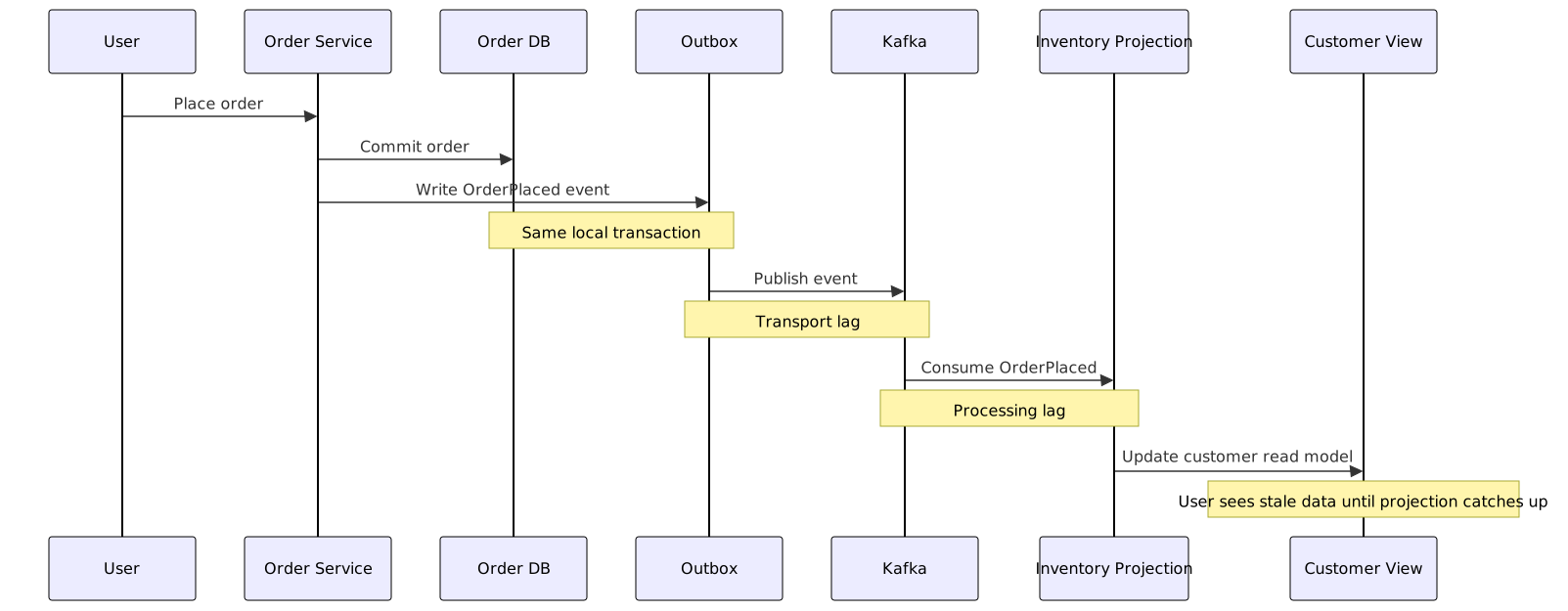
There is transport lag, where messages are delayed in brokers or networks.
There is processing lag, where consumers are alive but slow.
There is semantic lag, where the event arrived on time but cannot be applied because the receiver lacks prerequisite context, schema understanding, or sequencing.
There is reconciliation lag, where the system accepts inconsistency now and relies on later batch correction.
And there is the most insidious kind: decision lag. That happens when the business assumes a state has converged but the architecture has no such guarantee.
Consider the common e-commerce flow. Pricing updates are published from a pricing service. Search indexes consume the event. Caches refresh. Recommendation engines recompute scores. Promotions evaluate eligibility. If all of this happens asynchronously, a customer may see one price in search, another in product detail, and a third in checkout. Every system is “working.” The experience is broken.
Synchronization lag is not only a technical defect. It is often a breach of domain invariants across asynchronous boundaries.
Forces
Architects should name the forces because they rarely disappear. They have to be balanced.
Autonomy versus consistency
Microservices promise independent deployment and team ownership. That autonomy is real only if services can make progress without tightly coupled synchronous dependencies. Asynchronous integration helps. It also introduces lag.
Throughput versus freshness
Kafka, Pulsar, and similar platforms are excellent at moving large volumes of data reliably. But a system optimized for throughput often tolerates buffering, batching, backpressure, and replay. Those same features create delay under load.
Local transactions versus cross-system truth
Each service can maintain strong consistency within its own database. Cross-service consistency becomes eventual unless you choose expensive orchestration or distributed transactions, which in most enterprises are either unavailable, unsafe, or politically impossible.
Domain semantics versus generic integration
Generic “entity changed” events feel efficient. They are also semantically weak. Rich domain events produce better downstream behavior but require thought, stewardship, and versioning discipline.
Operational simplicity versus resilience
A direct synchronous call is simpler to reason about in the moment. Event-driven synchronization is more resilient under partial failure. The bill comes later in tracing, reconciliation, idempotency, and observability.
Human expectations versus system reality
Business stakeholders hear “real-time” and imagine immediate convergence. Engineers hear “near real-time” and imagine p95 under fifteen seconds. Architects must close that gap with explicit service level objectives for freshness, not just uptime.
Solution
The right solution is rarely “eliminate lag.” The better goal is to design, bound, observe, and compensate for lag according to domain semantics.
That means four things.
First, define authoritative ownership per bounded context. A service should publish business facts it owns, not leaked table mutations. Events should reflect domain meaning: OrderPlaced, InventoryReserved, PaymentCaptured, AddressCorrected. Those names matter. They tell downstream consumers what changed and why.
Second, establish freshness expectations by use case. Some views can be stale. Some decisions cannot. An order confirmation page may require payment state from the authoritative payment context now. A marketing segmentation dashboard can wait.
Third, use an architecture that supports asynchronous propagation with explicit lag handling: transactional outbox, Kafka topics partitioned by aggregate key, idempotent consumers, ordered processing where required, dead-letter handling, and reconciliation jobs.
Fourth, make inconsistency visible and recoverable. If a read model is stale, say so. If a consumer falls behind, alert on business lag, not just CPU. If an event is missed, reconcile from source of truth.
A robust synchronization design usually combines streaming propagation with periodic reconciliation. Streaming gives timely updates. Reconciliation gives eventual correctness when the real world happens, and it always does.
Architecture
A practical enterprise architecture for managing synchronization lag has a few standard parts, but the details matter.
1. Authoritative domains and published language
Every bounded context owns specific business facts. The publishing model should follow that ownership. This is classic domain-driven design, and it becomes painfully relevant in distributed estates.
If the Inventory context owns stock reservations, it should publish reservation events. It should not expose low-level row changes or expect downstream systems to infer business meaning from them. Domain events reduce semantic lag because consumers can react to business intent, not reverse-engineered persistence updates.
2. Transactional outbox
The dual-write problem is the birthplace of many ghost lags. A service writes to its database and publishes to Kafka. One succeeds, the other fails. Now the system has not just lag, but divergence.
The transactional outbox pattern addresses this by writing the business change and an outbound event record in the same local transaction. A relay process then publishes the outbox record to Kafka. This does not remove delay entirely, but it preserves correctness and recoverability.
3. Event streaming backbone
Kafka is well-suited when you need durable event propagation, replay, partitioned ordering, and many downstream consumers. Use topics aligned to domain streams rather than one giant integration swamp. Partition by aggregate key when ordering matters for an entity lifecycle. Keep schemas versioned and governed.
4. Consumer-side materialized views
Downstream services often maintain read models or projections tailored to their own use cases. This is good. It preserves bounded context autonomy.
But every materialized view is a promise to be wrong for a while.
Treat projections as derivative models with measurable freshness. Include source offsets, event timestamps, or freshness metadata so consumers and operators know how stale the view may be.
5. Reconciliation pipeline
You need a second line of defense. Nightly is often too late; continuous or frequent reconciliation is better for high-value domains. Reconciliation compares authoritative state with downstream projections or dependent systems and repairs drift.
This can be implemented as:
- periodic snapshot comparison
- change data capture backfill
- replay from event logs
- targeted correction workflows for failed entities
6. Lag-aware user and process design
The architecture should not pretend convergence where it cannot guarantee it. If a process depends on settled payment, do not read a lagging projection; query the authoritative service or use an orchestrated step. If a dashboard is eventually consistent, annotate freshness. Good architecture includes honest UX.
Here is a simplified lag timeline.
And here is a broader architectural shape.
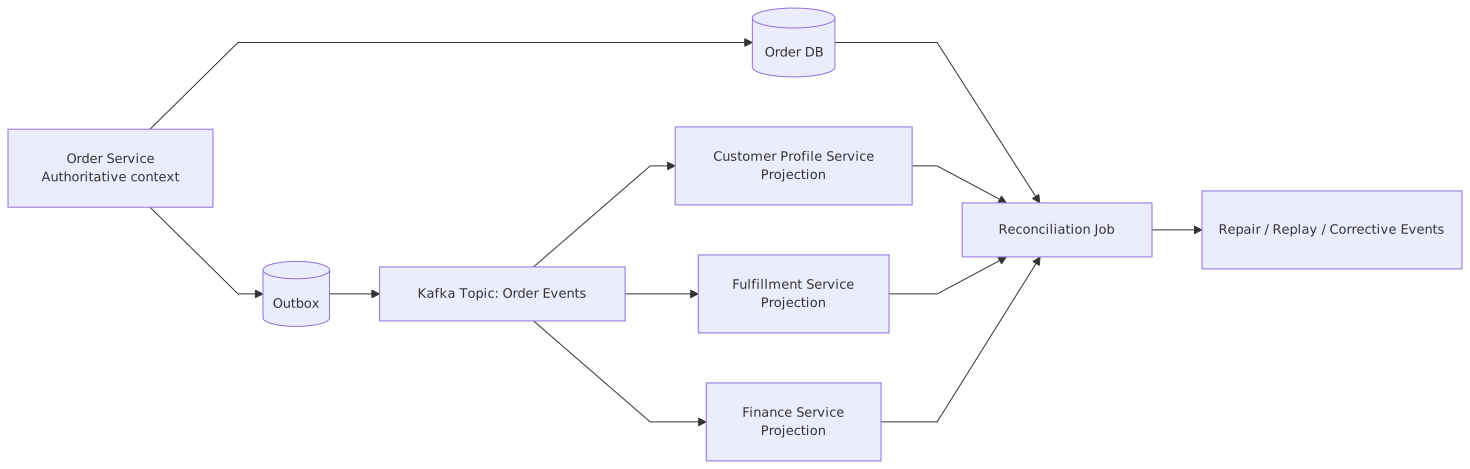
The point of the architecture is not to achieve magical immediacy. It is to provide controlled asynchrony.
Migration Strategy
Most enterprises do not begin with clean domain events and beautifully partitioned Kafka topics. They begin with a monolith, a collection of databases used as integration surfaces, and a spreadsheet of things everybody is afraid to touch.
This is where progressive strangler migration earns its keep.
You do not replace all synchronization paths at once. You peel them away in slices, aligned to domain capability and business risk.
Step 1: Identify volatile domains and stale pain points
Start where lag already hurts or where change velocity is high. Pricing, inventory availability, customer profile, order status, and reference data are common candidates. Do not begin with the most politically central domain if the organization lacks event discipline. Start where you can prove value.
Step 2: Establish domain ownership and canonical business events
Not enterprise canonical data models. Those usually become committees with diagrams. What you need are authoritative contexts and published domain events.
For example:
- Pricing owns
PriceChanged - Inventory owns
StockAdjustedandReservationConfirmed - Orders owns
OrderPlaced,OrderCancelled,OrderShipped
This is the beginning of semantic governance. EA governance checklist
Step 3: Introduce outbox publication at the edge of the legacy system
If the monolith remains authoritative for some domains, add an outbox pattern there first. Publish trustworthy events without rewriting the world. This gives downstream consumers a stable integration contract while the core remains in place.
Step 4: Build new projections and consumers beside existing integrations
Do not cut over all reporting, APIs, and downstream systems in one move. Build new event-driven read models in parallel. Compare them against legacy outputs. Measure lag and correctness. This is where reconciliation starts paying off early.
Step 5: Strangle synchronous dependencies selectively
Where downstream consumers currently call the monolith for non-critical reads, redirect them to projections once freshness is acceptable. Keep critical commands against authoritative sources until domain invariants and compensations are clear.
Step 6: Move write ownership capability by capability
Only after events, consumers, and reconciliation are stable should you move command ownership out of the monolith. This is the part people try to do first because it looks bold. It is usually the wrong order.
Step 7: Retire point-to-point sync and batch glue
As event-driven flows prove themselves, remove fragile ETL chains and custom sync jobs. But keep reconciliation. Mature architectures still reconcile. The difference is they reconcile exceptional drift, not routine chaos.
A migration diagram makes this clearer.
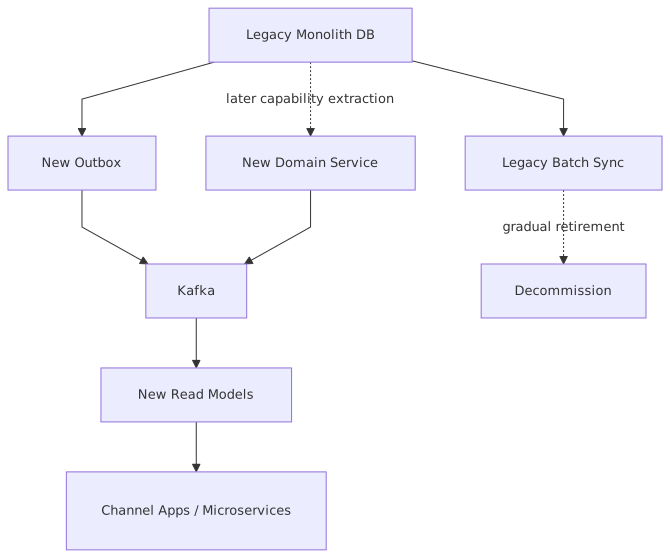
The strangler pattern works because it respects operational reality. Enterprises cannot suspend the business while architecture catches up with ambition.
Enterprise Example
Consider a global retailer with stores, e-commerce, and regional fulfillment centers. Inventory availability is the battlefield.
Historically, inventory lived in an ERP and was batch-synchronized every fifteen minutes to e-commerce and store systems. That was acceptable when online demand was modest. It became intolerable during flash sales and holiday peaks. Customers could purchase items shown as available online, only for the warehouse to reject fulfillment because the last units had already been reserved elsewhere. The architecture produced overselling, order cancellations, customer complaints, and a genuinely ugly support backlog.
The first instinct from some teams was to make every channel perform synchronous stock checks directly against ERP. Predictably, that collapsed under scale and introduced tight coupling into the checkout path. The ERP became both critical dependency and performance bottleneck. This is the sort of solution that looks responsible in a steering committee and reckless in production.
The better design recognized separate domain semantics:
- Inventory ledger in the ERP remained authoritative for financial stock positions.
- A new Inventory Availability context became authoritative for sellable stock and reservations.
- E-commerce and store channels consumed availability projections, not ERP tables.
- Reservation events flowed through Kafka, keyed by SKU and location.
- Checkout used a synchronous reservation command to the Availability service because that decision could not tolerate stale reads.
- Search and browse used lag-tolerant projections with freshness indicators.
This distinction mattered. “Stock on hand” and “available to promise” are not the same thing. One is accounting truth; the other is commercial truth. Treating them as one field was the source of much pain.
The migration began by publishing stock-adjustment and reservation events from the legacy ERP via an outbox. A new availability service built a real-time reservation model. Channels switched browse experiences first, then later checkout reservation calls. Reconciliation jobs compared ERP positions, reservation streams, and channel projections to detect drift.
The result was not zero lag. Search pages still accepted a few seconds of staleness during extreme load. But overselling dropped sharply because the critical invariant moved to the synchronous reservation boundary, while lag-tolerant experiences remained asynchronous.
That is mature architecture: not “everything real-time,” but the right consistency in the right place.
Operational Considerations
If you cannot observe lag, you do not control it. You merely hope.
Operational design for synchronization lag should include the following.
Freshness SLOs
Define service level objectives for data freshness by business capability:
- order status visible to customer within 5 seconds
- price propagation to channels within 30 seconds
- finance reporting reconciliation complete within 15 minutes
These are business-facing promises, not just broker metrics.
Lag telemetry
Measure:
- event age from creation to consumption
- consumer group lag
- projection update delay
- percentage of entities outside freshness window
- reconciliation drift rate
- replay backlog and catch-up duration
A consumer can have low broker lag and still be semantically behind if it is skipping or parking events due to schema or dependency errors.
Schema governance
Use versioned contracts and compatibility rules. Event evolution is inevitable. Consumer breakage is optional. Weak schema discipline turns synchronization lag into synchronization failure.
Idempotency and ordering
Consumers should tolerate duplicates. Some streams require order by aggregate key. Others do not. Over-ordering harms throughput; under-ordering corrupts business state. This is a domain decision, not a broker checkbox.
Backpressure and replay
Have explicit policies for slow consumers, poison messages, and replay storms. Replaying six months of compacted events into an unprepared downstream system is a fine way to discover hidden assumptions.
Reconciliation operations
Reconciliation must be a first-class operational process:
- scheduled comparison jobs
- entity-level repair tooling
- correction event generation
- audit trail of repaired drift
- thresholds for automatic versus manual intervention
Data retention and auditability
Lag incidents often become audit incidents. Retain enough event history, offsets, and correction records to explain what happened. “The queue was behind” is not an audit narrative.
Tradeoffs
There is no free lunch here. Only bills sent to different departments.
Event-driven synchronization improves decoupling but increases cognitive load
Teams gain autonomy and resilience. They also inherit eventual consistency, replay semantics, schema versioning, and distributed debugging. If the organization is not ready, the architecture becomes theater.
Rich domain events reduce ambiguity but require stewardship
Well-designed events are an asset. Badly designed events become a second database schema no one owns properly.
Reconciliation improves correctness but adds complexity
You need it anyway. The tradeoff is not whether to reconcile, but whether to do it deliberately or by support tickets and finance adjustments.
Synchronous checks reduce lag for critical decisions but create runtime coupling
Use them sparingly at business invariant boundaries: payment authorization, inventory reservation, fraud approval. Do not let every service call every other service just to feel safe.
Fine-grained services can amplify lag paths
More services mean more boundaries, more topics, more projections, more opportunities for drift. Sometimes a modular monolith is the wiser move, especially when the domain is not mature.
Failure Modes
Architects should be suspicious of happy-path diagrams. Systems fail in ordinary, repetitive ways.
Dual writes without outbox
The database commits, the event publish fails, and a downstream system never learns of the change. Reconciliation eventually catches it, or worse, nobody notices.
Out-of-order events
A cancellation arrives before a creation in one consumer path. The projection is now nonsense unless the consumer can buffer, reject, or reconcile.
Poison messages
A schema edge case, null field, or invalid state causes a consumer to halt. Lag accumulates behind one toxic event while upstream teams insist they “published successfully.”
Hot partitions
One aggregate key or SKU gets disproportionate traffic. Kafka preserves order per partition, which is helpful until one hot partition turns freshness into a lottery.
Semantic misalignment
A downstream system interprets OrderCompleted as “safe to invoice,” while upstream meant only “customer checkout finished.” This is not a transport failure. It is a domain language failure.
Reconciliation masking systemic issues
Teams sometimes use reconciliation as a broom. If daily repair jobs are correcting thousands of entities, the architecture is not resilient; it is surviving by clerical labor.
Lag during incident recovery
A downstream outage causes backlog growth. When the consumer recovers, replay load degrades dependent databases, extending lag and causing a secondary incident. Recovery plans must include catch-up behavior, not just restart scripts.
When Not To Use
There are cases where elaborate synchronization architecture is the wrong answer.
Do not use a heavily asynchronous, event-driven synchronization model when:
- a single transactional system can meet the need
- domain boundaries are unclear and ownership is political fiction
- the business requires immediate atomic consistency across operations
- the organization lacks operational maturity for streaming platforms
- the change volume is low and batch integration is sufficient
- regulatory controls require deterministic transactional confirmation before proceeding
A modular monolith with explicit modules and a shared transactional store can be vastly better than a fleet of microservices passing vague events around. There is no virtue in distributing a system before the domain language is stable. microservices architecture diagrams
Likewise, if the business process truly needs linearizable, immediate state agreement, then accept the coupling and design for it directly. Eventual consistency is a strategy, not a religion.
Related Patterns
Several architecture patterns sit close to synchronization lag management.
Transactional Outbox
Prevents dual-write divergence between local state and event publication.
Change Data Capture
Useful when legacy systems cannot publish proper events. Better than polling tables, though semantically weaker than domain events.
CQRS
Supports separate write models and lagging read models. Valuable when read concerns differ sharply, but should not be adopted merely for fashion.
Saga
Coordinates long-running business transactions across services. Useful when consistency is achieved through orchestration or choreography with compensations.
Materialized View
Local projection optimized for a consumer use case. Essential in distributed systems, but every view must carry a freshness contract.
Strangler Fig
Progressive replacement pattern for migrating from monolith or legacy integration to event-driven capabilities.
Reconciliation / Repair Loop
Compares authoritative state with derived state and repairs drift. In many enterprises, this is the difference between plausible architecture and real architecture.
Summary
Data synchronization lag is not just the delay between write and read. It is the distance between business truth and system belief.
Good distributed architecture does not attempt to wish that distance away. It names ownership, encodes domain semantics, chooses where lag is acceptable, and protects the boundaries where it is not. It uses Kafka and asynchronous propagation where autonomy and resilience matter. It uses synchronous interaction where business invariants demand it. It adopts transactional outbox to avoid dual-write lies. It employs reconciliation because reality is untidy and production always finds the gap in your diagrams.
Most importantly, it treats migration as a sequence of careful cuts, not a grand rewrite. Progressive strangler migration, side-by-side projections, and measured cutover win more often than heroic replacement programs.
The memorable line here is simple: stale data is rarely just old data; it is old meaning.
That is why synchronization lag belongs in the architect’s hands, not left as a broker tuning exercise. Once you see the problem as semantic drift across bounded contexts, the design becomes clearer. You stop asking for universal real-time truth. You start designing trustworthy systems that know what they own, how fresh they are, and how to recover when they fall behind.
That is the sort of honesty distributed systems need.
Frequently Asked Questions
What is a service mesh?
A service mesh is an infrastructure layer managing service-to-service communication. It provides mutual TLS, load balancing, circuit breaking, retries, and observability without each service implementing these capabilities. Istio and Linkerd are common implementations.
How do you document microservices architecture for governance?
Use ArchiMate Application Cooperation diagrams for the service landscape, UML Component diagrams for internal structure, UML Sequence diagrams for key flows, and UML Deployment diagrams for Kubernetes topology. All views can coexist in Sparx EA with full traceability.
What is the difference between choreography and orchestration in microservices?
Choreography has services react to events independently — no central coordinator. Orchestration uses a central workflow engine that calls services in sequence. Choreography scales better but is harder to debug; orchestration is easier to reason about but creates a central coupling point.