⏱ 20 min read
Disaster recovery used to be a room with tape drives and a prayer. Then it became a second data center with a spreadsheet full of half-truths. In the cloud era, we got something better and more dangerous: the ability to build systems that appear immortal. Appear is doing a lot of work there.
Multi-region failover is one of those topics that seduces architects into drawing elegant boxes and arrows while the real problem sits elsewhere, usually in the semantics of the business. You can replicate servers. You can replicate databases. You can even replicate Kafka clusters if you’re willing to pay the bill and accept some complexity. But replicating meaning — “has this payment been captured?”, “has this order already shipped?”, “is this customer allowed to see this balance?” — that’s where the real architecture lives. event-driven architecture patterns
That is the heart of the matter. Multi-region failover is not a networking trick. It is a domain problem disguised as infrastructure.
The firms that get this right do not start with DNS policies or load balancer health checks. They start by deciding which business capabilities must survive regional loss, what inconsistency the business can tolerate, and where they are prepared to pay in latency, complexity, and operational burden. The firms that get it wrong build active-active systems because the diagram looks modern, then discover too late that their refund service and inventory service disagree in two continents at once.
This article takes a hard look at multi-region failover topologies in cloud architecture, especially active-active patterns. We’ll cover the topology choices, the migration path from simpler models, where Kafka and microservices fit, how reconciliation really works, and when the whole idea is overkill. I’ll stay close to enterprise reality: legacy estates, uneven modernization, political boundaries, and systems that still have to make money on Monday morning. microservices architecture diagrams
Context
Most enterprises adopt multi-region architecture for one of four reasons.
First, resilience. A region fails, or more commonly, enough of its dependencies fail that the region is effectively unavailable. This might be a cloud control plane issue, a network partition, a broken identity dependency, a managed database outage, or a bad deployment amplified at regional scale.
Second, latency. Users in Singapore should not have to wait for Virginia to think.
Third, regulatory and data sovereignty concerns. Personal data, payment records, and operational telemetry are often subject to where they can live and where they can be processed.
Fourth, merger-driven sprawl. Many “multi-region” estates are not strategically designed at all. They are the sedimentary layers of acquisition, with Europe running one stack, North America another, and a central architecture team trying to call it a platform.
These drivers matter because they push toward different topologies. A business chasing low latency might tolerate eventual consistency. A bank processing payments may not. A manufacturer can often replay telemetry; a trading platform may not survive duplicate execution.
This is why domain-driven design belongs in the room from the first conversation. Regions are not just deployment targets. They are boundaries that stress your domain model. If your bounded contexts are muddled, region failover will expose it brutally.
An order management context might tolerate asynchronous replication of order history. A payment authorization context likely needs stronger semantics around idempotency and ledger integrity. A customer profile context may need regional partitioning for privacy reasons. A fraud detection context may accept model drift between regions for a short period if the alternative is downtime. Different bounded contexts demand different failover behavior.
One region strategy for the whole estate is usually a sign of architectural laziness.
Problem
The obvious problem sounds simple: keep the service available if a cloud region fails.
The real problem is nastier. How do you preserve business correctness while moving traffic, data, and processing across failure boundaries you do not fully control?
That expands into several sub-problems:
- How quickly must failover happen?
- Is failover automated, operator-driven, or phased?
- Can both regions serve traffic at once?
- What happens to in-flight transactions during a partition?
- How are writes coordinated?
- How do downstream systems know which region is authoritative?
- How are duplicate events detected and reconciled?
- Can the user tolerate stale reads?
- Can the business tolerate double-processing?
- How is data brought back into alignment after recovery?
Active-passive is often pitched as the safe answer. It isn’t safe, merely simpler. Active-active is often pitched as the modern answer. It isn’t modern, merely more demanding.
The architectural challenge is to choose the minimum topology that satisfies the business recovery objective without creating a distributed system whose failure modes exceed the original outage risk.
Forces
There are always forces pulling in opposite directions.
Availability versus correctness. You can keep serving traffic in two regions, but every cross-region write path drags consistency questions behind it.
Latency versus coordination. The more a transaction needs synchronous global agreement, the less “multi-region” helps end-user performance.
Autonomy versus standardization. Product teams want local freedom. Platform teams want one approved way of doing failover. Enterprises need both, and rarely get the balance right.
Cost versus preparedness. True active-active costs more in infrastructure, observability, data replication, testing, and operations. The bill arrives monthly; the outage arrives once a year. Guess which one finance notices first.
Domain purity versus legacy gravity. In a greenfield DDD microservices landscape, one can shape bounded contexts around consistency needs. In a 20-year enterprise core system, the domain is often trapped inside a shared schema and a pile of batch jobs.
Regulatory partitioning versus operational convenience. Keeping data in-region helps compliance. It also makes global reporting, support tooling, and central operations messier.
Recovery speed versus reconciliation pain. Fast failover often means accepting temporary divergence and repairing later.
The mature architect doesn’t eliminate these tensions. They make them explicit and choose consciously.
Solution
There are three broad failover topologies worth discussing:
- Active-passive multi-region
- Active-active with regional affinity
- Active-active with globally distributed write processing
The first is where most enterprises should begin. The third is where many architects want to end. The second is where much of the real world sensibly stops.
Active-passive multi-region
One region serves production traffic. Another is warm standby, receiving replicated data and periodic validation. On failure, traffic is shifted.
This is operationally understandable. It contains the blast radius of write complexity. It works well for systems with modest recovery time objectives and where failover is infrequent.
Its weakness is that failover is still an event. Things change during failover: DNS, routing, connection pools, leadership, caches, secrets propagation, scheduled jobs, and external integrations. If you don’t exercise it, your standby region is a museum exhibit.
Active-active with regional affinity
Both regions serve traffic, but each user, tenant, or domain partition has a preferred home region. Reads and writes are primarily local. Data is replicated asynchronously to the other region for resilience, analytics, or fallback.
This is the sweet spot for many enterprises. It delivers lower latency and better resilience without forcing every write into cross-region coordination. It works especially well when the domain has natural partitioning: customer geography, tenant placement, line-of-business ownership, or market segmentation.
The trick is to preserve domain semantics. If a customer can operate in both regions simultaneously, affinity starts to leak. If inventory is global and scarce, affinity may not save you from conflict. If downstream systems are not partition-aware, they become hidden coupling points.
Active-active with globally distributed writes
Both regions accept writes for the same business entities, and the system ensures a consistent outcome through consensus, conflict resolution, or carefully scoped commutative operations.
This is the expensive pattern. It belongs where the business case is equally expensive: globally distributed platforms with strict uptime requirements, sophisticated engineering discipline, and the ability to reason explicitly about concurrent updates.
Most enterprises should use this pattern sparingly, at bounded-context level, not as a blanket mandate.
Here is a simple view of the topology spectrum:
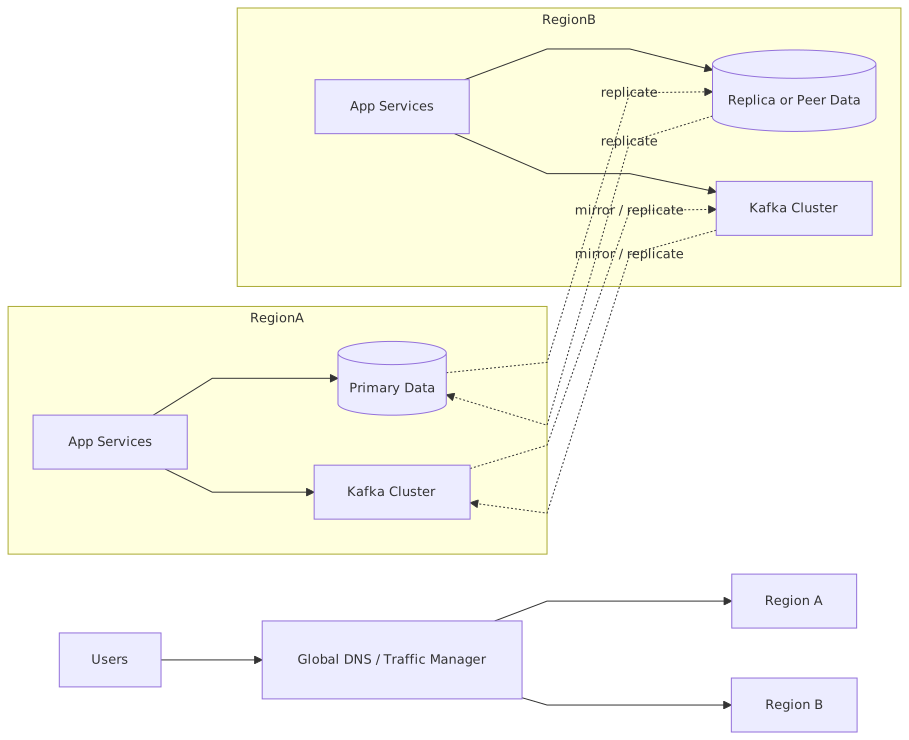
The diagram is deceptively calm. In reality, the choice is not whether to replicate. It is what semantics to attach to replication.
Architecture
A serious multi-region architecture has several layers, and each one must be designed with failover behavior in mind.
Traffic management
Traffic management decides where a request lands. This may be DNS-based, anycast, edge routing, or application-level redirection. Health checks are necessary, but they are blunt instruments. A region can pass health checks while being operationally useless because an identity provider, database writer, or internal event bus is degraded.
This is why failover decisions often need business health, not just technical health. “Can authorize payment” is more useful than “port 443 responds.”
For active-active with affinity, routing should align to domain semantics: tenant, country, account home region, or session stickiness. Random balancing across regions is how you accidentally invent global concurrency.
Application services and bounded contexts
In domain-driven design terms, not every bounded context deserves the same failover pattern.
- Customer preferences may support eventual consistency and local writes.
- Order orchestration may work regionally if order ownership is stable.
- Pricing may replicate reference data outward.
- Payments and ledgers often need stronger controls, append-only models, and explicit reconciliation.
- Fraud detection may consume globally replicated events while producing region-local decisions.
The mistake is to force one regional strategy across all contexts. Better to classify contexts by consistency need, recovery target, and natural partitioning. The topology should follow the domain, not the vendor reference architecture.
Data architecture
Data is where active-active dreams go to die.
A multi-region database story generally falls into one of these categories:
- single-writer, cross-region replicas
- multi-writer with conflict management
- sharded ownership by region or tenant
- event-sourced append logs with downstream projections
- dual systems: transactional local store plus replicated analytical or search stores
For operational systems, I am deeply skeptical of generic multi-writer databases being adopted as a silver bullet. They solve transport and storage replication; they do not solve domain conflict. If two regions update the same insurance claim differently within a network partition, “last write wins” is not architecture. It is abdication.
The more sustainable model is usually one of these:
- ownership partitioning: a business entity has a home region
- command routing: writes for an entity are routed to the authoritative region
- event sourcing with idempotent processing: region-local appends plus replicated event streams
- sagas and compensations for cross-context coordination rather than distributed transactions
Kafka and event streaming
Kafka is often the backbone of modern multi-region failover architectures, and just as often, it is misunderstood.
Kafka is excellent at durable event transport, decoupling services, enabling replay, and feeding reconciliation workflows. It is not a magic global transaction coordinator.
In multi-region design, Kafka can support:
- asynchronous replication of domain events
- regional decoupling between producers and consumers
- replay into rebuilt projections after failover
- outbox pattern integration from transactional services
- reconciliation by comparing event streams and offsets
- progressive migration from monolith to region-aware microservices
A common enterprise pattern is local Kafka clusters per region with selective replication of topics. Not every topic should be global. Reference data, customer profile changes, order state transitions, and audit events may need replication. Local telemetry, ephemeral retries, and region-specific operational events often do not.
You must also be clear about event identity. Every event should carry stable keys, causation metadata, and idempotency information. Without that, replay becomes duplicate business action.
Control plane versus data plane
One subtle but important distinction: your control plane can be less available than your data plane for short periods, but not if failover depends on it.
Too many cloud-native systems rely on region-scoped control services to orchestrate failover, scale-up, secret refresh, or service discovery. During a regional incident, that dependence becomes fatal. Design so the data plane can continue with degraded but safe behavior even if parts of the control plane are unavailable.
Migration Strategy
Nobody credible starts with a mature active-active topology on day one, especially in an enterprise with legacy systems. You migrate toward it, and the only sane way is progressively.
This is where the strangler pattern earns its keep.
Start by identifying business capabilities where multi-region matters most and where domain boundaries are strong enough to isolate. Wrap the legacy estate, expose stable APIs, and peel off bounded contexts one at a time. Introduce event publication through an outbox. Build observability before ambition. Then move from cold standby to warm passive, then to active-active with regional affinity for chosen contexts.
A pragmatic migration sequence looks like this:
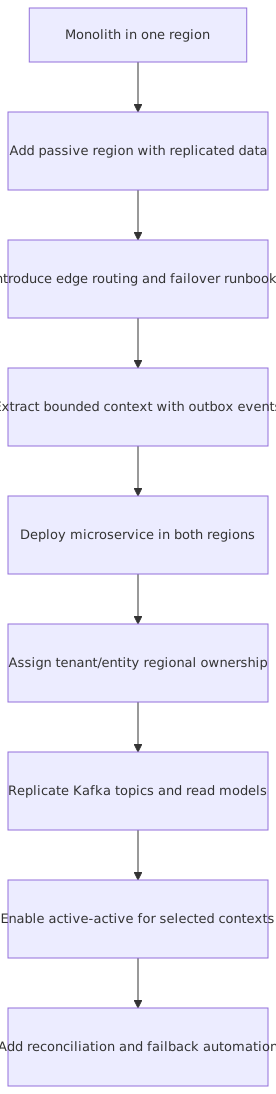
Several principles matter here.
Migrate by bounded context, not technical layer
Do not “multi-region the whole platform” as a platform program before you know which domains can handle it. Extract a context such as customer notifications or catalog first. Learn there. Then approach order capture. Leave payments and inventory until you have scars.
Introduce the outbox pattern early
If you have microservices and Kafka, use transactional outbox or equivalent reliable event publication. This avoids the classic split-brain between database commit and event emission. In failover and replay scenarios, that reliability becomes foundational.
Make regional ownership explicit
The migration gets dramatically easier once you assign a home region to entities or tenants. This lets you build active-active at the traffic layer while avoiding uncontrolled write conflicts. Over time, you can choose where to loosen that model.
Build reconciliation as a first-class capability
Reconciliation is not a cleanup script. It is part of the architecture.
After failover, failback, or a partition, you need to answer:
- Which commands were accepted in each region?
- Which events were published and consumed?
- Which projections are stale?
- Which side is authoritative for each entity?
- Which compensating actions are needed?
Reconciliation demands canonical identifiers, version metadata, event traceability, and a business-owned policy for conflict handling. Some conflicts can be auto-resolved. Others must go to operations or back office teams.
Test failover before enabling automation
Enterprises love automation right up until it automates the wrong thing. Start with operator-assisted failover. Automate evidence gathering, drift detection, and readiness checks first. Full automatic failover should come only when the domain semantics and operational confidence justify it.
Enterprise Example
Consider a global retail bank modernizing its card servicing platform.
The legacy world is familiar: a central monolith in one primary region, nightly batch feeds, a shared customer schema, and a call center application that assumes the world is serial. Business leadership wants higher resilience after a major regional outage, and digital channels now serve customers across Europe and Asia.
A naïve answer would be full active-active for everything. That would be a mistake.
The architects instead partition the problem by bounded context.
- Customer profile is regionally hosted with asynchronous replication for read-heavy channels.
- Card controls such as spend limits and freeze/unfreeze become microservices deployed in both regions, with customer home-region ownership. Commands route to the authoritative home region.
- Transaction history projections are built from replicated Kafka event streams and can lag slightly.
- Ledger and settlement remain single-writer in one region initially, with warm passive failover, because financial correctness matters more than universal write locality.
- Fraud scoring consumes events from both regions and can operate with model drift for short periods.
This gives the bank active-active experience where it is valuable to customers — mobile app responsiveness and resilience for card controls — without forcing the hardest financial records into premature multi-writer complexity.
A simplified architecture might look like this:
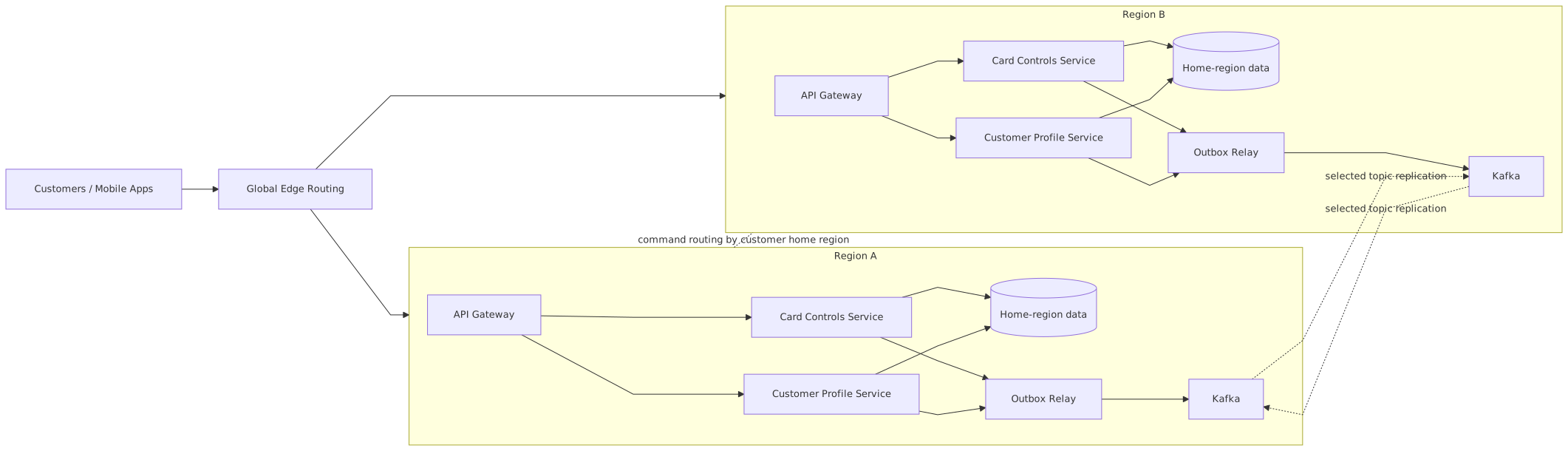
Now imagine Region A suffers a partial outage. Customers homed in Region A are temporarily routed to Region B. Region B can still serve read models and some low-risk interactions immediately. For write commands, it either:
- routes synchronously to Region A if the authoritative path is still alive,
- queues and retries for non-urgent actions,
- or, for selected operations like card freeze, accepts a region-local emergency override event with explicit reconciliation flags.
That last point is important. Not all business actions deserve the same consistency treatment. In consumer banking, “freeze card now” has a very different tolerance profile than “change billing address.” Domain semantics shape failover behavior.
When Region A recovers, reconciliation compares accepted commands, emitted events, and resulting state. Exceptions with material financial impact route to an operations queue. This is slower than a clean greenfield fantasy. It is also how enterprises survive contact with reality.
Operational Considerations
Topology is only half the job. Operations decides whether the design lives or dies.
Observability
You need region-aware telemetry:
- request routing decisions
- cross-region latency
- replication lag
- consumer lag in Kafka
- command acceptance and rejection by authority rules
- reconciliation queue size
- duplicate detection rates
- failover and failback timelines
A dashboard showing CPU and response time is theater. You need to see business health by region and by bounded context.
Runbooks and game days
A failover architecture not exercised is a rumor. Run regional failure game days. Simulate degraded dependencies, not just total outages. Practice loss of message replication, identity provider degradation, stale DNS, and split-brain scenarios. Measure business outcome, not merely infrastructure switchover time.
Idempotency and deduplication
Every externally visible command should be idempotent or carry a deduplication key. Every event consumer should assume duplicates. In multi-region systems, duplicate delivery is not an edge case. It is the tax you pay for availability.
Secrets, config, and identity
Many failovers stall on the boring things: expired certificates in standby, missing IAM permissions, region-local secrets stores, or role assumptions that only work in the primary. Multi-region design includes identity architecture, not just app deployment.
Data lifecycle and compliance
Cross-region replication can create hidden compliance problems. Audit your topics, stores, and backups. Architects often focus on hot-path replication and forget that observability data, dead-letter queues, and support exports may also cross borders.
Tradeoffs
Let’s be blunt.
Active-active gives you better utilization, lower user latency in some cases, and stronger resilience to regional disruption. It also gives you more moving parts, more subtle failure modes, and a permanent reconciliation burden.
Active-passive is simpler, cheaper, and often the right answer for systems where failover is rare and correctness is paramount. But it carries the risk of under-tested standby paths and slower recovery.
Regional affinity active-active is usually the best compromise. It accepts that business entities often have a natural home. It limits write conflict while preserving some of the resilience and performance gains of active-active.
Global multi-writer active-active should be reserved for contexts where:
- the domain can model concurrency clearly,
- conflict resolution is acceptable or explicit,
- engineering maturity is high,
- observability and operations are strong,
- and the business case justifies the complexity.
There is no shame in choosing active-passive for the ledger and active-active for the customer portal. In fact, that asymmetry is often the mark of good architecture.
Failure Modes
This topic gets interesting when things go wrong, because they always do.
Split brain
Both regions believe they are authoritative and accept writes for the same entity. This is the classic nightmare. Prevention is better than cure: clear authority rules, command routing, lease or leadership controls where suitable, and conservative failover automation.
Stale read-induced bad decisions
A service in Region B acts on lagging replicated data and makes an invalid business decision — approving a refund already issued, re-allocating inventory already consumed, re-opening a claim already closed. Eventual consistency is acceptable only where the domain can tolerate the consequences.
Duplicate event processing
Replication, retries, replay, and consumer restarts can all trigger duplicate effects. If handlers are not idempotent, users see multiple emails, duplicate shipments, or repeated account actions.
Partial failover
The region is not fully down. Some services work, others don’t. These are harder than clean outages. Routing all traffic away may amplify problems; keeping traffic local may strand critical workflows. This is where business capability health checks matter.
Reconciliation drift
Post-recovery, systems appear healthy but data sets have silently diverged. This is one of the most expensive failures because it hides until customers or auditors discover it.
Dependency asymmetry
Your service is active-active, but the payment gateway, identity provider, ERP adapter, or anti-money-laundering system is not. Real architecture is constrained by the least multi-region-friendly dependency in the chain.
When Not To Use
There are several situations where multi-region active-active is the wrong move.
Do not use it for a system with low business criticality and a tolerable outage window. A good backup and restore practice plus active-passive may be enough.
Do not use it when the domain has high write contention on the same entities and no acceptable conflict policy. You are not “future-proofing.” You are creating a larger blast radius.
Do not use it when your operational maturity is weak. If you cannot reliably deploy, observe, and recover a single-region microservices platform, adding a second active region is just doubling confusion.
Do not use it simply because your cloud provider made the diagram look easy. Providers sell possibility, not responsibility.
And do not use it to compensate for poor domain boundaries. If every service still depends on a shared relational schema and synchronous call chains, multi-region will merely distribute your monolith’s fragility.
Related Patterns
A few patterns regularly accompany sound multi-region design:
- Strangler Fig Pattern for incremental modernization
- Transactional Outbox for reliable event publication
- Saga / process manager for cross-service coordination
- Bulkhead isolation to limit regional blast radius
- Circuit breakers and graceful degradation for partial dependency failure
- CQRS where read models can be regionally replicated and rebuilt
- Event sourcing where append semantics and replay support recovery
- Cell-based architecture for stronger partitioning by tenant or business slice
- Home region / shard ownership for deterministic write authority
Notice how many of these are really about reducing ambiguity. Multi-region failover rewards explicitness.
Summary
Multi-region failover topologies are not an infrastructure fashion statement. They are a set of choices about business continuity, correctness, and the shape of your domain under stress.
The central lesson is simple: start with semantics, not servers. Use domain-driven design to classify bounded contexts by consistency need and resilience target. Prefer progressive migration over heroic redesign. Use the strangler pattern to modernize incrementally. Let Kafka and event streaming support decoupling, replay, and reconciliation, but do not mistake them for a substitute for domain policy. Build reconciliation deliberately. Design for duplicate handling. Test partial failures, not just dramatic outages.
Most enterprises should begin with active-passive, evolve selected contexts into active-active with regional affinity, and reserve true global multi-writer designs for the few places where the business can both justify and govern the complexity.
In short: distribute your systems only as far as your domain understanding can carry them. Beyond that point, redundancy turns into confusion wearing a high-availability badge.
Frequently Asked Questions
What is cloud architecture?
Cloud architecture describes how technology components — compute, storage, networking, security, and services — are structured and connected to deliver a system in a cloud environment. It covers decisions on scalability, resilience, cost, and operational model.
What is the difference between availability and resilience?
Availability is the percentage of time a system is operational. Resilience is the ability to recover from failures — absorbing disruption and returning to normal. A system can be highly available through redundancy but still lack resilience if it cannot handle unexpected failure modes gracefully.
How do you model cloud architecture in ArchiMate?
Cloud services (EC2, S3, Lambda, etc.) are Technology Services or Nodes in the Technology layer. Application Components are assigned to these nodes. Multi-region or multi-cloud dependencies appear as Serving and Flow relationships. Data residency constraints go in the Motivation layer.