⏱ 19 min read
Architecture Decision Records don’t usually fail because teams refuse to write them. They fail because teams write them like tombstones.
A date. A title. A choice. A few consequences. Then the document sinks into a wiki graveyard where nobody visits until an outage, an audit, or a painful migration drags it back into daylight. By then the context is gone, the people have moved on, and the “decision” has become folklore with a stale URL.
In a distributed system, that is not just inconvenient. It is dangerous.
Microservices, event streams, data products, platform APIs, compliance controls, service boundaries, tenancy rules, resilience policies—none of these live alone. Every meaningful architectural decision leans on another one, conflicts with a third, and gets superseded by a fourth. Decisions form lineage. They form tension. They form a web of intent. Treating ADRs as isolated documents is like trying to understand a city from a box of street signs.
The better model is to treat ADRs as a knowledge graph.
Not a fancy visualization for architecture theatre. A real graph of decision nodes, domain concepts, constraints, relationships, owning teams, affected services, supersessions, and operational consequences. A graph that makes architectural knowledge queriable, traceable, and alive. A graph that lets you answer the questions enterprise systems actually ask: Why does this service publish this event? Which decision introduced eventual consistency here? What old assumption blocks this migration? Which Kafka retention policy exists because of a regulatory constraint?
That is the core idea of this article: Architecture Decision Records become genuinely useful in distributed systems when they are modeled as connected knowledge, not static prose. And once you do that, you get more than documentation. You get decision lineage, impact analysis, migration intelligence, and a bridge between domain-driven design and enterprise architecture.
Context
Distributed systems amplify memory loss.
In a monolith, you could often infer intent by reading code, walking the schema, or talking to two senior engineers who had been around long enough. In a modern enterprise landscape—dozens or hundreds of microservices, Kafka topics, data pipelines, API gateways, identity providers, cloud infrastructure, partner integrations—that kind of tribal reconstruction does not scale. event-driven architecture patterns
Worse, distributed systems are built from local optimizations. A team chooses asynchronous messaging to improve resilience. Another team introduces a customer profile service to rationalize duplicate data. A platform team standardizes on Kafka for event streaming. Security introduces token introspection rules. Finance demands data residency. Each decision may be sensible in isolation. Together they create an architectural terrain with ridges, fault lines, and hidden sinkholes.
This is where domain-driven design matters. Architecture is not merely technology topology; it is encoded business meaning. Decisions are made in relation to bounded contexts, aggregates, policies, and domain events. If your ADRs say “use Kafka for integration” but cannot express that Customer Identity and Order Fulfillment are separate bounded contexts with different ownership, consistency requirements, and language, then your ADR corpus is structurally incapable of preserving the semantics that gave the decision meaning in the first place.
A knowledge graph gives you a way to preserve those semantics.
It lets an ADR link not just to another ADR, but to a domain concept, a service, an event contract, a risk, a regulatory control, a data store, an SLA, or a migration epic. That is the point. Architecture knowledge lives in relationships.
Problem
Classic ADR practice is document-centric. That model breaks down in distributed enterprises for five reasons.
First, decisions are rarely final. They are revised, narrowed, superseded, partially rolled back, or reinterpreted by downstream teams. “Adopt event-driven integration” eventually becomes “Adopt Kafka for cross-domain events except for payment authorization which remains synchronous.” The paper trail matters.
Second, decisions have scope, and scope is often fuzzy. A choice intended for one bounded context gets copied into another without understanding the original forces. Before long, “our architecture standard” is just cargo cult with branding.
Third, migration is where architecture knowledge goes to die. During strangler migrations, legacy and target states coexist for months or years. Teams create adapters, reconciliation jobs, topic bridges, anti-corruption layers, and temporary data duplication. Those are decisions. Temporary architecture is still architecture. Yet ADR repositories rarely model temporal states and transition relationships well.
Fourth, operational consequences are disconnected from design intent. The ADR says “choose eventual consistency.” Operations sees duplicate events, replay complexity, reconciliation dashboards, and support tickets. The relationship between decision and failure mode is buried in narrative text instead of made explicit.
Fifth, enterprise governance asks graph-shaped questions of linear documents: EA governance checklist
- Which systems depend on this security decision?
- Which topics are governed by this data retention policy?
- Which services are still operating under a superseded integration standard?
- What migration assumptions conflict with the new customer domain model?
A wiki page cannot answer these well. A graph can.
Forces
There are several forces pushing architects toward a more connected model.
Domain semantics versus technical mechanics
Too many architecture repositories know more about Kubernetes than customers, orders, policies, claims, or settlements. That is upside down. Technology choices only make sense in relation to domain semantics. The meaning of a “CustomerUpdated” event depends on whether customer identity, CRM preferences, and billing party are the same thing. In many enterprises they are not.
If ADRs are not linked to bounded contexts and ubiquitous language, they become shallow technical memos detached from business truth.
Decision lineage in long-lived systems
Enterprises do not rebuild from scratch. They inherit. Core platforms survive mergers, reorganizations, outsourcing cycles, cloud migrations, and strategic reversals. Decisions have ancestry. Some are fossils. Some are still load-bearing. Some are dead but not yet removed. cloud architecture guide
Lineage is not nice-to-have. It is how you know whether a current constraint is intentional or accidental.
Progressive migration and coexistence
Real migrations are incremental. You strangle around edges. You dual-write reluctantly. You run reconciliation jobs because data does not line up on day one. You publish canonical events while a legacy batch feed still runs overnight because finance cannot miss close-of-business. During this period, architecture is transitional and messy.
A decision graph needs to model coexistence, not just target state purity.
Compliance, ownership, and auditability
Architecture decisions increasingly carry risk and regulatory significance. Data retention, encryption boundaries, PII handling, data residency, explainability, and segregation of duties are not implementation details. A graph allows traceability from regulation to decision to control to affected services and data flows.
Scale of change
Once you have enough services and teams, no single architect can hold the full mental model. The graph becomes shared memory.
Solution
Treat ADRs as first-class nodes in an enterprise knowledge graph.
Each ADR remains a human-readable record. Keep the essay. Keep the rationale. Keep the date and status. But stop there and you get literature, not architecture intelligence. Add explicit relationships and typed metadata, and now you have something operationally useful.
At minimum, model these entities:
- ADR
- Bounded Context
- Domain Concept
- Service
- Event / Topic
- API Contract
- Data Store
- Constraint / Policy
- Risk
- Migration Initiative
- Operational Control
- Team / Ownership Group
Then model relationships such as:
influencessupersedesconstrainsimplementsaffectsowned_bypublishesconsumesrequires_reconciliation_withtemporarily_coexists_withmaps_to_domain_conceptviolatesmitigated_by
This is where the idea becomes practical. You are no longer browsing documents. You are traversing architecture intent.
For example:
- ADR-117 “Adopt Kafka for cross-domain event propagation”
- influences Service: Customer Profile
- affects Topic: customer.profile.changed.v1
- constrained by Policy: PII minimization
- superseded in part by ADR-203 “Use CDC only for legacy replication, not domain events”
- requires_reconciliation_with Legacy CRM nightly export
- maps_to_domain_concept Customer Identity
- owned_by Team: Customer Platform
Now ask:
- Which services are still publishing domain events derived from CDC?
- Which decisions touching Customer Identity have open reconciliation dependencies?
- Which current operational controls exist because of decisions superseded in the last 18 months?
That is a graph problem. It should be solved as one.
The shape of the graph
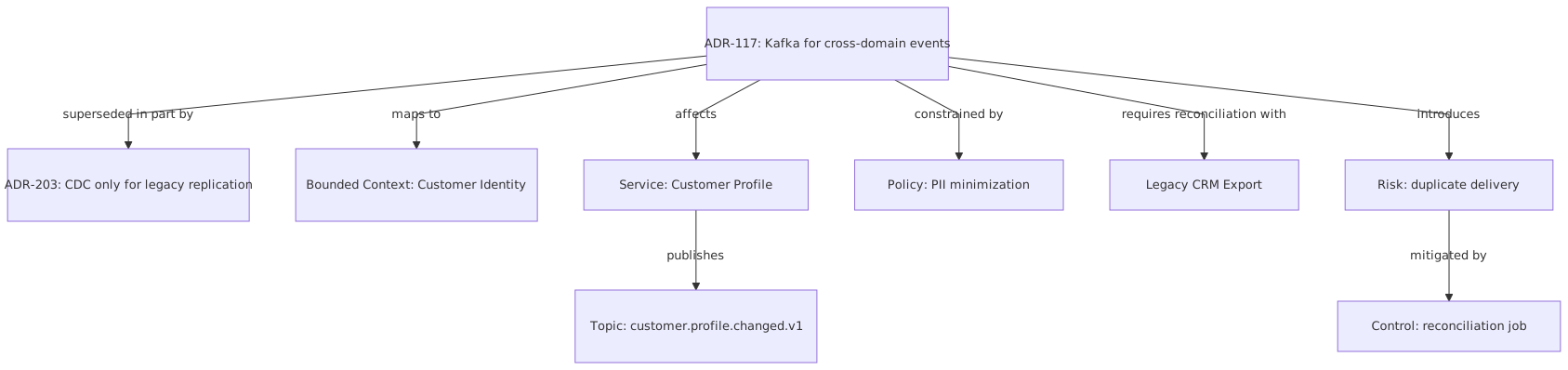
The clever bit is not the drawing. It is the semantics.
A useful ADR graph encodes business meaning and architectural consequence in the same model. That gives you a decision system, not a document archive.
Architecture
The architecture for an ADR knowledge graph should be boring in the right places.
Do not begin with a giant enterprise repository project run by a central ivory tower. That path produces metadata ceremonies nobody loves and stale diagrams everyone ignores. Start with a small but strongly typed model, integrate it into delivery workflows, and let value pull adoption.
A practical architecture has five layers.
1. Authoring layer
Teams still write ADRs in Markdown or AsciiDoc stored with code or in a controlled docs repository. Good. Keep that. Engineers need low-friction authoring close to delivery artifacts.
But require lightweight front matter or structured metadata:
- ADR id
- status
- date
- bounded contexts
- services
- events/topics
- constraints
- supersedes / superseded by
- migration initiative
- owner
The prose remains the source of nuance. The metadata provides graph edges.
2. Extraction and enrichment
A pipeline parses ADR metadata, extracts links, validates references, and enriches them using service catalogs, API registries, Kafka schemas, CMDB records, and domain maps.
This is where enterprise architecture earns its keep. The graph should not depend entirely on manual tagging. If an ADR references customer.profile.changed.v1, the system should resolve that topic from the event catalog. If a service name is used, it should map to the service registry. If a bounded context is missing, flag it.
3. Graph store
Use a graph database if you truly need relationship-heavy querying across many entity types. Neo4j, Neptune, JanusGraph—fine. If the problem is smaller, a relational model with adjacency tables can be enough. Do not reach for graph tech merely because the article has the word “graph” in it.
When relationship traversal is central to your use case, however, graph storage pays for itself quickly.
4. Query and visualization
Expose the graph in three ways:
- human browsing for architects and engineers
- API access for internal tooling
- targeted visualizations such as decision lineage, impact maps, migration dependency views
One warning: visualizations become spaghetti fast. The best views are scoped views, not “everything connected to everything” galaxy maps.
5. Governance and lifecycle
ADRs need lifecycle states: proposed, accepted, trial, superseded, deprecated, withdrawn. Relationships also need temporal semantics. A transitional relationship like temporarily_coexists_with should have expected end dates. Temporary decisions that have no expiry are how permanent complexity is born.
Decision lineage

This sort of lineage view is gold during migration and audit. It explains not just what exists, but why the mess looks the way it does.
Migration Strategy
This is where the knowledge graph stops being an elegant idea and becomes useful in the dirt.
Most enterprises already have ADRs, architecture review records, Confluence pages, Jira epics, standards documents, Kafka topic catalogs, service metadata, and migration plans. None of it lines up cleanly. Good. Expect that. Migration is not data cleansing with better stationery.
Use a progressive strangler strategy.
Phase 1: Start with high-value domains
Pick one or two business-critical bounded contexts—say Customer Identity and Order Fulfillment. These are usually rich in integration complexity and full of old decisions that still matter. Model a small subset of ADR relationships around them.
Do not model the enterprise. Model the pain.
Phase 2: Ingest current ADRs with minimal metadata
Take existing ADRs and add only a few mandatory fields:
- bounded context
- affected services
- status
- owner
- relationship to prior decisions
This gets you enough structure to build lineage without creating an adoption revolt.
Phase 3: Connect to delivery reality
Integrate with:
- service catalog
- Kafka schema registry or topic catalog
- API gateway catalog
- cloud tagging / CMDB
- work management for migration initiatives
The graph should know the difference between a decision that exists on paper and one manifested in running systems.
Phase 4: Add migration and reconciliation semantics
This is the moment most models miss. During strangler migration, there will be:
- duplicate sources of truth
- event replay windows
- delayed synchronization
- anti-corruption mappings
- compensating workflows
- batch and stream coexistence
Model them explicitly. Add relationships like:
coexists_withreconciles_withderived_frombridged_bysunset_target
A migration without reconciliation semantics is fantasy. In distributed systems, consistency gaps are not edge cases; they are design material.
Phase 5: Enforce freshness through workflow
Require updates to graph metadata when:
- a new service is introduced
- a Kafka topic is created for cross-domain use
- a migration milestone is completed
- a decision is superseded
- a reconciliation control is added or retired
Not heavyweight approval. Lightweight completeness.
Progressive strangler view
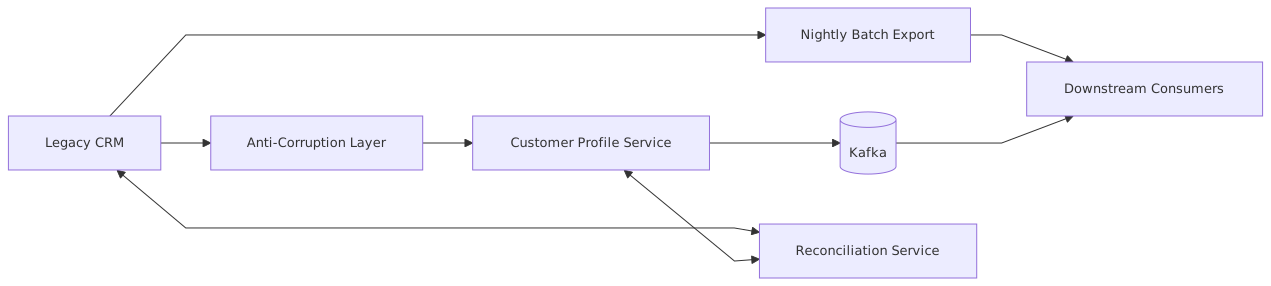
This diagram is worth more when tied to ADR lineage. The anti-corruption layer, dual publishing, and reconciliation service are not accidental scaffolding. They exist because specific decisions were made under specific constraints.
That is migration reasoning in a form teams can use.
Enterprise Example
Consider a global insurer modernizing customer and policy platforms after a merger. Two regional businesses have overlapping notions of “customer.” One system treats customer as policyholder. Another treats customer as a legal party. A third CRM stores household marketing preferences. Meanwhile, claims, billing, and agent systems all subscribe to customer-related updates.
The first architectural mistake would be technical: “Let’s create a canonical customer event in Kafka.” The deeper problem is semantic. There is no single customer concept yet. There are competing bounded contexts and overlapping identities.
A disciplined team starts with DDD. They define:
- Party Management bounded context for legal persons and organizations
- Policy Administration bounded context for insured relationships and policyholder roles
- CRM Engagement bounded context for contact and preference management
Then ADRs emerge:
- ADR-52: Separate Party Management from CRM Engagement
- ADR-61: Customer Profile service becomes published language for contact preferences, not legal identity
- ADR-74: Kafka adopted for cross-domain eventing
- ADR-91: Legacy policy system remains system of record for policyholder role during transition
- ADR-108: Reconciliation service compares Party IDs and CRM IDs nightly
- ADR-131: Claims consumes Party events, not CRM preference events
- ADR-149: Retire batch sync after policy platform migration wave 2
Without a graph, these are documents. With a graph, they reveal structure:
- ADR-74 depends on ADR-52 and ADR-61
- ADR-91 constrains ADR-74 in the policy domain
- ADR-108 mitigates failure modes introduced by ADR-91 and ADR-74
- ADR-149 sunsets ADR-108 and batch-related controls
Now imagine a support issue: claims systems show stale addresses for some customers. The knowledge graph points to:
- claims consumes Party events
- address preference updates originate in CRM Engagement
- temporary mapping logic in reconciliation bridges household addresses to party contacts
- that mapping was introduced by ADR-108 and is scheduled for retirement under ADR-149, but migration wave 2 is delayed
You can now reason about the incident with context, not archaeology.
This is what enterprise architecture should do. It should shorten the path from operational symptom to decision cause.
Operational Considerations
An ADR graph is only useful if it survives contact with operations.
Reconciliation as a first-class concern
In distributed systems, reconciliation is not a shameful workaround. It is often the price of incremental change. If you are migrating from legacy master data into event-driven microservices, there will be periods where two systems disagree. Model the reconciliation jobs, compare windows, tolerances, ownership, and escalation paths. microservices architecture diagrams
If a decision introduces eventual consistency, the graph should link to the reconciliation mechanism that makes it survivable.
Kafka realities
Kafka is a good fit when decision lineage needs to include asynchronous propagation, consumer independence, replay, and event retention. But Kafka also multiplies the importance of architectural traceability:
- topic naming and ownership matter
- schema evolution matters
- retention settings matter
- idempotency expectations matter
- replay impacts downstream state
An ADR graph should connect decisions to topic contracts and operational policies. Otherwise teams forget why a retention period is seven days, or why a topic cannot include PII, or why a consumer must tolerate duplicates.
Ownership and stewardship
Every node that matters should have an owner. The graph without ownership is a museum. Useful for tours, useless for change.
Query patterns
Useful enterprise queries include:
- show all accepted ADRs affecting this service
- show all superseded decisions still manifested in production assets
- find cross-domain events with no bounded-context mapping
- list temporary migration decisions past their expected expiry
- show risks introduced by eventual consistency choices lacking reconciliation controls
These queries change architecture from slideware into operating leverage.
Tradeoffs
This approach is not free.
The first tradeoff is modeling overhead. Every typed relationship asks teams to be more explicit. Some will resist, and fairly so. If you over-model too early, the repository becomes bureaucracy with arrows.
The second is false precision. A graph looks authoritative even when the underlying semantics are fuzzy. If your enterprise cannot agree on what “Customer” means, drawing 47 edges to it will not create truth. DDD work must precede graph confidence.
The third is staleness risk. A beautiful graph decays faster than a mediocre wiki if ownership and workflow integration are absent.
The fourth is tool temptation. Buying graph tooling before clarifying use cases is a classic enterprise move. The result is often expensive emptiness.
The fifth is centralization pressure. A knowledge graph can become a governance choke point. That is a failure of operating model, not concept. Federated contribution with clear semantic standards works better than centralized authorship.
Failure Modes
A few failure modes show up repeatedly.
Graph as architecture theatre
A central team builds an impressive visualization nobody uses in delivery. It looks modern. It changes nothing.
Metadata without meaning
Teams tag ADRs with service names but ignore domain semantics. You get a dependency graph, not a decision graph. Better than nothing, but still shallow.
No temporal model
Superseded and transitional decisions remain active forever because nobody tracks lifecycle. Temporary integrations become permanent scar tissue.
Reconciliation omitted
The graph models target architecture but not coexistence controls. Then migration incidents arrive and the repository has no explanation for data divergence.
Standardization by copy-paste
Teams reuse old ADRs as templates without linking lineage or clarifying scope. The graph fills with inherited assumptions masquerading as standards.
Domain drift
Bounded contexts evolve but graph vocabulary does not. Soon the graph preserves yesterday’s language while today’s systems speak something else. That creates dangerous confidence.
When Not To Use
Do not use this approach everywhere.
If you have a small system, a handful of services, and a stable team with strong shared context, a simple ADR repository is enough. A graph would be cleverness tax.
If your organization lacks basic ADR discipline, do not begin with graph ambitions. First establish the habit of recording decisions clearly and concisely. Graph structure on top of chaos is just indexed chaos.
If the domain model is immature or politically contested, be careful. A graph can calcify bad language. In that case, invest first in DDD discovery, event storming, bounded context mapping, and ownership clarity.
And if your architecture governance culture is punitive, a graph may become a surveillance tool rather than a learning tool. That poisons contribution. The goal is shared understanding, not compliance theatre.
Related Patterns
This approach sits naturally beside several other patterns.
Bounded Context Map from DDD provides the semantic backbone. Without context boundaries, the graph cannot represent meaning well.
Architecture Decision Records remain the narrative unit of decision capture.
Service Catalogs provide live references to runtime assets and ownership.
Event Catalogs and Schema Registries connect decisions to asynchronous contracts in Kafka-centric environments.
Strangler Fig Migration provides the migration shape. The graph makes its transitional decisions visible.
Anti-Corruption Layer is often a node worth tracking explicitly because it embodies semantic translation and temporary coupling.
Fitness Functions can consume graph data. For example, detect services using superseded security or integration decisions.
Operational Runbooks and Controls should be linked where a decision introduces a known risk requiring active mitigation.
Summary
Distributed systems do not suffer from a lack of decisions. They suffer from disconnected decisions.
That is why ADRs stored as isolated documents age badly. They preserve prose but lose structure. And in enterprise systems, structure is where the truth lives: what depends on what, what was temporary, what got superseded, what domain concept a service actually represents, what reconciliation exists because consistency was intentionally deferred.
Treating ADRs as a knowledge graph is a practical response to that reality.
It aligns with domain-driven design because it ties decisions to bounded contexts and business semantics. It supports migration because it captures coexistence, strangler transitions, and reconciliation controls. It fits Kafka and microservices because it models topics, consumers, contracts, and operational consequences as connected entities rather than scattered references. And it gives enterprise architecture something it too rarely has: a way to explain today’s architecture as the accumulated result of yesterday’s decisions.
The important thing is not the graph database. It is the change in posture.
Stop writing ADRs like gravestones. Start treating them like living links in a chain of intent.
That is how architecture becomes memory instead of mythology.
Frequently Asked Questions
What is a service mesh?
A service mesh is an infrastructure layer managing service-to-service communication. It provides mutual TLS, load balancing, circuit breaking, retries, and observability without each service implementing these capabilities. Istio and Linkerd are common implementations.
How do you document microservices architecture for governance?
Use ArchiMate Application Cooperation diagrams for the service landscape, UML Component diagrams for internal structure, UML Sequence diagrams for key flows, and UML Deployment diagrams for Kubernetes topology. All views can coexist in Sparx EA with full traceability.
What is the difference between choreography and orchestration in microservices?
Choreography has services react to events independently — no central coordinator. Orchestration uses a central workflow engine that calls services in sequence. Choreography scales better but is harder to debug; orchestration is easier to reason about but creates a central coupling point.