⏱ 20 min read
Large cloud systems do not usually fail because one engineer made one bad choice on one Wednesday afternoon. They fail because we asked change to travel too far, too fast, through a system that had no sensible way to absorb uncertainty.
That is the real point of deployment rings.
A deployment ring is not merely a release technique. It is an architectural boundary for risk. It gives us a way to say: this change may be technically correct, the tests may be green, the pipeline may be pristine, and yet we still do not trust it equally across every user, every tenant, every region, and every workflow. We let it earn that trust.
In the enterprise, this matters more than teams like to admit. Most cloud estates are not greenfield systems running a neat set of twelve-factor services with perfect observability and one clean domain model. They are settlements built on older roads: ERP cores, identity platforms, Kafka backbones, microservices with uneven quality, packaged software, custom APIs, reporting stores, brittle batch jobs, and a compliance department that does not care how elegant your CI/CD story sounds. Change moves through this landscape like weather through a mountain range. Some places absorb it. Others flood. microservices architecture diagrams
Deployment rings are how sensible architects turn release from a leap into a sequence of smaller bets.
But here is the trap: many organizations adopt ring rollout as an operational feature flag and miss the architectural implications entirely. They think of rings as percentages, environments, or pilot groups. In reality, the useful question is not “what percentage goes first?” but “which business semantics should be exposed first, and what blast radius are we willing to tolerate if we are wrong?”
That is where architecture begins.
Context
Modern cloud systems have made software delivery faster, but they have also widened the consequences of failure. In a monolith deployed quarterly, defects were expensive but often slow-moving. In a distributed system deployed hourly, defects can be cheap to introduce and devastatingly fast to propagate.
This acceleration is intensified by cloud-native architecture. Microservices decompose execution paths across teams. Kafka and event streaming decouple time while increasing eventual consistency concerns. Platform automation reduces friction to deployment, which is wonderful right up until the moment a mistaken assumption reaches every region before the first support ticket is opened. event-driven architecture patterns
Release safety therefore cannot live only in test automation. Tests prove some things. They do not prove tenant-specific data quality, hidden coupling, behavioral edge cases in production load, or the quiet terror of a downstream system that “accepts” a message but processes it incorrectly three hours later.
Deployment rings sit at the intersection of software delivery and architectural risk management. They let us progressively expose changes across carefully chosen audiences, scopes, or business slices. A ring might represent internal users, a low-criticality tenant set, a single geography, a single product line, or a bounded domain with tolerant downstreams.
The ring model becomes especially powerful in enterprises where the domain is uneven. Not every workflow has the same value, criticality, reversibility, or regulatory burden. Not every customer can be treated as a canary. Not every service can be rolled back by simply redeploying the previous container image. If a pricing service publishes bad price events into Kafka, rollback is not a button; it is a reconciliation campaign.
That is why deployment rings are architectural, not merely operational.
Problem
The problem is simple to describe and hard to solve: how do you introduce change into a cloud system without letting uncertainty become a full-system incident?
The simplistic answer is “test more.” Of course you should test more. But production failures in enterprise systems are rarely pure code defects. They are mismatches between software behavior and domain reality.
A new order orchestration service may work perfectly in synthetic tests yet fail when a particular customer has split shipments, credit hold rules, tax exemptions, and a warehouse integration that only emits updates during local business hours. A revised customer identity schema may validate fine but break support tooling that depended on undocumented null semantics. A Kafka consumer may scale beautifully while producing duplicate state transitions in a downstream read model because replay behavior was not considered.
These are domain failures dressed as technical failures.
Without deployment rings, release is all-or-nothing. A change crosses from “not in production” to “everywhere in production.” That jump assumes homogeneous risk. Enterprises do not have homogeneous risk. They have critical customers, special contracts, jurisdiction-specific processes, data residency rules, integration dependencies, and product capabilities that are one bad release away from executive attention.
So the real problem is this: we need a mechanism to stage exposure in a way that aligns with domain semantics, operational reality, and the shape of our architecture.
Forces
Architectural decisions are shaped by forces, and deployment ring design is full of them.
1. Speed versus confidence
Business wants faster delivery. Operations wants stability. Architects who pretend this tension can be eliminated are usually selling a method, not describing reality.
Rings help by preserving speed while introducing controlled exposure. But every ring adds latency and coordination overhead. If you create too many rings, your deployment model becomes ceremonial and teams route around it.
2. Technical blast radius versus business blast radius
These are not the same thing.
A technically small component can have enormous business impact. A discount-calculation microservice might be tiny, stateless, and easy to deploy. If it calculates promotions incorrectly for one retail segment on a holiday weekend, the blast radius is not technical. It is commercial.
Ring design must reflect business semantics, not just infrastructure topology.
3. Stateless rollout versus stateful consequences
Most cloud deployment tooling is optimized for stateless replacement: roll forward, roll back, switch traffic. But enterprise systems are full of stateful side effects: database writes, published events, external API calls, financial postings, notifications, approvals.
This matters because ring rollout can contain exposure, but it cannot magically erase side effects. Once a bad event is on Kafka and consumed by six downstream services, the system may need reconciliation, compensation, or replay with corrected semantics.
4. Autonomy versus consistency
Microservices promise team autonomy. Release rings often reintroduce cross-team coordination because a meaningful business capability cuts across several services. If checkout changes, pricing, inventory, payment, fulfillment, and notification may all need ring-aware behavior.
You cannot manage deployment risk at the capability level unless your architecture can observe and control the capability across service boundaries.
5. Tenant segmentation versus fairness and support complexity
Using low-risk tenants as early rings is sensible. It is also politically delicate. Pilot customers may get better or worse quality depending on how you operate. Support teams must know which tenant is in which ring. Product teams must explain why features differ temporarily across accounts or geographies.
6. Progressive migration versus legacy coexistence
In a strangler migration, rings often become the vehicle for moving traffic from legacy systems to new services. This is powerful, but coexistence introduces dual-run behavior, reconciliation concerns, and domain drift between old and new models.
Migration is where ring theory meets reality.
Solution
The practical solution is to treat deployment rings as first-class architectural constructs that map to business risk, not just deployment percentages.
A ring is a controlled scope of exposure with explicit entry criteria, observability, rollback strategy, and reconciliation plan.
That sentence is doing a lot of work, so let us unpack it.
A ring is controlled scope because it should represent a known group: internal users, selected tenants, one region, one product line, or one transaction class. Random percentages are useful for consumer systems, but enterprises often need semantic cohorts.
A ring has explicit entry criteria because teams should know what evidence is required before widening exposure: error rates, business KPIs, support ticket thresholds, latency, reconciliation drift, domain invariant checks.
A ring requires observability because without ring-specific telemetry, you are just deploying in slices and hoping. Metrics, logs, traces, and business events must be attributable to ring membership.
A ring needs a rollback strategy because not all changes can simply be reversed. Some require traffic redirection. Some require feature disablement. Some require write suppression. Some require compensating transactions.
And a ring should have a reconciliation plan because in distributed systems, especially event-driven ones, the question after a failed rollout is often not “how do we revert code?” but “how do we repair state?”
This leads to a more useful architectural model:
- Ring 0: internal users, synthetic traffic, or non-customer workloads
- Ring 1: low-criticality or friendly tenants, often with opt-in support readiness
- Ring 2: broader production subset, selected by region, product, or domain capability
- Ring 3: full release
There is no magic in these numbers. What matters is that each ring reflects a meaningful increase in risk exposure.
The best ring strategies are deeply informed by domain-driven design. If your bounded contexts are clear, your rings can align to capability boundaries. If your domains are muddled, ring rollout becomes blunt and expensive.
Architecture
The architecture for deployment rings has three major parts:
- Targeting and control plane
- Application and domain behavior control
- Observation and reconciliation
The control plane decides who is in a ring and routes behavior accordingly. That may involve API gateways, service mesh routing, feature flag systems, tenant metadata, region policies, or orchestration services.
The application layer must be ring-aware where business behavior changes. This is often where teams get lazy. They treat the ring as a traffic router only. But meaningful rollout often requires domain-level controls: alternate policy evaluation, dual-write suppression, new event versions only in certain cohorts, or fallback to legacy processing for critical flows.
Then comes observation and reconciliation. This is the hard bit, and the bit mature enterprises eventually learn to respect.
Ring-aware architecture at a high level

This diagram looks simple, which is precisely why architects should be suspicious. The arrows are easy. The semantics are not.
Domain semantics matter
A serious ring design asks:
- Can the business capability be exposed per tenant, region, or workflow?
- Does the domain model support coexistence between old and new behavior?
- Which invariants must hold regardless of ring?
- Which downstream consumers can tolerate mixed-mode operation?
Suppose you are modernizing order management. The bounded context for Order Capture might be ringed independently of Fulfillment if the integration contract is stable and downstream semantics remain unchanged. But if the new service changes line-item identity rules or emits new order states, then bounded contexts are not independent in practice, whatever the team topology chart claims.
This is why DDD is useful here. Bounded contexts tell us where semantic consistency matters. Context maps tell us where translation, anti-corruption, or conformist relationships exist. Ring rollout should honor those boundaries.
If you deploy a new model into one bounded context while pretending all adjacent contexts interpret it the same way, you are not doing progressive delivery. You are conducting a distributed experiment on your own business.
Event-driven systems and Kafka
Kafka changes the nature of ring rollout because it separates producers and consumers in time. A service deployed to Ring 1 may emit events that are consumed globally unless you design otherwise.
That gives you several options:
- Topic partitioning by ring or tenant cohort
- Versioned events with consumer tolerance
- Header-based ring metadata
- Dual topics during migration
- Consumer-side gating and translation
Each comes with tradeoffs.
Header-based metadata is attractive because it avoids topic sprawl, but every consumer must behave correctly. Dual topics simplify consumer logic but increase operational overhead and reconciliation effort. Versioned events are elegant until someone discovers an undocumented consumer that breaks on the new schema.
A sensible architecture often uses ring-aware event publication only for high-risk changes and keeps stable contracts unchanged where possible.
A more realistic enterprise flow
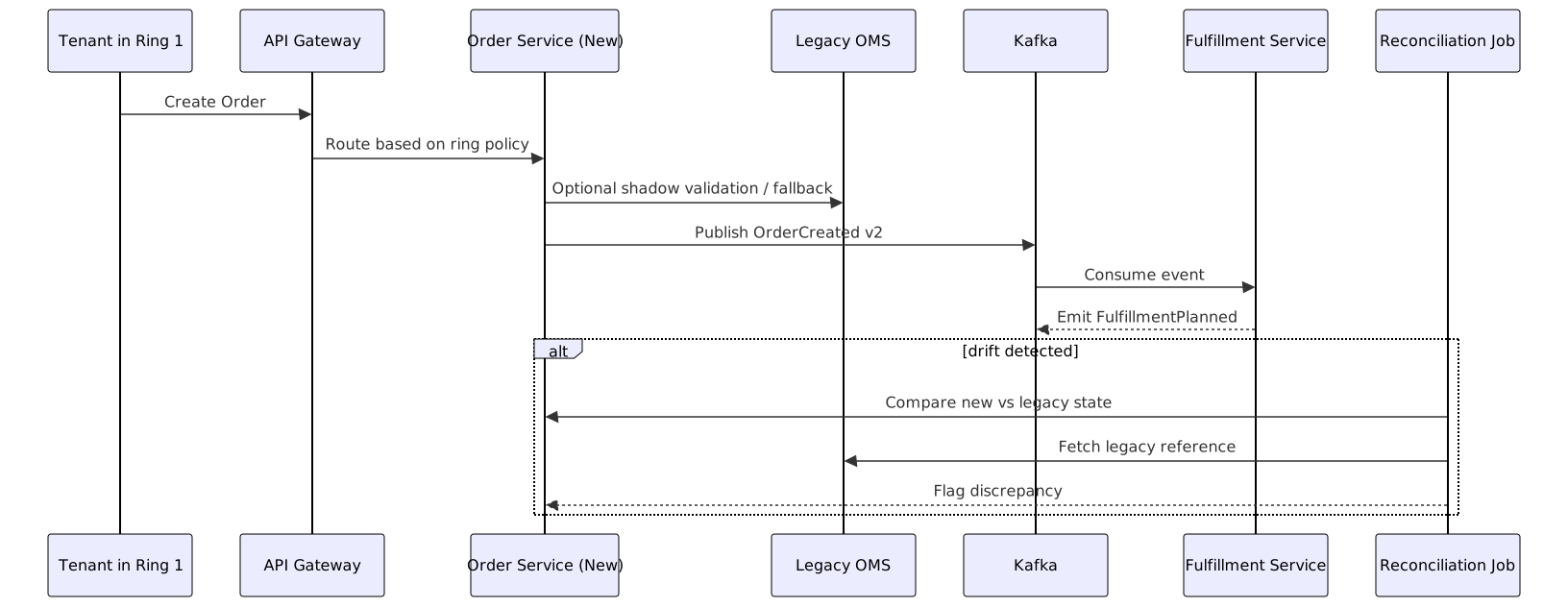
Notice the shadow validation and reconciliation. Those are not nice-to-haves during migration. They are the difference between a controlled rollout and a slow-motion state corruption exercise.
Migration Strategy
Deployment rings become most valuable during migration, especially progressive strangler migrations from legacy estates to cloud services.
The usual migration fantasy goes like this: we build the new service, switch traffic, and retire the old system. The actual enterprise version is closer to this: we build the new service, route one customer cohort to it, discover three undocumented behaviors in the legacy system that nobody wanted but everyone depends on, add translation logic, run dual reads, reconcile state, slowly widen exposure, and only then begin retiring old functionality.
That is not failure. That is what migration looks like when reality is invited into the room.
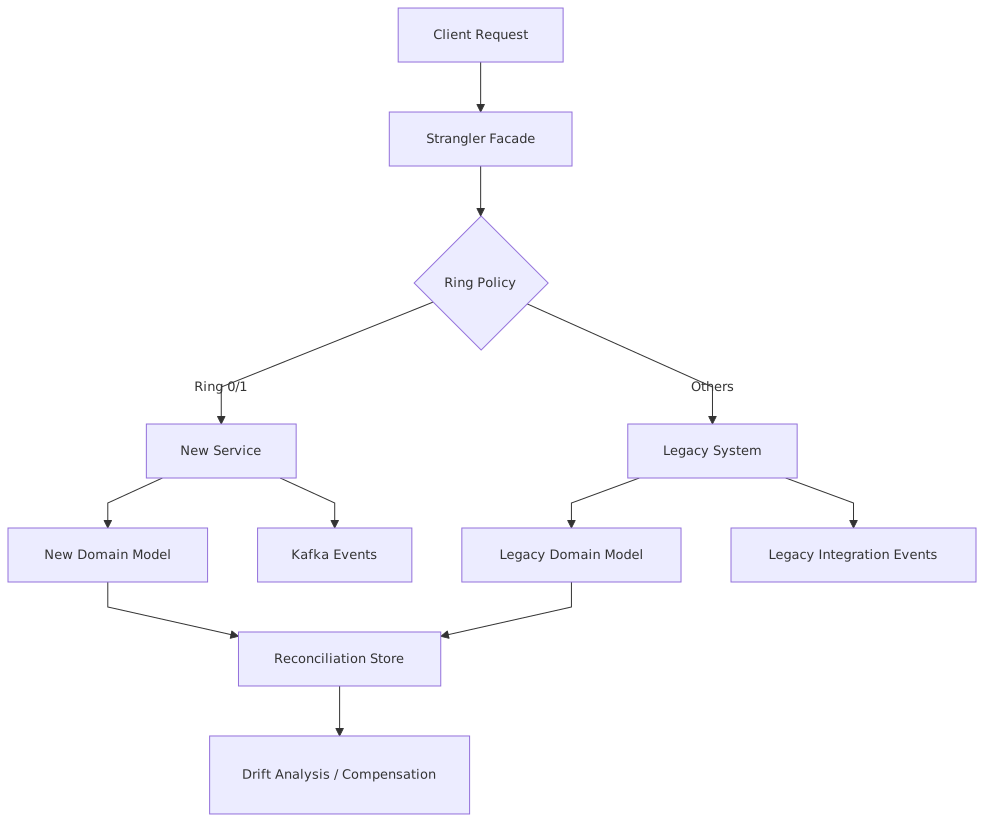
Strangler with rings
A progressive strangler migration works best when you can isolate a capability and route specific cohorts through the new path while preserving stable contracts around it.
Typical steps:
- Identify a bounded capability
- Example: customer profile updates, order capture, invoice generation
- Create an anti-corruption layer
- Protect the new domain model from legacy quirks
- Introduce ring-based routing
- Route internal users or selected tenants to the new capability
- Shadow, compare, and reconcile
- Run old and new behavior in parallel where needed
- Expand ring scope by domain confidence
- Not merely by time
- Retire legacy paths gradually
- Remove reads, then writes, then dependencies
This is where migration reasoning matters. You do not widen a ring because a sprint ended. You widen it because the architecture has earned the right.
Strangler rollout model
Reconciliation is part of architecture
Reconciliation deserves blunt language: if you are migrating stateful, event-driven enterprise workflows and you do not have an explicit reconciliation design, you do not have a migration strategy. You have optimism.
Reconciliation can include:
- comparing source-of-truth records between legacy and new systems
- validating domain invariants
- replaying events to rebuild projections
- compensating downstream actions
- correcting derived views and financial aggregates
- identifying duplicate or missing transitions
There are two common forms:
- Operational reconciliation: fast checks during rollout to decide whether to widen or halt
- Business reconciliation: deeper correction campaigns for data and financial integrity
Architects must decide where the source of truth lives during each migration phase. Dual-write without source-of-truth clarity is a factory for drift.
Enterprise Example
Consider a global retailer modernizing its pricing and promotion platform.
The legacy world is an old merchandising engine tied to batch jobs, regional pricing rules, and a data warehouse that everyone swears is “not operational” until a bad release causes the call center and finance teams to rely on it. The target architecture is a cloud-native pricing domain made up of microservices, with Kafka carrying price-change events to commerce, store systems, mobile apps, and analytics consumers. cloud architecture guide
The business pressure is intense. Promotions change daily. Regional regulations differ. Peak periods are unforgiving. A pricing error can mean lost margin, consumer trust issues, and public embarrassment.
The team’s first instinct is to deploy by percentage. That would be a mistake. Price behavior is not a generic web feature. It is deeply semantic. The right ring model is domain-driven:
- Ring 0: internal employee channels and test stores
- Ring 1: a small region with lower promotion complexity
- Ring 2: e-commerce channel in one major market
- Ring 3: in-store channels and global rollout
Why this sequence? Because the domain complexity rises unevenly. Some regions have straightforward price lists. Others have layered promotions, tax interactions, supplier funding rules, and legal display requirements. A 5% traffic rollout chosen randomly could land in the hardest possible business cases.
The architecture uses an API facade and policy engine to direct price calculation requests. For Ring 1, the new pricing service handles calculation, but the legacy engine still runs in shadow mode for comparison. Price results are checked against tolerances. Kafka events include a ring identifier so downstream analytics and alerting can distinguish migrated traffic.
The first serious issue appears not in API latency but in reconciliation. The new service emits price-change events immediately, while the legacy process batches certain promotional states. Store systems downstream, built around the old timing assumptions, display temporary inconsistencies. Nothing is “down,” but the business semantics are wrong.
This is classic enterprise architecture territory. The fix is not just technical patching. The architects introduce a translation layer that preserves legacy timing semantics for selected channels during intermediate rings. They also add a reconciliation job to compare effective price state across channels every fifteen minutes and flag divergence before broadening exposure.
The migration takes longer than originally promised. It also avoids a global pricing incident during holiday season. That is the kind of tradeoff grown-up architecture makes.
Operational Considerations
Deployment rings only work if operations can see, control, and explain them.
Observability by ring
You need technical telemetry, certainly:
- latency
- error rates
- saturation
- retries
- queue lag
- consumer group health
- schema validation failures
But ring rollout lives or dies on business observability:
- order conversion rate
- payment success rate
- promotion acceptance
- fulfillment delay
- cancellation rate
- tenant support cases
- reconciliation drift
- financial discrepancy counts
A release should not widen because CPU looks healthy while order fallout quietly climbs.
Support and incident response
Support teams need ring visibility. If a tenant is in Ring 1 and encountering a problem, support should know the active code path, feature state, event version, and fallback options. This usually requires operational metadata that can be queried by tenant, account, or transaction.
Rollback and roll-forward discipline
The cleanest rollback is traffic redirection before irreversible state changes occur. After that, rollback becomes compensation.
A healthy ring architecture therefore prefers:
- backward-compatible database changes
- additive event schemas
- delayed activation of writes where possible
- idempotent consumers
- compensating commands for side effects
In distributed systems, “roll forward with a fix” is often more realistic than pure rollback. But that only works if blast radius remains ring-contained.
Governance without bureaucracy
Enterprises often overreact and turn rings into a release committee ritual. That kills delivery momentum. Good governance is mostly encoded policy: EA governance checklist
- mandatory ring progression checks
- automated KPI thresholds
- documented exception handling
- ring ownership and approval paths
- reconciliation completion criteria
Architecture should create discipline, not ceremony.
Tradeoffs
Deployment rings are useful because they make tradeoffs explicit.
The first tradeoff is complexity for safety. Ring-aware routing, telemetry, support tooling, and reconciliation all add design and operational overhead. For critical systems, that overhead is justified. For simple internal applications, it may be waste.
The second is slower universal rollout for lower systemic risk. Rings delay full exposure. Product teams may complain. They are not entirely wrong. But a slower rollout that avoids state corruption is usually cheaper than a fast rollout followed by weeks of forensic cleanup.
The third is coexistence cost. During migration, old and new paths often run side by side. This creates translation logic, duplicate observability, and temporary model inconsistency. Coexistence is ugly. The alternative is big-bang replacement, which is usually uglier in a more expensive way.
The fourth is domain fidelity versus implementation convenience. It is easier to define rings by region, environment, or traffic percentage. It is better to define them by business semantics when risk varies by workflow or tenant type. Better is not easier.
Failure Modes
Deployment rings fail in recognizable ways.
1. Rings defined without domain meaning
If rings are arbitrary percentages in a system where customer cohorts behave differently, early rollout tells you very little. You may prove the easy cases and miss the dangerous ones.
2. No ring-specific telemetry
Teams widen rollout based on generic service health while domain outcomes degrade. This is how successful deployments create business incidents.
3. Shared event streams leak changes beyond the ring
A producer in Ring 1 emits events consumed globally, effectively bypassing the ring boundary. Kafka is excellent at preserving data movement. It is indifferent to your release intent.
4. Rollback assumes statelessness
Code is reverted, but side effects remain: duplicated messages, financial postings, customer communications, cache poisoning, stale projections. The incident continues after the “rollback.”
5. Legacy and new systems drift silently
Dual-run periods without systematic reconciliation create hidden divergence. By the time teams notice, the repair effort is large and politically painful.
6. Rings become permanent
Temporary migration structures can calcify. A “pilot path” survives for years, increasing cognitive load and support cost. Architects must design for removal as carefully as for introduction.
When Not To Use
Deployment rings are not universally appropriate.
Do not use elaborate ring architectures for:
- small internal tools with low business impact
- batch systems where release can be safely isolated in time
- products with trivial rollback and no persistent side effects
- teams lacking observability and support maturity to operate rings properly
Also, avoid ring rollout when the architecture cannot meaningfully isolate behavior. If a change necessarily affects global shared state immediately and cannot be contained by tenant, region, workflow, or traffic path, ringing may create false confidence.
In those cases, invest first in better modularity, bounded contexts, contract control, and reversibility. Release strategy cannot compensate forever for poor architecture.
Related Patterns
Deployment rings sit alongside several related patterns.
Canary releases are a close cousin, usually focused on a small percentage of traffic rather than semantically meaningful cohorts.
Feature toggles provide runtime control of functionality and are often part of ring implementation, though not sufficient by themselves.
Blue-green deployment is useful for infrastructure replacement but less expressive for domain-segmented exposure.
Strangler fig migration is the natural partner during modernization, using routing and coexistence to replace legacy capabilities incrementally.
Anti-corruption layers help preserve domain integrity when old and new models coexist.
Saga and compensation patterns become relevant where ring rollback involves business transaction correction rather than simple redeployment.
Outbox and idempotency patterns are crucial in Kafka-heavy architectures to contain duplicate or partial side effects.
These patterns work best together when guided by domain understanding rather than by platform fashion.
Summary
Deployment rings are one of those ideas that look operational on the surface and architectural underneath.
Used well, they let enterprises reduce release risk without freezing delivery. They provide a disciplined way to expose change gradually, aligned to the semantics of the business rather than the convenience of deployment tooling. They are especially valuable in cloud systems built from microservices and Kafka-backed event flows, where stateful side effects make naive rollback a fantasy.
But rings are not magic. They demand clear bounded contexts, explicit migration reasoning, strong telemetry, and a real reconciliation strategy. They force architects to confront uncomfortable questions: where does truth live, what side effects are reversible, which customers can tolerate change first, and what exactly counts as “safe” in domain terms?
That is why deployment rings belong in architecture conversations, not just DevOps dashboards.
The memorable line is this: a deployment ring is a promise about blast radius. If you cannot explain that promise in business language, you have not designed a ring. You have drawn a circle around uncertainty and hoped for the best.
Hope is not an architecture.
Frequently Asked Questions
What is cloud architecture?
Cloud architecture describes how technology components — compute, storage, networking, security, and services — are structured and connected to deliver a system in a cloud environment. It covers decisions on scalability, resilience, cost, and operational model.
What is the difference between availability and resilience?
Availability is the percentage of time a system is operational. Resilience is the ability to recover from failures — absorbing disruption and returning to normal. A system can be highly available through redundancy but still lack resilience if it cannot handle unexpected failure modes gracefully.
How do you model cloud architecture in ArchiMate?
Cloud services (EC2, S3, Lambda, etc.) are Technology Services or Nodes in the Technology layer. Application Components are assigned to these nodes. Multi-region or multi-cloud dependencies appear as Serving and Flow relationships. Data residency constraints go in the Motivation layer.