⏱ 5 min read
In an API-first organization, APIs are not just integration points — they are the product. Mobile apps, partner integrations, internal microservices, AI agents, and automation workflows all communicate through APIs. That makes APIs your largest attack surface, your primary trust boundary, and your most valuable control point. If APIs fail, the business fails. If APIs leak data, trust collapses. If APIs are abused, operational costs explode. integration architecture diagram
Security architecture in API-first companies is not about adding a gateway and hoping for the best. It is about designing a system where every request is verified, authorized, observable, and resilient — by default. modeling integration architecture with ArchiMate
The layered security model
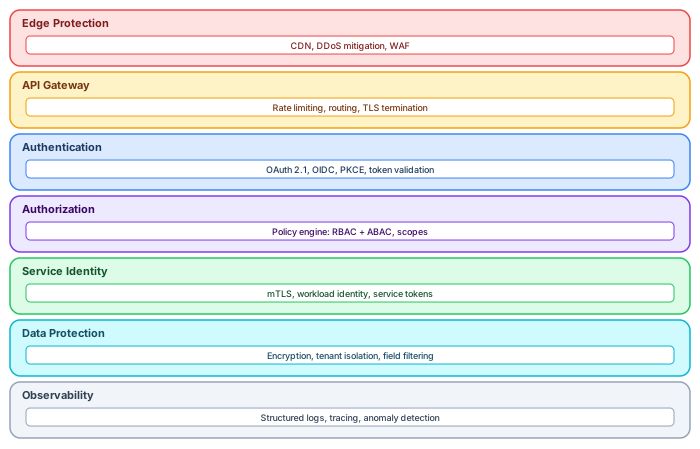
Strong API security is layered. Each layer assumes the previous one can fail. application cooperation diagram
Edge Protection (CDN, DDoS mitigation, WAF) absorbs volumetric attacks and filters known malicious patterns before traffic reaches the API infrastructure. API Gateway handles rate limiting, routing, TLS termination, and request validation. It is the first application-aware layer — enforcing request size limits, content type validation, and basic schema compliance.
Authentication (OAuth 2.1, OpenID Connect) verifies identity. Use short-lived access tokens. Validate issuer, audience, expiry, and signature on every request. Prefer PKCE for public clients. Rotate signing keys regularly. For internal services, use mTLS-based workload identity rather than shared API keys.
Authorization (Policy Engine) decides what the authenticated identity is allowed to do. Modern API-first systems require RBAC for role-based access combined with ABAC for contextual decisions. Authorization must consider subject (user or service), action (GET/POST/DELETE), resource (which account, which record, which tenant), and context (IP address, device type, risk score, time of day). Scopes alone are not sufficient for real-world security.
Service-to-Service Identity ensures that internal APIs do not rely on network trust. mTLS between services, workload identity frameworks (SPIFFE/SPIRE), and explicit service authorization policies prevent lateral movement inside the system.
Data Protection Controls enforce encryption in transit and at rest, tenant isolation (derive tenant from the validated token, never trust client-provided tenant IDs), field-level filtering (return only the fields the caller is authorized to see), and sensitive access logging.
Observability and Detection provides the visibility that makes everything else effective. Structured logging, correlation IDs across the request chain, distributed tracing, centralized security event collection, and automated anomaly detection. Monitor 401/403 spikes, unusual tenant activity, payload anomalies, and geographic inconsistencies.
Zero Trust for APIs

Zero Trust means every request is authenticated, every request is authorized, every request is logged, and nothing is implicitly trusted. Even internal service-to-service calls within the same Kubernetes cluster must validate identity and check policy. Network location (being "inside the perimeter") grants zero privilege. This is particularly critical in API-first organizations where the boundary between internal and external is blurred — the same API may serve both a mobile app and an internal service.
Abuse and availability controls
API abuse patterns include scraping (automated data extraction), credential stuffing (automated login attempts with leaked credentials), enumeration (discovering valid user IDs or account numbers through API responses), and expensive query attacks (crafting requests that consume disproportionate server resources). Mitigation controls: rate limiting per user, tenant, and IP; burst and sustained throttling; request size caps; query cost analysis (reject GraphQL queries exceeding a complexity threshold); replay protection; and idempotency keys for write operations. Availability is a security property — an API that can be trivially overwhelmed is insecure regardless of its authentication and authorization controls.
Secure SDLC for APIs

Security must integrate into CI/CD, not exist as a separate phase. Include threat modeling during API design (before code is written). Run SAST and dependency scanning on every pull request. Scan for hardcoded secrets in code and configuration. Execute DAST against staging environments before promotion to production. Validate infrastructure-as-code and policy-as-code in the pipeline. Security is not a phase — it is a continuous property of the delivery pipeline.
Governance at scale
Enterprise API-first organizations require: a central identity platform (one OAuth/OIDC provider, not five), standard token structures (consistent claims across all services), a shared policy engine (one authorization framework, not per-service implementations), an API catalog with lifecycle governance (every API registered, versioned, and owned), and versioning and deprecation standards (consistent rules for when and how APIs evolve). Without governance, inconsistency becomes the largest security risk — not because any single API is weak, but because the differences between APIs create gaps that attackers exploit. ARB governance with Sparx EA
Frequently Asked Questions
What is enterprise architecture?
Enterprise architecture is a discipline that aligns an organisation's strategy, business operations, information systems, and technology infrastructure. It provides a structured framework for understanding how an enterprise works today, where it needs to go, and how to manage the transition.
How is ArchiMate used in enterprise architecture practice?
ArchiMate is used as the standard modeling language in enterprise architecture practice. It enables architects to create consistent, layered models covering business capabilities, application services, data flows, and technology infrastructure — all traceable from strategic goals to implementation.
What tools are used for enterprise architecture modeling?
Common enterprise architecture modeling tools include Sparx Enterprise Architect (Sparx EA), Archi, BiZZdesign Enterprise Studio, LeanIX, and Orbus iServer. Sparx EA is widely used for its ArchiMate, UML, BPMN and SysML support combined with powerful automation and scripting capabilities.