⏱ 20 min read
Most architecture diagrams lie.
Not because architects are dishonest, but because the system moves faster than the drawing. The tidy boxes on a slide deck suggest a world where requests take straight roads, events arrive in order, teams agree on language, and failures politely stay inside service boundaries. Real distributed systems do not behave that way. They behave like cities at rush hour: detours, bottlenecks, improvised shortcuts, and the occasional fire in a tunnel no one documented.
That is why runtime architecture maps matter.
A runtime map diagram is not another polished “system context” picture for the steering committee. It is a working model of how the system actually behaves while it is alive: which service calls which, what events flow through Kafka, where retries pile up, where data is duplicated, where reconciliation is needed, and where the business domain leaks through technical seams. If the static architecture diagram tells you what you intended to build, the runtime map tells you what you are now responsible for operating. event-driven architecture patterns
In modern distributed systems, especially microservices estates built over years rather than weekends, the runtime view is the only view that consistently reveals the truth. It shows the choreography between order management and inventory, the sagas hidden inside “simple APIs,” the fact that a customer record is really four records with an identity problem, and the uncomfortable reality that your so-called decoupled architecture still has three services that cannot survive if one Kafka topic stalls.
This article argues for runtime maps as a first-class architecture artifact. Not as documentation theater, but as a practical instrument for design, migration, resilience, and governance. I’ll frame the problem, the forces acting on it, the shape of a solution, and the tradeoffs that come with it. I’ll also show where runtime maps fit into domain-driven design, progressive strangler migration, reconciliation, and enterprise-scale Kafka ecosystems. And, just as importantly, I’ll point out when not to use them.
Context
Distributed systems become opaque long before they become elegant.
A company starts with a transactional core—an ERP, a monolith, maybe a couple of integration jobs. Then growth happens. Teams split. Channels multiply. A CRM is added, then an e-commerce platform, then event streaming, then specialized services for pricing, fulfillment, fraud, recommendations, notifications, billing. Each local decision is sensible. The overall shape becomes less so.
At first, architecture is described structurally: applications, interfaces, environments. That is useful, but incomplete. In an enterprise, the questions that hurt are rarely static.
- Why does a payment capture sometimes appear before order confirmation?
- Why does inventory drift from warehouse reality?
- Which service is authoritative for customer consent at runtime?
- Why do refunds fail only when shipment cancellation arrives late?
- Which flows depend on Kafka, which use synchronous APIs, and which quietly use both?
- What happens when reconciliation discovers two sources of truth that both claim authority?
These are runtime questions. They demand runtime artifacts.
A runtime architecture map makes those interactions explicit. It captures the moving parts: command paths, event propagation, state transitions, time dependencies, retry behavior, compensation logic, eventual consistency windows, and operational choke points. It is architecture with a pulse.
And in enterprises, pulse matters. Static decomposition without runtime semantics is how people accidentally design coupled microservices. They separate the code and centralize the behavior. That gives you the operational overhead of distributed systems with none of the autonomy. microservices architecture diagrams
Problem
Most teams know they have dependencies. Few know the shape of dependency at runtime.
That distinction is not philosophical. It is expensive.
A conventional landscape diagram might show Order Service, Payment Service, Inventory Service, and Shipping Service. Fine. But it tells you almost nothing about the real behavior:
- Does Order block on Payment synchronously?
- Is inventory reserved through a command or inferred from an event?
- Are duplicate messages safe?
- Is customer notification triggered from the order aggregate, shipping lifecycle, or a separate projection?
- How many bounded contexts are being crossed in a single business transaction?
- Where exactly does business reconciliation compensate for technical uncertainty?
Without a runtime map, teams fill the gaps with assumptions. Assumptions become hidden contracts. Hidden contracts become incidents.
The deeper problem is semantic erosion. In distributed systems, the names survive longer than the meanings. “OrderCreated” may really mean “shopping cart submitted.” “PaymentAuthorized” may mean “authorization attempted.” “Customer” may refer to a legal entity in one service, a marketing profile in another, and an identity principal in a third. If you map runtime interactions without domain semantics, you end up with a wiring diagram. Useful, but not enough.
A proper runtime map diagram does two jobs at once:
- It exposes the execution topology.
- It clarifies the domain meaning flowing through that topology.
That second point is classic domain-driven design. Bounded contexts do not just separate codebases; they separate language, rules, and authority. Runtime maps are where those boundaries are tested under pressure.
Forces
Several forces push enterprises toward runtime mapping, whether they realize it or not.
1. Domain complexity outlives technical fashion
Teams can replace REST with gRPC, RabbitMQ with Kafka, or a monolith with microservices. The business still needs to sell products, allocate stock, invoice correctly, and satisfy regulations. The domain is the long game. Runtime maps help connect technical interactions back to domain outcomes.
2. Event-driven architecture increases observability needs
Kafka is a wonderful machine for decoupling time, throughput, and ownership. It is also a brilliant way to hide business flow inside asynchronous fog. Once systems communicate by topics, partitions, consumer groups, retries, dead-letter streams, and projections, architecture becomes harder to reason about from code structure alone.
3. Progressive migration creates hybrid reality
Most enterprises are not greenfield. They live in coexistence: mainframe plus cloud, packaged SaaS plus custom services, old batch plus new streaming. A progressive strangler migration does not replace the old world in one move. It wraps, reroutes, partitions, and gradually shifts capability. During that period, the runtime map is often the only coherent picture.
4. Consistency is negotiated, not guaranteed
Distributed systems trade atomicity for autonomy. That means eventual consistency, sagas, retries, and compensations. It also means reconciliation. If your architecture depends on asynchronous propagation, late arrivals, duplicate events, and occasional human correction, then your runtime map must show those realities.
5. Operations sees coupling before architecture does
Architects often discover hidden coupling after operations has already been paged for it. The outage reveals the truth. Runtime maps shrink that delay.
Solution
The solution is to treat runtime architecture maps as living enterprise artifacts, owned jointly by architecture, platform, and domain teams.
Not all diagrams deserve to live. This one does.
A runtime map diagram should show, at minimum:
- business capabilities and bounded contexts
- synchronous request paths
- asynchronous event flows
- authoritative systems of record
- projections and read models
- compensation and reconciliation paths
- failure containment boundaries
- observability points
- migration seams where old and new systems coexist
In practice, I recommend three layers.
Layer 1: Domain runtime map
Start with domain semantics, not technology. Show bounded contexts, business events, commands, and ownership. Ask: what is the meaning of an order, a payment, a reservation, a shipment? Who decides? Who reacts? Who merely caches?
Layer 2: Technical runtime map
Add protocols and infrastructure. Which interactions are REST, gRPC, Kafka topics, CDC streams, scheduled jobs? Where are idempotency keys enforced? Which calls are synchronous because they must be, and which are asynchronous because they should be?
Layer 3: Operational runtime map
Overlay failure and support concerns. Show retries, dead-letter handling, replay points, circuit breakers, fallback paths, latency-sensitive links, and reconciliation jobs. This is where architecture graduates from modeling to accountability.
Here is a simple domain runtime map for an order flow.

This looks straightforward. It never is.
The important thing is not the arrows. It is the semantics. “Place Order” is a command into the Order context. “Payment Authorized” is an event from the Payment context, but only if authorized actually means committed authorization, not merely accepted for processing. “Stock Reserved” must mean inventory authority has taken a decision, not that a request was enqueued. If those meanings are weak, the runtime map becomes theater again.
Now add operational texture.
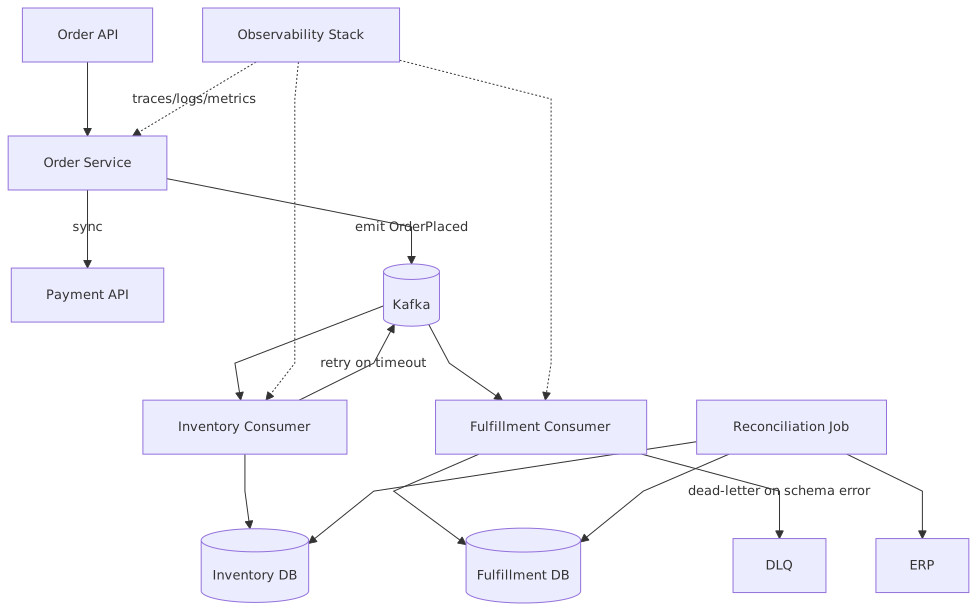
That diagram tells a more honest story. There are sync and async paths. There are retries. There is a dead-letter queue. There is reconciliation because the system is not mathematically perfect, only operationally managed.
This is the shape of the solution: architecture diagrams that acknowledge time, semantics, and failure.
Architecture
A good runtime map in distributed systems is opinionated about four things: authority, time, coupling, and recovery.
Authority
Every significant business fact needs an authority. Not every consumer needs a copy, and not every copy has authority. That sounds obvious until you see three systems all editing customer status. Runtime maps should clearly mark systems of record and downstream projections.
In DDD terms, authority often aligns with bounded contexts. The Payment context decides payment state. The Inventory context decides stock reservation state. The Order context coordinates customer-facing lifecycle, but should not invent downstream truth. If Order says “paid” before Payment says so, you have built optimism into your domain model. Optimism has a long incident history.
Time
Most architecture drawings are timeless. Runtime maps are not. They should reveal temporal dependencies:
- what must happen synchronously to preserve user experience or contractual correctness
- what may happen asynchronously
- acceptable staleness windows
- replay windows
- timeout thresholds
- reorder sensitivity
Time is architecture. If a shipment event can arrive before payment settlement, then the domain must either permit that state or block it. There is no diagrammatic neutrality.
Coupling
Microservices are usually sold as decoupling tools. In practice, they often relocate coupling into runtime behavior. A service may be deployment-independent and still be operationally handcuffed to five others because every request fans out. Runtime maps expose this fan-out.
A useful test is simple: if one context is unavailable, how many user journeys degrade, and how badly? Runtime mapping turns that from folklore into a visible property.
Recovery
Every distributed system has partial failure. The real design question is recovery strategy.
Some failures need immediate retry. Some need compensation. Some need replay. Some need reconciliation. A runtime map should distinguish these, because they are not interchangeable.
- Retry is for transient technical faults.
- Compensation is for reversing an earlier business action.
- Replay is for rebuilding downstream state from durable event history.
- Reconciliation is for detecting and correcting divergence between systems.
Architects who muddle these concepts produce systems that recover badly and expensively.
Migration Strategy
Migration is where runtime maps earn their salary.
A progressive strangler migration is not merely about routing traffic from old to new. It is about gradually relocating domain authority without losing operational control. That means mapping current runtime behavior, target behavior, and interim hybrid states.
The worst migration plans focus only on code replacement. Enterprises need behavior replacement.
Suppose a monolithic order management system currently handles order capture, payment initiation, allocation, invoicing, and shipment updates. A sensible migration might carve out Payment, then Inventory, then Fulfillment. But the sequence matters less than the runtime seams. You need to know:
- which events the monolith can emit reliably
- which decisions must remain in the monolith during transition
- where anti-corruption layers are needed
- how dual-write risk is avoided
- how reconciliation catches divergence while both worlds coexist
Here is a simplified strangler pattern runtime map.
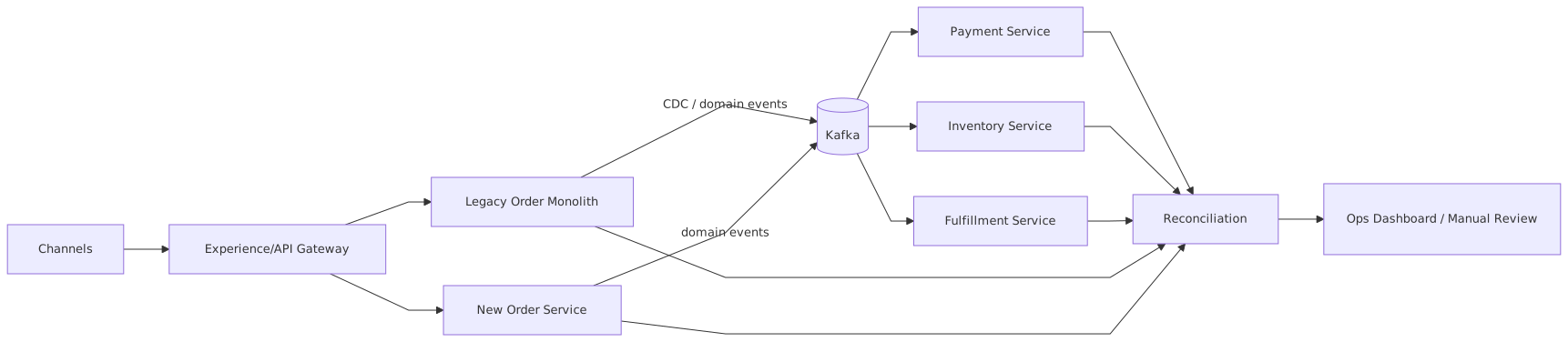
The architectural principle is straightforward: strangle behavior in slices, not in slogans.
A few rules help.
Migrate around bounded contexts
Do not split randomly by technical layer. Split where domain language and authority are already distinct or can become distinct. Payment is often a better early candidate than “customer utilities.” Inventory reservation can be isolated if stock authority is clear. Reporting, by contrast, may be better served by event projection than service extraction.
Prefer event publication over shared database reads
If the monolith’s database remains the integration hub, migration stalls. CDC can help bootstrap event publication, but it should be treated as a bridge, not the destination. Runtime maps should clearly mark where you are still depending on old persistence models.
Reconciliation is not optional in hybrid states
During migration, you will have overlap, lag, duplication, and occasional semantic mismatch. Reconciliation is the safety net. It compares authoritative states across systems, identifies drift, and either auto-corrects or raises an exception for human review.
This matters especially when using Kafka. Event streaming gives durability and replay, but it does not magically solve semantic mismatch, missing upstream events, bad mappings, or historical gaps. Reconciliation catches the places where theory met Tuesday.
Keep migration observability explicit
Every phase of migration should have runtime maps with instrumentation points. Which flows are cut over? What percentage of traffic is in the new path? Where do fallbacks occur? Which events are emitted by both systems? What is the mismatch rate? If you cannot answer these quickly, you are migrating blind.
Enterprise Example
Take a global retailer. Not a toy startup with three services and a manifesto. A real retailer: online channels, stores, warehouse management, ERP, promotions, returns, loyalty, customer support, multiple regions, and enough edge cases to keep the legal department employed.
The retailer’s order landscape had grown organically. The e-commerce platform captured orders. A central ERP handled financial posting. A warehouse platform owned physical fulfillment. Inventory was spread across store systems and regional stock engines. Payments were partly outsourced. Kafka had been introduced to decouple channels from back-end processing, but over time the event catalog became a museum of ambiguity.
“OrderConfirmed” was emitted by two different systems with different meanings.
“ShipmentUpdated” could mean packed, handed to carrier, or carrier acknowledgment received.
Inventory projections in the customer channel were refreshed from streams, but final reservation happened elsewhere.
Support teams regularly saw “paid but not shipped” and “shipped but not invoice-posted” cases.
The architecture diagrams looked professional. The operations war room looked unconvinced.
So the team built runtime architecture maps around the order lifecycle. Not one giant poster no one would read, but a set of linked maps at capability level.
What changed?
First, they identified true bounded contexts. Order Capture, Payment, Inventory Allocation, Fulfillment, Customer Notification, Financial Posting. This sounds banal, but it exposed a major issue: “Order Management” was not a bounded context at all. It was an umbrella over six domains with conflicting authority.
Second, they classified runtime interactions:
- customer-facing acceptance remained synchronous in Order Capture
- payment authorization moved to a synchronous edge plus asynchronous settlement updates
- allocation became event-driven
- fulfillment status updates were accepted as eventually consistent
- financial posting remained downstream and asynchronous
Third, they added a reconciliation service focused on key domain invariants:
- every paid order must eventually either allocate or enter exception state
- every shipped order must have a financial posting record
- every cancellation after reservation must release stock
- every refund must map to a captured payment
The result was not beauty. It was clarity.
They discovered one nasty failure mode: duplicate payment authorization events under consumer replay caused Order Capture to transition an already-cancelled order back into a paid state, which in turn re-triggered fulfillment. The bug had survived for months because the static design looked fine. The runtime map exposed a missing idempotency boundary and a broken state machine assumption.
They also found a migration path. Instead of replacing the entire order platform, they strangled Inventory Allocation first. Kafka events from legacy order capture fed the new allocation service. Reconciliation compared reservation outcomes against warehouse and ERP records. Only after the mismatch rate dropped below an agreed threshold did they move more decision-making out of the old stack.
This is how enterprise architecture should work: less mythology, more controlled relocation of truth.
Operational Considerations
A runtime map becomes valuable only when tied to operations.
Observability
Every major edge in the runtime map should have traceability. For synchronous calls, distributed tracing is usually enough. For Kafka, correlation is harder but still essential. Event keys, causation IDs, and business transaction IDs should be part of the map and the implementation.
If your runtime map shows a flow that cannot be observed end-to-end, treat that as architectural debt.
Data quality and schema discipline
Event-driven systems rot through schema drift as often as through outages. Runtime maps should note schema ownership and compatibility rules. A topic is not just plumbing; it is a published contract. Weak governance here creates subtle runtime failures that only show up in downstream projections. EA governance checklist
Idempotency
If Kafka is involved, duplicates are not an edge case. They are a design condition. Every state-changing consumer should have an explicit idempotency strategy, and the runtime map should indicate where that guarantee lives. Some teams hide this in code and call it implementation detail. That is a mistake. It is part of the runtime architecture.
Reconciliation operations
Reconciliation should have a visible operating model:
- schedule or trigger conditions
- invariants being checked
- tolerance thresholds
- auto-remediation rules
- manual review workflow
Without this, reconciliation becomes a vague promise rather than a working control.
Human intervention
Enterprise systems often need exception queues and support tooling. That is not architectural failure. It is practical design. The trick is to make manual intervention explicit, bounded, and auditable. Runtime maps should show where people enter the loop.
Tradeoffs
Runtime maps are not free.
They take effort to create and, more importantly, to keep current. If they drift, they become just another artifact that reassures managers and misleads engineers. A runtime map only earns trust when it is continuously maintained through architecture governance, delivery practices, and telemetry.
They also risk over-modeling. Some teams produce maps so detailed they become unreadable. The answer is not more detail. The answer is layered views. Keep domain meaning visible. Add technical and operational detail in progressive levels.
There is also a cultural tradeoff. Runtime maps expose uncomfortable truths: accidental centralization, weak domain boundaries, over-reliance on synchronous chains, undocumented compensations, and ambiguous ownership. Some organizations would rather keep the diagram vague than face the politics. That instinct is understandable and fatal.
Another tradeoff sits between flexibility and standardization. Enterprises want a common notation, but too much rigidity produces dead artifacts. I favor a light standard: required semantics, standard symbols for authority and flow types, but room for context-specific annotation.
Failure Modes
A runtime map can fail in several predictable ways.
The wiring-diagram trap
If the map shows only services and arrows, it misses domain meaning. Then architects discuss infrastructure while business inconsistency sneaks past.
The static snapshot trap
If the map does not represent timing, retries, and asynchronous lag, it is only a topology chart. Useful for onboarding, weak for runtime reasoning.
The false-authority trap
If projections or caches are drawn as peers to systems of record, teams start making decisions in the wrong place. That leads to divergent truth.
The migration fantasy trap
In strangler migrations, teams often draw target-state maps and ignore the hybrid middle. That middle is where most complexity lives. If the coexistence state is not mapped, it will still exist, just badly understood.
The unreconciled-event trap
Kafka encourages confidence in event history, but not every business fact arrives correctly, once, or at all. If the map has no reconciliation path, operational drift becomes inevitable.
The governance trap
If no team owns the map, everyone assumes someone else does. Then the runtime map dies quietly while the incidents keep breathing.
When Not To Use
Runtime architecture maps are not universal medicine.
Do not invest heavily in them for small, simple systems where a handful of components have obvious interactions and low business criticality. A CRUD application with one database and a couple of integrations does not need an elaborate runtime map. It needs good code, decent logging, and restraint.
Do not build heavyweight runtime mapping if the domain is still highly experimental. In early product discovery, architecture should not calcify around diagrams. Keep the model light until the domain stabilizes enough to justify deeper semantic mapping.
Do not confuse runtime maps with process diagrams for human workflows. They are related, but different. A BPMN process map of claims handling is not the same as a runtime architecture map of services, events, authority, and reconciliation. BPMN training
And do not use runtime maps as a substitute for architecture decisions. A map can reveal coupling; it does not resolve it. It can expose semantic confusion; it does not invent a bounded context. It is a powerful lens, not a magic wand.
Related Patterns
Several patterns pair naturally with runtime architecture maps.
Event storming
A good precursor for identifying domain events, commands, and bounded contexts. It helps discover the semantics that the runtime map later operationalizes.
Bounded contexts and context mapping
Straight from domain-driven design. Runtime maps become far more useful when they align with context boundaries and show upstream/downstream relationships clearly.
Saga orchestration and choreography
Runtime maps should reveal whether long-running business transactions are coordinated centrally or through event collaboration. Both are valid. Both fail differently.
Strangler Fig pattern
Essential for migration. Runtime maps make the intermediate states visible and governable.
Anti-corruption layer
Crucial when integrating legacy systems or packaged applications whose language should not pollute your target domain model.
CQRS and projections
Common in Kafka-based architectures. Runtime maps should show the difference between command-side authority and read-side convenience.
Reconciliation and repair loops
Not glamorous, but deeply important in enterprise systems. A grown-up architecture assumes some divergence and provides controlled correction.
Summary
Runtime architecture maps are the antidote to one of enterprise architecture’s oldest bad habits: drawing systems as if they were still.
They are not just prettier diagrams. They are a way of thinking. A runtime map forces you to answer the questions that matter in distributed systems: who owns which business fact, what happens first, what can lag, where coupling hides, how failures propagate, and how truth is restored when systems disagree.
That makes them especially valuable in microservices and Kafka-heavy estates, where asynchronous flow can blur responsibility and migration can leave old and new worlds entangled for years.
The best runtime map diagrams combine three things:
- domain semantics from DDD
- technical flow across services, APIs, and event streams
- operational reality including retries, reconciliation, and human intervention
Used well, they improve architecture design, migration planning, observability, incident response, and governance. Used badly, they become decorative fiction.
My advice is blunt: if your distributed system is business-critical, event-driven, and evolving through progressive strangler migration, build runtime maps early and keep them alive. Mark authority. Mark timing. Mark failure. Mark reconciliation. Draw the world as it runs, not as it was promised.
Because in distributed systems, the map is not the territory.
But without a runtime map, you are governing the territory blind.
Frequently Asked Questions
What is a service mesh?
A service mesh is an infrastructure layer managing service-to-service communication. It provides mutual TLS, load balancing, circuit breaking, retries, and observability without each service implementing these capabilities. Istio and Linkerd are common implementations.
How do you document microservices architecture for governance?
Use ArchiMate Application Cooperation diagrams for the service landscape, UML Component diagrams for internal structure, UML Sequence diagrams for key flows, and UML Deployment diagrams for Kubernetes topology. All views can coexist in Sparx EA with full traceability.
What is the difference between choreography and orchestration in microservices?
Choreography has services react to events independently — no central coordinator. Orchestration uses a central workflow engine that calls services in sequence. Choreography scales better but is harder to debug; orchestration is easier to reason about but creates a central coupling point.