⏱ 21 min read
Distributed systems rarely fail with a bang. They fail with a shrug.
A customer updates an address in one service, and another service still ships to the old one. Finance books revenue, but the ledger lags. Inventory says “available” while the warehouse says “already picked.” Nobody sees a database crash. No red light blinks in the data center. The system is up. The APIs are healthy. The dashboards are green. And yet the business is quietly wrong.
That is the dangerous kind of failure.
We have spent a decade getting better at service availability observability: CPU, memory, request latency, error rates, saturation, retries, circuit breakers. Good. Necessary. But availability observability is not consistency observability. A service can respond in 30 milliseconds and still tell a lie. In distributed systems, that lie is usually born in the gap between domain events, replicated state, asynchronous messaging, and local transactions.
This is where most architecture conversations become evasive. People say “eventual consistency” as if naming the beast has domesticated it. It has not. Eventual consistency is not a strategy. It is a consequence. If you choose distributed autonomy, asynchronous collaboration, and polyglot persistence, you are choosing a world where truth arrives in pieces. The architectural question is not whether inconsistency exists. It does. The question is whether you can observe it, reason about it in domain terms, and recover before the business pays for it.
That is the heart of data consistency observability.
The best teams do not ask only, “Is the service healthy?” They ask, “Is the order lifecycle coherent?” “Has every shipment been invoiced?” “Do customer balances match the ledger?” “How long does a domain fact remain divergent across bounded contexts?” Those are not infrastructure questions. They are domain-driven design questions wearing operational clothes.
This article argues for a practical architecture pattern: treat consistency as an observable business property, not an implicit side effect of messaging middleware. Build explicit signals around domain invariants, reconciliation loops, lag windows, causal flows, and business-level drift. Use Kafka where it helps, but do not worship the broker. Instrument the seams between services. Make inconsistency visible enough that operations, engineering, and the business can discuss the same problem with the same vocabulary. event-driven architecture patterns
Because in the enterprise, inconsistency is never merely technical debt. It is delayed truth. And delayed truth has a balance sheet.
Context
Modern enterprises are a patchwork of systems with different speeds, different owners, and different notions of reality.
A customer order might begin in a web storefront, flow through pricing, inventory, fraud, payment, fulfillment, shipping, customer notifications, and finance. Some parts are synchronous. Many are not. There may be Kafka topics carrying domain events, APIs for command-style interactions, a data lake for analytics, and an ERP system that still runs the general ledger because replacing it would cost a political career.
This architecture exists for good reasons. Microservices allow team autonomy. Event streaming decouples producers and consumers. Domain-driven design helps us split the business into bounded contexts, each with language and rules that make sense locally. We stop pretending one giant canonical model can satisfy everyone. microservices architecture diagrams
But each bounded context has its own persistence and its own transaction boundary. That is the price of autonomy. An OrderPlaced event may be committed in the ordering context while inventory has not yet reserved stock and finance has not yet recorded receivables. The business process is one thing. The system state is many things.
Traditional monitoring does not see this. It sees components. It does not see semantic drift.
That matters because business processes cross bounded contexts. The customer does not care that the payment service is eventually consistent with the order service. The customer cares whether an order is accepted, charged, shipped, and supportable as one coherent journey. If your architecture fragments truth, your observability must stitch it back together.
Problem
The central problem is simple to describe and hard to manage:
In distributed systems, business truth is assembled from multiple local truths, and the gaps between them are often invisible.
A few examples make it plain:
- An order service writes
OrderConfirmedand publishes an event. - Kafka accepts the event.
- The inventory service is temporarily behind due to consumer lag.
- The shipping service receives a derived event from another topic and creates a shipment record.
- The finance service misses the event because of a bad schema evolution and silently dead-letters it.
- Customer support sees an order that exists, a shipment that exists, and no invoice.
The system is “working.” Nothing crashed outright. But the business invariant is broken.
There are several reasons this happens:
- Local transactions do not compose.
Each service can preserve its own consistency. Very few can guarantee cross-service atomicity without introducing harmful coupling.
- Events are facts, but not always complete facts.
A domain event says something happened in one bounded context. It does not ensure every other context interpreted it correctly.
- Asynchrony creates lag windows.
During these windows, divergent read models and partial process states are expected. The trouble is not the existence of the window. The trouble is not knowing its size, meaning, and business impact.
- Operational tooling is infrastructure-centric.
We monitor brokers, queues, pods, and APIs. We do not monitor “orders shipped but not invoiced after 15 minutes.”
- Reconciliation is treated as a back-office nuisance.
In reality, reconciliation is a first-class control loop in distributed architecture.
The result is a familiar enterprise disease: support tickets detect what telemetry missed.
Forces
Architecture is the art of living with forces you cannot eliminate.
Here, the important forces are these.
Autonomy vs coherence
Microservices and bounded contexts give teams room to move. They can evolve schemas, release independently, and optimize for local domain needs. That is the upside.
The downside is that coherence becomes emergent. No one transaction protects the whole business flow. If you want coherence, you must build it from events, process managers, compensations, and observability.
Throughput vs certainty
Kafka is excellent at moving large volumes of events with durability and partitioned order. But Kafka does not magically solve semantic consistency. It gives you a highly capable transport and replay model. It does not certify that consumers processed the right meaning, in the right order, with the right version.
High throughput systems are especially vulnerable because operational success can hide semantic decay. Millions of events flowing smoothly can still produce small percentages of business drift that become expensive at scale.
Domain truth vs integration truth
Domain-driven design teaches us that each bounded context has a model tailored to its purpose. Inventory may think in reservations and allocations. Finance thinks in postings and settlements. Ordering thinks in intent and lifecycle.
That means consistency cannot be reduced to field equality across databases. You need semantic mappings. “Reserved” in inventory is not the same thing as “committed” in ordering, and neither is the same as “recognized” in finance. Observability has to understand these distinctions.
Fast failure vs quiet failure
A timeout is noisy. A duplicate event processed twice may be subtle. A stale projection may be invisible until an executive report is wrong. Distributed inconsistency often accumulates in silence. That makes it operationally dangerous.
Coupling vs compensability
You can reduce inconsistency by tightening synchronous coordination. But then availability suffers, teams slow down, and one service’s outage becomes everyone’s outage.
Or you can embrace asynchronous patterns, accept temporary divergence, and invest in compensation and reconciliation. Most enterprises land here, whether they admit it or not.
Solution
The solution is not “make everything strongly consistent.” That is fantasy in most enterprise landscapes, and when pursued aggressively it usually becomes a central bottleneck disguised as governance. EA governance checklist
The practical solution is to create data consistency observability as an explicit architecture capability with five parts:
- Define domain invariants across bounded contexts
- Trace causal flows for business entities
- Measure divergence and lag as first-class signals
- Continuously reconcile expected vs observed state
- Provide operational paths for compensation and repair
This starts with domain semantics.
1. Define domain invariants
An invariant is not a database constraint stretched across services. It is a business rule that should hold, eventually or within a defined time window.
Examples:
- Every paid order must have an invoice within 10 minutes.
- Every shipped parcel must map to an order line allocation.
- Customer credit exposure in CRM must reconcile with finance receivables within one business day.
- No inventory reservation may remain orphaned beyond 30 minutes after order cancellation.
These are domain statements, not technical metrics. They belong to product owners, domain architects, and operational teams together.
2. Trace causal flows
Distributed consistency is easier to reason about when you can follow a business entity across services. Correlation IDs help, but they are too generic on their own. What you need is a model of causal lineage:
OrderPlacedPaymentAuthorizedInventoryReservedShipmentCreatedInvoicePosted
Each fact should be attributable to a business key such as OrderId, ShipmentId, CustomerAccountId, and ideally linked in an event lineage graph. This lets you ask not only “Did the consumer read the event?” but “Did the business process complete coherently?”
3. Measure divergence and lag
There is no consistency without time. In distributed systems, the difference between healthy and unhealthy often is not whether systems diverge, but how long they diverge and for which classes of business transaction.
You need metrics like:
- event processing lag by domain stream
- age of incomplete business flows
- count of invariant violations by severity
- reconciliation drift percentage by bounded context
- duplicate or out-of-order event impact rate
- dead-lettered events by business capability, not just topic
This is where observability stops being generic and becomes useful.
4. Reconcile continuously
Reconciliation is the safety net for all the reasons distributed systems drift:
- missed events
- poison messages
- schema evolution mismatches
- consumer bugs
- manual back-office edits
- replay side effects
- integration outages
A reconciliation service compares expected domain outcomes with actual states across systems. Sometimes it is streaming and near real-time. Sometimes it is batch. In enterprise reality, it is often both.
5. Enable repair
Observability without repair is theatre.
When you detect a drift, you need a decision path:
- ignore because still inside tolerance window
- retry processing
- replay an event
- trigger compensation
- create an operational task
- route to manual exception handling
- patch from source of truth
This must be explicit. Otherwise your consistency dashboard becomes a museum of unresolved guilt.
Architecture
A useful architecture for consistency observability typically combines event streaming, invariant evaluation, lineage tracking, and reconciliation.
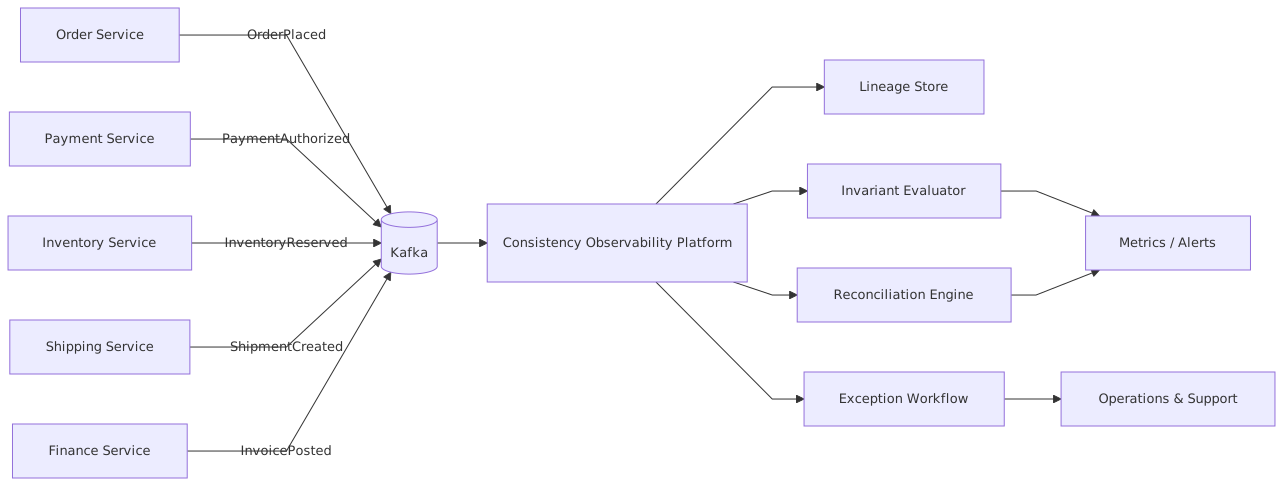
The pattern is straightforward.
Event sources
Domain services publish business events, ideally from a reliable outbox pattern rather than ad hoc dual writes. If you still have services writing to a database and “also” publishing to Kafka in the same application transaction without proper guarantees, you do not have consistency observability yet. You have wishful thinking.
The outbox pattern matters because observability built on incomplete event publication is built on sand.
Consistency observability platform
This is not one magical product. It is a set of capabilities:
- event ingestion from Kafka and selected APIs
- correlation and lineage assembly
- invariant rule evaluation
- lag and drift metrics
- reconciliation jobs
- exception routing and dashboards
Some organizations implement this as a dedicated platform team capability. Others embed it in business process orchestration and data quality tooling. Either can work. What matters is ownership.
Lineage store
The lineage store keeps enough normalized history to answer questions like:
- Which events have occurred for this order?
- Which expected events are missing?
- Did processing happen out of sequence?
- Which version of the payload was consumed?
- Which downstream entities were created from this source event?
This is not necessarily a full event store for the entire enterprise. Do not overreach. It is a targeted operational history for consistency analysis.
Invariant evaluator
The invariant evaluator consumes lineage and state snapshots to determine whether domain rules are holding.
A good evaluator understands:
- time windows
- expected state transitions
- domain-specific exceptions
- severity tiers
- confidence levels when data is partial
For instance, “shipment exists without invoice after 2 minutes” may be informational. After 30 minutes it may be critical. Context matters.
Reconciliation engine
This component periodically compares source-of-truth systems with dependent systems.
Examples:
- compare payment authorizations with order financial status
- compare warehouse allocations with inventory reservations
- compare ERP invoice records with customer-facing order summaries
Some reconciliations are event-driven. Others are nightly. In the real world, both coexist because some enterprise systems are not built for streaming semantics. Architects should accept this instead of pretending every ERP table will become a clean event source by next quarter.
Exception workflow
Detected inconsistencies need triage and action. Integrating with workflow tools, ITSM, case management, or back-office operations is often more valuable than another dashboard widget. Enterprises fix problems through process, not merely through telemetry.
Here is a sequence view of how one inconsistency becomes observable.
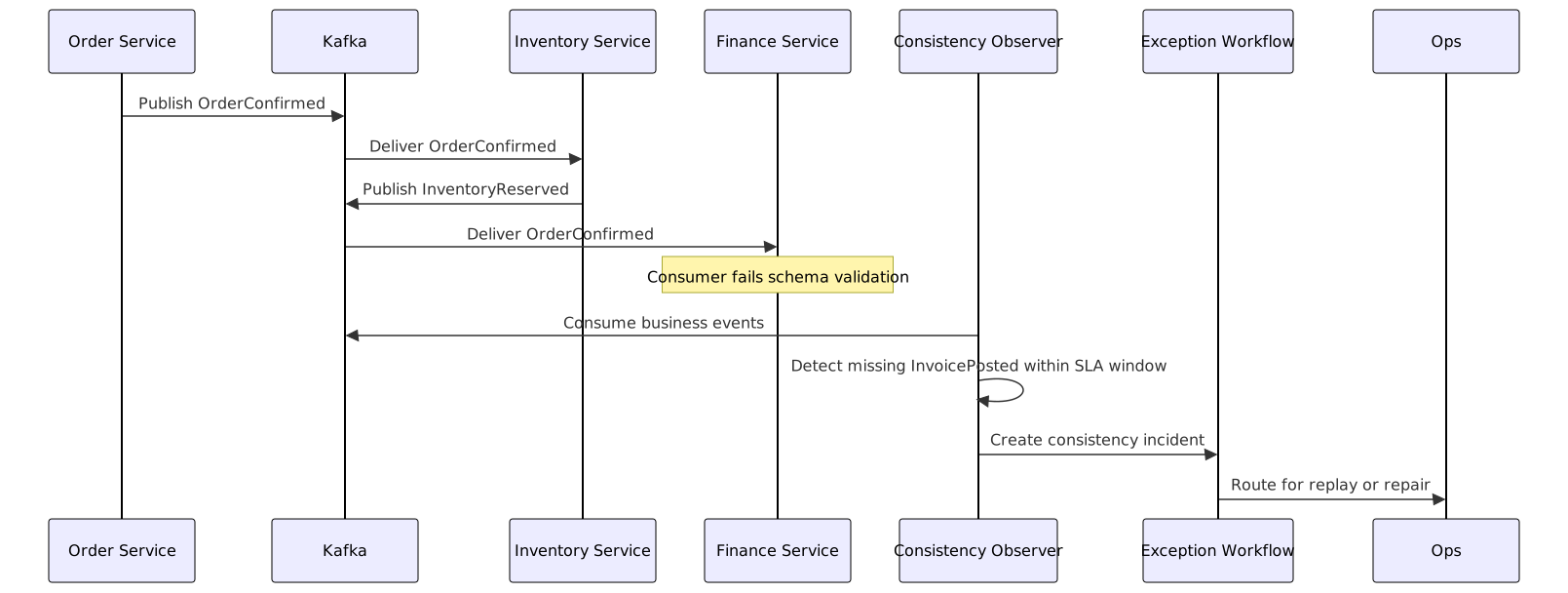
That is the key idea: the observer does not just watch technical delivery. It watches business completion.
Migration Strategy
This is not a pattern you roll out with a grand rewrite. If you try, the initiative will become a platform program, then a steering committee, then a memory.
Use a progressive strangler migration.
Start where inconsistency already hurts money or reputation. Usually that means order-to-cash, claims processing, payments, billing, or inventory fulfillment. Pick one value stream. Define a handful of cross-context invariants. Instrument the events and state checks. Get one dashboard that operations can trust. Then widen.
A sensible migration path looks like this:
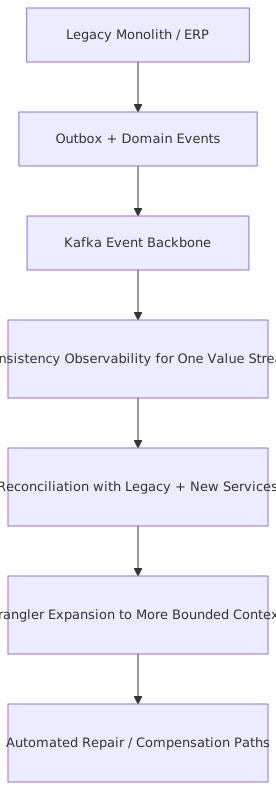
Phase 1: Make events reliable
Before observing consistency, ensure important business events are published reliably. Introduce:
- outbox pattern
- idempotent consumers
- schema versioning discipline
- clear business keys
This phase often reveals hidden domain ambiguity. Good. Better now than during an audit.
Phase 2: Establish domain invariants for one flow
Do not attempt an enterprise-wide consistency ontology. That way lies abstraction fever.
Choose one flow, for example:
- order confirmed → payment authorized → inventory reserved → shipment created → invoice posted
Then define:
- allowable lag windows
- exception categories
- authoritative source per fact
- repair actions
Phase 3: Add reconciliation
Once streaming observability exists, add periodic reconciliation to catch missed or malformed events. This is especially important in hybrid environments where legacy systems still perform manual or batch updates.
Phase 4: Introduce repair automation
Automate the boring recoveries:
- replay from topic offset
- republish from outbox
- trigger compensating command
- clear false-positive exceptions
Keep manual control for financial or regulatory changes.
Phase 5: Expand the strangler boundary
As more functionality moves from monolith or ERP edges into bounded contexts, carry consistency observability with it. The observability layer becomes the continuity mechanism that lets old and new worlds coexist.
This is often the hidden value of the pattern: during migration, it becomes the trust fabric.
Enterprise Example
Consider a global retailer modernizing order fulfillment.
The estate is typical. E-commerce ordering is already split into microservices. Inventory allocation runs across regional warehouse systems. Shipping is outsourced to a carrier integration platform. Finance still posts invoices and revenue in SAP. Kafka connects the modern parts. Batch interfaces still exist around the edges because, of course they do.
The business complaint is maddeningly specific: customers receive shipping confirmations before invoices appear in their account history, and support cannot explain whether the order is genuinely complete or merely delayed. Finance also reports daily mismatches between shipped orders and posted receivables.
A naive monitoring program would inspect topic lag, API errors, and SAP integration jobs. Those metrics exist. They do not solve the business question.
The architecture team instead defines three invariants:
- Every
ShipmentCreatedmust correspond to anInvoicePostedwithin 15 minutes for standard domestic orders. - Every
OrderCancelledmust release inventory reservations within 5 minutes. - Every
PaymentCapturedmust reconcile with finance posting by end of trading day.
Then they implement a consistency observability slice for the order-to-cash domain.
- Ordering, inventory, shipping, and finance events flow through Kafka.
- A lineage service tracks the order journey by
OrderId. - A rule engine flags missing downstream facts after domain-specific SLA windows.
- A reconciliation process compares SAP invoice postings nightly with the lineage store and creates exceptions for drift.
- Support receives a domain view: “Order shipped, invoice delayed due to finance consumer schema mismatch; replay queued.”
What do they discover?
First, a non-trivial share of issues are not broker failures at all. They are schema evolution mistakes in downstream consumers. Finance had deployed a stricter parser that rejected an optional field variation. The events were available; the meaning was not accepted.
Second, some inconsistencies are legitimate business exceptions. Cross-border shipments have customs holds and different invoicing windows. Without domain semantics, these would have been false positives.
Third, reconciliation uncovers manual SAP corrections that never flowed back into the customer-facing systems. The issue was not event delivery. It was side-door process behavior. Enterprises are full of side doors.
The result is not perfect consistency. That was never the goal. The result is controlled inconsistency with visibility, accountability, and repair. Support call times drop. Finance closes faster. Engineering stops guessing.
That is architecture doing business work.
Operational Considerations
A pattern only matters if it survives contact with production.
Treat business keys as sacred
If your services cannot agree on durable business identifiers, your observability will be fuzzy. Correlation IDs alone are not enough. You need stable domain keys that survive retries, replays, and channel changes.
Instrument for semantics, not just transport
Monitor:
- missing expected events
- duplicate business actions
- age of pending process states
- ratio of reconciled vs unreconciled items
- top invariant breaches by domain capability
Do not stop at consumer lag and offset movement.
Design for replay
Kafka gives you replay, but replay is dangerous without idempotency and side-effect controls. A replay that republishes invoices or re-triggers shipment creation is not recovery. It is multiplication of pain.
Own your schemas
Schema evolution is one of the most common consistency failure modes. Use compatibility policies, consumer-driven contracts where appropriate, and explicit event version handling. “We use Avro” is not a governance model. ArchiMate for governance
Set tolerance windows with the business
A consistency alert without a business-agreed tolerance is noise. Some drifts matter in seconds, others in hours. Observability should reflect commercial reality, not architect anxiety.
Expect multiple tempos
Not every system will become event-native. Some contexts will emit streams. Others will expose change data capture. Others will only support batch extracts. Your observability architecture should combine streaming and scheduled reconciliation without shame.
Tradeoffs
There is no free lunch here.
Benefit: better business trust
Cost: additional platform complexity
You will build lineage stores, rule engines, reconciliation jobs, and workflows. This is more moving parts. But it is purposeful complexity in exchange for reduced ambiguity.
Benefit: preserves service autonomy
Cost: accepts temporary inconsistency
This pattern does not eliminate eventual consistency. It operationalizes it. If the organization cannot tolerate any temporary divergence, you may need more synchronous coordination in specific flows.
Benefit: domain-level visibility
Cost: domain modeling effort
You must define invariants, sources of truth, and semantic mappings. That takes real collaboration across product, engineering, and operations. It cannot be delegated entirely to observability engineers.
Benefit: safer migration path
Cost: hybrid-state overhead
During strangler migration, you will observe both legacy and new systems. This doubles some operational burden. Still worth it. Hybrid ignorance is worse than hybrid complexity.
Failure Modes
Architects should always ask how the pattern itself fails.
1. Observability becomes purely technical
If dashboards only show topics, offsets, and pod health, you have not implemented consistency observability. You have rebranded platform monitoring.
2. Invariants are too generic
Rules like “all services should be in sync” are useless. Invariants must be domain-specific, time-bound, and actionable.
3. No source-of-truth discipline
If every team claims authority over the same business fact, reconciliation becomes political theatre. Define who owns what truth.
4. Replay causes duplicate side effects
Without idempotency keys, deduplication, or side-effect fences, repair automation can create more inconsistency than it removes.
5. Reconciliation is delayed beyond usefulness
A nightly batch is too late for some domains. If a customer-facing issue needs sub-minute detection, your control loop must match that reality.
6. Exception queues become graveyards
If nobody owns the operational workflow, detected drift accumulates. Over time, teams stop trusting the alerts. Unresolved exceptions are the observability equivalent of ignored smoke alarms.
When Not To Use
This pattern is not universal.
Do not use heavy consistency observability if:
- the domain is low-risk and inconsistencies have negligible business consequence
- a simple monolith with ACID transactions already serves the need well
- the system is so small that direct state inspection is enough
- synchronous orchestration is acceptable and simpler for the critical flow
- the organization lacks operational ownership for reconciliation and repair
Also, do not use this pattern as an excuse to decompose a coherent monolith prematurely. If a business capability needs strict transactional guarantees and the team boundary is stable, a modular monolith may be the better architecture. Splitting everything into microservices and then building elaborate consistency observability to compensate is sometimes just an expensive way to rediscover the value of local transactions.
That is an uncomfortable truth, but a useful one.
Related Patterns
Several established patterns fit naturally with consistency observability.
Outbox Pattern
Ensures domain events are published reliably from a local transaction boundary. Essential for trustworthy event-based observation.
Saga
Coordinates long-running distributed business processes. Consistency observability complements sagas by measuring whether they complete as intended and where compensations occur.
CQRS
Read models often become stale or divergent by design. Consistency observability helps quantify acceptable staleness and detect broken projections.
Event Sourcing
Provides rich historical facts and replay capability, but still does not remove the need for cross-context semantic reconciliation.
Change Data Capture
Useful in migration and legacy integration, especially when systems cannot publish domain events directly. Less semantically rich than true domain events, but often practical.
Strangler Fig Pattern
Ideal for progressive migration. Consistency observability provides the safety rails while old and new systems coexist.
Summary
Distributed systems do not merely process data. They distribute truth.
That is why consistency cannot be left as a side effect of messaging infrastructure or a hopeful property of “eventual” designs. If the business process crosses bounded contexts, then the architecture must provide a way to see when those contexts disagree, for how long, and with what consequence.
The right move is not to chase mythical global atomicity. It is to become explicit:
- define domain invariants
- track business lineage
- measure lag and drift
- reconcile continuously
- repair deliberately
Use domain-driven design to decide what consistency means in each bounded context and across the seams between them. Use Kafka where event streaming makes sense, but remember the broker is a transport, not a truth machine. Use strangler migration to introduce these capabilities gradually, especially around high-value enterprise flows. And never forget that reconciliation is not a second-class batch job. In distributed architecture, it is one of the core ways the system keeps its promises.
A healthy distributed system is not one that never diverges.
It is one that knows when it has diverged, knows whether that divergence is acceptable, and knows how to come back.
That is the difference between systems that are merely running and systems the business can trust.
Frequently Asked Questions
What is a service mesh?
A service mesh is an infrastructure layer managing service-to-service communication. It provides mutual TLS, load balancing, circuit breaking, retries, and observability without each service implementing these capabilities. Istio and Linkerd are common implementations.
How do you document microservices architecture for governance?
Use ArchiMate Application Cooperation diagrams for the service landscape, UML Component diagrams for internal structure, UML Sequence diagrams for key flows, and UML Deployment diagrams for Kubernetes topology. All views can coexist in Sparx EA with full traceability.
What is the difference between choreography and orchestration in microservices?
Choreography has services react to events independently — no central coordinator. Orchestration uses a central workflow engine that calls services in sequence. Choreography scales better but is harder to debug; orchestration is easier to reason about but creates a central coupling point.