⏱ 19 min read
Distributed systems fail in inches, not miles.
Most architecture diagrams lie by omission. They show boxes, arrows, databases, event streams, and perhaps a cloud icon floating over everything like a benevolent weather system. What they rarely show is the one force that eventually humbles every ambitious platform: time. Not abstract time. Network time. Queueing time. Retry time. Human waiting time. The ugly little delays that turn a clean domain model into a pile of accidental coupling.
This is why many distributed systems feel fine in architecture review and awful in production. The business says “real time,” engineering says “event driven,” and operations inherits a system where every boundary is technically decoupled but practically hostage to latency. A fraud check that adds 250 milliseconds here. A customer profile lookup over there. A Kafka consumer lag spike. A payment authorization waiting on a downstream service in another region. Nothing dramatic in isolation. Together, they turn a transaction path into a traffic jam. event-driven architecture patterns
So here is the argument: in distributed systems, architectural boundaries should be shaped not just by business capability or team ownership, but by latency zones. If two parts of a system must collaborate within a tight response budget, they belong in the same latency zone even if they are separate services. If they can tolerate seconds or minutes of delay, they belong in a different zone and should communicate accordingly. This sounds obvious. It is not commonly practiced.
We have spent years teaching teams to draw service boundaries around domains. That remains correct. But domain-driven design without time awareness is incomplete. A bounded context is not just a semantic boundary. In an operational enterprise system, it is also a statement about coordination cost, consistency expectations, and acceptable delay. If you ignore that, you get a system with lovely language and miserable behavior.
Latency is architecture. Treat it that way.
Context
Modern enterprises run on chains of dependent decisions. A customer submits an order. Pricing validates discounts. Inventory reserves stock. Payments authorize funds. Fraud scores the transaction. Shipping estimates a route. Notifications confirm the sale. Loyalty updates points. Analytics records the journey. Compliance archives the event.
On the whiteboard, this often becomes a service per capability, a Kafka backbone, and an expectation that asynchronous communication will solve all coupling problems. It does solve some. It creates others.
The enterprise reality is more awkward. Some of those capabilities must participate in an immediate user-facing interaction. Others must not, because they are slow, volatile, or operated by another team with different uptime characteristics. Some require hard transactional semantics. Others are naturally eventual. Some represent core domain decisions. Others are projections, enrichments, or side effects.
This is where the notion of latency zones helps. A latency zone is a deliberately designed part of the architecture where interactions share a similar timing expectation and operational style. It is not merely a network segment. It is a design boundary that combines:
- domain semantics
- response-time expectations
- consistency needs
- failure-handling strategy
- integration style
- operational ownership
A useful enterprise architecture does not ask, “Should this be synchronous or asynchronous?” That is too small a question. It asks, “Which business decisions must happen inside the same latency zone, and which should be pushed beyond it?”
That distinction changes everything.
Problem
Distributed systems tend to collapse under hidden temporal coupling.
A checkout service appears independent, but it cannot return a response until five downstream systems finish their work. A customer onboarding journey seems modular, but one anti-money-laundering lookup occasionally takes three seconds and freezes the entire flow. A claims system emits events correctly, yet downstream reconciliation becomes a daily firefight because upstream services assumed immediate propagation that never really existed.
The classic symptoms are familiar:
- APIs with unpredictable tail latency
- cascading timeouts across microservices
- retries amplifying load during incidents
- business operations blocked by slow non-critical dependencies
- Kafka topics used as magic dust rather than explicit consistency boundaries
- domain logic smeared across synchronous calls and asynchronous consumers
- endless debates about eventual consistency after the architecture is already live
The deeper problem is poor boundary placement.
Teams often draw service boundaries around ownership, codebases, or nouns in a business glossary. That is useful, but incomplete. A service boundary drawn without regard to timing creates brittle workflows. If two services must collaborate in under 150 milliseconds for a customer interaction, separating them may be reasonable only if their coordination cost is tightly controlled. If one of them routinely needs external data, human review, or model scoring, forcing it into the same request path is architectural self-harm.
Put bluntly: not every business capability deserves a seat at the hot path.
Forces
Several competing forces shape latency-driven boundaries.
Domain semantics
Domain-driven design still matters. A latency zone should not become an excuse to throw unrelated business concepts into one operational bucket. The model must preserve bounded contexts and ubiquitous language. Order Management is not Payments. Fraud is not Customer Profile. But within a bounded context, some decisions are core and immediate, while others are advisory, downstream, or compensating.
The semantics tell you which decisions are essential to commit now.
Response budgets
Every interaction has a practical time budget. Users tolerate only so much delay. Machine-to-machine flows have SLAs. Batch windows close. Call center agents cannot stare at a spinner while a dozen services coordinate themselves. Latency zones make these budgets explicit rather than accidental.
Consistency requirements
Some operations require immediate consistency because the business risk is unacceptable otherwise. Inventory reservation, credit exposure checks, or duplicate payout prevention may need strong guarantees. Other data can lag: loyalty points, recommendation updates, analytics, and many notifications.
Consistency is expensive. Delay is the bill.
Failure isolation
A critical design goal is to ensure that non-essential failures do not contaminate essential flows. If your confirmation email provider is down, the order should still complete. If your fraud scoring service is degraded, maybe the order should proceed into review rather than block all sales. Latency zones help isolate these decisions.
Team and platform reality
Teams, deployment cycles, and operational maturity matter. An organization with poor observability and weak event governance should be careful with aggressively asynchronous designs. Likewise, a team that cannot manage multi-service request tracing should not pretend it can reason confidently about a 14-hop synchronous chain. EA governance checklist
Regulatory and audit constraints
Many enterprises must prove what happened and when. In those environments, asynchronous boundaries are not just technical choices. They shape audit trails, legal evidence, and reconciliation obligations. Kafka helps here, but only if topics represent meaningful business facts rather than noisy internal chatter.
Solution
Design boundaries by latency zones layered over bounded contexts.
That means you first use domain-driven design to understand the business model, aggregate boundaries, and ownership of decision-making. Then you ask a second, more operational question: what must happen now, what may happen soon, and what can happen later?
A practical architecture usually ends up with three broad latency zones:
- Immediate zone
Milliseconds to low hundreds of milliseconds. User-facing decisions and hard transactional rules live here. Strong control, minimal dependencies, explicit response budgets.
- Near-real-time zone
Seconds to low minutes. Important but not interaction-blocking processes live here: fraud enrichment, fulfillment preparation, cache propagation, derived state updates, partner integrations with tolerant SLAs.
- Deferred zone
Minutes to hours or longer. Reporting, analytics, audit packaging, back-office reconciliation, large-scale data synchronization, and non-critical enrichments belong here.
These are not universal numbers. The point is not the exact threshold. The point is disciplined separation.
Within each bounded context, decide which commands and state transitions belong in which zone. The immediate zone should contain only what the business must decide before acknowledging the interaction. Everything else should be emitted as events or scheduled as work.
That gives you a cleaner shape:
- commands in the immediate zone
- domain events at the boundary
- asynchronous processing in downstream zones
- explicit reconciliation where consistency spans zones
This is not “just use events.” It is more disciplined than that. It says eventing is a contract between latency zones, not an afterthought.
Architecture
A useful mental model is a core transactional kernel surrounded by asynchronous satellites. The kernel is small on purpose. If it grows without restraint, every external concern sneaks into the critical path and your latency budget evaporates.
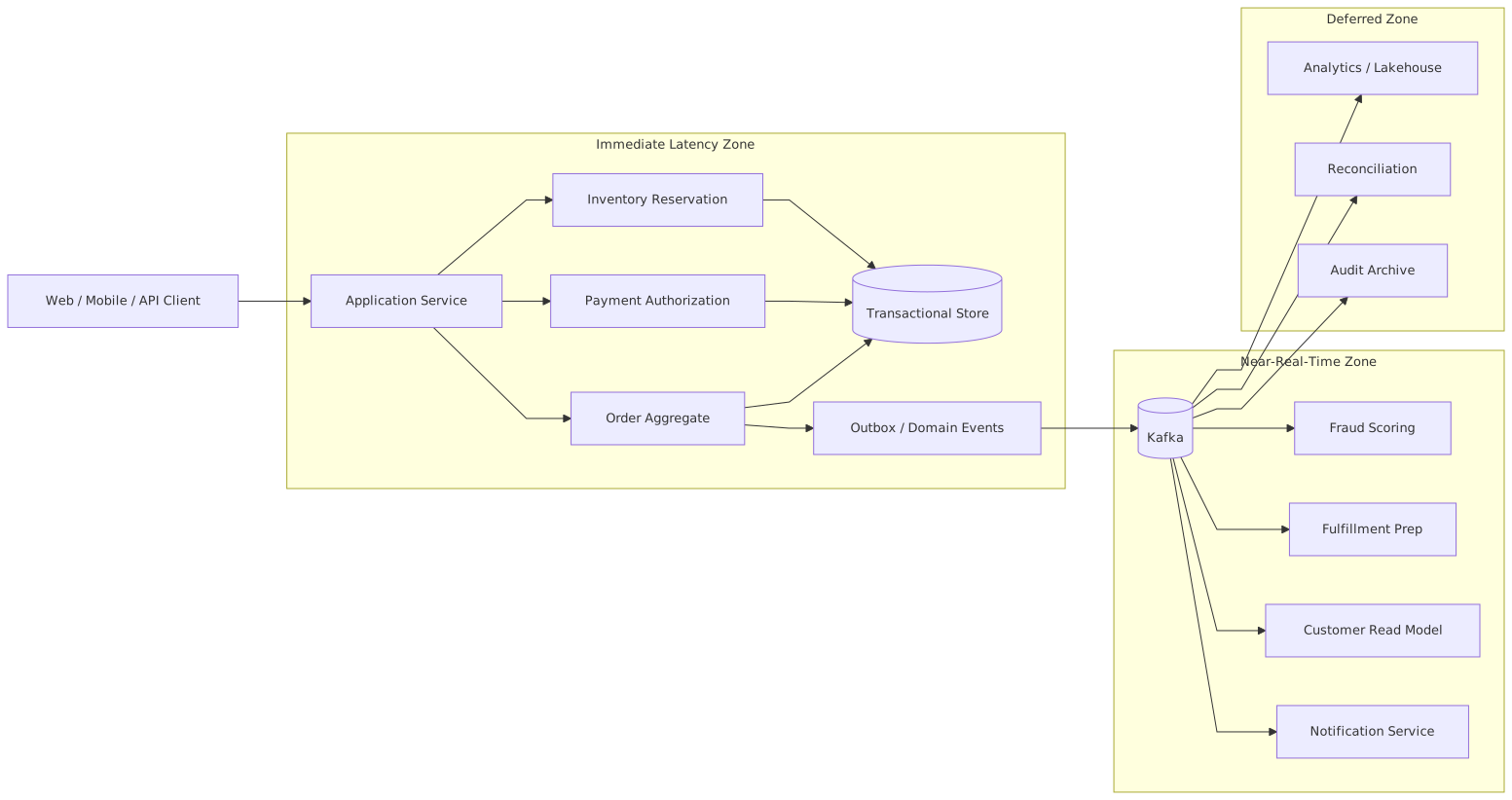
Notice what is absent from the immediate zone: analytics, notifications, recommendation engines, and most partner integrations. They are important. They are not entitled to block the order.
This is the first hard lesson: architecture is an exercise in saying no.
Domain semantics inside latency zones
The model must still respect bounded contexts. Do not collapse everything into a giant “fast lane” service. Instead, define immediate interactions around domain decisions that truly require synchronous coordination.
For example, in retail commerce:
- Order Management decides whether an order is accepted.
- Payments decides whether funds are authorized.
- Inventory decides whether stock is reserved.
These may remain separate services, but they are in the same immediate latency zone because the business operation cannot complete sensibly without them. A recommendation service, however, should not participate in that acceptance decision. Neither should loyalty accounting in most cases.
A good heuristic is to ask: if this capability is unavailable, should the business transaction stop, degrade, or continue?
That one question reveals more architectural truth than many design workshops.
Kafka as a zone boundary
Kafka is particularly useful at the boundary between immediate and later zones because it gives durable, ordered event streams and replayability. But Kafka should carry domain events and integration events with care. If every service publishes every internal mutation, you get a busy message broker and very little architecture.
Use events to state business facts:
- OrderPlaced
- PaymentAuthorized
- InventoryReserved
- ShipmentAllocated
- OrderReleasedForFulfillment
Those facts then feed near-real-time processors and deferred consumers. The topics become the seam where temporal decoupling is explicit.
Kafka does not remove consistency concerns. It merely changes how they show up. Instead of blocking writes, you now manage lag, idempotency, duplicates, ordering, poison messages, and replay side effects. That is usually a better trade. But let us not romanticize it.
Reconciliation is part of the design
Any architecture split across latency zones needs reconciliation. Not as a cleanup script. As a first-class capability.
Why? Because eventual consistency is not eventual correctness unless you actively verify it.
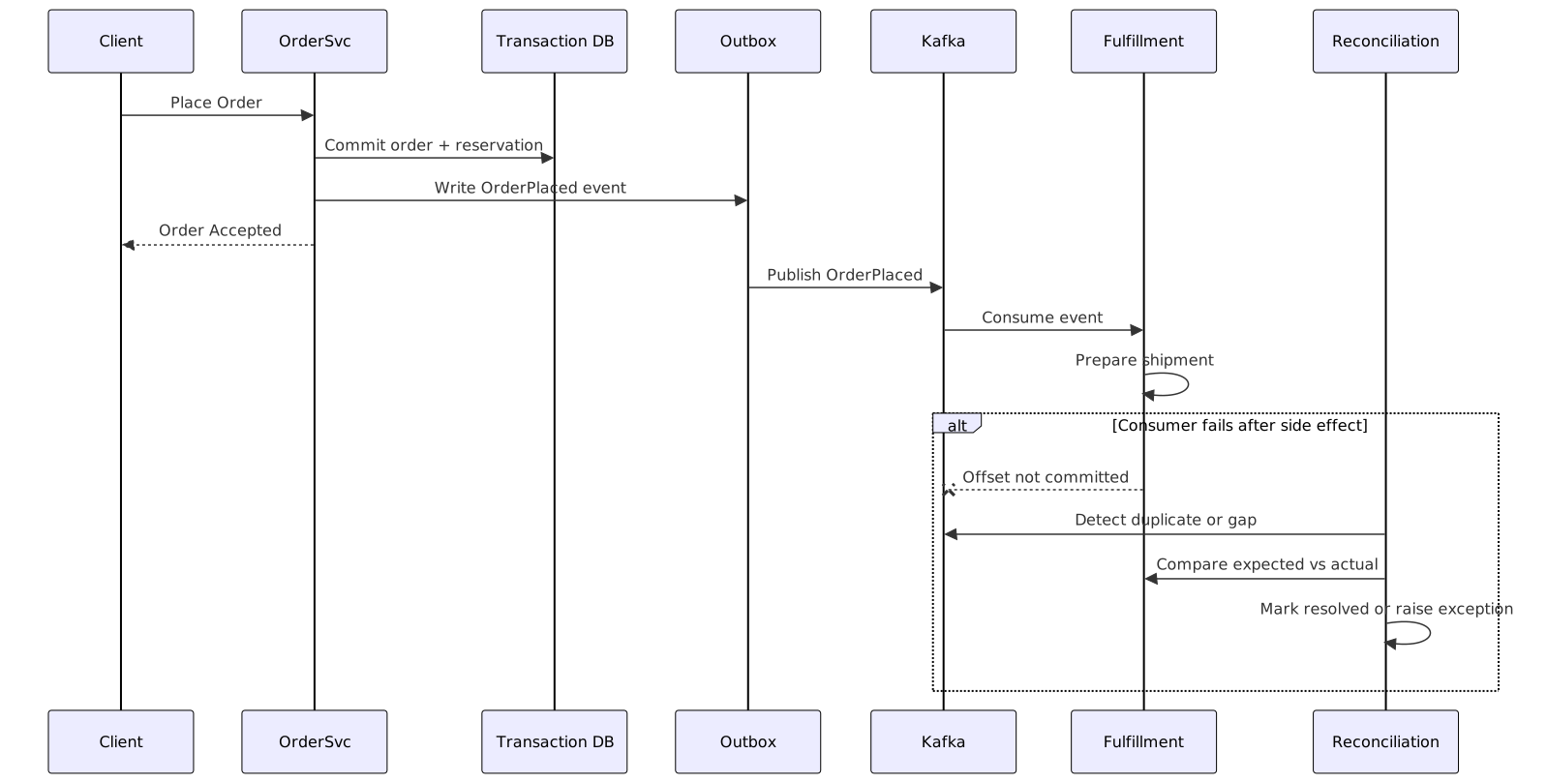
Suppose an order is accepted and an event is emitted, but a downstream fulfillment consumer fails after reserving a shipment slot and before acknowledging the Kafka offset. Suppose a payment authorization succeeds but the event publication is delayed. Suppose a partner system applies an update twice. You need systematic ways to compare intended state with observed downstream state.
This often means:
- outbox pattern in the immediate zone
- idempotent consumers downstream
- replayable event history
- business reconciliation jobs by key domain entity
- exception queues for unresolved mismatches
- operational dashboards that show semantic drift, not just CPU and memory
A reconciliation service is often the unsung hero of enterprise architecture. It is where honesty lives.
Migration Strategy
Most enterprises cannot redraw system boundaries from scratch. They inherit a patchwork of synchronous APIs, legacy databases, nightly jobs, and heroic operators. So the right migration is usually progressive, not revolutionary.
This is where the strangler pattern earns its keep.
Start by identifying one business journey with obvious latency pain. Checkout. Claims submission. Customer onboarding. Trade booking. Then map the transaction path and classify every dependency:
- must be immediate
- can move to near-real-time
- should be deferred
- should be removed entirely
This exercise is often humbling. Teams discover that half the “required” calls are historical accidents.
A practical migration path looks like this:
1. Instrument the current path
Before changing architecture, measure the actual latency budget and tail behavior. Find p95 and p99 latencies, timeout chains, retry rates, queue lag, and business fallout. You cannot fix temporal coupling you have not seen.
2. Establish domain events from the legacy core
Even if the core remains monolithic, introduce an outbox or change-data-capture approach to emit stable business events. This creates the first seam. Keep the event vocabulary aligned with the domain, not the tables.
3. Peel off deferred responsibilities
Notifications, analytics feeds, search indexing, and low-risk read models are excellent first candidates. They reduce load on the core and teach the organization how to handle asynchronous processing.
4. Move near-real-time processes next
Fraud enrichment, fulfillment preparation, customer profile denormalization, and partner updates often fit here. This requires stronger idempotency and replay handling. It also reveals where domain semantics were previously implicit.
5. Shrink the immediate zone deliberately
Once downstream capabilities are stable, reduce synchronous dependencies from the hot path. Replace “call before commit” with “emit after commit” where business rules allow it. This is the decisive architectural shift.
6. Add reconciliation before confidence disappears
As more capability moves across asynchronous boundaries, build reconciliation alongside it. Do not wait for production incidents to prove you need it. They will.
7. Retire old integration paths slowly
Legacy synchronous calls and duplicate update jobs tend to linger. Sunset them in stages, and maintain observability so the enterprise can see semantic continuity, not just technical deployment success.
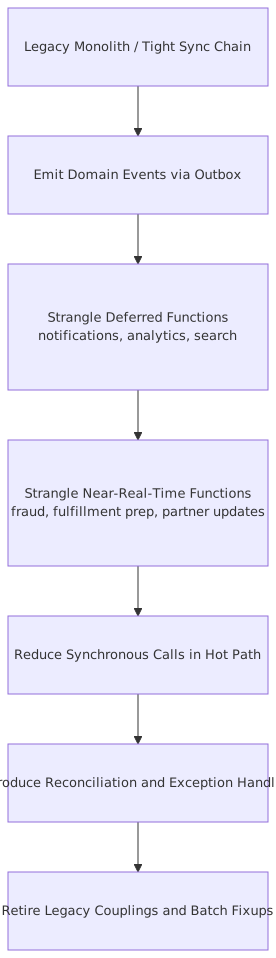
Migration is not just code movement. It is semantic clarification. A team discovers what an “accepted order” really means when they stop pretending every downstream side effect is part of that same moment.
Enterprise Example
Consider a global retailer modernizing its order platform.
The legacy architecture centered on a large commerce application with direct synchronous calls to payment gateways, fraud screening, customer profile, tax calculation, inventory, loyalty, CRM, and email. The system technically worked. Operationally, it was held together with caffeine and escalation calls. During seasonal peaks, p99 checkout latency exceeded six seconds. A slowdown in the loyalty system could reduce conversion. An outage in email confirmation once blocked order completion for forty minutes because the code path insisted on a successful downstream acknowledgment.
That is not architecture. That is a hostage situation.
The retailer reworked the platform around latency zones.
Immediate zone
The checkout path retained only:
- order validation
- payment authorization
- inventory reservation
- tax calculation where legally required at commit
- order acceptance persistence
These capabilities were kept under strict response budgets and close operational scrutiny. Some remained separate services, but they were treated as one latency zone with aggressive timeout discipline and minimal fan-out.
Near-real-time zone
After order acceptance, Kafka carried domain events to:
- fraud scoring and post-authorization review
- fulfillment planning
- customer account updates
- loyalty accrual
- CRM synchronization
- customer notification workflows
Fraud was the tricky part. The business originally wanted fraud in the immediate path. Analysis showed that only a small subset of orders required hard-stop screening. So they introduced rules: high-risk profiles stayed synchronous; the majority moved to near-real-time post-acceptance review with hold-and-release mechanics. That was the kind of compromise only a domain-informed architecture can make.
Deferred zone
Analytics, finance extracts, data lake ingestion, and long-term audit archiving moved fully out of the request path.
Results
The platform cut p99 checkout latency dramatically, improved conversion, and reduced incident blast radius. But the biggest gain was less visible: clearer semantics. “Order accepted” became a real business state, not a vague promise that a dozen systems might eventually agree with.
The project also surfaced reconciliation needs. Occasionally, loyalty accrual missed an event due to a consumer bug. Because the architecture treated Kafka as a durable fact stream and introduced reconciliation by order ID, those gaps were identified and repaired systematically rather than through customer complaints.
This is what good enterprise architecture looks like: not fewer problems, but better-shaped ones.
Operational Considerations
Latency zones succeed or fail in operations.
Observability by business flow
Tracing should show not just technical spans but domain progress. You want to know:
- order accepted
- payment authorized
- inventory reserved
- fulfillment prepared
- notification sent
That is more useful than a hundred generic service metrics. Instrument by business entity and state transitions.
SLOs per zone
Do not assign one SLA to the whole distributed chain. The immediate zone needs strict latency and availability targets. Near-real-time consumers need lag targets and completion windows. Deferred processes need throughput and data freshness targets. Different zones. Different promises.
Backpressure and retry discipline
Retries are dangerous when uncontrolled. In the immediate zone, retries must be cautious because they inflate tail latency and can amplify outages. In asynchronous zones, retries need jitter, dead-letter handling, and poison-message policies. A queue is not a forgiveness machine.
Idempotency everywhere it matters
Kafka consumers, command handlers, and partner integrations must tolerate duplicates and replays. Exactly-once semantics are useful in narrow contexts, but enterprise reliability still mostly comes from idempotent business processing.
Data retention and replay
If events define the zone boundary, retention policy becomes architecture, not storage housekeeping. Replay is essential for recovery, onboarding new consumers, and rebuilding projections. But replay without side-effect controls can cause fresh damage.
Ownership and governance
Somebody must own topic schemas, event vocabulary, compatibility rules, and semantic versioning. Otherwise, event-driven architecture decays into shared-chaos architecture.
Tradeoffs
This approach is powerful, but not free.
Pros
- clearer separation between critical and non-critical work
- lower user-facing latency on core flows
- better failure isolation
- explicit consistency boundaries
- stronger alignment between domain decisions and technical behavior
- easier progressive migration from legacy systems
Cons
- more complexity in event design and operational tooling
- harder debugging across asynchronous flows
- need for reconciliation as an ongoing capability
- semantic design work up front
- possibility of duplicated data and denormalized models
- more moving parts than a well-structured monolith
The biggest tradeoff is this: you are exchanging immediate coordination for eventual verification. In many enterprises, that is the right trade. But it requires maturity. If the organization cannot govern events, monitor lag, and handle exceptions, it may simply be moving confusion around.
Failure Modes
Architectures organized by latency zones fail in recognizable ways.
The “everything is immediate” trap
Teams keep too many dependencies in the hot path because they fear eventual consistency. Result: high latency, poor resilience, and a system where optional concerns become mandatory bottlenecks.
The “everything is asynchronous” fantasy
The opposite mistake. Critical business invariants get pushed into eventual workflows where they do not belong. Result: overselling inventory, duplicate payments, broken exposure limits, or compliance breaches.
Semantic drift across zones
The event says one thing, the downstream service interprets another. This happens when event contracts are technical rather than domain-based. “OrderUpdated” is almost always a bad event name because it says nothing useful.
Missing reconciliation
Teams trust the broker and forget the business. Eventually, data diverges and nobody can explain whether an order was truly fulfilled, merely planned, or lost in transit between systems.
Replay disasters
A new consumer reprocesses old events and accidentally resends emails, double-books shipments, or reopens closed cases. Replay requires side-effect discipline.
False bounded contexts
Sometimes a latency zone becomes a backdoor for poor domain modeling. Different business capabilities get shoved together because they are “fast path” concerns, and the result is a muddled core with no coherent model.
When Not To Use
Do not use latency zones as a fashionable overlay if the problem does not warrant it.
If your system is a well-structured monolith with clear module boundaries, low latency, and a single team, do not fracture it just to imitate distributed design patterns. A monolith can contain latency-aware modules without network boundaries.
Do not use this style when the business process truly requires tight, strongly consistent transactions across a small cohesive domain and there is little benefit in separating concerns. Some financial ledger systems, for example, should remain highly coordinated in a narrow core.
Do not lean heavily on asynchronous zones if your organization lacks:
- event governance
- tracing and monitoring
- operational support for replay and dead letters
- discipline around schema evolution
- appetite for reconciliation workflows
And do not pretend latency zones solve poor domain understanding. If the team cannot define what “accepted,” “booked,” “settled,” or “fulfilled” means, no amount of Kafka will save them.
Related Patterns
Several patterns complement latency-zone architecture.
Bounded Context
The essential DDD pattern. Latency zones sit across or within bounded contexts, but should never erase them.
Outbox Pattern
Crucial for reliably publishing domain events from the immediate zone without dual-write hazards.
Saga
Useful for long-running business processes across zones. But use sagas carefully. A saga is coordination, not magic compensation dust.
CQRS
Helpful where immediate write models and downstream read models have different latency and scaling needs.
Strangler Fig
The right migration approach for most enterprises. Replace dependencies incrementally rather than launching a transformation program that dies in PowerPoint.
Anti-Corruption Layer
Important when migrating from legacy domains whose semantics do not match the new event vocabulary.
Summary
The central idea is simple and worth repeating: architecture boundaries in distributed systems should be designed by both domain semantics and latency expectations.
Domain-driven design tells us where meaning lives. Latency zones tell us where timing pressure lives. Good enterprise architecture needs both. Without domain thinking, systems become technically clever but semantically confused. Without latency thinking, they become semantically elegant but operationally brittle.
The practical outcome is a smaller immediate zone, richer event boundaries, more deliberate near-real-time processing, and explicit reconciliation. Kafka and microservices can help, but only when used to represent meaningful business facts and intentional temporal separation. Not every dependency belongs on the hot path. Not every concern deserves a synchronous vote. microservices architecture diagrams
That is the memorable line here: separate what must decide now from what merely wants to know soon.
Do that, and your distributed system has a chance to behave like a business platform rather than a committee meeting on a bad network.
Frequently Asked Questions
What is a service mesh?
A service mesh is an infrastructure layer managing service-to-service communication. It provides mutual TLS, load balancing, circuit breaking, retries, and observability without each service implementing these capabilities. Istio and Linkerd are common implementations.
How do you document microservices architecture for governance?
Use ArchiMate Application Cooperation diagrams for the service landscape, UML Component diagrams for internal structure, UML Sequence diagrams for key flows, and UML Deployment diagrams for Kubernetes topology. All views can coexist in Sparx EA with full traceability.
What is the difference between choreography and orchestration in microservices?
Choreography has services react to events independently — no central coordinator. Orchestration uses a central workflow engine that calls services in sequence. Choreography scales better but is harder to debug; orchestration is easier to reason about but creates a central coupling point.