⏱ 18 min read
Distributed systems do not fail because engineers are careless. They fail because time is ruthless.
A monolith can pretend the world changes all at once. A distributed estate cannot. In the real enterprise, one team deploys on Tuesday, another has a CAB window next month, a vendor package upgrades once a year, and the reporting platform still runs code written by people who now have children in high school. Yet the business keeps moving. Product names change. Customer identities merge. an old one, and things break in ways that are both subtle and expensive.
This is where data model version bridges earn their keep.
A version bridge is not a glamorous pattern. It does not impress in architecture review because it looks like compromise. And that is precisely why it matters. Good enterprise architecture is often the art of surviving incompatible truths long enough to reach a better future. A version bridge lets multiple representations of the same business concept coexist without demanding a big-bang rewrite. It gives old and new models a controlled border crossing.
Think of it as a customs office between countries that used to be one nation. Same history. Same goods. Different paperwork now.
In distributed systems—especially around Kafka, event-driven integration, microservices, and progressive migration—this pattern becomes a practical tool for preserving domain semantics while systems evolve. It is not only about translation. It is about protecting meaning. event-driven architecture patterns
Context
Most enterprises do not start greenfield. They inherit. They acquire. They outsource. They build around constraints and then spend years pretending those constraints are strategic decisions.
So you end up with multiple data models describing roughly the same domain:
- an order in the ERP
- an order in the commerce platform
- an order event in Kafka
- an order projection in the analytics lakehouse
- an order aggregate in the fulfillment service
Each looks familiar until it matters. Then the differences become painful. The ERP treats an order as a legal commitment. Commerce treats it as a customer journey artifact. Fulfillment treats it as work to be scheduled. Analytics treats it as a fact grain. All are valid. None are interchangeable.
Now add evolution over time. The old order model had a single shipping address. The new domain says shipment instructions belong per fulfillment group. The old customer model used local account IDs. The new model uses global party identities. The old event called a cancellation a status change. The new model treats it as a business decision with reason codes, actor, and compensating financial consequences.
This is not a mere schema mismatch. It is domain drift.
Version bridges are useful when the organization needs to evolve a model incrementally, preserve service continuity, and avoid forcing every producer and consumer to move in lockstep.
Problem
The problem is simple to describe and nasty to solve: how do you change a shared or widely distributed data model without freezing delivery across the enterprise?
If one service changes its API or event contract and all consumers are expected to upgrade immediately, the architecture is not distributed; it is a hostage negotiation. Tight coordination masquerades as autonomy.
The deeper issue is this: distributed systems spread not just code but semantics. Once a model is published—through APIs, Kafka topics, database extracts, batch files, SaaS connectors, BI feeds—it escapes. Consumers build assumptions around structure, cardinality, default values, event ordering, and implied business meaning. Over time those assumptions become part of the landscape, even if nobody documented them.
A naive schema migration focuses on fields:
- add
customerType - split
nameintofirstNameandlastName - replace
statuswithlifecycleState
But architecture pain usually arrives through semantics:
- “customer” used to mean account holder; now it means a party in a relationship graph
- “order shipped” used to mean a warehouse confirmation; now it means legal transfer of custody
- “product” used to mean SKU; now it can mean bundle, subscription, or entitlement
When semantics change, compatibility is not a serialization concern. It is a domain concern.
Without a bridge, teams typically choose one of four bad options:
- Big-bang migration
Everything changes at once. It looks clean on slides and catastrophic in production.
- Dual-write chaos
Producers publish old and new models independently. Drift begins on day one.
- Frozen legacy model
Innovation is blocked because every change must preserve obsolete assumptions.
- Consumer-specific adapters everywhere
Every team writes its own translation. Meaning fragments. Defects multiply.
A version bridge addresses this by making translation explicit, governed, and architecturally central.
Forces
This pattern exists because several forces pull in opposite directions.
1. Domain semantics must evolve
Businesses change names, regulations, products, and operating models. Data models must follow. If they do not, the architecture starts encoding yesterday’s business.
Domain-driven design is useful here because it reminds us that a model belongs inside a bounded context. There is no universal customer, order, or product. There are context-specific representations with explicit meanings. A bridge acknowledges that two versions may reflect different ubiquitous languages, not just different field layouts.
2. Teams deploy independently
Microservices promise independent delivery, but shared contracts put hard limits on that promise. Event-driven systems amplify the problem because consumers are often unknown, delayed, or loosely governed. Kafka topics become public infrastructure. Once an event shape is widely consumed, it acquires the stability expectations of a platform.
3. Legacy cannot disappear instantly
A bank cannot switch off a core system because a domain model improved. A retailer cannot migrate warehouse integrations during peak season. A healthcare enterprise cannot casually break audit trails and clinical feeds.
4. Data consistency still matters
Different versions of the same concept create reconciliation problems. If old and new representations both remain active, someone must decide what is authoritative, how divergence is detected, and what compensating action follows.
5. Performance and operability matter
Every bridge adds latency, complexity, observability needs, and failure paths. Translation logic is business-critical code even when teams call it “just mapping.”
The hard truth: there is no free migration. There is only whether you pay the price deliberately or as production incidents.
Solution
A data model version bridge is an architectural component or set of components that translates between model versions while preserving domain intent, compatibility rules, and migration control.
It can sit in different places:
- inside a service boundary
- at an API facade
- as an event transformer in Kafka streams
- in an anti-corruption layer between bounded contexts
- in a dedicated compatibility service
- in data ingestion or projection pipelines
The bridge should do more than reshape payloads. It should encode explicit policies for:
- field transformation
- semantic conversion
- defaulting
- deprecation
- enrichment
- identity translation
- version routing
- reconciliation rules
- observability of translation success and loss
At its best, a version bridge is a temporary strategic structure. Temporary matters. Permanent bridges become sedimentary architecture: layers of old agreements nobody dares remove.
The core idea
Keep a canonical decision inside the bounded context that owns the business concept, then expose compatibility outward through controlled translation.
That is an opinion worth holding tightly. Do not let external consumers dictate your internal domain model forever. Instead:
- evolve the internal model to fit current business truth
- define old and new external contracts consciously
- bridge between them during transition
- retire old versions on a schedule
This is not the same as inventing an enterprise-wide canonical model. Those often collapse under their own ambition. The point is not one universal schema to rule them all. The point is disciplined translation at context boundaries.
Architecture
A common architecture uses a domain-owning service with an internal current model, plus versioned ingress and egress adapters. Kafka often acts as the transport, but the bridge logic belongs to the domain boundary, not to the broker.
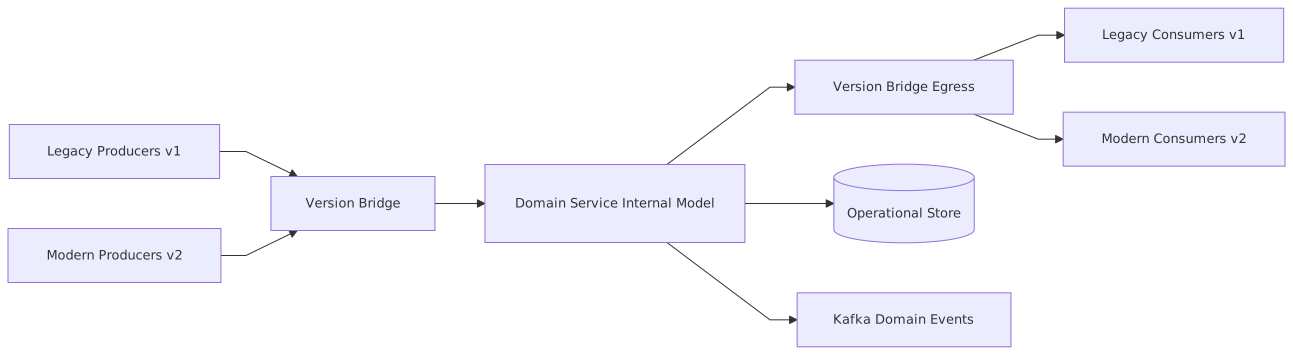
The internal model should represent the current domain semantics. Inbound bridges convert older versions into that model. Outbound bridges translate current state or events into supported external versions.
This leads to a practical rule: translate at the edge, decide in the middle.
If instead you keep multiple internal representations active throughout the service, you are not bridging; you are breeding. Every code path becomes conditional on version, and the service slowly turns into a museum.
Inbound bridge
The inbound bridge handles old API requests, old event versions, batch imports, or partner files. It should validate not only syntax but semantic compatibility.
Examples:
- v1
status = CANCELLEDmay need v2 decomposition intoorderDecision=Cancelled,cancelReason, andcancelledBy - v1 customer IDs may need lookup against a master identity map
- old shipment records may need expansion into multiple fulfillment instructions
Inbound transformation can be lossy or ambiguous. If so, do not hide it. Record translation quality, defaults used, and assumptions made.
Outbound bridge
The outbound bridge takes current domain state and emits old or new versions as needed. This is common during migration where downstream consumers are upgraded incrementally.
For Kafka, this often means publishing:
- parallel versioned topics, or
- one topic with schema version metadata and support libraries, or
- an event gateway that derives old-compatible events from current domain events
Which one is right depends on consumer maturity and governance. My bias: use explicit versioned contracts when semantics differ materially. If meaning changed, hiding the change behind “backward-compatible fields” is usually dishonest. EA governance checklist
Reconciliation path
Where dual representations exist, reconciliation becomes unavoidable.
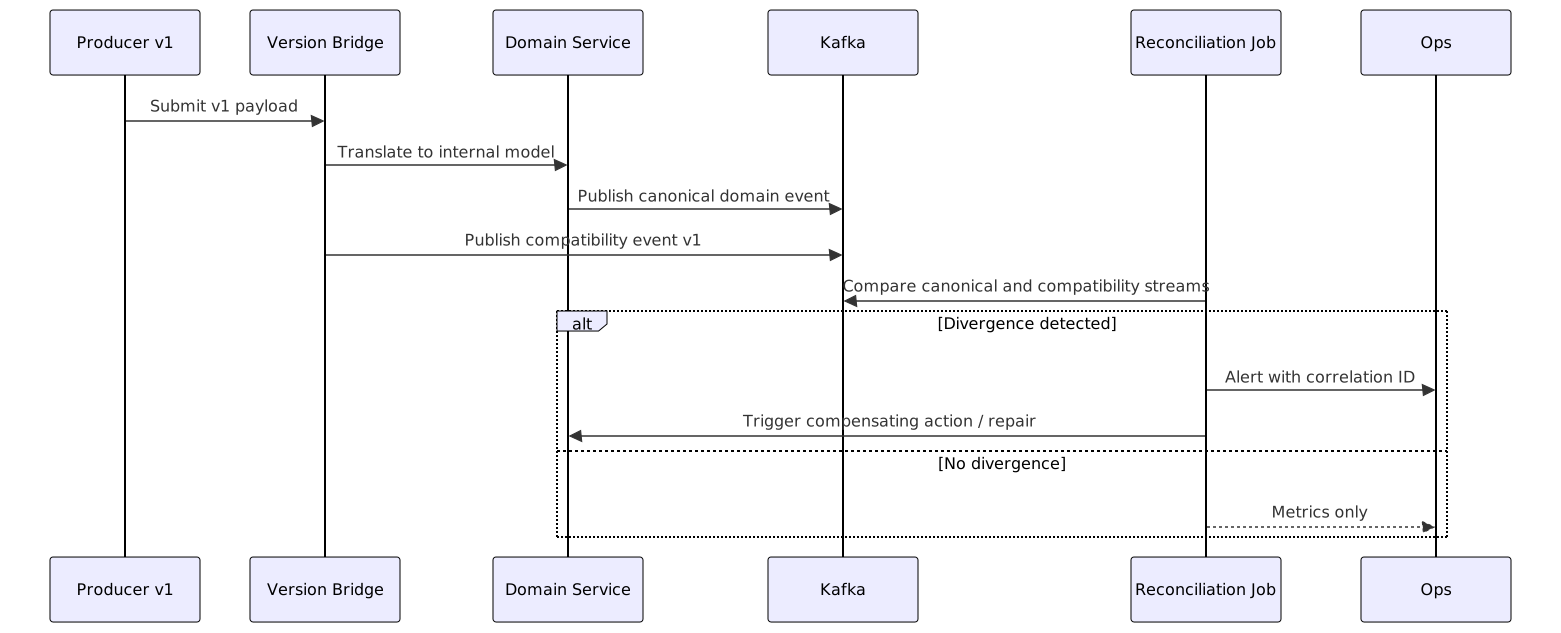
This is the part many architectures omit from pretty diagrams. They should not. Translation defects are not hypothetical. They are production facts waiting for load.
Migration Strategy
The bridge pattern shines when used with progressive strangler migration.
You do not replace the old model by proclamation. You narrow its relevance, move traffic deliberately, and build confidence through instrumentation.
A sensible migration strategy often follows these stages:
1. Define semantic boundaries
Before writing any mapping code, write down what changed in business terms.
Not:
- field A becomes field B
But:
- customer identity moves from local account ownership to global party resolution
- shipping is no longer order-level; it is fulfillment-group-level
- cancellation becomes a business event with accountability and financial implications
If you cannot explain the semantic delta, your bridge will be a collection of accidental transformations.
2. Establish the target model inside the owning bounded context
This is where domain-driven design matters. The target model should serve the current business language of the owning context, not a committee compromise.
Use aggregate boundaries, invariants, and domain events that reflect real business decisions. Resist the urge to make the internal model “look like both versions.”
3. Introduce ingress compatibility
Accept old inputs, convert them to the target model, and measure how often defaults, assumptions, or enrichments are needed.
This tells you whether migration is merely technical or whether hidden semantic dependencies remain in the estate.
4. Emit both old and new forms temporarily
For Kafka and event-driven estates, dual publication is often unavoidable during transition. But make it disciplined:
- one canonical event lineage
- derived compatibility events generated from canonical events
- clear ownership for derivation
- correlation IDs across both versions
- contract tests for parity where parity is expected
Do not let teams independently publish “their version” of old and new contracts. That creates semantic forks.
5. Reconcile continuously
Run comparison jobs or stream processors that validate key invariants across versions:
- same business key
- same monetary totals after transformation
- same lifecycle transition
- acceptable lag between derived events
- expected null/default population rates
This is where migration moves from hope to evidence.
6. Shift consumers incrementally
Use traffic segmentation, topic migration, API gateway routing, or consumer group-by-group cutover. In a strangler approach, every migrated consumer reduces the surface area of old contracts.
7. Retire aggressively
Bridges should have an exit plan. Track remaining dependencies. Publish deprecation dates. Escalate unsupported consumers. Remove dead mappings. Nothing ages worse than “temporary” compatibility code that survives five budgeting cycles.
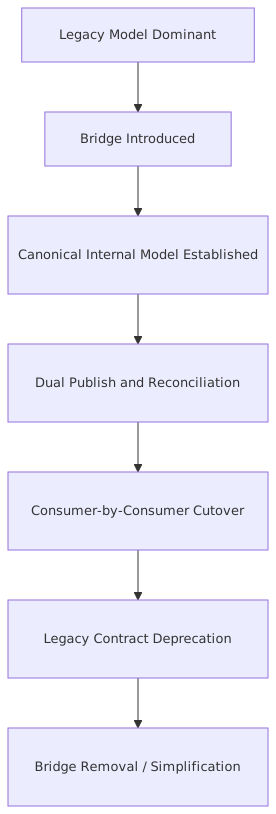
Progressive strangler migration is not only safer; it produces better learning. You discover where the old model encoded business assumptions people forgot to mention.
Enterprise Example
Consider a global insurer modernizing policy administration.
The legacy core policy system represented a policyholder as a single account owner tied to one policy record. Over the years, the business expanded into commercial products, brokers, joint ownership, insured parties distinct from payers, and regional compliance obligations. A new customer domain service was introduced around a party model: person, organization, role, relationship, and identity resolution across countries.
The old estate, however, was everywhere:
- policy admin batch feeds
- claims microservices
- CRM extracts
- broker APIs
- Kafka topics for downstream analytics
- finance reconciliation jobs
The tempting move was a universal customer schema program. It would have produced a thick slide deck and little else.
Instead, the insurer took a bounded-context approach. The new customer domain owned a current internal model centered on Party, Role, and Relationship. A version bridge translated:
- legacy account-holder records into party-role structures inbound
- canonical party events into old customer account events outbound
- identity mappings through a mastered correlation service
- unresolved ambiguity into explicit exception queues
The key semantic challenge was not field mapping. It was this: in the legacy world, “customer” implied payer and primary contact. In the new world, those were roles that could differ. That meant some old consumers could not be faithfully supported forever because they assumed a single authoritative customer entity.
So the architecture encoded degradation rules:
- for legacy consumers, publish the primary billing party as
customer - if no billing party existed, use a configured precedence rule
- flag ambiguity metrics
- route exceptional cases for operational review
Claims systems were migrated first because they benefited from clearer party roles. CRM followed. Finance stayed on the old compatibility contract longer because quarter-end controls made change windows tight.
Kafka was used for domain events, but not as a dumping ground for every shape. Canonical party events were published once. Compatibility events for old consumers were derived in a controlled bridge service with schema governance and lineage metadata. Reconciliation jobs compared party-role state with compatibility events and raised alerts when precedence rules generated unstable outcomes. ArchiMate for governance
The result was not purity. It was progress. Within eighteen months, most strategic consumers adopted the new contract, ambiguity incidents dropped because upstream data quality improved, and the bridge surface area was reduced by over half. The old policy core still existed, but it no longer dictated the enterprise customer language.
That is what a successful migration looks like in the wild: less heroism, more controlled borders.
Operational Considerations
The bridge is now a critical part of production architecture, so treat it accordingly.
Observability
You need more than CPU and latency metrics. Track translation health as a business concern:
- count of messages by version
- transformation failures by rule
- defaulted fields frequency
- lossy conversion rate
- unresolved identity mappings
- reconciliation mismatch counts
- lag between canonical and compatibility publications
A bridge that is “up” but quietly defaulting 12% of cancellations without reason codes is not healthy.
Contract testing
Use schema compatibility checks, but do not stop there. Add semantic contract tests:
- lifecycle transitions map correctly
- monetary values preserve precision and meaning
- required invariants still hold after translation
- unsupported scenarios fail explicitly, not silently
Idempotency and ordering
Kafka makes this especially sharp. If v1 and v2 events coexist, consumers may see duplicates, reordered compatibility emissions, or delayed derived events. Design with:
- stable business keys
- event IDs and causation IDs
- clear ordering scope
- idempotent consumers
- replay-safe translation logic
Data lineage
Every derived payload should be traceable back to source version, source event ID, translation ruleset, and bridge release. Without lineage, reconciliation turns into folklore.
Governance
Version bridges need policy:
- who may create a new version
- what qualifies as backward compatible
- when a semantic change requires a new contract
- how long old versions are supported
- who owns retirement
Without governance, a bridge becomes a junk drawer.
Tradeoffs
This pattern is useful because reality is messy. It is costly for exactly the same reason.
Benefits
- avoids big-bang migration risk
- preserves service continuity
- allows bounded contexts to evolve internally
- supports gradual consumer adoption
- makes semantic translation explicit
- improves migration observability
Costs
- added operational complexity
- latency and processing overhead
- reconciliation burden
- risk of semantic drift between canonical and compatibility views
- temptation to keep legacy alive indefinitely
- increased governance needs
The biggest tradeoff is strategic: a bridge buys time, but time can be squandered. If leadership uses compatibility to postpone difficult retirements forever, the bridge becomes an expensive monument to indecision.
My rule is simple: build a bridge to cross a gap, not to live on it.
Failure Modes
This pattern fails in recognizable ways.
1. The bridge is treated as “just mapping”
Then the tricky semantic cases are hidden in utility classes, undocumented defaults, and tribal knowledge. Production incidents follow.
2. No canonical internal model exists
If the service carries v1, v2, and partial v3 internally, complexity explodes. Every feature becomes version-aware. The migration stalls.
3. Translation is lossy but silent
A field disappears. A role collapses to a single customer. A multi-valued concept becomes scalar. If this is not explicit and measured, downstream decisions are corrupted quietly.
4. Reconciliation is skipped
Dual publication without reconciliation is faith-based architecture. Divergence accumulates until audit, billing, or customer service discovers it the hard way.
5. Ownership is unclear
One team owns the service, another owns Kafka contracts, a third owns downstream extracts, and nobody owns semantics. Bridges rot fastest in organizational fog.
6. Version support is open-ended
If there is no retirement pressure, old versions become permanent. Then every future change gets harder, not easier.
7. The wrong thing is bridged
Some semantic shifts are so large that translation is fiction. In those cases, pretending compatibility exists only delays necessary consumer redesign.
When Not To Use
Not every schema change deserves a version bridge.
Do not use this pattern when:
- the change is small and genuinely backward compatible
- the system landscape is simple enough for coordinated deployment
- there are very few consumers and they can migrate quickly
- the semantic gap is so large that a bridge would mislead consumers
- latency and complexity budgets are extremely tight
- the old model should be shut down, not preserved
Also do not use it as a substitute for bounded contexts. If two teams have fundamentally different models because they do different business work, forcing one to bridge endlessly into the other may be the wrong answer. Sometimes separate contracts and explicit anti-corruption layers are cleaner than a centralized version bridge.
And if your organization lacks the discipline to retire old contracts, be careful. A bridge without governance is how integration architecture turns into archaeology. integration architecture guide
Related Patterns
Several patterns sit close to this one, but they are not identical.
Anti-Corruption Layer
Very related. An anti-corruption layer protects one bounded context from another’s model. A version bridge is more specific: it manages evolution between versions of related models and contracts, often within the same domain lineage.
Strangler Fig Pattern
This is usually the migration strategy around the bridge. The bridge helps old and new coexist while traffic is shifted gradually.
Schema Versioning
Necessary but insufficient. Schema versioning manages structural evolution. Version bridges deal with semantics, compatibility behavior, and operational coexistence.
Canonical Data Model
Useful in limited scopes, dangerous as an enterprise religion. A bridge should anchor on a context-owned canonical internal model, not necessarily an enterprise-wide one.
Event Upcasting
In event-sourced systems, old events may be transformed to current in-memory representations. That is a close cousin to inbound bridging, though often narrower in scope.
Consumer-Driven Contracts
Helpful for governing compatibility expectations. Still, they do not solve the semantic translation problem by themselves.
Summary
Data model version bridges are what serious distributed systems use when the business must keep moving while meaning changes underneath the software.
They are not elegant in the abstract. They are practical in the way steel beams are practical. You do not admire them for purity; you admire them because the building stays up.
The essential principles are straightforward:
- evolve the domain model inside the owning bounded context
- translate at the edges
- make semantic change explicit
- use progressive strangler migration
- reconcile continuously
- observe translation quality as a first-class production concern
- retire compatibility aggressively
In Kafka and microservice estates, this pattern can be the difference between controlled modernization and a slow-motion contract disaster. But it only works if architects treat data as language, not plumbing. Fields are easy. Meaning is hard.
And that, in enterprise architecture, is usually the whole game.
Frequently Asked Questions
What is a service mesh?
A service mesh is an infrastructure layer managing service-to-service communication. It provides mutual TLS, load balancing, circuit breaking, retries, and observability without each service implementing these capabilities. Istio and Linkerd are common implementations.
How do you document microservices architecture for governance?
Use ArchiMate Application Cooperation diagrams for the service landscape, UML Component diagrams for internal structure, UML Sequence diagrams for key flows, and UML Deployment diagrams for Kubernetes topology. All views can coexist in Sparx EA with full traceability.
What is the difference between choreography and orchestration in microservices?
Choreography has services react to events independently — no central coordinator. Orchestration uses a central workflow engine that calls services in sequence. Choreography scales better but is harder to debug; orchestration is easier to reason about but creates a central coupling point.