⏱ 5 min read
Why EA governance matters more in event-driven architectures
EDA increases decoupling, which increases autonomy—while also increasing the risk of fragmentation (hundreds of topics, inconsistent contracts, unclear ownership). Governance becomes the mechanism that preserves coherence without destroying speed. ArchiMate for architecture governance
Recommended Reading
Kafka’s model enables multiple independent consumer groups to consume the same stream, which is powerful but also amplifies governance needs (who can consume what, under what contract). turn16view0turn17view0turn19view1
Define architecture principles and enforceable standards
EA governance should define standards such as:
- Topic naming and ownership rules
- Partition key strategy guidance (ordering and scale implications) turn16view0
- Schema governance and compatibility requirements turn19view0
- Default-deny access control expectations turn17view0
These standards become more effective when they are implemented as platform guardrails, not only as documentation.
Architecture compliance reviews for event platforms
TOGAF material on compliance reviews defines architecture compliance review as scrutiny of a project’s compliance against established architectural criteria, spirit, and business objectives, positioned as core to an architecture compliance strategy. TOGAF roadmap template
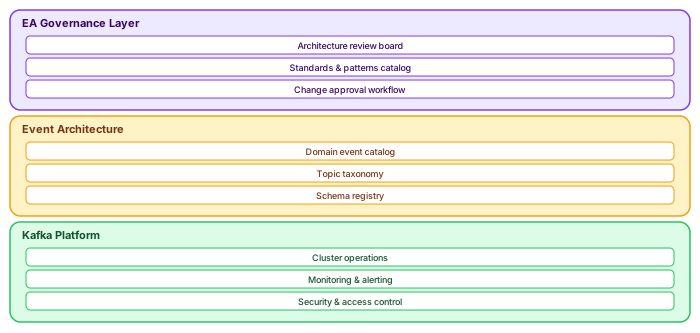
In EDA, compliance reviews should focus on:
- Contract compliance (schema compatibility, versioning)
- Security posture (authentication, authorization model)
- Operational readiness (replication, failure tolerance, ownership model)
Use “data contracts” as the bridge between governance and autonomy
Schema registry data contracts documentation describes contracts as formal agreements on structure and semantics, including constraints, metadata (e.g., sensitive fields), and rules/policies (e.g., encryption, DLQ routing). turn19view1
This is the governance object that enables domain autonomy without chaos: teams can publish events freely, but must honor contracts that downstream consumers can trust.
Make security and access control part of architecture governance
Kafka authorization documentation shows that ACLs are structured and that access is restricted by default when ACLs are missing (super users only), unless you change behavior. turn17view0
Enterprise governance should treat access control as architecture, not as an ops afterthought, because it directly determines which domains can see which streams and how lateral movement risks are controlled.
Frequently asked questions
What is the single best governance investment for EDA?
Data contracts with enforceable schema evolution rules, paired with secure-by-default authorization. turn19view1turn17view0
Architecture governance for event-driven systems
Event-driven architectures introduce governance challenges that traditional request-reply systems do not face. Events are asynchronous, loosely coupled, and often cross domain boundaries — meaning a single event schema change can affect consumers across multiple teams without immediate visibility. Architecture governance must adapt: schema registries enforce compatibility, topic naming conventions enable discoverability, and consumer dependency tracking reveals hidden coupling. integration architecture diagram
Model event-driven architectures in Sparx EA using ArchiMate Application Events, Application Components (producers and consumers), and Flow relationships. Tag each topic with ownership, schema version, and consumer count. Build an Event Flow viewpoint that shows producers on the left, topics in the center, and consumers on the right — this view becomes the governance instrument for the architecture review board. ArchiMate layers explained
Operational considerations
Kafka deployments require attention to operational fundamentals that are often underestimated during initial architecture decisions. Partition strategy determines consumer parallelism — too few partitions limits throughput, too many creates metadata overhead and increases leader election time during broker failures. A practical starting point: 3 partitions for low-volume topics, 6-12 for medium traffic, and 30+ only for topics exceeding 10,000 messages per second.
Retention configuration directly affects storage costs and replay capability. Set retention per topic based on the business requirement: 7 days for operational events (sufficient for most consumer catch-up scenarios), 30 days for analytics events (covers monthly reporting cycles), and multi-year for regulated data (financial transactions, audit trails). Use tiered storage to move older data to object storage (S3, Azure Blob) automatically, reducing broker disk costs without losing replay capability. enterprise cloud architecture patterns
Monitoring must cover three levels: cluster health (broker availability, partition balance, replication lag), application health (consumer group lag, producer error rates, throughput per topic), and business health (end-to-end event latency, data freshness at consumers, failed processing rates). Deploy Prometheus with JMX exporters for cluster metrics, integrate consumer lag monitoring into the platform team's alerting, and build business-level dashboards that domain teams can check independently.
If you’d like hands-on training tailored to your team — Sparx Enterprise Architect, BPMN, SysML, Apache Kafka or the Archi tool — or modelling coaching in ArchiMate and TOGAF-aligned governance, you can reach us via our contact page.
Frequently Asked Questions
What is architecture governance in enterprise architecture?
Architecture governance is the set of practices, processes, and standards that ensure architecture decisions are consistent, traceable, and aligned to organisational strategy. It typically includes an Architecture Review Board (ARB), architecture principles, modeling standards, and compliance checking.
How does ArchiMate support architecture governance?
ArchiMate supports governance by providing a standard language that makes architecture proposals comparable and reviewable. Governance decisions, architecture principles, and compliance requirements can be modeled as Motivation layer elements and traced to the architectural elements they constrain.
What are architecture principles and how are they modeled?
Architecture principles are fundamental rules that guide architecture decisions. In ArchiMate, they are modeled in the Motivation layer as Principle elements, often linked to Goals and Drivers that justify them, and connected via Influence relationships to the constraints they impose on design decisions.