⏱ 7 min read
Recommended Reading
Executive summary
Data ownership in Kafka is ownership of event meaning, evolution, and accountability. With Kafka topics acting as durable logs, unclear ownership creates compliance and operational risk. Kafka’s core conceptual framing reinforces that event data is stored and distributed across brokers, making ownership a governance prerequisite. architecture decision records
- Domain event ownership model
- Platform guardrails: defaults, policies, enforcement
- Governance: schema evolution, compatibility, deprecation

- Schema evolution and compatibility.
- Schema compatibility pattern.
The ownership lifecycle

Data ownership in Kafka-based architectures follows a clear principle: the team that produces events owns the data. This sounds obvious, but the implications are profound — it means the producing team is responsible for schema quality, backward compatibility, data accuracy, and documentation.
Domain team responsibilities (producer/owner): Define the event schema using Avro, Protobuf, or JSON Schema. Register schemas in the Schema Registry with backward compatibility enforced. Ensure data quality — events must be valid, complete, and timely. Document the event contract: what each field means, when events are produced, and what guarantees apply (at-least-once, exactly-once).
Platform team responsibilities: Manage the Kafka cluster and Schema Registry. Monitor topic health: throughput, consumer lag, error rates. Enforce platform policies: topic naming conventions, retention periods, partition limits. Provide self-service tooling for topic creation, schema registration, and consumer group management.
Consumer team responsibilities: Subscribe to topics and build their own read models (projections). Handle schema evolution gracefully — when the producer adds a new field, consumers must not break. Own their consumer group's offset management, error handling, and retry logic. Never request changes to the producer's schema for consumer convenience — build an anti-corruption layer instead.
Ownership governance
Track ownership in the architecture repository. Every topic has a tagged value Owner_Team and Owner_Contact. Schema changes require owner approval through the architecture review board. Orphan topics (no registered owner) are flagged for decommissioning. Quarterly ownership reviews ensure that team changes (reorgs, attrition) do not leave topics unowned.
Responsibility matrix: who owns what
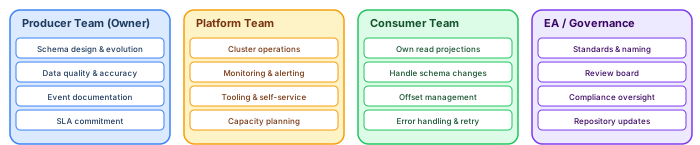
Data ownership in Kafka-based architectures distributes responsibility across four roles. Clarity on who owns what prevents the most common failure modes: schemas that break consumers, topics that nobody maintains, and data quality issues that nobody investigates.
Producer team (data owner): The team that produces events to a topic owns the data. This means they are responsible for schema design and evolution (defining the Avro/Protobuf schema, registering it, and evolving it with backward compatibility). They are responsible for data quality — events must be valid, complete, and timely. They own the event documentation: what each field means, when events are produced, what guarantees apply (at-least-once delivery, ordering within partition key). They commit to an SLA: maximum event latency, availability target, and data freshness guarantee.
Platform team (infrastructure owner): The team that operates the Kafka cluster owns the infrastructure. They manage broker health, monitor partition balance, handle upgrades, and plan capacity. They operate the Schema Registry, enforce platform-wide policies (retention defaults, replication factors), and provide self-service tooling for topic creation, monitoring, and consumer group management. They do NOT own the data itself — they own the pipes, not the water.
Consumer team (projection owner): Each consuming team owns its own read model. When they subscribe to a topic, they accept the producer's schema as-is. They build their own projections (materialized views, search indexes, aggregated state) from the event stream. They manage their consumer group's offset, error handling, retry logic, and dead letter queue. Critically, consumers must handle schema evolution gracefully — when the producer adds a new field, consumers must not break.
EA / governance team (standards owner): The enterprise architecture team owns the standards and governance process. They define naming conventions, review new topic designs, maintain the architecture repository, and conduct compliance audits. They chair the architecture review board for schema changes that affect multiple consumers.
When ownership disputes arise
The most common ownership dispute occurs when a consumer team wants the producer to change their schema to make consumption easier. The ownership principle is clear: the producer defines the contract, and consumers adapt. If a consumer needs data in a different shape, they build a transformation layer — they do not ask the producer to reshape the data for one consumer's convenience. This prevents producer schemas from becoming bloated with consumer-specific fields. ArchiMate for digital transformation
The exception: when multiple consumers need the same transformation, a shared stream processor (owned by the platform team) can create a derived topic with the transformed data. This is explicitly modeled in the architecture repository as a new topic with its own ownership, schema, and governance. ArchiMate modeling standards
// Kafka Streams: Shared transformation for multiple consumers
// Owned by the platform team, documented in EA repository
StreamsBuilder builder = new StreamsBuilder();
builder.stream("payments.transaction.authorized", Consumed.with(keySerde, valueSerde))
    .mapValues(event -> enrichWithCurrency(event))
    .mapValues(event -> anonymizePII(event))
    .to("analytics.payments.enriched", Produced.with(keySerde, enrichedSerde));
// Output topic: analytics.payments.enriched
// Owner: Platform Team
// Consumers: BI, ML pipeline, Regulatory reporting
Modeling data ownership in the architecture repository
Data ownership decisions must be modeled in the EA repository to be enforceable and auditable. For each Kafka topic, create an Application Collaboration element (or use a custom stereotype) with tagged values: Owner_Team, Owner_Contact, Schema_Subject (the Schema Registry subject name), Data_Classification (Public / Internal / Confidential / Restricted), Retention_Period, and Consumer_Count.
Build two governance views. The Ownership Map view shows all topics grouped by owning team, colored by data classification. At a glance, architecture leadership can see which teams own the most topics, where sensitive data flows, and whether any topics are unowned. The Consumer Dependency view shows, for each topic, all consuming services and their teams. This reveals hidden coupling — if a single topic has 15 consumers across 8 teams, a schema change requires coordinating with all 8 teams.
Run ownership audits quarterly. The audit checks: every active topic has an owner (no orphans), every owner is a current team (not a disbanded or reorganized team), data classification is current (not inherited from an outdated assessment), and consumer registrations match actual consumer groups (detected consumers match documented consumers). Discrepancies trigger remediation actions tracked in the governance workflow. Sparx EA governance best practices
If you’d like hands-on training tailored to your team — Sparx Enterprise Architect, BPMN, SysML, Apache Kafka or the Archi tool — or modelling coaching in ArchiMate and TOGAF-aligned governance, you can reach us via our contact page.
Frequently Asked Questions
What is enterprise architecture?
Enterprise architecture is a discipline that aligns an organisation's strategy, business operations, information systems, and technology infrastructure. It provides a structured framework for understanding how an enterprise works today, where it needs to go, and how to manage the transition.
How is ArchiMate used in enterprise architecture practice?
ArchiMate is used as the standard modeling language in enterprise architecture practice. It enables architects to create consistent, layered models covering business capabilities, application services, data flows, and technology infrastructure — all traceable from strategic goals to implementation.
What tools are used for enterprise architecture modeling?
Common enterprise architecture modeling tools include Sparx Enterprise Architect (Sparx EA), Archi, BiZZdesign Enterprise Studio, LeanIX, and Orbus iServer. Sparx EA is widely used for its ArchiMate, UML, BPMN and SysML support combined with powerful automation and scripting capabilities.