⏱ 5 min read
Recommended Reading
Executive summary
Event-driven systems require EA repositories to represent contracts and flows, not only applications and infrastructure. Kafka’s documentation grounds the event log platform model; schema registry guidance provides contract evolution semantics; and lineage standards (OpenLineage/PROV) provide the metadata structure to prove movement and transformation.
- Repository data model: domains, events, topics, consumers
- Governance: ownership, compatibility, retention
- Evidence: lineage and audit trails
- Tooling: EA integrations and publication

- Schema evolution and compatibility.
Three pillars of an EDA repository
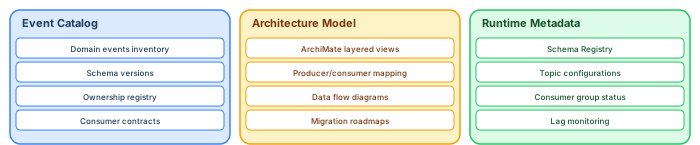
An enterprise architecture repository for event-driven systems must serve three distinct but connected purposes: cataloging events (what events exist and who owns them), modeling architecture (how events flow through the system), and tracking runtime metadata (what is actually running in production). Sparx EA performance optimization
Event catalog: The authoritative inventory of all domain events, integration events, and operational events. Each entry includes: event name, owning team, schema version, producing service, consuming services, business description, and SLA (freshness, completeness, availability). This is the "phone book" of the event-driven enterprise — when a team wants to consume payment events, they find the catalog entry, understand the contract, and register as a consumer.
Architecture model: ArchiMate views showing how events flow across layers. Producer/consumer mapping views show which Application Components produce to and consume from which topics. Data flow views show how events move from source through transformation to destination. Migration roadmaps show how the event architecture evolves over time. These views live in Sparx EA and provide the governance-grade traceability that the event catalog alone cannot.
Runtime metadata: Live data from the Kafka platform: Schema Registry contents (current schemas and compatibility history), topic configurations (partitions, replication, retention), consumer group status (active consumers, committed offsets, lag). This runtime layer validates that the architecture model matches reality — if the model says Service A consumes from Topic X but the consumer group metadata shows no active consumers, there is a drift that needs investigation.
Connecting the three pillars
The event catalog references ArchiMate elements in the architecture model (each catalog entry links to an Application Component). The architecture model references runtime metadata (each topic element links to its Schema Registry entry). Automated reconciliation scripts compare model-to-runtime weekly and flag discrepancies. This three-pillar approach ensures the repository is accurate, governed, and useful — not just another documentation exercise. ArchiMate modeling best practices
Architecture governance for event-driven systems
Event-driven architectures introduce governance challenges that traditional request-reply systems do not face. Events are asynchronous, loosely coupled, and often cross domain boundaries — meaning a single event schema change can affect consumers across multiple teams without immediate visibility. Architecture governance must adapt: schema registries enforce compatibility, topic naming conventions enable discoverability, and consumer dependency tracking reveals hidden coupling.
Model event-driven architectures in Sparx EA using ArchiMate Application Events, Application Components (producers and consumers), and Flow relationships. Tag each topic with ownership, schema version, and consumer count. Build an Event Flow viewpoint that shows producers on the left, topics in the center, and consumers on the right — this view becomes the governance instrument for the architecture review board. ArchiMate relationship types
Repository maintenance as a continuous practice
Architecture repositories degrade without active maintenance. Elements become stale as systems change, relationships break as integrations are modified, and views become misleading as the architecture evolves. Three maintenance practices prevent degradation: quarterly ownership review, automated drift detection, and annual model housekeeping. integration architecture diagram
Quarterly ownership review verifies that every element has a current owner (not someone who left the organization six months ago), every element's status reflects reality (not "Active" when the system was decommissioned), and every element's tagged values are current (not carrying a 2023 risk assessment for a system that was rebuilt in 2025). Run a script that flags elements whose Last_Reviewed date is older than 6 months.
Automated drift detection compares the model against runtime reality. Query the CMDB, cloud provider APIs, or monitoring systems to discover which applications and infrastructure actually exist, then compare against the model. Discrepancies are either model gaps (real systems not yet modeled) or zombie entries (modeled systems that no longer exist). Both degrade model trustworthiness if left uncorrected. enterprise cloud architecture patterns
If you’d like hands-on training tailored to your team — Sparx Enterprise Architect, BPMN, SysML, Apache Kafka or the Archi tool — or modelling coaching in ArchiMate and TOGAF-aligned governance, you can reach us via our contact page.
Frequently Asked Questions
What is enterprise architecture?
Enterprise architecture is a discipline that aligns an organisation's strategy, business operations, information systems, and technology infrastructure. It provides a structured framework for understanding how an enterprise works today, where it needs to go, and how to manage the transition.
How is ArchiMate used in enterprise architecture practice?
ArchiMate is used as the standard modeling language in enterprise architecture practice. It enables architects to create consistent, layered models covering business capabilities, application services, data flows, and technology infrastructure — all traceable from strategic goals to implementation.
What tools are used for enterprise architecture modeling?
Common enterprise architecture modeling tools include Sparx Enterprise Architect (Sparx EA), Archi, BiZZdesign Enterprise Studio, LeanIX, and Orbus iServer. Sparx EA is widely used for its ArchiMate, UML, BPMN and SysML support combined with powerful automation and scripting capabilities.