⏱ 19 min read
Event Stream Forking in Event-Driven Systems | fork diagram
There comes a moment in the life of a large system when the event stream stops being a clean river and starts looking like a disputed border.
One team wants to modernize billing. Another wants real-time fraud detection. A third is trying to carve out customer communications from a crumbling monolith that still thinks “account updated” is a reasonable business fact. Everyone agrees the event stream is the source of truth—right until they need it to mean different things to different parts of the estate.
That is where event stream forking enters the picture.
Used well, forking is not a hack. It is a controlled architectural move: a way to let one stream of domain facts give rise to more than one downstream interpretation, lifecycle, or bounded context. Used badly, it becomes data copy-paste with Kafka in the middle, and then the estate fills with ghosts—duplicate facts, diverging semantics, and reconciliation jobs nobody loves. event-driven architecture patterns
The important thing is this: event stream forking is not merely about cloning messages. It is about deciding where one domain history can legitimately branch into multiple operational histories. That distinction matters. In enterprises, semantics break before infrastructure does.
This article digs into event stream forking as an architectural pattern in event-driven systems, especially where Kafka, microservices, domain-driven design, and progressive migration intersect. We will look at why teams fork streams, how the pattern works, where it goes wrong, and when you should walk away from it entirely. microservices architecture diagrams
Context
Most event-driven systems begin with noble intentions. A service publishes domain events. Other services subscribe. Teams celebrate loose coupling. The architecture slide looks elegant.
Then the business happens.
The original event stream, often shaped around one operational system, starts serving multiple needs:
- transactional workflows
- analytics
- regulatory reporting
- machine learning features
- search indexing
- downstream bounded contexts with different models
- migration from monolith to microservices
At first, consumers simply subscribe to the same topic or queue and interpret events in their own way. This works while the semantics remain stable and the consumers are forgiving.
But as systems grow, one stream must serve different realities:
- one consumer needs immutable business facts
- another needs enriched operational events
- another needs privacy-filtered copies
- another needs reordered or rekeyed events
- another needs a new event contract because the old one is carrying the scars of a legacy data model
At that point, “just subscribe to the same stream” stops being architecture and starts being denial.
Event stream forking is a response to this pressure. A fork creates a new stream derived from an existing one, but shaped for a different purpose, boundary, or migration path.
This is especially common in Kafka-centric enterprises, where streams become long-lived integration assets rather than transient messages. Kafka makes forking technically easy. That is both its power and its danger.
Problem
The problem is simple to describe and surprisingly difficult to solve:
How do you let multiple parts of the organization evolve from a shared stream of events without forcing them to share the same event model, operational constraints, and release cadence forever?
A single upstream stream often becomes overloaded with conflicting expectations:
- backward compatibility for old consumers
- cleaner domain language for new services
- high retention for replay-based systems
- low latency for operational workflows
- strict ordering by one key
- different partitioning for another key
- inclusion of PII for one use case
- exclusion of PII for another
These requirements do not align naturally. They pull the stream in different directions.
In domain-driven design terms, the root issue is usually that one published event model is being asked to serve multiple bounded contexts. That is almost always temporary at best and corrosive at worst. A bounded context defines meaning. Once different contexts need different meanings, one stream cannot honestly represent all of them without becoming vague, leaky, or bloated.
A common enterprise symptom looks like this:
- The monolith emits
CustomerChanged. - Billing interprets it as a credit profile update.
- CRM interprets it as contact preference update.
- Marketing interprets it as segmentation input.
- Compliance interprets it as legal entity change.
Same event. Four meanings. No peace.
Forking becomes attractive because it allows each downstream path to stabilize around its own semantics without rewriting the whole estate in one reckless move.
Forces
A good architecture article is really a catalog of tensions. Event stream forking exists because several forces collide.
1. Shared facts, divergent meanings
Events should represent domain facts. But facts are never consumed in a semantic vacuum. What “OrderPlaced” means to fulfillment may not be what it means to revenue recognition.
If you fork carelessly, you duplicate facts and create alternate truths. If you refuse to fork, you trap multiple domains in one language.
2. Need for independent evolution
A large organization wants teams to evolve independently. Different consumers need different schemas, enrichment, retention policies, and partition strategies.
A single canonical event stream sounds disciplined. In practice, it often becomes a governance bottleneck with the social dynamics of airport security. EA governance checklist
3. Migration without a flag day
Most enterprises are not building greenfield systems. They are escaping something older, slower, and politically protected.
Forking can support a strangler migration by allowing new services to consume a derived stream while the legacy system continues to operate on the original one. This gives you evolutionary movement instead of one large outage disguised as a transformation program.
4. Replay and reconciliation
Forked streams are often used to rebuild state, backfill new services, or repair downstream views. That means replay matters. Once replay enters the story, determinism, idempotency, ordering, and retention become first-class concerns.
5. Compliance and data boundaries
Enterprises frequently need a sanitized stream for external consumers, a region-specific stream for data residency, or an auditable stream for regulators.
These are not implementation details. They are architectural constraints with legal consequences.
6. Operational simplicity versus semantic purity
A fork can isolate consumers and simplify delivery. It can also multiply pipelines, ownership confusion, and operational drift.
The fork diagram on the whiteboard is always cleaner than the on-call rotation six months later.
Solution
Event stream forking is the deliberate creation of one or more downstream streams from an upstream event stream, where each fork serves a distinct bounded context, operational purpose, or migration pathway.
The key word is deliberate.
A forked stream is not just a copy. It is usually one of these:
- a semantic fork: same underlying business history, but remapped into a different domain language
- an operational fork: same business meaning, but with different partitioning, retention, latency, or delivery guarantees
- a policy fork: filtered or transformed for privacy, geography, tenancy, or security constraints
- a migration fork: transitional stream used to incrementally move from legacy consumers to modern services
A sound fork preserves lineage. Consumers should be able to trace forked events back to the source event or source aggregate history. If they cannot, you have not forked a stream; you have manufactured a rumor.
At a high level, the pattern looks like this:
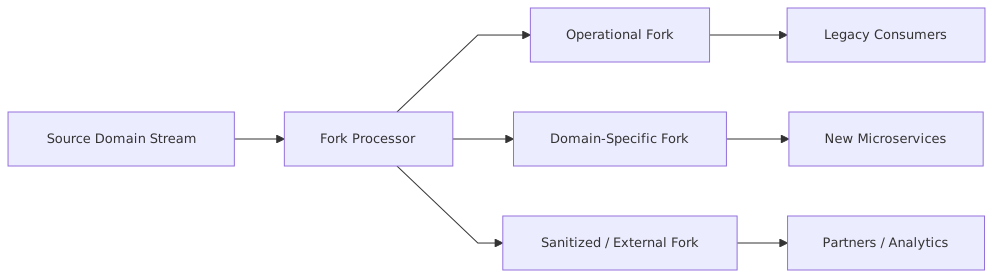
The fork processor may be implemented with Kafka Streams, Flink, stream processors in microservices, or integration components. The technology is secondary. The architecture question is: what semantic contract does each fork own?
A practical rule helps here:
Fork for bounded context, policy boundary, or migration stage. Do not fork merely because one team dislikes another team’s schema.
That line sounds sharp because it needs to be.
Architecture
Event stream forking sits at the intersection of event sourcing, streaming integration, and domain model translation. It deserves more care than many teams give it.
Source stream
The source stream should contain stable domain facts to the greatest extent possible. Not “screen changed” events. Not CRUD exhaust. Facts.
Examples:
PaymentAuthorizedShipmentDispatchedPolicyRenewedAccountClosed
The more source events resemble user interface mutations or database deltas, the less value you get from forking. You simply spread weak semantics across more places.
Fork processor
The fork processor consumes source events and emits one or more derived streams.
Its responsibilities commonly include:
- filtering
- mapping into new event types
- enrichment from reference data
- repartitioning
- redaction or tokenization
- version adaptation
- lineage metadata propagation
A disciplined processor also stamps derived events with metadata such as:
- source event id
- source topic and partition
- source offset or sequence
- transformation version
- correlation id
- event time and processing time
Without lineage metadata, reconciliation becomes archaeology.
Forked streams by bounded context
Here is where domain-driven design matters.
Suppose the source domain is Sales and it emits OrderPlaced. Downstream contexts should not automatically consume that same event unchanged. Fulfillment may need FulfillmentRequested. Finance may need RevenueCommitmentOpened. Customer Engagement may need OrderConfirmationNeeded.
These are not cosmetic renames. They reflect distinct models and responsibilities.
A fork is often the right place to publish an anti-corruption layer in streaming form.
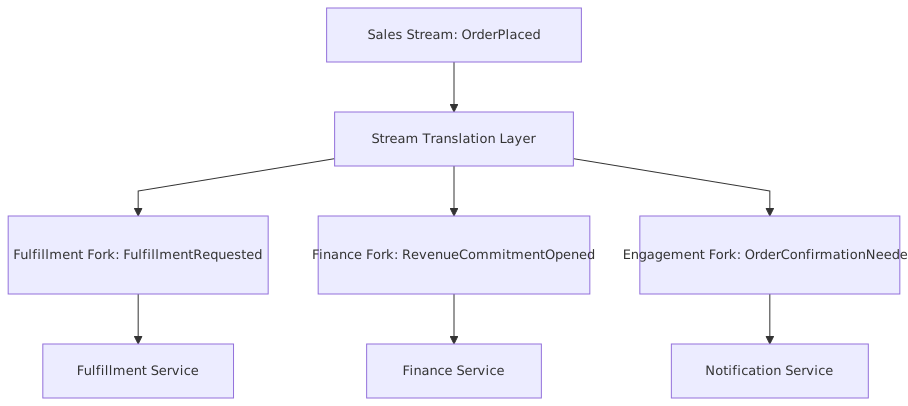
This is healthier than forcing every downstream team to individually reinterpret OrderPlaced according to local needs. Shared source fact. Distinct downstream language. That is proper context mapping.
Partitioning and ordering
Forks often require different partition keys. This is one of the strongest technical reasons to fork.
The source stream may be keyed by customerId. A downstream fraud service may require paymentInstrumentId. A fulfillment pipeline may need warehouseId. Repartitioning a shared source stream in every consumer is wasteful and fragile; a managed fork can centralize the concern.
But be careful. When you change keys, you often change the ordering guarantees that consumers have come to rely on. Some workflows will silently break. A fork that “works fine in test” can still destroy business behavior by shifting the order in which compensating actions appear.
Schema and compatibility
Forked streams should have independent schema lifecycles. That is one of their benefits. It is also a governance burden. ArchiMate for governance
Do not pretend a forked stream is just another version of the source stream. It is a separate contract. Version it independently. Document it independently. Own it independently.
Storage and replay model
In Kafka, retention makes forks powerful. A new service can replay a forked stream to bootstrap state or recover projections. This is a gift.
It also means mistakes replay beautifully.
If a forking transformation is not deterministic over historical input, reprocessing can produce a different history. Enterprises discover this the hard way during migrations, audits, and disaster recovery tests.
Migration Strategy
This is where event stream forking earns its keep.
In a progressive strangler migration, the aim is not to replace the legacy system in one move. The aim is to shift responsibility gradually while preserving operational continuity. Forking gives you a bridge.
The migration usually unfolds in stages:
1. Observe the legacy stream
Start by capturing or exposing events from the legacy estate. Sometimes these are true domain events. More often, they are integration events with questionable naming and unhelpful payloads. Fine. Start there.
2. Build a migration fork
Create a derived stream that expresses the target domain model more cleanly. This stream becomes the onboarding point for new microservices.
This is not just data transformation. It is domain translation. It is where you pay down semantic debt without stopping the business.
3. Run new and old paths in parallel
New services consume the forked stream while the monolith continues operating on the old stream or database triggers. This is the uncomfortable middle, and it is unavoidable.
Parallel run introduces the need for reconciliation:
- compare state derived by new services against legacy state
- detect missing or duplicate events
- validate timing differences
- investigate semantic mismatches
4. Shift ownership by capability
As confidence grows, move individual capabilities to the new service boundary. The fork may remain transitional for some time, or it may become the permanent published interface for that bounded context.
5. Retire the temporary fork or promote it
Not every migration fork should live forever. Some deserve promotion into a strategic domain stream. Others should die once the target service publishes its own native events.
This distinction matters. Temporary migration assets have a nasty habit of becoming permanent architecture because the project ended and nobody came back.

Reconciliation during migration
Reconciliation is where serious architecture separates itself from slideware.
When both old and new paths process related business facts, you must compare outcomes. Not every mismatch is a bug; some reflect better target semantics. But unexplained mismatches are dangerous.
Reconciliation usually includes:
- event count comparison by business key and period
- state snapshot comparison
- lag analysis
- duplicate detection
- poison-event tracking
- business KPI comparison, not just technical metrics
A migration without reconciliation is faith-based architecture.
Enterprise Example
Consider a large insurer modernizing policy servicing.
The legacy policy administration platform emits coarse events into Kafka using a connector over database change capture. One of the topics is effectively PolicyUpdated, carrying a broad payload with fields for premium, insured parties, address, renewal date, broker details, and status flags. It is the software equivalent of a junk drawer.
Three initiatives need this data:
- a new customer self-service platform
- a pricing modernization program
- a compliance reporting service for regional regulators
If all three consume the raw stream directly, trouble arrives quickly.
The self-service platform needs customer-facing policy lifecycle events:
PolicyRenewalOfferedCoverageChangedPaymentMethodChanged
The pricing engine needs underwriting and premium adjustment facts:
RiskProfileAdjustedPremiumRecalculated
Compliance needs region-specific legal reporting events with sensitive fields redacted or transformed.
So the insurer builds a stream forking layer.
The source CDC-driven topic remains, but a policy domain translation service maps legacy updates into several forked streams:
- a customer-policy-events topic
- a pricing-policy-events topic
- a compliance-policy-events topic
Each fork has its own schema registry subject, data retention rules, and ownership model. The migration fork for customer self-service is used first, because that initiative is furthest along.
The team runs the new customer platform in shadow mode for three months. It consumes the forked stream, derives customer-visible policy timelines, and compares them nightly against outputs from the monolith. Several discrepancies appear:
- address changes are emitted before policy endorsements in some regions
- some endorsements collapse multiple legacy updates into one business event
- duplicate CDC records produce repeated downstream notifications
These are not infrastructure defects. They are semantic and ordering defects. The fork processor is adjusted to:
- group legacy mutations into a business transaction window
- emit idempotency keys
- attach lineage back to source record ids
- suppress non-business-noise changes
Eventually, the self-service platform becomes system of engagement for policy changes. Later, the pricing engine stops consuming the fork and starts subscribing to native events from a new underwriting service. The compliance fork remains in place because its policy and redaction rules justify a dedicated stream.
That is a healthy outcome. One fork promoted, one retired, one retained. No purity theatre. Just architecture with intent.
Operational Considerations
Forking is easy to diagram and expensive to run. Operations matter.
Observability
Every fork should expose:
- source-to-fork lag
- transformation failure rates
- dead-letter counts
- duplicate rates
- schema validation failures
- replay duration
- reconciliation status
If you cannot answer “which source events produced this derived event?” in minutes, your observability is insufficient.
Idempotency
Fork processors and downstream consumers must tolerate reprocessing. In Kafka-based systems, retries, rebalances, and replay are normal. If duplicate derived events trigger duplicate business actions, the architecture is not production-grade.
Poison events
Some events will fail transformation because of malformed payloads, unknown enum values, missing reference data, or version drift. Decide early:
- halt the pipeline
- skip and quarantine
- emit partial event
- route to dead-letter stream
There is no universally correct answer. There is only an explicit tradeoff between correctness and continuity.
Backfills and replays
New forks often require historical backfill. This stresses schema evolution, throughput, and determinism.
A common failure is replaying years of source events through current transformation logic and discovering that old business rules no longer map cleanly. Historical replay is not just a technical exercise; it is time travel through changing domain policy.
Data governance
Forked streams multiply data assets. Classify them. Catalog them. Record lineage. Enforce retention and privacy policies.
The enterprise risk here is not complexity alone. It is unmanaged replication of sensitive business data under the respectable banner of event-driven architecture.
Tradeoffs
Event stream forking solves real problems. It also creates new ones.
Benefits
- enables independent evolution of bounded contexts
- supports strangler migration without big-bang cutover
- isolates consumers from poor legacy schemas
- supports different operational characteristics per stream
- creates cleaner downstream contracts
- centralizes domain translation and anti-corruption
Costs
- more streams to govern
- more schemas to version
- more pipelines to monitor
- more lineage to track
- risk of semantic drift between source and fork
- potential duplication of storage and processing
The biggest tradeoff is this:
Forking buys autonomy by introducing another place where truth can bend.
That is acceptable when the bend is explicit, bounded, and governed. It is dangerous when teams quietly build alternate business histories.
Failure Modes
Most failures in event stream forking are not caused by Kafka. They are caused by weak boundaries and wishful thinking.
1. Copying instead of translating
Teams create a “new” stream that is just the old payload with a different topic name. No semantic change. No ownership change. No value. Just more estate.
2. Semantic drift
The source event means one thing, the forked event gradually means another, and lineage no longer explains the difference. Reconciliation becomes impossible because the two streams are no longer about the same business fact.
3. Hidden coupling
A forked stream claims independence but still depends on quirks of the upstream schema, field population order, or legacy null handling. This is one of the classic migration traps.
4. Non-deterministic transformation
Enrichment based on mutable reference data can make reprocessing produce different results from the original run. If replay changes history, your audit posture gets exciting in all the wrong ways.
5. Ordering assumptions collapse
Rekeying or parallel processing changes the visible order of events. Downstream services were depending on accidental order. Nobody noticed until customers did.
6. Reconciliation theatre
A dashboard says “99.8% aligned” but no one knows whether the remaining 0.2% represents rounding noise or unpaid claims. Reconciliation that stops at technical counts is false comfort.
7. Migration fork becomes permanent sludge
A temporary fork outlives the migration, accumulates new consumers, and turns into an undocumented strategic dependency. This happens all the time.
When Not To Use
You do not need event stream forking every time a second consumer appears. Restraint is part of good architecture.
Do not use this pattern when:
The source events are not meaningful domain facts
If the upstream stream is just low-level data change exhaust, forking spreads weak semantics. First improve the source or introduce a proper domain publishing layer.
Consumer differences are trivial
If one consumer merely needs a field added or a schema version bump, a fork is likely overkill. Use normal contract evolution.
The estate cannot govern additional streams
If your organization lacks schema management, lineage, observability, and ownership discipline, forking will amplify the chaos.
You need synchronous consistency
Forks are asynchronous by nature. If the business process demands immediate cross-component consistency, do not disguise a synchronous requirement as a stream pattern.
The transformation embeds too much mutable business logic
If the fork processor becomes a second application with branching rules, side effects, and decision logic, stop. You may need a proper domain service, not a stream transformer.
You are forking because teams cannot agree on names
That is not architecture. That is politics with serialization.
Related Patterns
Event stream forking sits near several adjacent patterns.
Event-carried state transfer
Useful for distributing state snapshots, but different from forking. Forking is about deriving alternate streams; event-carried state transfer is about pushing enough state for autonomy.
CQRS projections
A projection derives read models from events. A fork derives another stream. The distinction matters because streams become integration contracts, while projections are often internal artifacts.
Anti-corruption layer
A forking processor can act as a streaming anti-corruption layer between bounded contexts. This is often the healthiest way to use it.
Change Data Capture
CDC is a common upstream source for migration forks, especially in monolith modernization. But CDC records are not domain events, and treating them as such without translation is one of the industry’s lazier mistakes.
Branch by abstraction
In code migration, branch by abstraction lets old and new implementations coexist. Event stream forking plays a similar role in integration and data flow migration.
Outbox pattern
The outbox pattern helps reliably publish source events from transactional systems. It often complements forking, but does not replace it.
Summary
Event stream forking is one of those patterns that looks suspiciously simple until you try it in a real enterprise.
On the surface, it is straightforward: consume one stream, emit several. In practice, it is a decision about meaning, ownership, migration, and operational truth. It asks whether a shared history can legitimately branch into multiple bounded contexts without becoming contradictory.
That is why domain-driven design matters here. A fork should reflect a real boundary: a different language, a different policy regime, a different operational need, or a different migration stage. If it does not, you are probably just multiplying topics.
Used properly, forking is a practical tool for progressive strangler migration, especially in Kafka and microservices estates. It lets you modernize one capability at a time, build cleaner downstream contracts, and reconcile old and new worlds without betting the company on a weekend cutover.
Used poorly, it creates semantic drift, hidden coupling, replay nightmares, and permanent transition architecture.
The memorable line is this:
Fork the stream only when the business has already forked the meaning.
That is the real test. The technology can always copy messages. The hard part is knowing when the domain deserves a new path.
Frequently Asked Questions
What is enterprise architecture?
Enterprise architecture aligns strategy, business processes, applications, and technology in a coherent model. It enables impact analysis, portfolio rationalisation, governance, and transformation planning across the organisation.
How does ArchiMate support architecture practice?
ArchiMate provides a standard language connecting strategy, business operations, applications, and technology. It enables traceability from strategic goals through capabilities and services to infrastructure — making architecture decisions explicit and reviewable.
What tools support enterprise architecture modeling?
The main tools are Sparx Enterprise Architect (ArchiMate, UML, BPMN, SysML), Archi (free, ArchiMate-only), and BiZZdesign. Sparx EA is the most feature-rich, supporting concurrent repositories, automation, scripting, and Jira integration.