⏱ 5 min read
What event-driven architecture means in practice
Event-driven architecture (EDA) is a pattern where systems react to events as they occur; Kafka platforms are often used to implement EDA by providing durable event storage and real-time consumption. Confluent’s EDA overview frames EDA around detecting, processing, managing, and reacting to events in real time. application cooperation diagram
Recommended Reading
Kafka’s official documentation explains the platform as combining publishing/subscribing, durable storage, and stream processing, which aligns directly with core EDA needs beyond simple message delivery. turn16view0
Event design: keys, structure, and compatibility
Enterprise event design is where EDA succeeds or collapses.
From Kafka fundamentals, each record includes a key, value, and timestamp; keys are often the foundation for partitioning strategy and ordering scope. turn16view0
For enterprise-wide interoperability, schema governance is crucial. Schema registry documentation describes centralized schema management, compatibility checking, and schema evolution controls—capabilities that prevent silent integration breakage when producers change payloads. turn19view0 integration architecture diagram
Topic design: modeling domains, not just systems
A scalable topic strategy often mirrors business domains (orders, customers, shipments) rather than application boundaries, because Kafka consumer groups enable multiple independent subscribers (multiple groups) to consume the same domain stream without coupling. turn16view0
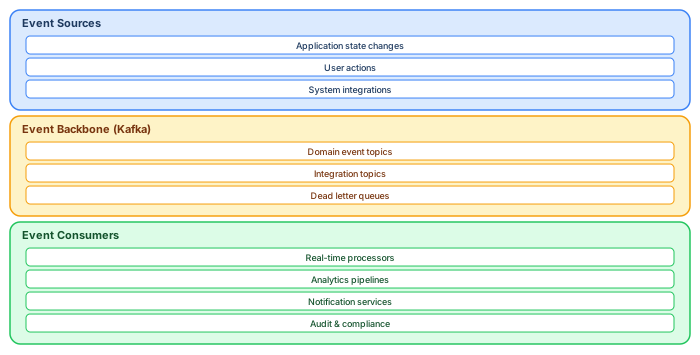
This aligns with EDA’s promise: decouple producers and consumers while still sharing a reliable stream of change.
Consistency patterns and delivery semantics
Kafka documentation highlights that Kafka can provide strong guarantees such as ordering within partition and replication-based durability, and it discusses message delivery guarantees at a high level. turn16view0

For more advanced “exactly-once” style semantics, delivery semantics documentation (ecosystem design docs) explains that default behavior is at-least-once and that transactions can enable stronger semantics.
In enterprise EDA, consistency is rarely a single switch; it is a pattern choice (idempotency, transactions, processing guarantees) aligned to business risk tolerance.
Stream processing and event-driven workflows
Kafka documentation introduces the Streams API as an integrated option for non-trivial transformations (aggregations, joins, stateful processing) and positions stream processing as a core capability of Kafka as a streaming platform. turn16view0 modeling integration architecture with ArchiMate
Architecturally, stream processing often becomes the “event choreography” layer: deriving projections, enriching events, and managing state transitions across domains.
Enterprise operating model: platform team plus product-aligned teams
EDA works at scale when:
- A platform team provides guardrails: topic standards, security defaults, observability, schema governance.
- Product/domain teams own event streams as products: versioning, contracts, SLOs.
Schema registry “data contracts” documentation explicitly frames a data contract as a formal agreement between upstream and downstream components on structure and semantics, and it highlights versioning, metadata, and rules/policies as contract elements. turn19view1
Frequently asked questions
Do we need schema governance from day one?
Schema registry documentation explicitly argues “always start with a schema registry,” warning that retrofitting increases workload and risk. turn19view0
Event sourcing pattern with Kafka

Event sourcing stores every state change as an immutable event rather than overwriting the current state. Kafka's append-only log is a natural fit for this pattern. A command (e.g., "authorize payment") produces an event (e.g., "payment.authorized") that is appended to a Kafka topic. Consumers build materialized views (projections) by replaying events — the current account balance is the sum of all credit and debit events for that account.
Enterprise benefits: Full audit trail (every state change is recorded), temporal queries (reconstruct state at any point in time), and decoupled services (each consumer builds its own optimized view). Challenges: Eventual consistency (read models may lag behind writes by milliseconds to seconds), schema evolution (events are immutable — you cannot retroactively change their structure), and storage growth (event logs grow indefinitely unless compacted or archived).
CQRS pattern: separating reads and writes
Command Query Responsibility Segregation (CQRS) pairs naturally with Kafka. Write operations (commands) produce events to Kafka topics. Read operations query materialized views built by consumers. This separation allows independent scaling: write throughput is bounded by Kafka partition count, read throughput is bounded by the query database capacity. For enterprises processing millions of reads per second alongside thousands of writes, CQRS with Kafka provides the architectural separation needed to meet both SLAs.
If you’d like hands-on training tailored to your team — Sparx Enterprise Architect, BPMN, SysML, Apache Kafka or the Archi tool — or modelling coaching in ArchiMate and TOGAF-aligned governance, you can reach us via our contact page.
Frequently Asked Questions
What is enterprise architecture?
Enterprise architecture is a discipline that aligns an organisation's strategy, business operations, information systems, and technology infrastructure. It provides a structured framework for understanding how an enterprise works today, where it needs to go, and how to manage the transition.
How is ArchiMate used in enterprise architecture practice?
ArchiMate is used as the standard modeling language in enterprise architecture practice. It enables architects to create consistent, layered models covering business capabilities, application services, data flows, and technology infrastructure — all traceable from strategic goals to implementation.
What tools are used for enterprise architecture modeling?
Common enterprise architecture modeling tools include Sparx Enterprise Architect (Sparx EA), Archi, BiZZdesign Enterprise Studio, LeanIX, and Orbus iServer. Sparx EA is widely used for its ArchiMate, UML, BPMN and SysML support combined with powerful automation and scripting capabilities.